Summary
It can be, but the margin is thinner than the headline suggests: Brazilian apartments yield about 6.13% gross on asking prices (FipeZAP, September 2026), and a non-resident landlord keeps closer to 3.8% once vacancy, management and the 15% withholding tax on rent are paid.
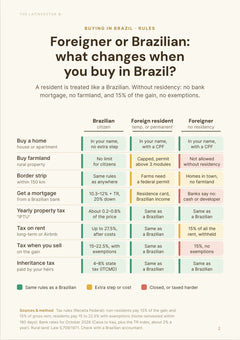
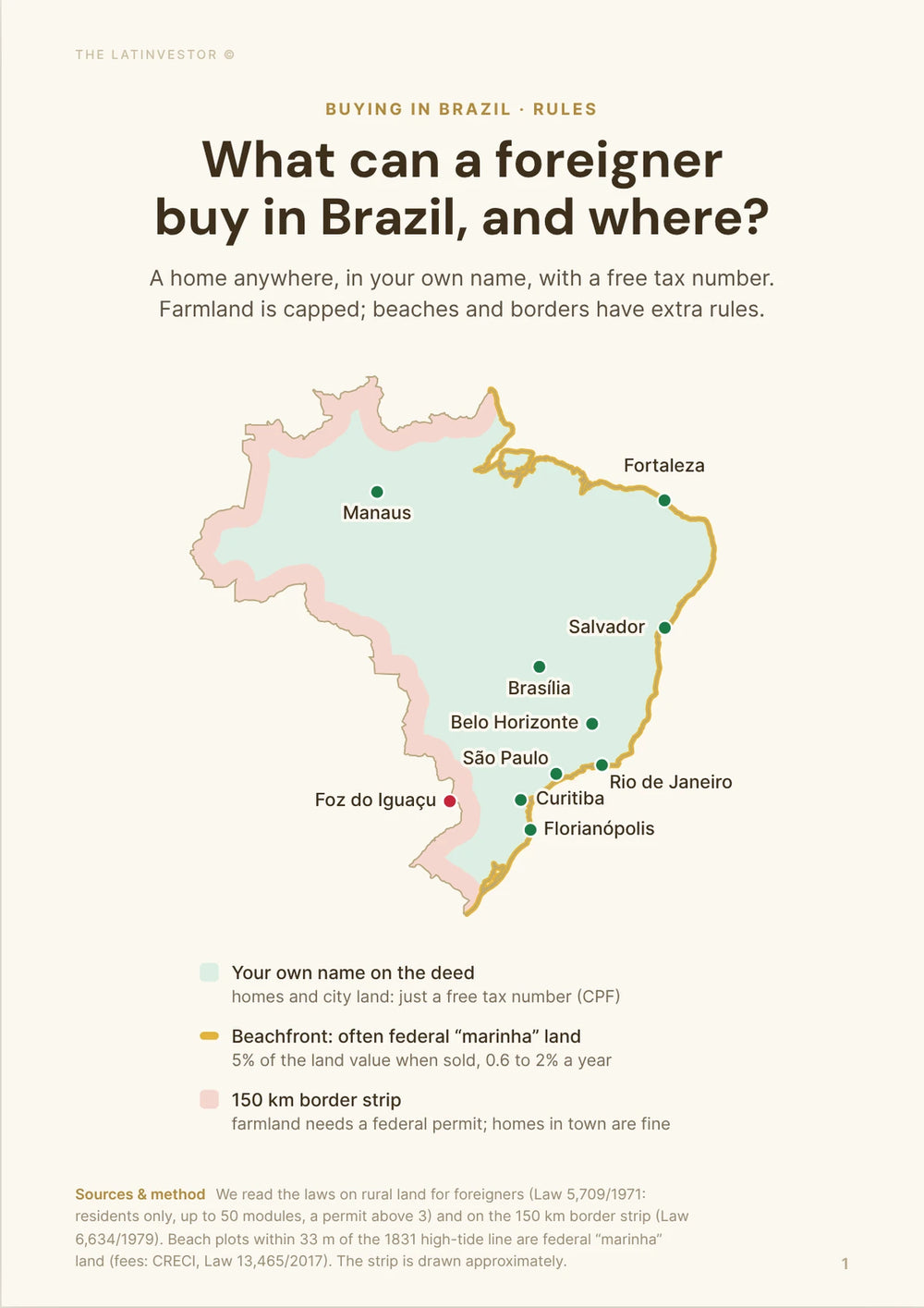
A foreigner can buy and rent out an urban apartment in their own name with just a CPF. No residency is needed, and the limits only concern rural land and the 150 km border strip.
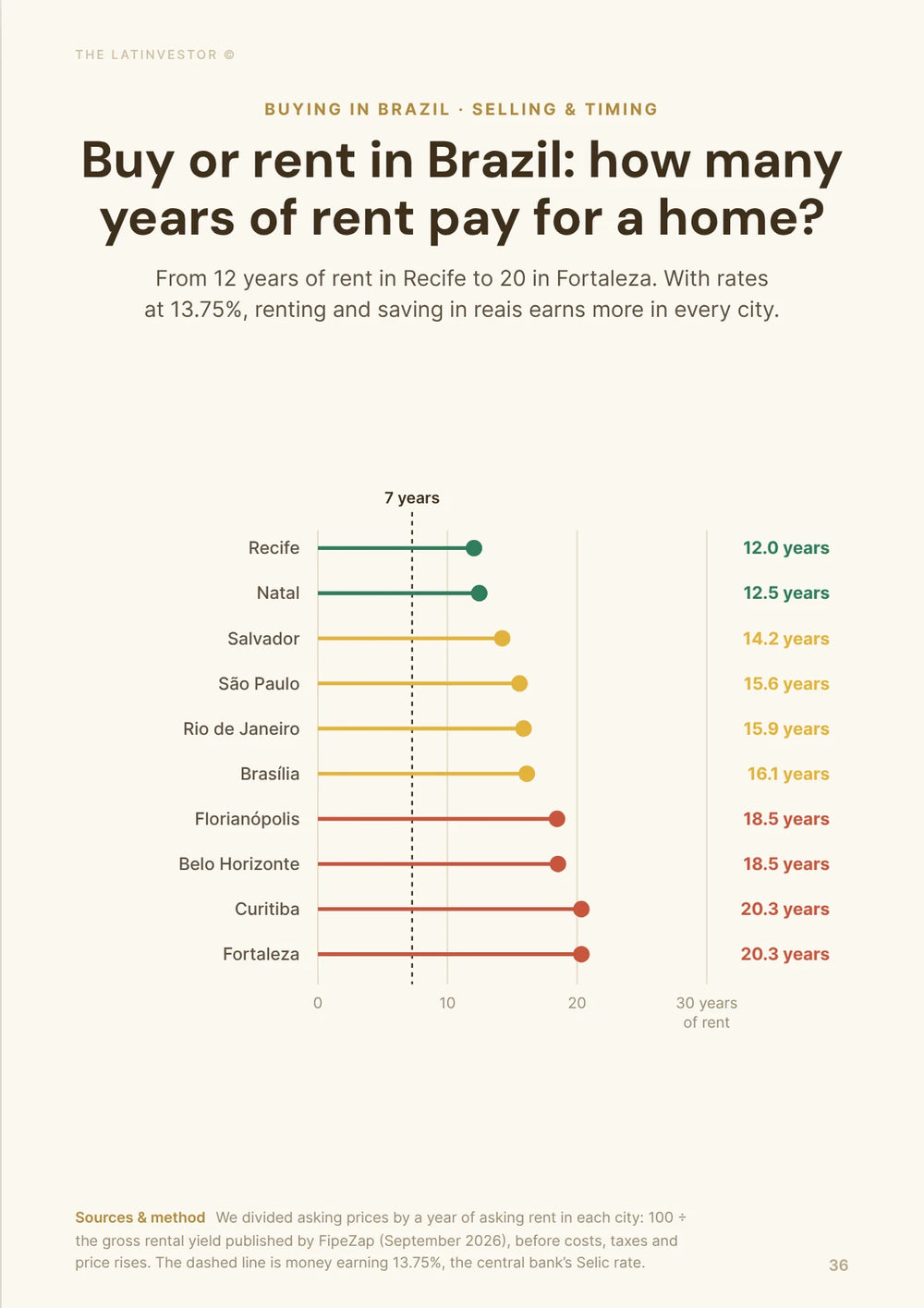
The national yield hides big gaps: about 7.03% in Salvador and 6.43% in São Paulo, but only 4.92% in Fortaleza and Curitiba. One-bedroom units do best, at 6.74% on average.
Rents are rising faster than prices: asking rents went up 9.13% in the 12 months to September 2026, against 5.51% for sale prices and 4.58% for inflation. Rio (+14.8%) and Fortaleza (+16.59%) led the way.
The catch is the Selic rate at 13.75%: a net yield under 4% only makes sense if you also count on rent growth and price gains, and accept the currency risk.
Airbnb is not the easy upgrade it looks like. An average one-bed in São Paulo grossed R$32,800 on Airbnb over the last 12 months, less than a long lease at the citywide average rent, while listings there jumped 66%.
In Rio, an average one-bed on Airbnb grossed R$61,300, almost double a long lease, but after Airbnb's 16% fee, a co-host, running costs and tax, you keep about R$21,500, a bit less than the R$23,000 a long lease leaves.
On a long lease, the tenant normally pays the ordinary condo fee and, by contract, the IPTU. You only carry them when the unit is empty, which in São Paulo can mean 35 to 84 days between tenants.
The best yields are in "near-prime" areas: about 8.02% in São Paulo's Centro / República and around 6.8% in Flamengo, Botafogo and Laranjeiras in Rio, against about 5.1% in Leblon.
Non-residents pay 15% on gross rent, withheld at source, and the new CBS/IBS tax only reaches individual landlords with more than three properties and over R$240,000 of rent a year.
Since May 2026, the STJ has said a residential building can block professional short stays unless two-thirds of owners vote to allow them, and a binding ruling is still pending.
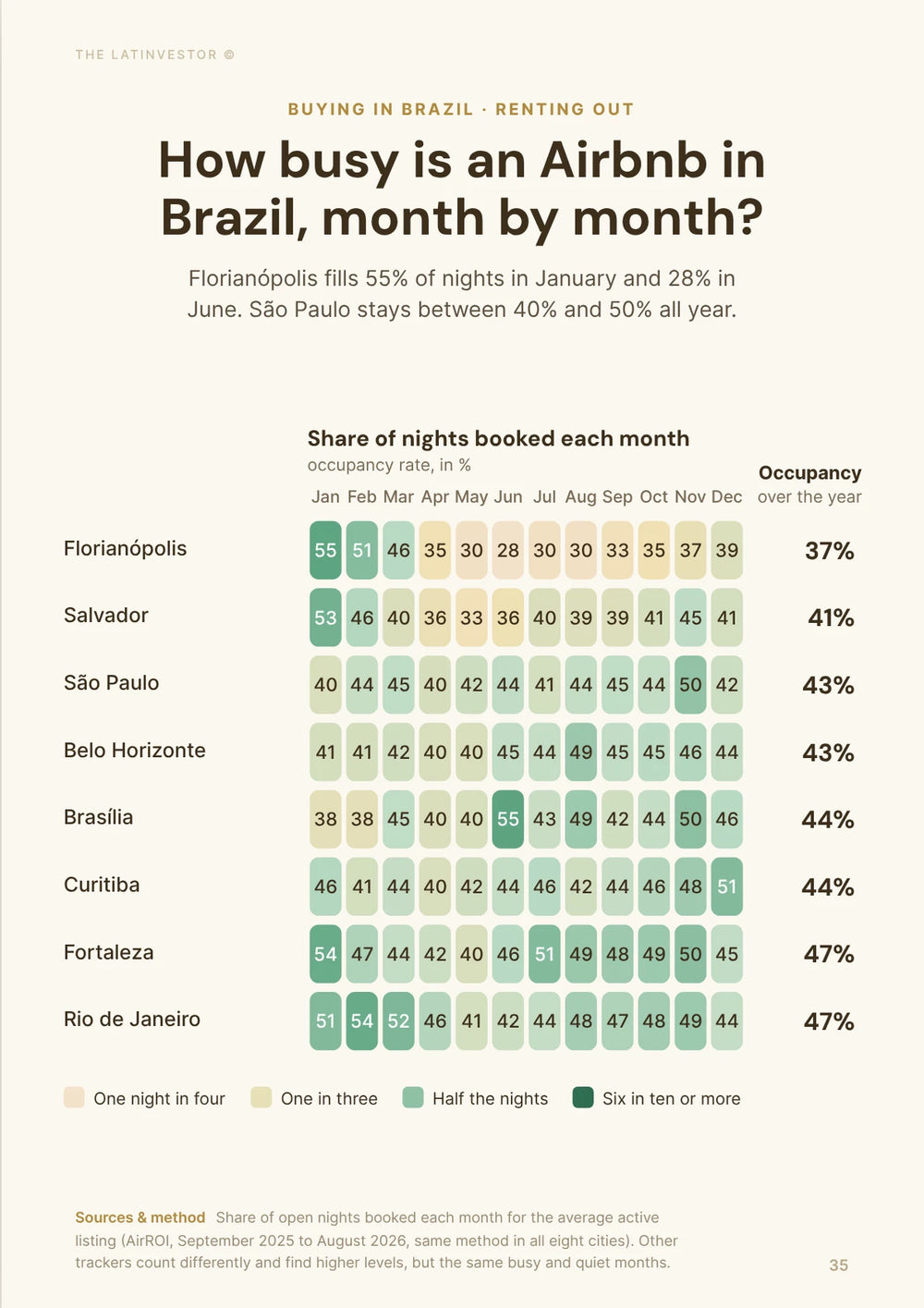
Short-term occupancy is lower than most sellers claim: about 37% to 43% a year in the big cities, with peaks of 54% in Rio in February and 55% in Florianópolis in January.
Bottom line: buy a small, well-located apartment for a long lease, check the building's rules before you even think about Airbnb, and run your numbers net of the 15% withholding.


Can a foreigner legally rent out a property in Brazil?
Can a foreigner own and rent out a home in Brazil in 2026?
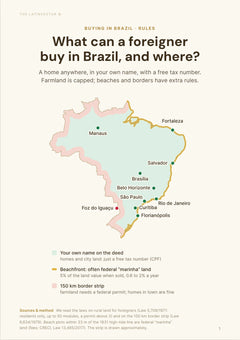
Yes. Foreigners can own and rent out urban homes in Brazil, in their own name, with no zone off-limits for city apartments or houses.
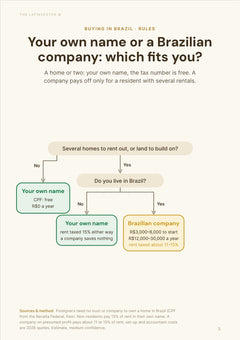
Most foreign buyers hold the property personally with a CPF, the free taxpayer number you can get from the Receita Federal or a Brazilian consulate. A Brazilian company is an option for several rentals or estate planning, but it is not required and not automatically cheaper.
The real limits concern rural land: purchases beyond a small first holding need INCRA approval under Lei 5.709/1971, and rural land within the 150 km border strip needs national-security clearance. None of this applies to a city apartment.
Do I need residency to rent out in Brazil?
No. Non-residents can own and lease property in Brazil while living abroad.
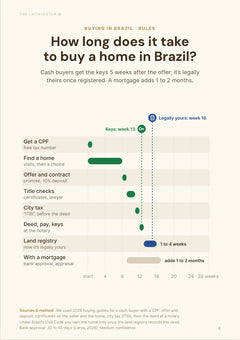
You need a CPF to sign the lease, register the property and deal with tax. A local bank account is not legally required, but it makes collecting rent much easier, since tenants pay by Pix, bank transfer or boleto.
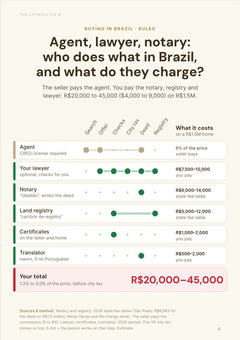
Managing from abroad works if you hire a local administrator (imobiliária) who handles the tenant, repairs and the monthly tax withholding. Most charge a share of the rent, typically around 8% to 10% for a long lease.
Long lease or Airbnb: which one actually pays more in Brazil?
Is long-term renting more profitable than short-term in Brazil in 2026?
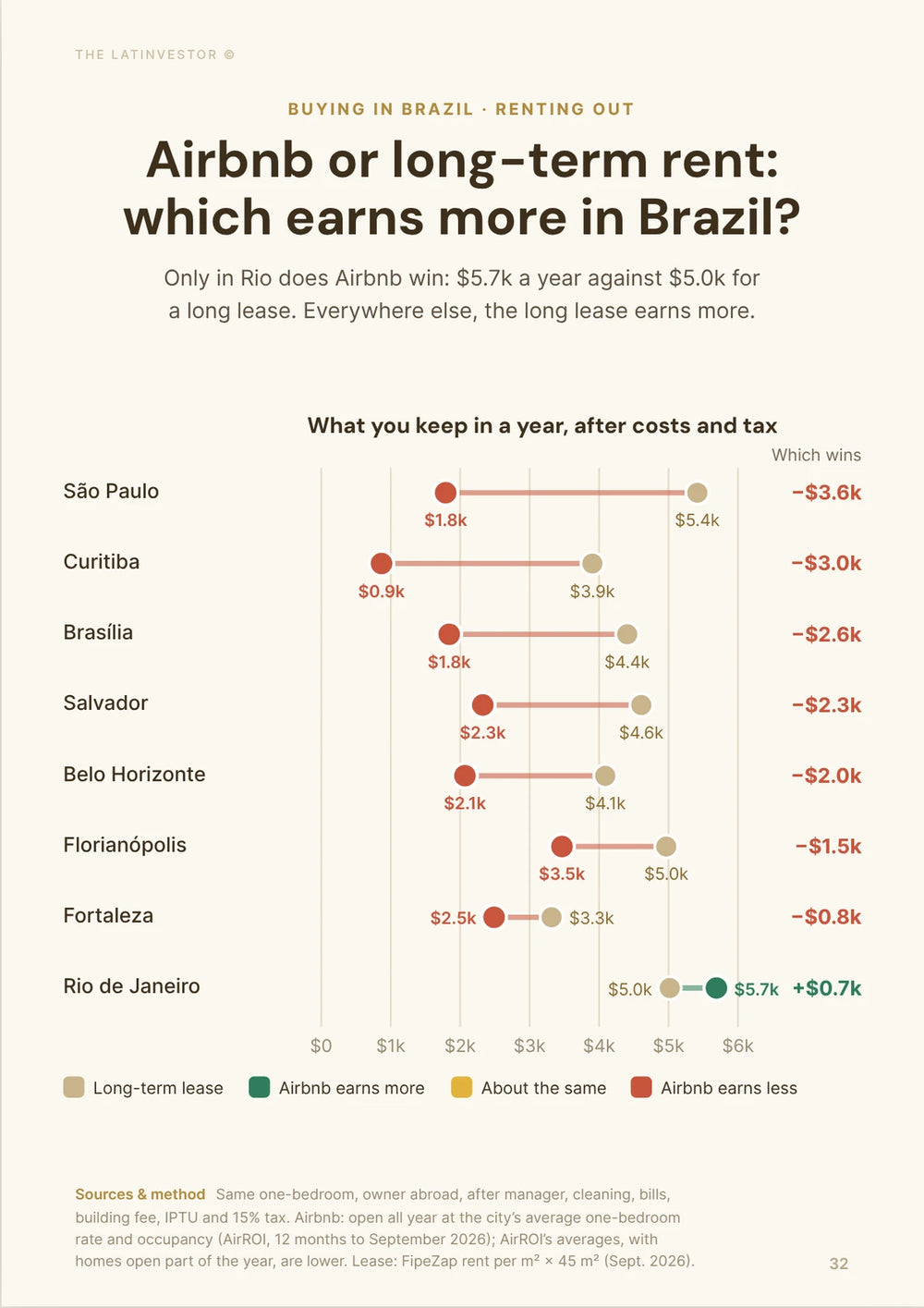
In most cases, yes. A long lease usually earns about the same as Airbnb once costs are paid, with far less work and risk, and Airbnb only wins clearly in strong tourist areas where the building allows it.
São Paulo is the clearest example. A 45 m² one-bed rents for about R$2,960 a month (USD 586, EUR 524) at the citywide average asking rent, or about R$35,500 a year. The average one-bed on Airbnb there grossed R$32,800 over the 12 months to September 2026, before platform fees, cleaning and condo fees.
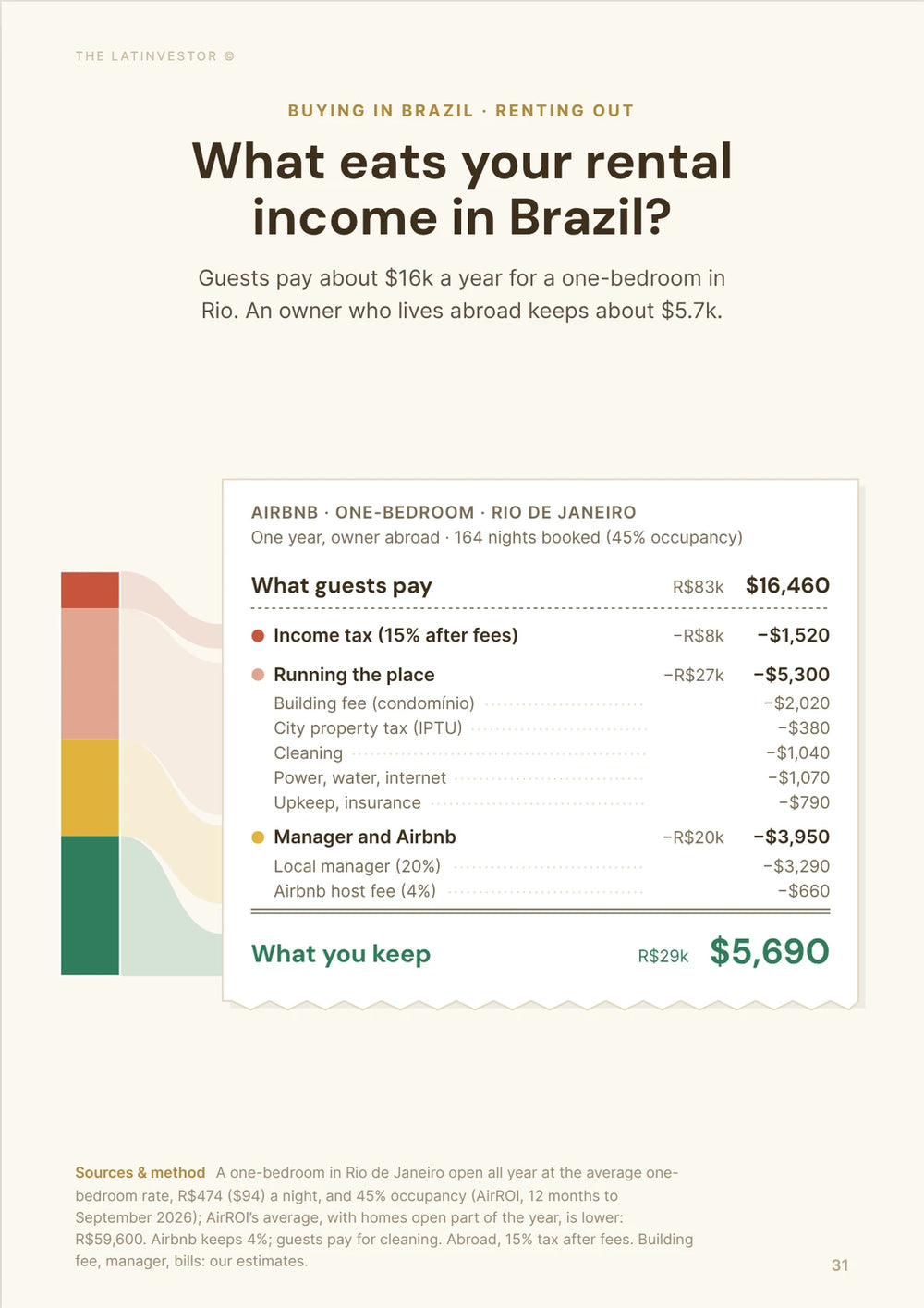
Rio is different: an average one-bed on Airbnb grossed R$61,300 (USD 12,100, EUR 10,800), almost double a long lease at the citywide average. But take off Airbnb's 16% host fee, a co-host (from about 10%), running costs (about 24% in AirROI's low-end model) and the 15% withholding, and you keep around R$21,500. A long lease at the citywide average, with one empty month and a 10% administrator, leaves about R$23,000 after the same tax, and the tenant pays the condo fee.
Short-term still makes sense in beach and tourist areas like Copacabana, Ipanema and Leblon in Rio, or in parts of Florianópolis, if the building explicitly allows it and you are ready for the work.
What's the average gross rental yield in Brazil in 2026?
About 6.13% a year, according to FipeZAP's rent-to-price ratio for September 2026, based on asking rents and asking prices across the cities it tracks.
The city spread is wide: about 7.03% in Salvador, 6.43% in São Paulo, 6.3% in Rio, 6.2% in Brasília, 5.42% in Florianópolis, 5.4% in Belo Horizonte, and only 4.92% in Fortaleza and Curitiba.
Smaller units yield more. One-bedroom apartments average 6.74%, two-bedrooms 6.45% and three-bedrooms 5.58%, because their price rises faster than their rent as they get bigger.
What's the realistic net rental yield for a foreign owner in Brazil in 2026?
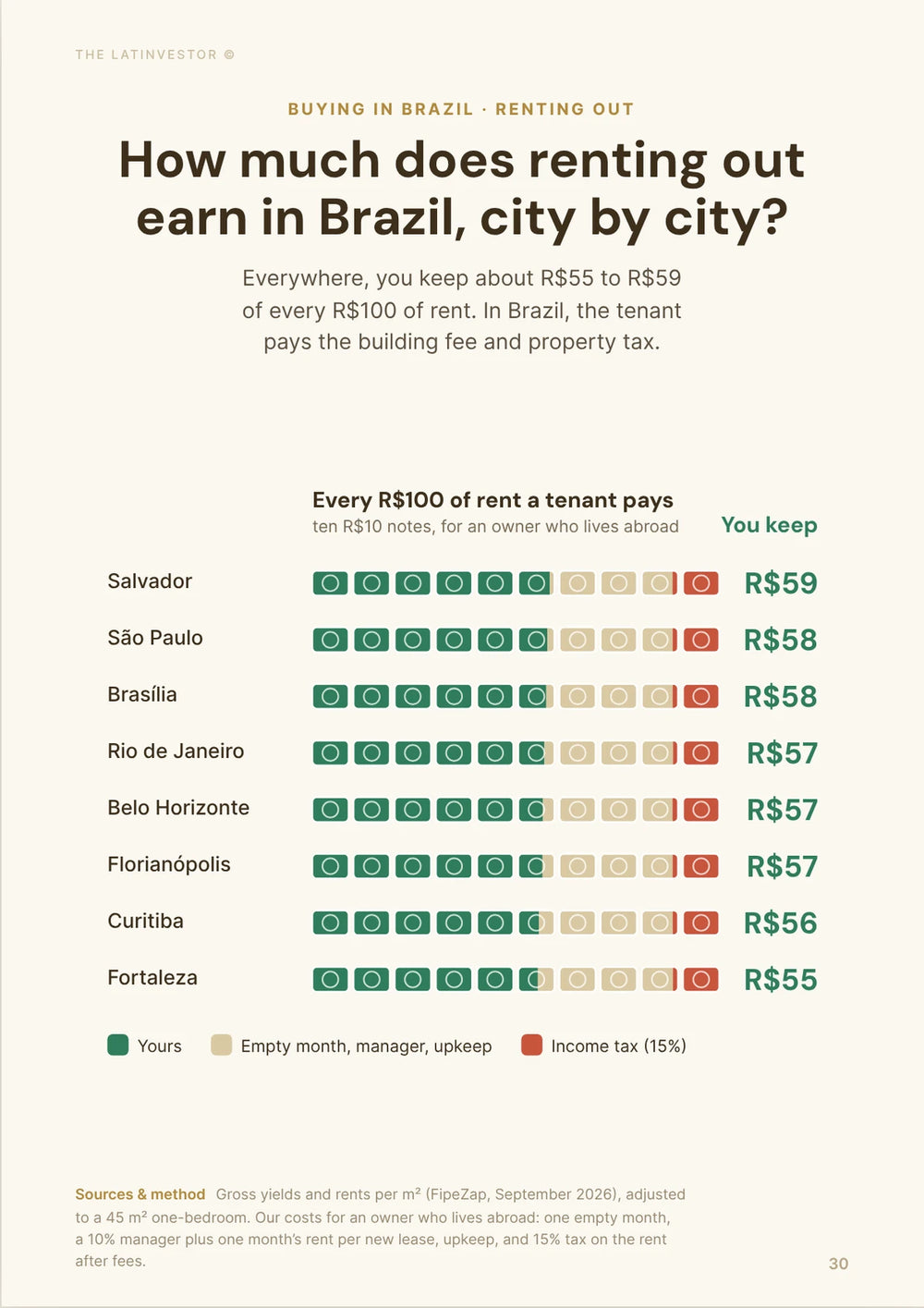
For a non-resident on a long lease, expect roughly 3.8% net on the national average, or about 3% to 4.4% depending on the city. This is our estimate, after one empty month a year, a 10% administrator fee, about 0.4% of the property value for repairs and condo costs while empty, and the 15% withholding tax on gross rent.
Applied city by city, that gives about 4.4% in Salvador, 4% in São Paulo, 3.9% in Rio, 3.3% in Florianópolis and about 3% in Fortaleza and Curitiba.
One thing many foreign buyers get wrong: on a long lease, the tenant pays the ordinary condo fee by law, and the IPTU property tax is normally passed to the tenant in the contract. You only pay extraordinary condo charges (works, reserve fund), plus everything while the unit is empty. On Airbnb, every cost is yours.
What monthly rent can I get in Brazil in 2026?
At FipeZAP's September 2026 averages, a 45 m² one-bed asks about R$3,270 a month (USD 648, EUR 579), a 65 m² two-bed about R$3,340 (USD 661, EUR 591), and a 90 m² three-bed about R$4,250 (USD 842, EUR 752).
The national average asking rent is R$54.77 per m², but smaller units ask much more per m²: R$72.68 for one-beds against R$51.41 for two-beds.
Cities differ a lot: São Paulo asks about R$65.78 per m², Rio R$61.86 and Florianópolis R$61.81, while Fortaleza asks only R$42.22.
Rents keep climbing: asking rents rose 9.13% nationally in the 12 months to September 2026, with Fortaleza up 16.59% and Rio up 14.8%, against 6.22% in São Paulo and 3.56% in Florianópolis.
Does renting out still beat a 13.75% Selic rate?
On rental income alone, no. With the Selic at 13.75% since the Copom's September 2026 meeting, a net rental yield of about 3.8% is far below what Brazilians get on a simple fixed-income product.
The case for buying rests on the other parts of the return. Asking rents rose 9.13% in a year and sale prices 5.51%, against 4.58% inflation, so a well-bought apartment can add a few points a year in value. But FipeZAP prices are asking prices, and sellers granted an average discount of 9% in the 12 months to June 2026, so your purchase price matters more than the index.
Expensive credit also works in your favor as a landlord: Brazilians who cannot afford a mortgage keep renting, which supports demand. As a non-resident you will almost certainly buy in cash anyway, since banks usually ask for Brazilian nationality or permanent residency.
What to do: aim for a gross yield of at least 6.5% on your actual purchase price, negotiate below the asking price, and remember that your return in dollars or euros also depends on the real.
What should I budget to hold a rental in Brazil in 2026?
What's the total monthly cost to hold a rental in Brazil in 2026?
It depends on who pays. On a long lease, the tenant normally covers the ordinary condo fee and the IPTU, so your regular costs are the administrator fee, the withholding tax and repairs.
When the unit is empty or on Airbnb, the costs are yours. Condo fees average about R$842 a month (USD 167, EUR 149) in São Paulo and R$620 (USD 123, EUR 110) in Rio, according to Loft's 2026 listing survey, and buildings with pools, gyms and 24-hour doormen charge well above that. Add IPTU, electricity, internet and, for Airbnb, cleaning and supplies.
The condo fee is usually the biggest fixed cost, so check the last 12 months of condo bills and any upcoming extraordinary calls (chamadas extras) before you buy.
How long does a rental stay empty in Brazil?
Plan for one to two months a year. Secovi-SP puts the average time to rent a home in São Paulo at 35 to 84 days, so a well-priced unit in a good area should sit at the low end.
Each empty month costs you rent plus the condo fee and IPTU, which is why pricing slightly below the market often pays off.
Location drives vacancy: homes close to metro lines, job centers and universities find tenants much faster.
Turnover peaks around December and January, when many leases end and people move for new jobs or the school year. A lease that ends in February or March usually re-lets faster than one that ends in mid-year.
How much tax does a foreign landlord pay on rent in Brazil?
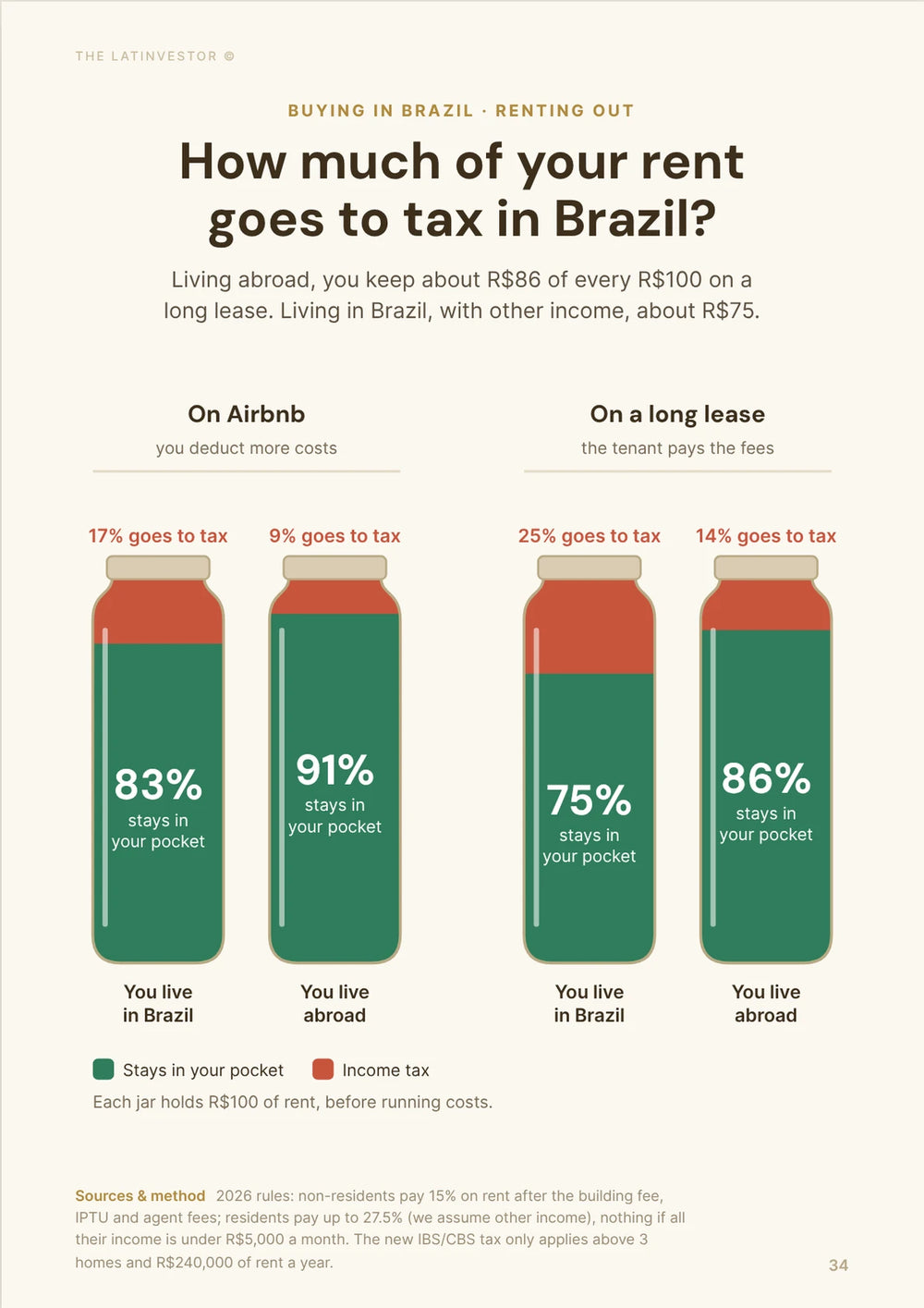
A non-resident pays 15% on the gross rent, withheld at source. That is the standard rate in the Receita Federal's 2026 tables, with exceptions for owners in tax havens, where the rate can be higher.
In practice, your administrator or legal representative in Brazil withholds the tax and pays it each month. Make sure your contract says who does it, and keep the payment slips: you may be able to credit this tax in your home country.
If you become a Brazilian tax resident, the rules change: rent goes into the monthly IRPF system (Carnê-Leão), at rates up to 27.5%, but you can deduct items like condo fees and IPTU that you pay yourself.
The new CBS/IBS consumption tax, phased in from 2026, does not hit most foreign owners. An individual landlord only falls into the regular regime with more than three properties and over R$240,000 (USD 47,500, EUR 42,500) of rent the year before. In January 2026, the Receita Federal publicly denied that every Airbnb host would pay a new tax.
Where do rentals perform best in Brazil in 2026?
Which neighborhoods have the highest long-term demand in Brazil in 2026?
In São Paulo, demand is strongest in Pinheiros and Vila Mariana for their metro access and lifestyle. In Rio, Botafogo stands out for its central location and young professional tenants.
Families look for space, schools and safety: Moema in São Paulo, Barra da Tijuca in Rio (where two-beds ask a median of about R$5,100 a month), and Ecoville in Curitiba.
Students rent near the big universities: Butantã and Perdizes in São Paulo (USP and PUC), Trindade in Florianópolis (UFSC) and Pampulha in Belo Horizonte (UFMG).
Expats tend to choose Jardins and Itaim Bibi in São Paulo, Leblon and Ipanema in Rio, and Jurerê Internacional in Florianópolis.
Which neighborhoods have the best rental yield in Brazil in 2026?
The best yields are in "near-prime" areas: Centro / República in São Paulo (about 8.02% gross), and Flamengo, Botafogo and Laranjeiras in Rio (about 6.8%).
Pinheiros (6.57%) and Copacabana (6.69%) also beat the national 6.13%. The most famous addresses yield the least: Leblon about 5.08%, Ipanema 5.25%, Jardins 5.59% and Itaim Bibi 5.64%.
Near-prime areas work because they get tenants who are priced out of the next neighborhood, while purchase prices stay lower. In São Paulo's Centro, check the building closely: security and maintenance vary a lot from one street to the next.
Where do tenants pay the highest rents in Brazil in 2026?
In São Paulo, Pinheiros and Itaim Bibi ask the most: about R$3,300 to R$5,000 a month (USD 653 to 990, EUR 584 to 885) for a one-bed, and R$6,000 to R$8,500 for a two-bed in Pinheiros.
In Rio, Leblon and Ipanema are the most expensive, but their prices are so high that they yield less than the city average. In Florianópolis, a one-bed in Jurerê Internacional can ask R$5,000 to R$12,000 a month.
These areas combine beach or park access, walkability, restaurants and corporate offices.
Tenants there are executives at multinationals, entrepreneurs, diplomats and high-earning couples, often with a company housing allowance.
What do tenants actually pay more for in Brazil?
What features increase rent the most in Brazil in 2026?
A parking space (vaga), a 24-hour doorman (portaria) and air conditioning in hot coastal cities are the features tenants pay most for.
In São Paulo, a unit without a vaga is much harder to rent to car owners, and parking spaces are often sold separately, so check what the deed includes.
A swimming pool is often overrated: it raises the condo fee (which the tenant pays, and compares) without lifting the rent much, except in family buildings.
Cheap upgrades that help: blackout curtains, good lighting, split air conditioning and a fresh coat of paint between tenants.
Do furnished rentals rent faster in Brazil in 2026?
Usually yes, in areas popular with young professionals, expats and students, who want to move in right away.
Furnished units also ask a higher rent, especially in expat areas. In family suburbs the advantage fades, because tenants bring their own furniture. Furnishing also keeps the option of switching to mid-term or short-term rentals open, if the building allows it.
How regulated is long-term renting in Brazil?
Can I freely set rent prices in Brazil?
Yes. There is no rent control in Brazil: you set the starting rent at market level.
During the lease, rent is adjusted once a year by the index written in the contract, usually IGP-M or IPCA. Neither index is mandatory, and adjustments can't happen more than once a year. After three years, either side can go to court to bring the rent back to market level (ação revisional).
What's the standard lease length and deposit in Brazil?
Most residential leases run 30 months, because that length lets you take the property back at the end without giving a reason.
You can ask for only one guarantee: a guarantor (fiador), a cash deposit (caução), rental guarantee insurance (seguro-fiança) or a fund-quota guarantee. A cash deposit is capped by law at three months' rent, and asking for two guarantees at once is not allowed.
The deposit is returned at the end of the lease, minus unpaid rent, bills or damage beyond normal wear. Write it into the contract, with a check-in inspection report (vistoria) and photos.
How does short-term renting really work in Brazil in 2026?
Is Airbnb legal in Brazil?
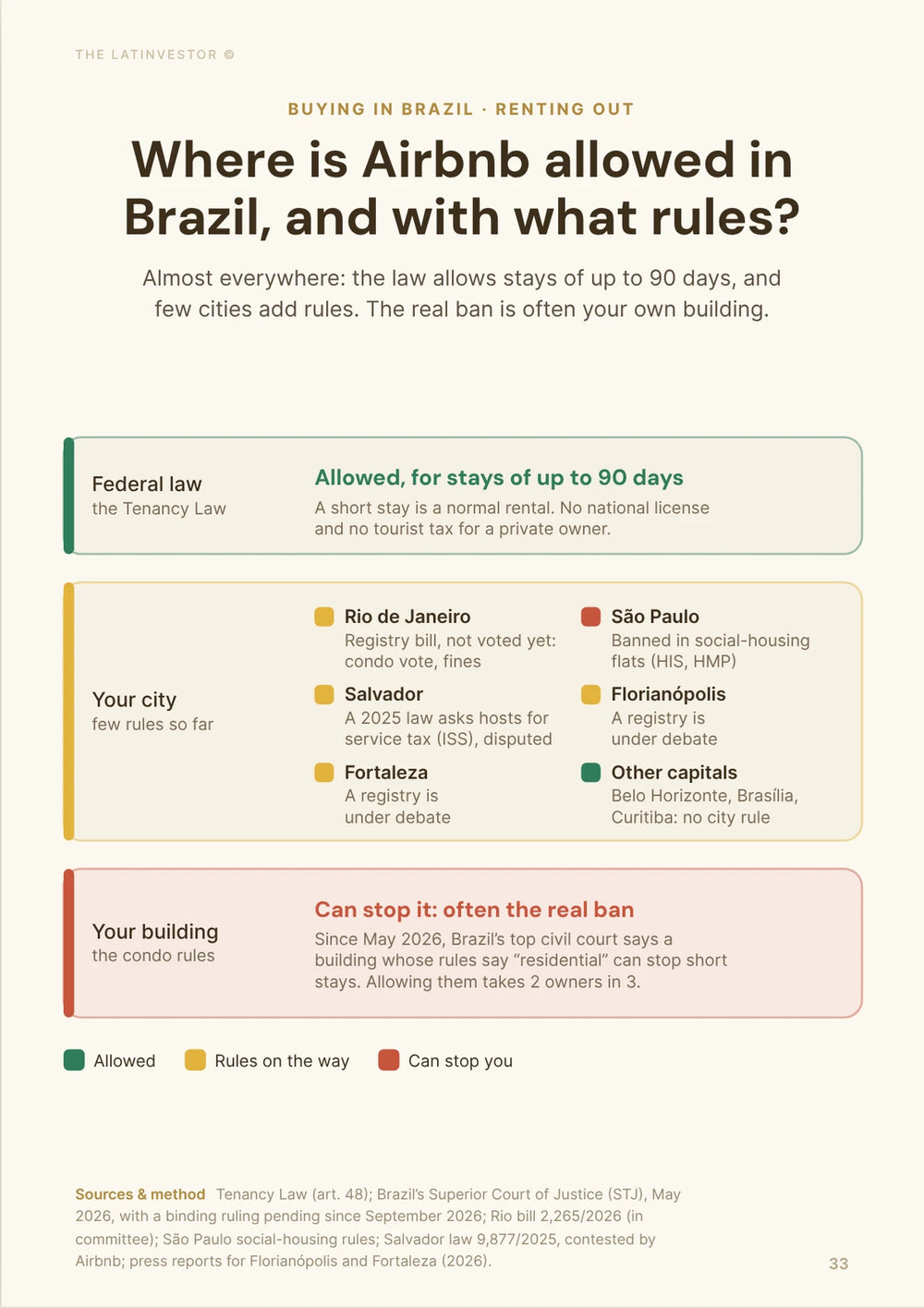
Yes at the federal level: the tenancy law allows "seasonal rentals" (locação para temporada) of up to 90 days.
There is no national license. Rio has no general municipal license either: a bill to regulate platform rentals is still in committee at the city council. Commercial lodging businesses must register on Cadastur, but a private apartment listed on Airbnb is not automatically one.
There is no national cap on nights. In practice, the limit comes from your building's convention, and since 2026 the courts have given buildings more power (see below).
The usual consequence of breaking the rules is the building itself: fines, an order to stop, or a lawsuit.
What's the average short-term occupancy in Brazil in 2026?
About 40% a year in the big cities, which is lower than many sellers claim. Over the 12 months to September 2026, AirROI measured about 42.6% in Rio, 40.1% in São Paulo, 41.5% in Curitiba, 41.8% in Brasília and 37.4% in Florianópolis.
That means roughly 135 to 155 booked nights a year for an average listing. The best-reviewed listings do much better, and new ones often do worse in their first year.
The beach cities peak in summer: Rio reached 54.1% in February 2026 and Florianópolis 55.1% in January.
The low season is harsh outside São Paulo: Florianópolis fell to 28% to 30% from May to August 2026. São Paulo, driven by business travel, stays between about 40% and 50% all year.
What's the average nightly rate in Brazil in 2026?
It varies a lot by city: about R$624 a night in Rio and R$618 in Florianópolis, against R$372 in Salvador, R$317 in Brasília, R$309 in São Paulo, R$275 in Belo Horizonte and R$250 in Curitiba.
For a one-bed, the average is about R$487 in Rio and R$302 in São Paulo. Two-beds reach about R$755 in Rio.
The seasonal swing is strong in beach cities: Rio's average rate went from about R$578 in September 2025 to R$751 in February 2026, and Florianópolis from about R$597 in April to R$746 in January.
Is short-term rental supply saturated in Brazil in 2026?
In the big cities, increasingly so. AirROI counted about 34,925 active Airbnb listings in São Paulo (up 66% in a year), 33,138 in Rio (up 50%) and 20,255 in Florianópolis (up 48%).
Demand has grown too, with a record 9.3 million international visitors in 2025, but not as fast as supply, which explains occupancy around 40%.
Competition is fiercest in Copacabana and Ipanema in Rio and in Pinheiros and Itaim Bibi in São Paulo, where many new studios were built with short stays in mind.
Salvador grew fastest (listings up 74% to about 7,903), so newer markets fill up quickly too. Still, quieter areas like Campeche in Florianópolis, or business districts with few listings, can work for a well-run unit.
Can your building stop you from running an Airbnb after the 2026 court rulings?
Yes, more easily than before. On May 7, 2026, the STJ ruled that professionally run short stays don't fit an exclusively residential building unless at least two-thirds of the owners vote to change its purpose.
The question is not fully settled. In September 2026, the STJ chose a new case (Tema 1.443) to decide, with a binding effect, whether a "residential use" clause is enough to ban platform rentals or whether the convention must say it explicitly. Similar cases are suspended across the country until then.
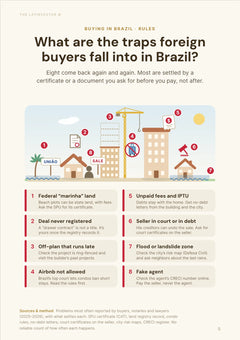
São Paulo adds another trap: units built as affordable housing (HIS-1, HIS-2, HMP), which include many of the small new studios, cannot legally be used for Airbnb under municipal rules.
What to do before buying for short stays: read the building's convention and internal rules, ask the síndico for the latest assembly minutes, get written confirmation that short stays are allowed, and check the unit's housing designation in São Paulo. If any of these is unclear, price the unit as a long-term rental only.
Our methodology
This article estimates what a foreign owner can really earn by renting out an apartment in Brazil: gross and net yields, rents, short-term rental income, holding costs, tax and the rules that limit what you can do.
Prices, rents and gross yields come from FipeZAP's September 2026 indices, which track asking prices and asking rents in dozens of Brazilian cities. Short-term figures (revenue, occupancy, nightly rates, listing counts) come only from AirROI, for October 2025 to September 2026, and we never mixed them with another provider. Our net yields are our own estimates, built from these gross yields with stated assumptions on vacancy, fees, repairs and tax.
The rules come from official sources: the Lei do Inquilinato, the Receita Federal's 2026 tax tables, the STJ's 2026 decisions on condominiums, the Banco Central do Brasil for the Selic rate, and municipal and Receita Federal guidance on the CBS/IBS tax reform.
We checked these figures in October 2026. Conversions use about 5.05 reais per US dollar and 5.65 reais per euro.
Limits: FipeZAP and listing data show asking prices, not final sale prices or rents actually paid, and sellers granted an average 9% discount in the year to June 2026. Short-term averages mix good and bad listings. Tax depends on your country of residence and any treaty, so check with a Brazilian accountant.
Key sources used for this analysis include FipeZAP rental report (September 2026), FipeZAP sales report (September 2026), Lei do Inquilinato, Receita Federal 2026 tax tables, STJ decision of May 2026, STJ Tema 1.443 (September 2026), Banco Central do Brasil (Selic), IBGE (IPCA), Sefaz Salvador on the CBS/IBS reform, Agência Gov (Receita Federal, January 2026), FipeZAP sale discount survey, INCRA, Exame on HIS/HMP units, QuintoAndar, AirROI, Portas on 2026 condo fees and Embratur and Secom on 2025 tourism.