Summary
In September 2026, apartments in Rio de Janeiro were listed at R$ 11,302 per square meter on average (about $2,240), so a 70 sqm apartment asks around R$ 791,000 ($157,000, or €140,000).
By size, plan roughly R$ 250,000 to R$ 550,000 for a studio, R$ 350,000 to R$ 750,000 for a one-bedroom, R$ 550,000 to R$ 1,100,000 for a two-bedroom and R$ 800,000 to R$ 1,600,000 for a three-bedroom outside the prime beach areas.
New-build apartments asked about R$ 12,850 per sqm in the year to March 2026, roughly 14% more than the city's resale-heavy average.
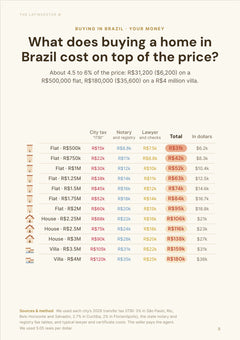
Non-resident foreigners almost always pay cash. With closing costs of 4% to 6%, a R$ 1,000,000 apartment needs about R$ 1,040,000 to R$ 1,060,000 in total.
The neighborhood is what moves the price: from R$ 7,011 per sqm in Tijuca to R$ 28,837 in Leblon, four times more. Listings in Méier or Campo Grande go much lower, around R$ 3,300 to R$ 3,800.
For a first purchase on a budget, Tijuca, Vila Isabel and Méier get you space near the metro or train for R$ 350,000 to R$ 600,000.
The beach is where prices run: Leblon +13.2%, Ipanema +10.3% and Copacabana +9.9% in a year, against +5.57% for the city and 4.58% inflation.
Those fast risers now yield less: about 5.1% gross in Leblon against 6.8% in Botafogo or Flamengo, before the 15% tax a non-resident pays on rent.
ITBI, Rio's transfer tax, is 3%, and the notary, registry and legal fees usually add R$ 15,000 to R$ 40,000.
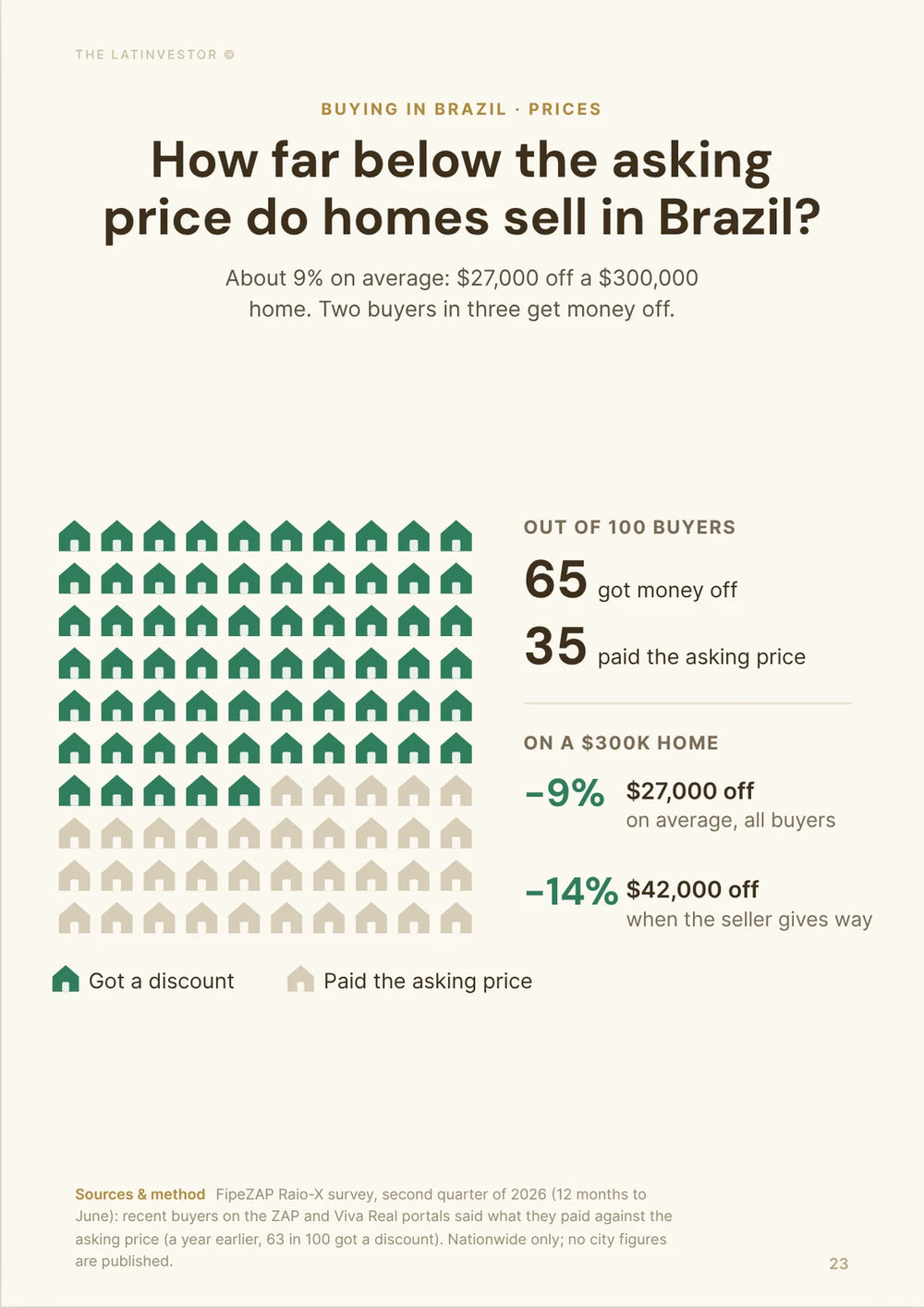
Asking prices are not sale prices: Brazilian buyers who got a discount averaged 14% off, so opening 10% to 15% below the asking price is normal outside the beachfront.
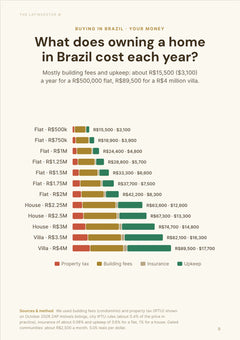
Once you own, the average condo fee in Rio is R$ 620 a month (up 9.2% in a year), IPTU often runs R$ 2,000 to R$ 6,000 a year on a R$ 1,000,000 apartment, and Light raised electricity tariffs by 8.59% in March 2026.
Bottom line: a two-bedroom near the metro in Tijuca, Flamengo or Botafogo, bought cash after real negotiation, is the safest bet. Leblon and Ipanema are for people who want the address, not the yield.


What does each size of apartment cost in Rio right now?
What's the average and median apartment price in Rio de Janeiro in 2026?
In September 2026, the average asking price for an apartment in Rio de Janeiro was R$ 11,302 per square meter, or about $2,240 and €2,000 per sqm. At that level, a typical 70 sqm apartment asks around R$ 791,000 ($157,000, or €140,000).
The median listing is a little lower: about R$ 10,534 per sqm in September 2026, because a few very expensive Zona Sul units pull the average up.
In practice, most normal apartments in Rio sell between R$ 350,000 and R$ 1,500,000 ($69,300 to $297,000), with the lower end in the North and West Zones and the upper end in Zona Sul and Barra da Tijuca.
The 70 sqm example and the practical range are our calculations. We converted at about R$ 5.05 per dollar (Banco Central do Brasil, PTAX).
How much is a studio apartment in Rio de Janeiro in 2026?
In 2026, a typical studio in Rio costs about R$ 250,000 to R$ 550,000 ($49,500 to $109,000, or €44,200 to €97,300).
At neighborhood averages, a 30 sqm studio asks about R$ 210,000 in Tijuca, R$ 414,000 in Copacabana and R$ 810,000 in Ipanema. In older buildings in Copacabana, Flamengo or Centro, listings had a median around $66,000 (R$ 333,000) in October 2026.
Studios are usually 25 to 40 sqm. Small units cost more per square meter: across Brazil, one-bedrooms ask R$ 12,260 per sqm against R$ 8,989 for two-bedrooms, so a cheap total price can still be an expensive square meter.
The studio median comes from TuLugar listings (October 2026, small samples). We checked ranges on VivaReal Rio listings.
How much is a one-bedroom apartment in Rio de Janeiro in 2026?
In 2026, a typical one-bedroom in Rio costs about R$ 350,000 to R$ 750,000 ($69,300 to $149,000, or €61,900 to €133,000).
For a 50 sqm one-bedroom at September 2026 averages, count about R$ 351,000 in Tijuca, R$ 640,000 to R$ 690,000 in Flamengo, Botafogo or Copacabana, and R$ 1,350,000 to R$ 1,440,000 ($267,000 to $285,000) in Ipanema or Leblon. In Copacabana, one-bedroom listings had a median around $115,000 (R$ 581,000) in October 2026.
A one-bedroom in Rio is usually 40 to 60 sqm. Older buildings in Copacabana and Flamengo often have more space for the money than new compact units.
The Copacabana median comes from TuLugar (October 2026, few listings). Ranges are our estimates, checked against VivaReal.
How much is a two-bedroom apartment in Rio de Janeiro in 2026?
In 2026, a typical two-bedroom in Rio costs about R$ 550,000 to R$ 1,100,000 ($109,000 to $218,000, or €97,300 to €195,000).
An 80 sqm two-bedroom asks around R$ 561,000 in Tijuca, R$ 1,030,000 to R$ 1,100,000 in Flamengo, Botafogo or Copacabana, R$ 1,160,000 in Barra da Tijuca, and R$ 2,160,000 to R$ 2,310,000 ($428,000 to $457,000) in Ipanema or Leblon. In Barra, two-bedroom listings had a median around $249,000 (R$ 1,260,000) in October 2026.
This is the size local families look for, which makes it the easiest apartment to rent out and to resell later.
The Barra median comes from TuLugar (October 2026). The typical range is our estimate.
How much is a three-bedroom apartment in Rio de Janeiro in 2026?
In 2026, a typical three-bedroom in Rio costs about R$ 800,000 to R$ 1,600,000 ($158,000 to $317,000, or €142,000 to €283,000) outside the prime beach areas.
At 110 sqm and September 2026 averages, that means about R$ 770,000 in Tijuca, R$ 870,000 in Recreio, R$ 1,490,000 in Botafogo, R$ 1,600,000 in Barra da Tijuca and R$ 1,930,000 ($382,000) in Lagoa. In Ipanema or Leblon, the same size asks R$ 3,000,000 to R$ 3,200,000 ($594,000 to $634,000), and much more with a sea view.
Three-bedrooms are usually 90 to 130 sqm. Many older ones include a maid's room (dependência), which adds space but not always value.
Ranges are our estimates, checked against Imovelweb Rio listings.

Is a new-build apartment in Rio worth the premium?
Only if you need it to be new: launches asked about R$ 12,850 per sqm ($2,540) in the year to March 2026, roughly 14% more than the city's average asking price of R$ 11,302, which is mostly resale.
That launch price jumped 68.5% in a year, far above the national 10.1%. This reflects what developers are building (many compact units in prime areas) as much as real price growth, so don't read it as the value of your future apartment.
At the top end, the market has dried up: only 11 luxury units (above R$ 3,000,000) were launched in Q2 2026, against 84 a year earlier, while high-end new units averaged R$ 33,431 per sqm and R$ 71,338 in Leblon.
A resale apartment in an older Copacabana, Flamengo or Tijuca building is usually the better deal, as long as you check the building's finances. Off-plan, Law 13.786/2018 lets the developer keep up to 25% of what you paid if you cancel, or 50% when the project has a patrimônio de afetação.
The 14% gap is our calculation; the two indexes do not cover exactly the same period.
How much cash do you really need to buy in Rio?
What's the typical total budget (all-in) to buy an apartment in Rio de Janeiro in 2026?
In 2026, a R$ 1,000,000 apartment in Rio needs about R$ 1,040,000 to R$ 1,060,000 in total ($206,000 to $210,000, or €184,000 to €188,000), because closing costs add 4% to 6% of the price.
That covers ITBI (3%), the notary deed, registration, certificates and, if you use one, a lawyer. Sworn translations, a power of attorney and bank fees on the transfer from abroad push it to the top of the range.
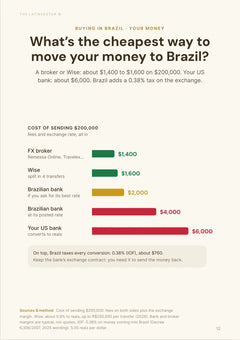
The money must come in through the official exchange system, in your name. Keep the exchange contract: you will need it to send the money back when you sell, and for a residence application.
The 4% to 6% range is our estimate from these fee tables.
What down payment is typical to buy in Rio de Janeiro in 2026?
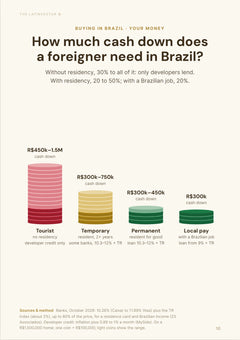
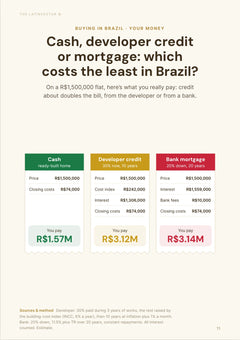
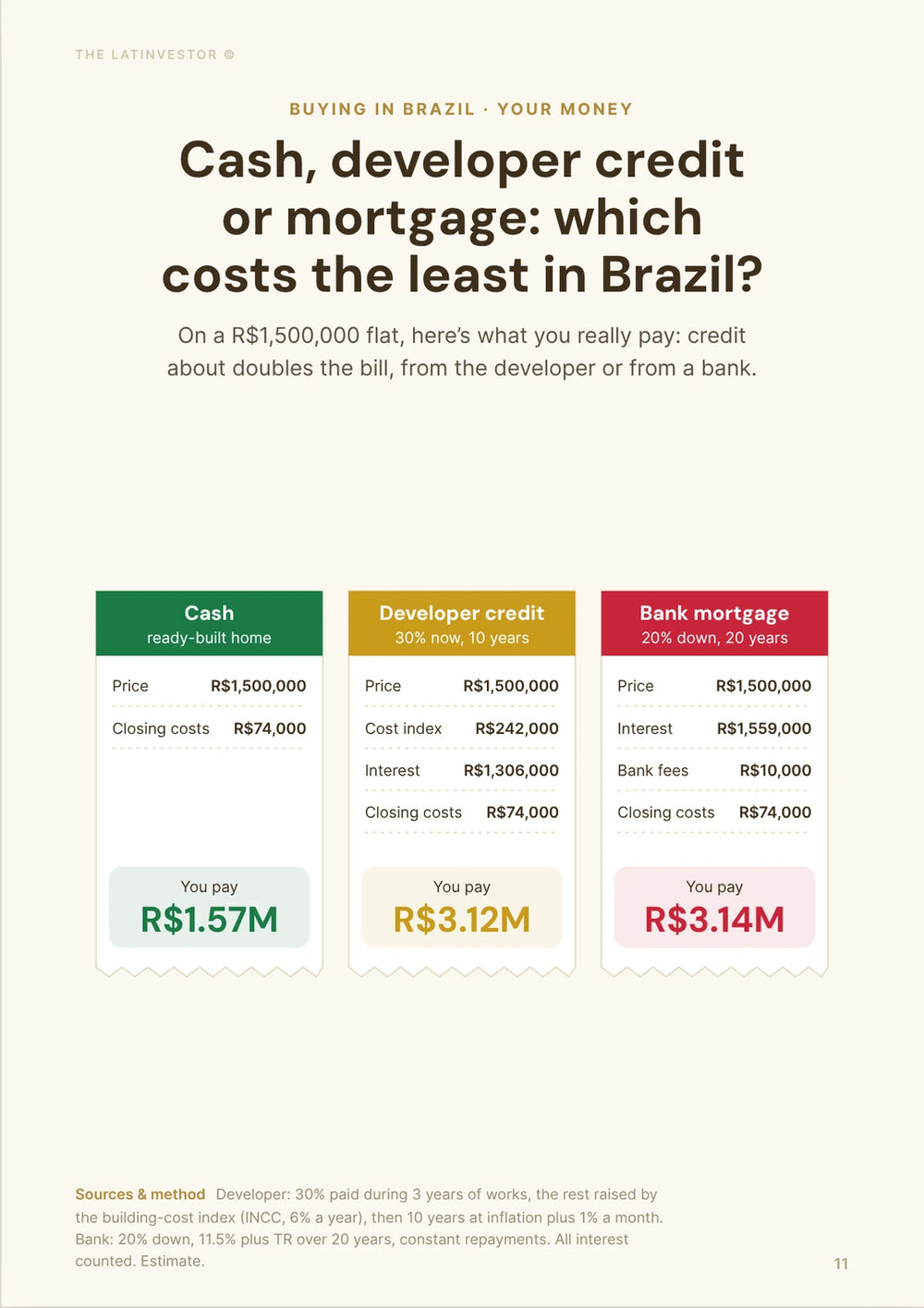
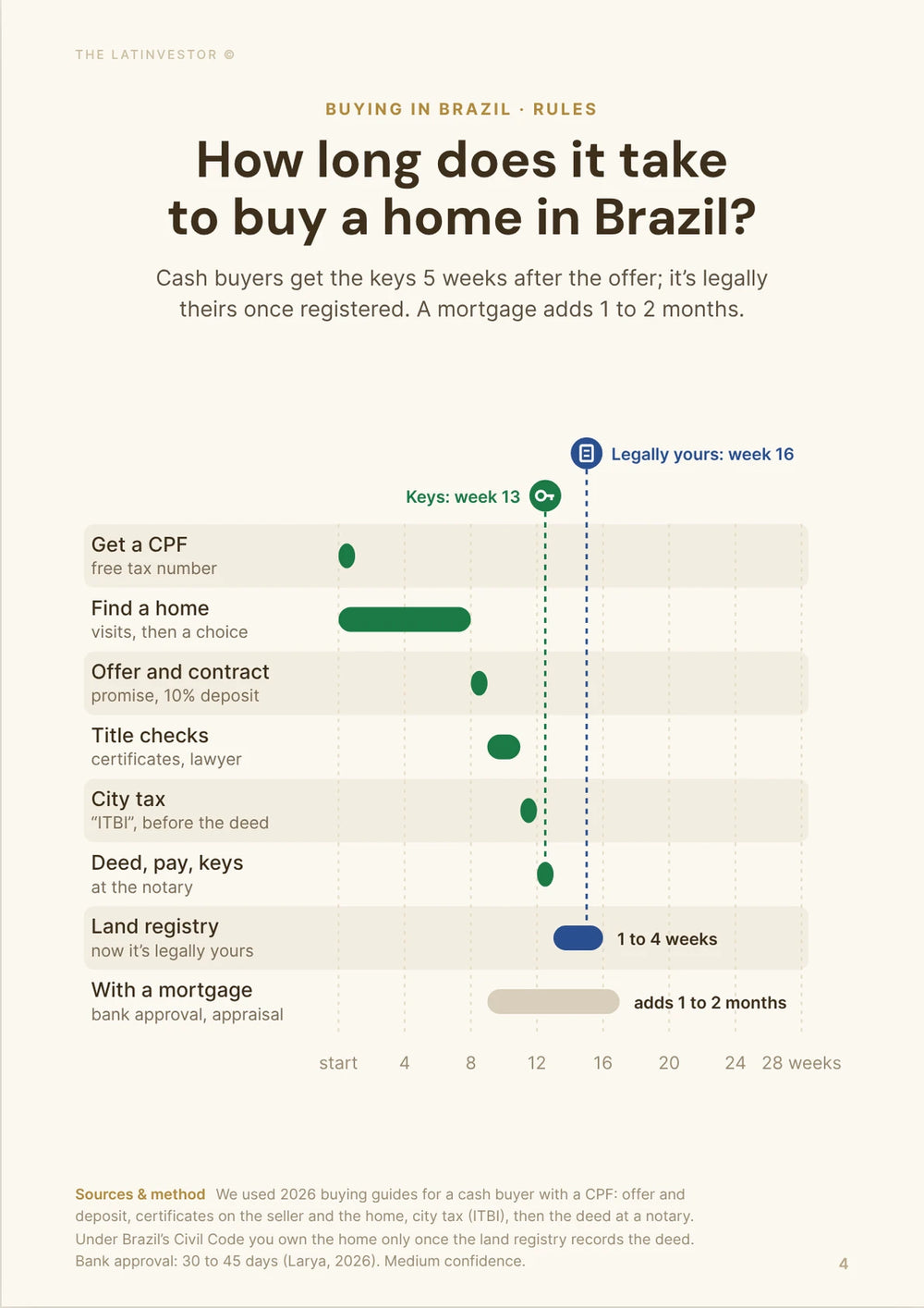
For a non-resident foreigner, the realistic answer is 100%: Brazilian banks generally ask for nationality, naturalization or permanent residency, plus local income and credit history, so almost all international buyers pay cash.
Residents who qualify usually put down at least 20% to 30%, and credit is expensive. In September 2026, average home-loan rates were 7.98% a year plus TR at Caixa and about 11.8% to 11.9% plus TR at Itaú, Bradesco and Santander, with the Selic at 13.75%.
The Central Bank cut the Selic from 14% to 13.75% in September 2026 and meets again on November 3 and 4. Even with a few more cuts, a loan will stay costly in 2027, so don't plan a purchase around one.
The 20% to 30% down payment is the usual bank practice, not a fixed rule.
Which Rio neighborhoods are cheapest, and which are pulling ahead?
How much does the price per m² for apartments vary by neighborhood in Rio de Janeiro in 2026?
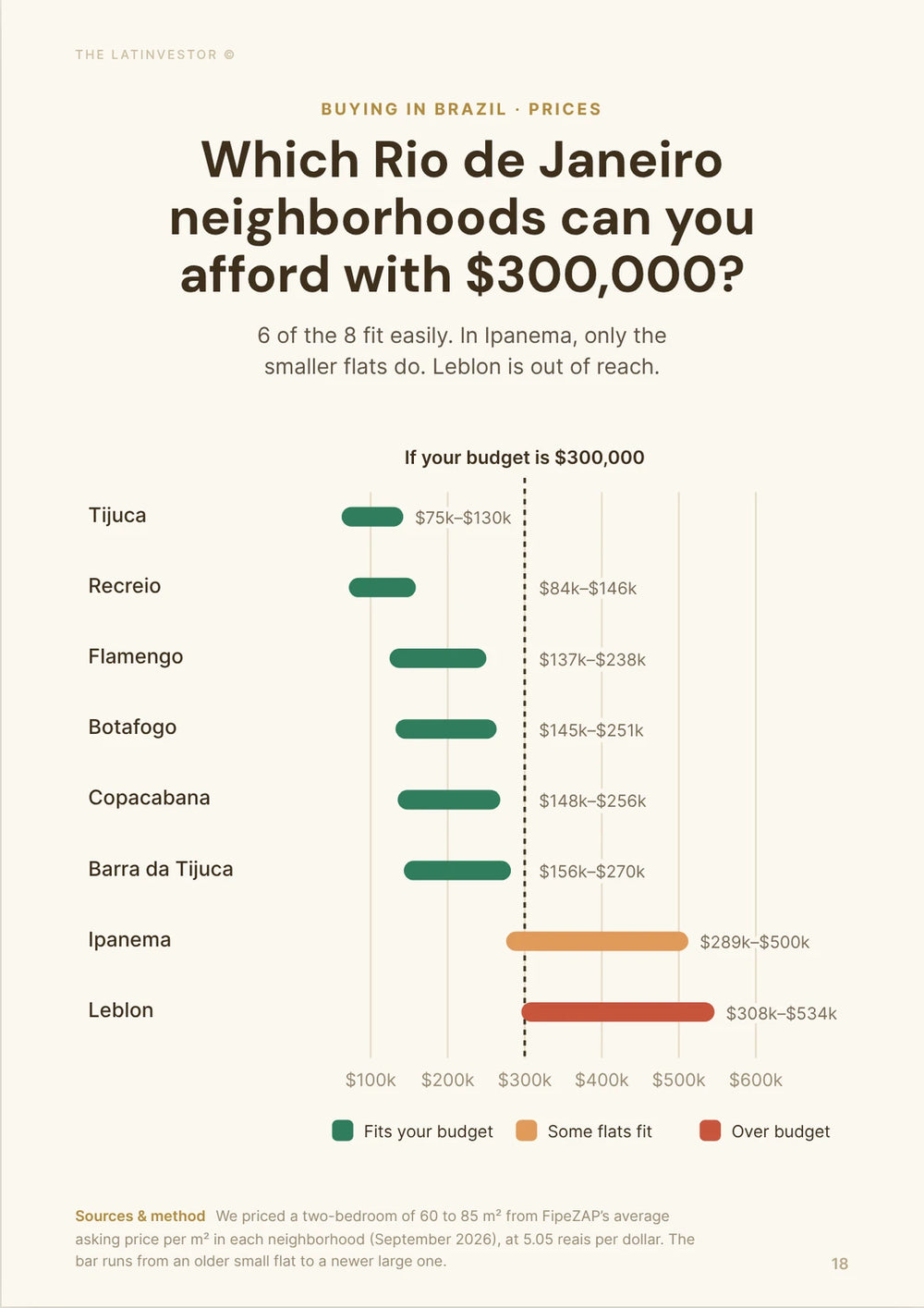
A lot: in September 2026, asking prices ranged from R$ 7,011 per sqm in Tijuca to R$ 28,837 in Leblon, four times more. Listings in Méier (around R$ 3,830) and Campo Grande (around R$ 3,270) go lower still.
| Neighborhood | Asking price per sqm | 12-month change | 50 sqm one-bed | 80 sqm two-bed |
|---|---|---|---|---|
| Leblon | R$ 28,837 | +13.2% | R$ 1,442,000 | R$ 2,307,000 |
| Ipanema | R$ 26,996 | +10.3% | R$ 1,350,000 | R$ 2,160,000 |
| Lagoa | R$ 17,519 | +1.3% | R$ 876,000 | R$ 1,402,000 |
| Barra da Tijuca | R$ 14,561 | +4.9% | R$ 728,000 | R$ 1,165,000 |
| Copacabana | R$ 13,811 | +9.9% | R$ 691,000 | R$ 1,105,000 |
| Botafogo | R$ 13,555 | +4.2% | R$ 678,000 | R$ 1,084,000 |
| Flamengo | R$ 12,833 | +5.9% | R$ 642,000 | R$ 1,027,000 |
| Rio average | R$ 11,302 | +5.57% | R$ 565,000 | R$ 904,000 |
| Laranjeiras | R$ 11,092 | +3.3% | R$ 555,000 | R$ 887,000 |
| Recreio | R$ 7,897 | +2.9% | R$ 395,000 | R$ 632,000 |
| Tijuca | R$ 7,011 | +2.3% | R$ 351,000 | R$ 561,000 |
Inside each neighborhood, the building matters as much as the address: age, view, parking space, elevator and condo fee can move a price by 30% or more on the same street.
Apartment prices in the table are our calculations (size × price per sqm).
What neighborhoods are best for first-time buyers on a budget in Rio de Janeiro in 2026?
Tijuca, Vila Isabel and Méier are the best budget picks in 2026, with Grajaú, Maracanã and Recreio also worth a look. In these areas, R$ 350,000 to R$ 600,000 ($69,300 to $119,000) buys a proper one or two-bedroom.
Tijuca, at R$ 7,011 per sqm, gives you the metro and steady local demand. Vila Isabel (around R$ 4,770 per sqm in listings) and Méier (around R$ 3,830) are cheaper still, with good shops and train or bus links. Recreio, at R$ 7,897, is the cheapest beach area but far from the center.
The trade-off: fewer foreign buyers and tourists, so you sell to local families and rent to local tenants. That is not a problem if the apartment is near the metro and the condo fee is reasonable.
The choice of neighborhoods is ours, based on transport, services and local demand.
Which neighborhoods have the fastest-rising apartment prices in Rio de Janeiro in 2026?
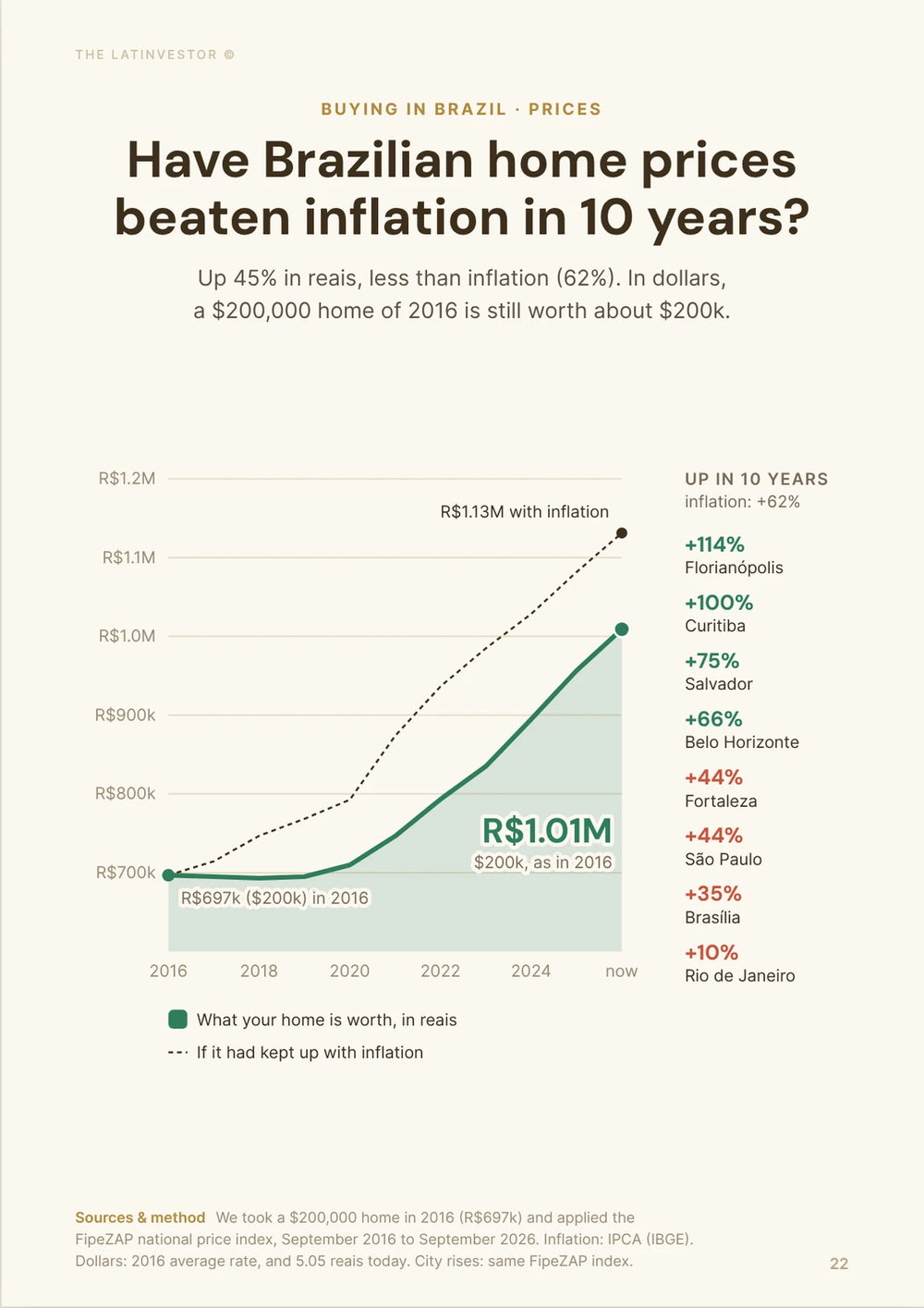
The beach neighborhoods: in the year to September 2026, asking prices rose 13.2% in Leblon, 10.3% in Ipanema and 9.9% in Copacabana, against 5.57% for the city as a whole.
The rest of the city barely beat inflation (4.58%): Flamengo +5.9%, Barra +4.9%, Botafogo +4.2%, Laranjeiras +3.3%, Recreio +2.9%, Tijuca +2.3% and Lagoa +1.3%.
Centro and Lapa get a lot of talk thanks to the city's Reviver Centro program, which pushes office-to-home conversions, but FipeZAP publishes no residential index there, so there is no solid proof yet that prices are rising faster than elsewhere.
Are Rio's beach neighborhoods getting too expensive to make sense?
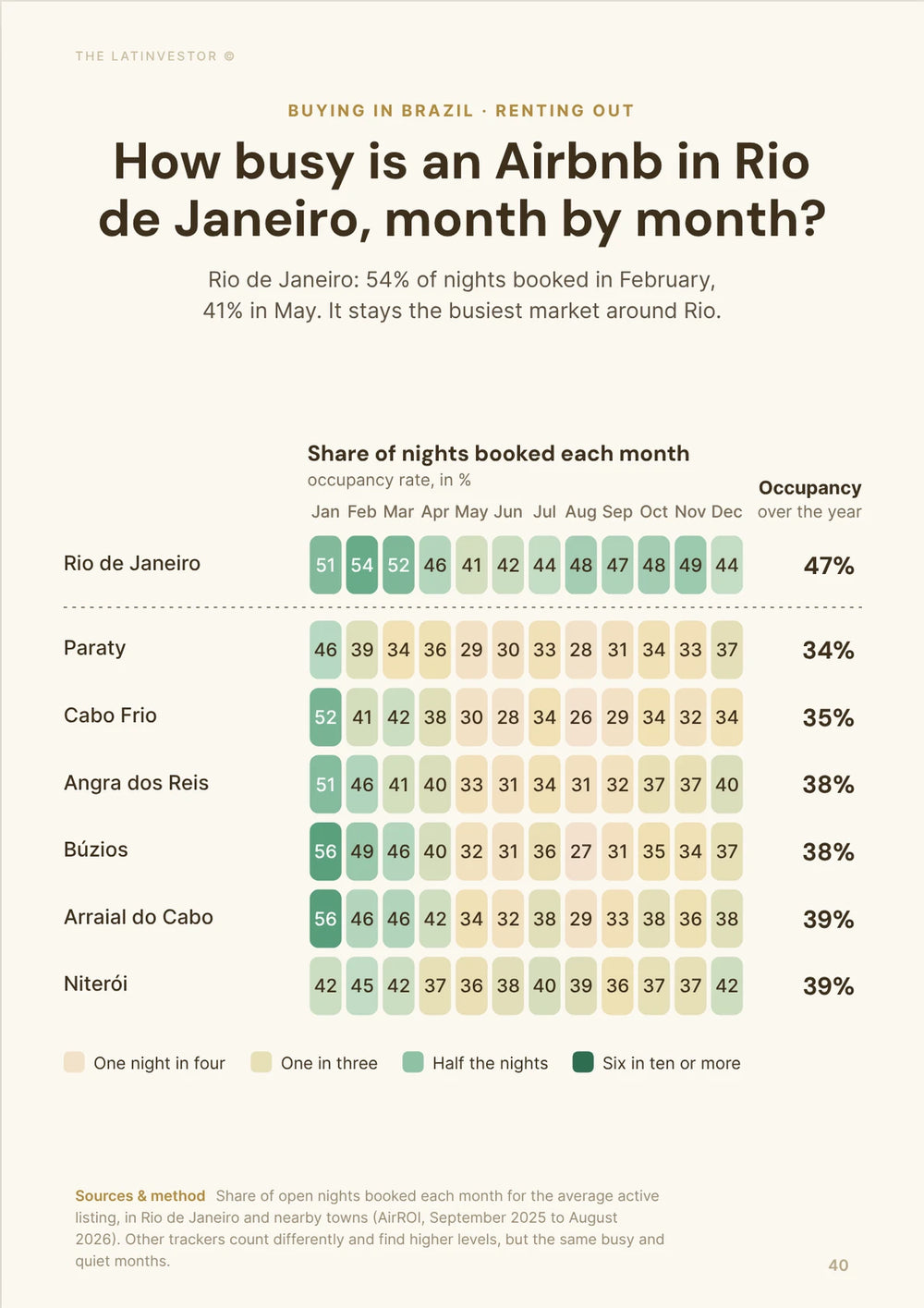
For an investor, partly yes: prices in Leblon and Ipanema rose about twice as fast as the city in a year, and their rental yield is now the lowest of the neighborhoods FipeZAP tracks, about 5.1% to 5.3% gross.
Botafogo and Flamengo look better: gross yields around 6.8%, prices up only 4% to 6%, and rents up almost 20% in a year. Copacabana sits in between, at about 6.7% gross, but its prices already rose 9.9%. Across Rio, asking rents rose 14.8% in a year, almost three times faster than sale prices.
Remember that a non-resident pays 15% tax on gross rent, withheld at source, so a 6.8% gross yield is closer to 5.8% before any cost. On a long lease, the tenant pays the condo fee and IPTU; on Airbnb, you do, and since May 2026 a building can require a two-thirds owners' vote for short stays.
What to do: if you buy to rent out, look at Botafogo, Flamengo or Tijuca first. If you want Leblon or Ipanema, buy because you want to live there, negotiate hard, and don't count on the last year's growth repeating with the Selic at 13.75%.
The 5.8% is our calculation (6.8% minus 15% tax). Rules: Receita Federal (non-resident withholding) and the STJ (short stays, May 2026).
What do you pay on top of the price when you buy?
What are all the buyer closing costs when you buy an apartment in Rio de Janeiro?
On a R$ 1,000,000 apartment, buyer closing costs usually total R$ 40,000 to R$ 60,000 ($7,920 to $11,900, or €7,080 to €10,600).
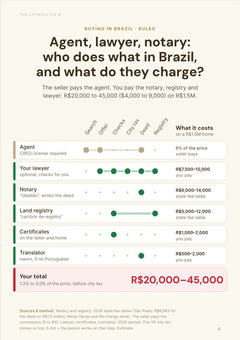
The biggest item is ITBI, Rio's transfer tax, at 3% of the higher of the price and the city's valuation: R$ 30,000 on a R$ 1,000,000 apartment. Notary deed, registration and certificates add about 1% to 2.5%, and a lawyer 0.5% to 1.5% if you hire one.
In total, notary, registry and legal fees usually come to R$ 15,000 to R$ 40,000 ($2,970 to $7,920). They weigh more on cheap apartments because of minimum fees. The agent's 6% to 8% commission is normally paid by the seller.
The fee ranges are our estimates.
On average, how much are buyer closing costs as a percentage of the purchase price for an apartment in Rio de Janeiro?
Plan for 4% to 6% of the price, and about 5% to 6% if you are a foreigner buying from abroad.
Buyers who handle the paperwork themselves stay near 4%. Those who pay a lawyer, sworn translations and a power of attorney can reach 7%.
If you sell later, add 6% to 8% of commission on the way out: a purchase and resale costs about 10% to 14% in total, so a short holding period rarely pays.
The ranges are our estimates.
How far below the asking price can you go in Rio right now?
Usually 10% or more outside the beachfront: Brazilian buyers who got a discount averaged 14% off in the 12 months to June 2026, and the average across all sales was about 9%.
Sellers have reasons to listen. Credit is expensive with the Selic at 13.75%, so fewer local buyers can borrow, and in September 2026 the number of active listings in Rio fell slightly while 269 sellers cut their price.
The room depends on the neighborhood. In Tijuca, Lagoa, Laranjeiras or Recreio, where prices rose only about 1% to 3% in a year, open 10% to 15% below the asking price. In Leblon, Ipanema or Copacabana, sellers know prices are rising, so expect less.
Before you make an offer, ask for the matrícula (property registration), the IPTU bill, a condo-debt certificate and the minutes of the last condo meetings. Unpaid fees follow the apartment, and a planned façade or elevator job (chamada extra) can cost tens of thousands of reais: use it to negotiate.
The 10% to 15% opening offer is our advice, not a market statistic.
What does a Rio apartment cost you every month and every year?
What are typical HOA fees in Rio de Janeiro right now?
The condo fee (condomínio) averaged R$ 620 a month in Rio in 2026 ($123, or €110), up 9.2% from R$ 568 in 2025.
That average hides a wide range: simple older buildings often charge R$ 400 to R$ 900 a month, while towers in Zona Sul or Barra with doormen, security, pools and elevators can ask R$ 1,500 to R$ 4,000 ($297 to $792) or more.
On a long lease, the tenant pays the condo fee and IPTU by law. You pay them yourself when the apartment is empty or on short stays, which is why a high fee hurts an Airbnb plan most.
The tenant rule is Article 23 of the Tenancy Law (Lei 8.245/1991).
What utilities should I budget monthly in Rio de Janeiro right now?
For a one or two-bedroom, budget about R$ 450 to R$ 900 a month ($89 to $178) for electricity, water, gas and internet, on top of the condo fee.
Electricity is the big one, and it went up: ANEEL approved an average 8.59% rise in Light's tariffs in March 2026, about twice inflation. A court briefly raised it to 16.69%, but that decision was suspended.
The bill depends mostly on air conditioning. An apartment that runs AC every day in summer can pass R$ 1,200 a month, while one where water and gas are included in the condo fee costs much less.
The monthly budget is our estimate.
How much is property tax on apartments in Rio de Janeiro?
IPTU on an apartment worth around R$ 1,000,000 usually runs R$ 2,000 to R$ 6,000 a year ($396 to $1,190, or €354 to €1,060), and much more in Leblon or Ipanema.
It is calculated on the city's assessed value (valor venal), which is usually well below the market price, so the bill is often 0.2% to 0.6% of what you paid.
Exemptions for pensioners and low-value homes rarely apply to a foreigner's second home. Ask the seller for the last IPTU bill before you sign, and check there is no unpaid IPTU: debts follow the property.
The IPTU range is our estimate; there is no single citywide effective rate.
What's the yearly building maintenance cost in Rio de Janeiro?
Set aside about 0.3% to 1% of the apartment's value a year for building work not covered by the monthly fee: R$ 3,000 to R$ 10,000 ($594 to $1,980) on a R$ 1,000,000 apartment.
Newer buildings are usually at the low end. Older buildings in Copacabana, Flamengo, Tijuca and Centro can need much more when the façade, elevators, plumbing or fire system have to be redone.
Routine upkeep is in the condo fee, but big jobs are charged separately as a chamada extra. Read the last meeting minutes before you buy: they tell you what's coming.
No official source tracks special assessments in Rio.
How much does home insurance cost in Rio de Janeiro?
Basic home insurance for an apartment usually costs R$ 300 to R$ 1,200 a year ($59 to $238); brokers quote a Brazilian average of R$ 500 to R$ 600 a year.
It is optional unless a bank requires it, but worth it for a foreign owner who isn't there: water leaks into the neighbor's apartment and electrical damage are the common claims. The building's own policy covers the structure, not your interior or your liability.
The range for Rio is our estimate.
Our methodology
This article estimates what an apartment costs in Rio de Janeiro by size and neighborhood, plus the costs of buying and owning one.
We multiplied typical apartment sizes by the September 2026 FipeZAP asking prices per square meter for the city and its neighborhoods, used TuLugar and Guru dos Imóveis listing data where FipeZAP has no figure, and the ILI DataZAP index for new-builds. Discounts come from the FipeZAP Raio-X survey and loan rates from the Banco Central.
Rules on ITBI, IPTU, notary fees, loans, rental tax and short stays come from Prefeitura do Rio, CNB/RJ, the Banco Central, Receita Federal and the STJ.
We checked these figures in October 2026 and used about 5.05 reais per US dollar and 5.65 reais per euro.
FipeZAP and listing sites show asking prices, not sale prices, and some neighborhood samples are small. Apartment prices by size, fees, IPTU, maintenance and insurance ranges are our estimates. Always check the matrícula, the IPTU bill and the condo minutes of the specific apartment.
Key sources used for this analysis include FipeZAP September 2026, FipeZAP rents, FipeZAP Raio-X, Hasta, TuLugar, Guru dos Imóveis, ILI DataZAP via Diário do Rio, Banco Central lending rates, BCB PTAX, IBGE IPCA, Prefeitura do Rio (ITBI), Prefeitura do Rio (IPTU 2026), CNB/RJ, Loft via Portas and ANEEL.