Summary
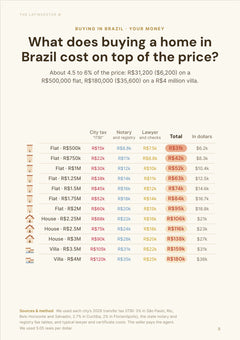
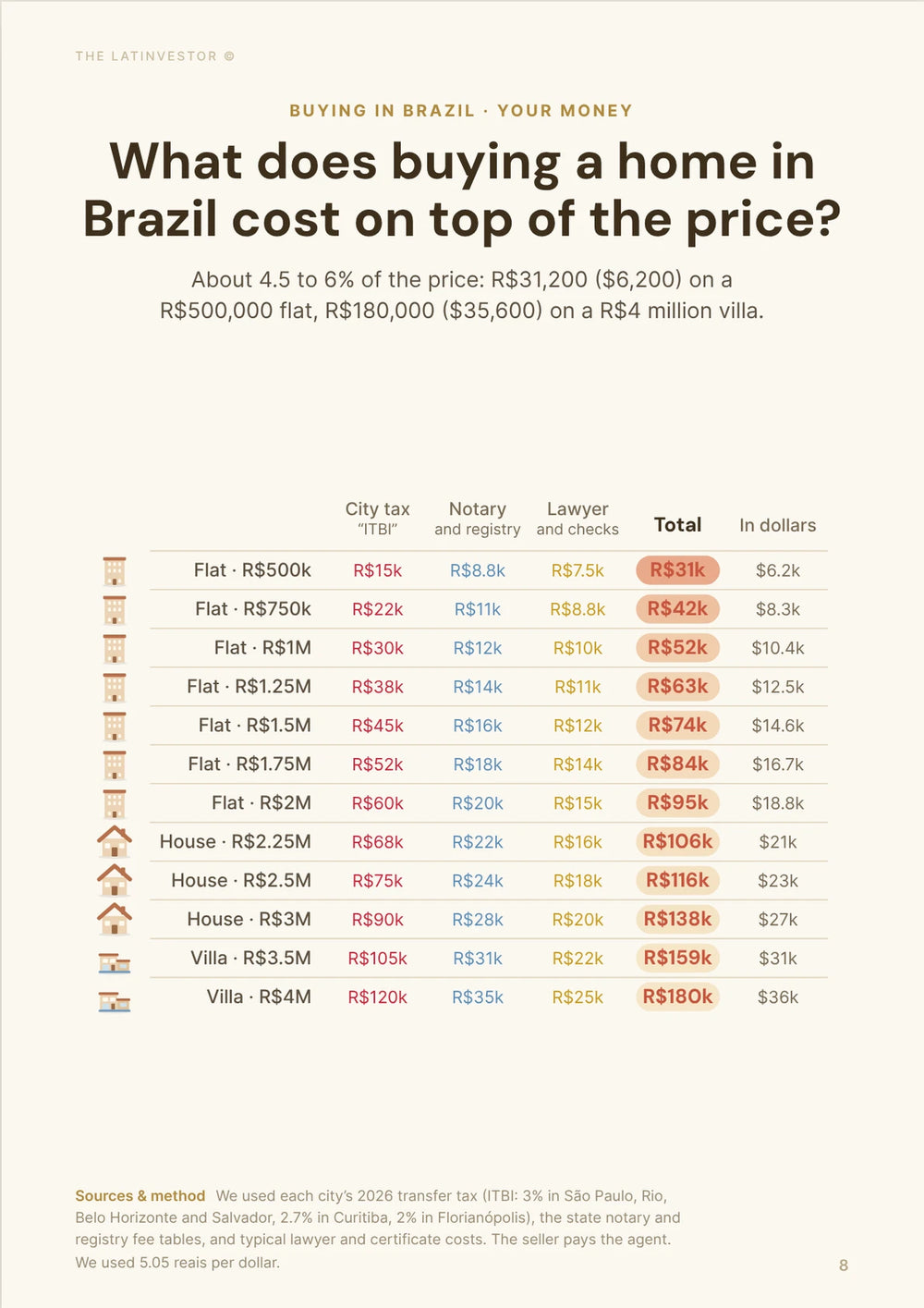
Buying a home in Rio de Janeiro costs about 4% to 6% on top of the price. On a BRL 1,000,000 apartment (about USD 198,000 or EUR 177,000), that is roughly BRL 40,000 to BRL 60,000.
The bare minimum (ITBI, deed and registration, no lawyer) comes to about BRL 39,000 to BRL 44,000 on that BRL 1,000,000 flat, or 3.9% to 4.4%.
The ITBI transfer tax is the big line: 3% in Rio, the same for foreigners and Brazilians. There is no foreigner surcharge, no VAT on a resale home and no first-time buyer discount.
Rio's notary fees are among the highest in Brazil: our estimate for a BRL 1,000,000 deed in 2026 is about BRL 5,500, and the state's tables rose with the Selic (14.26%) on 1 January 2026. You can sign the deed at a notary in another state to pay less.
The agent's 6% to 8% commission (CRECI-SP reference) is usually paid by the seller, but check the contract on new builds.
The costly surprises are unpaid condo fees and IPTU, which stay attached to the flat, and deposit scams by PIX. A registered buyer can be charged condo fees even before getting the keys.
There is room to bargain: Brazilian buyers reported an average discount of 9% off the asking price in the year to June 2026, and 14% when they got one.
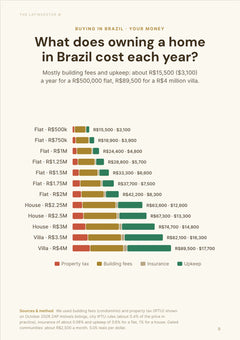
As an owner, plan for condo fees (BRL 620 a month on average in Rio listings in 2026), IPTU at 1% of the city's assessed value, and the state fire tax (from BRL 44.66 a year for flats up to 50 sqm).
If you rent it out as a non-resident, 15% of the gross rent is withheld at source. On a long lease, the tenant pays the condo fees and IPTU.
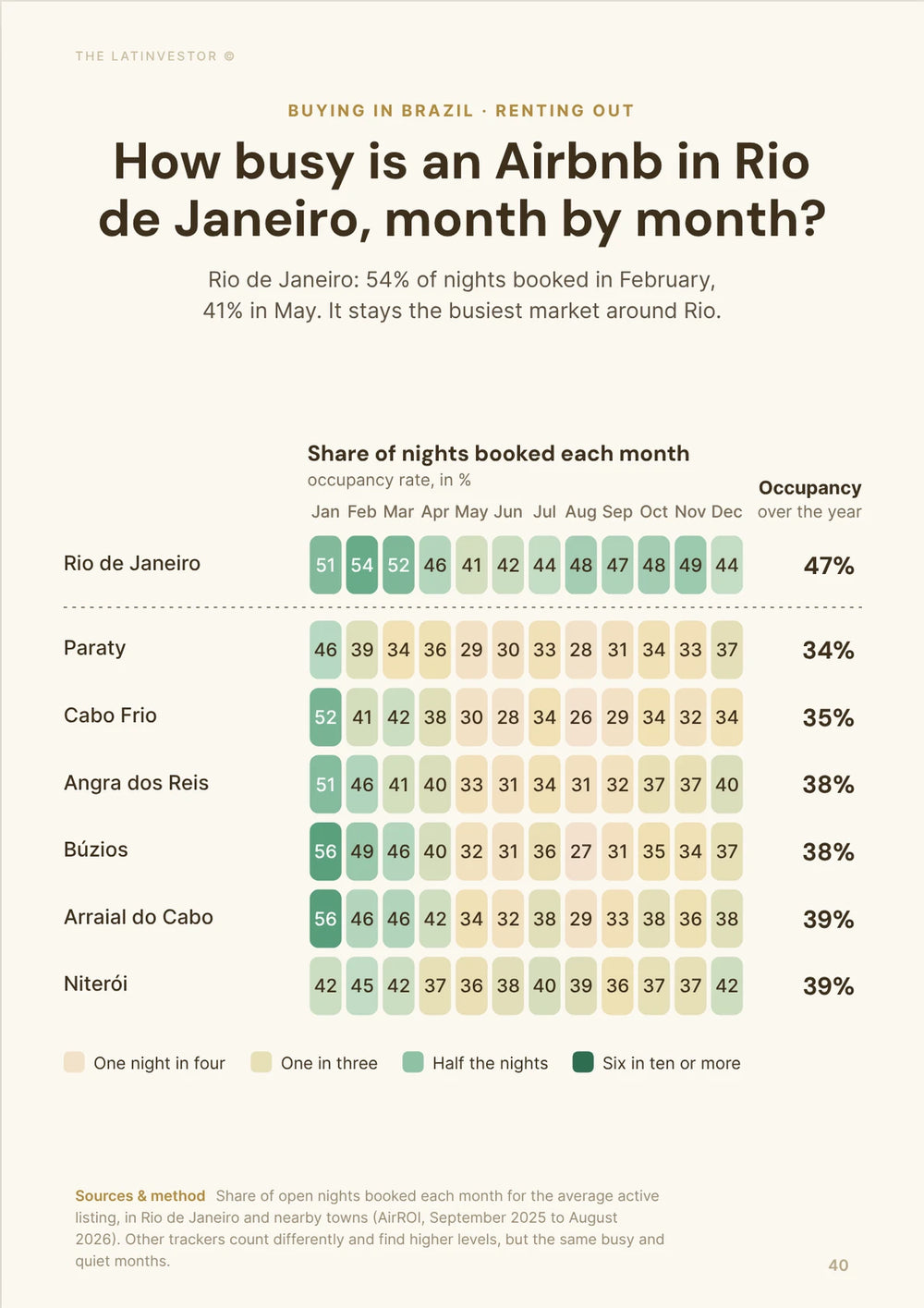
For Airbnb, the risk is your building: since May 2026 a residential condo can need a two-thirds owners' vote to allow platform rentals.
When you sell, expect about 6.5% to 9% of the price in selling costs before capital gains tax, which starts at 15% of the gain.
Bottom line: budget 5% to 6% of the price, ask Rio's city hall which value it will tax for ITBI, compare notary quotes, and get the condo and IPTU debt certificates before you pay anything.


How much should you budget on top of the purchase price in Rio de Janeiro?
How much are total buyer closing costs in Rio de Janeiro in 2026?
Plan for about 4% to 6% of the purchase price. On a BRL 1,000,000 property (about USD 198,000 or EUR 177,000), that is BRL 40,000 to BRL 60,000 (about USD 7,920 to USD 11,900, or EUR 7,080 to EUR 10,600).
The floor is around 4%: the 3% ITBI, the deed and the registration, with no lawyer. That is about BRL 39,000 to BRL 44,000 (about USD 7,720 to USD 8,710) on a BRL 1,000,000 flat.
The top end, around 6%, is what you pay with a lawyer, sworn translations and a full set of certificates. Rio sits at the expensive end of Brazil because its notary tables are among the highest in the country.
If you hire your own buyer's agent, their fee comes on top. Ordinary sales in Rio don't work that way: the seller pays the agent.
What's the usual total % of fees and taxes over the purchase price in Rio de Janeiro?
For a typical cash purchase, the total lands between 4% and 6% of the price. Here is how a BRL 1,000,000 apartment adds up.
ITBI at 3% is BRL 30,000 (about USD 5,940). The escritura costs about BRL 5,500 (about USD 1,090) under our estimate of the 2026 Rio table. Registration adds roughly BRL 3,000 to BRL 8,000 (about USD 594 to USD 1,580) once surcharges and certificates are included.
So the ITBI makes up 3% of the price, the notary and registry roughly 1%, and the rest depends on the help you hire.
What costs are always mandatory when buying in Rio de Janeiro in 2026?
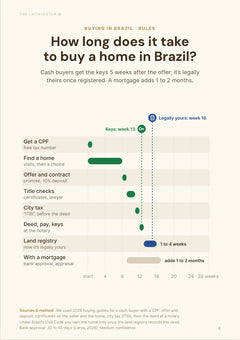
Three costs are mandatory: the 3% ITBI, the escritura pública signed at a notary (tabelionato de notas), and the registration at the property registry (RGI). You only become the legal owner once the registration is done.
If you buy with a Brazilian bank loan, the bank's contract replaces the escritura. Most foreigners buy in cash, so they pay it.
Not mandatory but worth it: a property lawyer, the debt and lawsuit certificates on the seller and the flat, a CPF (free, through a Brazilian consulate if you live abroad) and sworn translations if you don't read Portuguese.
What taxes do I pay when buying a property in Rio de Janeiro in 2026?
What is the property transfer tax rate in Rio de Janeiro in 2026?
The ITBI in Rio is 3%, set by Municipal Law 6.250/2017. It is charged on the transaction value, and the city can tax a higher value if it thinks the declared price is too low.
Foreigners pay exactly the same rate as Brazilians. There is no VAT on a resale home and no separate stamp duty: the ITBI is the only purchase tax, and the rest is cartório fees.
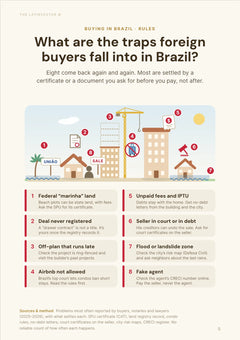
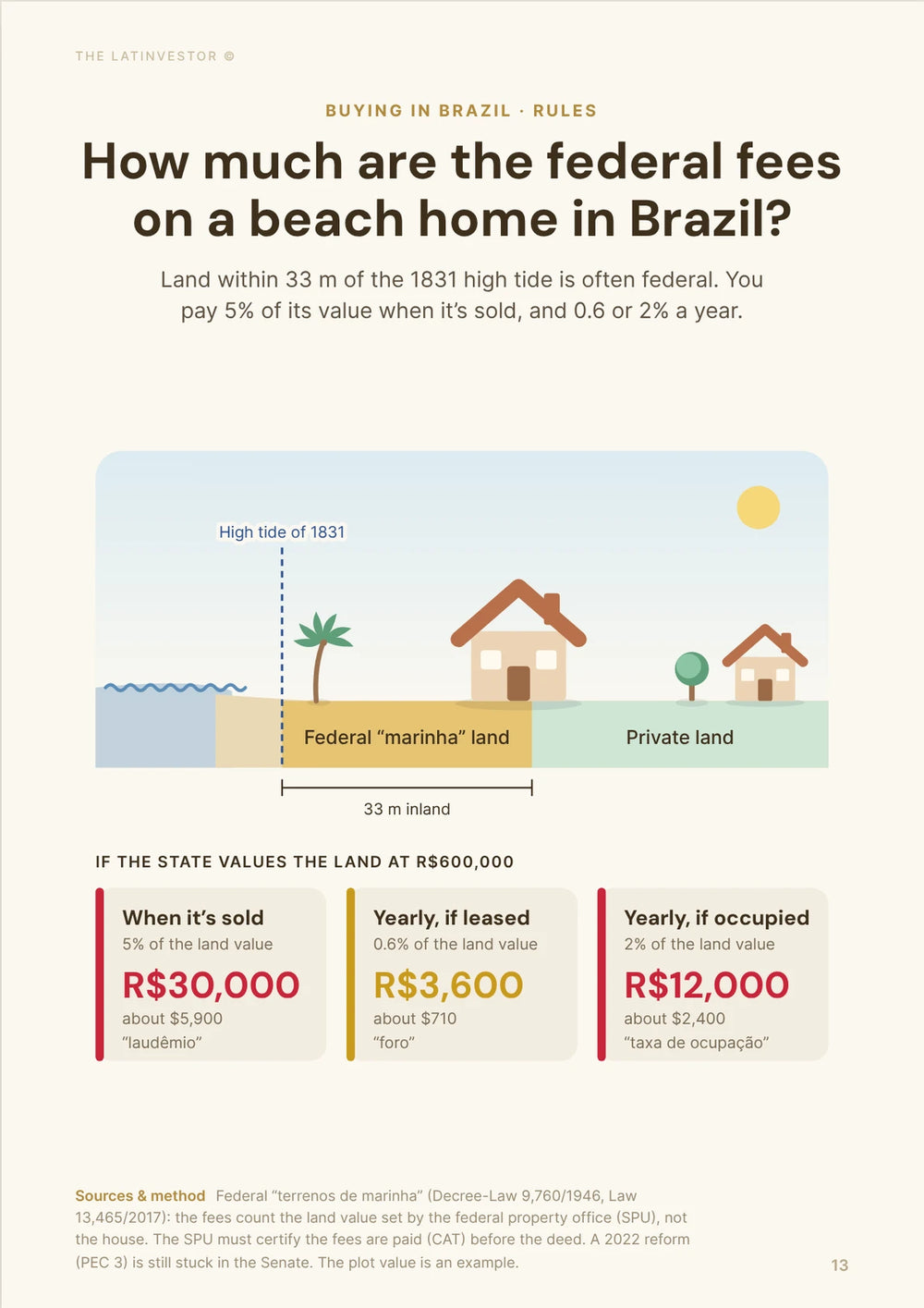
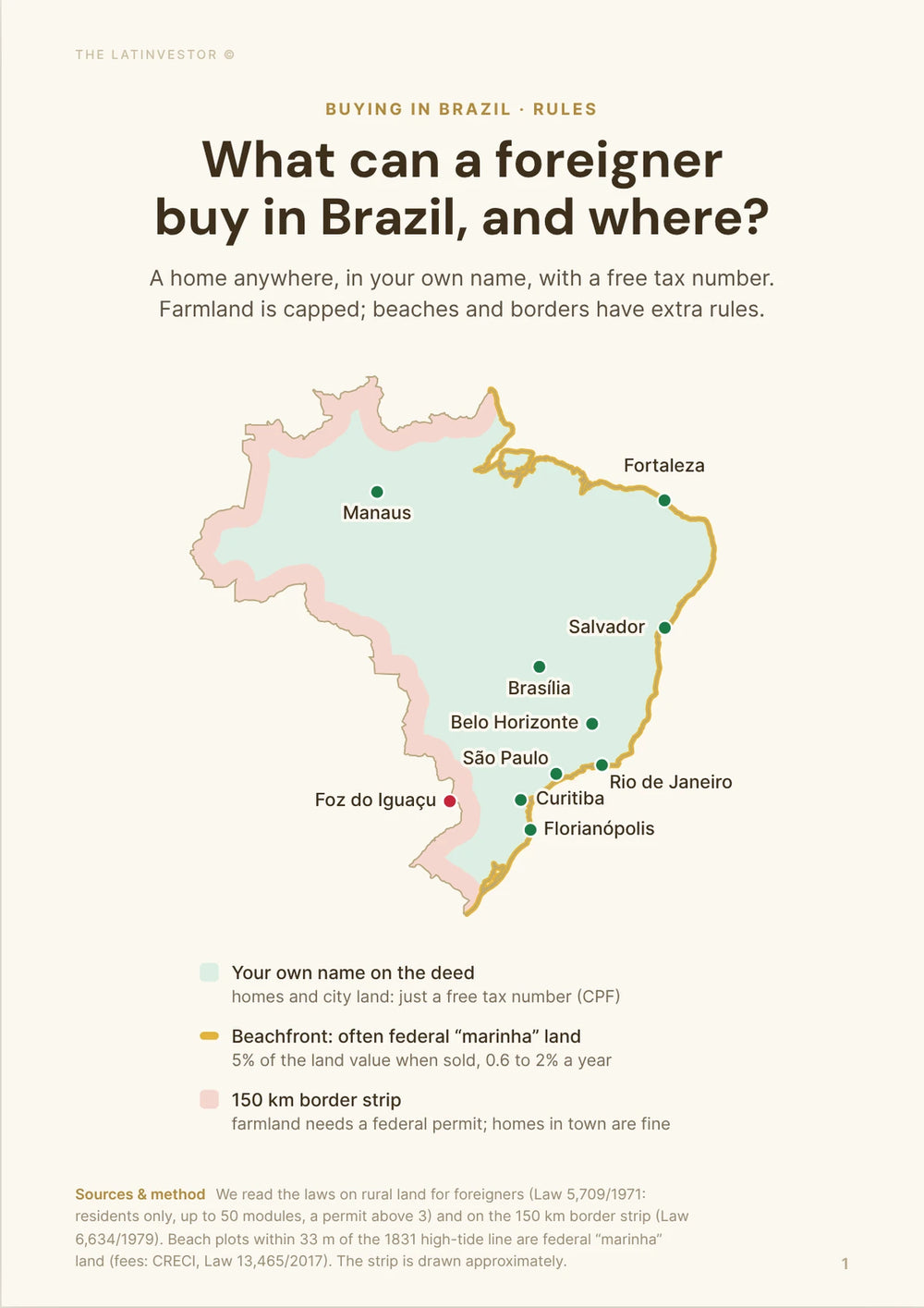
Many flats near the beach sit on terrenos de marinha (federal coastal land). There, a 5% laudêmio is due on the value of the land, not the building. The seller usually pays it, but check this in the contract.
Pay the ITBI only through the city's official guide. Never send it to an account given to you by a third party.
Are there tax exemptions or reduced rates for first-time buyers in Rio de Janeiro?
No. Rio has no ITBI break for first-time buyers, so a foreigner should budget the full 3%.
The exemptions that exist are aimed at specific housing cases and must be requested at the city with documents, before you pay. Don't count on one for an ordinary purchase.
New builds and resales pay the same 3%. Buying through a Brazilian company doesn't lower it either, and adds accountant and filing costs.
Which professional fees will I pay as a buyer in Rio de Janeiro in 2026?
How much does a notary or conveyancing lawyer cost in Rio de Janeiro in 2026?
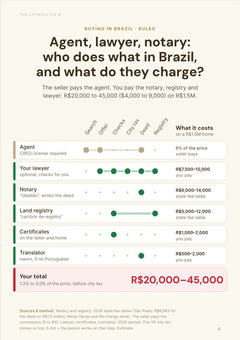
The escritura follows a state table, not a percentage. For a BRL 1,000,000 flat, it costs about BRL 5,500 (about USD 1,090 or EUR 973) in 2026 by our estimate, or about 0.55% of the price. The tables are progressive, so the share falls as the price rises.
Registration at the RGI adds a few thousand reais. Since March 2026, Rio's registries ask for an advance deposit when you file the deed, so keep cash available at that stage.
A lawyer is not mandatory, and fees are free to negotiate. Ask for a fixed quote that covers the certificates, the contract review and the signing. Sworn translations of passports, powers of attorney or marriage documents usually cost a few hundred to a few thousand reais.
A tax adviser is worth a few thousand reais if you plan to rent out or later sell and send the money abroad.
What's the typical real estate agent fee in Rio de Janeiro in 2026?
Agent commissions usually run from 6% to 8% of the sale price. That is the reference range published by CRECI-SP, and it is not a legal rate. On a BRL 1,000,000 flat, that is BRL 60,000 to BRL 80,000 (about USD 11,900 to USD 15,800).
The seller usually pays it. With developers, the brokerage fee is sometimes shifted to the buyer in the contract. The STJ accepts this if it is clearly disclosed, but it ruled the SATI "technical advice" fee abusive.
Commissions are negotiable: around 5% is possible on a quick, simple sale, and more is common on luxury or complicated deals.
How much do legal checks cost (title, liens, permits) in Rio de Janeiro?
The certificates (updated matrícula, liens, lawsuits against the seller, IPTU and condo debts) cost a few hundred to a few thousand reais in total, plus your lawyer's time.
A bank valuation, only needed if you borrow, also costs a few hundred to a few thousand reais.
The check you can't skip is the updated matrícula at the RGI, plus a debt check on both the flat and the seller. Unpaid IPTU or condo fees become your problem after the purchase.
Why are Rio's notary fees so high, and can you pay less?
Rio's deeds are the second most expensive in Brazil after Minas Gerais, because the state table is high and rose again with the Selic on 1 January 2026. You can pay a little less by signing the escritura at a notary in another state: only the registration has to happen at the Rio registry where the flat sits.
The gap is real. According to Bel Radar data published in July 2026, a BRL 10,000,000 deed costs about BRL 29,600 in Rio, against about BRL 22,300 in São Paulo and about BRL 6,000 in Goiás. Some Rio developers already sign their deeds in other states for this reason.
What to do: on a BRL 1,000,000 purchase, the saving is a few thousand reais, so it is worth it only if signing elsewhere is easy for you (a power of attorney, or you travel anyway). Above BRL 3 million to BRL 5 million, get quotes from two or three notaries in different states before you choose.
What hidden or surprise costs should I watch for in Rio de Janeiro right now?
What are the most common unexpected fees buyers discover in Rio de Janeiro?
The usual surprises: unpaid condo fees (condomínio atrasado), cartório extras that add up (certified copies, signature recognition), and being asked to pay the commission when you assumed the seller would.
Unpaid IPTU and condo fees follow the flat, not the seller. In October 2025 the STJ confirmed that a registered buyer can be charged condo fees even before getting the keys. Ask the building manager for a condo debt statement and the city for an IPTU certificate.
The most common fraud is pressure to send a deposit by PIX to someone who is not the registered owner. Pay only the owner shown on the matrícula, and pay the ITBI only through the city's portal.
What sellers forget to mention: special condo levies (chamadas extras) already voted for building works, extra certificates when the seller is divorced or the flat is part of an estate, and building move-in rules.
Are there extra fees if the property has a tenant in Rio de Janeiro?
No specific fee, but expect a few hundred to a few thousand reais of extra lawyer time to read the lease, check the guarantee and confirm notice periods.
You take over the existing lease. You can't evict the tenant just because you bought: you need the lease to allow it or an agreement with the tenant, often in exchange for compensation.
The landlord can ask for only one guarantee (guarantor, insurance or a deposit of up to three months' rent), so check which one is in place and who holds it.
A tenanted flat puts off buyers who want to live in it. That gives you room to negotiate if you buy it as an investment.
Which fees are negotiable, and who really pays what in Rio de Janeiro?
Which closing costs are negotiable in Rio de Janeiro right now?
You can negotiate who pays the commission (especially with developers), your lawyer's fee, how many optional certificates you order, and where you sign the deed.
You can't negotiate the 3% ITBI or the cartório fees, which follow the state tables.
SATI-type fees in developer contracts can usually be refused outright.
Can I ask the seller to cover some closing costs in Rio de Janeiro?
Rarely for the ITBI or the deed: by custom and by law, those are the buyer's costs. But a seller whose flat has been listed for months will often pay to fix whatever blocks the sale.
What sellers usually accept: clearing condo and IPTU arrears, paying the laudêmio on marinha land, and fixing missing paperwork. Some prefer to cut the price instead.
Your leverage: a long listing, proof of funds and a quick cash closing. With the Selic at 13.75%, many local buyers can't get cheap credit, so a cash buyer stands out.
Is price bargaining common in Rio de Janeiro in 2026?
Yes. In the FipeZAP survey, Brazilian buyers reported an average discount of 9% off the asking price over the 12 months to June 2026. Those who got a discount averaged 14% off.
On a BRL 1,000,000 asking price, 9% is BRL 90,000 (about USD 17,800), more than all your closing costs. Rio's average asking price was BRL 11,302 per sqm in September 2026, but that is an asking price, not a sale price.
Use the 9% as a target, ask for recent sale prices in the same building, and push harder on flats listed for months or needing work.
What monthly, quarterly or annual costs will I pay as an owner in Rio de Janeiro?
What's the realistic monthly owner budget in Rio de Janeiro right now?
A realistic monthly budget for an apartment, excluding any loan, is about BRL 1,000 to BRL 4,000 (about USD 198 to USD 792, or EUR 177 to EUR 708). That is our estimate, not an official figure.
It covers condo fees, IPTU in instalments, utilities and a repair reserve. The condo fee varies the most: Rio listings averaged BRL 620 a month in 2026, all sizes combined, but a building with doormen, a pool and 24-hour security can cost two or three times that.
A modest flat in Tijuca can stay around BRL 800 to BRL 1,500 a month all-in. A large unit in Leblon or Ipanema with full staff can pass BRL 8,000 (about USD 1,580).
What is the annual property tax amount in Rio de Janeiro in 2026?
Rio charges residential IPTU at 1% of the city's assessed value (valor venal), not of your price. On a flat worth around BRL 1,000,000, the bill usually lands between BRL 2,000 and BRL 6,000 a year (about USD 396 to USD 1,190) by our estimate, and much more in Leblon or Ipanema.
The valor venal is set by the city from the flat's area, age, location and use, and it is usually well below the market price. The only reliable figure is the last IPTU bill: ask the seller for it before you sign.
Paying the year in one go by 6 February 2026 earned a 7% discount. Otherwise you pay in 10 monthly instalments. Homes with a valor venal up to BRL 81,659 are exempt, which rarely applies to a foreigner's flat.
What is Rio's fire tax, and do I have to pay it?
Yes. On top of IPTU, the state of Rio charges every property a yearly Taxa de Incêndio, collected by the fire brigade (Funesbom). In 2026 it started at BRL 44.66 for homes up to 50 sqm and rises with size. The bills were due on 5 and 11 February 2026.
It is small, but it is due even if the bill never reaches you. Ask the seller for proof that recent years are paid, or check the property online with Funesbom before you sign.
If I rent it out, what extra taxes and fees apply in Rio de Janeiro in 2026?
What tax rate applies to rental income in Rio de Janeiro in 2026?
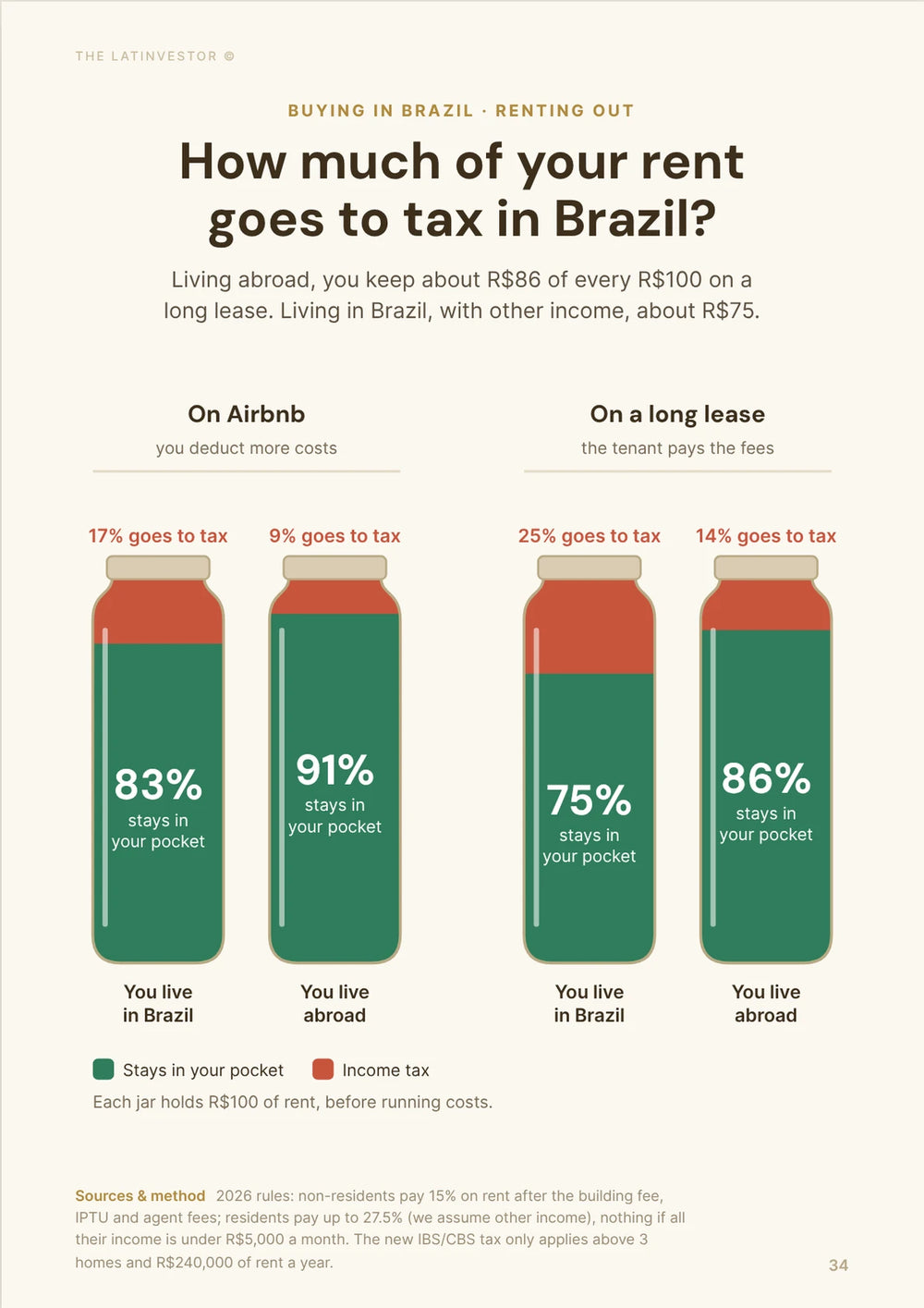
It depends on where you are tax resident. As a non-resident, 15% of the gross rent is withheld at source, with almost no deductions. Any "net yield" you are quoted should already include it.
A resident pays the monthly IRPF scale from 0% to 27.5% and can deduct condo fees and IPTU paid by the owner.
On a long lease, the tenant normally pays the condo fees and IPTU, under the tenancy law. You only pay them while the flat is empty or rented short term.
Do I pay tax on short-term rentals in Rio de Janeiro in 2026?
Yes. Airbnb income is taxed like ordinary rent: 15% withheld for a non-resident, the IRPF scale for a resident.
Short stays also mean you pay the condo fees, IPTU, utilities and Airbnb's 16% host fee yourself, so your net is lower than the nightly rate suggests.
Can your Rio building stop you renting on Airbnb?
Yes, and in 2026 that is a bigger risk than the tax. In May 2026 the STJ ruled that offering a flat on platforms like Airbnb in a residential condominium needs the approval of two-thirds of the owners. In September 2026 it picked a lead case (Tema 1.443) to settle the question for the whole country.
Rio has no general city licence for short stays yet. At city level, PL 372/2025 was approved in committee in December 2025 (3 votes to 1) but has not been voted on by the full council, and a newer bill, PL 2.265/2026 (May 2026), is still in committee. No city law is in force as of October 2026. So the rules could change.
What to do: before buying for Airbnb in Copacabana, Ipanema or Barra, read the building's convenção and regimento interno, and ask the manager for the minutes of recent meetings. If short stays aren't explicitly allowed, price the flat as a long-term rental.
If I sell later, what taxes and fees will I pay in Rio de Janeiro in 2026?
What's the total cost of selling as a % of price in Rio de Janeiro in 2026?
Selling usually costs about 6.5% to 9% of the price before capital gains tax, mostly because of the agent.
The range runs from about 6% for a simple sale to 10% or more if the paperwork needs fixing or you pay the laudêmio on marinha land.
What makes up that total: the agent commission (6% to 8% under the CRECI-SP reference), updated certificates, your lawyer, any IPTU or condo arrears, and the 5% laudêmio on the land value if it applies.
Add the buying costs, and a purchase followed by a resale costs about 10% to 14% of the price in total, before any gains tax. Plan to hold for several years.
What capital gains tax applies when selling in Rio de Janeiro in 2026?
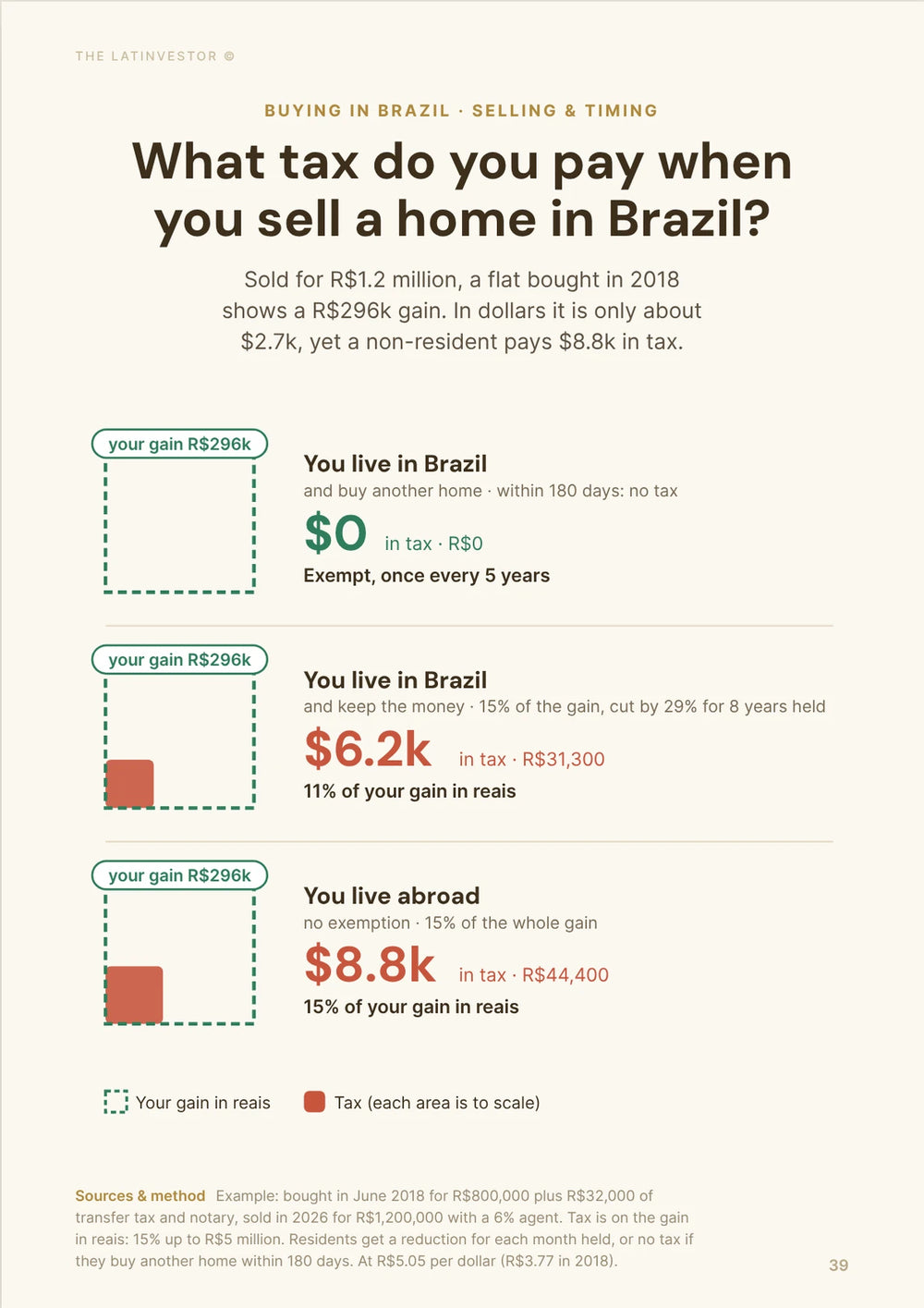
The tax is charged on the gain, not the sale price: 15% up to BRL 5 million of gain, 17.5% up to BRL 10 million, 20% up to BRL 30 million, then 22.5%.
Residents have two main exemptions: selling their only property for up to BRL 440,000 (with no other sale in the last five years), or reinvesting the money in another home in Brazil within 180 days. Don't count on either as a non-resident: they need a case-by-case check.
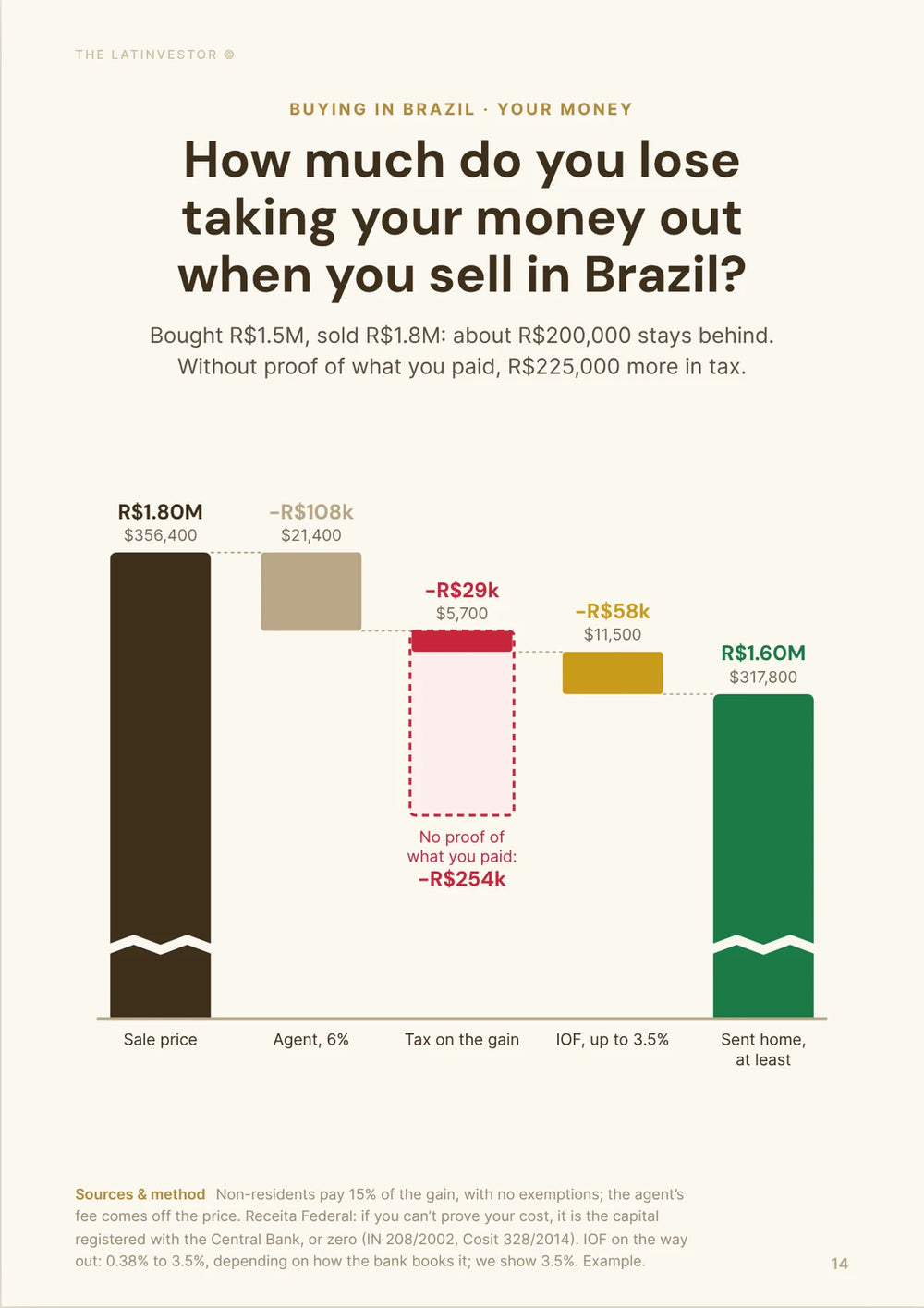
Foreigners don't automatically pay a higher rate. Keep proof of your purchase price, the ITBI you paid, your improvement costs and the money you brought in: they lower your taxable gain and make it easier to send the money abroad.
Our methodology
This article estimates what a buyer, especially a foreigner paying cash, pays on top of the price in Rio de Janeiro, and then what owning, renting out and selling cost.
Taxes come from official sources: the city's ITBI and IPTU rules, the state fire tax, Receita Federal rules for rental and capital gains tax, and federal rules on marinha land. The deed cost is our estimate from the Rio court's fee table, updated for 2026. Condo fees, discounts and asking prices come from recent market sources (Loft, FipeZAP), which we name each time.
We built the 4% to 6% total by adding the 3% ITBI to the deed and registry costs of a BRL 1,000,000 example, then adding typical lawyer and translation costs. Lawyer, translation and repair costs are free-market prices, so we give them as ranges.
We checked these figures in October 2026. Conversions use about 5.05 reais per US dollar and 5.65 reais per euro.
Limits: the registry fee and the IPTU bill depend on each flat, FipeZAP figures are asking prices, not sale prices, and the 9% discount is a national average.
Key sources used for this analysis include Prefeitura do Rio de Janeiro (ITBI), Law 6.250/2017, TJRJ notary fee table, CNB/RJ, Portas on deed costs, Rio City Hall (IPTU 2026), Metrópoles on the fire tax, CRECI-SP, Receita Federal, Secretaria do Patrimônio da União, FipeZAP Raio-X via Portas, Loft via Portas and Oliveira Lawyers.