Summary
In 2026, $100,000 (about R$ 505,000) buys roughly 45 square meters in Rio de Janeiro at the city's average asking price of R$ 11,302 per square meter: about 72 sqm in Tijuca, 37 sqm in Copacabana or Botafogo, and under 20 sqm in Ipanema or Leblon.
At $100,000 you are mostly looking at an older one-bedroom in the North Zone, a compact two-bedroom in Recreio, or a studio in an old Copacabana building. Keep R$ 25,000 to R$ 60,000 aside for a refresh.
A small Copacabana unit on Airbnb grosses about R$ 61,300 a year for an average one-bedroom, but after running costs and the 15% tax for non-residents it barely beats a long lease, and since May 2026 short stays in a residential building can need a two-thirds owners' vote.
A comfortable 80 sqm two-bedroom costs around R$ 561,000 in Tijuca, R$ 1,100,000 in Botafogo or Flamengo and over R$ 2,200,000 in Ipanema. Homes actually sold in Rio averaged R$ 757,000 in the first half of 2026, and recorded sale values ran about 22% below asking prices in Leblon, 6% in Ipanema.
At $200,000 (about R$ 1,010,000), the city average gives you about 89 sqm: 144 sqm in Tijuca, 75 sqm in Botafogo, 69 sqm in Barra da Tijuca.
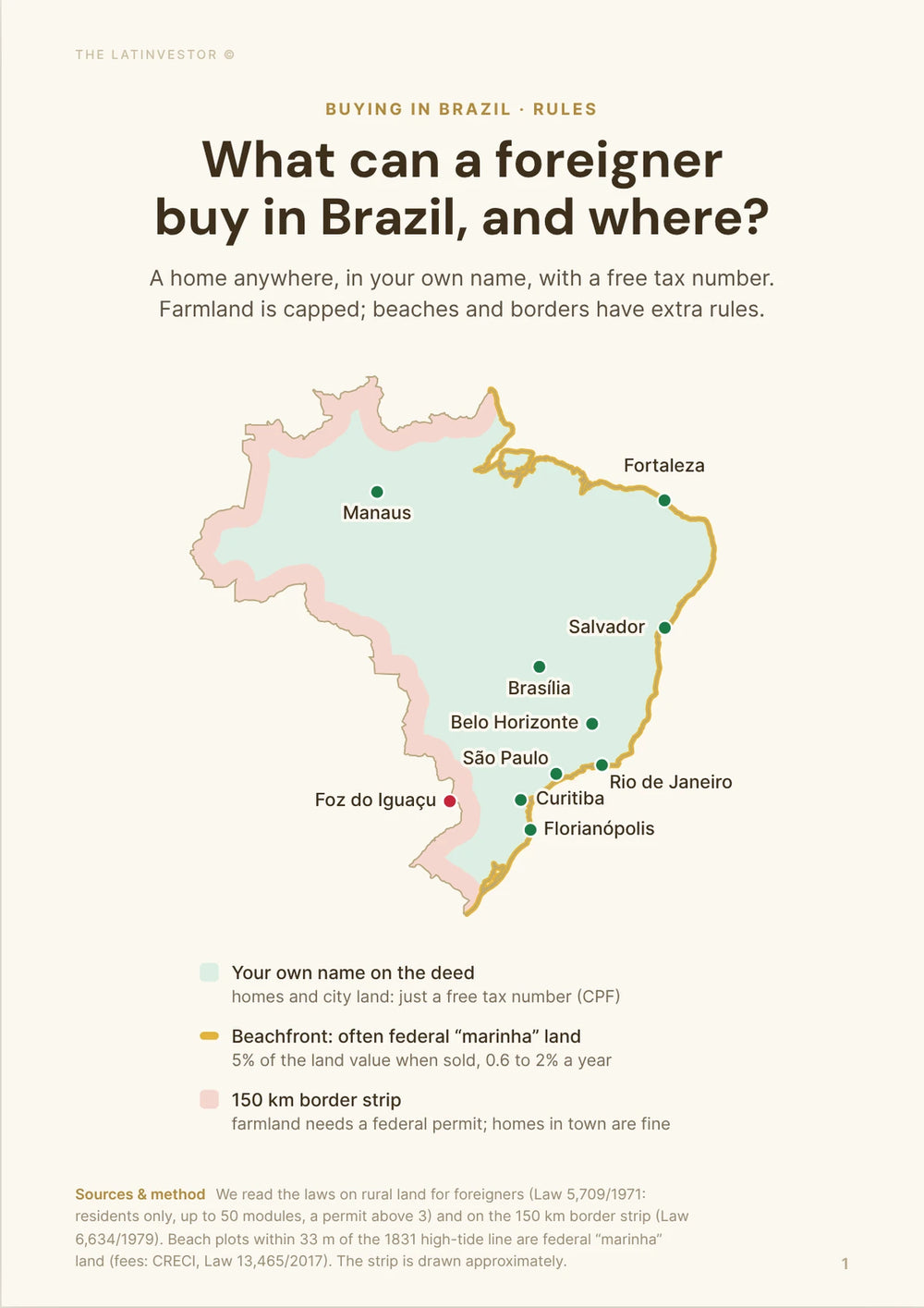
Rio is not in the North or Northeast, so the property residence permit needs the full R$ 1,000,000, about $198,000: a $200,000 budget only just clears it.
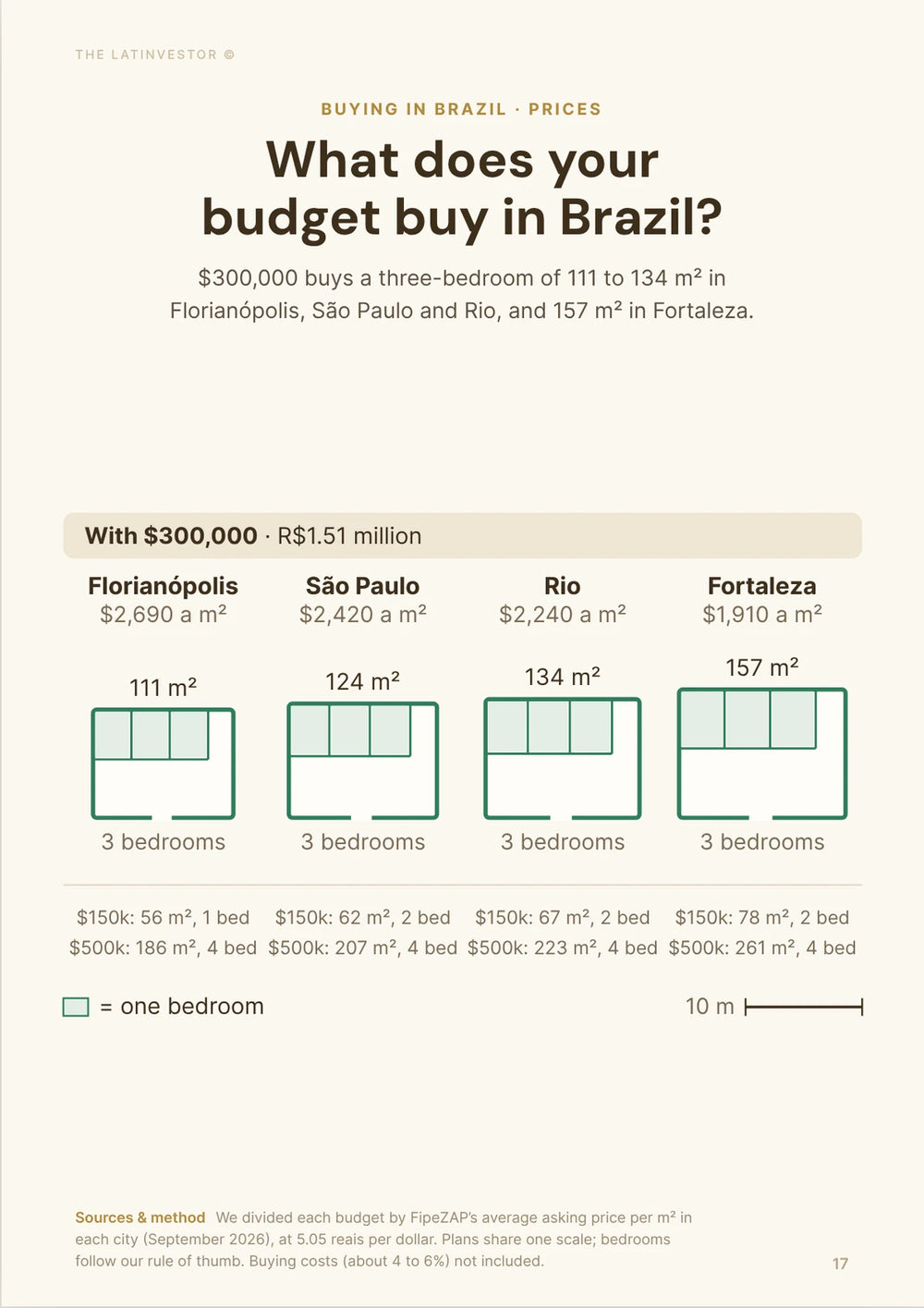
At $300,000 (about R$ 1,520,000), a proper two-bedroom in Botafogo, Flamengo, Laranjeiras or Copacabana is within reach, at 110 to 137 sqm at neighborhood averages.
At $500,000 (about R$ 2,520,000), Lagoa gives you about 144 sqm and Ipanema or Leblon about 87 to 93 sqm.
Luxury starts around $700,000 (R$ 3,540,000). Leblon asks R$ 28,837 per sqm after rising 13.2% in a year, so even $700,000 only gets you about 123 sqm there.
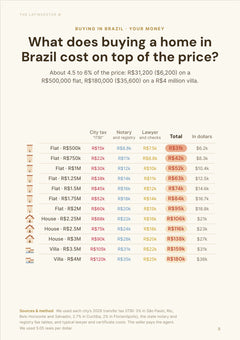
Plan for 4% to 6% in closing costs on top of the price, with Rio's ITBI transfer tax at 3%.
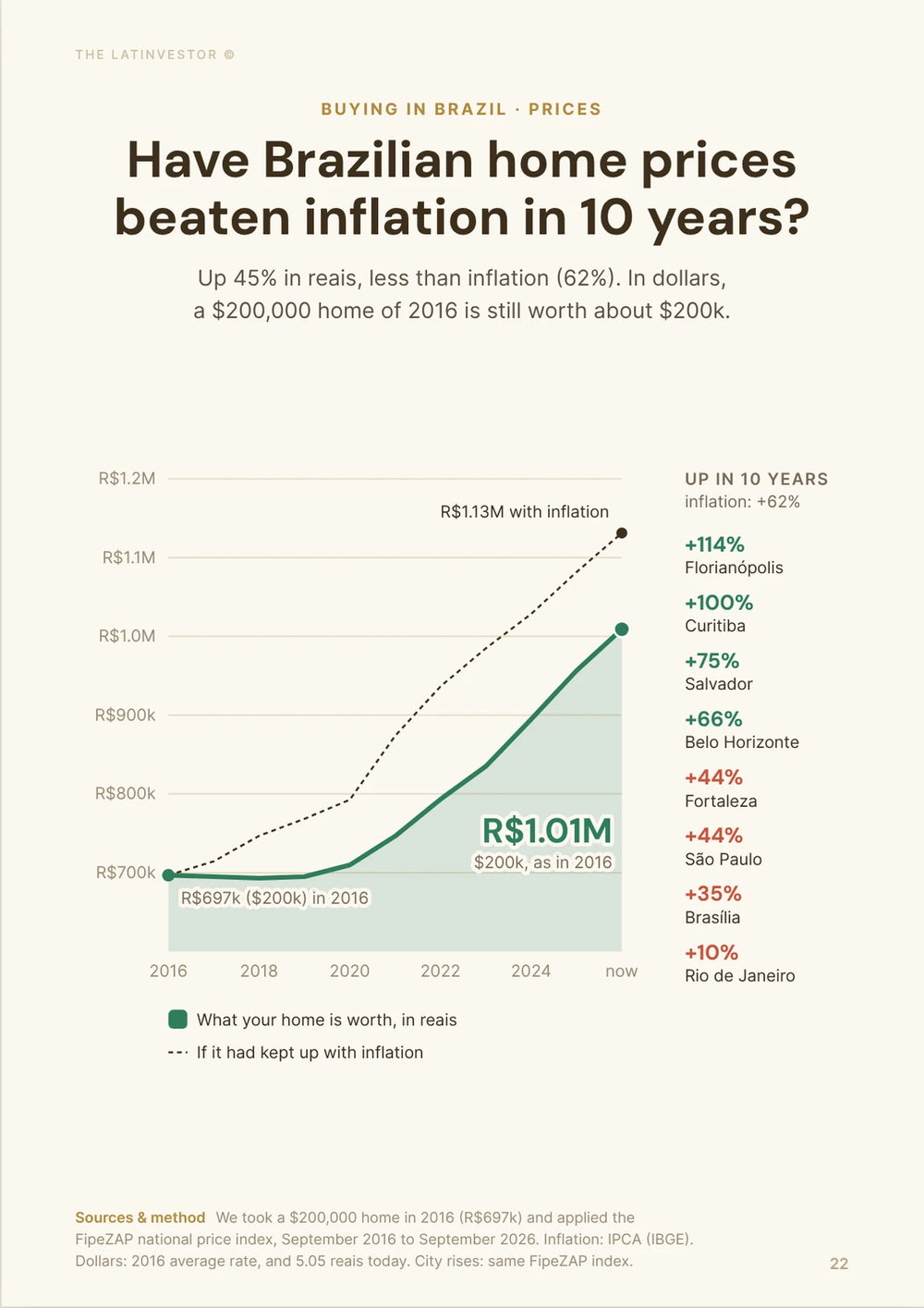
Rio's asking prices rose 5.57% in a year, barely above 4.58% inflation, but the beach neighborhoods ran ahead: Leblon +13.2%, Copacabana +9.9%, against +2.3% in Tijuca. With the Selic at 13.75%, buyers who got a discount averaged 14% off.
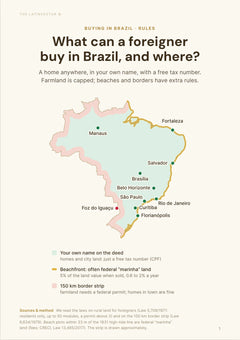
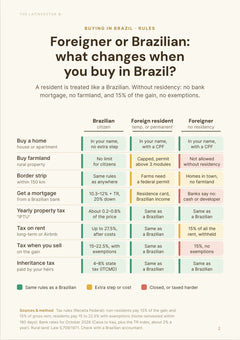
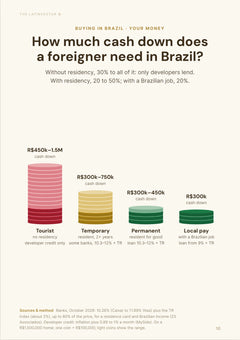
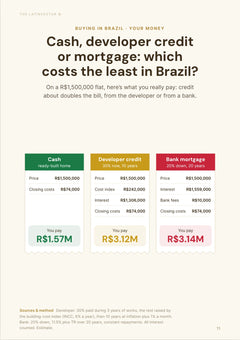
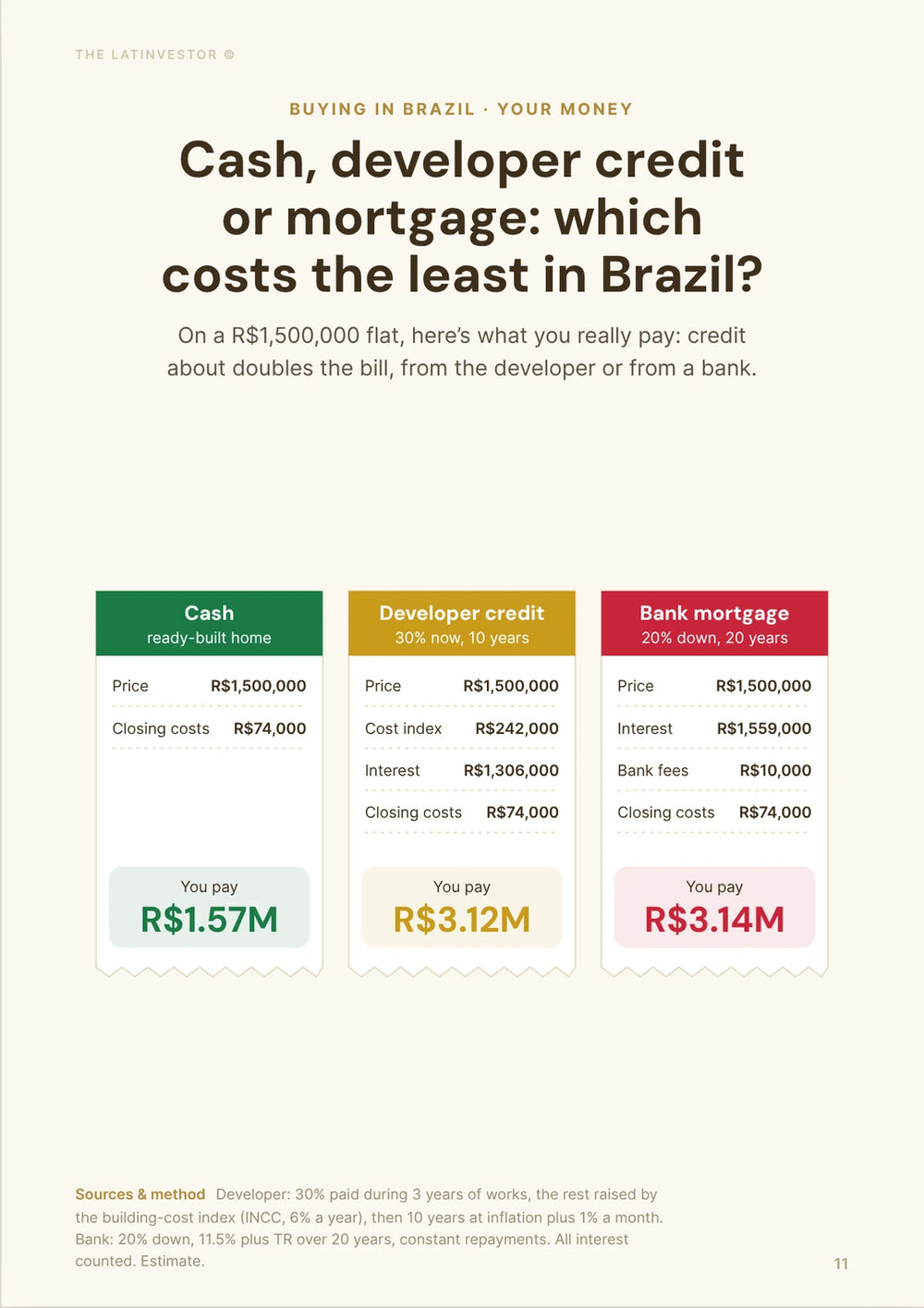
Non-resident foreigners almost always pay cash: banks generally ask for Brazilian nationality or permanent residency, and home loans run around 8% to 12% a year plus TR.
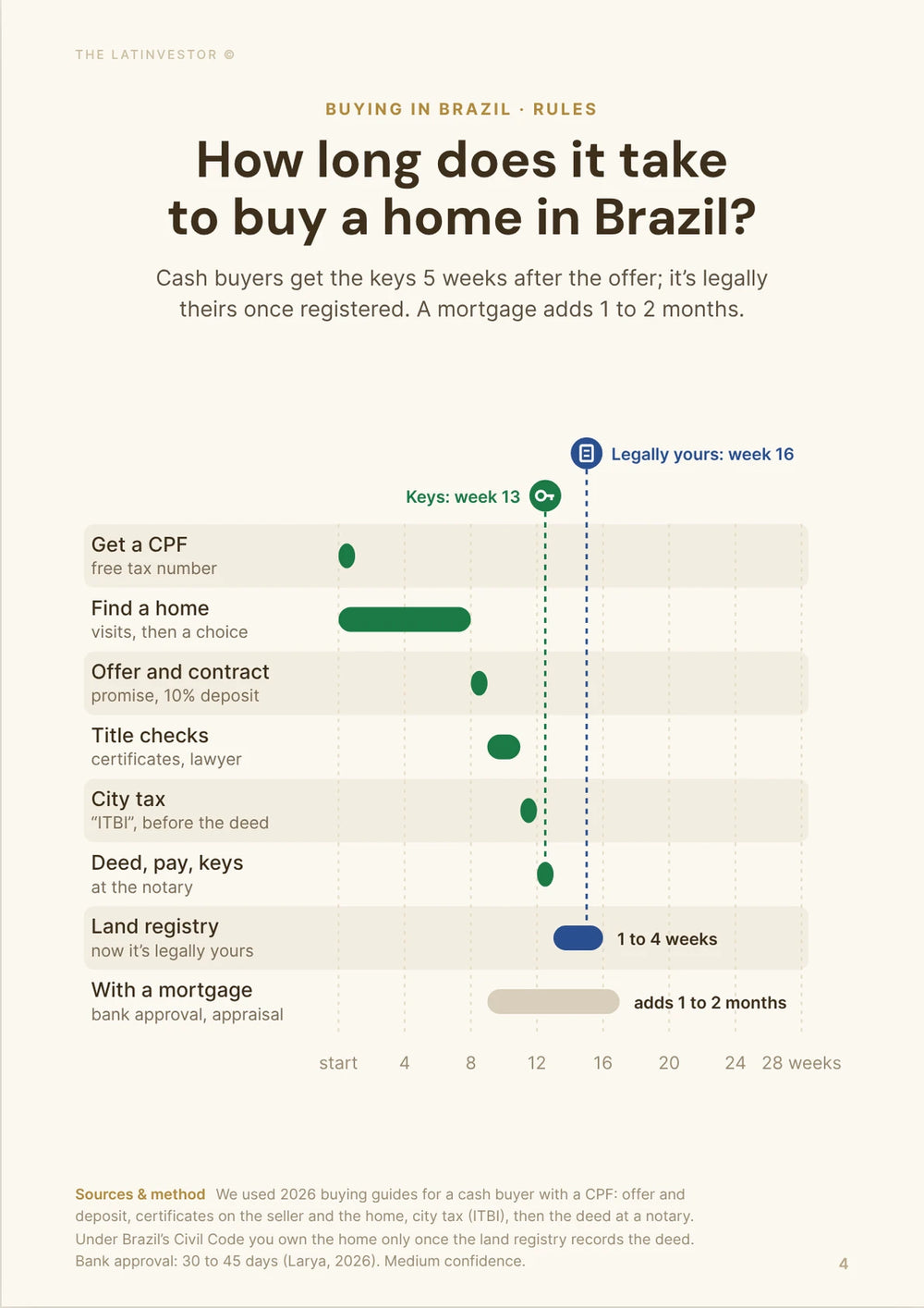
Standard two-bedrooms near the metro resell fastest, while the average sale in Brazil takes about 16 months to close.
Bottom line: with $100,000 to $200,000, a two-bedroom in Tijuca, Flamengo or Botafogo near the metro, bought cash after hard negotiation, is the safest bet. Zona Sul beachfront needs $500,000 or more.


What can you really get for $100k in Rio de Janeiro right now?
Are there any decent properties for $100k in Rio de Janeiro, or is it all scams?
Yes, decent properties for $100,000 (about R$ 505,000) exist in Rio, but not on the beach: at the city average of R$ 11,302 per square meter, that budget buys about 45 sqm.
The best value is in the North Zone and the West Zone. Tijuca averages R$ 7,011 per sqm, so $100,000 gets you about 72 sqm near the metro. Listing averages are lower still in Vila Isabel (around R$ 4,770 per sqm), Méier (around R$ 3,830) and Campo Grande (around R$ 3,270), where a one-bedroom or small two-bedroom fits the budget. In Recreio, $100,000 buys a two-bedroom of 45 to 77 sqm, far from the center.
In Copacabana (R$ 13,811 per sqm) or Botafogo (R$ 13,555), the same money means a studio or compact one-bedroom of 18 to 45 sqm, usually in an older building. Ipanema and Leblon are out of reach: at R$ 28,837 per sqm in Leblon, $100,000 buys about 18 sqm.
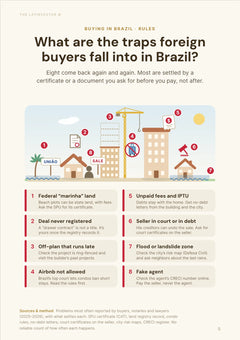
To avoid scams, check the property's registration (matrícula) at the cartório, ask for the IPTU and condo debt certificates, pay ITBI only through the city's official portal, and be wary of any Zona Sul deal that looks too cheap.
What property types can I afford for $100k in Rio de Janeiro (studio, land, old house)?
For $100,000 (R$ 505,000), the realistic options are an older one-bedroom in Tijuca, Vila Isabel or Méier, a two-bedroom in Recreio or Campo Grande, or a studio in an older building in Copacabana, Flamengo or Centro, where listings had a median around $66,000 in October 2026.
At this price, expect a building from several decades ago with basic finishes. Plan R$ 25,000 to R$ 60,000 ($4,950 to $11,900) for a refresh, and R$ 80,000 to R$ 180,000 ($15,800 to $35,600) when the wiring, plumbing and bathrooms all need redoing.
For long-term value, an older apartment near the metro in Tijuca, Flamengo or Botafogo beats a house in the far West Zone: local buyers want metro access, so it is easier to resell.
What's a realistic budget for a comfortable home in Rio de Janeiro in 2026?
In 2026, a comfortable 80 sqm two-bedroom in Rio costs around R$ 561,000 ($111,000) in Tijuca, R$ 1,100,000 ($218,000) in Botafogo or Flamengo, and R$ 2,200,000 to R$ 2,300,000 ($436,000 to $455,000) in Ipanema or Leblon, at September 2026 average asking prices.
Most foreign buyers who want comfort without a long commute end up spending R$ 1,000,000 to R$ 1,500,000 ($198,000 to $297,000, or €177,000 to €265,000), which buys a proper two-bedroom in Flamengo, Botafogo, Laranjeiras or a good part of Copacabana.
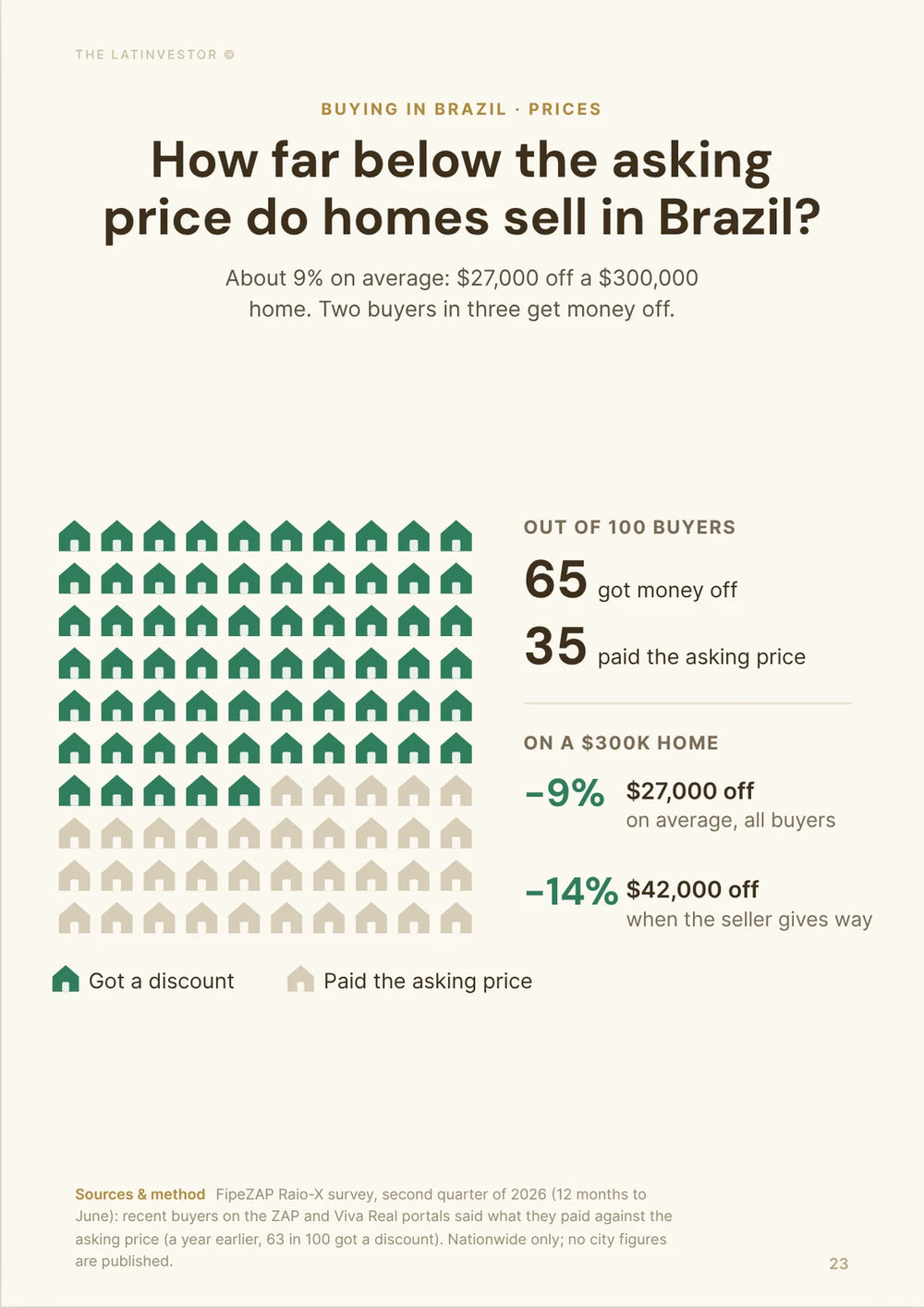
Asking prices are not what people pay. The average home sold in Rio in the first half of 2026 went for about R$ 757,000 ($150,000), across 23,755 transfers recorded for ITBI, the city's transfer tax. The gap with asking prices depends on the area: recorded values per sqm were about 22% below asking prices in Leblon, but only about 6% below in Ipanema.
"Comfortable" in Rio means 70 to 90 sqm in a building with a doorman (portaria), a working elevator, reasonable condo fees, and a metro station or main bus line within walking distance.

Can a small Copacabana apartment pay for itself on Airbnb?
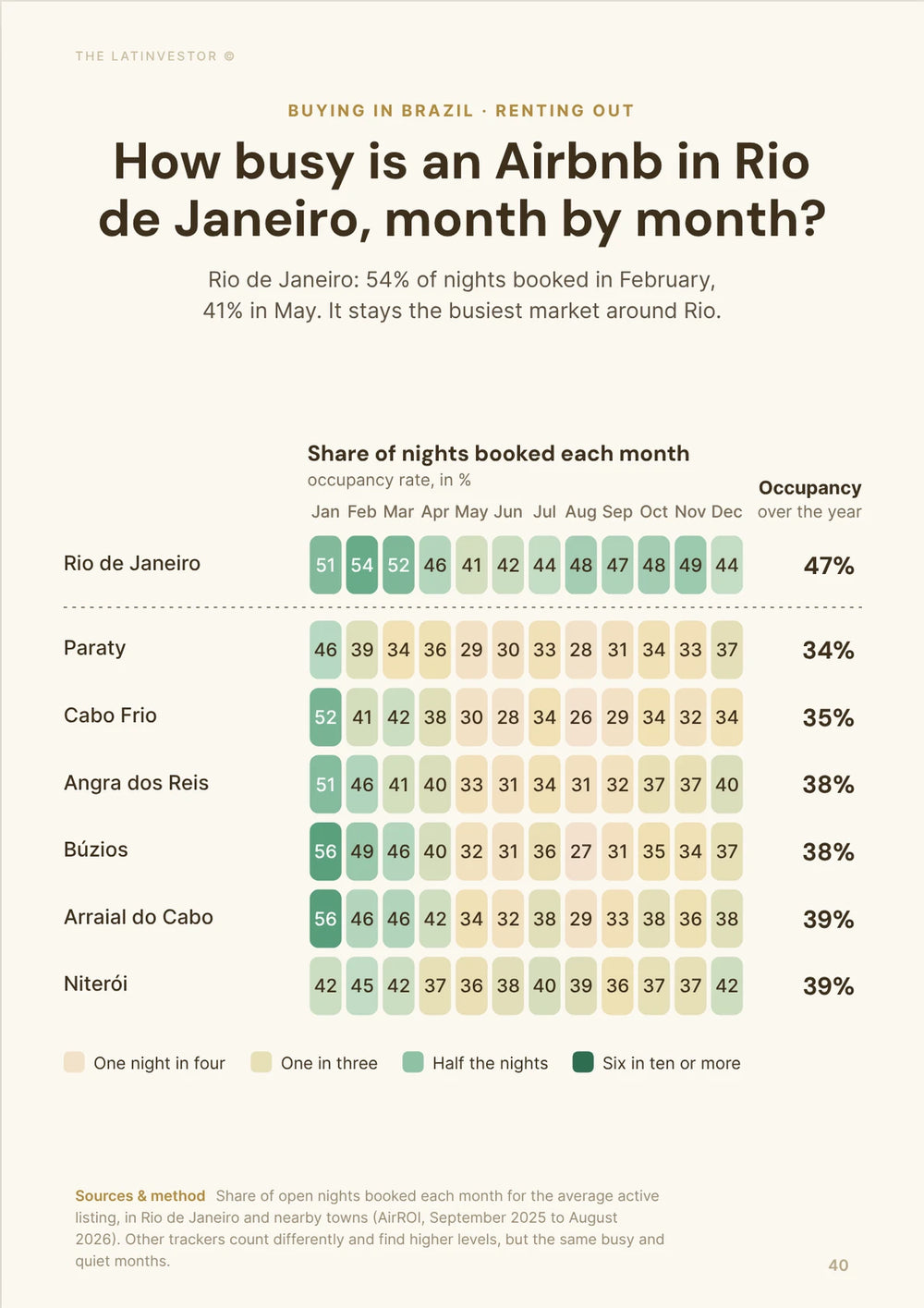
Not as well as the nightly rates suggest. A one-bedroom in Copacabana had a listing median around $115,000 (R$ 581,000) in October 2026, and an average entire one-bedroom in Rio grossed about R$ 61,300 a year on Airbnb, at 45% occupancy and R$ 487 a night.
That looks like a 10% gross return, but AirROI's own cost model takes about a quarter off for the platform, utilities and running costs, and a non-resident then pays 15% Brazilian tax. You end up near 6.8% before condo fees and IPTU, which you pay yourself on short stays. A long lease in Copacabana yields about 6.7% gross, and the tenant pays the condo fees and IPTU.
Competition is rising fast: the number of active Airbnb listings in Rio grew about 50% in a year. And the rules have shifted: in May 2026 the STJ said short stays in a residential building need a two-thirds owners' vote, and in September 2026 it froze similar cases nationwide (Tema 1.443) until it sets a binding rule.
What to do: before you buy, read the building's convention and the last assembly minutes, and ask the manager in writing whether short stays are allowed. If the answer is vague, price the unit as a long-term rental.
What can I get with a $200k budget in Rio de Janeiro?
What "normal" homes become available at $200k in Rio de Janeiro?
At $200,000 (around R$ 1,010,000), Rio starts to feel normal: a proper one or two-bedroom in an established middle-class neighborhood, with a doorman, an elevator and sometimes a parking space.
At September 2026 averages, that budget buys about 89 sqm citywide, 144 sqm in Tijuca, 91 sqm in Laranjeiras, 79 sqm in Flamengo, 75 sqm in Botafogo, 73 sqm in Copacabana and 69 sqm in Barra da Tijuca.
These are asking prices: Brazilian buyers who got a discount averaged 14% off in the 12 months to June 2026, so your money can go a bit further.
Where are the smartest $200k buys in Rio de Janeiro, and where are prices running?
The smartest $200,000 buys are Tijuca for space and metro access, and Flamengo, Botafogo and Laranjeiras for location. Barra da Tijuca gets you newer buildings, but at R$ 14,561 per sqm it is not cheap, and you will need a car.
Prices are not moving at the same speed. In the year to September 2026, Copacabana rose 9.9% while Flamengo rose 5.9%, Barra 4.9%, Botafogo 4.2%, Laranjeiras 3.3% and Tijuca 2.3%. Recreio, the cheapest beach area at R$ 7,897 per sqm, rose only 2.9%, with a listing median around $161,000.
The slower neighborhoods are where you can negotiate. Tijuca, Laranjeiras and Botafogo combine fair prices, metro or easy transit and steady demand from local families, which is what makes them easy to resell.
Does a $200k purchase in Rio get you residency?
Only just. Brazil's real estate investor residence (RN 36/2018) asks for at least R$ 1,000,000 in property, about $198,000. The lower R$ 700,000 bar only applies to the North and Northeast, so it doesn't help in Rio.
That makes $200,000 a tight fit: if the real gets stronger or you negotiate a good discount, your purchase price can end up under R$ 1,000,000. If residency is the goal, make sure the price written in the deed is at least R$ 1,000,000.
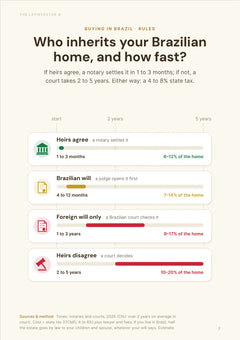
Buying does not give you residence automatically. You must apply, prove the money came from abroad through the official exchange system, and register the property in your name. Keep the exchange contract, the deed and the registration certificate.
What can I buy with $300k in Rio de Janeiro in 2026?
What quality upgrade do I get at $300k in Rio de Janeiro?
Going from $200,000 to $300,000 (R$ 1,520,000) gets you a better building: proper portaria, a parking space, nicer common areas and a quieter street inside the same neighborhood.
Yes, $300,000 can buy into a newer building, mostly in Barra da Tijuca and Recreio, where the housing stock is more recent than in Zona Sul. In Barra, two-bedroom listings had a median around $249,000 (R$ 1,260,000) in October 2026.
At this budget you get updated kitchens and bathrooms, air conditioning, and in newer towers a pool, gym and party room.
Can $300k buy a 2-bedroom in a good area of Rio de Janeiro?
Yes, $300,000 buys a two-bedroom in Botafogo, Flamengo, Laranjeiras, the calmer parts of Copacabana, and most of Barra da Tijuca.
At September 2026 averages, R$ 1,520,000 gives you about 137 sqm in Laranjeiras, 118 sqm in Flamengo, 112 sqm in Botafogo, 110 sqm in Copacabana and 104 sqm in Barra. Expect less in a newer building or with a view: 80 to 110 sqm is a realistic range for a good two-bedroom.
Which places become "accessible" at $300k in Rio de Janeiro?
At $300,000, you no longer need to compromise in Botafogo, Flamengo, Laranjeiras or Copacabana, and Lagoa opens up for smaller units: at R$ 17,519 per sqm, the budget buys about 87 sqm there.
These areas give you the classic Rio life: beach or bay nearby, walkable streets, restaurants, the metro, and an address local buyers will always want.
Here, $300,000 typically buys a well-kept two-bedroom with a doorman, or a nicely finished one-bedroom close to the beach. Ipanema and Leblon still mean about 53 to 56 sqm.
What does a $500k budget unlock in Rio de Janeiro?
What's the typical size and location for $500k in Rio de Janeiro?
In 2026, $500,000 (around R$ 2,520,000) buys about 186 sqm in Botafogo, 173 sqm in Barra da Tijuca or 144 sqm in Lagoa at average asking prices. In newer buildings with views, buyers usually land at 120 to 160 sqm.
Yes, $500,000 can buy a family home with outdoor space, mainly in Barra da Tijuca and Recreio: ground-floor units with gardens or townhouses in gated condos. In beachfront Zona Sul, the money goes on location, not on a garden.
At this level you get three bedrooms, two or more bathrooms, and often a home office or a maid's room (dependência).
Which "premium" neighborhoods open up at $500k in Rio de Janeiro?
At $500,000, Ipanema, Leblon, Lagoa, Gávea and Jardim Botânico come within reach, but for smaller units or streets away from the beach.
They are premium because of the beach or the lagoon, tree-lined streets, the best restaurants and schools, and lower crime than the rest of the city.
In Ipanema (R$ 26,996 per sqm) or Leblon (R$ 28,837), $500,000 buys about 87 to 93 sqm at the average, so a well-kept two-bedroom, often without a sea view. Lagoa gives you about 144 sqm for the same money.
Where does "luxury" start in Rio de Janeiro in 2026?
At what amount does "luxury" start in Rio de Janeiro right now?
In Rio, real luxury starts around $700,000 (R$ 3,540,000, or about €626,000), and there is no doubt left from $1,000,000 (R$ 5,050,000).
What makes it luxury: a Leblon, Ipanema or Lagoa address, a building with full-time doorman and security, a sea or lagoon view, modern finishes, and parking spaces in streets where parking is nearly impossible.
Prime is also where prices moved most: Leblon asking prices rose 13.2% and Ipanema 10.3% in the year to September 2026. At R$ 28,837 per sqm in Leblon, $700,000 buys about 123 sqm.
Mid-tier luxury typically runs from $1,000,000 to $2,000,000 (R$ 5,050,000 to R$ 10,100,000), while beachfront penthouses in Leblon or Ipanema can pass $5,000,000 (R$ 25,250,000).
Which areas are truly high-end in Rio de Janeiro right now?
The truly high-end areas are Leblon, Ipanema, Lagoa, Gávea and Jardim Botânico. Leblon is the most expensive neighborhood in Brazil's FipeZAP index, at R$ 28,837 per sqm in September 2026.
They combine the beach or the lagoon, the city's best schools and restaurants, lower crime, and old wealthy communities that newer areas can't copy.
Buyers there are mostly Brazilian business owners and executives, wealthy families, and some foreigners. In a developer sample of studio and one-bedroom sales in Copacabana, Ipanema and Leblon, 32% of buyers were foreign, with Argentines in first place.
How much does it really cost to buy, beyond the price, in Rio de Janeiro in 2026?
What are the total closing costs in Rio de Janeiro in 2026 as a percentage?
In 2026, closing costs on a cash purchase in Rio typically add 4% to 6% of the price. Plan for about 5% to 6%.
Buyers who handle the paperwork themselves stay near 4%; those who pay a lawyer, sworn translations and a power of attorney can reach 7%.
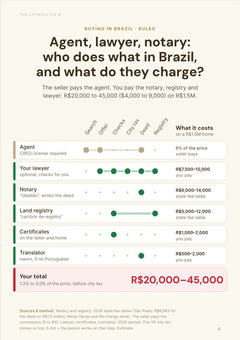
The biggest item is ITBI, Rio's transfer tax, at 3%. Add 1% to 2.5% for the notary and registry, and 0.5% to 1.5% if you hire a lawyer. The agent's 6% to 8% commission is usually paid by the seller.
How much are notary, registration, and legal fees in Rio de Janeiro in 2026?
In 2026, notary, registration and legal fees typically total R$ 15,000 to R$ 40,000 ($2,970 to $7,920, or €2,650 to €7,080) for a standard apartment, depending on the price.
That is about 1.5% to 3% of the price, and the percentage is higher on cheaper properties because of minimum fees at the cartório.
The ITBI transfer tax (3%) costs more than all of them together. After that comes the registry, then the notary deed (escritura).
What annual property taxes should I expect in Rio de Janeiro in 2026?
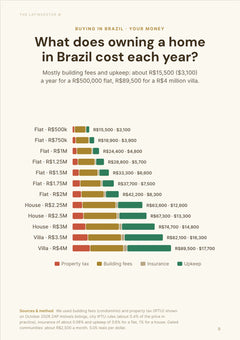
In 2026, IPTU on a typical apartment worth around R$ 1,000,000 runs roughly R$ 2,000 to R$ 6,000 a year ($396 to $1,190, or €354 to €1,060), and much more in Leblon or Ipanema.
That is often 0.2% to 0.6% of market value, because the city's assessed value (valor venal) is usually well below the market price.
Zona Sul apartments have higher assessed values and bigger bills; the North and West Zones pay less. Exemptions for pensioners and low-value homes rarely apply to a foreigner's second home, so ask the seller for the last IPTU bill before you sign.
On top of IPTU, budget condo fees: Rio listings averaged about R$ 620 a month in 2026, and far more in towers with pools and 24-hour security.
Is a mortgage realistic for foreigners in Rio de Janeiro right now?
For a non-resident foreigner, not really: banks generally ask for Brazilian nationality, naturalization or permanent residency, plus local income and credit history, so almost all international buyers pay cash.
Residents who qualify pay a lot. In September 2026, average rates on regulated home loans were 7.98% a year plus TR at Caixa, and about 11.8% to 11.9% plus TR at Itaú, Bradesco and Santander, with the Selic at 13.75%.
If you do qualify, expect to need a CPF, proof of stable income (ideally Brazilian), a banking history in Brazil, and often a local representative (procurador) for the paperwork.
Should you buy in Rio now or wait for rates to fall?
If you pay cash, now is a decent time, but not in every neighborhood. Rio's asking prices rose 5.57% in the year to September 2026, against 4.58% inflation, so under 1% in real terms. The beach neighborhoods ran far ahead: Leblon +13.2%, Ipanema +10.3%, Copacabana +9.9%.
Elsewhere the market is calm: Lagoa rose 1.3%, Tijuca 2.3% and Recreio 2.9%. That is where sellers are most open to offers. The Selic has been at 13.75% since September 2026, which keeps many local buyers who need credit out of the market.
Rents are the other story: they rose 14.8% in a year citywide and about 20% in Copacabana, Botafogo and Flamengo. If you plan to rent out long-term, the numbers work better than a year ago.
What you can do: start 10% to 15% below the asking price, especially outside the beachfront. Buyers who got a discount averaged 14% off. In Leblon or Copacabana, sellers know prices are rising, so expect less room.
What will be easy to resell in Rio de Janeiro?
What property types resell fastest in Rio de Janeiro in 2026?
In 2026, fairly priced two-bedrooms in Tijuca, Botafogo, Flamengo and Copacabana resell fastest, especially with clean paperwork, reasonable condo fees and no disputes in the building.
Selling still takes time: completing a sale takes about 16 months on average in Brazil, according to Abrainc figures quoted by QuintoAndar. A well-priced apartment in a liquid neighborhood can go in a few months, but don't count on it.
Properties sell faster when they match what local buyers want: metro access, a reliable portaria and the standard two-bedroom layout that families and young professionals look for.
The slowest to resell are large luxury units with very high condo fees, houses far from rental demand, and anything with legal problems such as an unsettled inheritance or unpermitted works.
Our methodology
This article estimates what a foreign buyer can get in Rio de Janeiro at each budget, from $100,000 to luxury, plus the costs of buying and owning.
We divided each budget by the September 2026 FipeZAP asking price per square meter for the city and its neighborhoods, and used TuLugar's October 2026 listing data for neighborhoods FipeZAP doesn't cover. Airbnb figures come from AirROI only, discounts from the FipeZAP Raio-X survey, actual sale values from Loft's survey of Rio ITBI records and City Hall ITBI data, and mortgage rates from the Banco Central.
Rules on transfer tax, IPTU, residency and bank loans come from Prefeitura do Rio, the Ministry of Justice (RN 36/2018), the Banco Central and the STJ.
We checked these figures in October 2026 and used about 5.05 reais per US dollar and 5.65 reais per euro.
FipeZAP and listing sites show asking prices, not sale prices, and some neighborhood samples are small. Renovation, fee, IPTU and luxury ranges are our estimates. Always check the matrícula, the IPTU bill and the condo convention of the specific property.
Key sources used for this analysis include FipeZAP September 2026, Loft ITBI survey via Diário do Rio, FipeZAP Raio-X, TuLugar, AirROI, BCB PTAX, Banco Central lending rates, IBGE IPCA, Prefeitura do Rio (ITBI), Prefeitura do Rio (IPTU 2026), CNB/RJ, Ministry of Justice (RN 36/2018), STJ, ADEMI-RJ and QuintoAndar.