
Summary
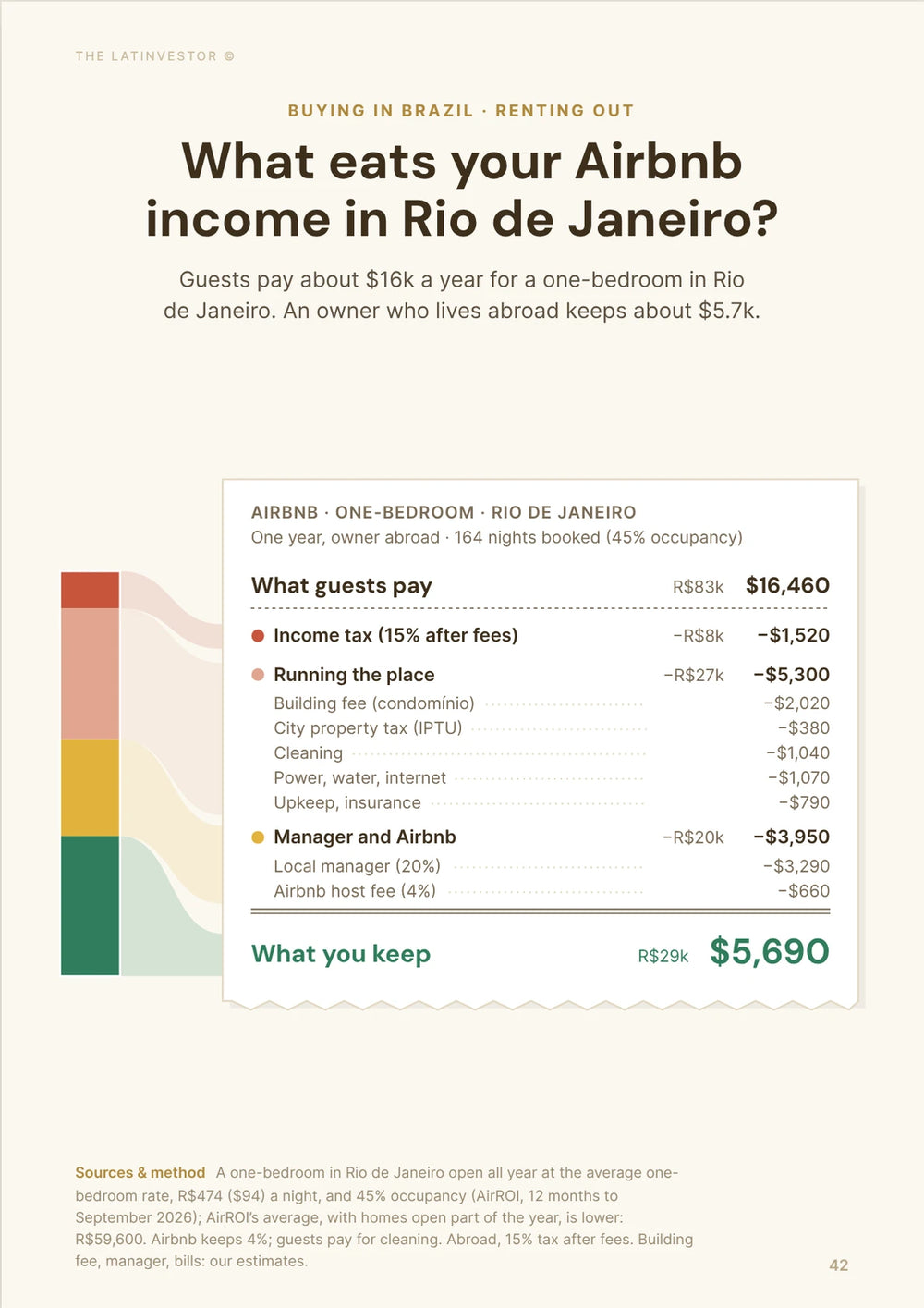
It can be, but only in a building that allows it and with realistic numbers: an average one-bed in Rio grossed about R$61,300 a year and keeps about R$21,500 once Airbnb's 16% fee, a co-host, running costs and the 15% non-resident tax are paid.
Short stays are legal, but your building has the last word. On May 7, 2026, the STJ ruled that offering a unit on platforms in a residential building needs the approval of two-thirds of the owners, and a binding decision (Tema 1.443) is still pending.
Rio has no Airbnb license and no cap on nights yet. Three city bills have been filed since early 2025 (PL 372/2025 and PL 2.265/2026 among them), and a committee backed registration, Cadastur and condominium approval in December 2025, but nothing had passed by October 2026.
Before you buy, get the convention, the last assembly minutes and a written yes from the síndico, and price the unit as a long-term rental first.
The average listing charged about R$624 a night and was booked 42.6% of the time over the 12 months to September 2026 (AirROI), well below the 50% to 80% that sellers often promise.
That gives about R$72,000 of gross revenue a year (R$6,000 a month) for the average listing, R$61,300 for a one-bed and R$87,100 for a two-bed.
Seasons matter: revenue per available night peaked at about R$406 in February 2026, at Carnival, and fell to about R$265 in May.
Costs are heavy: Airbnb's 16%, running costs of about 24%, a co-host at about 10% and the 15% withholding take about two-thirds of gross revenue, before the condo fee (about R$620 a month on average).
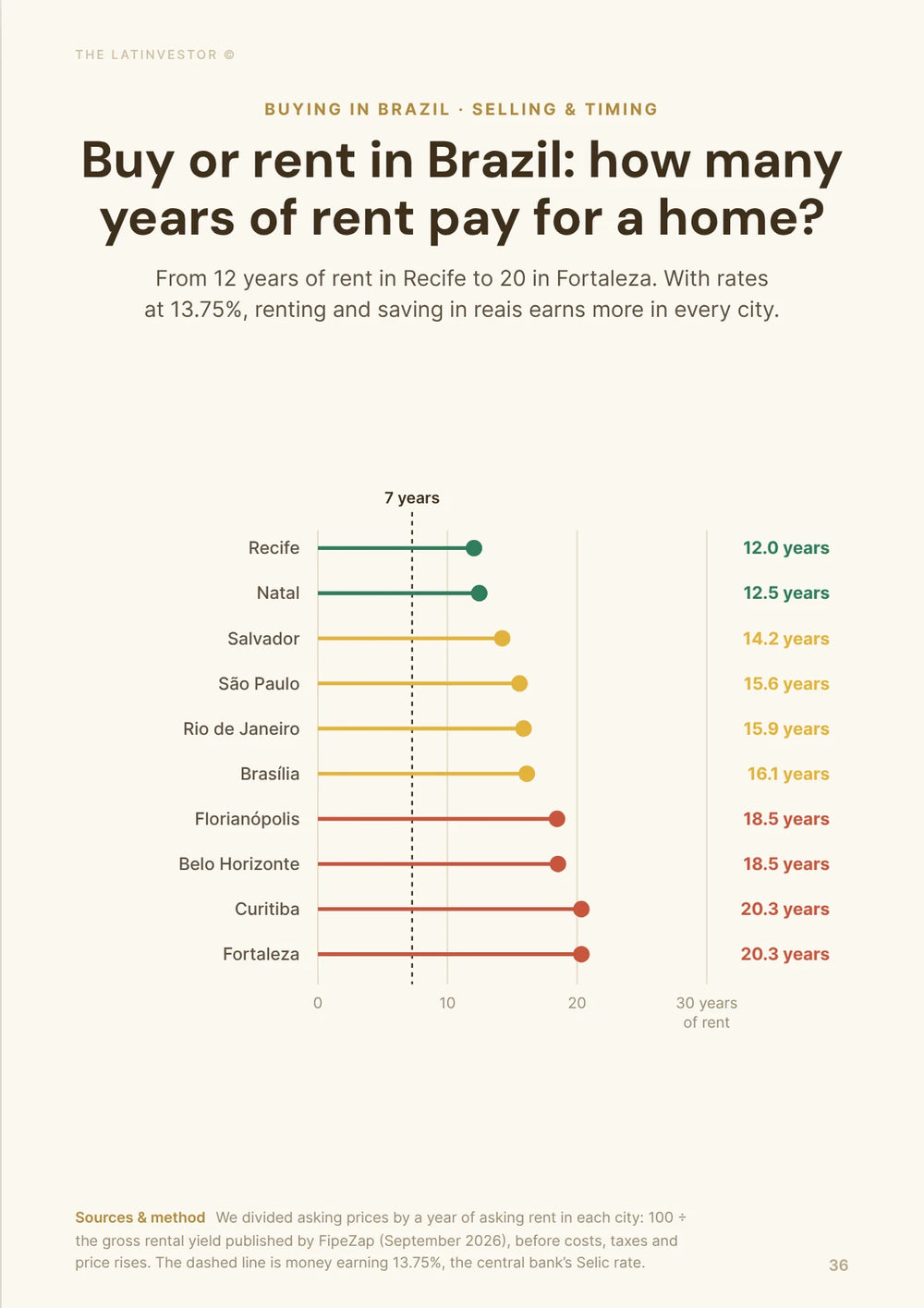
After the average condo fee, a one-bed keeps about R$14,000 a year, or about 2.8% on its asking price, while the Selic rate is 13.75%.
Competition is the other problem: active listings rose 50% in a year to about 33,138, faster than demand, even with a record 12.5 million visitors in 2025 and foreign arrivals up 17.4% from January to May 2026.
Two-beds are the better bet: about R$755 a night and R$87,100 a year against R$487 and R$61,300 for one-beds, with similar occupancy (43% against 45%).
Bottom line: an Airbnb in Rio works if the building allows it in writing, the unit is a well-run two-bed, and the deal still makes sense as a long-term rental. Otherwise, the rental yield is far below what the 13.75% Selic rate pays.


Can your building stop your Airbnb in Rio after the 2026 STJ ruling?
Is short-term renting allowed in Rio de Janeiro in 2026?
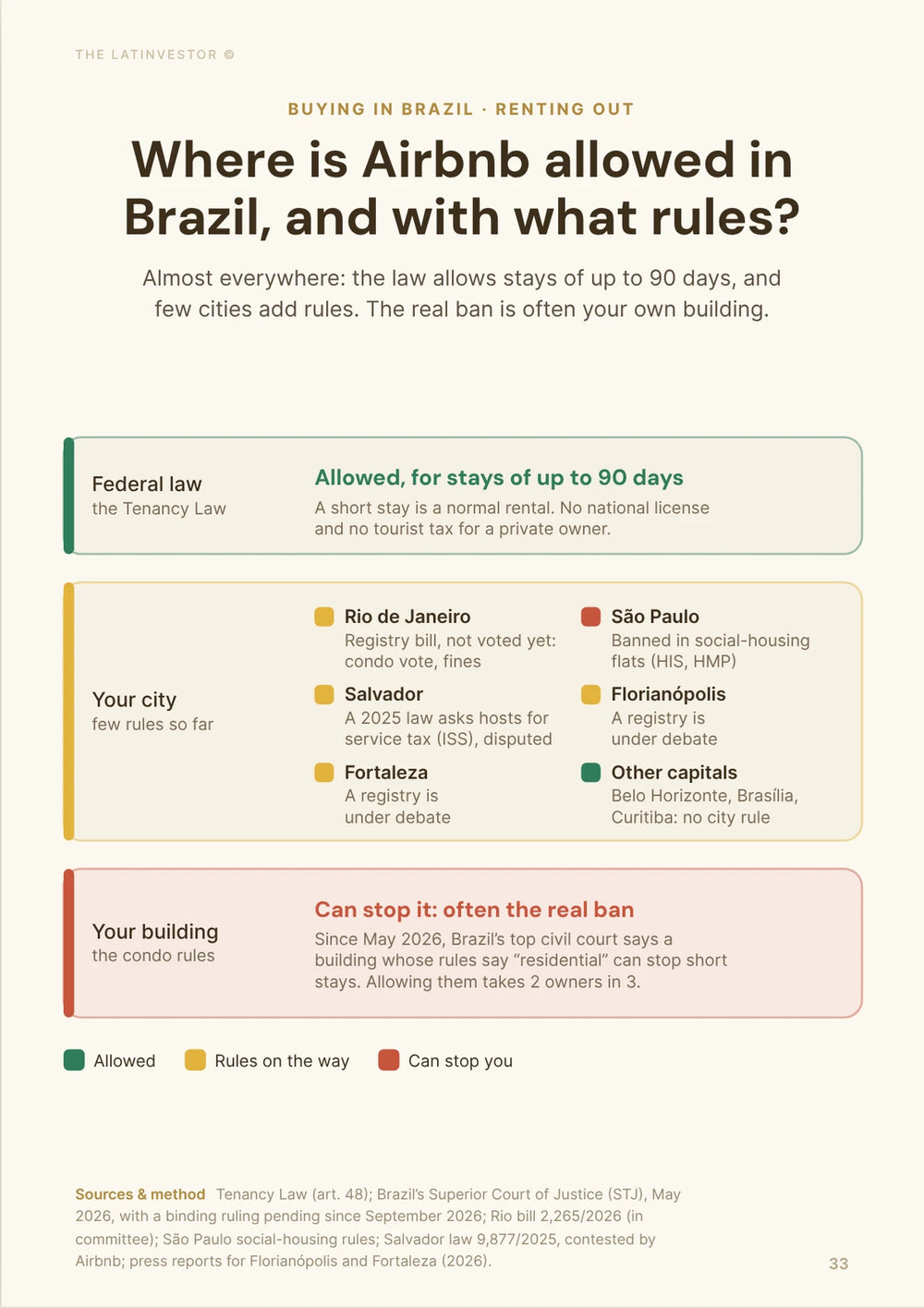
Yes, but in an apartment it now depends on your neighbors. Short stays are legal under federal law, and the city had no specific Airbnb law in October 2026.
The federal baseline is the Lei do Inquilinato, which allows seasonal rentals (aluguel por temporada) of up to 90 days per contract.
The real constraint is the building. On May 7, 2026, the STJ ruled that offering a unit on platforms like Airbnb in a residential condominium needs the approval of at least two-thirds of the owners. On September 17, 2026, it picked a new case (Tema 1.443) to decide, with binding effect, whether a plain "residential use" clause is enough to ban platform rentals, and similar lawsuits are suspended until then.
That matters a lot in Copacabana, Ipanema, Leblon, Botafogo, Flamengo and Barra da Tijuca, where almost everything is in condominiums. If you rent against the building's rules, expect fines, an order to stop, cancelled bookings and a unit worth less to the next buyer.
Are there minimum-stay rules and maximum nights-per-year caps for Airbnbs in Rio de Janeiro as of 2026?
No. Rio has no minimum stay and no yearly cap on nights, unlike the yearly night caps of some European cities.
The 90-day rule in federal law limits each seasonal contract, not the number of nights you can rent in a year. It applies the same way to studios, apartments, houses and to resident or non-resident owners.
Many hosts still set 2- or 3-night minimums, and some use 30-night minimums to cut turnover and keep the building on their side.
Do I have to live there, or can I Airbnb a secondary home in Rio de Janeiro right now?
You don't have to live there. A second home or an investment apartment can be rented short term, as long as the building allows it.
No extra city permit applies just because it's a second home. But an empty unit rented all year creates more turnover and more complaints than an owner who rents out occasionally, and that's what gets assemblies to vote against short stays.
Can I run multiple Airbnbs under one name in Rio de Janeiro right now?
Yes. No rule in force limits the number of units one person or company can list.
Scale changes your tax and legal position, though. Under the CBS/IBS reform, an individual with more than three rental properties and over R$240,000 (USD 47,500, EUR 42,500) of rent a year falls into the regular regime, where short stays are taxed like hotel stays. Many units with staff or hotel-like services can also be treated as a lodging business, with Cadastur registration.
Do I need a short-term rental license or a business registration to host in Rio de Janeiro as of 2026?
Not for a simple private rental. In October 2026, Rio had no municipal Airbnb license, and an apartment listed on Airbnb is not automatically a lodging business.
Your work is tax reporting, building approval, basic safety and clear house rules. Cadastur becomes mandatory only if you run a real lodging business, with staff, hotel-like services or many units.
That could change: the city council is debating several bills that would add a registration (see below), so treat licensing as a live risk, not a settled question.
Are there neighborhood bans or restricted zones for Airbnb in Rio de Janeiro as of 2026?
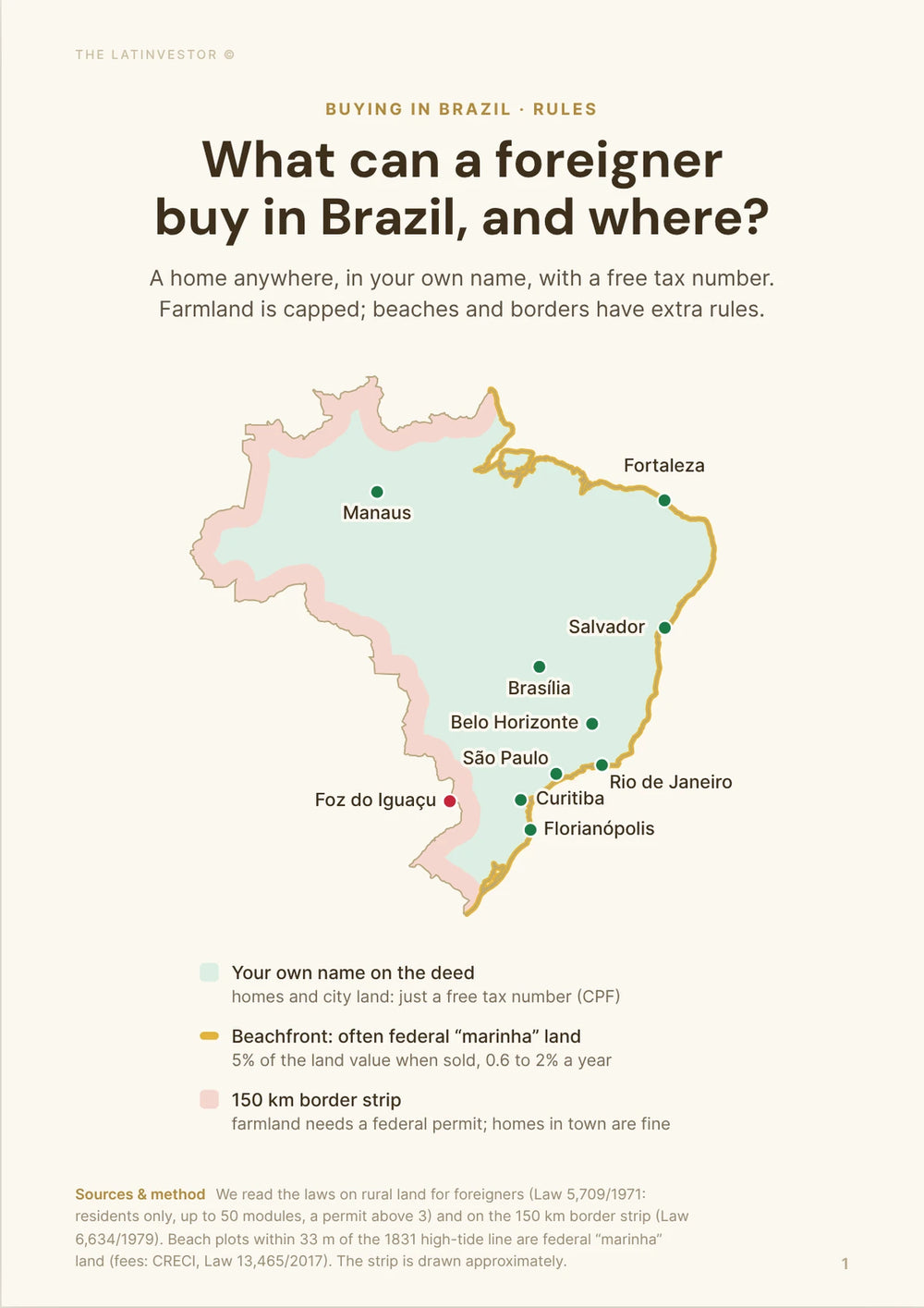
No. No neighborhood is closed to Airbnb, whether Copacabana, Ipanema, Leblon, Botafogo, Santa Teresa, Barra da Tijuca or Centro.
The restrictions come building by building, and they are most common where condominiums are dense and turnover is visible: Copacabana, Ipanema, Leblon, Flamengo, Botafogo and Barra da Tijuca.
Is Rio about to regulate Airbnb, and what would change for owners?
Probably some registration at some point, but nothing had passed by October 2026. Three bills have been filed at the city council since early 2025, and the city still has no specific short-term rental law.
The first, PL 372/2025, originally asked for a municipal license, an operating permit (alvará) and liability insurance. On December 15, 2025, a committee approved a softer report by 3 votes to 1: mandatory registration of units and hosts, Cadastur, express approval from the condominium, reporting duties to the city and tax collected by the platforms. It still needs a vote by the full council of 51 councilors. A newer bill, PL 2.265/2026, filed in May 2026, covers guest privacy, taxation and building security, and was still in committee.
The pressure behind it is rents. Secovi-RJ data reported in April 2026 showed long-term rents up 17% on average in Rio and up to 50% in neighborhoods like Copacabana, with Zona Sul long-term supply down 27.5% in two years. Airbnb, for its part, cites an FGV study saying its activity moved more than R$12 billion in the city in 2025.
What to do: assume a registration and platform-collected tax will come, and make sure your numbers still work with them. Buy only where the building already allows short stays in writing, because every version of the bills puts the condominium's approval first.
What should you check before buying an apartment for Airbnb in Rio right now?
Get written proof that short stays are allowed before you sign. Since the STJ's May 2026 ruling, a building that hasn't voted to allow them can stop you, and a seller's "everyone does Airbnb here" is worth nothing.
Ask for the convention, the internal rules and the minutes of the last two or three assemblies, and look for any vote on "locação por temporada" or platforms. Then ask the síndico to confirm in writing. If the convention only says "residential use", assume the answer could be no until the STJ rules on Tema 1.443.
Ask for the condo fee and IPTU in writing, since you pay both on a short-term rental. Beachfront buildings with 24-hour doormen and old elevators can charge far more than Rio's average of about R$620 a month (USD 123, EUR 110), and that alone can wipe out the profit.
Finally, price the unit as a long-term rental. If the deal only works with Airbnb income, one assembly vote or one new city rule can break it. Use that risk to negotiate.
How much does an Airbnb really earn in Rio in 2026?
What's the average and median nightly price on Airbnb in Rio de Janeiro in 2026?
About R$624 a night (USD 124, EUR 110) on average over the 12 months to September 2026. A one-bed averaged about R$487 (USD 96, EUR 86) and a two-bed about R$755 (USD 150, EUR 134).
We don't give a median, because no reliable 2026 source publishes one for Rio. Averages are pulled up by penthouses and houses, so a plain studio will usually charge less.
The biggest price driver is the micro-location: distance to the beach, the view, how safe the street feels, access to the metro and whether guests can get in without trouble at the door.
How much do nightly prices vary by neighborhood in Rio de Janeiro in 2026?
A lot, but no reliable public dataset gives 2026 nightly rates by neighborhood, so be wary of anyone quoting precise figures.
What we can say: Leblon, Ipanema and beachfront Copacabana charge above the R$624 city average, and Centro, Lapa, Tijuca or Catete below it.
The catch is that buying there costs much more too. Apartments ask about R$28,837 per m² in Leblon and R$26,996 in Ipanema, against R$13,811 in Copacabana, R$13,555 in Botafogo and R$11,302 for Rio as a whole. A higher nightly rate rarely makes up for paying twice as much per m².
What's the typical occupancy rate in Rio de Janeiro in 2026?
About 42.6% of available nights for the average listing over the 12 months to September 2026, or roughly 155 booked nights a year. One-beds did slightly better (45%) than two-beds (43%).
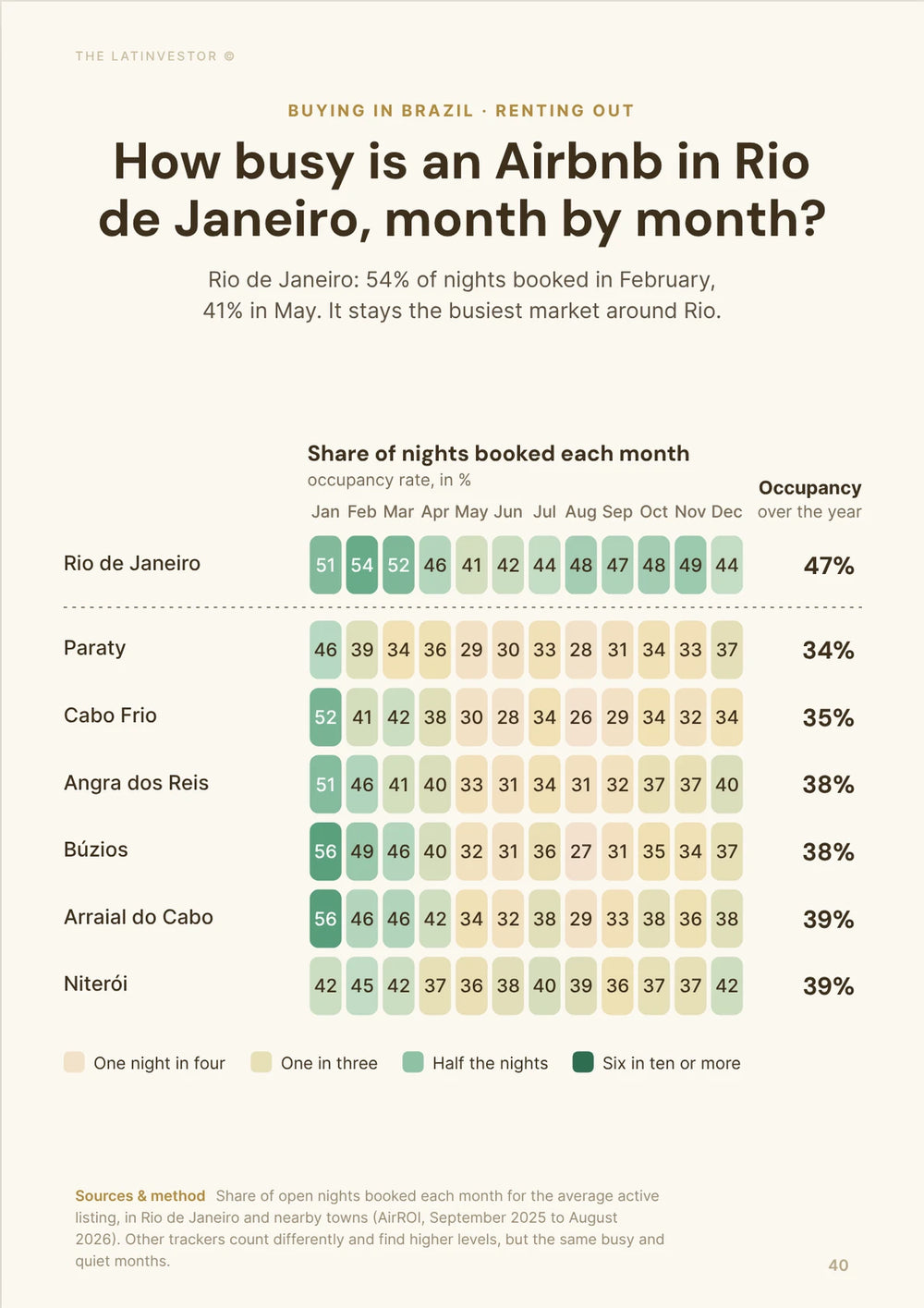
Month by month, occupancy moved between about 41% (May 2026) and 54% (February 2026, Carnival). Plan around 40% to 45%, and treat 50% or more over a full year as a strong result.
What lifts a listing above average is not the famous neighborhood name, but reviews, photos, fast replies and pricing that follows the calendar.
What's the average monthly revenue per listing in Rio de Janeiro in 2026?
About R$6,000 a month (USD 1,190, EUR 1,060), or R$71,981 a year, for the average listing. That's gross, before Airbnb's fee, cleaning, the condo fee and tax.
| Listing type | Average nightly rate | Occupancy | Gross revenue per year |
|---|---|---|---|
| All active listings | R$624 | 42.6% | R$71,981 |
| Entire home, 1 bedroom | R$487 | 45% | R$61,300 |
| Entire home, 2 bedrooms | R$755 | 43% | R$87,100 |
A two-bed grossed about R$87,100 a year (USD 17,200, EUR 15,400), about 42% more than a one-bed at R$61,300 (USD 12,100, EUR 10,800).
What's the typical low-season vs high-season monthly revenue in Rio de Janeiro in 2026?
A peak month brings in about one and a half times more than a low month. Measured as revenue per available night (occupancy times nightly rate), Rio went from about R$406 in February 2026, at Carnival (54.1% booked at R$751), to about R$265 in May (41.1% at R$644).
High season runs from December to March, with Réveillon and Carnival. The quieter months are April to August, with a small lift for the July holidays. In September 2026, Rock in Rio pushed citywide hotel occupancy to 77.6% during its first weekend, and to 85.4% in Copacabana and Leme.
What's a realistic Airbnb monthly expense range in Rio de Janeiro in 2026?
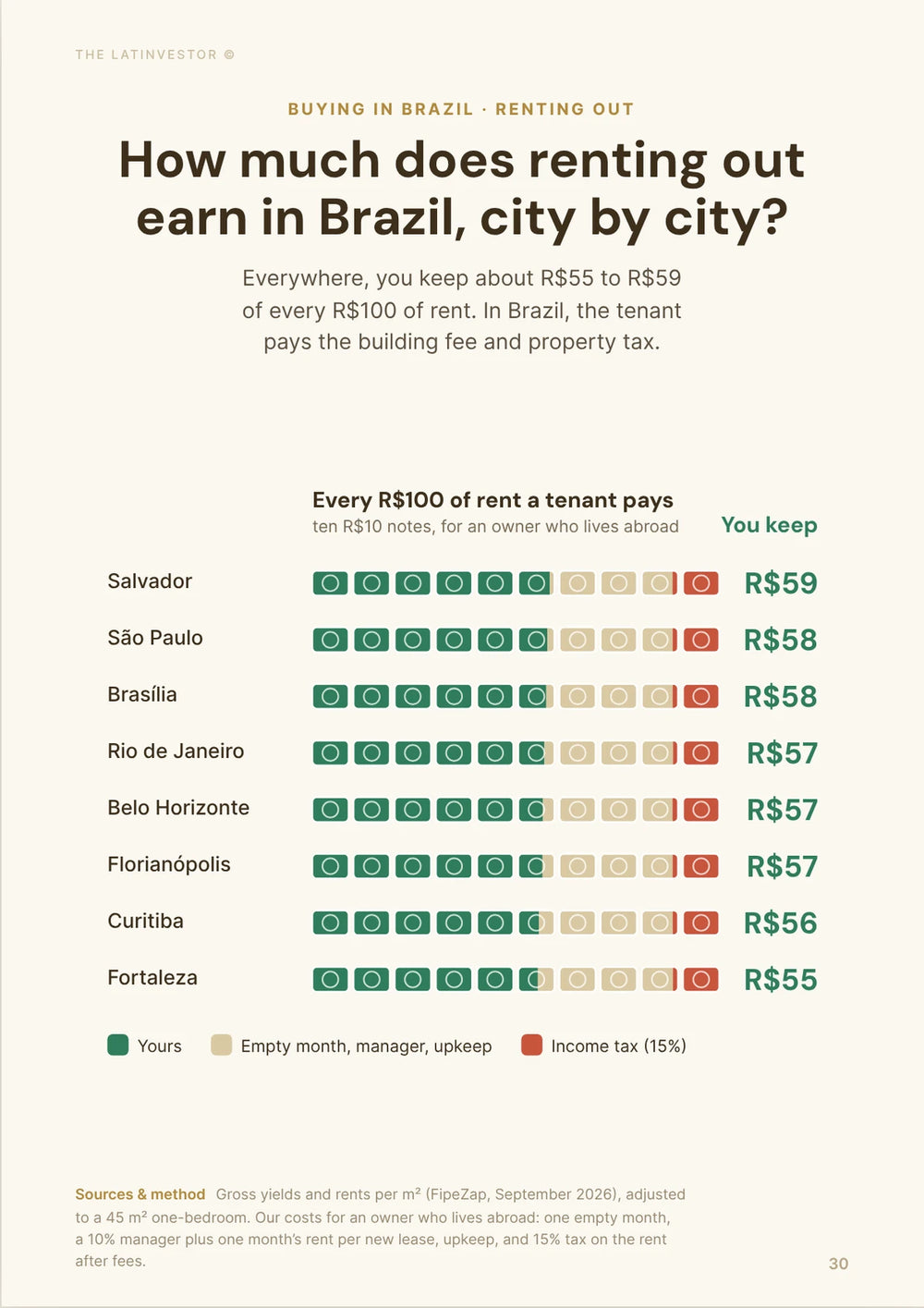
Plan on losing about half of gross revenue to fees and running costs, before the condo fee and tax.
Airbnb takes 16% of each booking on Brazilian listings under its single host fee. AirROI's low-end model puts running costs at about 24% of gross revenue for an owner-managed unit, including about 5% for utilities and internet. A co-host, which you'll need if you live abroad, adds about 10% or more in our estimate.
Then come the fixed costs, all yours on a short-term rental: the condo fee averages about R$620 a month in Rio (USD 123, EUR 110), and much more in older beachfront buildings with doormen and elevators. Add IPTU, insurance and repairs.
What's realistic monthly net profit and profit per available night for Airbnb in Rio de Janeiro in 2026?
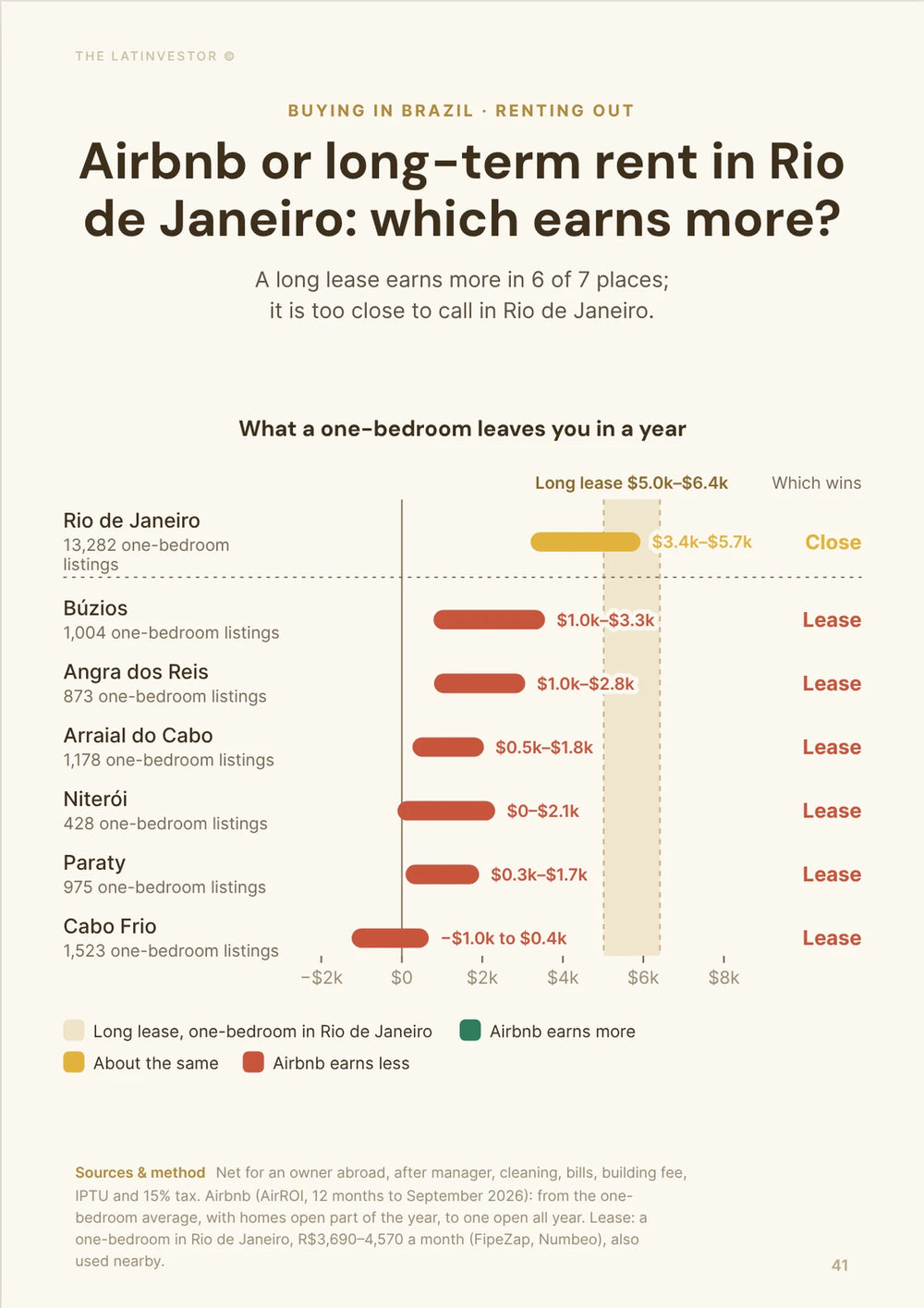
An average one-bed keeps about R$21,500 a year (USD 4,260, EUR 3,810), or about R$1,790 a month and R$59 per available night, after Airbnb's 16%, a 10% co-host, 24% running costs and the 15% non-resident withholding. After the average condo fee, it's about R$14,000 (USD 2,770, EUR 2,480).
On a 45 m² unit asking about R$509,000 (USD 101,000, EUR 90,000) at Rio's average price per m², that's about 2.8% net a year, while the Selic rate is 13.75%.
A two-bed does a bit better: about R$30,500 (USD 6,040, EUR 5,400) before the condo fee, and about R$23,000 after the average one, or about 2.9% on a 70 m² unit asking about R$791,000. Its condo fee will often be above average, so check the real one.
Managing it yourself adds back the co-host's 10%, or about R$6,100 a year on a one-bed, but that's hard from abroad.
How much tax does a foreign Airbnb host pay in Rio?
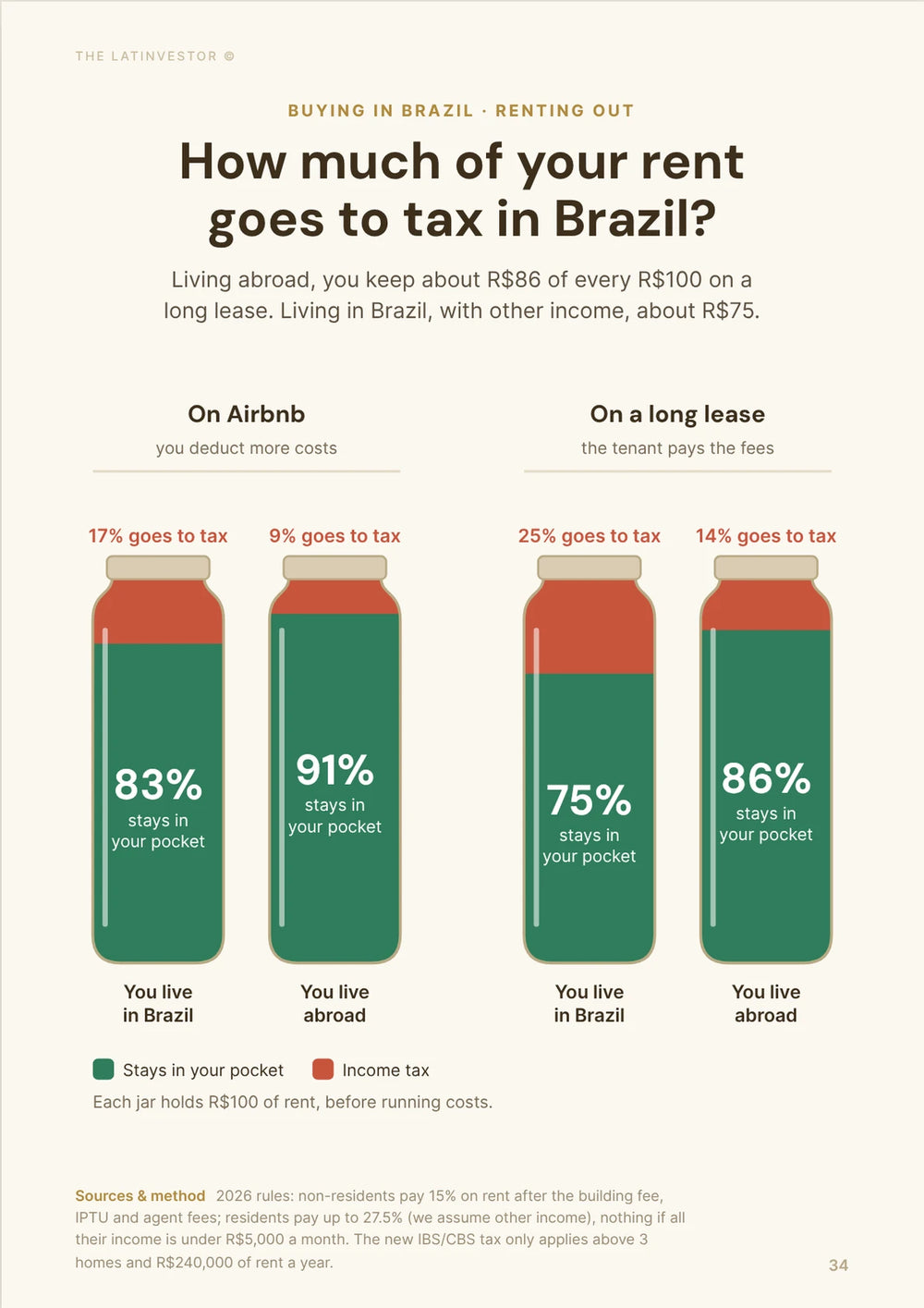
If you live abroad, 15% of your rent is withheld at source, on the gross amount. That's why every net figure in this article includes it.
Brazilian tax residents pay monthly Carnê-Leão on rent from individuals, on the progressive scale up to 27.5%, with condo fees and some property taxes deductible. Your country of residence and any tax treaty can change the final bill, so check with a Brazilian accountant.
The CBS/IBS reform does not hit most foreign owners: stays of up to 90 days are taxed like hotel stays only for individuals with more than three rental properties and over R$240,000 of rent a year. In January 2026, the Receita Federal publicly denied that every Airbnb host would pay a new tax. If Rio's bills pass, the platforms could also start collecting the city's tax directly.
Is it too late to start an Airbnb in Rio, with listings up 50% in a year?
How many active Airbnb listings are in Rio de Janeiro as of 2026?
About 33,138 active listings over the 12 months to September 2026, up 50% in a year.
Demand grew too, but more slowly. Rio had a record 12.5 million visitors in 2025, and more than 1.2 million foreign visitors from January to May 2026, up 17.4%. That's why occupancy sits around 43% instead of rising.
Which neighborhoods are most saturated in Rio de Janeiro as of 2026?
The obvious ones: Copacabana, Ipanema, Leblon, Barra da Tijuca, Botafogo and Centro/Lapa. They combine tourists, a large stock of small apartments and names guests search before they know the city, so a plain listing there competes mostly on price.
Less crowded options can exist in Flamengo, Catete, Glória, Jardim Oceânico and selected Santa Teresa houses, if the property feels safe and well run. These are our own observations, not measured data.
What local events spike demand in Rio de Janeiro in 2026?
Carnival is the big one. In February 2026, the average nightly rate reached R$751, about 30% above its September 2025 level (R$578).
Réveillon in Copacabana and the December-to-March summer come next. Rock in Rio, held on September 4 to 7 and 11 to 13, 2026, pushed hotel occupancy to 77.6% citywide. Big Maracanã matches, concerts and school holidays add smaller peaks.
Set event prices and minimum stays three to six months ahead, and earlier still for Carnival and Réveillon.
What occupancy differences exist between top and average hosts in Rio de Janeiro in 2026?
Big ones. The average listing books about 43% of its nights, and well-reviewed, well-priced listings book far more, while new ones often sit below average for their first months.
We don't give a precise top-host figure, because no public 2026 source we trust publishes one for Rio. What moves a listing up: reviews, fast replies, dynamic pricing, good photos and a layout that fits the guests the area attracts.
Which price points are most crowded, and where's the "white space" for new hosts in Rio de Janeiro right now?
The crowded end is studios and one-beds, where most of the 50% jump in listings went. A one-bed averages about R$487 a night, and new ones fight mostly on price.
The white space is bigger, better-run units: two-beds average about R$755 a night and earn about 42% more a year than one-beds, with almost the same occupancy.
To win there, offer two real bedrooms, strong air conditioning, blackout curtains, fast Wi-Fi, a workspace, a beach kit, a secure entrance and an easy check-in.
What property works best for Airbnb in Rio right now?
What bedroom count gets the most bookings in Rio de Janeiro as of 2026?
One-beds book slightly more often (45% against 43% for two-beds), but two-beds earn more: R$87,100 a year against R$61,300.
One-beds suit couples and short city breaks. Two-beds catch families, friends and event crowds, and Brazil's big domestic leisure market often travels that way.
What property type performs best in Rio de Janeiro in 2026?
For most owners, a renovated one- or two-bed apartment in a building that allows short stays in writing. It's the easiest to run from abroad and to resell.
Houses carry less building risk, because no assembly can vote you out, and can earn well in peak months. But in Rio they need more management, security and maintenance, and the ones that are hard to reach often underperform despite higher rates.
Our methodology
This article estimates whether buying an apartment in Rio de Janeiro to rent on Airbnb makes sense for a foreign owner: the rules, the revenue, the costs, the tax and what is left at the end.
Short-term figures (nightly rates, occupancy, revenue, listing counts and monthly seasonality) come only from AirROI, for October 2025 to September 2026. We never mixed AirROI with another provider. Net figures are our own estimates, built from AirROI's gross revenue with Airbnb's 16% fee for Brazilian listings, AirROI's running-cost model, a 10% co-host, the 15% non-resident withholding and the average condo fee reported by Portas. Property prices are FipeZAP asking prices for September 2026.
The rules come from the Lei do Inquilinato, the STJ's May 2026 decision and its September 2026 notice on Tema 1.443, the Ministry of Tourism (Cadastur), the Receita Federal, and the bills and committee votes at Rio's city council, as reported by local press.
We checked these figures in October 2026, using about 5.05 reais per US dollar and 5.65 reais per euro.
Limits: AirROI averages mix good and bad listings and only cover Airbnb. FipeZAP shows asking prices, not final sale prices. Rock in Rio figures are hotel occupancy, not Airbnb. Tax depends on your country of residence and any treaty, and the STJ's binding decision on condominiums was still pending in October 2026.
Key sources used for this analysis include Lei do Inquilinato (Law 8.245/1991), STJ decision of May 2026, STJ Tema 1.443 (September 2026), Câmara Municipal do Rio, PL 372/2025, Diário do Rio (December 2025), ADEMI-RJ (July 2026), LexLegal (April 2026), Gov.br Cadastur, Receita Federal Carnê-Leão, Agência Gov (Receita Federal, January 2026), AirROI Rio de Janeiro, Airbnb service fees, Portas on 2026 condo fees, FipeZAP sales report (September 2026), Rio City Hall on 2025 visitors, Correio da Manhã on 2026 arrivals and Brasilturis on Rock in Rio 2026.