Summary
The Punta Cana market is still active in 2026, but buyers now have the upper hand on generic condos: apartments in Punta Cana-Bávaro ask about $2,278 per m² (CLIC, June 2026), while about 40% of the condos for sale are off-plan.
There is no official days-on-market figure. Our read is that a fairly priced finished condo takes roughly 3 to 6 months to find a serious buyer, longer if it competes with nearby off-plan projects.
Nobody publishes the gap between asking and sale prices here, so we removed the old "96% of asking" figure. In practice, finished resales listed for months are where you get the biggest discounts.
Punta Cana is a condo market: CLIC counted 12,854 apartments for sale in Punta Cana-Bávaro in June 2026, while Casanix lists about 1,617 houses priced in dollars across the whole province.
Off-plan supply is huge: 459 of the 1,138 condos Evalua tracked in September 2026 were off-plan, and RE/MAX counts more than 50 off-plan projects in its local sample.
No index measures price growth by neighborhood, so we dropped the old "10% to 25%" gains. Off-plan in Downtown Punta Cana asks about $2,363 per m² and Vista Cana $2,441 (Evalua).
The big airport works are done (Terminal B opened in April 2024), and the 2026 projects are smaller, like the Nisibón-Uvero Alto road started on 22 April 2026.
Many locals find prices out of reach: a median 2-bedroom at about $240,000 equals about 45 years of the average tourism wage (RD$27,580 a month in May 2026).
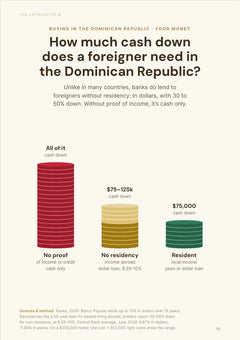
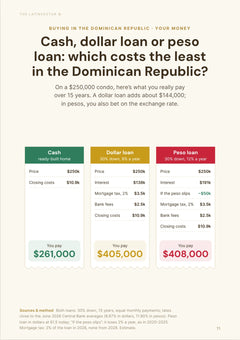
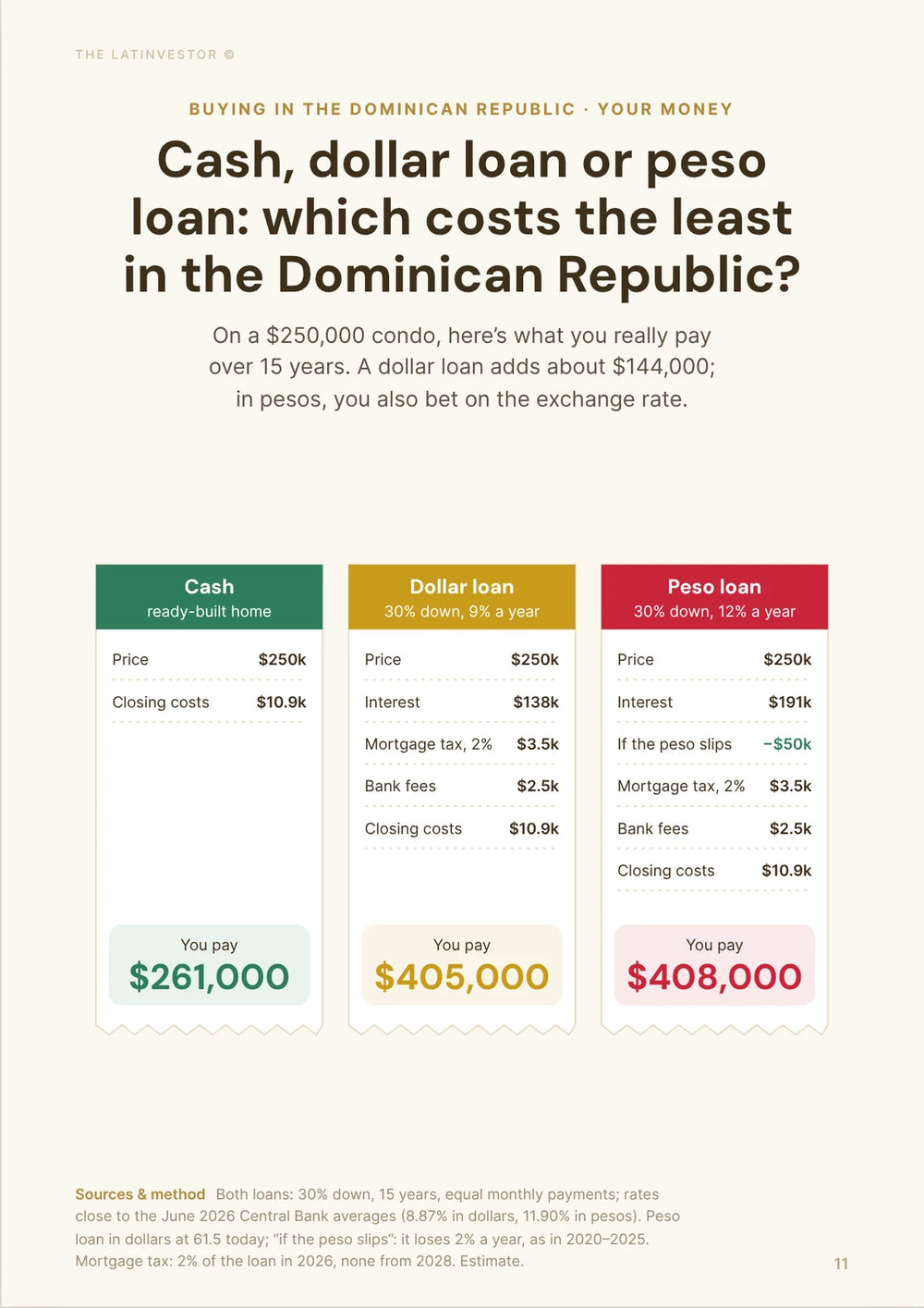
Foreigners can buy in their own name, but banks are cautious: brokers report 30% to 50% down payments, and the average dollar home loan cost 8.87% in June 2026.
Demand is there: the airport handled 6.38 million international passengers in January-June 2026, up 19.3%. But Airbnb occupancy stayed at 36.4% (AirROI) because supply grew as fast.
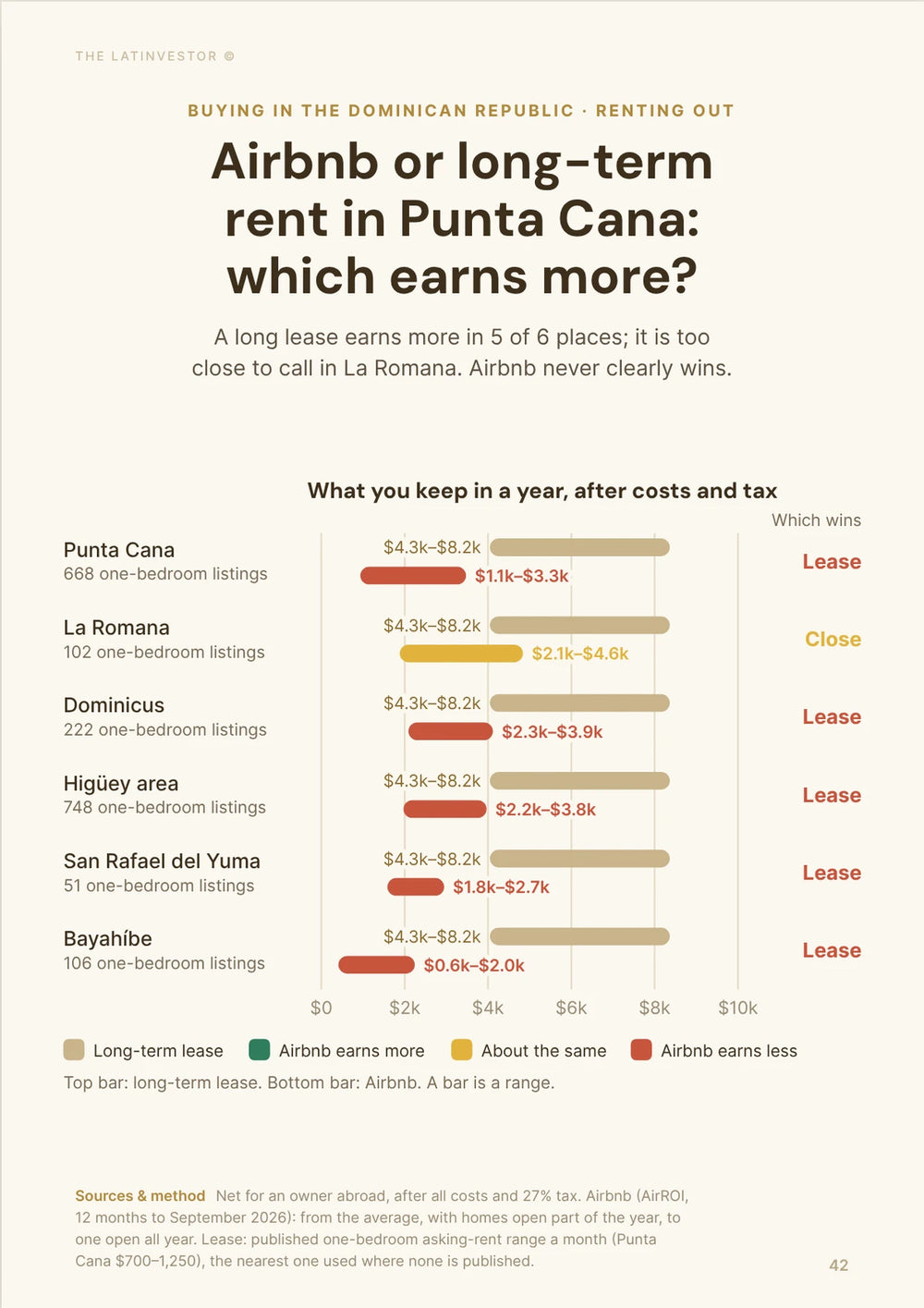
A long lease beats the average Airbnb: a $250,000 2-bedroom rented at the $1,500 median nets about 3.7% before income tax, against about 1.4% for an average 2-bedroom Airbnb.
Law 30-26 (June 2026) cut the tax on resale gains to a flat 10% for individuals, but its effect on Confotur exemptions is still unclear.
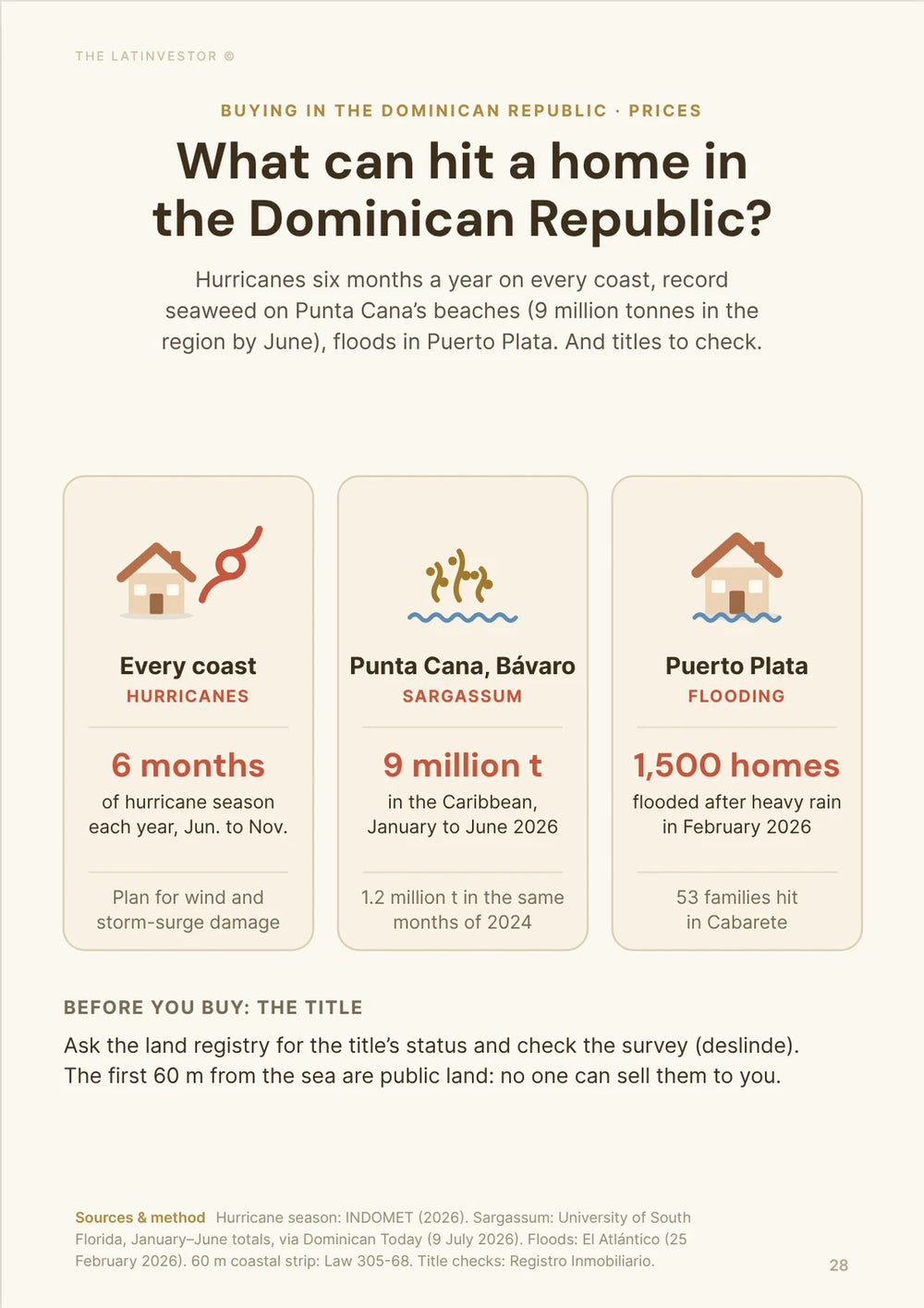
Record sargassum (about 9 million tonnes in the region in January-June 2026) is a new risk for beach rentals on the east coast.
The bottom line: buy finished, titled units in established areas at a price where a $1,500 rent still gives you about 7% gross; treat off-plan condos sold on Airbnb projections as the riskiest part of the market.


Is Punta Cana's market still strong, and how fast do homes sell in 2026?
In 2026, the Punta Cana market is still busy, but it is more selective than during the 2021-2023 boom.
The strong spots are walkable beach areas like Los Corales and El Cortecito, the established gated communities (Cap Cana, Cocotal, Punta Cana Village) and well-run rental buildings. The weak spots are generic inland condos priced like the beach, and off-plan projects from developers with no delivery record.
Punta Cana is a tourism market first. Airport traffic, Airbnb occupancy and foreign buyers move it more than local salaries. Apartments in Punta Cana-Bávaro ask a median of about $2,278 per m² (CLIC, June 2026, excluding Cap Cana), and a 2-bedroom about $240,000 (RE/MAX, August 2026). These are asking prices, not sale prices.
What's the average days-on-market in Punta Cana in 2026?
No one publishes a days-on-market figure for Punta Cana, so we removed the old "75 days" estimate. Listing age on portals is not the same as time to sell.
Our read of listings and broker comments is that a fairly priced finished condo usually takes roughly 3 to 6 months to find a serious buyer. Turnkey units close to the beach in Los Corales or El Cortecito can go faster. Overpriced villas and units with title problems can sit for a year.
The main reason it is slower than in 2021-2023: a resale condo now competes with more than 50 off-plan projects (RE/MAX count) that offer payment plans, furniture packages and sometimes paid closing costs.
Are properties selling above or below asking in Punta Cana in 2026?
Mostly below. But nobody publishes matched asking and closing prices for Punta Cana, so any precise figure like "96% of asking" is a guess. We removed it.
In the deals and broker comments we saw, buyers usually get a few percent off, and more on finished resales that compete with off-plan projects or have been online for months. Selling above asking is rare.
The units most likely to get strong offers are scarce beachfront condos, marina-front homes in Cap Cana, renovated Los Corales units and well-run condos in Cana Bay or El Cortecito with a real rental history.
On off-plan, the discount often comes as extras: furniture, a longer payment plan or the developer paying part of the closing costs. Ask for the price per m² with and without them.
What kinds of residential properties can I realistically buy in Punta Cana?
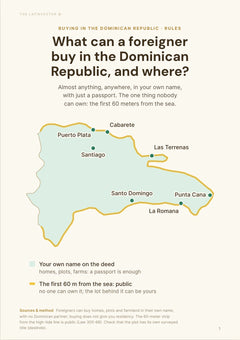
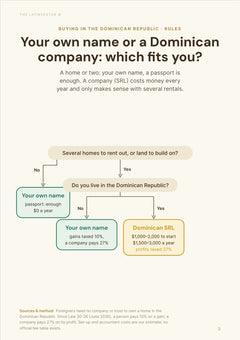
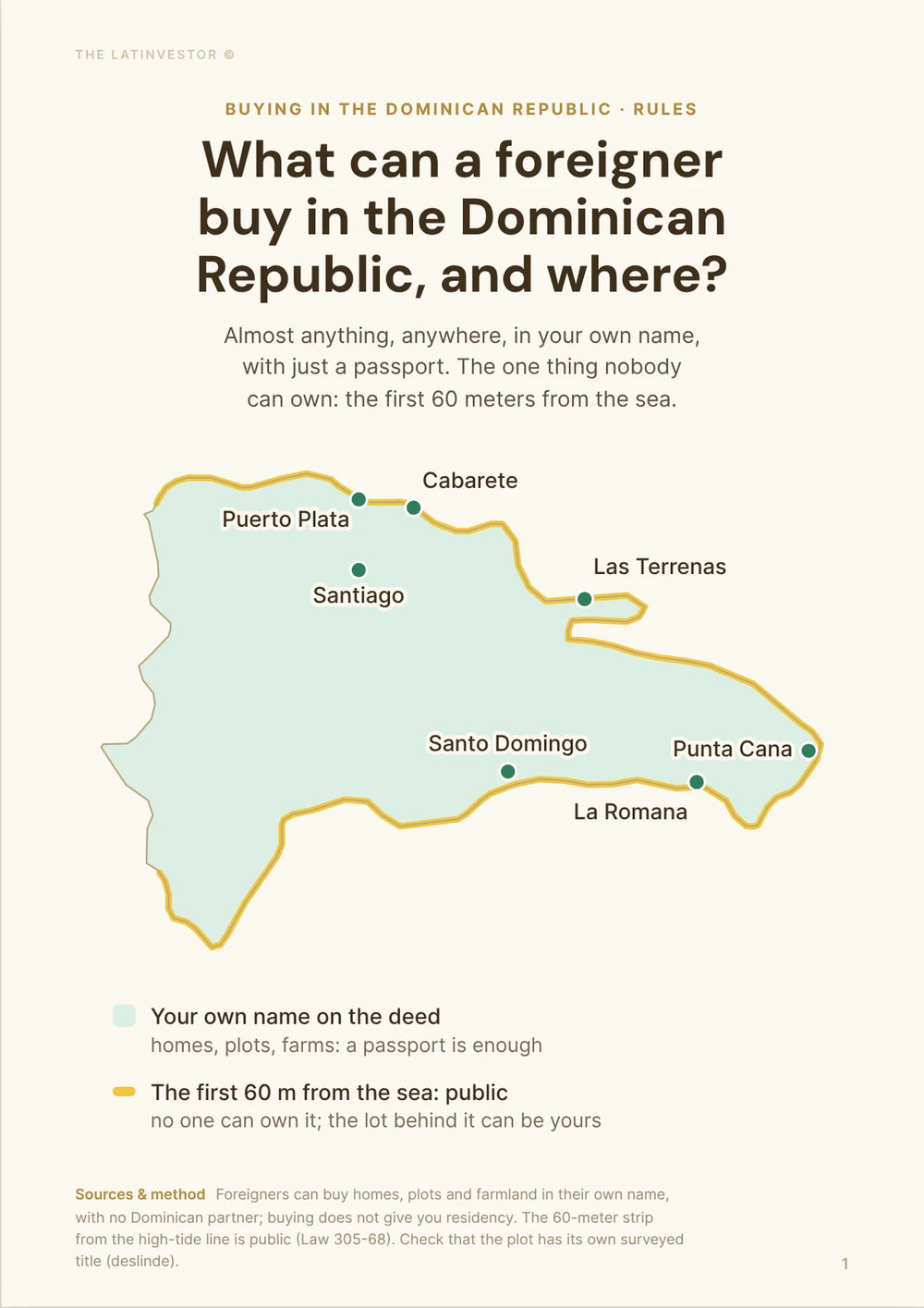
In Punta Cana, a foreigner can buy a condo, a townhouse, a villa, a house or land, usually inside a gated or master-planned community, in their own name.
The easiest first purchase is a finished condo: it is simpler to maintain from abroad, easier to rent and easier to resell than a standalone house.
What property types dominate in Punta Cana right now?
Condos, by far. CLIC counted 12,854 apartments for sale in Punta Cana-Bávaro in June 2026, while Casanix lists about 1,617 houses priced in dollars across the whole La Altagracia province (October 2026). They are different portals, so treat the gap as a picture, not a census.
The typical unit is a 1-bedroom or 2-bedroom condo in a tourist or resort area. A finished 1-bedroom asks about $190,000 and a 2-bedroom about $240,000 (Evalua; RE/MAX).
Developers build condos because foreign buyers want easy maintenance and furnished units with a pool, security and a rental desk. That is also why short-term rental supply grew so fast.
- How much should you pay for a house in Punta Cana?
- How much should you pay for an apartment in Punta Cana?
- How much should you pay for a villa in Punta Cana?
- How much should you pay for a condo in Punta Cana?
- How much should you pay for lands in Punta Cana?
Are new builds widely available in Punta Cana right now?
Yes, very. In September 2026, 459 of the 1,138 condos Evalua tracked in Punta Cana were off-plan, about 40%. RE/MAX counts more than 50 off-plan projects in its local sample.
The biggest concentrations are in Downtown Punta Cana, Vista Cana, Bávaro, Pueblo Bávaro, Cana Bay, Cap Cana, Cabeza de Toro and the road north to Macao and Uvero Alto.
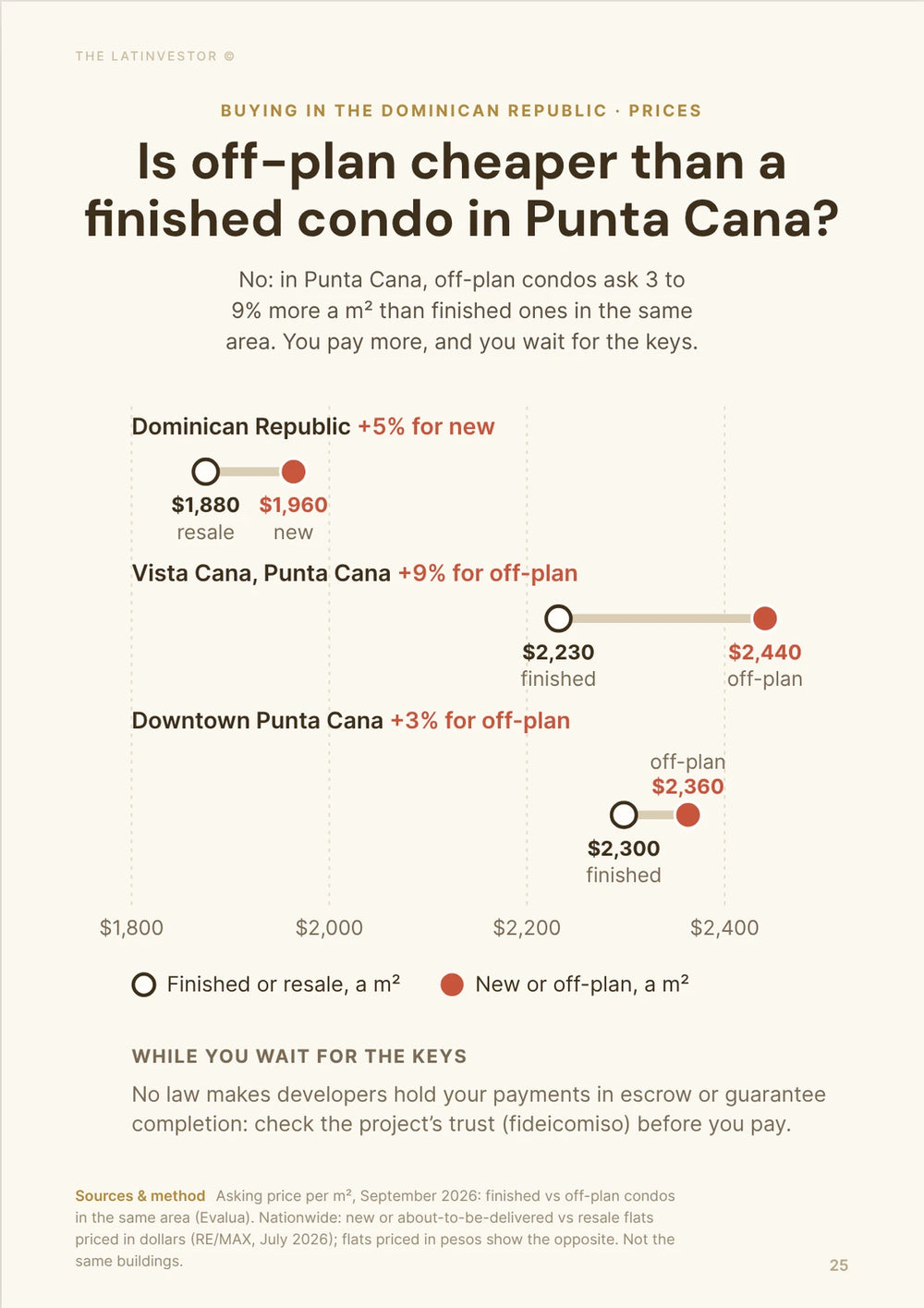
New is not much dearer than finished here: off-plan condos ask about $2,621 per m² against $2,648 for finished ones in Evalua's count, about 1% less. In Bávaro, where most projects compete, off-plan asks about 5% less.
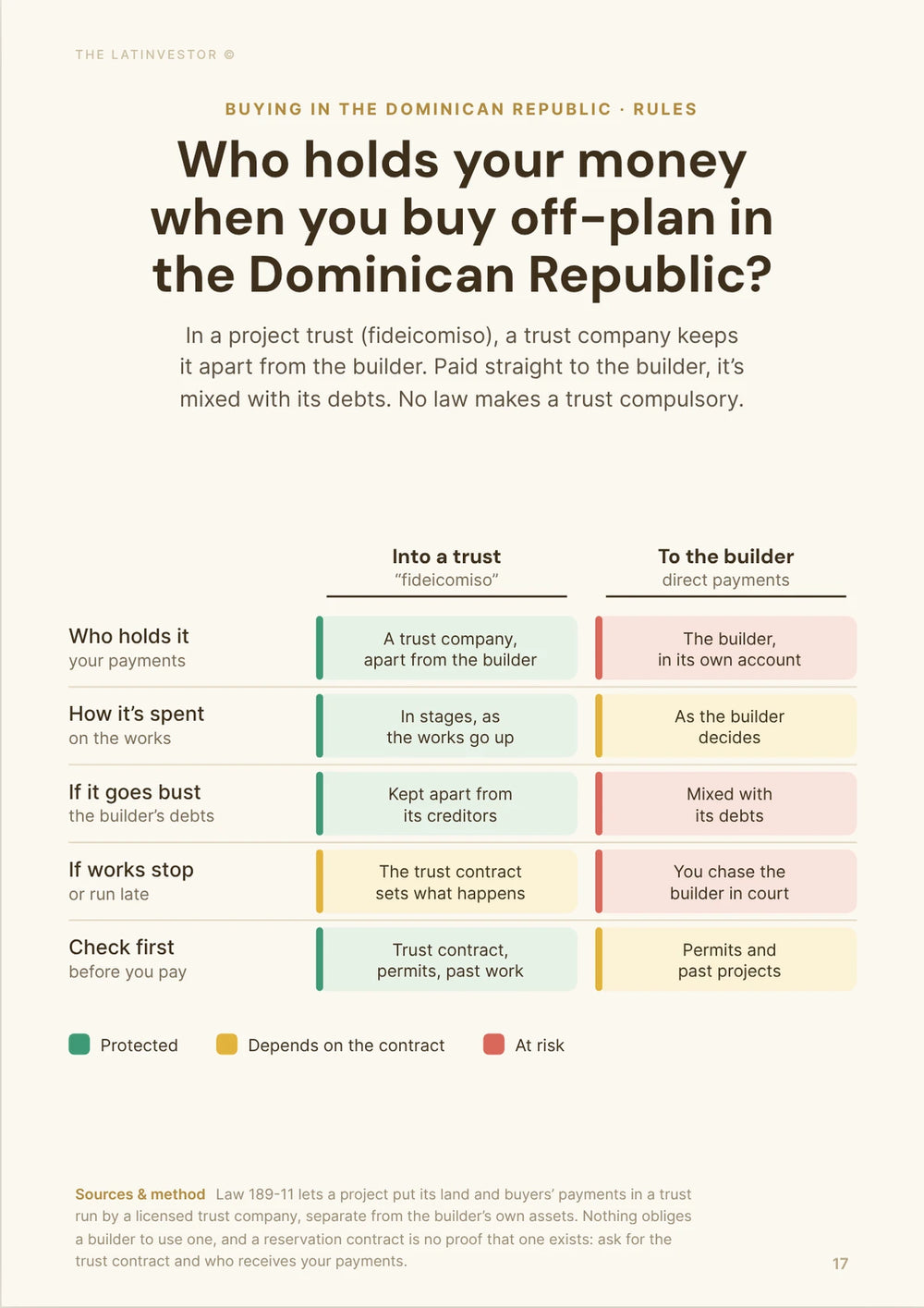
Remember there is no general legal escrow for off-plan in the Dominican Republic: your protection is the project's fideicomiso (Law 189-11) and your contract, and a fideicomiso does not guarantee completion.
Which neighborhoods are improving fastest in Punta Cana in 2026?
The areas changing fastest in 2026 are not the most expensive ones. Cap Cana is already premium; the visible change is in Downtown Punta Cana, Vista Cana, Cabeza de Toro, El Cortecito, Los Corales and parts of Verón.
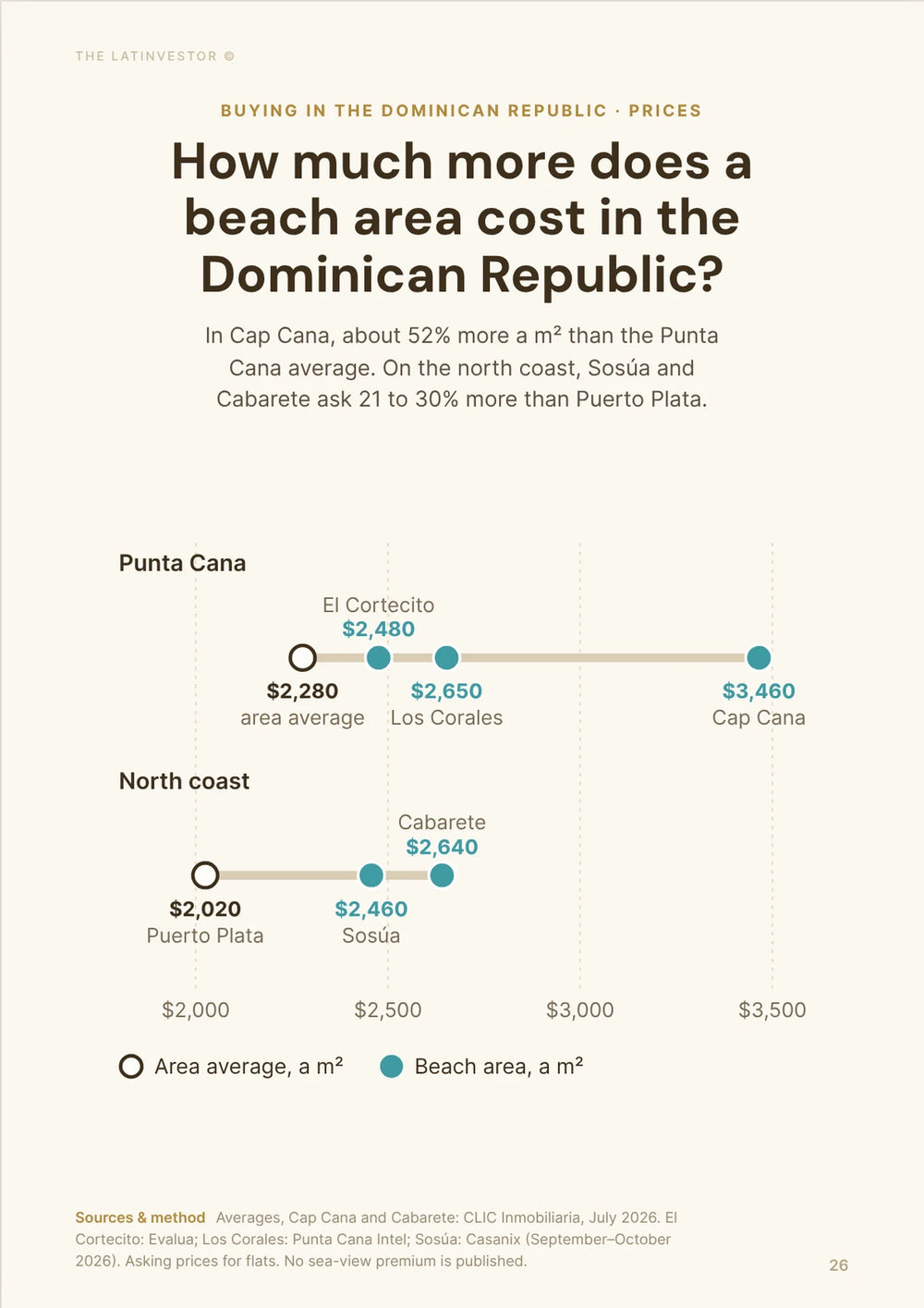
For a sense of price, Cap Cana asks about $3,465 per m² (CLIC), Los Corales about $2,653 (Punta Cana Investment Intelligence model) and finished condos in Bávaro $1,969 (Evalua).
Which areas in Punta Cana are gentrifying in 2026?
The clearest cases are El Cortecito, Los Corales, Cabeza de Toro, Downtown Punta Cana, Vista Cana and the pockets of Verón closest to the main road.
You see it on the street: older beach buildings renovated in Los Corales, more polished condo projects in El Cortecito, resort-style projects in Cabeza de Toro, and more clinics, banks, cafés and supermarkets around Downtown Punta Cana.
How much prices moved there is hard to say: no index tracks Punta Cana prices by area, so we removed the old "10% to 25%" gain. Today, off-plan condos ask about $2,363 per m² in Downtown Punta Cana and $2,441 in Vista Cana, about 3% and 9% above finished units in the same areas (Evalua, September 2026).
Where are infrastructure projects boosting demand in Punta Cana in 2026?
In 2026, infrastructure is shaping demand most around the airport and Punta Cana Village, along the Verón-Bávaro corridor, and on the road north to Macao and Uvero Alto.
The big airport works are already done: the Terminal B expansion opened in April 2024. The 2026 projects are smaller: the reconstruction of the Nisibón-Uvero Alto road started on 22 April 2026, and a 105-room Novotel near the airport was announced in October 2026 for 2027. The IDB-backed water and sanitation program for Punta Cana-Bávaro matters more for daily life, but its works are slow and spread over years.
No study measures how much these projects lift prices in Punta Cana, so we removed the old "5% to 10%" and "10% to 20%" premiums. Pay for what exists today, not for the press release.
What do locals and insiders say the market feels like in Punta Cana?
Locals and insiders describe the Punta Cana market as busy and expensive, with good deals still around, but no longer easy money.
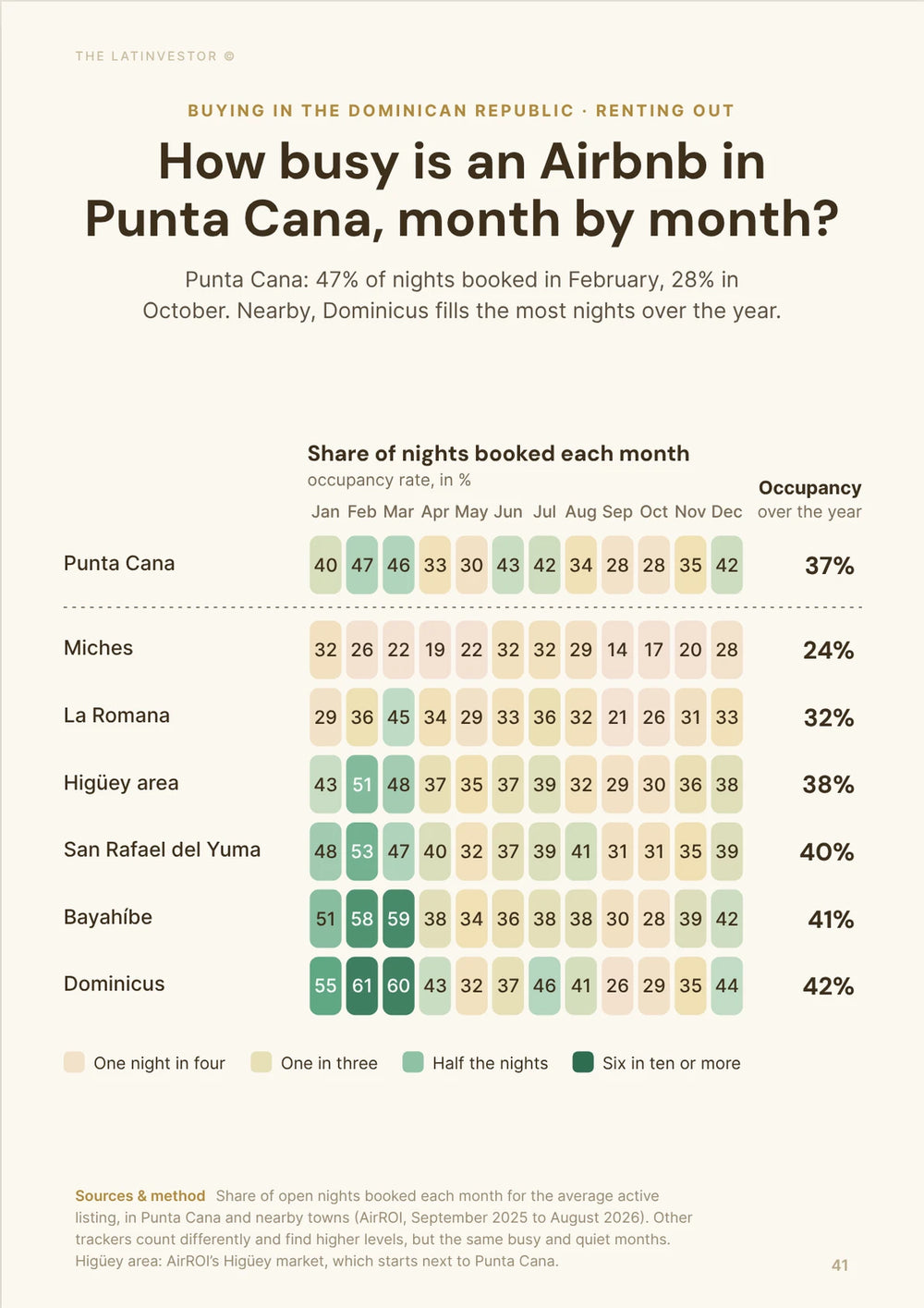
Buyers are more careful in 2026: with 2,446 active Airbnb listings booked 36.4% of the time on average (AirROI), rental projections get questioned much more than a few years ago.
Do people think homes are overpriced in Punta Cana in 2026?
Many do, especially in Cap Cana, Cana Bay, Los Corales, El Cortecito and some glossy off-plan projects.
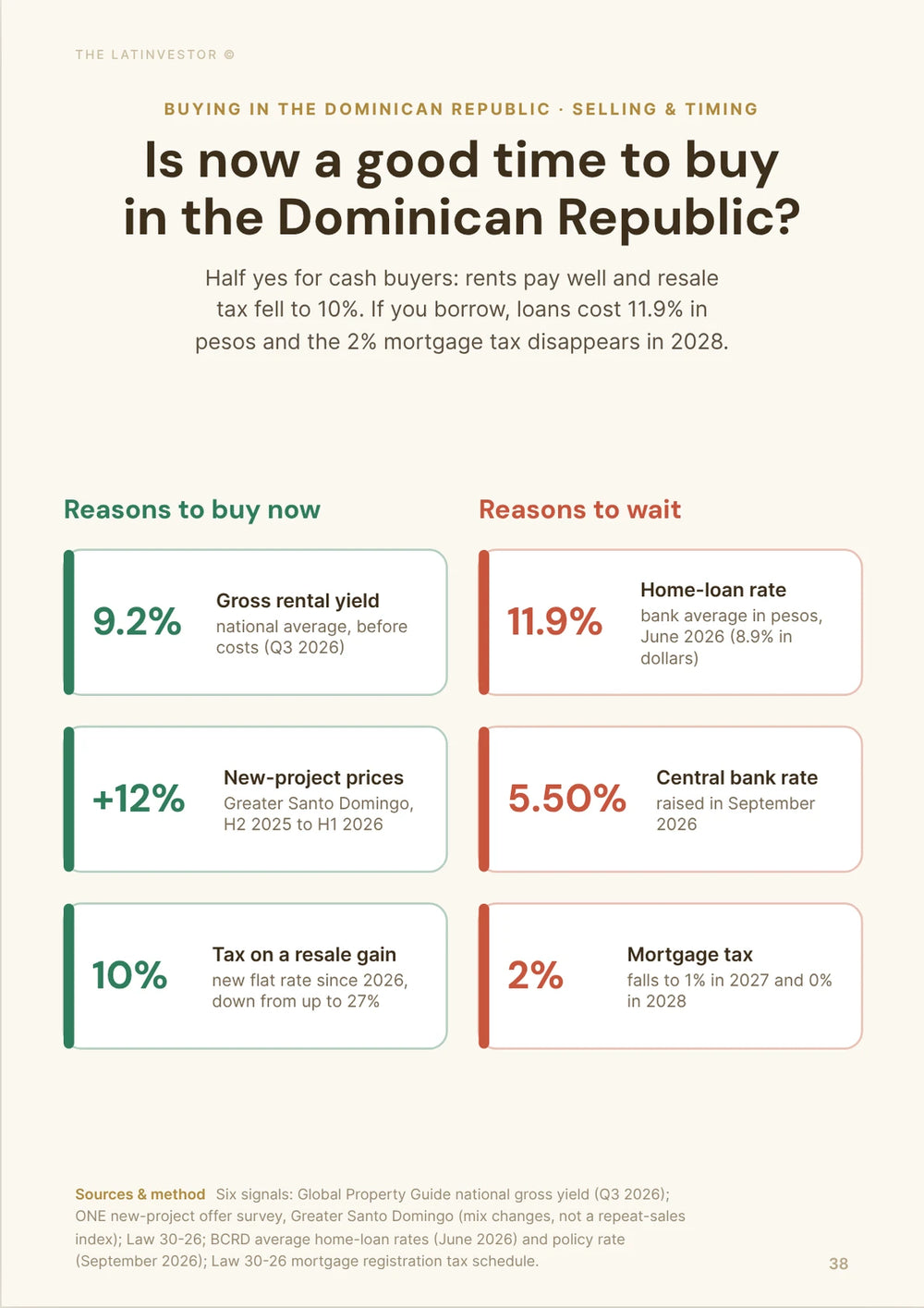
Their main argument is the gap with local incomes. A median 2-bedroom at about $240,000 (about RD$14.8 million) equals about 45 years of the average registered tourism wage, which was RD$27,580 (about $450) a month in May 2026. Local salaries don't set prices here: foreign buyers do.
Other arguments: rising condo fees (from $185 to $350 a month in the listings we saw), expensive furnishing and Airbnb projections that ignore vacancy, fees and management.
The other side: tourism keeps growing, foreign buyers pay in dollars, and truly prime beach and resort land is limited. Prime areas are not where the overpricing is; generic inland stock is.
What are common buyer mistakes people regret in Punta Cana right now?
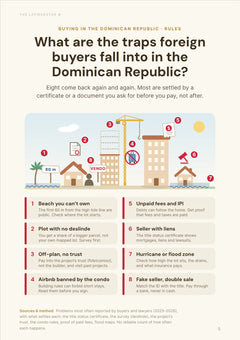
Number one: buying too far from real demand. A cheaper inland unit looks close on a map, but it is not walking distance to the beach or services, and it competes with dozens of similar projects.
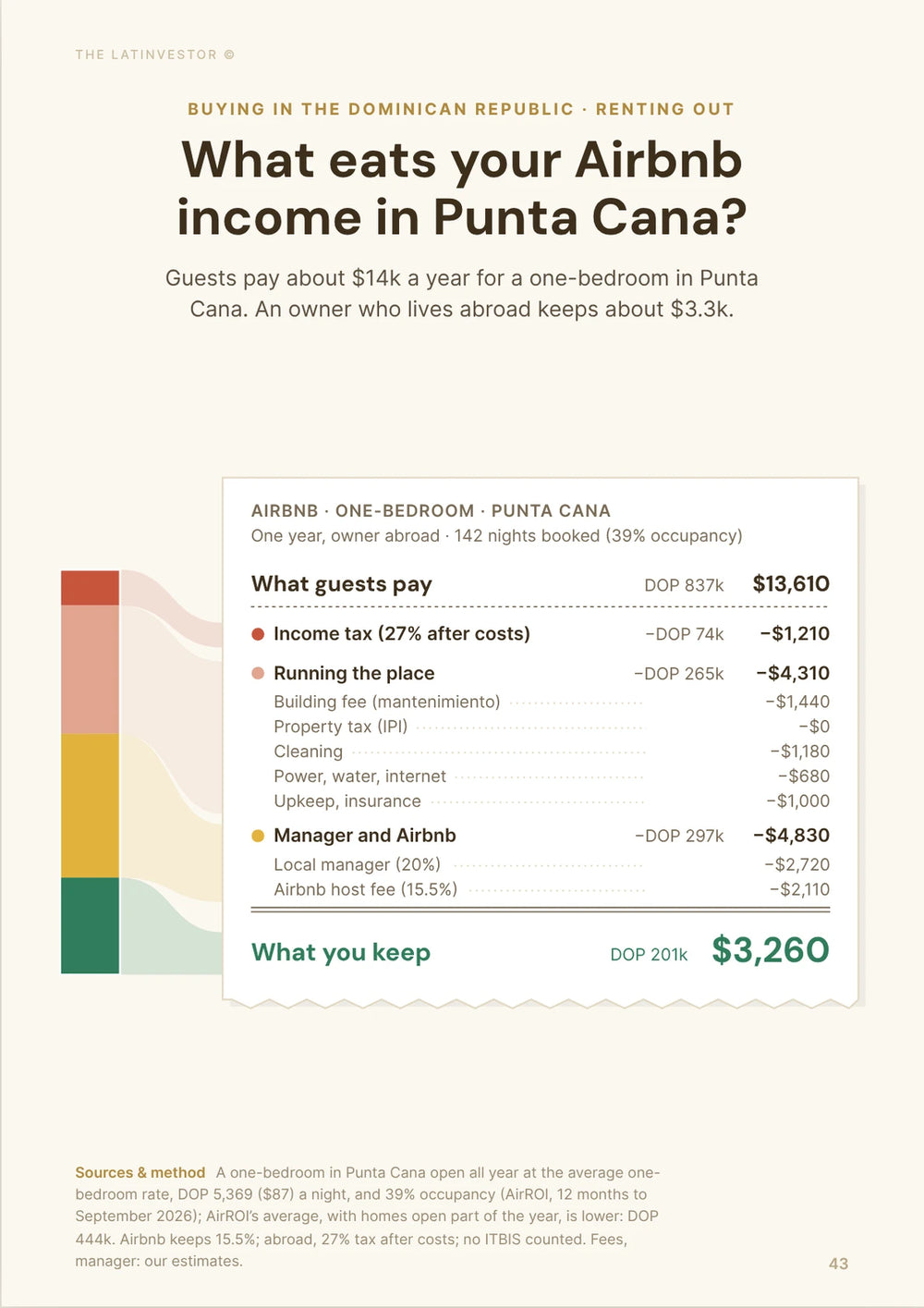
Number two: trusting Airbnb projections. The average Punta Cana listing was booked 36.4% of the time between October 2025 and September 2026 (AirROI). Then come Airbnb's 15.5% host fee, 20% to 25% for management, electricity, condo fees, repairs and tax. Also check that the condo rules allow short stays.
Number three: assuming a project has Confotur benefits. Only units listed in an approved resolution get the exemption, and only on the first purchase. Check the project on MITUR's Confotur search before you sign.
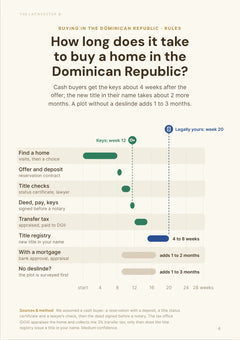
Number four: skipping title checks. Get a fresh Certificado de Título and make sure the unit has its own surveyed title (deslinde), not a "constancia anotada".
Is Punta Cana a property bubble in 2026?
It is the question people type most about Punta Cana this year. Our answer: not a bubble in prime areas, but an oversupply of generic condos.
Prices have not crashed: Punta Cana-Bávaro apartments still ask about $2,278 per m² (CLIC, June 2026). Tourism is strong too: the airport handled 6.38 million international passengers in January-June 2026, up 19.3%.
The weak point is supply. About 40% of the condos for sale are off-plan (Evalua), RE/MAX counts more than 50 off-plan projects, and Airbnb occupancy stays at 36.4% because new listings keep arriving. When those units are delivered, many investors will try to rent or resell at the same time.
What to do: compare any off-plan price with finished resales nearby, ask how many units were sold to short-term renters, check the developer's past deliveries, and get the delivery date and penalties in the contract.
The number to aim for: a price that works as a long-term rental. At the $1,500 median 2-bedroom rent, that means about $250,000 or less for a 7.2% gross yield.
How easy is it for foreigners to buy in Punta Cana in 2026?
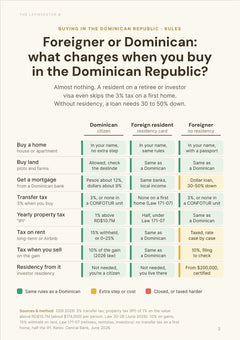
Legally, it is easy: foreigners can buy in their own name, with the same title as a Dominican, and no residency is needed. In practice, it takes more checks than at home.
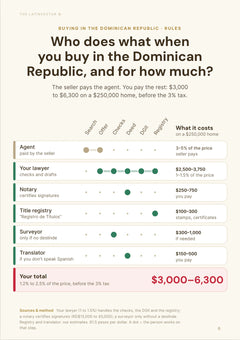
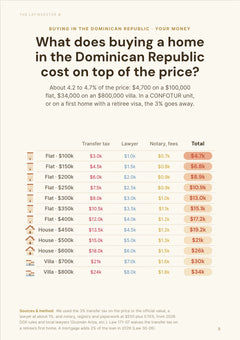
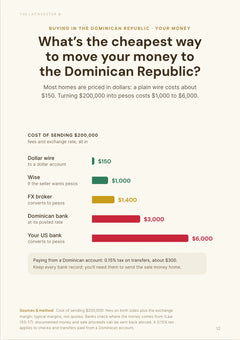
Budget about 4.5% to 6.5% of the price for buying costs, including the 3% transfer tax, or about 1.5% to 3.5% on a valid Confotur first purchase. On a $200,000 (about RD$12.3 million) condo, that is $9,000 to $13,000 without Confotur.
Do foreigners face extra challenges in Punta Cana right now?
Moderate ones. There is no nationality-based ban on owning homes, but the gap between a safe deal and a risky one is large in Punta Cana.
The real problems are practical: judging a location from abroad, checking a developer's promises, reading contracts in Spanish, checking Confotur claims and testing rental projections.
Two checks matter most: a fresh Certificado de Título plus a certification from the Registro de Títulos (about RD$1,000), and an individual surveyed title (deslinde). If the deslinde is still missing, it costs about RD$18,000 to RD$60,000 (about $295 to $975) and takes 30 to 90 days.
Do banks lend to foreigners in Punta Cana in 2026?
Some do, but don't count on it. Many foreigners in Punta Cana pay cash or use a developer payment plan.
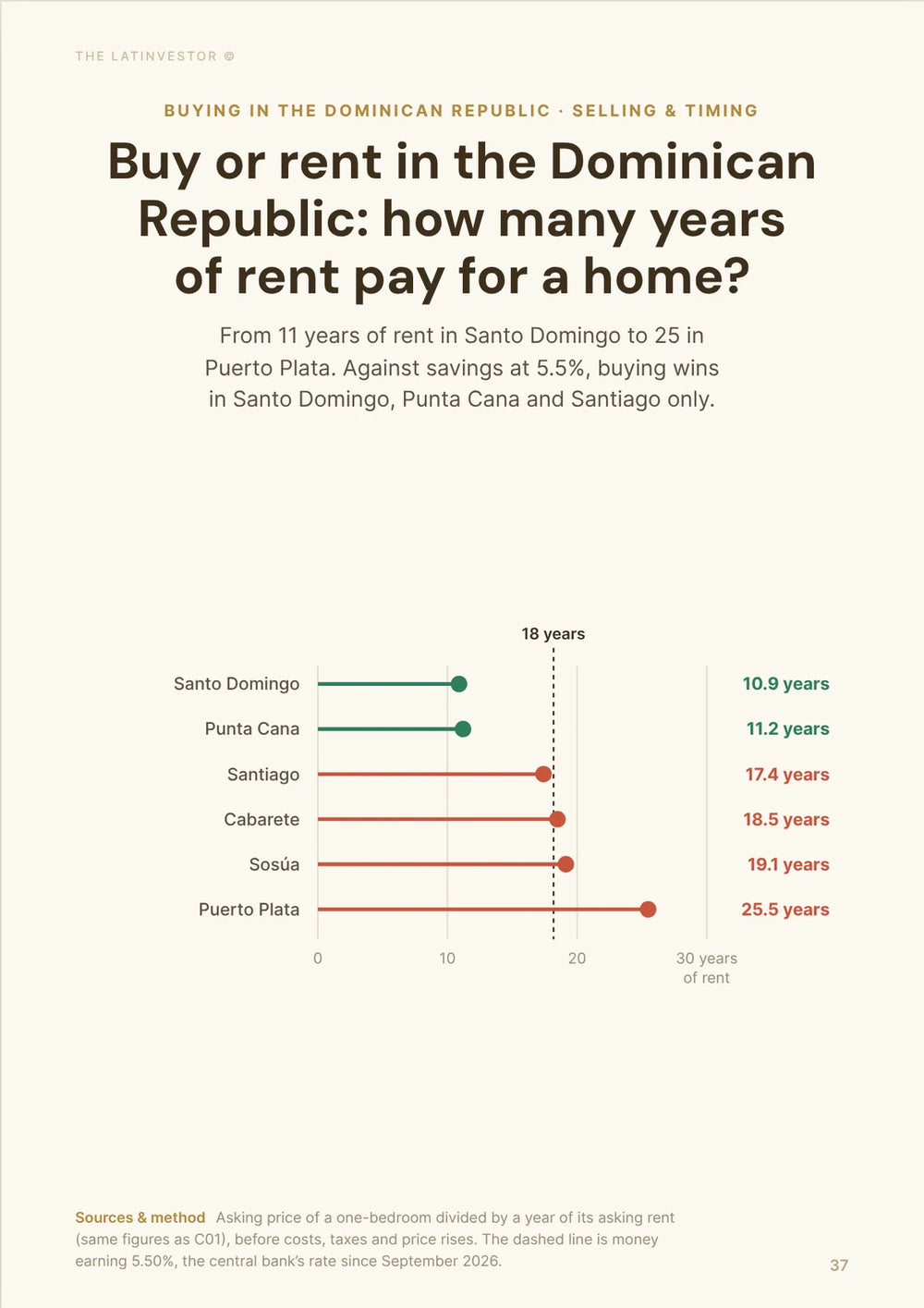
No bank publishes a rate for non-residents. Brokers report 30% to 50% down payments and 10 to 15 year terms. Banco Popular advertises a dollar mortgage up to 70% of the value and 15 years, but it is not guaranteed to a foreign non-resident.
For a sense of price: the average dollar home loan cost 8.87% in June 2026 (BCRD), and Banco BDI's May 2026 reference rates were 8.9% to 11.4% for dollar loans and 14% to 15% in pesos. A mortgage also pays a 2% registration tax on the loan in 2026 (1% in 2027, 0 from 2028).
Expect to show your passport, proof of income, bank statements, tax returns, credit history, the source of your down payment and the purchase documents.
What did Law 30-26 change for Punta Cana buyers?
Law 30-26, in force since June 2026, is the tax change everyone in Punta Cana talks about. The 3% transfer tax on buying did not change.
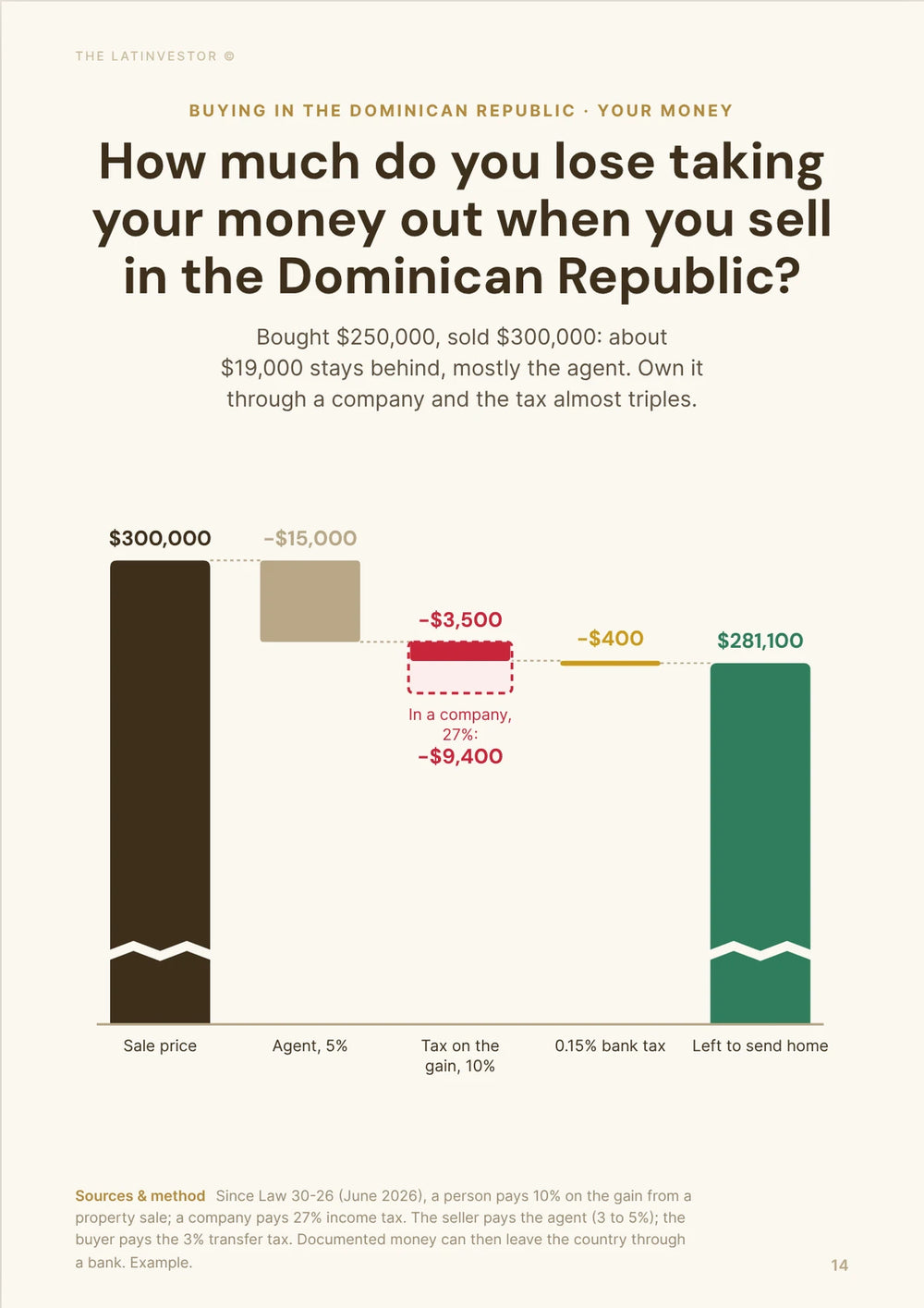
When you sell, an individual now pays a flat, final 10% on the gain, instead of the 27% rate on an inflation-adjusted gain before. Rent paid by a company to an individual landlord now has 15% withheld, up from 10%. The 2% tax on registering a mortgage falls to 1% in 2027 and 0 in 2028.
The open question is Confotur, which matters a lot here because many Punta Cana projects are sold "with Confotur". The law says you can't use two incentive regimes on the same operation, and lawyers such as Pellerano & Herrera say its effect on Confotur is still unclear. On a $240,000 condo, the 3% exemption is worth $7,200 at closing.
What to do: ask your lawyer for a written opinion, check the project's resolution number on MITUR's Confotur search, and write into the contract who pays if the exemption is refused.
How risky is buying in Punta Cana compared to other nearby markets?
Punta Cana is not the riskiest beach market in the Dominican Republic, but it is not a low-risk housing market either.
Its strength is deep tourism demand. Its weakness is that most units depend on tourists, foreign buyers and rental income, plus natural risks: hurricane season runs until 30 November, and 2026 brought record sargassum.
Is Punta Cana more volatile than nearby places in 2026?
It looks less volatile than smaller emerging markets like Miches, Pedernales or parts of Samaná, and more volatile than resident-driven cities like Santo Domingo or Santiago.
Over the past decade, Punta Cana swung harder than Santo Domingo, especially during COVID, but it also came back faster than smaller beach markets thanks to the country's busiest airport and resort cluster. There is no sale-price index to measure the swings precisely.
The national economy helps: the IMF projects about 4.6% growth in 2026, and inflation was 5.12% in September 2026.
Is Punta Cana resilient during downturns historically?
Moderately. During the 2020 tourism collapse, demand stopped sharply, then came back strongly once flights returned, with better properties recovering faster than generic inland stock. We have no index to say how much prices fell.
The airport shows the recovery: 6.38 million international passengers in January-June 2026 alone, up 19.3% on a year earlier.
What usually holds value best: Cap Cana and Punta Cana Village homes, Cocotal villas, beach-close condos in Los Corales and El Cortecito, and rental-ready units in well-run resort communities.
Is sargassum hurting Punta Cana property in 2026?
It is a real worry this year. About 9 million tonnes of sargassum built up in the region from January to June 2026, a record against 8.3 million tonnes in 2025 (University of South Florida, reported by Dominican Today on 9 July 2026). Bávaro, Punta Cana and Uvero Alto are among the most exposed beaches.
It hits short-term rentals first: guests leave bad reviews when the beach smells or can't be used. In October 2026, the Environment Ministry was inspecting how more than 15 hotels between Uvero Alto and Cabeza de Toro handle the seaweed.
What to check: visit in summer, not only in winter, ask the building or the nearest hotel how often the beach is cleaned, and look at the unit's booking calendar for June to August. A pool and a short drive to a cleaner beach help.
How strong is rental demand behind the scenes in Punta Cana in 2026?
Rental demand is real in 2026, but uneven. The best demand is where people can easily reach beaches, jobs, shops, the airport and services.
And it is split in two: steady long-term demand from workers and expats, and short-term tourist demand that is more crowded than it looks.
Is long-term rental demand growing in Punta Cana in 2026?
Yes, but nobody measures it precisely, so we removed the old "5% to 8%" growth figure.
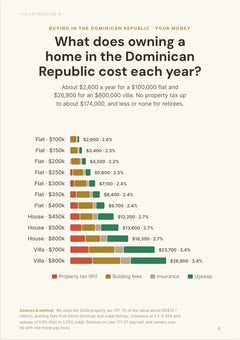
What we can measure: a long-term 1-bedroom in Punta Cana-Bávaro asks a median of $1,150 a month and a 2-bedroom $1,500 (CLIC, March 2026). A $250,000 2-bedroom rented at $1,500 grosses 7.2%, and about 3.7% net before income tax once you count a month of vacancy, about $200 a month of condo fees, 10% management, upkeep, insurance and IPI. As a non-resident, budget for Dominican income tax on that profit (the general rate for non-residents is 27%).
The main tenants are tourism and airport workers, Dominican professionals, expats, remote workers and school families. The strongest areas are Downtown Punta Cana, Punta Cana Village, Vista Cana, Cocotal, Bávaro and the better-connected parts of Verón.
Is short-term rental demand growing in Punta Cana in 2026?
Tourist demand is growing; occupancy per listing is not. AirROI tracks 2,446 active Airbnb listings in Punta Cana, booked 36.4% of the time on average at about RD$9,175 (about $149) a night, between October 2025 and September 2026. We dropped the second, higher occupancy figure we used to quote from another platform.
For a 2-bedroom open all year, AirROI's averages (RD$7,182 a night at 36% occupancy) give about RD$943,700 a year. After fees, management, condo fees and upkeep, that is about 1.4% net of a $250,000 price, before income tax.
Short-term renting is legal, with no national Airbnb license. MITUR's draft registry (RENATUR) was withdrawn on 20 July 2026 after a consultation. Your building's condo rules are the real gatekeeper: they can ban short stays.
The main guests are US and Canadian beach tourists, families, couples, remote workers and wedding groups who want more space than a hotel room.
What are the realistic short-term and long-term projections for Punta Cana in 2026?
The outlook is positive for good, titled, easy-to-rent units, and weak for generic resort stock. No credible institution publishes a Punta Cana price forecast, so treat any precise number, including ours, as a view.
What's the 12-month outlook for demand in Punta Cana in 2026?
Demand should stay firm for well-priced finished condos and homes in established communities, and slow where off-plan supply piles up.
What will decide it: airport arrivals, US and Canadian demand, mortgage rates (the central bank raised its rate to 5.50% in September 2026), and how many new units get delivered. The peso matters less: property is priced in dollars, and the peso is about 61.5 per dollar in October 2026, about 3% stronger than in January.
Our base case for the next 12 months: prime prices edge up a few percent, roughly in line with inflation (5.12%), while generic off-plan condos stay flat or get discounted. We removed the old "3% to 8%" forecast because nothing backs that precision.
What's the 3 to 5 year outlook for housing in Punta Cana in 2026?
Positive for scarce, well-located property; flat for average new-build stock.
The big forces are air traffic, water and sanitation works, resort building, growth in Cap Cana and Vista Cana, and continued development across Bávaro, Cabeza de Toro and the road north to Uvero Alto.
The biggest risk is overbuilding: too many similar condos delivered at once, all counting on the same Airbnb guests. That would push down rents, resale prices and occupancy for average units.
Are demographics or other trends pushing prices up in Punta Cana in 2026?
Yes, but tourism and foreign buyers matter more than local population growth.
The shifts: La Altagracia keeps growing as workers move east for tourism jobs, and more foreigners use Punta Cana as a base. The country had about 9.24 million visitors in January-September 2026, up 7.5%.
Other drivers: remote work, second homes, Airbnb investing, resort expansion and direct flights to Punta Cana's airport.
These pressures should last through the late 2020s, but the price benefit will go to areas with real services, rental demand and limited competing supply.
What scenario would cause a downturn in Punta Cana in 2026?
The most likely mix: too many off-plan condos delivered at once, weaker North American travel, rates staying high and disappointing Airbnb returns.
Early warning signs: bigger developer discounts, more investors reselling off-plan contracts, Airbnb occupancy falling below today's 36.4%, slower airport growth and more delayed projects. Another record sargassum year or a strong hurricane would add to it.
In that scenario, our rough guess is that prime property would hold close to its price, while generic resort condos, weak inland units and overpriced villas could fall 10% to 20% from inflated asking prices.
Our methodology
This article looks at how the Punta Cana property market is doing in 2026: how fast homes sell, what you can buy, which areas are improving, what locals think, buying and financing for foreigners, risks, rental demand, the 2026 tax law and the outlook.
Prices come from asking prices on CLIC Inmobiliaria (June 2026), Evalua (September 2026), RE/MAX Metropolitana (August 2026) and Casanix (October 2026), plus Punta Cana Investment Intelligence's model for areas without listing data. Long-term rents come from CLIC (March 2026) and Global Property Guide, and short-term rental data from AirROI only. Tourism comes from the Banco Central and airport statistics, wages from El Dinero, and mortgage rates from the BCRD and Banco BDI.
Rules come from Law 30-26 (capital gains, mortgage tax, rent withholding), DGII (transfer tax, IPI), Law 108-05 (titles), MITUR's Confotur system and 1122 Real Estate for closing costs. Infrastructure comes from the Presidency, Diario Financiero and the IDB, and natural risks from the Environment Ministry and INDOMET.
We checked these figures in October 2026. Conversions use about 61.5 Dominican pesos per US dollar.
Where we had no direct figure, like days-on-market, the gap between asking and sale prices, or price forecasts, we estimated it, gave a rough range and said so. Punta Cana has no sale-price index, so all prices here are asking prices. Your own costs will depend on the exact unit, its title, the building and how you finance it.
Key sources used for this analysis include CLIC Inmobiliaria price per m² report, CLIC Inmobiliaria Punta Cana rents, Evalua Punta Cana condos, RE/MAX Metropolitana Punta Cana guide, Casanix La Altagracia houses, Punta Cana Investment Intelligence price map, Properstar Punta Cana listings, AirROI Punta Cana Airbnb data, Global Property Guide rental yields, Banco Central de la República Dominicana tourism statistics, BCRD Q1 2026 tourism report, BCRD exchange rates, BCRD policy-rate decision, Revista Mercado on airport traffic, El Inmobiliario on visitor arrivals, El Dinero on the tourism wage, El Dinero on inflation, El Dinero on the IMF projection, IMF Dominican Republic profile, ONE census data, Banco BDI reference rates, Tropical Assets on foreign financing, Superintendencia de Bancos SIMBAD, Law 30-26, DGII property tax information, Law 108-05, 1122 Real Estate closing costs, MITUR Confotur search, Pellerano & Herrera on Confotur and Law 30-26, The Built Report, MITUR SITUR, Diario Financiero on Terminal B, Presidency on the Nisibón-Uvero Alto road, Presidency on the Accor airport hotel, IDB Punta Cana-Bávaro water project, Environment Ministry sargassum operation, INDOMET hurricane season notice and Dominican Today on record sargassum.