
Summary
It depends on what you want: Angelópolis and La Paz for safe resale and good tenants, the Centro Histórico for a cheap entry, and San Andrés Cholula for students and visitors. Asking prices run from about MXN 22,000 per m² citywide to MXN 33,400 per m² for apartments in Angelópolis.
The priciest apartments are in Angelópolis (about MXN 33,400 per m²), San Andrés Cholula (about MXN 30,000) and La Paz (about MXN 25,700). The cheapest homes are in Amalucan, Castillotla, San Manuel and Los Héroes, where houses often list for MXN 0.9-2 million.
Official prices are still rising: the SHF index shows homes in the Puebla-Tlaxcala metro area up 8.5% in a year. But asking prices for apartments in Angelópolis and La Paz are down about 9% since April 2025, so buyers in those areas have room to negotiate.
Gross rental yields average about 6.1% citywide. Our rough check gives about 5.9% for an Angelópolis apartment and about 5.4% in La Paz.
Airbnb is shrinking: AirDNA counts 2,408 active listings, down 33.4% in a year, at 50% occupancy and about USD 43 a night. The average listing earns about MXN 140,000 a year, barely more than a long-term 2-bedroom.
Long-term demand is strongest around Angelópolis, La Paz, Zavaleta, the universities and San Andrés Cholula. A well-priced apartment usually rents in 25-35 days, and a 2-bedroom goes for around MXN 11,000 a month.
Up-and-coming areas are renovated blocks of the Centro Histórico, San Bernardino Tlaxcalancingo near UDLAP, Coronango and the RUTA Line 4 bus corridor.
Avoid old Centro Histórico buildings with no clear management, far-off mass housing with weak demand, and generic investor condos that rely on Airbnb at 50% occupancy.
Flooding is a real check now: after the June 28, 2026 storm, the city counted 104 flood risk points, and the federal civil protection agency flagged 32 at-risk neighborhoods in the capital.
Houses in Angelópolis have held up better than apartments, with average asking prices up 17.5% since April 2025. For the next few years, we'd plan on mid-single-digit yearly growth, not double-digit jumps.
Locals favor La Paz, Bello Horizonte, Santa Cruz Buenavista and Lomas de Angelópolis. Expats lean toward the Centro Histórico, San Andrés Cholula and the Atlixcáyotl corridor near Ibero.
The bottom line: in Puebla, buy for long-term tenants or to live in, in Angelópolis, La Paz or near a university, negotiate hard on apartments, and check the flood map before you sign.

What does it cost to buy in each part of Puebla right now?
Which areas in Puebla have the highest property prices per square meter in 2026?
In October 2026, the most expensive areas to buy an apartment in Puebla are Angelópolis at about MXN 33,400 per m² (USD 1,800), San Andrés Cholula at about MXN 30,000 per m² (USD 1,610) and La Paz at about MXN 25,700 per m² (USD 1,380).
For comparison, the citywide asking price is about MXN 22,000 per m² (USD 1,190) on one portal and about MXN 27,700 (USD 1,490) on another, depending on what each one counts. A typical Angelópolis apartment of 116 m² lists for about MXN 3.88 million (USD 209,000), and a 120 m² one in La Paz for about MXN 3.09 million (USD 166,000).
Each of these areas costs more for different reasons:
- Angelópolis: newer towers, offices, malls, private schools and Ibero nearby, with security and parking.
- San Andrés Cholula: UDLAP, gated developments and the Lomas de Angelópolis area, which belongs to this municipality.
- La Paz: an established, central-west area with cafés, hospitals and older but well-kept homes and apartments.
Which areas in Puebla have the most affordable property prices in 2026?
The cheapest areas in Puebla are on the east and south sides: houses in Plazas Amalucan list for about MXN 914,000 on average (USD 49,100), in San Isidro Castillotla for about MXN 1.18 million (USD 63,400) and in Jardines de San Manuel for about MXN 1.97 million (USD 106,000).
Across San Ramón, Castillotla and Amalucan, most homes list for MXN 0.9-1.8 million, roughly USD 48,400-97,000. Los Héroes de Puebla, a large mass-housing development in the east, sits at the bottom of the market too.
The Centro Histórico is a special case: apartments there average about MXN 1.87 million (USD 101,000), about half the price of Angelópolis, but restored colonial houses average close to MXN 7.9 million (USD 423,000).
The trade-offs: Los Héroes and Amalucan mean long commutes and weak demand from the tenants who pay best, San Manuel has older homes that often need work, and the Centro Histórico comes with noise and heritage rules (any renovation of a listed building needs an INAH permit).
Are property prices in Puebla going up or down right now?
Both, depending on what you look at. Official prices are still going up: the SHF index shows mortgaged homes in the Puebla-Tlaxcala metro area up 8.5% in a year (first half of 2026), faster than the national 7.9%.
But asking prices for apartments in the two most popular areas have slipped. On Propiedades.com, the average apartment in Angelópolis is down 9.2% between April 2025 and October 2026, and in La Paz down 9.4%. Houses in Angelópolis went the other way, up 17.5% over the same period.
Our read: too many similar new apartments were launched in the west, while bank mortgages aren't growing (new loans were flat in the first half of 2026 nationally, and rates sit around 10-11%). Houses with land are scarcer and keep their value better.
What to do: on a resale or new apartment in Angelópolis or La Paz, offer below the asking price and ask the agent for recent closed sales in the same building. Don't use the 8.5% SHF figure to justify a high price: it tracks mortgaged homes across the whole metro area, not your tower.
Which areas in Puebla give the best rental yields?
Which neighborhoods in Puebla have the highest gross rental yields in 2026?
Across Puebla, gross rental yields average about 6.1% in 2026, and the areas with the best mix of rent and price are the Centro Histórico, San Pedro and San Andrés Cholula near the universities, and Angelópolis.
Our rough check: an Angelópolis apartment listed at MXN 3.88 million that rents for about MXN 19,000 a month yields about 5.9% gross. In La Paz, MXN 3.09 million against about MXN 14,000 a month gives about 5.4%. That's before maintenance fees, predial, vacancy and income tax.
Here is why these areas do better than others in Puebla:
- Cholula: steady demand from UDLAP students and staff, and from weekend visitors to the Great Pyramid.
- Centro Histórico: lower entry prices for apartments, with tenants who want to live within walking distance of everything.
- Angelópolis: high rents from professionals and relocating families, though prices are high too.
Is Airbnb still worth it in Puebla, and where?
Which neighborhoods in Puebla perform best on Airbnb in 2026?
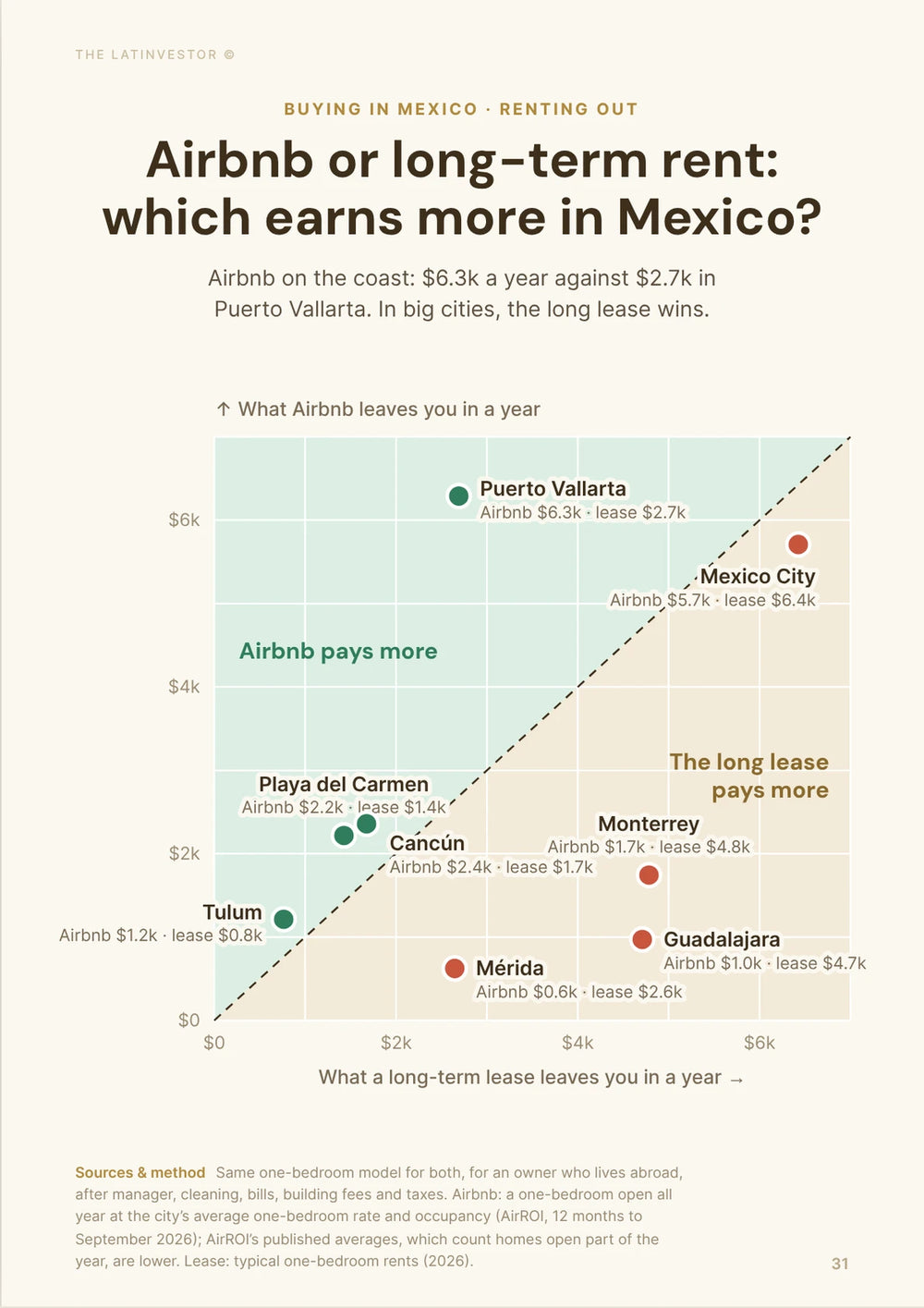
The areas that still work on Airbnb are the Centro Histórico near the Zócalo, the Barrio de los Sapos and the center of San Pedro Cholula, but the city average is modest: 50% occupancy at about USD 43 (MXN 800) a night.
The average active listing earns about USD 7,500 a year (MXN 140,000), or about MXN 11,700 a month, before platform fees, cleaning, utilities and furniture. A standard 2-bedroom on a long lease brings about MXN 11,000 a month with far less work.
Here is what makes these areas better than the rest for short stays:
- Centro Histórico near the Zócalo: the UNESCO-listed center draws cultural visitors all year.
- Barrio de los Sapos: antiques, crafts, bars and galleries pull in weekend visitors.
- San Pedro Cholula center: the Great Pyramid makes it a separate tourist market from Puebla proper.
Which tourist areas in Puebla have too many short-term rentals?
The weakest spots are generic apartments in the Centro Histórico away from the main sights, look-alike units in the Cholula tourist core, and newer condo buildings in Angelópolis sold mainly as Airbnb investments.
The market is already correcting: AirDNA counted 2,408 active listings in Puebla in September 2026, down 33.4% in a year. Owners who couldn't fill their units have stopped hosting, and some now compete for furnished long-term tenants.
With half of all nights still empty on average, don't buy a unit that only makes sense on Airbnb. Run the numbers at long-term rent first, and treat short stays as a bonus. Short stays also carry a 3% state lodging tax collected by the platform.
Which areas in Puebla are best for long-term rentals?
Which neighborhoods in Puebla have the strongest demand for long-term tenants?
The strongest long-term demand is in the Reserva Territorial Atlixcáyotl around Angelópolis, La Paz, Zavaleta, Jardines de San Manuel near BUAP, and San Andrés Cholula near UDLAP.
A well-priced apartment there usually rents in 25-35 days, and small furnished units near the universities or Angelópolis can go in 15-25 days. Vacancy runs about 3-5% in these areas, against 5-7% citywide.
Each area has its own tenants:
- Atlixcáyotl and Angelópolis: professionals and corporate employees, plus Ibero students and staff.
- La Paz and Zavaleta: young professionals and families who want a central, secure area.
- Jardines de San Manuel: BUAP students, teachers and visiting academics on a budget.
- San Andrés Cholula near UDLAP: students, professors and their families.
What these areas share is a nearby job or study anchor. Puebla has no metro, so being close to a university or an office corridor matters more than transit.
What are the average long-term monthly rents by neighborhood in Puebla in 2026?
In 2026, a 2-bedroom apartment in Puebla rents for around MXN 11,000 a month (USD 591), from about MXN 4,500 for a 1-bedroom in San Manuel up to MXN 25,000 for a good apartment in Lomas de Angelópolis.
In the cheaper areas like San Manuel, Los Héroes, Amalucan or Mayorazgo, a 1-bedroom goes for around MXN 4,500 (USD 242), and an older 2-bedroom for well under the city average.
In the middle of the market, a 1-bedroom in the Centro Histórico rents for about MXN 6,000 (USD 323) and one in Zavaleta for about MXN 10,000 (USD 538).
At the top, good apartments rent for about MXN 16,000-22,000 in Angelópolis (USD 860-1,180), MXN 18,000-25,000 in Lomas de Angelópolis (USD 968-1,340) and MXN 14,000-20,000 in Zavaleta. A 1-bedroom in Angelópolis is around MXN 15,000 (USD 806).
Which areas in Puebla are up and coming?
Which neighborhoods in Puebla are gentrifying and attracting new investors in 2026?
In 2026, the areas drawing new buyers are renovated blocks of the Centro Histórico, San Bernardino Tlaxcalancingo near UDLAP and UVM, Coronango on the northwest edge, and neighborhoods along the RUTA Line 4 bus corridor.
They attract buyers for the same reason: they're cheaper than Angelópolis or La Paz but close to a university, a new road or a job corridor. Prices across the metro area rose 8.5% in a year, and the edge areas started from lower prices. We couldn't find a reliable 2026 growth figure for each of them, so check recent sales before paying a premium.
Which areas in Puebla have major infrastructure projects planned that will boost prices?
The areas to watch are the RUTA Line 4 corridor on the Periférico Ecológico, the south of the city near the industrial parks, and the streets getting new storm drains in 2026.
RUTA Line 4 already runs with new buses and working stations, which makes outer neighborhoods along the Periférico easier to live in. In August 2026 the city also announced MXN 160 million for storm collectors in Amalucan, Avenida 11 Sur, Agua Santa and near the Central de Abasto, areas that flood today.
Better transport and fewer floods help prices, but not overnight. Buy for what the area is now, and see the project as a plus once it's actually finished.
Which areas in Puebla should you avoid as a property investor?
Which neighborhoods in Puebla have problems that should make you think twice?
Be careful with old Centro Histórico buildings with no clear management, far-off mass housing with weak demand, and pockets with high crime, which you should check in official data before buying.
Here are the main problems in each type of area:
- Older Centro Histórico buildings: hidden renovation costs, heritage rules, noise and messy condo arrangements.
- Far-off mass housing like parts of Los Héroes: long commutes, few tenants who pay well and slow price growth.
- Quickly built Atlixcáyotl and Quetzalcóatl condo projects: too many similar units, and paperwork that needs a close look in recently regularized zones.
For these to become good buys, Centro buildings would need clear management and approved renovation permits, outer areas better transport, and new condos real demand beyond other investors.
Which areas in Puebla have stagnant or falling property prices in 2026?
No area has crashed, but apartments in Angelópolis and La Paz are the clearest soft spots: average asking prices there are down about 9% since April 2025, while the metro area as a whole rose 8.5% in a year.
Outer housing developments are the other laggards: they're cheap, but few buyers or tenants want them.
Here is what holds these areas back:
- Generic Angelópolis and La Paz condos: lots of similar new supply and buyers who can't get bigger mortgages.
- Far-off housing developments: no jobs nearby and long commutes keep demand low.
- Units built for Airbnb: at 50% average occupancy, and with listings down a third, many don't earn enough.
Which parts of Puebla flood, and how do you check a property?
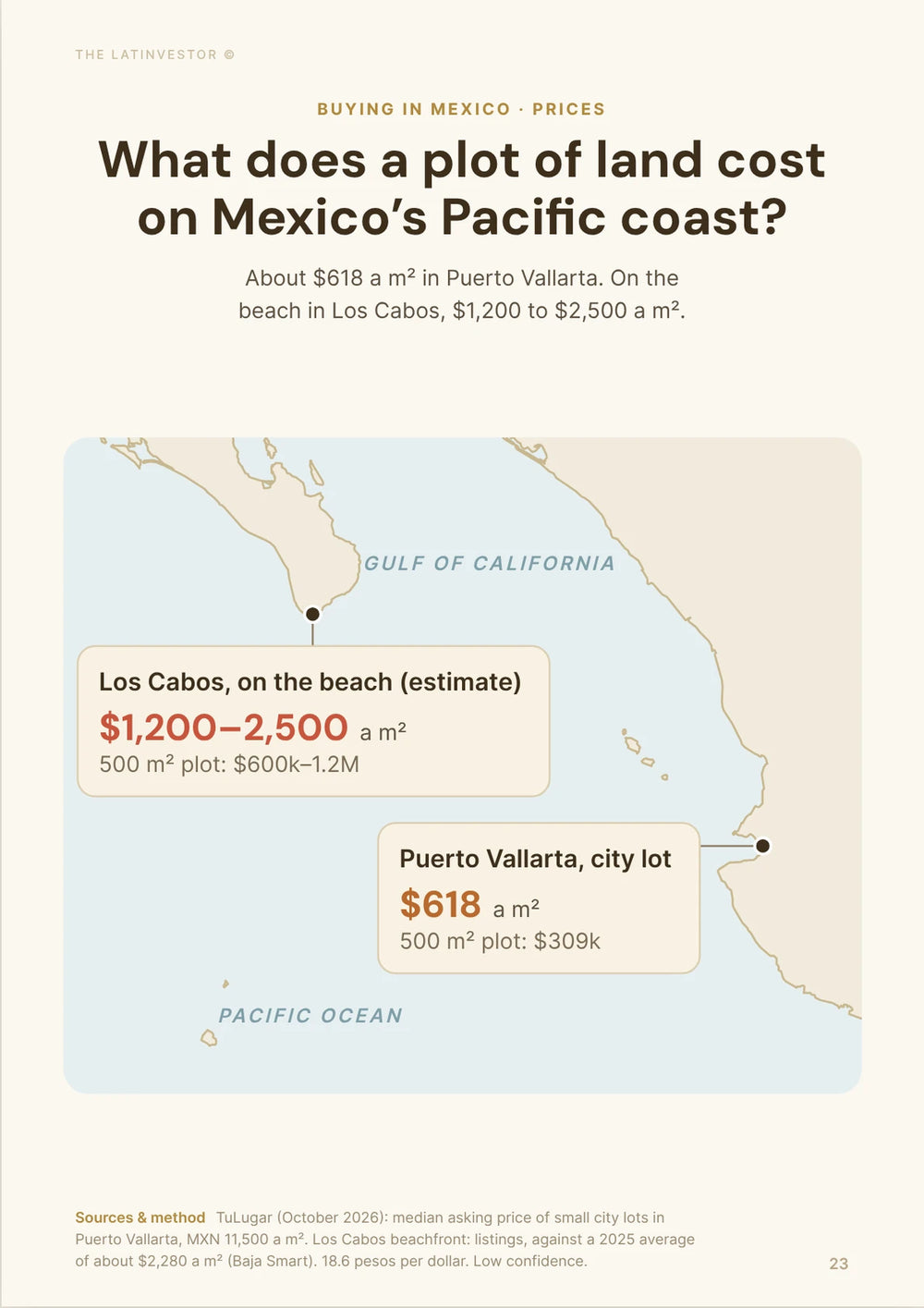
Flooding is real in parts of Puebla and has become a buying question after the storm of June 28, 2026, which dropped 62 mm of rain and left up to 70 cm of water at several points, including streets in the Centro Histórico.
After that storm, the city counted 104 flood risk points (59 tied to drains and sewers, 45 along rivers and ravines). The federal civil protection agency listed 32 at-risk neighborhoods in the capital, including San José del Puente, Reforma Azul and Valle del Sol. The city's own review also covers Santa Cruz Buenavista, Bosques de San Sebastián, Bosques del Atoyac and the Laguna de Chapulco area.
The city has put MXN 231.4 million into flood prevention for 2026, 55% more than in 2025, but most works aren't finished.
What to do: look at the street on Google Street View in July or August, ask neighbors about the last rainy season, avoid ground floors and basements near the Atoyac and Alseseca rivers or the ravines, and ask the seller in writing whether the property has ever flooded. Check that your home insurance covers floods.
Which areas in Puebla have the best long-term price growth?
Which areas in Puebla have gone up the most recently?
The areas that have gone up most in recent years are Angelópolis and Lomas de Angelópolis (especially houses), San Bernardino Tlaxcalancingo near UDLAP, and Coronango on the expanding edge of the city.
Here is what we know about each:
- Angelópolis houses: average asking prices up 17.5% between April 2025 and October 2026, now about MXN 3.9 million (USD 210,000).
- Lomas de Angelópolis: gated communities where homes list for MXN 4-7 million or more, with steady demand from families.
- San Bernardino Tlaxcalancingo: student and staff demand near UDLAP and UVM.
- Coronango: cheaper entry prices that pulled in first-time buyers.
La Paz, often cited as a steady winner, has cooled: its apartments now list for less than in April 2025. Growth has followed jobs, universities and new roads, and houses with land have done better than apartments.
Which neighborhoods in Puebla should see prices grow in the coming years?
The best bets for future growth are the RUTA Line 4 corridor, renovated blocks of the Centro Histórico, houses in the Atlixcáyotl-Angelópolis corridor and the south of the city near the industrial parks.
We found no reliable 2026 or 2027 forecast by neighborhood. Our view is mid-single-digit yearly growth for good houses and well-located apartments, closer to inflation for generic new condos, and more upside only where a project like new drainage or transport actually gets finished.
The single biggest driver will be access: areas that become easier to reach, and that stop flooding, gain the most.
What do locals and expats really think of each area in Puebla?
Which areas in Puebla do local residents consider the most desirable to live?
Locals rank La Paz, Bello Horizonte, Santa Cruz Buenavista and Lomas de Angelópolis in San Andrés Cholula as the most desirable places to live.
Here is what draws them to each:
- La Paz: central, family-friendly, close to good schools and hospitals.
- Bello Horizonte: established and convenient, with apartments averaging about MXN 2.65 million (USD 142,000).
- Santa Cruz Buenavista: quiet, tree-lined streets (but it's on the city's flood review list, so check the exact street).
- Lomas de Angelópolis: gated communities with newer homes and private security.
The typical residents are upper-middle-class Mexican families, young professionals from the corporate corridor and business owners who want security and modern services.
Locals and foreign buyers mostly agree, though locals care more about being near family and traditional markets, and foreigners more about walkability and colonial charm.
Which neighborhoods in Puebla have the best reputation among expats?
Expats like the Centro Histórico for its walkable colonial streets, San Andrés Cholula near UDLAP for its international crowd, and the Atlixcáyotl corridor near Ibero for modern apartments.
Here is why:
- Centro Histórico: museums, restaurants and events within walking distance, in a UNESCO-listed center.
- San Andrés Cholula near UDLAP: other foreigners, English-speaking services and the Great Pyramid nearby.
- Atlixcáyotl corridor near Ibero: modern buildings, reliable services and easy access to offices.
The typical expat here is a university professor or researcher, a retiree who finds Mexico City too expensive, a remote worker or someone relocated by a company. Puebla's expat community is much smaller than in the beach towns or Mexico City.
Which areas in Puebla do locals say are overhyped by foreign buyers?
Locals say foreign buyers overrate generic investment condos in Angelópolis, Airbnb-style units in the Centro Histórico and some master-planned communities marketed mostly to outside investors.
Here is why locals think they're overpriced:
- Generic Angelópolis condos: prices ran ahead of rents, and asking prices are now falling.
- Centro Histórico short-stay units: buyers expect high occupancy, but the city average is 50%.
- Investor-focused master plans: the pitch relies on price growth that depends on more investors buying in.
Foreign buyers see a ready-made rental product. Locals look at noise, parking and how far it is from family.
Which areas in Puebla are considered boring or undesirable by residents?
Residents tend to find the far-off mass-housing developments like parts of Los Héroes, purely residential zones with no shops nearby and areas next to industrial zones boring or undesirable.
Here is why:
- Los Héroes de Puebla: long commutes, little to do and identical houses.
- Far-off residential-only zones: no shops, restaurants or culture within walking distance.
- Next to industrial areas: noise, trucks and less prestige.
Our methodology
This article compares Puebla's neighborhoods on purchase prices, rents, rental yields, Airbnb performance, price trends and risks, to help you decide where to buy.
Prices by neighborhood come from asking-price medians and averages on Propiedades.com, NOCNOK and TuLugar (October 2026), with zone price bands from Tandacasa. Official price growth comes from the SHF index for the Puebla-Tlaxcala metro area. Rents match our article on rents in Puebla, and yields are our own division of a year of asking rent by the asking price.
Short-term rental figures come from AirDNA (October 2025 to September 2026). Flood risk comes from Puebla civil protection and local press reporting from October 2026. Mortgage conditions come from Banxico and BBVA Research.
We checked these figures in October 2026. Conversions use about 18.6 pesos per US dollar and 20.9 pesos per euro.
The limits: asking prices aren't sale prices, and the gap can be large in a soft market. Neighborhood figures rest on fewer listings than citywide ones, and the SHF index only covers homes bought with a mortgage. Growth outlooks are our own estimates.
Key sources used for this analysis include SHF, Propiedades.com, NOCNOK, TuLugar, Tandacasa, Global Property Guide, AirDNA, Publimetro Puebla, Puebla civil protection, Banxico, SESNSP, UNESCO, UDLAP and Ibero Puebla.