Summary
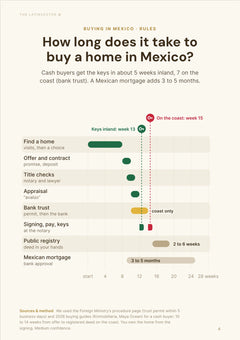
Yes, it is safe to buy property in Mexico if title, land status, permits and payments are checked before your money becomes hard to get back. The trouble in 2026 sits in specific deals: Quintana Roo alone had blacklisted 123 irregular developments by August 2026.
Most bad stories come from mixing up very different purchases. A finished condo with registered private title is low risk; land still under ejido status is very high risk for anyone expecting a normal private purchase.
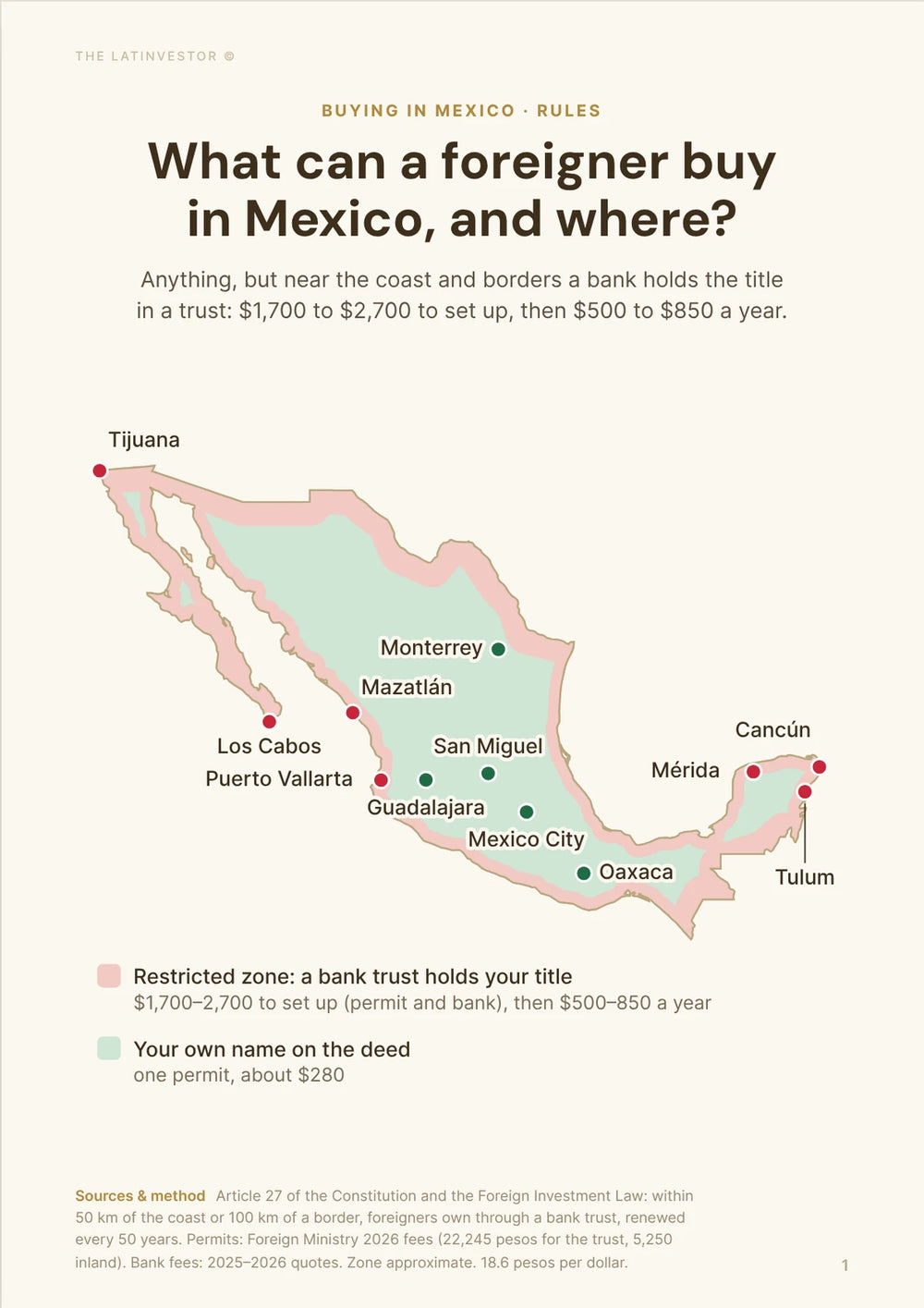
Foreigners can own legally across Mexico. Within 50 km of the coast or 100 km of a border, you hold residential property through a bank trust (fideicomiso), and no 2025-2026 reform has removed that rule.
The fideicomiso is not the weak point. The SRE permit costs MXN 21,650 and banks charge about USD 550 to 700 a year; what matters is that the trust is real and registered, not improvised.
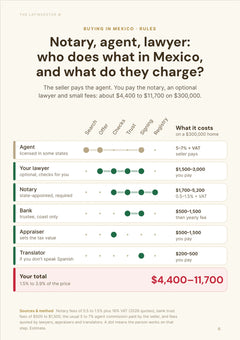
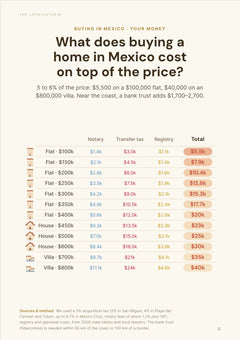
The notary is your strongest safeguard, and notary fees are only about 0.5% to 1.5% of the price. Bring the notary in before a large deposit, and check the seller, liens and legal description against the registry, not against the seller's copies.
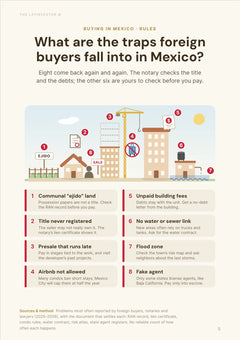
Ejido land is still the clearest trap. In October 2026, Tulum authorities warned about two developments without urban permits, one of them on an ejido parcel; former ejido land is only safe when the whole conversion to private title can be traced.
Presales carry developer risk that no contract removes. NOM-247 gives you a 5-business-day window to cancel and requires a Profeco-registered contract, but it cannot make a weak developer finish on time.
Irregular projects are a live issue on the Caribbean coast. Quintana Roo's state government listed 116 irregular developments in 2025 alone, with Tulum, Isla Mujeres, Playa del Carmen and Cancún the most affected.
Deposits are where manageable problems turn expensive. In Jalisco, Profeco received 483 formal complaints against real-estate companies between 2024 and August 2026, mostly refused refunds, late delivery and defects.
Fake sellers and double sales still happen. In Quintana Roo, lawyers say fraud makes up about 30% of the property cases they handle, so the official ownership chain counts far more than the paperwork you are shown.
Crime and natural hazards are local, not national. Tulum's homicide rate was about 26 per 100,000 over the year to September 2026, versus about 5.7 in Playa del Carmen, and 2026 brought floods in Puerto Vallarta and Puebla and water cuts in Los Cabos.
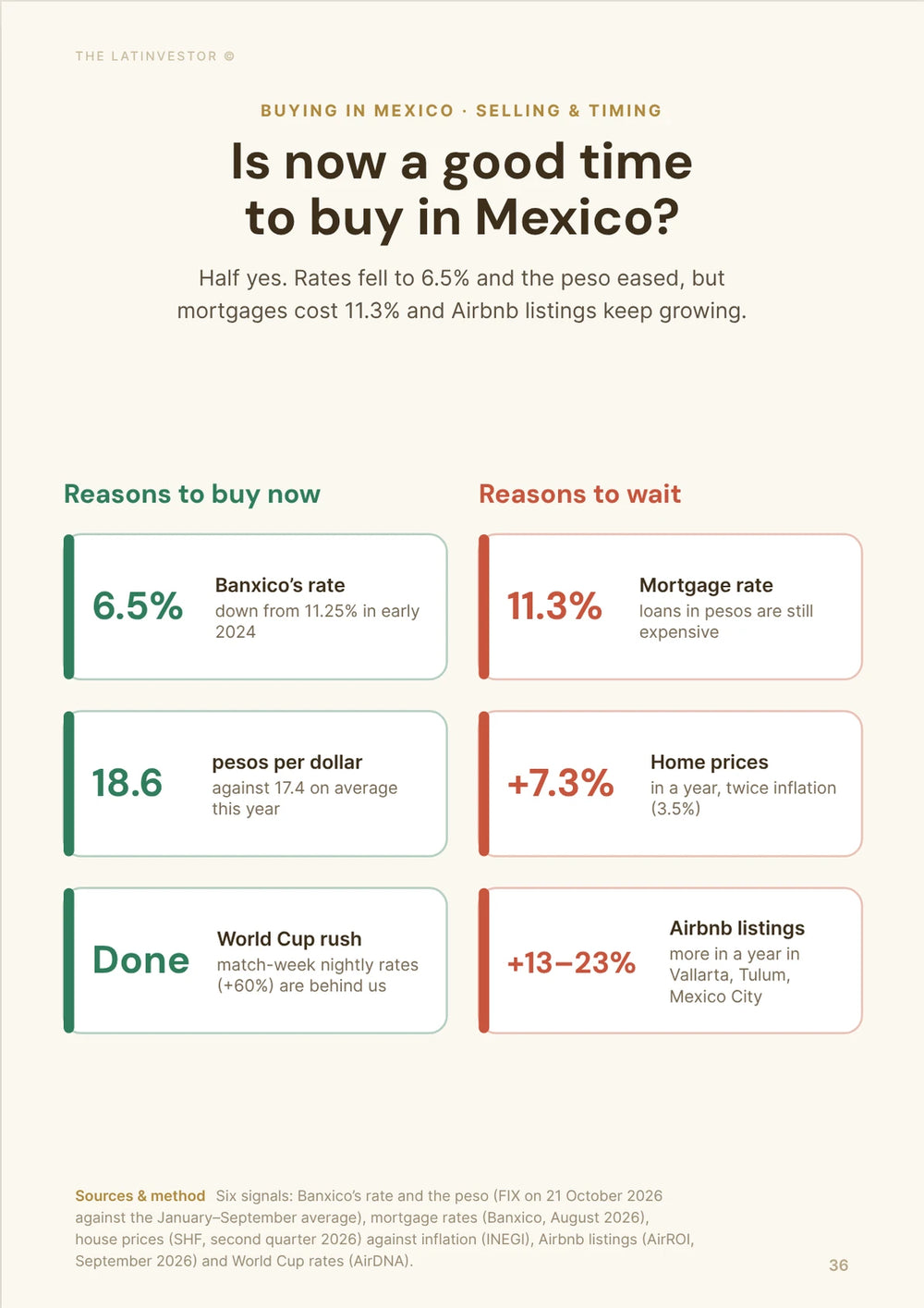
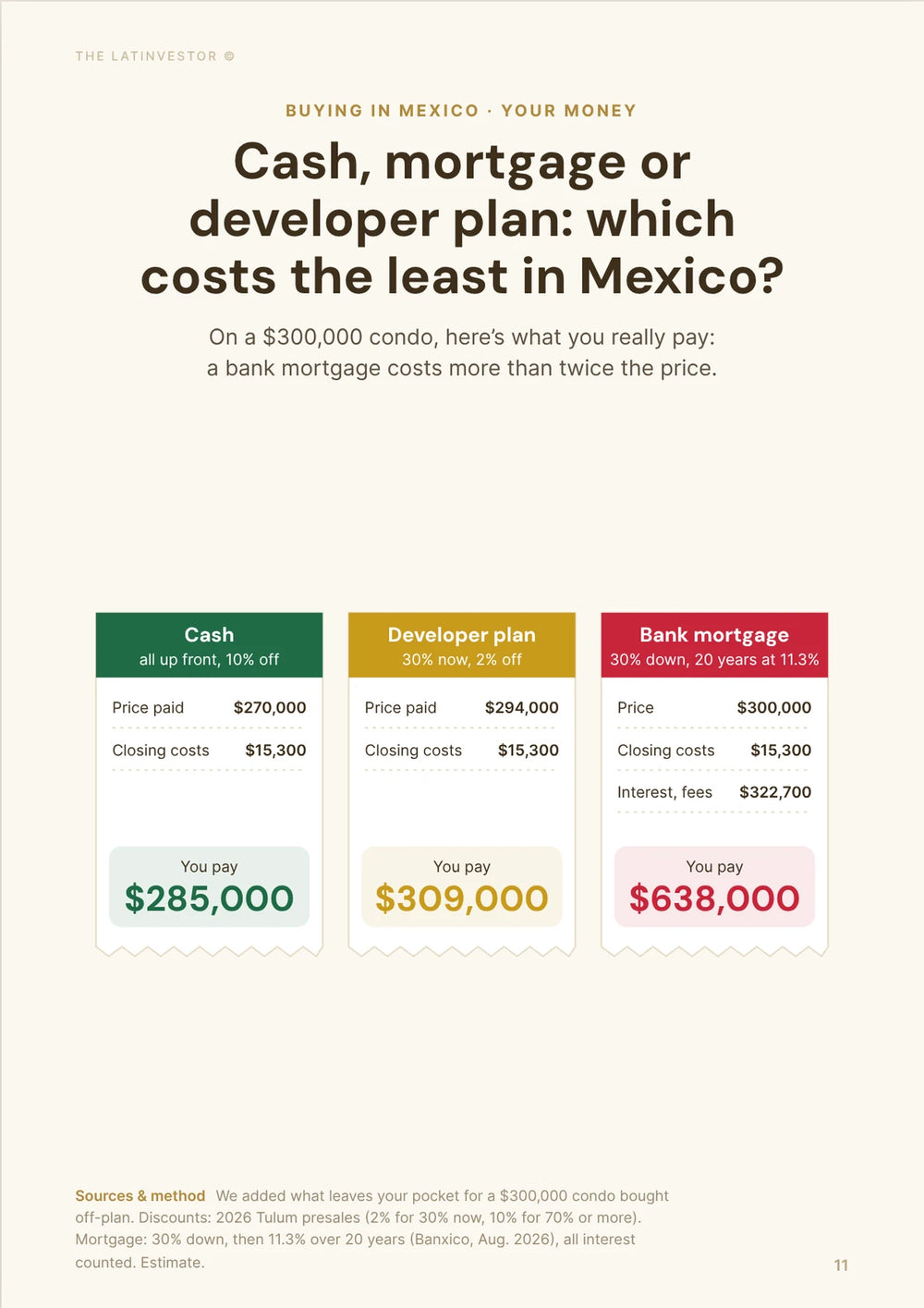
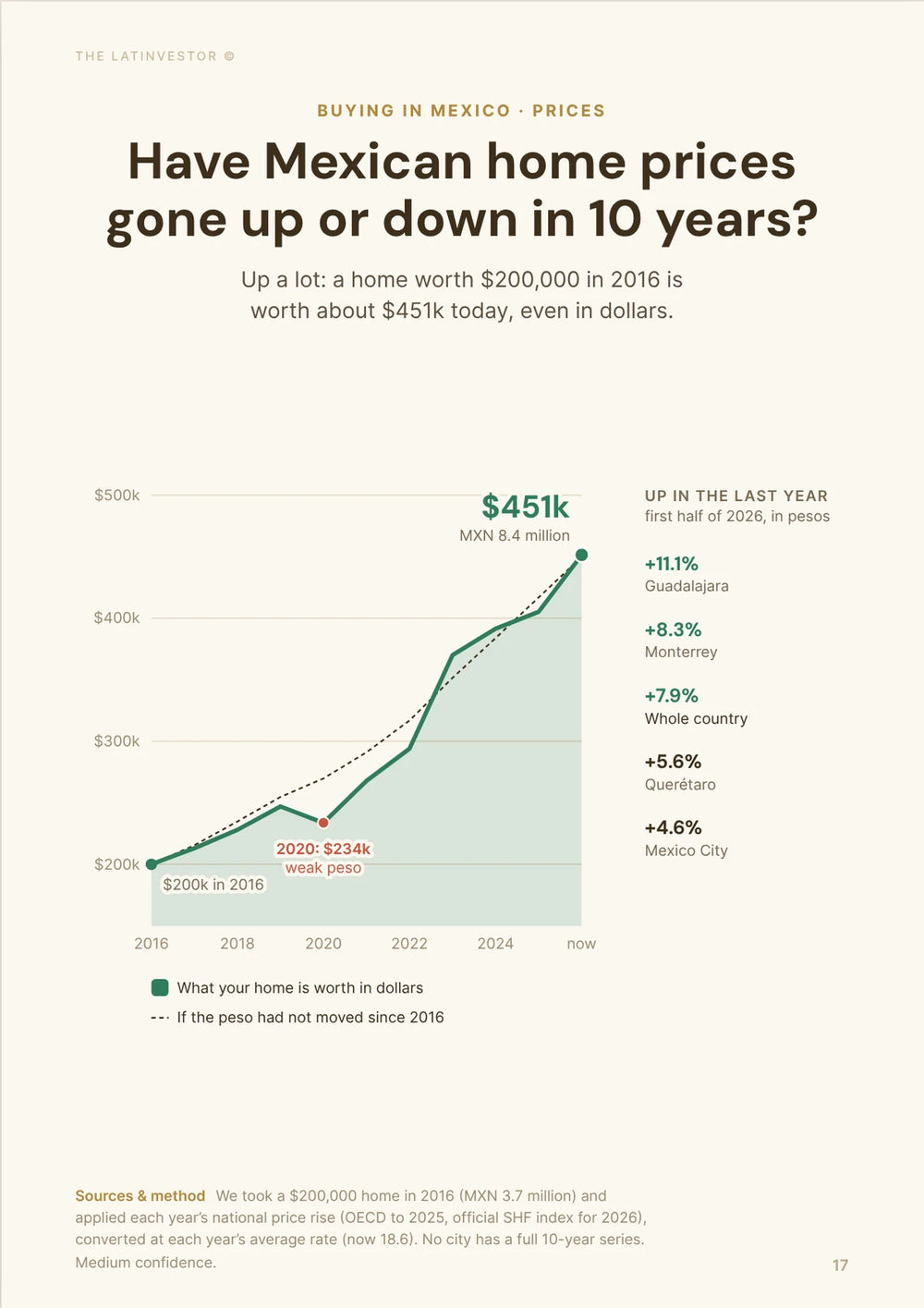
Rising prices push buyers to rush. SHF prices rose 7.9% in the first half of 2026, and 11.1% in Guadalajara, while commercial banks granted 1.9% fewer mortgages, which pushes more buyers toward cash and developer payment plans.
A good agent helps, but the agent should never be the only one checking the deal. Pressure to skip any of the checks in our 9 red flags is a reason to slow down or leave.
Bottom line: buy finished, privately titled property or verified presales, pay into a clean banking trail, and keep early payments reversible. If a deal depends on "trust me", walk away.

Why does buying property in Mexico have a risky reputation?
Buying property in Mexico is reasonably safe, but mistakes around title, ejido land, presales and early payments can turn a normal purchase into a legal fight.
Mexico has a working system of public deeds, property registries and rules for foreign buyers. The bad reputation comes from very different deals being described the same way. A finished condo with registered private title bought through a notary has little in common with wiring money for coastal land nobody has checked.
Three things explain most of the horror stories. Foreigners have to use special structures near the coast and borders. A lot of land is still ejido or other social property, not ordinary private title. And presale buyers pay large amounts before the property legally exists. In 2026, a fourth one is in the news: projects sold without the right permits, especially on the Caribbean coast.
| Type of Mexican property purchase | Risk level | Main issue | What makes it safer |
|---|---|---|---|
| Finished home with registered private title | Low | Title and liens | Independent registry and notary checks |
| Coastal home through a fideicomiso | Low to moderate | Correct trust structure | Proper SRE permit and bank trust |
| Developer presale | Moderate | Completion and developer risk | Contract, permits and developer checks |
| Former ejido land | Moderate to high | Conversion history | Full dominio pleno and registry trail |
| Land still under ejido status | Very high for a normal private purchase | Buyer may not be acquiring private title | Do not treat it as ordinary titled property |
Can foreigners safely own property in Mexico?
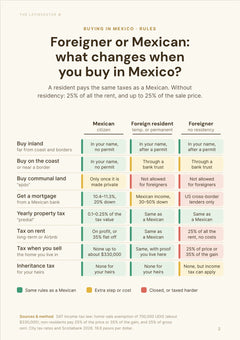
Yes. Foreigners can legally own property in Mexico; the only twist is that residential property near the coast or a border is held through a fideicomiso rather than direct title.
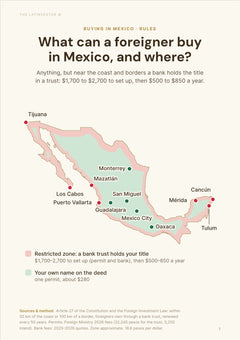
Article 27 of the Constitution sets a restricted zone within 100 km of an international border and 50 km of the coast. Foreign individuals cannot hold residential land there directly.
That covers most places foreigners want: Los Cabos, Puerto Vallarta, Riviera Nayarit, Cancún, Playa del Carmen and Tulum. Foreigners still buy legally in all of them, through a bank trust that gives them the economic rights to the property.
Outside the restricted zone, foreign buyers can take direct title after the SRE procedure. You may read online that the restricted zone is about to be scrapped: we found no reform enacted in 2025 or 2026, and SRE still applies the 50 km and 100 km limits.
| Property | Can a foreign individual buy it? | Typical structure | Main check |
|---|---|---|---|
| Residential property outside restricted zone | Yes | Direct ownership | SRE/notary procedure |
| Residential property near coast | Yes | Fideicomiso | Valid SRE trust permit |
| Residential property near border | Yes | Fideicomiso | Valid SRE trust permit |
| Certain non-residential property through Mexican company | Potentially | Corporate ownership | Use and foreign-investment rules |
| Ejido land | Different legal regime | Cannot be treated like ordinary private title | RAN status |
Is a fideicomiso in Mexico really safe, and what does it cost in 2026?
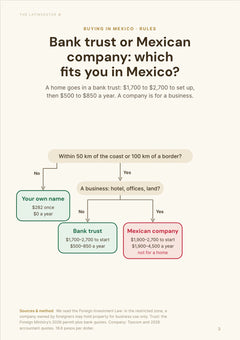
A properly created fideicomiso is a safe, standard structure, and it costs roughly USD 1,700 to 2,000 to set up plus USD 550 to 700 a year.
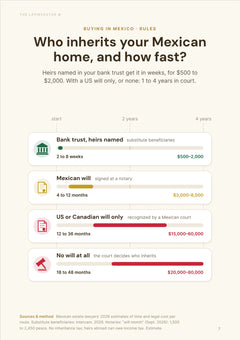
A Mexican bank acts as trustee and you are the beneficiary. You can use, rent, improve, sell and pass on the property under the trust terms. The bank cannot use the property as if it were its own.
SRE grants these trusts for up to 50 years, renewable, and the trust must be in a public deed. The SRE permit costs MXN 21,650 (about USD 1,160) under the fee schedule updated in September 2026. On top of that, banks charge an opening fee of roughly USD 550 to 800 and an annual fee of roughly USD 550 to 700, depending on the bank.
The real risk is not the trust itself but a fake or improvised version of it: a "nominee" Mexican owner, a private agreement instead of a registered trust, or a company set up only to dodge the rule for a home. If someone proposes that, stop.
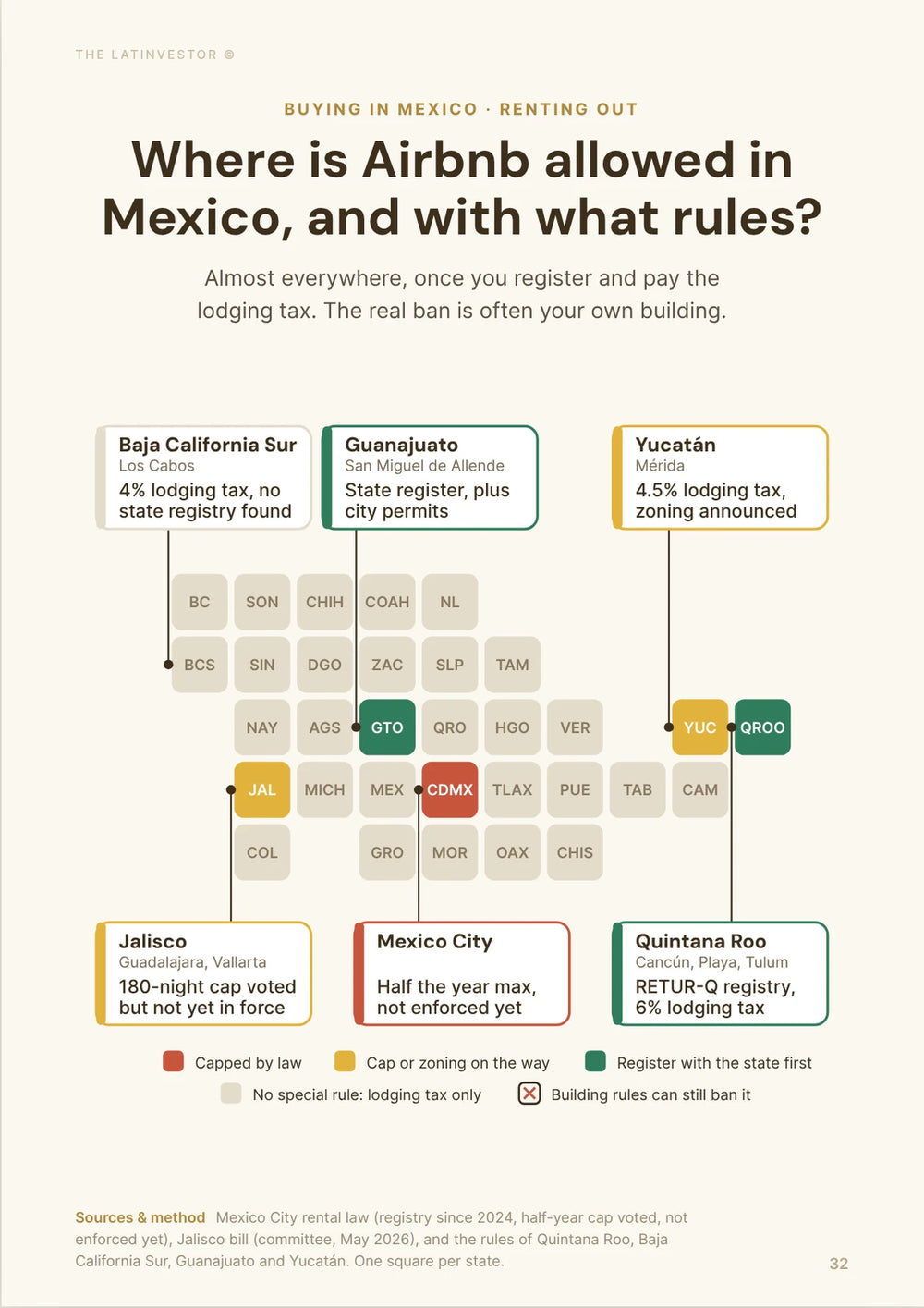
How much protection does a Mexican notary actually give a property buyer?
A Mexican notario público is one of your strongest protections, as long as the notary is involved before a large deposit is at risk.
A notario is a lawyer with public authority, very different from a notary in the United States. For a normal purchase, the notary checks ownership and transfer documents, drafts the public deed, reviews the registry, calculates and withholds certain taxes and sends the transfer for registration.
The notary also catches what a sales file hides: a mortgage still registered, an inheritance never completed, someone signing without authority, or a seller who is not the registered owner.
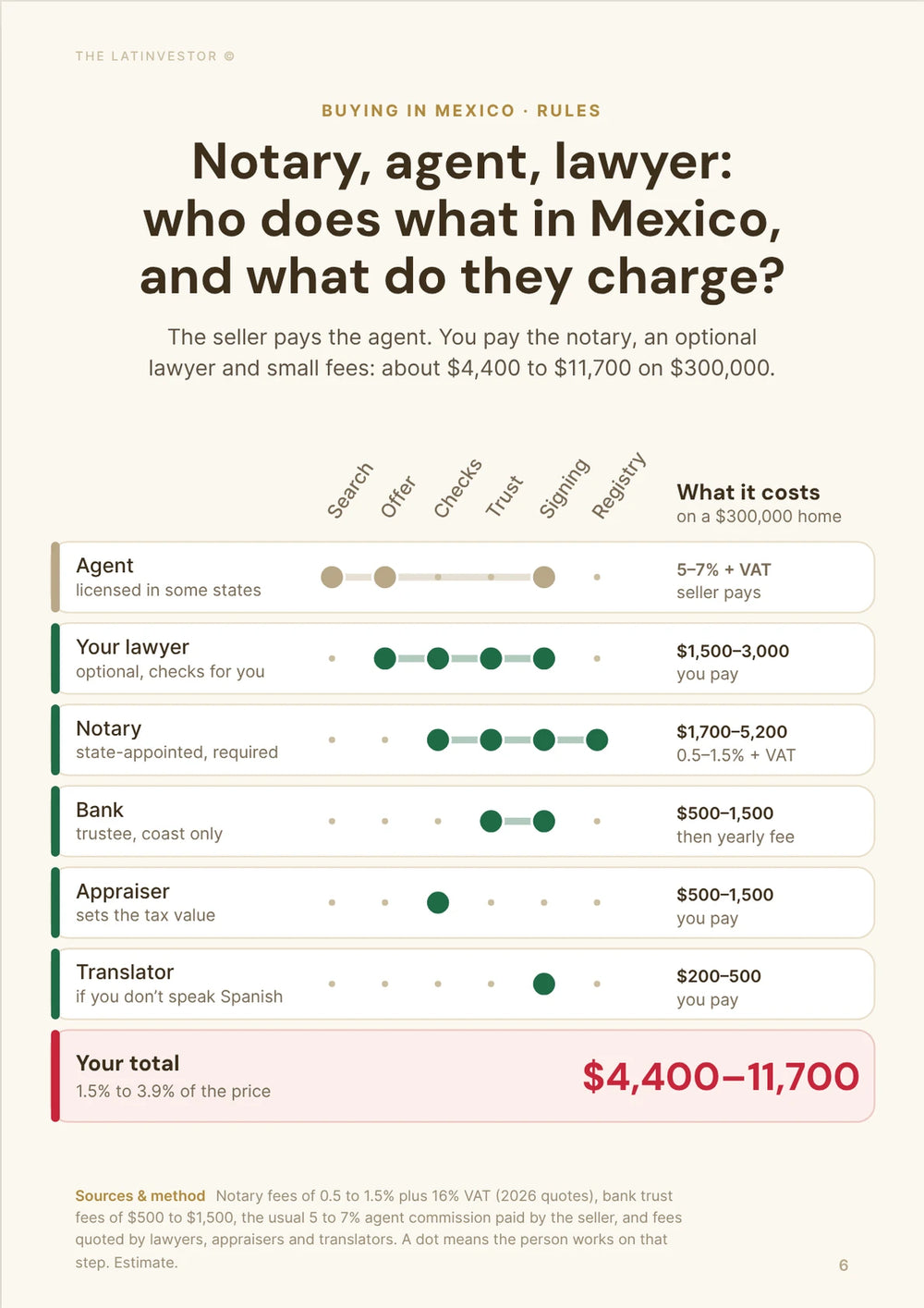
It is not expensive. Notary fees usually run about 0.5% to 1.5% of the price, within total closing costs of about 6% to 9% for a foreign buyer using a trust. The system is also going digital: the Colegio Nacional del Notariado Mexicano is rolling out the Sello Digital Notarial in 2026 to make notarized documents harder to forge.
What should we check before trusting a property title in Mexico?
Before trusting a title, we want the seller, the public registry, the deed, the legal description and any debts to match cleanly.
Seeing a deed is only the start. The registered owner should be the seller. The legal description should match the unit or lot you are actually buying. And the registry should be checked for mortgages, seizures, lawsuits or other encumbrances.
Check predial and other local dues too. If a company sells, the signer needs authority. If the property came through an inheritance, the succession must be far enough along for a valid sale.
A document the seller emails you shows what the seller wants you to see. A certificate you or your notary get from the registry shows what the official record says. Only the second one counts.
| What we check | What it answers | Where it comes from | What worries us |
|---|---|---|---|
| Registered owner | Does the seller own it? | Public Property Registry | Name does not match |
| Encumbrances | Is money or litigation attached to it? | Registry certificate | Mortgage, seizure or court annotation |
| Legal description | Are we buying the advertised property? | Deed, registry, cadastral records | Area or boundaries conflict |
| Property tax status | Are local obligations current? | Local authority | Unpaid predial |
| Seller authority | Can this person legally sell? | Corporate, probate or power documents | Authority is unclear |
| Foreign ownership structure | Can this buyer legally hold it this way? | SRE/notary | Informal workaround proposed |
Is ejido land still the biggest property trap in Mexico?
Yes. Ejido land is still the clearest way to lose money in Mexico, because an ejido right is not ordinary private ownership.
The Registro Agrario Nacional (RAN) runs a separate system for ejidos and other social land. It clearly separates ejido parcels from parcels that have completed dominio pleno and moved into private ownership.
The conversion takes formal steps: the ejido assembly authorizes dominio pleno, the decision is registered, the parcel holder gets a property title, and only then can the land enter the ordinary property registry.
It is not a historical problem. On 2 October 2026, Tulum's authorities and the state urban-development agency SEDETUS warned buyers about two developments, Yaax Taanil Kaah and Zonot Kaahah, sold without urban permits; one sits on a parcel of the Jacinto Pat ejido. Phrases like "the title is coming" or "everyone here buys this way" should end the conversation until RAN confirms the status.
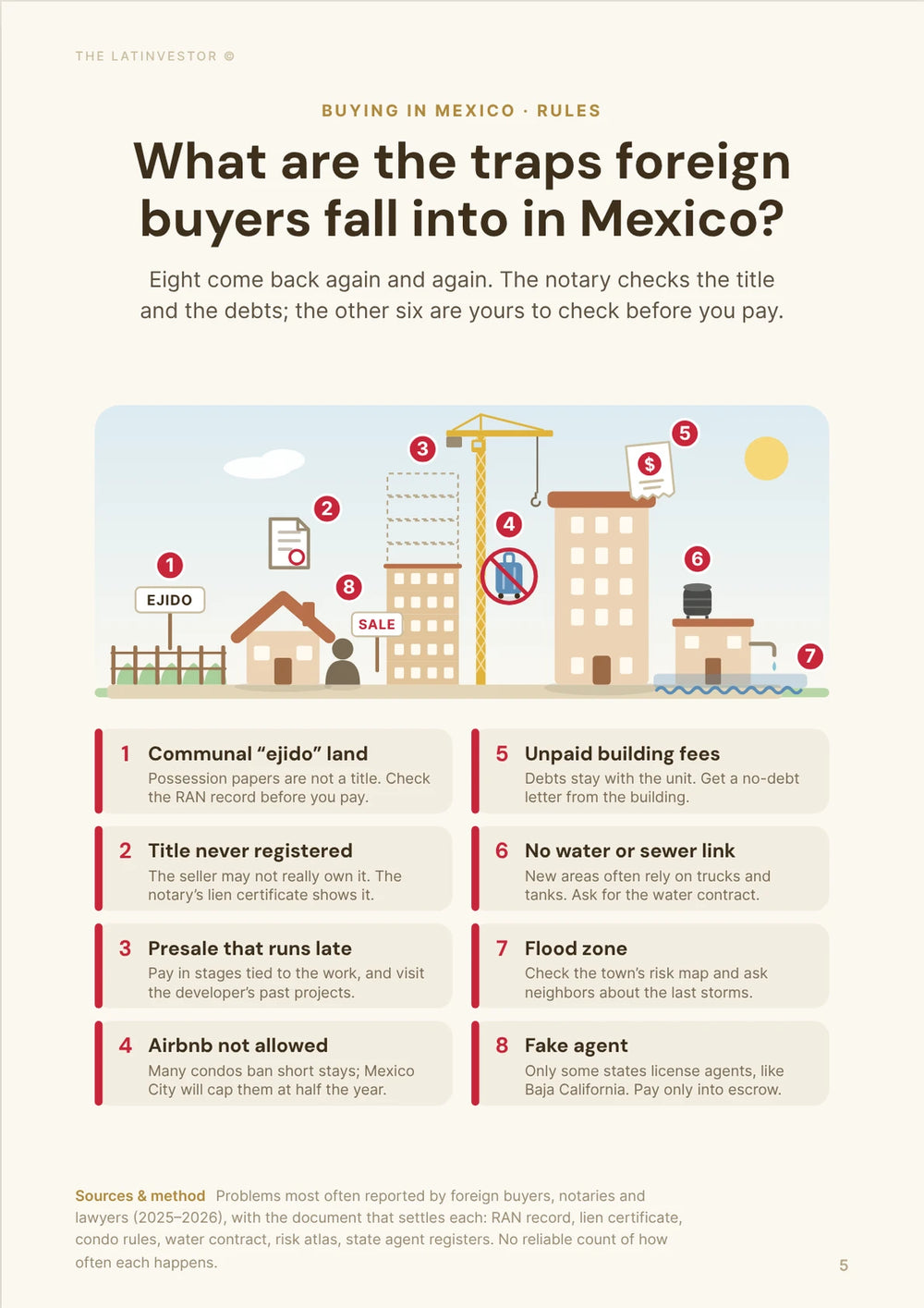
Can former ejido land be safe to buy?
Yes, former ejido land can be safe, but only once you can verify that the conversion to private property was actually completed.
"It used to be ejido" is not a red flag in itself. A lot of Mexico's urban and tourist growth sits on land whose status changed over time.
What matters is the paper trail: the assembly authorization, the RAN record of dominio pleno and the title issued, and a clean link from that title to the current entry in the Public Property Registry.
Watch the first sale after conversion: the Agrarian Law gives some parties a right of first refusal at that point. We buy converted land when the whole chain can be rebuilt on paper, and we walk away when the seller's argument is that the missing steps are "routine" and will be done later.
Are presale condos in Mexico safe right now?
Presale condos can be safe, but they carry more risk than finished property because you are paying for something the developer still has to build, finish and legally deliver.
NOM-247-SE-2021 regulates how homes are marketed and sold, and Profeco requires covered developer contracts to be registered. The contract must show its Profeco registration number, and terms that differ from the registered version to your detriment have no effect.
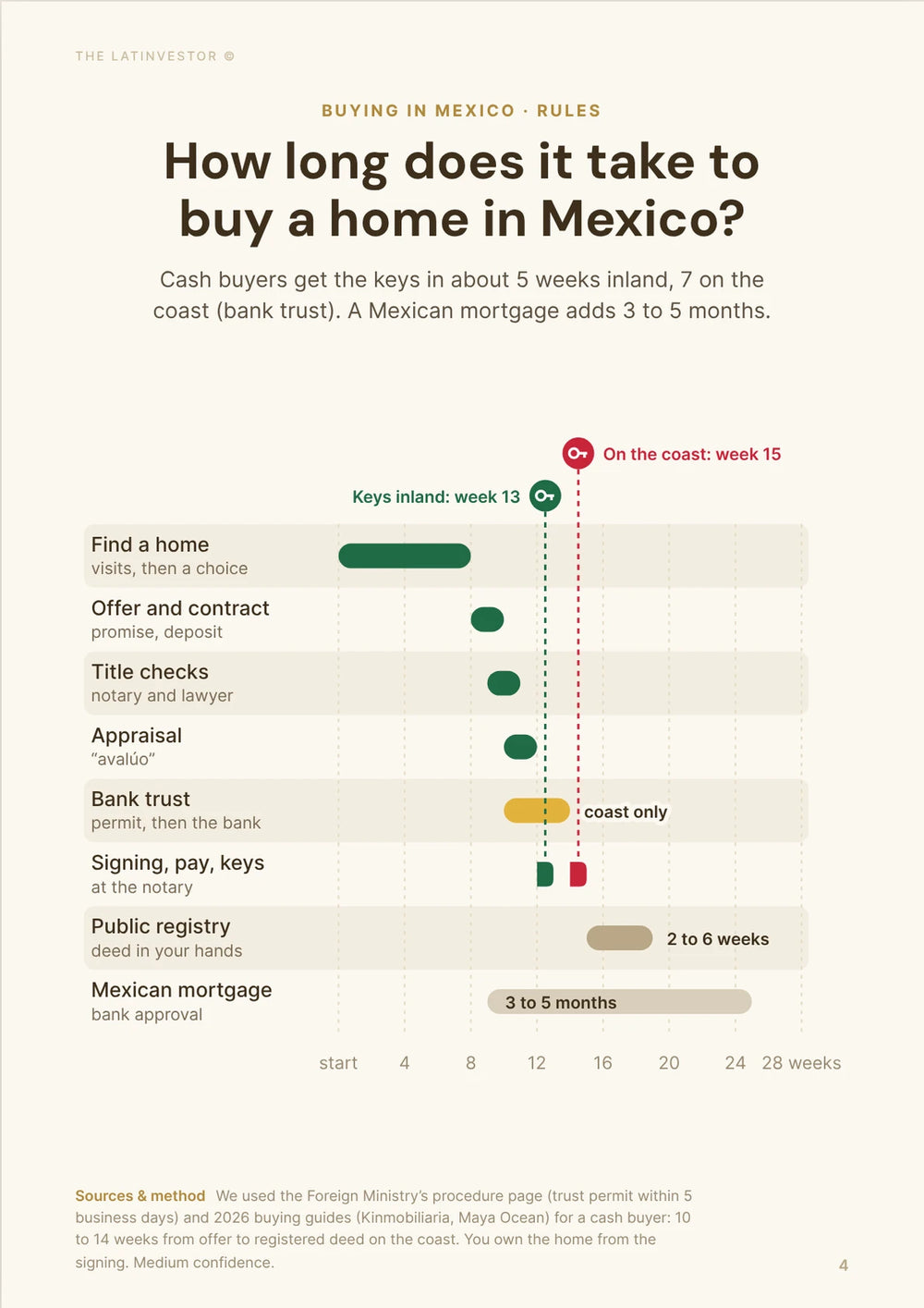
The rule also gives you a cooling-off period: the standard contract lets you cancel within 5 business days of signing. After that, what you get back depends on the contract's penalty clause, which NOM-247 requires to be reciprocal for buyer and developer.
None of this makes a weak developer strong. A compliant project can still be late, change specs or run out of money. So check both sides: the contract, the land, the construction and environmental permits, the developer's finished projects and proof that past buyers actually got their keys and deeds.
| Presale check | Better sign | Bad sign | What we learn |
|---|---|---|---|
| Profeco contract | Registration verified | Registration cannot be confirmed | Regulatory compliance |
| Land | Developer's rights independently verified | Ownership unclear | Whether project controls its site |
| Permits | Available and consistent with project | “Still being processed” | Construction legality |
| Track record | Several completed developments | Mainly renders and future projects | Delivery ability |
| Buyer remedies | Clear cancellation/default terms | Developer has broad discretion | What happens if things go wrong |
| Specifications | Written into contract or annexes | Mostly shown in marketing | What buyer is actually entitled to |
Are irregular developments in Tulum and the Riviera Maya a real problem in 2026?
Yes. Quintana Roo is where Mexico's permit problem is most visible right now: the state listed 116 irregular developments in 2025, and its blacklist reached 123 by August 2026.
Most cases are in Tulum, Isla Mujeres, Playa del Carmen and Cancún, according to SEDETUS figures reported in July and August 2026. "Irregular" usually means missing urban or environmental permits, building more units than authorized, or selling before the land is legally in order. In July 2026, President Sheinbaum also singled out Quintana Roo for double sales and land sold several times over.
This sits next to strong prices: Quintana Roo had the second-fastest state price growth in the first half of 2026, at 11.5%. Fast growth plus thin checks is exactly where buyers get hurt.
What to do: before paying anything, check the project against SEDETUS and municipal warning lists, ask for the construction licence, land-use permit and environmental authorization (MIA) by number, and have your notary or lawyer confirm them. A developer who sends renders instead of permit numbers is answering the question for you.
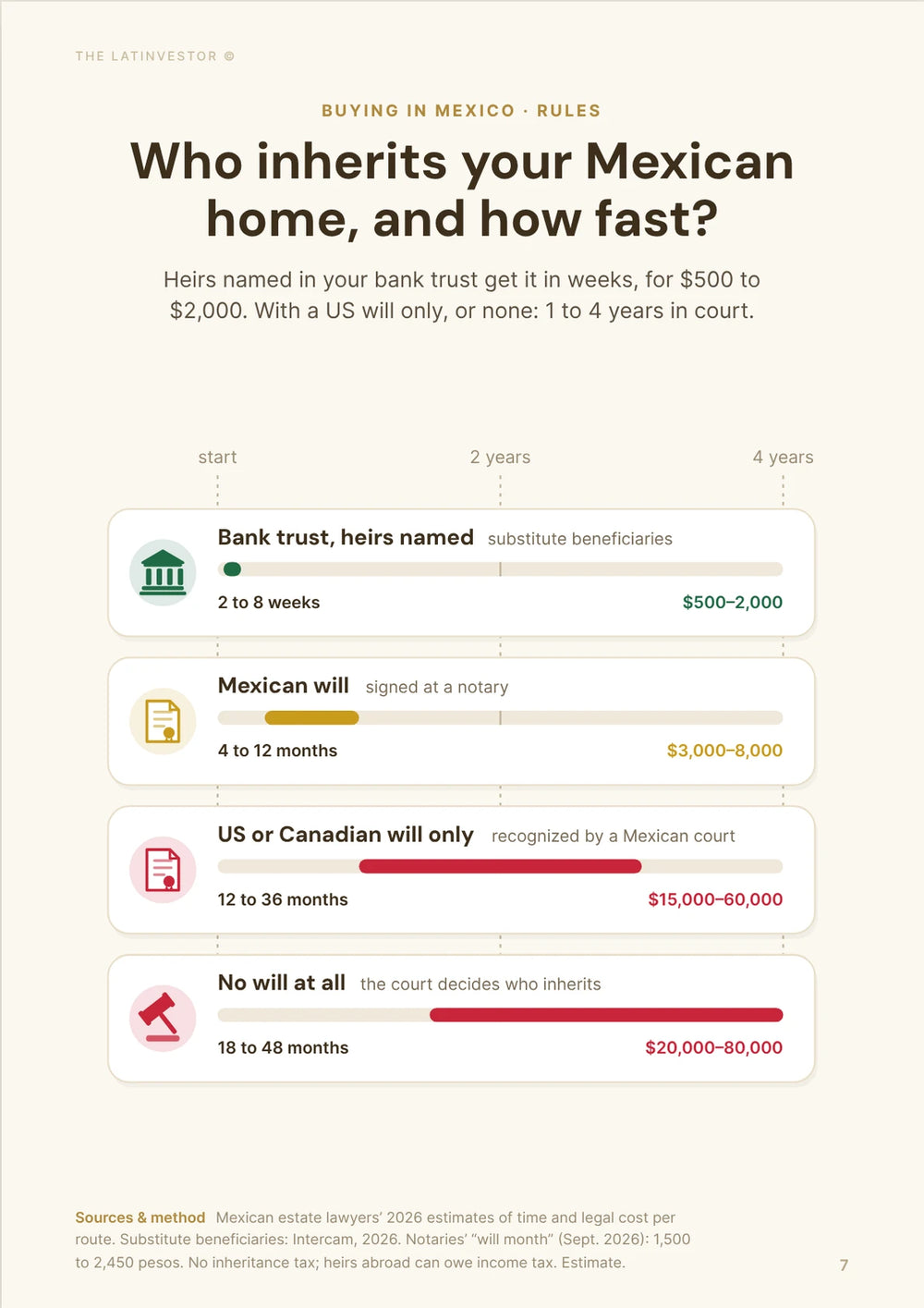
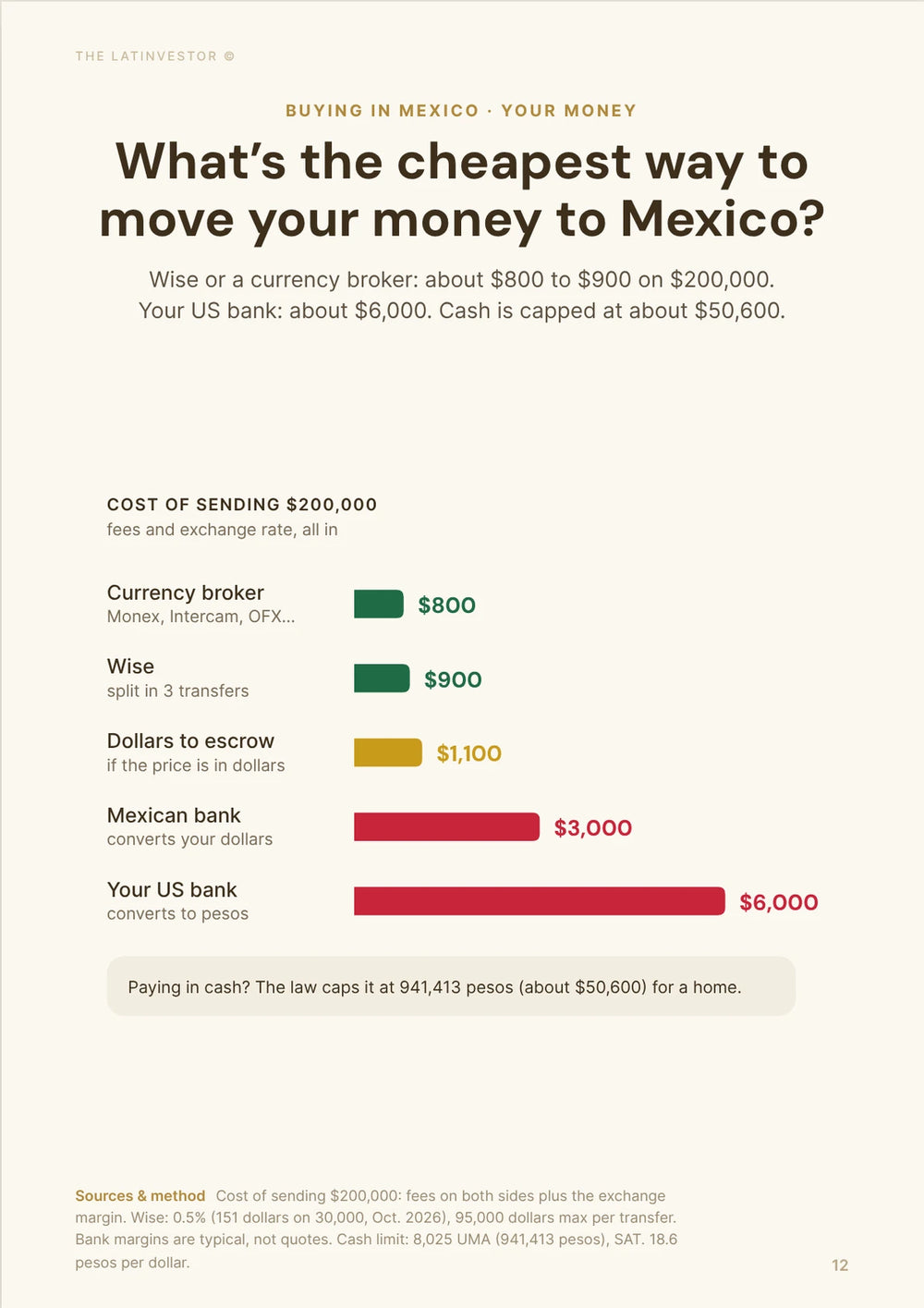
Is it safe to pay a property deposit in Mexico before all the checks are done?
No. Paying a large non-refundable deposit before independent checks are done is an avoidable risk.
Deposits are normal. The real question is whether you can get the money back if title, land status, permits or the contract turn out to be a problem.
Sales teams in hot markets use urgency: another buyer is interested, the price goes up tomorrow, the unit is released unless you pay today. For a resale, we want the legal review started before any meaningful payment becomes irreversible. For a presale, the contract should say exactly when deposits become non-refundable and what happens if the developer defaults.
Pay through banks, to the party named in the contract. Mexico's anti-money-laundering law requires identification and reporting for real-estate deals and limits large cash payments. Requests to pay an unrelated third party, split payments oddly or declare a lower price than you pay deserve a hard stop.
Can you get your deposit back if a Mexican developer cancels or delays?
Sometimes, but it is often slow and contested: in Jalisco, refused refunds top the list of complaints Profeco receives against developers.
In Jalisco alone, Profeco logged 483 formal complaints against real-estate companies between 2024 and 31 August 2026, including 145 in 2026, mainly over refused refunds or cancellations, late delivery and construction defects. One Zapopan project, Vita Poniente, left about 100 buyers with losses of at least MXN 50 million (about USD 2.7 million).
Your strongest rights are the ones written in the registered contract: the 5-business-day cancellation window, a reciprocal penalty if either side defaults, and a delivery date. Even when you win, getting your advance back returns your money; interest or damages depend on the contract and on how long the claim takes.
What to do: keep presale deposits small until permits and land are verified, pay in stages tied to construction milestones, ask whether funds go to a separate trust or escrow rather than the developer's operating account, and keep every receipt. If a refund stalls, file with Profeco early, with the contract registration number.
Can someone sell you a Mexican property they do not own?
Yes. Fraudulent sales and double sales happen in Mexico, which is why we verify the seller against official records rather than the seller's documents.
In Quintana Roo, members of the state bar said in July 2026 that fraud makes up about 30% of the property cases law firms handle there, using identity theft, altered deeds and forged signatures. The federal government has called for modernizing cadastres and property registries for the same reason.
Ordinary problems can have the same effect as fraud: a deed still in the name of a dead relative, heirs selling before the inheritance is settled, a company representative without authority, or a power of attorney narrower than claimed.
A signed private contract proves two people made promises; it does not give you the protection of a public deed registered in your name. We care far more about whether the official ownership chain works than about how convincing the paperwork looks.
Does crime make Mexican property unsafe to own?
Crime can make a specific property harder to rent, manage or resell, but national figures say little about one purchase.
In June 2026, 59.8% of adults in Mexico's cities said they felt unsafe where they live, according to INEGI's ENSU survey. That average hides big gaps, even between neighbours on the same coast.
Over the 12 months to September 2026, homicide rates were about 4.1 per 100,000 in Los Cabos, 5.7 in Playa del Carmen and 6.7 in Cancún, but about 26 in Tulum, less than an hour's drive from Playa (Enfemex, based on SESNSP data). Playa del Carmen's government reports a 51.6% fall in intentional homicides in January to August 2026.
For an owner, what matters is local: burglary, how long the property sits empty, road safety at night, the cost of private security, gated access and whether tenants and guests feel comfortable. A managed, gated condo and an isolated house in the same town are very different experiences. Check the neighbourhood and access roads, not the country's reputation.
Are hurricanes, floods, water cuts and earthquakes a serious property risk in Mexico?
Yes, in parts of Mexico, and 2026 showed again that they need to be checked street by street, not destination by destination.
This year alone: a June storm flooded parts of Puebla with up to 70 cm of water; an August flood hit at least 18 homes in Puerto Vallarta, where roadworks also disrupted water in about 40% of neighbourhoods; Los Cabos ran emergency water-delivery schedules in September; and Playa del Carmen collected about 45,100 tonnes of sargassum between January and late September.
Two developments in the same resort can sit at different heights, drain differently, follow different building standards and get very different insurance terms. CENAPRED's Atlas Nacional de Riesgos maps earthquakes, cyclones, floods and landslides, and is the place to start.
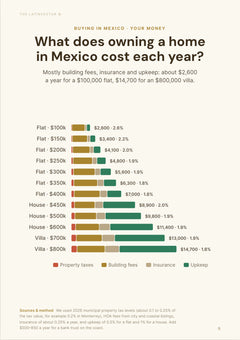
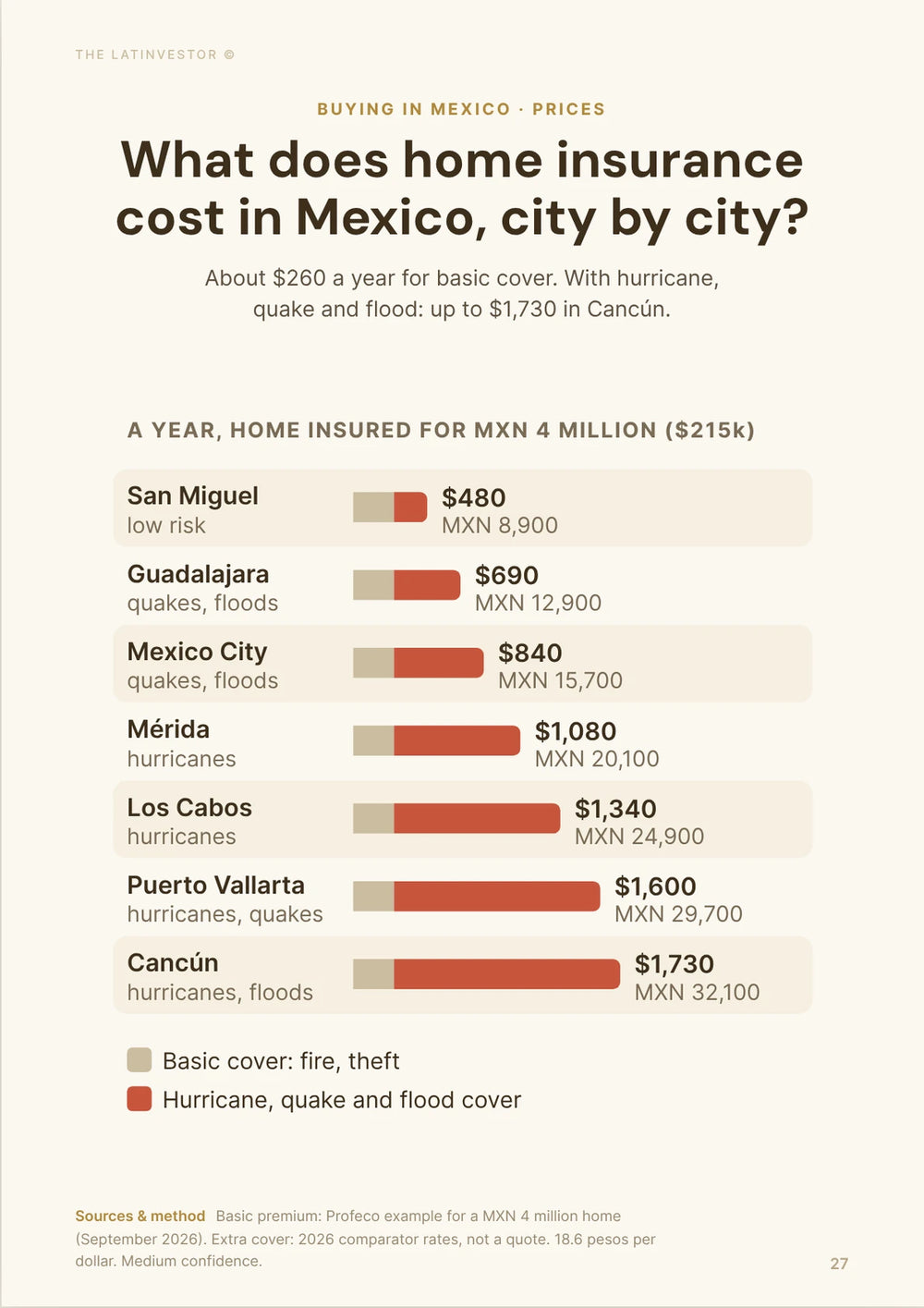
Ask for the building's structural documents, flood history and water supply (city network, wells, trucks, desalination). Price insurance before you buy: Profeco's September 2026 comparison found home policies from about MXN 4,900 to 25,900 a year for a home insured at around MXN 4 million, with very different coverage.
| Hazard | Where it matters most | What to check | Why city-level data are insufficient |
|---|---|---|---|
| Tropical cyclones | Caribbean, Gulf and Pacific coasts | Construction, openings, insurance | Buildings handle wind differently |
| Flooding | Low-lying/coastal urban areas | Elevation, drainage, flood history | Exposure can change within a few streets |
| Earthquakes | Several central and Pacific regions | Engineering, age, structural history | Building quality varies |
| Landslides | Hillside developments | Slope studies and drainage | Individual site design matters |
| Storm surge | Exposed coastlines | Elevation and coastal exposure | Distance alone does not show vulnerability |
| Water shortages | Los Cabos, parts of Puerto Vallarta and other fast-growing areas | Supply source, cuts history, storage | Supply can differ by neighbourhood and building |
Are rising Mexican property prices making buyers take more risks?
Yes. Prices are still climbing fast enough to make buyers rush, even though fewer bank mortgages are being signed.
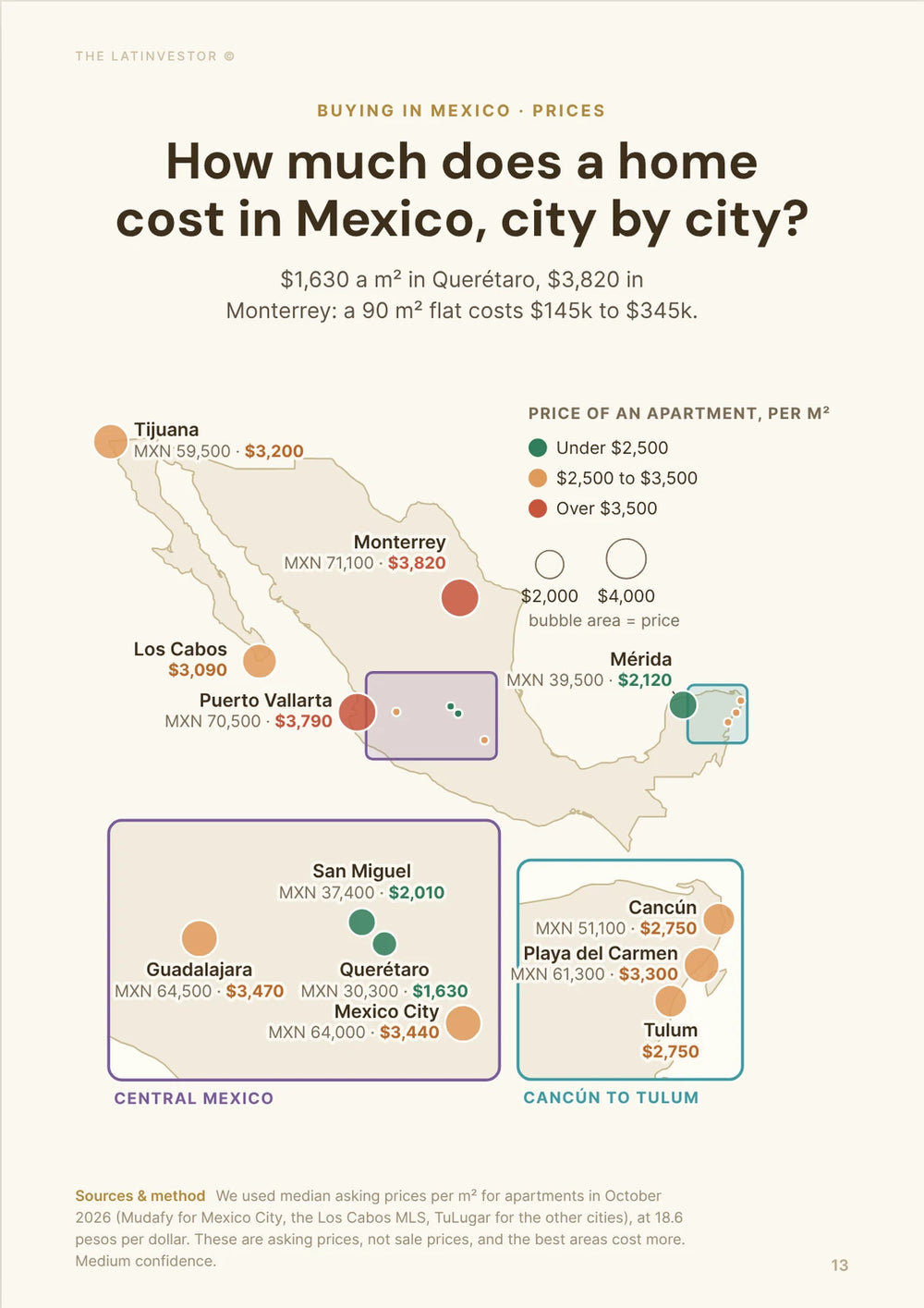
The Sociedad Hipotecaria Federal index shows prices of homes bought with a mortgage up 7.9% in the first half of 2026 compared with a year earlier, and new homes up 8.3%. Some states are well above that: Quintana Roo 11.5% and Jalisco 11.2%.
Metro areas spread widely: Guadalajara rose 11.1%, Tijuana 9.7%, Puebla-Tlaxcala 8.5% and Monterrey 8.3%, while Querétaro (5.6%) and Valle de México (4.6%) were slower.
The catch: according to the banking association ABM, commercial banks granted about 53,400 mortgages in the first half of 2026, 1.9% fewer than a year earlier. With prices rising faster than bank lending, more buyers lean on cash and developer payment plans, which is exactly where deposits are exposed. A home gaining 10% a year is still a bad buy if you cannot get clean title.
| SHF metropolitan market | First-half 2026 annual change | Compared with national 7.9% | Current picture |
|---|---|---|---|
| Guadalajara | 11.1% | Much faster | Strong pricing pressure |
| Tijuana | 9.7% | Faster | Strong appreciation |
| Puebla-Tlaxcala | 8.5% | Faster | Above national pace |
| Monterrey | 8.3% | Slightly faster | Broad strength |
| Querétaro | 5.6% | Slower | Moderate appreciation |
| Valle de México | 4.6% | Much slower | Relatively subdued |
Can we rely on a real-estate agent when buying property in Mexico?
A good agent is very useful, but the agent should never be the only person checking whether the deal is legally safe.
Agents help with prices, neighbourhoods, negotiation and logistics. They do not replace an independent check of title, registry and contract.
Many agents work for the seller or the developer. That is normal, but they are paid when the deal closes. NOM-247 has tightened the rules on how homes are marketed, yet a separate lawyer or notary checking the deal is still worth it.
The simplest test is how the agent reacts to checks. A professional has no problem with registry searches, a lawyer reading the contract, a Profeco lookup or a few extra days to fix a title issue. Pressure to skip those tells you more than any presentation.
What are the biggest red flags when buying property in Mexico?
The biggest red flags are unclear ownership, unfinished ejido conversion, missing permits, unverified presales, odd payment requests and pressure to skip independent checks.
One oddity does not mean fraud. Several together should change your decision fast.
A seller asking for a wire before any title review, ejido land sold as if conversion were guaranteed, a developer without a Profeco contract or permit numbers, or coastal property offered to a foreigner through an improvised structure: each should trigger questions.
If you are told to pay someone who has no clear place in the deal, or to declare a lower price than you actually pay, stop until it is explained and verified.
| Red flag | Why we care | What we would do |
|---|---|---|
| Large deposit demanded immediately | Due diligence has not happened | Make commitment conditional on checks |
| Seller discourages independent notary/lawyer | Removes an important safeguard | Stop and investigate |
| Ejido certificate presented as private title | Land may still be social property | Verify directly with RAN |
| Coastal property uses unusual foreign-ownership structure | May not comply with restricted-zone rules | Verify SRE requirements |
| No permit numbers, or project on a SEDETUS or municipal warning list | Project may be irregular or closed | Get licences checked by your notary or lawyer |
| Developer cannot verify Profeco contract | Consumer protections may be missing | Check before signing |
| Seller name differs from registry | Ownership may be defective | Resolve before payment |
| Money goes to unrelated third party | Payment trail makes little sense | Verify recipient |
| Declared price differs from real payment | Can create tax and legal problems | Record the real transaction |
So, is it actually safe to buy property in Mexico?
Yes, for an informed buyer, but we would avoid any deal that cannot survive independent checks of title, land status, permits, contracts and payments.
The legal route is well organised: foreign ownership is allowed by law, coastal and border purchases have the fideicomiso, transfers go through notaries and registries, RAN handles social land and its conversion, Profeco regulates developer contracts, and CENAPRED maps physical hazards. These protections work best when you use them early.
The genuinely dangerous deals are a narrow group: unconverted ejido land sold as private property, presales from developers or projects that cannot be verified (like the 123 irregular projects found in Quintana Roo), private contracts treated as title, large irreversible payments before checks, and deals built to avoid the institutions that would check them.
For a finished, privately titled home, with the seller and liens verified, the right ownership structure, a public deed and registration done, Mexico is not an unusually unsafe place to buy. Location still matters for crime, floods, water and resale. But the biggest risk you control sits inside the transaction. If everything important can be checked outside the sales process, it is an ordinary purchase. If the deal relies on "trust me", leave it.
Our methodology
This article estimates how safe it is to buy property in Mexico by separating the risks that can change the outcome of a purchase: foreign-ownership rules, fideicomisos, title and registry checks, ejido land, presales and permits, deposits and payments, seller fraud, local security, natural hazards and market pressure. The verdict is qualitative, not a probability of loss.
Legal rules come from the institutions that apply them: the Mexican Constitution and Foreign Investment Law, SRE's restricted-zone trust procedure and its September 2026 fee schedule, the Registro Agrario Nacional and the Ley Agraria for ejido land, NOM-247-SE-2021, the Federal Consumer Protection Law and Profeco for presales, and the federal anti-money-laundering law and SAT guidance for payments.
Figures come from official sources first: SHF's housing price index for the first half of 2026, INEGI's ENSU survey, SEDETUS and municipal warnings in Quintana Roo, local civil protection and water utilities, Profeco's insurance comparison and complaint data. Where no official series exists, we used dated 2026 press and data sites (Por Esto, N+, Crónica, El CEO, Enfemex for homicide rates based on SESNSP), and broker guides only for bank trust fees and closing-cost ranges, which we treat as estimates.
We checked these figures in October 2026. Conversions use about 18.6 pesos per US dollar and 20.9 pesos per euro.
Limits: there is no national count of ejido disputes, failed presales or property fraud, so we use state and city examples rather than national rates. Homicide rates are municipal, not neighbourhood figures. SHF prices cover homes bought with a mortgage, not cash sales or asking prices. Bank fees and closing costs vary by bank, state and price.
Key sources used for this analysis include the Mexican Constitution, the Foreign Investment Law, SRE's restricted-zone trust procedure and costs, Homia's 2026 bank-trust fee comparison, Compass Abroad on notary fees and closing costs, the Colegio Nacional del Notariado Mexicano on the Sello Digital Notarial, RAN procedures, RAN title issuance, the Ley Agraria, Quinta Fuerza on the Tulum permit warning, NOM-247-SE-2021, the Federal Consumer Protection Law, Profeco on buyer rights, Profeco on registered contracts, Profeco on contract revocation, Quintana Roo government on 116 irregular developments, Por Esto on irregular developments and land fraud, Riviera Maya News on the 123 blacklisted developments (August 2026), the anti-money-laundering law, SAT on vulnerable activities, N+ on Profeco complaints in Jalisco, INEGI's ENSU release for June 2026, INEGI's ENVIPE, Enfemex for Quintana Roo and Los Cabos, Playa del Carmen's government on homicides, CENAPRED's Atlas Nacional de Riesgos, Puebla civil protection, Quadratín on the Puerto Vallarta flood, SEAPAL on water disruption, Los Cabos on emergency water deliveries, Diario Cambio 22 on sargassum, Profeco's home insurance comparison, the SHF housing price index, El CEO on state price growth and Crónica on mortgage volumes.