Summary
A plot of land in Argentine Patagonia lists at a median of about USD 40,000 in El Bolsón, USD 106,000 in Bariloche (all plot sizes; USD 92,000 for a standard residential lot) and USD 155,000 in Villa La Angostura (TuLugar, October 2026).
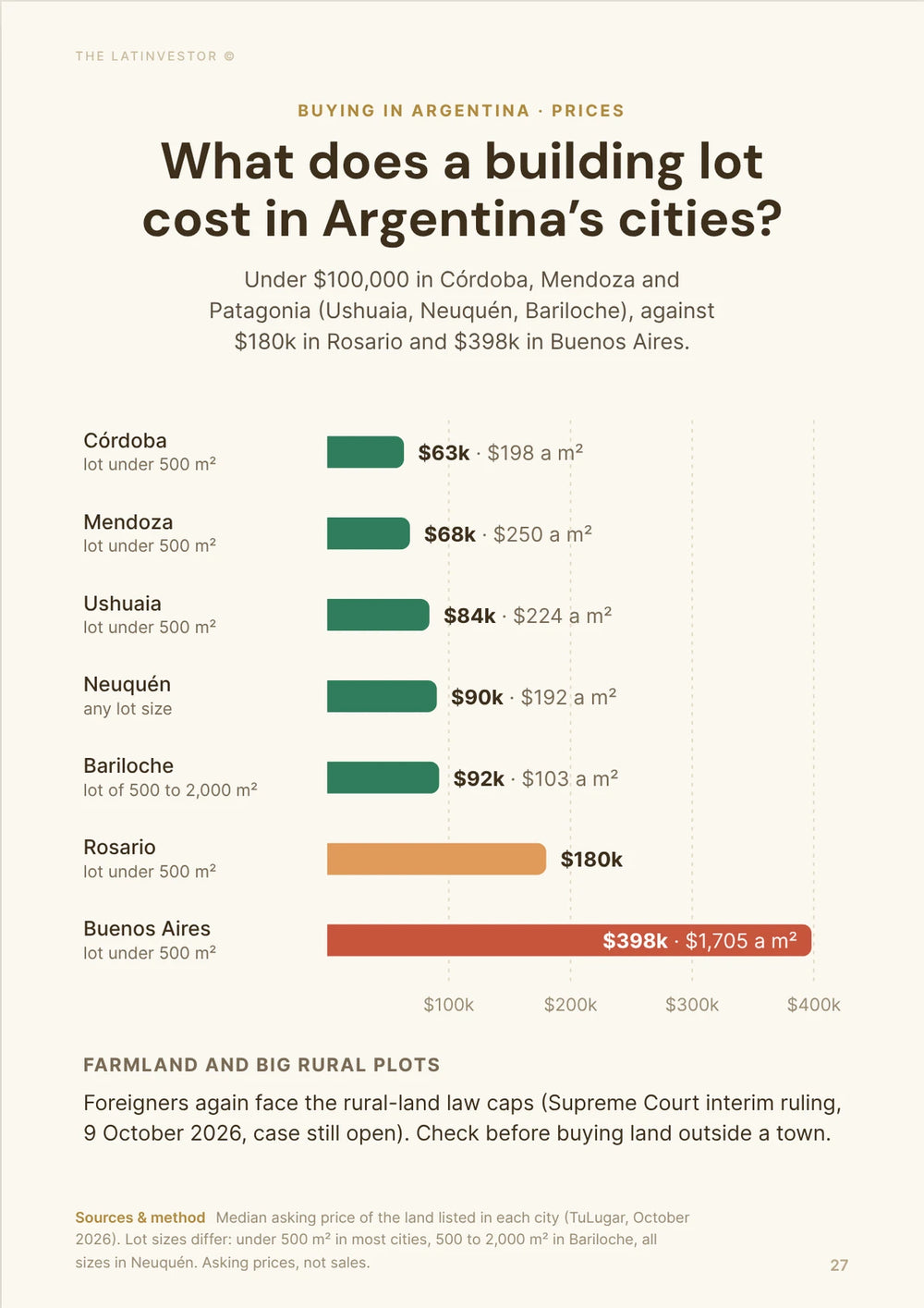
There is no Patagonia-wide land index, so the only honest way to compare is town by town: per square meter, land asks about USD 61 in Esquel, USD 104 in Bariloche and USD 192 in Neuquén.
The cheapest realistic entry is a small urban lot in El Bolsón, at a median of about USD 33,000; Esquel's residential lots of 500 to 2,000 m² ask about USD 39,000.
In the lake towns, a residential lot of 500 to 2,000 m² costs about USD 92,000 in Bariloche, USD 110,000 in Villa La Angostura and USD 135,000 in San Martín de los Andes.
A quinta or chacra of 2,000 to 10,000 m² asks about USD 70,000 in El Bolsón, USD 277,000 in Bariloche and USD 350,000 in Villa La Angostura.
The bigger the plot, the cheaper each square meter: in Bariloche it falls from about USD 103 on a residential lot to USD 79 on a chacra and USD 50 on land above one hectare.
Supply is not the problem: lots make up about 31% of everything for sale in Bariloche (37% of the listings TuLugar classifies by type) and 36% in El Bolsón, which leaves room to negotiate on plots that have sat on the market.
We found no published land median for Trevelin, Comodoro Rivadavia or Río Gallegos, so we removed the old estimates; Chilean Patagonia is out of scope.
Read the figures as asking prices: the gap to final prices is not published for land, and for Bariloche apartments it is about 3.5% (Mudafy).
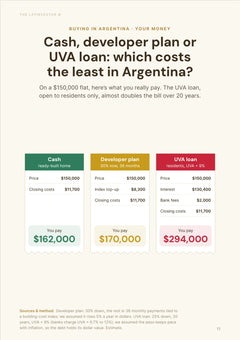
Buying a lot and building is not obviously cheaper: a Bariloche lot at USD 92,000 plus 120 m² at the USD 1,324 per m² reference building cost comes to about USD 251,000, before permits and overruns, against USD 305,000 for a median 3-bedroom house.
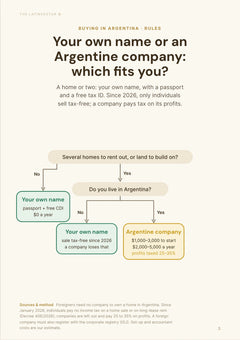
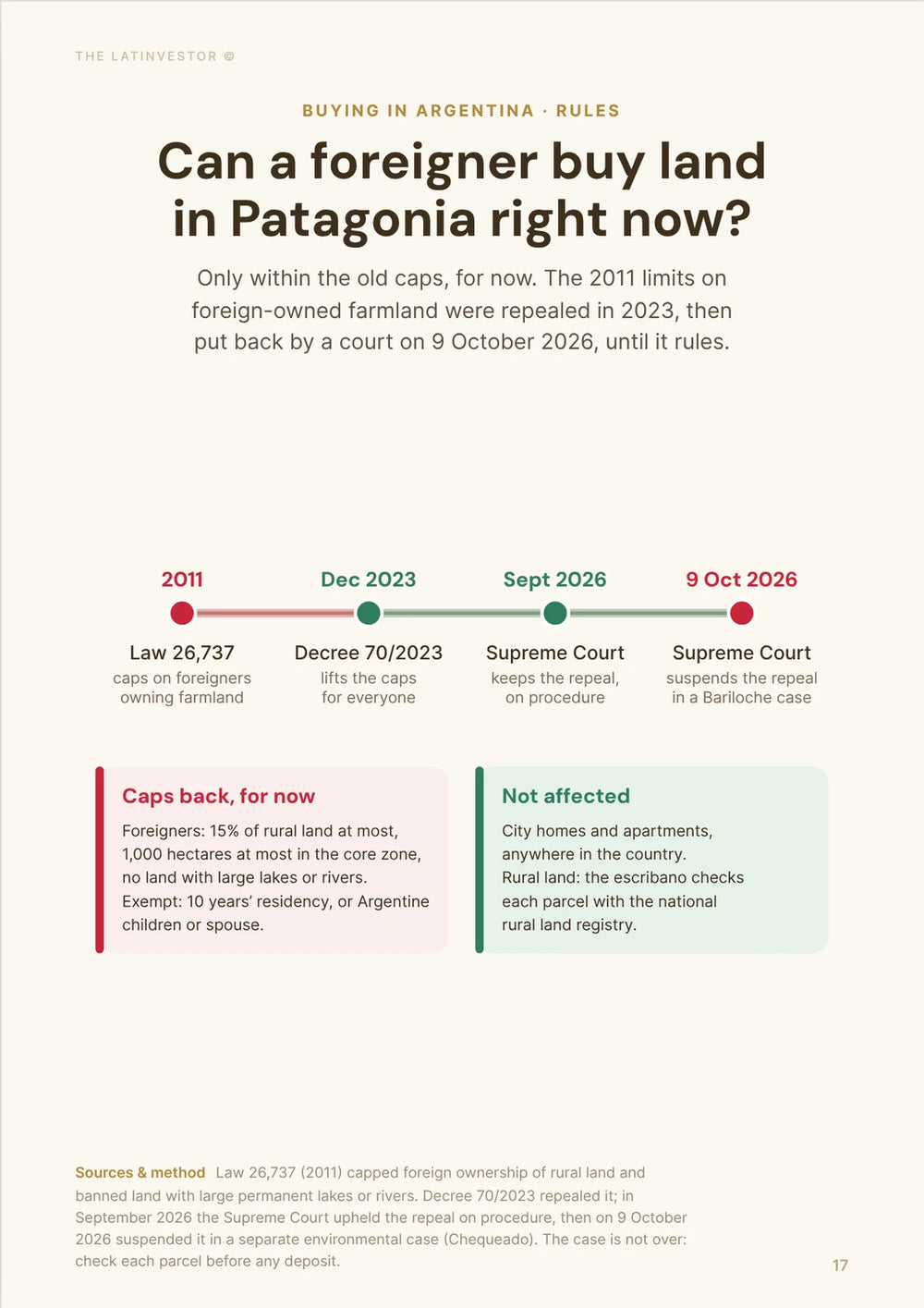
Since the Supreme Court decision of 9 October 2026, the 15% caps on foreign ownership of rural land apply again pending a final ruling, so a chacra or lake parcel outside the urban grid needs a check before any deposit.
Bottom line: compare by town and plot size, aim for a residential lot near USD 92,000 in Bariloche or USD 40,000 in El Bolsón, and check land status, fire risk and road access before you pay.

A quick summary table
| Metric | Value |
|---|---|
| Most expensive town for land | Villa La Angostura: median lot about USD 155,000 (EUR 138,000) |
| Most affordable towns for land | El Bolsón (median lot about USD 40,000) and Esquel (about USD 44,000) |
| Bariloche, all lots | Median about USD 106,000, about USD 104 per m² |
| Land price per m², all lots, by town | USD 61 (Esquel) to USD 192 (Neuquén); small urban lots in Ushuaia about USD 224 |
| Cheapest realistic entry | Urban lot under 500 m² in El Bolsón: median about USD 33,000 |
| Residential lot (500 to 2,000 m²) | About USD 39,000 (Esquel) to USD 135,000 (San Martín de los Andes); Bariloche USD 92,000 |
| Quinta or chacra (2,000 to 10,000 m²) | About USD 70,000 (El Bolsón), USD 277,000 (Bariloche), USD 350,000 (Villa La Angostura) |
| Land above one hectare | About USD 625,000 (El Bolsón) to USD 1 million (Bariloche), few listings |
| Price per m² as plots get bigger (Bariloche) | USD 103 (residential lot) → USD 79 (chacra) → USD 50 (above one hectare) |
| Share of lots among all listings | About 17% (San Martín de los Andes) to 36% (El Bolsón) |
| Gap between the most and least expensive town | Almost four times: USD 155,000 vs USD 40,000 median lot |
| Patagonia-wide land median | None published: compare town by town |
Patagonian towns ranked by land price
This table ranks the main towns of Argentine Patagonia by median lot price, from the most expensive to the cheapest. For each town you get the median of all land listings, the price per square meter, and medians for three plot sizes, plus what people usually do with the land, the main pros and cons, and the market segment.
Plot sizes follow TuLugar's categories: urban lot under 500 m², residential lot of 500 to 2,000 m², and quinta or chacra of 2,000 to 10,000 m². "n/a" means the portal publishes no reliable median for that size.
| Rank | Town | Median Lot Price (all land) | Land Price per Square Meter | Urban Lot (under 500 m²) | Residential Lot (500 to 2,000 m²) | Quinta or Chacra (2,000 to 10,000 m²) | Typical Land Use | Key Pros | Key Cons | Market Segment |
|---|---|---|---|---|---|---|---|---|---|---|
| 1 | Villa La Angostura | $155,000 | $113/m² | $48,000 | $110,000 | $350,000 | Second home or luxury build | Lake Nahuel Huapi, forest plots, strict zoning that protects the setting, strong summer and ski demand | Highest prices in the region, slow permits, forest fire exposure, access depends on Route 40 (closed after a landslide in October 2026) | Prime Land |
| 2 | San Martín de los Andes | $121,000 | $92/m² | n/a (15 listings) | $135,000 | $91,000 (thin sample) | Second home build | Lake Lácar, Chapelco ski area and airport, year-round tourism | Few lots for sale (about 17% of listings), strict building codes, prices already high | Prime Land |
| 3 | Bariloche | $106,000 | $104/m² | $55,000 | $92,000 | $277,000 | Custom home build, lot-and-build | Biggest and most liquid land market in Patagonia (about 1,700 lots listed), lake and mountain views, airport | Steep plots raise building costs, limited sewage and roads on the west side, lake and Llao Llao plots far above the median | Prime Land |
| 4 | Neuquén (city) | $90,000 | $192/m² | n/a | n/a | n/a | Primary residence build | Vaca Muerta oil and gas jobs, flat land, full services, real local demand | No lakes or mountains, smaller lots at a high price per m², prices follow the energy cycle | High-Value Land |
| 5 | Ushuaia | $84,000 (urban lots) | $224/m² (urban lots) | $84,000 | n/a | n/a | Primary residence build | Tight land between mountains and the Beagle Channel, cruise and tourism economy | Small plots, harsh winters, building materials shipped from far away | High-Value Land |
| 6 | Esquel | $44,000 | $61/m² | $55,000 | $39,000 | n/a | Self-build home | Low entry price, La Hoya ski area, airport (expansion tenders announced in October 2026) | Small market (66 lots listed), slower resale, cold winters | Affordable Land |
| 7 | El Bolsón | $40,000 | $72/m² | $33,000 | $42,000 | $70,000 | Self-build home, small farm | Lowest entry price, lots of choice (331 lots listed), growing interest from people leaving big cities | The early-2025 fire destroyed 166 homes, uneven services and road access, slow resale | Entry-Level Land |
We found no published land median for Trevelin, Comodoro Rivadavia or Río Gallegos, so we removed the old estimates rather than guess. As a first yardstick for Trevelin, residential lots in Esquel, 25 km away, ask about USD 39,000; check current listings before you rely on it.
This article covers Argentine Patagonia only. Chilean towns such as Pucón, Puerto Varas and Punta Arenas are a different market, with different rules and currency, and are left out.
Key insights about land purchase prices in Patagonia
- A median lot in Villa La Angostura (USD 155,000) costs almost four times one in El Bolsón (USD 40,000), even though the two towns are only about 200 km apart by road along the same lake corridor.
- Per square meter of all land, the gap looks smaller (USD 113 against USD 72) because El Bolsón lists more large, cheap plots. On the same plot size it stays wide: a residential lot of 500 to 2,000 m² costs about 2.6 times more in Villa La Angostura (USD 110,000 against USD 42,000).
- Neuquén and Ushuaia have the highest price per m² (USD 192 and USD 224) but sell small city lots, so their total lot prices (USD 84,000 to USD 90,000) stay below Bariloche's.
- Bigger plots are cheaper per square meter: in Bariloche, USD 103 on a residential lot, USD 79 on a chacra and USD 50 above one hectare; in El Bolsón, USD 88 on an urban lot down to USD 9 for a field.
- Land is plentiful on the market: about 1,700 lots are listed in Bariloche and 331 in El Bolsón. A lot that has been listed for months is where you push for a discount.
- Small samples can mislead. In San Martín de los Andes, 15 urban lots show a median of USD 360,000 and 28 chacras a median of USD 91,000, below residential lots: treat those two figures as noise and compare actual listings.
- Building has become more expensive in dollars: Zonaprop puts building costs up about 18.5% in dollars since January 2026, because the peso stayed strong while prices kept rising. That hits lot-and-build projects more than buying a used house.
- Forest plots carry real fire risk: the early-2025 fire around El Bolsón affected 221 homes, 166 of them destroyed. Check firebreaks, slope and distance to the forest edge.
- Access matters as much as the view: Route 40 near Puerto Arauco, the road into Villa La Angostura, was closed after a slope collapse on 18 October 2026.
- A town lot is not rural land, but a chacra, a field or a lake parcel outside the urban grid may be. Since 9 October 2026 the foreign-ownership caps on rural land apply again.
How should you read these land prices?
These are asking prices from online listings, not deed prices. No one publishes the negotiated discount on land in Patagonia. For Bariloche apartments, Mudafy's tracked sales show a median gap of about 3.5% between asking and final price; on land that has sat on the market for months, it can be larger.
Compare plots of the same size. A town median mixes small city lots and large plots, so the price per square meter only makes sense within one size category: that is why Neuquén's USD 192 per m² and Esquel's USD 61 per m² are not like for like.
Check what you can build before you look at the price. Zoning, minimum plot size, slope and sewage connection change the value of a lot from one block to the next, especially in Bariloche, Villa La Angostura and San Martín de los Andes.
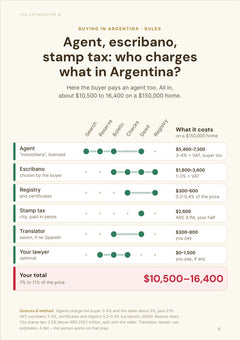
Count the buying costs on top. In Río Negro (Bariloche, El Bolsón) stamp tax is about 1% to 1.5%; in Neuquén it is about 2.5% (a Roomix figure, not confirmed by an official source), usually split between buyer and seller. With notary (1% to 2% plus VAT), registry and certificates (0.2% to 0.4%) and the agent, a buyer should budget roughly 5.5% to 9% of the price.
Is it cheaper to buy a lot and build than to buy a house right now?
Not by much, and often not at all. Reporte Inmobiliario put a standard build at about USD 1,324 per built m² in August 2026, before land, permits, fees and profit. For comparison, the Centro de Ingenieros de Mendoza puts an economy house at about ARS 1.62 million per m² in October 2026 and a mid-quality house at about ARS 2.1 million, land not included: about USD 1,050 and USD 1,350.
Take a Bariloche residential lot at the median USD 92,000 and a 120 m² house at USD 1,324 per m²: about USD 159,000 of building, so roughly USD 251,000 in total. The median 3-bedroom house in Bariloche lists at about USD 305,000. The saving of about USD 54,000 shrinks fast with an architect, connections, a sloped plot, Patagonian insulation and the usual overruns.
And the trend is against builders this year: INDEC's construction cost index rose 31.3% in pesos in a year to September 2026, while the dollar rose only about 4.9% since January. Zonaprop puts building costs up about 18.5% in dollar terms since January.
What to do: build only if you want something the market does not sell (a specific plot, view or design). Get a fixed-price quote per m² from a local builder before you buy the lot, and use it to cap your offer on the land.
Can foreigners still buy lake plots and chacras after the October 2026 ruling?
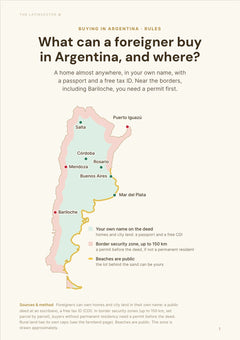
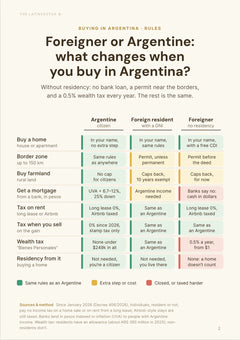
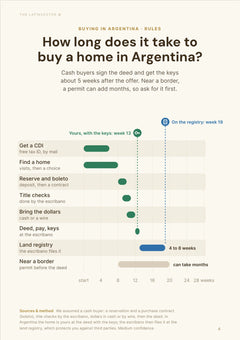
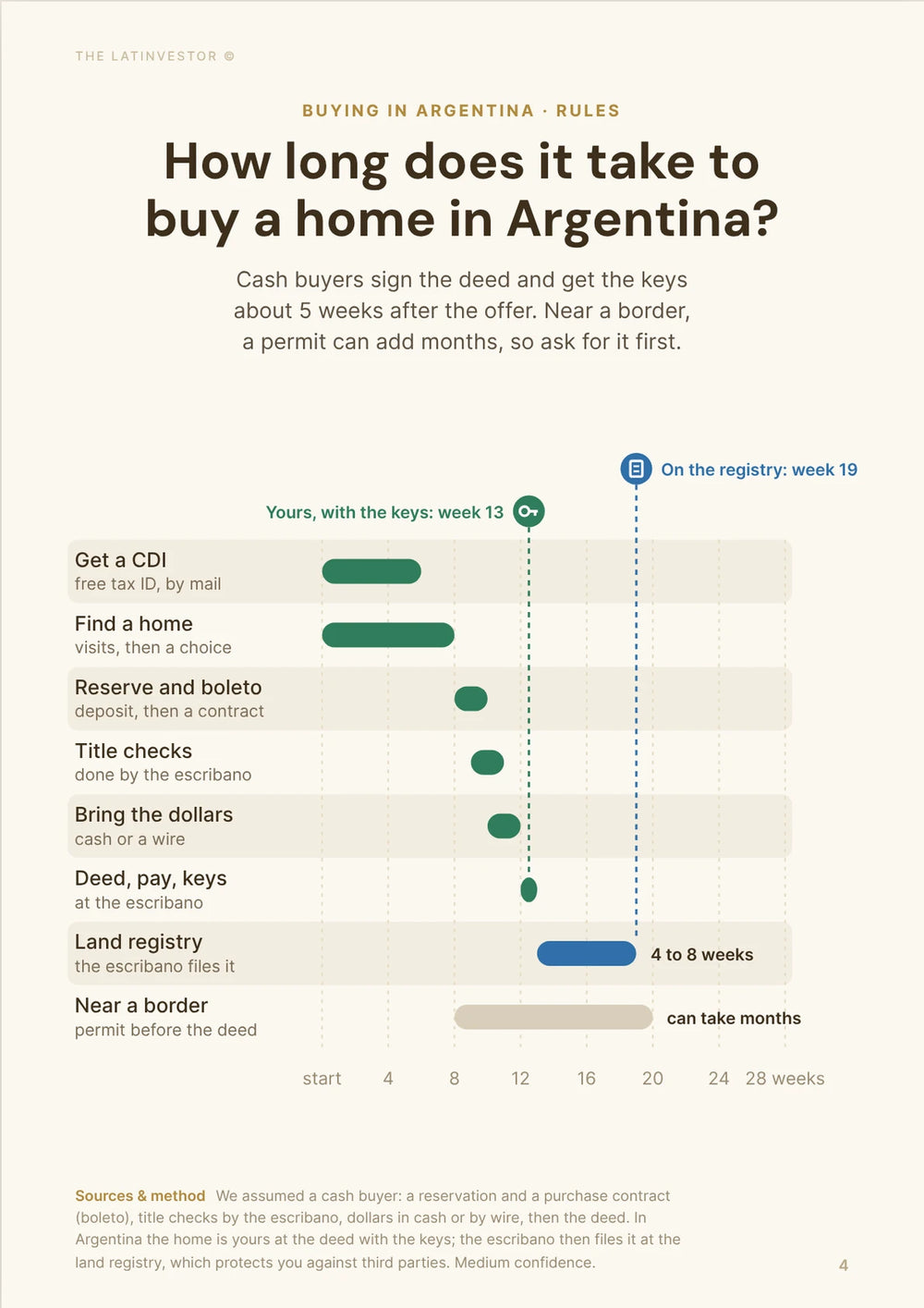
For a town lot, nothing changed: a foreigner can buy an urban plot in Bariloche, El Bolsón or Neuquén like a local, with a CDI tax number (free, up to 30 business days for non-residents).
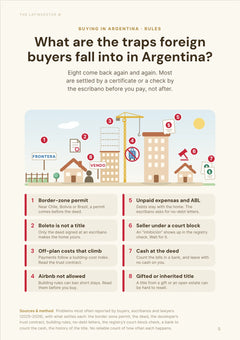
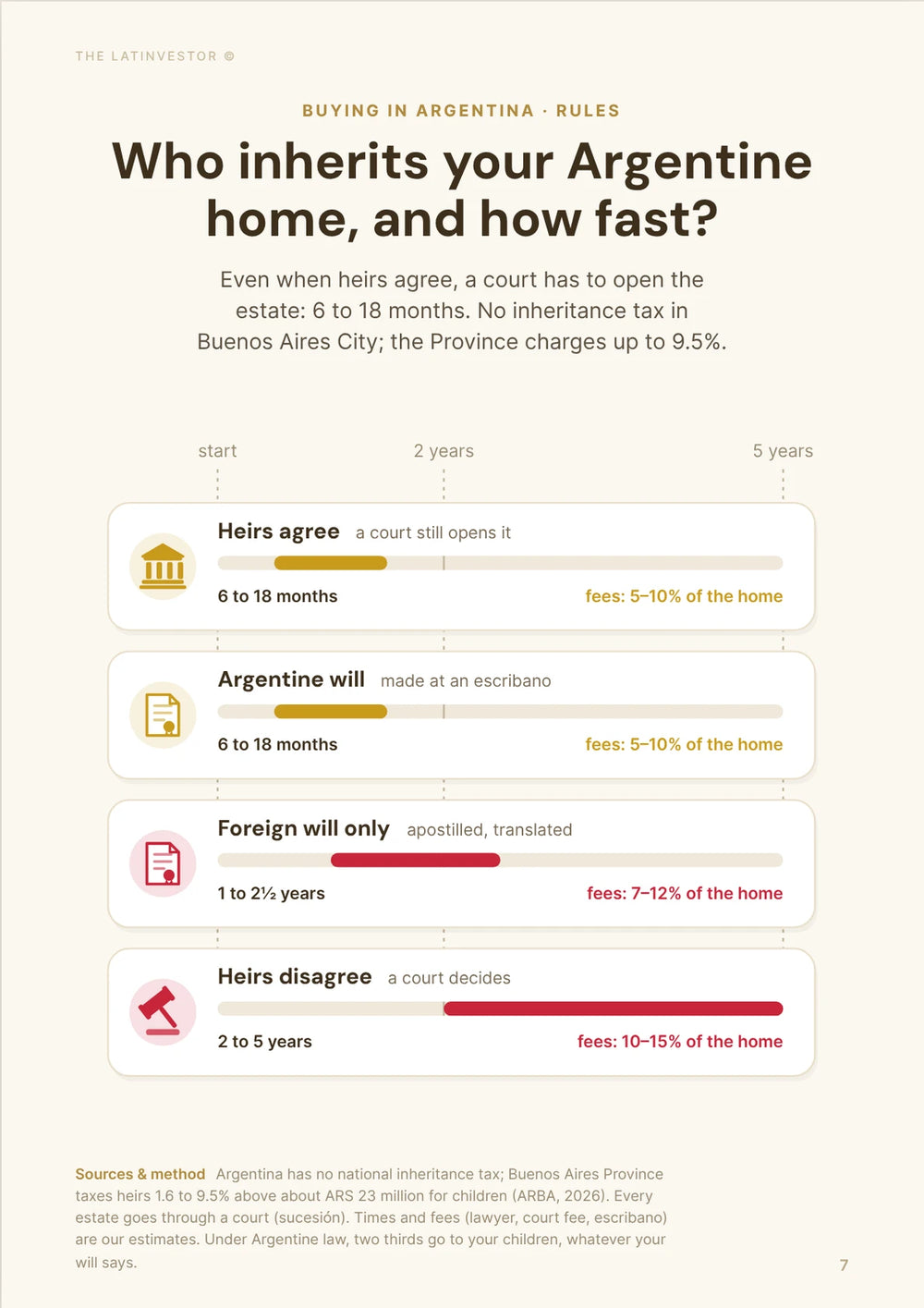
For rural land, it changed this month. On 9 October 2026 the Supreme Court provisionally suspended the repeal of the Rural Land Law (Law 26.737), in a case sent back to Bariloche. Until a final ruling, the limits on foreign ownership of rural land apply again, including the 15% caps, with extra protections near lakes and rivers. Border security zones near Chile (Decree-Law 15.385) are a separate check and can require prior authorization.
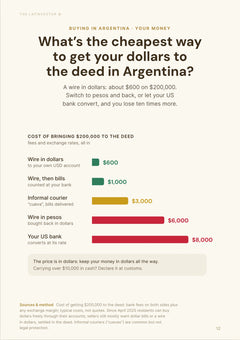
Paying is the other practical point. A contract in US dollars must be paid in dollars, and cash deals above ARS 275.85 million, about USD 178,000, must be reported to the UIF (July to December 2026). Most lots in this article sit below that line; a lake chacra may not.
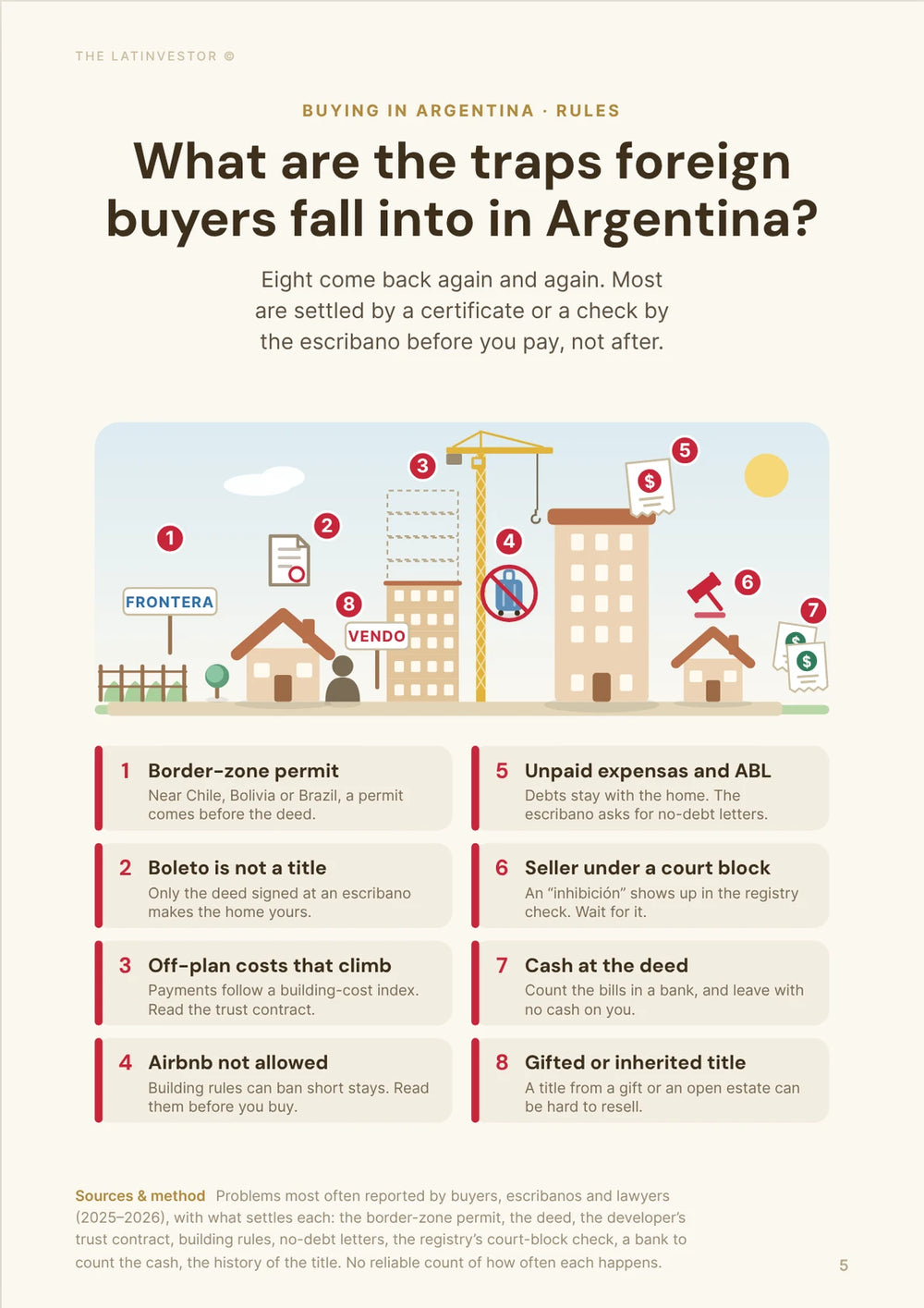
What to do: before paying a deposit on a chacra, a field or a lakefront parcel, ask the notary to confirm in writing whether it is classed as rural and whether it lies in a border zone, and make that a condition of the reservation.
Our methodology
This article estimates what residential land costs in Argentine Patagonia in October 2026: median lot prices and prices per square meter by town, medians by plot size, the cheapest entry, the cost of building on a lot, and the rules a foreign buyer of land should check. Chilean Patagonia is not covered.
All land figures come from TuLugar's town pages, read on 22 October 2026 for Villa La Angostura, San Martín de los Andes, Bariloche, Neuquén, Ushuaia, Esquel and El Bolsón. We used TuLugar's own plot-size categories and its price per square meter of plot area, and flagged medians based on very few listings. House prices used for comparison come from the same pages; the negotiation gap comes from Mudafy's tracked Bariloche sales.
Buying costs come from the 2026 Río Negro and Neuquén stamp-duty schedules and Roomix; building costs from Reporte Inmobiliario, INDEC, Zonaprop and the Centro de Ingenieros de Mendoza; the land-law update from Chequeado and the National Rural Land Registry; the cash-reporting threshold from the UIF rule for July to December 2026; fire and road risks from the Río Negro government and the Villa La Angostura municipality.
We checked these figures in October 2026. Peso amounts are converted at about ARS 1,550 per US dollar (official and MEP rates were within 1% of each other on 22 October 2026, the blue rate about ARS 1,570), and euro amounts at about ARS 1,740 per euro.
Where we had no direct figure, we said so: there is no Patagonia-wide land index, no published land median for Trevelin, Comodoro Rivadavia or Río Gallegos, no plot-size breakdown for Neuquén, and no published gap between asking and final prices for land. All portal figures are asking prices, which usually sit above final sale prices.
Key sources used for this analysis include TuLugar Villa La Angostura, TuLugar San Martín de los Andes, TuLugar Bariloche, TuLugar Neuquén, TuLugar Ushuaia, TuLugar Esquel, TuLugar El Bolsón, Mudafy Bariloche, Zonaprop, MercadoLibre Real Estate, Properati, RE/MAX Argentina, Río Negro stamp-duty schedule 2026, Neuquén stamp-duty schedule 2026, Roomix, Centro de Ingenieros de Mendoza, Reporte Inmobiliario, INDEC, Chequeado, National Rural Land Registry, Río Negro government, Villa La Angostura municipality and Infobae.