Summary
Is Patagonia a good place to live as an expat? Yes, if you want lakes, mountains and glaciers on your doorstep and can live with long distances and cold winters. By our estimate, a comfortable single life in the lake district costs about ARS 2,600,000 to ARS 4,000,000 (USD 1,680 to 2,600) a month.
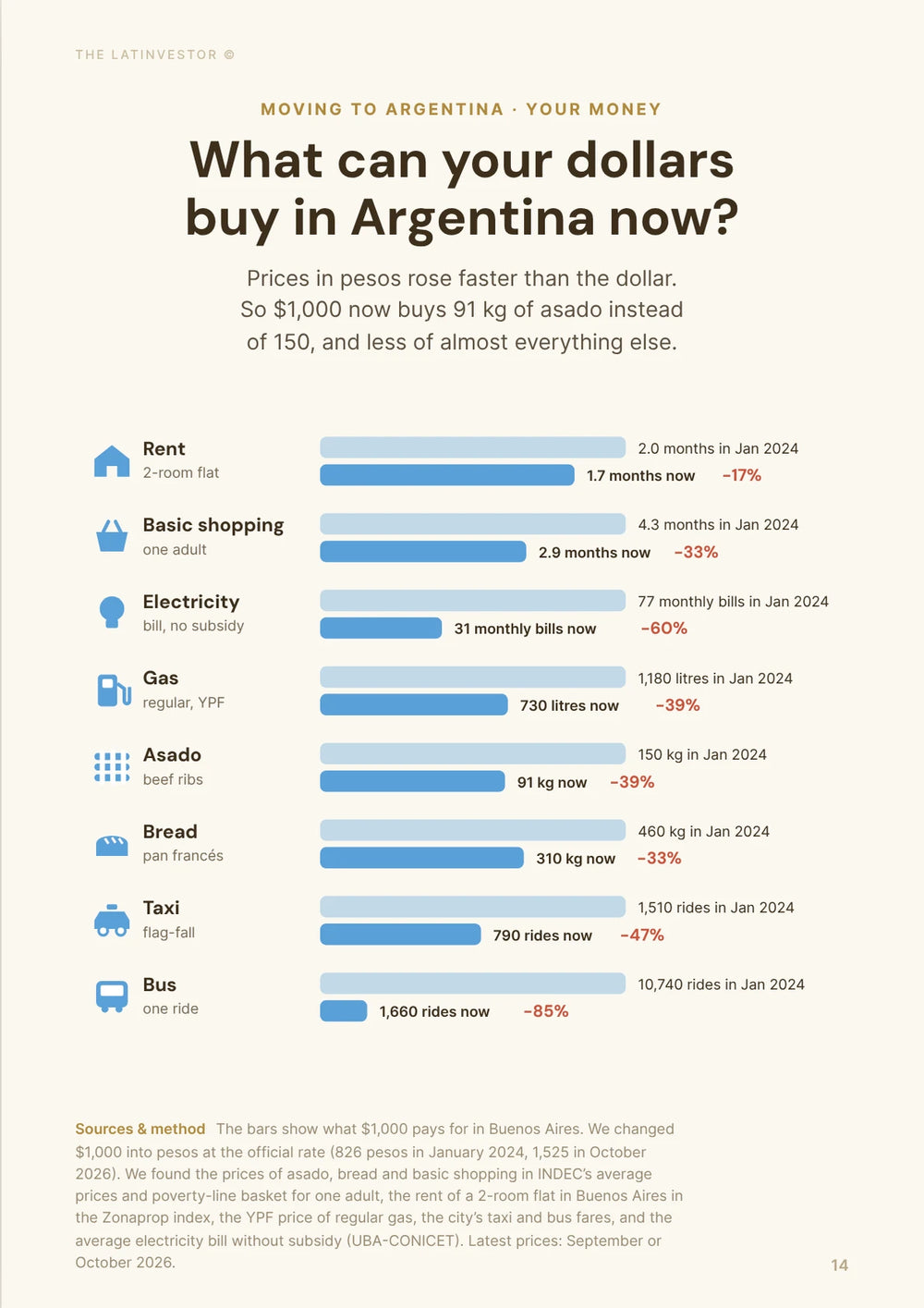
Inflation is far below its peak, at 33.4% over the year to September 2026, so budgets are easier to plan. But with the peso almost flat against the dollar in 2026, life got pricier for dollar earners.
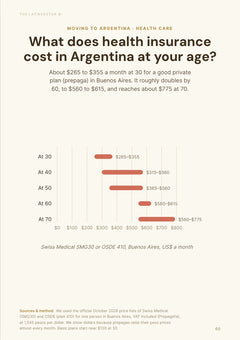
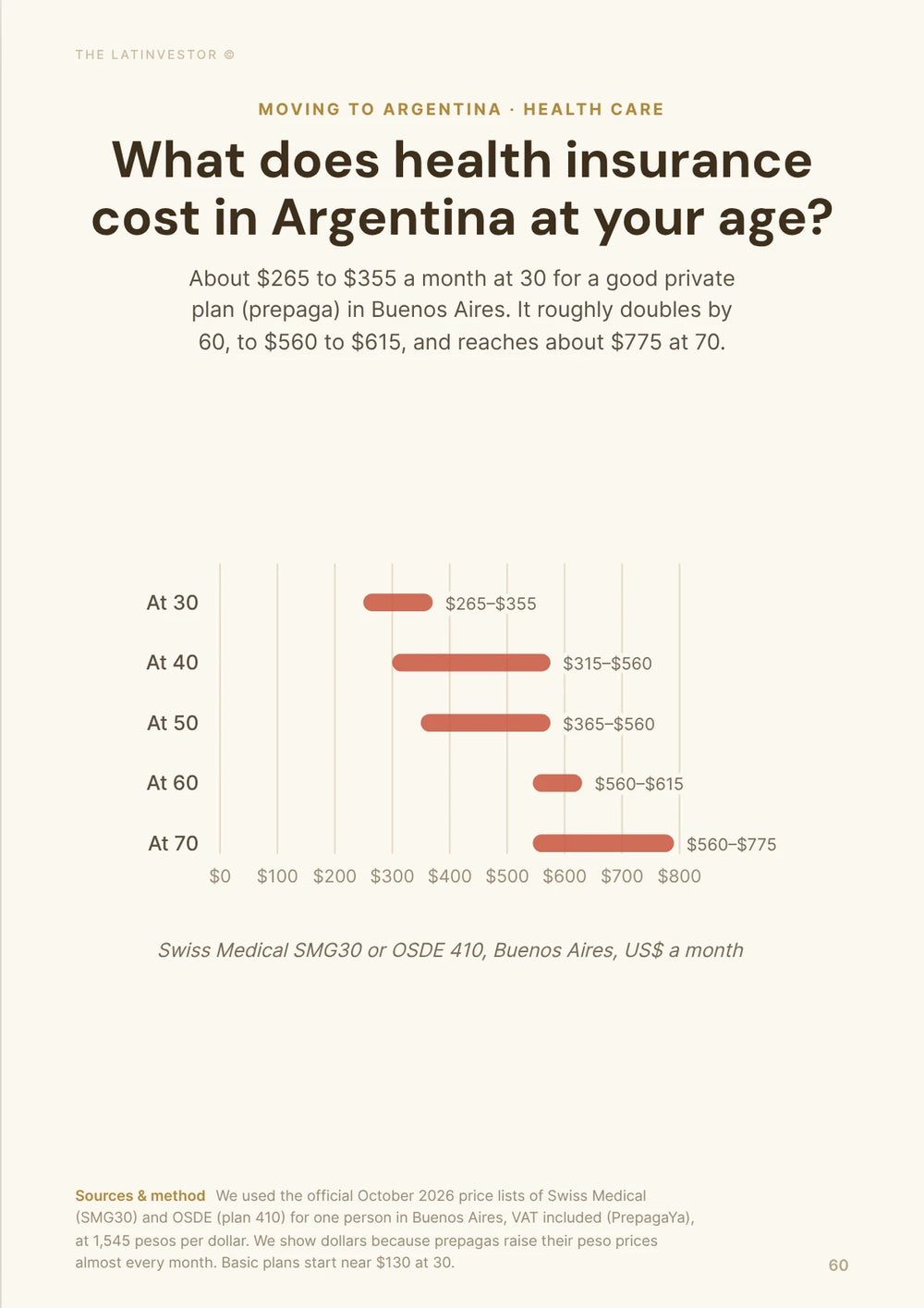
Hospitals handle general and emergency care, but complex cases often go to Neuquén or Buenos Aires. A private health plan for a 30-year-old lists at roughly ARS 200,000 to ARS 550,000 a month.
International schools are few and mostly in Bariloche and Neuquén, such as Woodville (IB). Fees are rarely published: Numbeo puts international primary school in Bariloche at about ARS 6,500,000 a year.
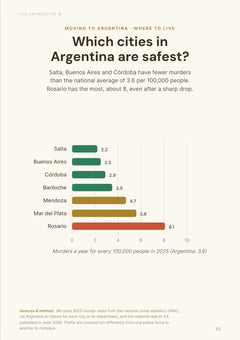
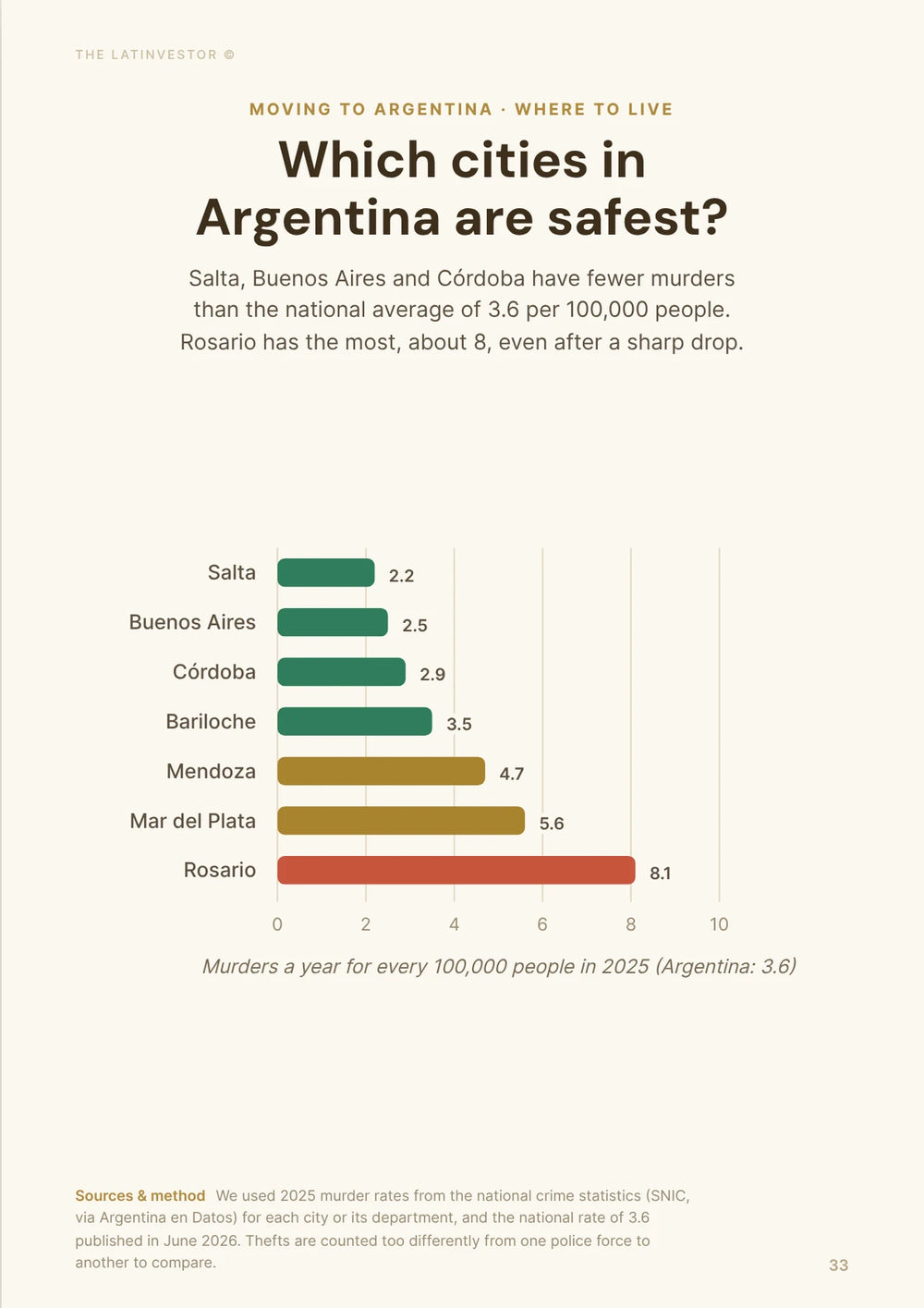
Main towns feel safer than Buenos Aires, but not on every measure: Bariloche had 3.5 homicides per 100,000 in 2025, against 2.5 in Buenos Aires. Río Negro province recorded 24 homicides in 2025, down from 35.
Heating and rent are the biggest costs. A central one-bedroom in Bariloche averaged about ARS 1,980,000 a month in July 2026, and a modest single life costs ARS 1,800,000 to ARS 2,500,000.
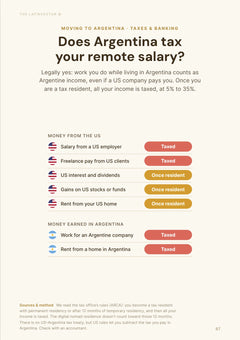
Income tax is national, from 5% to 35%, with most middle earners in the 15% to 27% brackets. Employees also pay 17% in social contributions.
Río Negro and Neuquén had about 79,000 foreign-born residents in the 2022 census, mostly from Chile, Paraguay and Bolivia, plus Europeans and a growing number of remote workers.
Expats cluster in Bariloche, San Martín de los Andes, Villa La Angostura, Neuquén, Ushuaia and Puerto Madryn, with El Bolsón and the Vaca Muerta towns emerging.
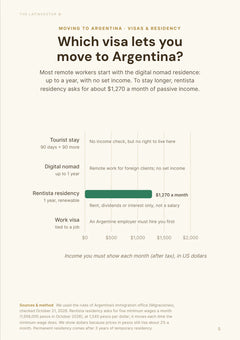
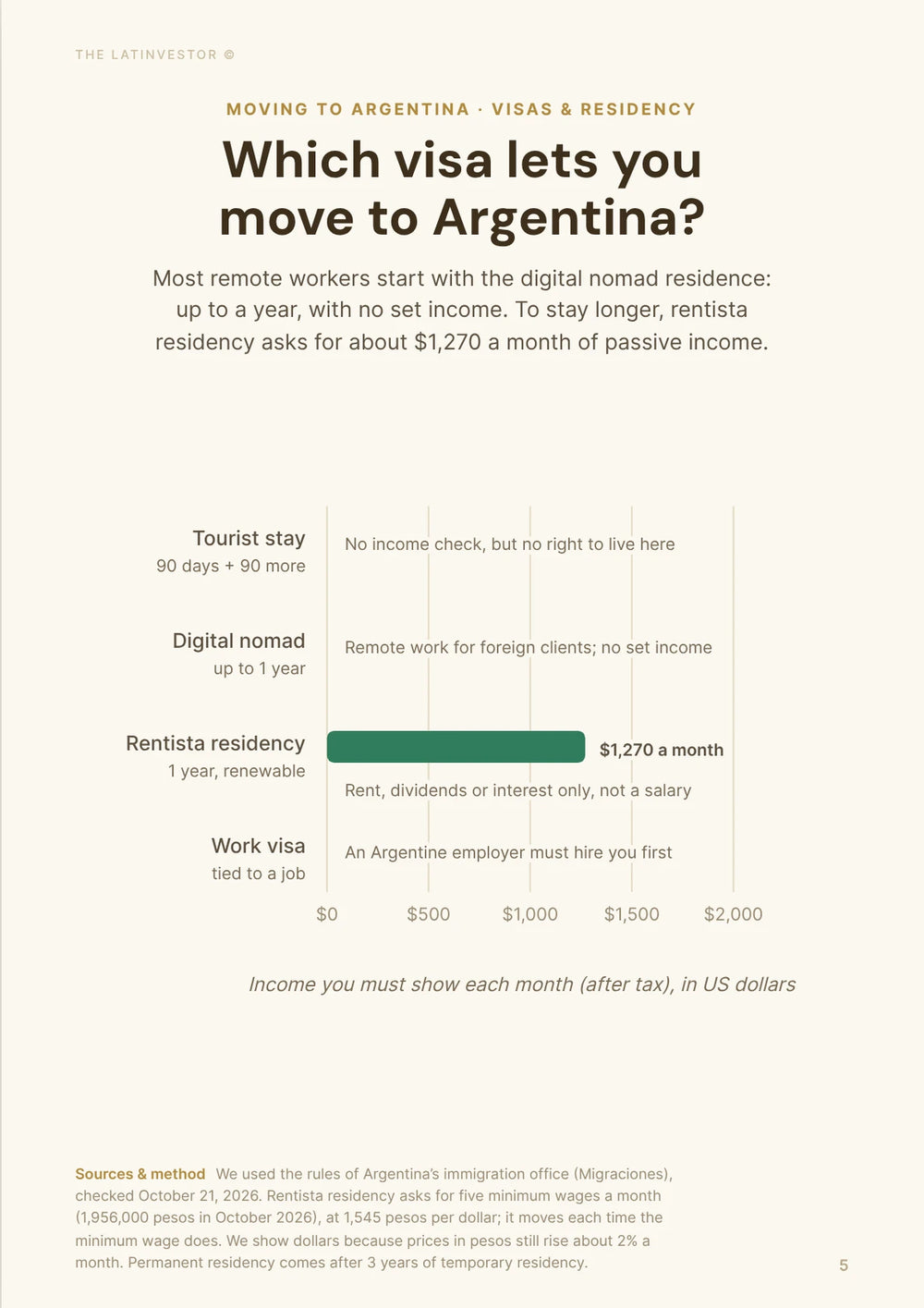
The Digital Nomad visa gives 180 days, renewable once for 180 more, with no official minimum income and an ARS 32,000 fee. Tourists get 90 days, with possible extensions.
There is no official processing time for residency, and the fee is ARS 100,000 for non-Mercosur citizens. Permanent residency comes after 3 years (2 for Mercosur citizens), and citizenship after 2 years of continuous legal residence plus a civic exam.
Energy is the big employer: Vaca Muerta projections point to some 17,000 new jobs by 2030. Energy workers earned a median of about ARS 10,300,000 gross a month in a July 2026 survey, while tourism staff earn about ARS 1,350,000 to ARS 1,400,000.
Expats love the nature and the small-town community, and dislike costly flights, long drives and missing products. Dinner rarely starts before 9 PM.
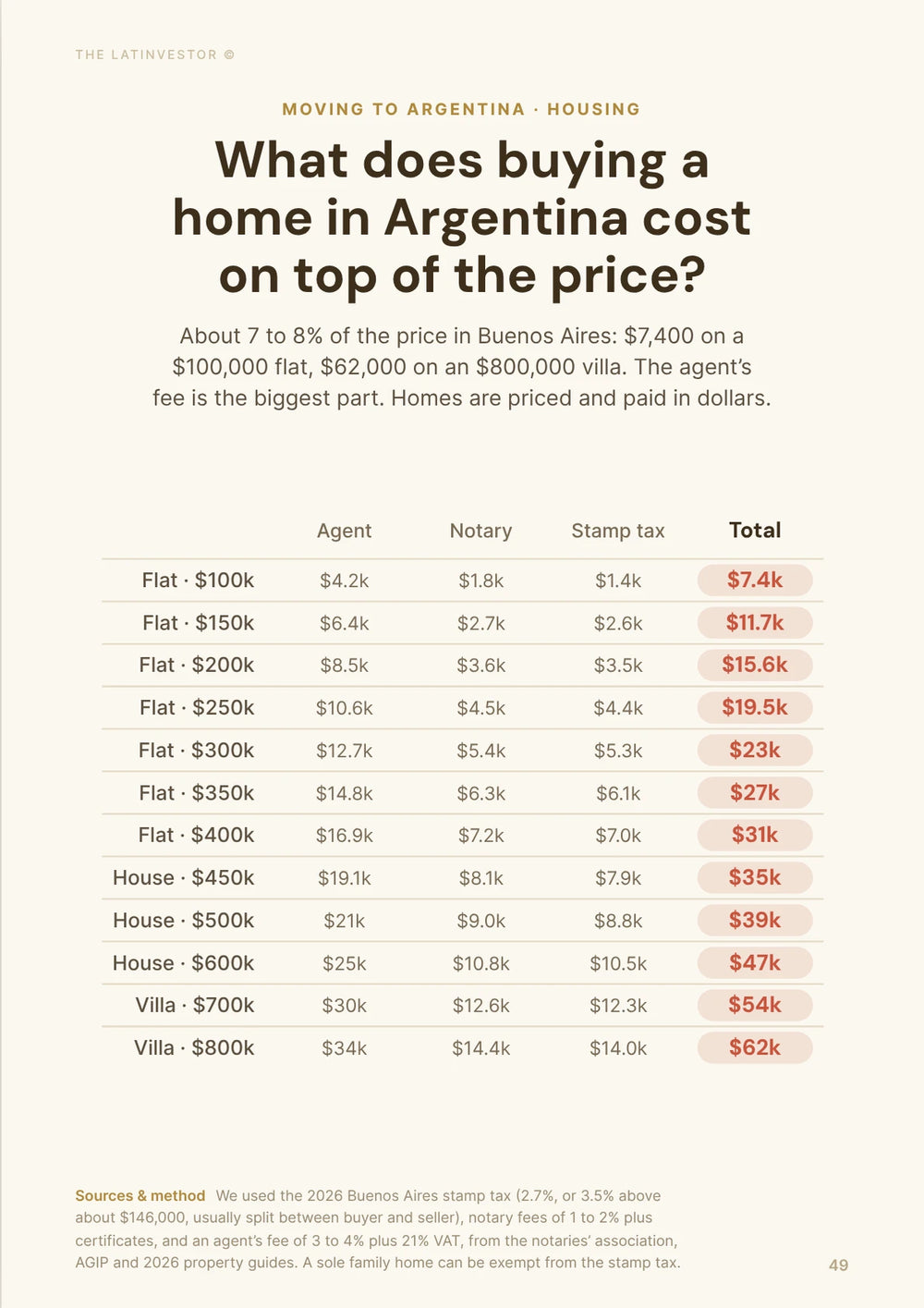
Foreigners can buy urban homes, but rural land may again fall under the 15% foreign cap after the Supreme Court ruling of 9 October 2026. Bariloche apartments list at a median of about ARS 4,700,000 per m².
Bottom line: Patagonia works best if you earn in dollars or euros, pick a town with an airport and a good hospital, and pay cash for a home, since mortgages are mostly inflation-indexed UVA loans for residents.

What are quality of life, healthcare, schools and safety like in Patagonia?
Is quality of life getting better or worse in Patagonia in 2026?
In 2026, quality of life in Patagonia is showing signs of stabilization, with inflation dropping significantly from the 200% peaks of 2023 and 2024 (33.4% over the year to September 2026), which makes day-to-day planning much easier for residents.
The factor that has improved the most in Patagonia over the past two years is the economic predictability that came with lower inflation rates, meaning expats earning in foreign currencies now find their budgets more consistent than before. Life did get more expensive in dollar terms in 2026, though: the peso lost only about 4% against the dollar between the end of 2025 (about 1,480 ARS per USD) and October 2026 (about 1,545 ARS), while local prices kept rising much faster.
However, the persistent challenge in Patagonia remains the region's remoteness, which makes specialized healthcare harder to access, flights expensive, and certain imported goods difficult to find or pricey when available.
Are hospitals good in Patagonia in 2026?
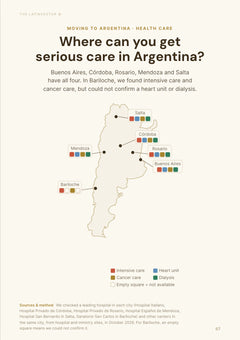
In 2026, hospitals in Patagonia provide solid care for general and emergency needs, but they fall short of the specialized services you would find in Western Europe or major North American cities, which means complex cases often require traveling to Buenos Aires or Neuquen.
The hospitals expats most commonly use in Patagonia include Hospital Zonal Ramon Carrillo in Bariloche for public care, Hospital Provincial Castro Rendon in Neuquen as the regional medical hub, and Hospital Regional Ushuaia in the far south.
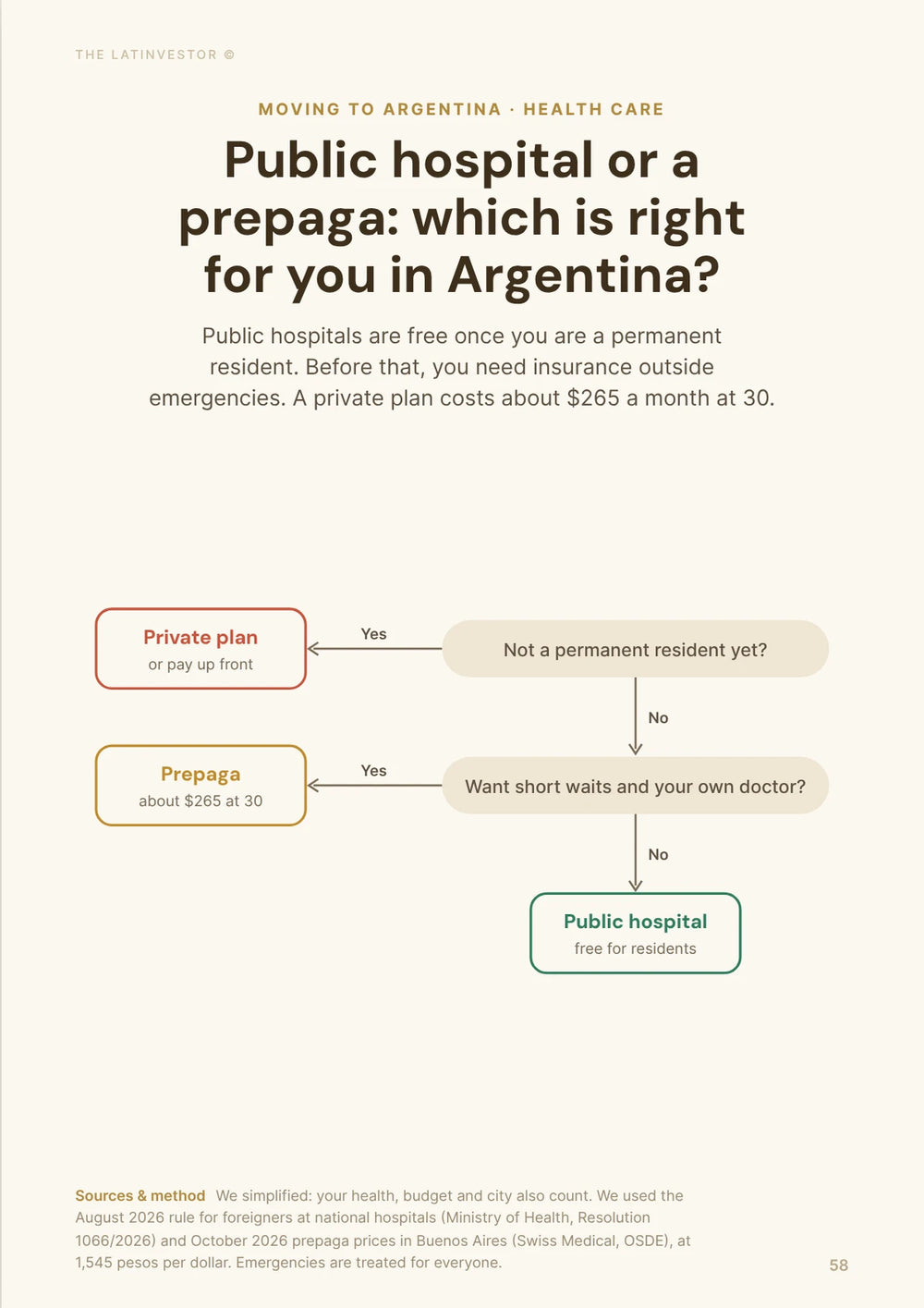
The price of a private doctor visit in Patagonia varies by town and clinic and is rarely published, so ask before you book. Most expats join a private health plan (prepaga) instead: in 2026, individual plans for a 30-year-old list at roughly ARS 200,000 to ARS 550,000 a month, which translates to about USD 130 to USD 360 or EUR 120 to EUR 320, from Medifé to OSDE, with prices quoted for Buenos Aires.
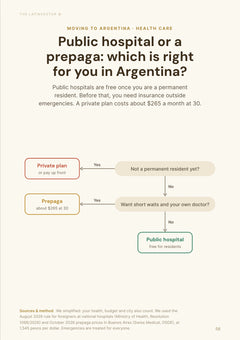
Private health insurance is strongly recommended for expats in Patagonia because it gives you faster access to care, more provider choices, and evacuation support if you need specialized treatment in a larger city. Since August 2026, national public hospitals can also ask foreigners without permanent residence to show insurance or pay for non-emergency care.
Are there any good international schools in Patagonia in 2026?
In 2026, Patagonia has a small but respectable selection of international and bilingual schools, though your options are far more limited than in Buenos Aires, with most quality choices concentrated in Bariloche and Neuquen city.
The most reputable schools among expat families in Patagonia include Woodville School in Bariloche, which is a verified IB World School, Colegio San Patricio in Bariloche offering a bilingual Cambridge-style track, and Colegio Bilingue Neuquen for families based near the energy sector hub.
Most bilingual or IB schools in Patagonia do not publish their 2026 fees, so ask each school directly. As a rough guide for Bariloche, Numbeo contributors put a year of international primary school at about ARS 6,500,000 per child, which works out to roughly USD 4,200 or EUR 3,750, from a small sample in July 2026, plus enrollment fees and extras like transport and exam fees.
Waitlists for popular international schools in Patagonia can be long, often requiring 6 to 12 months of lead time for the most sought-after intakes, and while public schools in Patagonia have dedicated teachers, they operate entirely in Spanish and follow the national curriculum, which can create continuity challenges for expat children who may relocate again.
Is Patagonia a dangerous place in 2026?
In 2026, Patagonia is generally considered safer than Argentina's major metropolitan areas like Buenos Aires, with most expats reporting that they feel comfortable walking around the main towns, though it is not crime-free and not safer on every measure: Bariloche had 3.5 homicides per 100,000 people in 2025, against 2.5 in Buenos Aires, while Río Negro province recorded 24 homicides in 2025, down from 35 in 2024.
The most common safety concerns in Patagonia are opportunistic theft, such as phone snatching and car break-ins, which tend to spike during the busy tourist seasons in winter for skiing and summer for hiking, particularly in high-traffic areas and parking lots near trailheads.
The safest neighborhoods for expats in Patagonia include Centro and Belgrano in Bariloche, Centro and Vega Maipú in San Martin de los Andes, Puerto Manzano in Villa La Angostura, and Centro in Ushuaia, all of which are well-lit and have steady foot traffic.
Women can generally live alone safely in Patagonia's main towns, especially in central areas with good lighting, though the standard advice applies: avoid walking alone late at night in isolated spots, stay aware of your surroundings near nightlife venues, and keep valuables out of sight.
How much does everyday life cost in Patagonia in 2026?
What monthly budget do I need to live well in Patagonia in 2026?
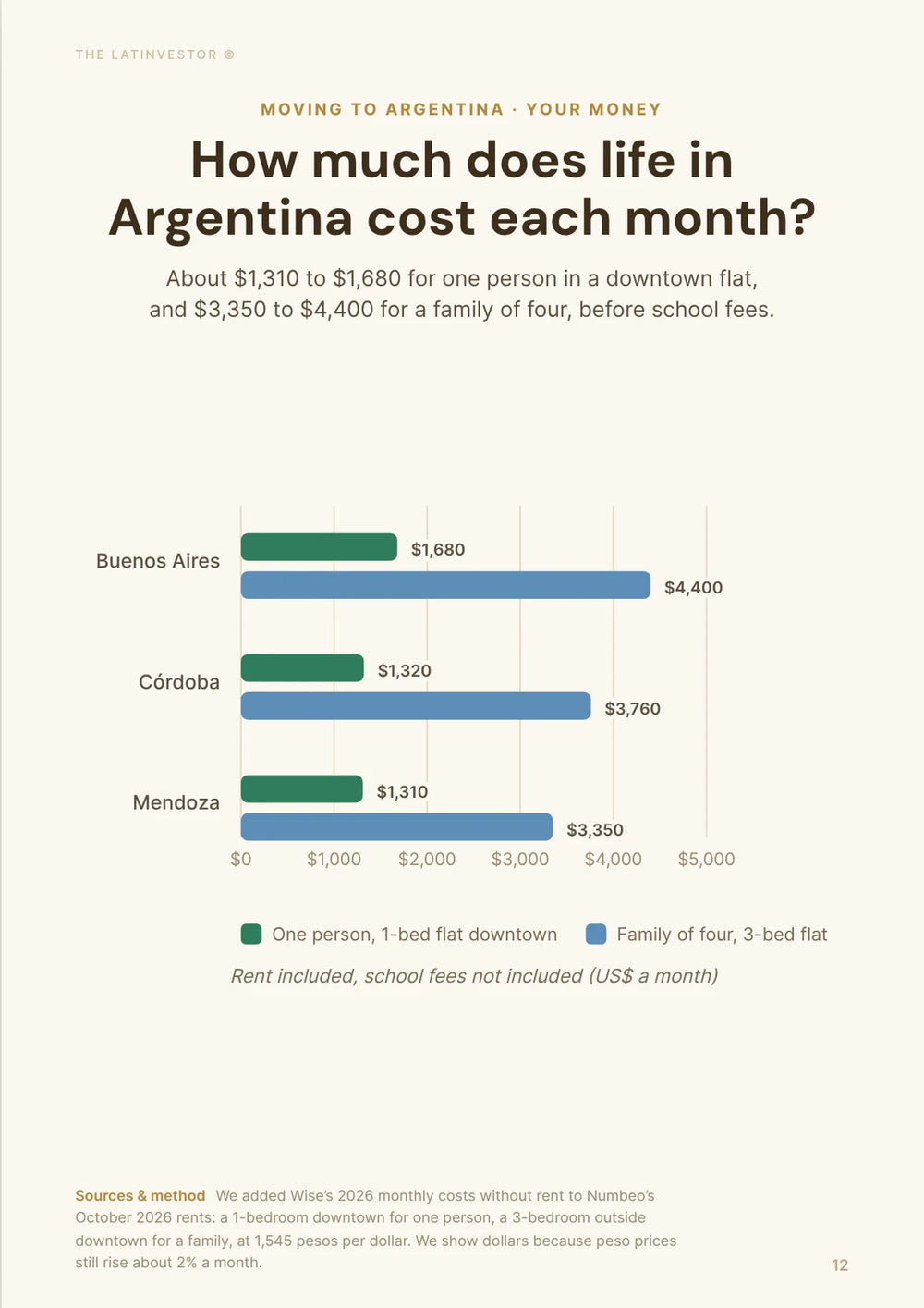
In 2026, by our estimate, a single person can live comfortably in Patagonia's lake district towns on a monthly budget of around ARS 2,600,000 to ARS 4,000,000, which translates to roughly USD 1,680 to USD 2,600 or EUR 1,500 to EUR 2,300, assuming you rent a one-bedroom apartment in a desirable neighborhood and enjoy occasional restaurants and weekend activities.
For a more modest but still decent lifestyle in Patagonia in 2026, you could manage on around ARS 1,800,000 to ARS 2,500,000 per month, about USD 1,170 to USD 1,620 or EUR 1,040 to EUR 1,450, though this would mean a simpler apartment, cooking at home most days, and limiting entertainment expenses.
A more comfortable or upscale lifestyle in Patagonia, with a nicer rental, regular dining out, gym membership, and frequent weekend excursions, would require around ARS 4,000,000 to ARS 6,000,000 per month for a couple, roughly USD 2,600 to USD 3,900 or EUR 2,300 to EUR 3,450.
In Patagonia, the expense category that takes up the largest share of your budget is typically heating during the long, cold winters, which can significantly increase utility bills, followed closely by rent in the popular lake district towns where demand from tourists and remote workers keeps prices elevated (in Bariloche, a central one-bedroom averaged about ARS 1,980,000 a month, roughly USD 1,280, on Numbeo in July 2026, from a small sample).
What is the average income tax rate in Patagonia in 2026?
In 2026, the income tax a typical middle-income earner pays in Patagonia (the rules are national) depends heavily on your specific income level and deductions, because Argentina uses a progressive tax system with large tax-free allowances, so there is no single typical rate; employees also pay 17% of gross salary in social contributions.
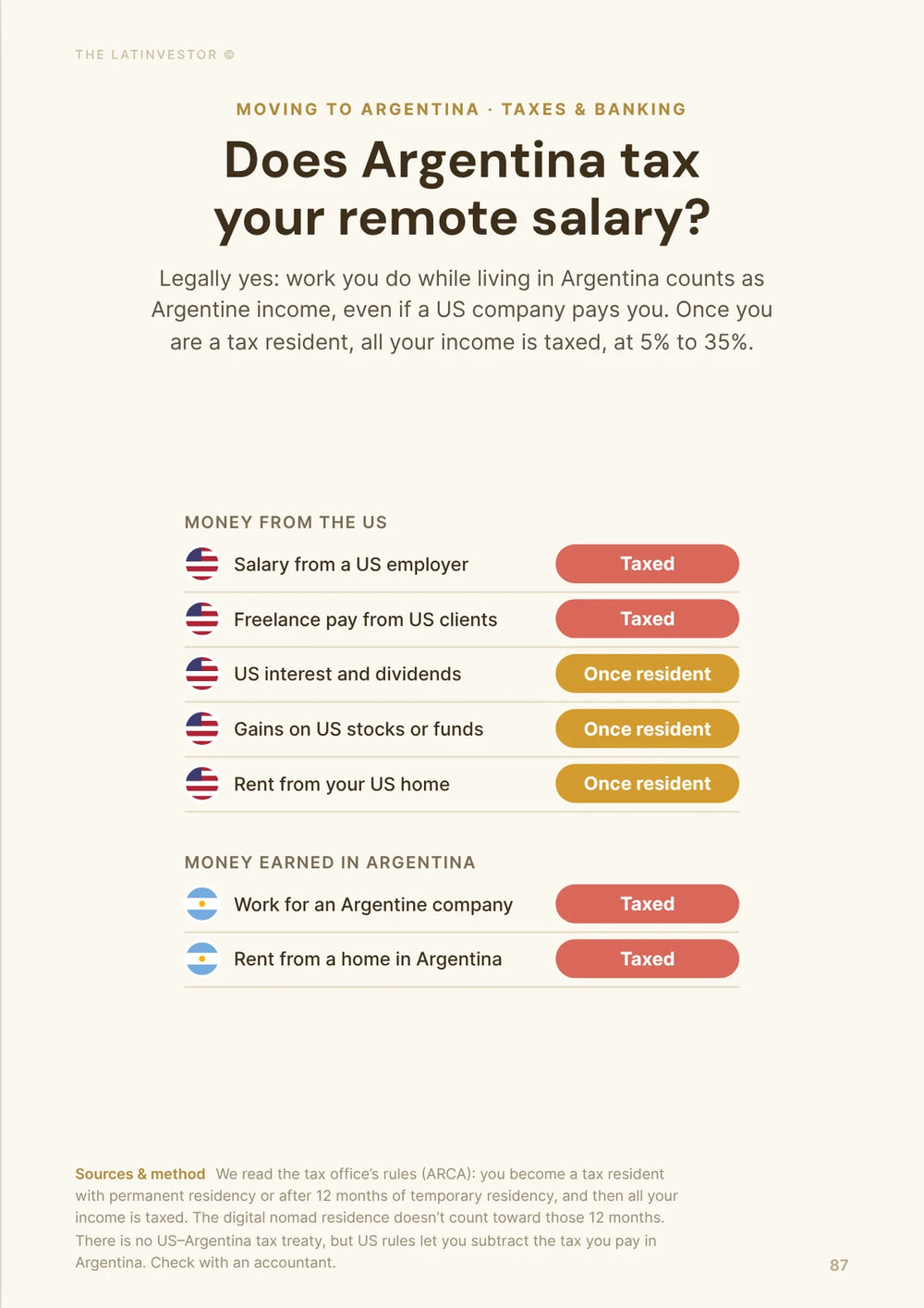
The income tax brackets in Argentina in 2026 start at 5% for the lowest taxable income and climb progressively to a top marginal rate of 35% for high earners, though most middle-income professionals land somewhere in the 15% to 27% marginal bracket range before deductions, and foreigners usually become Argentine tax residents only when they get permanent residence or after 12 months with temporary residence.
What kind of foreigners actually live in Patagonia in 2026?
Where do most expats come from in Patagonia in 2026?
In 2026, the largest groups of foreign residents in Patagonia come from neighboring South American countries like Chile, Paraguay, and Bolivia, followed by Europeans, particularly from Spain, Italy, and Germany, and a growing number of North Americans attracted by the remote work lifestyle.
The total foreign-born population in Patagonia remains a relatively small percentage compared to Buenos Aires (Río Negro and Neuquén provinces together had about 79,000 foreign-born residents in the 2022 census, the latest), but census data shows that certain towns like Bariloche and San Martin de los Andes have notably higher concentrations of international residents due to their tourism economies and lifestyle appeal.
Expats from South America often move to Patagonia for economic opportunities and family ties, while Europeans and North Americans are typically drawn by the region's natural beauty, outdoor lifestyle, and the ability to stretch foreign-currency income further than in their home countries.
The expat population in Patagonia is a diverse mix of retirees seeking tranquility, working professionals in the energy sector around Neuquen, and a rapidly growing community of digital nomads and remote workers who base themselves in the scenic lake district towns.
Where do most expats live in Patagonia in 2026?
In 2026, the top areas where expats concentrate in Patagonia include San Carlos de Bariloche, particularly neighborhoods like Centro, Belgrano, and Melipal, along with San Martin de los Andes, Villa La Angostura, Neuquen city and its nearby corridor including Plottier and Cipolletti, Ushuaia, and Puerto Madryn on the Atlantic coast.
These neighborhoods attract expats because they combine practical infrastructure like airports, hospitals, and international schools with the lifestyle benefits Patagonia is famous for, such as lake access, ski slopes, hiking trails, and a strong sense of outdoor community.
Emerging areas that are starting to attract more expats in Patagonia include El Bolson, which has a milder climate than Bariloche and a more bohemian vibe, as well as smaller towns along the Vaca Muerta energy corridor that are seeing rapid growth due to the oil and gas boom.
Are expats moving in or leaving Patagonia in 2026?
In 2026, Patagonia is experiencing a net inflow of expats, driven largely by the post-pandemic shift toward remote work and the region's appeal to digital nomads seeking a combination of natural beauty, affordable living, and stable internet in towns like Bariloche.
The main factor drawing expats to Patagonia right now is the ability to earn in stable foreign currencies like USD or EUR while enjoying a significantly lower cost of living than in most Western countries, combined with Argentina's digital nomad visa that makes extended stays straightforward.
The main factor causing some expats to leave Patagonia recently is the challenge of logistics, particularly the high cost of flights, the long distances between towns, and the limited access to specialized healthcare and international schools compared to larger cities like Buenos Aires.
Compared to similar destinations in the region like Chile's Lake District or Uruguay's coastal towns, Patagonia in Argentina offers a more dramatic landscape and lower costs, but with more economic volatility, which attracts adventurous expats comfortable with some unpredictability while deterring those seeking maximum stability.
What paperwork do I need to move to Patagonia in 2026?
What visa options are popular in Patagonia in 2026?
In 2026, the three most popular visa types for expats moving to Patagonia are the Digital Nomad Visa for remote workers, Temporary Residency for those with work contracts, family ties, or retirement income, and the standard Tourist Visa that allows stays of up to 90 days with possible extensions.
The Digital Nomad Visa, which is the most commonly used by location-independent expats, requires you to be from a country with visa-free tourist access to Argentina, demonstrate remote work for a foreign employer or clients, provide a CV, a professional reference and an Argentine criminal record certificate, and have a valid passport.
Argentina does offer a Digital Nomad Visa, launched in 2022, which allows you to live and work remotely in Patagonia for up to 180 days with the option to renew for another 180 days, and there is no official minimum income requirement (the first application costs ARS 32,000, about USD 21, for non-Mercosur citizens), but no special tax exemption either: work physically done in Argentina can count as Argentine-source income even when a foreign client pays for it.
The Digital Nomad Visa is initially valid for 180 days and can be extended once for another 180 days, giving you a maximum stay of one year, after which you would need to apply for a different residency category or leave and re-enter the country.
How long does it take to get residency in Patagonia in 2026?
In 2026, Migraciones does not publish a standard processing time for temporary residency, and straightforward cases with complete documentation move fastest, while applications with missing apostilles, translation issues, or high demand periods can take many months; the fee is ARS 100,000 (about USD 65) for non-Mercosur citizens.
The factors that most commonly delay residency applications in Patagonia are incomplete document apostilles, missing Spanish translations of foreign documents, appointment backlogs at the National Migration Directorate, and errors in the online application portal that require resubmission.
To become eligible for permanent residency in Argentina, you typically need to hold temporary residency for 3 years (2 years for Mercosur citizens), spending at least half of that time in the country, and since the 2025 reform (Decree 366/2025), citizenship requires 2 years of continuous legal residence plus a civic integration exam covering Spanish, Argentine history and democratic values.
How hard is it to find a job in Patagonia in 2026?
Which industries are hiring the most in Patagonia in 2026?
In 2026, the industries hiring the most in Patagonia are the oil and gas sector centered around the Vaca Muerta formation in Neuquen, where industry projections point to some 17,000 new jobs by 2030 and the government raised its oil resource estimate by 89% in August 2026, followed by tourism and hospitality in the lake district and Ushuaia, and fishing and seafood processing along the Atlantic coast near Puerto Madryn.
Getting hired in Patagonia without speaking Spanish is realistic only for remote work with foreign employers, certain international tourism roles, and some technical positions in the energy sector where English-speaking multinationals operate, but for most local jobs, Spanish fluency is expected.
The roles most accessible to foreign job seekers in Patagonia include engineering and technical positions in the Vaca Muerta oil and gas ecosystem, seasonal hospitality and adventure tourism jobs during peak seasons, English teaching positions, and remote professional roles where you work for companies outside Argentina while living in Patagonia.
What salary ranges are common for expats in Patagonia in 2026?
In 2026, typical salary ranges for expats working locally in Patagonia vary widely, with professional roles in the energy sector around Neuquen paying around ARS 10,300,000 gross per month at the median of a July 2026 survey of energy workers, roughly USD 6,650 or EUR 5,950, while those earning foreign income remotely often bring in USD 2,000 to USD 5,000 or more monthly by our estimate.
Entry-level or mid-level expat positions in Patagonia, such as hospitality management or administrative roles, typically pay close to the national pay scales, around ARS 1,350,000 to ARS 1,400,000 per month for tourism staff in September 2026, around USD 870 to USD 910 or EUR 780 to EUR 810, which is comfortable by local standards but may feel tight if you want a Western lifestyle.
Senior or specialized roles in Patagonia, particularly in the oil and gas sector or technical engineering positions, can pay from about ARS 5,400,000 gross per month for juniors to ARS 18,900,000 for senior staff, approximately USD 3,500 to USD 12,000 or EUR 3,100 to EUR 11,000, with some wellhead positions paying even higher due to harsh working conditions.
Employers in Patagonia do sponsor work visas for skilled positions, particularly in the energy sector where there are genuine shortages of qualified workers, but the overall volume is limited compared to major cities, and many expats find it easier to work remotely or set up their own business.
What's daily life really like for expats in Patagonia right now?
What do expats love most about living in Patagonia right now?
The things expats love most about living in Patagonia are the unparalleled access to nature with lakes, mountains, and glaciers as your everyday backdrop, the relaxed small-town pace of life that feels like a permanent vacation, and the strong sense of outdoor community among hikers, skiers, and adventure enthusiasts.
The lifestyle benefit most frequently praised by expats in Patagonia is the ability to step outside your door and immediately be in world-class hiking, skiing, or kayaking territory, making weekend adventures feel effortless rather than requiring elaborate planning.
The practical advantage expats appreciate most in Patagonia is how far their foreign-currency income stretches, allowing them to afford a quality of life with regular travel, good food, and comfortable housing that would cost significantly more in North America or Western Europe.
The social and cultural aspect that makes Patagonia particularly enjoyable for expats is the welcoming, relationship-driven nature of the smaller communities, where you quickly become a recognized face and can build genuine friendships through shared outdoor activities and local events.
What do expats dislike most about life in Patagonia right now?
The top complaints expats have about living in Patagonia are the logistical challenges of getting around a vast, sparsely populated region where flights are expensive and infrequent, the limited selection of international schools for families with children, and the difficulty of finding good long-term rentals in high-demand towns like Bariloche during peak seasons.
The daily inconvenience that frustrates expats most in Patagonia is the need to plan errands strategically because services, specialty shops, and even certain products simply are not available locally, meaning you either wait for trips to larger cities or pay premium prices for shipping.
The bureaucratic issue that causes the most headaches for expats in Patagonia is navigating Argentina's banking and financial system, which can be slow, requires extensive paperwork, and often involves unexpected currency controls or restrictions that complicate receiving foreign income.
Despite these frustrations, most expats in Patagonia find them manageable rather than deal-breakers because the lifestyle trade-offs, including the natural beauty, affordability, and community, generally outweigh the inconveniences for those who prioritize outdoor living over urban convenience.
What are the biggest culture shocks in Patagonia right now?
The biggest culture shocks expats experience when moving to Patagonia are discovering that almost everything operates on personal relationships rather than formal processes, adjusting to the dramatic seasonal personality shifts in tourist towns that go from bustling to nearly deserted, and realizing how spread out everything is with hours of driving between towns.
The social norm that surprises newcomers most in Patagonia is the expectation that you will develop personal connections with service providers, landlords, and neighbors before business gets done efficiently, which can feel frustrating at first but eventually becomes a rewarding part of daily life.
The aspect of daily routines in Patagonia that takes the longest for expats to adjust to is the late schedule for meals and socializing, with dinner rarely starting before 9 PM and social gatherings often extending well past midnight, combined with the siesta-influenced afternoon slowdown when many businesses close.
Can I buy a home as a foreigner in Patagonia in 2026?
Can foreigners legally own property in Patagonia in 2026?
In 2026, foreigners can legally own urban property in Patagonia with relatively few restrictions, making apartments and houses in towns like Bariloche, San Martin de los Andes, and Neuquen accessible to international buyers.
The specific restrictions that apply to foreigners buying property in Patagonia relate primarily to rural land, border zones, and properties near water sources, where Argentine law limits foreign ownership to protect national interests, so you must verify the specific parcel category before assuming any land is purchasable; the rural land law (Ley 26.737) was repealed by decree at the end of 2023, but on 9 October 2026 the Supreme Court provisionally suspended that repeal while a case runs at the federal court of Bariloche, so its limits (such as the 15% cap on foreign-owned rural land) may apply again.
In Patagonia, foreigners can generally own apartments, houses, and urban commercial properties without issue, but rural land purchases face stricter scrutiny under regulations that cap the percentage of agricultural land that can be foreign-owned, particularly for large parcels or land near international borders.
What is the average price per m² in Patagonia in 2026?
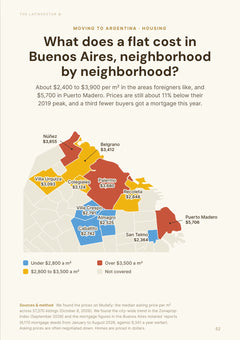
In 2026, the median asking price per square meter for apartments in Patagonia's flagship market of Bariloche is approximately ARS 4,700,000, which translates to roughly USD 3,050 or EUR 2,700, though prices vary significantly between prime tourist towns and regional hubs.
Property prices in Patagonia have trended upward over the past two to three years, driven by growing demand from remote workers and digital nomads seeking the lake district lifestyle, increased tourism recovery post-pandemic, and the energy sector boom boosting housing demand in the Neuquen corridor.
Do banks give mortgages to foreigners in Patagonia in 2026?
In 2026, mortgages for foreigners in Patagonia are available but limited, with most foreign buyers relying on cash purchases or developer financing rather than traditional bank mortgages due to stricter documentation requirements and the challenging macroeconomic environment.
The banks in Argentina that are known to occasionally offer mortgages to foreigners include Banco Nación, Banco Galicia, Banco Santander Argentina, and Banco Provincia, though each has specific requirements for foreign applicants and availability can change.
Most Argentine mortgages in 2026 are UVA loans, whose balance is indexed to inflation with an interest rate on top, with terms of up to 30 years at Banco Nación for eligible residents, while foreigners who qualify usually face a much larger down payment and less favorable terms than residents.
To qualify for a mortgage in Patagonia as a foreigner, you typically need proof of legal residency or a valid visa, documented income that meets the bank's debt-to-income requirements, a local tax identification number (CUIT or CUIL), and potentially a co-signer who is an Argentine resident.
Our methodology
This article looks at what it is like to live in Argentine Patagonia as an expat, mainly in Bariloche, the lake district, Neuquén and Ushuaia: quality of life, healthcare, schools, safety, monthly budgets, income tax, who the expats are and where they live, visas and residency, jobs and salaries, daily life, and buying a home as a foreigner.
Patagonia is a region, not a city, so few figures cover it as a whole. Monthly budgets are our own estimates for the lake district towns, built from Bariloche rents (Numbeo, a small sample) and everyday prices. Home prices are TuLugar median asking prices for Bariloche, energy salaries come from a July 2026 survey of 645 energy workers, tourism wages from the national pay scale, and safety from official homicide data compiled by Argentina en Datos and provincial police figures.
Visa, residency and citizenship rules come from Argentina's migration office (Migraciones), its 2026 fee schedule and Decree 366/2025. Tax rules come from ARCA and Deloitte. Property rules come from Decree 70/2023, Ley 26.737 and the Supreme Court ruling of 9 October 2026.
We checked these figures in October 2026. Peso amounts are converted at about 1,545 pesos per US dollar (official rate, 21 October 2026) and about 1,730 pesos per euro.
Some points have no reliable region-wide figure, such as doctor fees, school fees, the number of foreign residents, or prices outside Bariloche. There we gave a range labeled as our estimate, used a clearly named benchmark from one city, or left the number out. Asking prices are not final sale prices, and costs differ a lot between towns.
Key sources used for this analysis include INDEC CPI, BCRA Retail Exchange Rate, ARCA (ex-AFIP) Tax Brackets, Argentina Digital Nomad Visa Portal, InfoLEG Migration Law, INDEC Census 2022 Migrations Report, Properstar Bariloche Price Index, Argentina SNIC Crime Statistics, International Baccalaureate Organization, Numbeo Cost of Living, INDEC inflation, September 2026 (EFE), Indicadores Argentina exchange rates, Numbeo Bariloche, TuLugar price report, Argentina en Datos (Bariloche), Río Negro homicide data (Diario Río Negro), PrepagaYa health plan prices, Resolution 1066/2026, Deloitte tax update, ARCA tax residence rules, INDEC statistical yearbook, digital nomad residence, Migraciones fee schedule, Migraciones permanent residence, Decree 366/2025 analysis, Vaca Muerta resource estimate, energy salary survey (iProfesional), tourism pay scale (La Nación), Supreme Court land-law ruling (Infobae), Banco Nación mortgages and UVA mortgage comparison (La Nación).