Summary
No, long-term rents didn't fall after the World Cup; only event prices did, with Monterrey's average short-stay quote going from MXN 4,743 per person a night for June to MXN 796 for July. Monthly rents were still rising when the last indexes came out.
The spike was huge but narrow. In N+'s 90-listing sample, World Cup quotes were 248% above normal in Mexico City, 392% in Guadalajara and 660% in Monterrey, and almost all of it was hotels and short-stay apartments.
Many of those prices never cleared. Only 23 of the 90 listings had June bookings, and every Monterrey listing in the sample cut its price before kickoff, by 42% on average.
Hosts still made money, mostly through higher rates. AirDNA counted $1.33 billion in short-term rental revenue across the 16 host cities, 84% of the gain coming from higher nightly prices and only 16% from extra nights, with $30.6 million of extra revenue in Mexico.
In Mexico City, a standard two-bedroom was listed at MXN 21,921 a month in June 2026, up 9.6% in a year, nearly three times inflation.
Monterrey is the city where rents have actually stalled: about MXN 25,500 for a two-bedroom, up only 1.5% in the first half of 2026, below inflation.
Guadalajara is still hot: MXN 18,675 for a two-bedroom in June 2026, up 8.6% in a year.
Nationally there's no downturn either. INEGI's housing sub-index was up 3.57% year on year in August 2026, in line with inflation (3.45% in September).
Supply is the thing that moved. AirDNA counted 25,568 active short-term listings in Mexico City in September 2026, 27.8% fewer than a year earlier, and 4,519 in Monterrey, down 17.1%.
Airbnb demand didn't collapse, though: Mexico City listings still averaged 64% occupancy at $91 a night over the year to September 2026, so owners have little reason to dump units on the long-term market all at once.
New rules may matter more than the tournament. Mexico City caps renewal increases at last year's inflation (3.69% for 2026) and a stricter rental bill went to Congress on October 19, 2026, while Jalisco's 180-night Airbnb cap is still waiting for a plenary vote.
Rents are high for reasons that predate the World Cup: SHF's index of mortgaged homes rose 11.1% in the Guadalajara area and 8.3% around Monterrey in the year to mid-2026, which keeps people renting.
Tenants have more room than headlines suggest, mostly on furnished ex-Airbnb units and listings that have sat empty for weeks. In Mexico City, keeping an existing lease capped at 3.69% usually beats moving.
For buyers, the lesson is simple: ignore any income projection built on June 2026 nightly rates, and price a rental at a normal lease, minus the 25% tax a non-resident pays on gross rent.

How high did World Cup rental prices go in Mexico?
Very high, but only for short stays in the three host cities. Normal monthly rents across Mexico never saw anything close to that jump.
N+ tracked 90 listings (30 each in Mexico City, Guadalajara and Monterrey) and compared June quotes with January prices. Per person and per night, prices were 248% higher in Mexico City, 392% higher in Guadalajara and 660% higher in Monterrey.
Near the stadiums it got silly. A Monterrey room 200 metres from the stadium, normally MXN 1,093 a night, was quoted at MXN 18,552 for World Cup dates. A Guadalajara hotel near the Chivas stadium that charged MXN 909 per person for a normal match weekend asked MXN 14,176.
Those were hotels and Airbnb-style rentals. Only three metro areas hosted matches, and millions of tenants elsewhere kept paying normal monthly rents.
| Market | Normal benchmark | Initial World Cup quote | Increase | What was actually repriced |
|---|---|---|---|---|
| Mexico City | MXN 1,745/person/night | MXN 6,076 | +248% | Short-term accommodation |
| Guadalajara | MXN 949/person/night | MXN 4,668 | +392% | Short-term accommodation |
| Monterrey | MXN 624/person/night | MXN 4,743 | +660% | Short-term accommodation |
| Monterrey room near stadium | MXN 1,093/night | MXN 18,552 | About +1,600% | One extreme short-term listing |
Were people actually paying those huge World Cup rental prices?
Mostly not. A lot of the extreme prices failed the simplest test: nobody booked them.
When N+ checked the same 90 listings again in late May, only 23 had June bookings, and 40 of the others had almost no reservations at all.
The booked listings averaged about MXN 1,815 per person a night. The ones still available were asking about MXN 2,504. Cheaper places filled; ambitious ones sat empty.
Monterrey was the clearest case. Every listing in its sample cut its price before the tournament, by 42% on average and up to 70%. The room quoted at MXN 18,552 dropped to MXN 9,008, and the Guadalajara hotel at MXN 14,176 fell to MXN 3,609.
How far did World Cup prices fall once the tournament ended?
All the way back to normal. The event premium was gone within weeks.
In Monterrey, N+'s sample averaged MXN 4,743 per person a night for June and MXN 796 for July (about USD 43). That's an 83% fall, which sounds like a crash but is really just the World Cup premium disappearing.
Full-year data look calm. Over the 12 months to September 2026, which include the tournament, AirDNA puts the average nightly rate at $60 in Guadalajara and $67 in Monterrey. Nothing like the 300% to 600% jumps in the June quotes.
So the spike is over. The real question is whether monthly rents are following it down.
| Example | World Cup quote | Later level | Correction |
|---|---|---|---|
| Monterrey sample average | MXN 4,743/person/night (June) | MXN 796 (July) | -83% |
| Monterrey room near stadium | MXN 18,552/night | MXN 9,008 before kickoff | -51% |
| Guadalajara hotel near stadium | MXN 14,176/person | MXN 3,609 before kickoff | -75% |
| Guadalajara, all short-term listings | — | $60/night (year to Sept. 2026) | Event pricing gone |
Did the World Cup bring fewer guests than landlords expected?
Yes. Hosts earned more, but almost all of it came from higher prices, not more guests.
AirDNA counted about $1.33 billion in short-term rental revenue across the 16 host cities between June 10 and July 19, 2026, 26% more than a year earlier. Higher nightly rates explained 84% of the gain and extra booked nights only 16%. In 12 of the 16 markets, occupancy actually fell, because so many new listings appeared before the event.
Mexico's three host cities added $30.6 million of revenue. Monterrey's short-term revenue rose 96% and Guadalajara's 91% compared with the same weeks of 2025.
There were plenty of visitors, just not enough of them willing to pay any price.
| World Cup short-term rental metric (June 10 to July 19, 2026) | Result |
|---|---|
| Revenue across all 16 host cities | $1.33bn |
| Change vs. same period of 2025 | +26% |
| Share of the gain from higher rates | 84% |
| Share from additional booked nights | 16% |
| Extra revenue in Mexico's three host cities | $30.6m |
| Monterrey revenue change | +96% |
| Guadalajara revenue change | +91% |
Are normal apartment rents falling in Mexico City now?
No. More apartments came back on the market after the tournament, but asking rents were still climbing in the latest index.
Inmuebles24 put a standard 65 m² two-bedroom at MXN 21,921 a month in June 2026 (about USD 1,180), up 9.6% in a year and 3.7% in the first half of 2026 alone. In Cuauhtémoc and Coyoacán, asking rents rose 13.7% to 15.5% in a year.
June is still the latest index Inmuebles24 has published, so the post-World Cup months haven't been measured yet. El Economista reported at the end of July that more homes were back on the long-term rental market after the tournament, which is the first sign to watch.
For renters, the good news is more choice. There's no evidence yet of a citywide drop.
If Mexico City has more apartments now, why aren't rents dropping?
Because the extra supply is small next to the shortage, and much of it is furnished ex-Airbnb units in expensive areas.
A furnished apartment in Roma Norte, Condesa or Juárez that spent years serving tourists doesn't turn into affordable housing for a local family. Owners usually try medium-term stays, corporate leases or a high monthly price first.
If those units stay empty, asking rents will come down, but slowly. The first signs will be longer listing times, a free month or a lower deposit, well before a citywide index moves.
Mexico also has no real-time database of signed leases. Portals show what landlords ask, not what tenants end up paying.
Are Monterrey rents falling after the World Cup?
Not falling, but Monterrey is the host city where rents have stopped rising in real terms.
Monterrey had the most aggressive World Cup pricing of the three. Homie counted short-term supply going from about 3,700 to 7,200 properties in the run-up to the tournament, and N+'s sample went from MXN 624 to MXN 4,743 per person a night before every listing cut its price.
Long-term rents tell a quieter story. A standard two-bedroom in the metro area was listed at about MXN 25,500 a month in June 2026 (about USD 1,370), the most expensive of the three cities, but it rose only 1.5% in the first half of the year, below the 1.7% inflation of the same period.
AirDNA counted 4,519 active short-term listings in Monterrey in September 2026, 17.1% fewer than a year earlier, with 53% average occupancy. Some of the units built or furnished for the World Cup are now competing for normal tenants.
| Monterrey indicator | Latest figure | What it tells us |
|---|---|---|
| Active short-term listings (Sept. 2026) | 4,519 | -17.1% year on year |
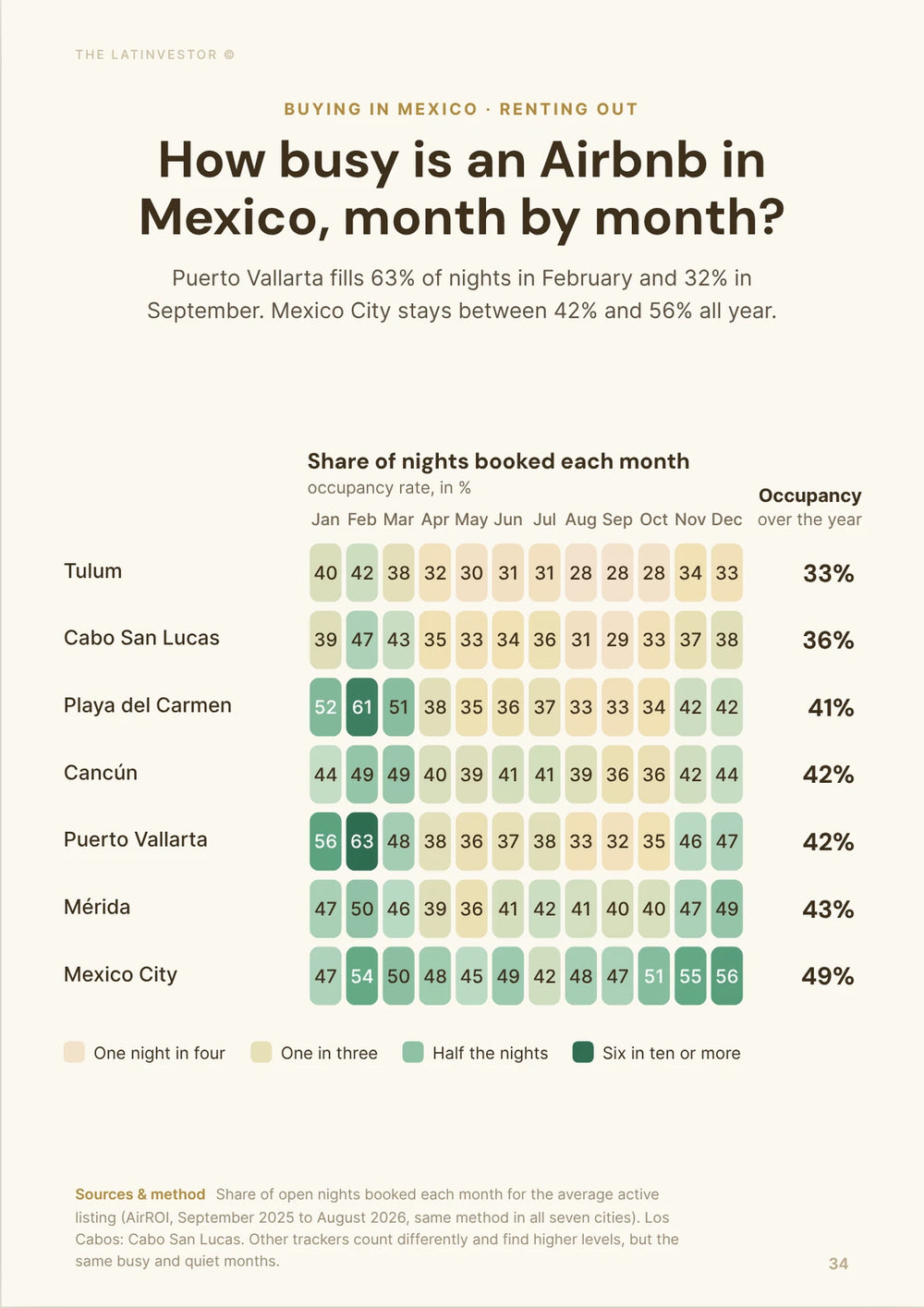
| Short-term occupancy (year to Sept. 2026) | 53% | Demand still there |
| Average short-term nightly rate | $67 | No sign of World Cup prices |
| World Cup quote cuts before kickoff | 42% on average | Landlords overpriced |
| Standard 2-bedroom asking rent (June 2026) | About MXN 25,500 | +1.5% in six months, below inflation |
Are Guadalajara rents falling after the World Cup?
No. Guadalajara's long-term rents were still rising more than twice as fast as inflation in the latest index.
Inmuebles24 put a standard two-bedroom at MXN 18,675 a month in June 2026 (about USD 1,000), up 8.6% in a year and 4.3% in the first half of 2026.
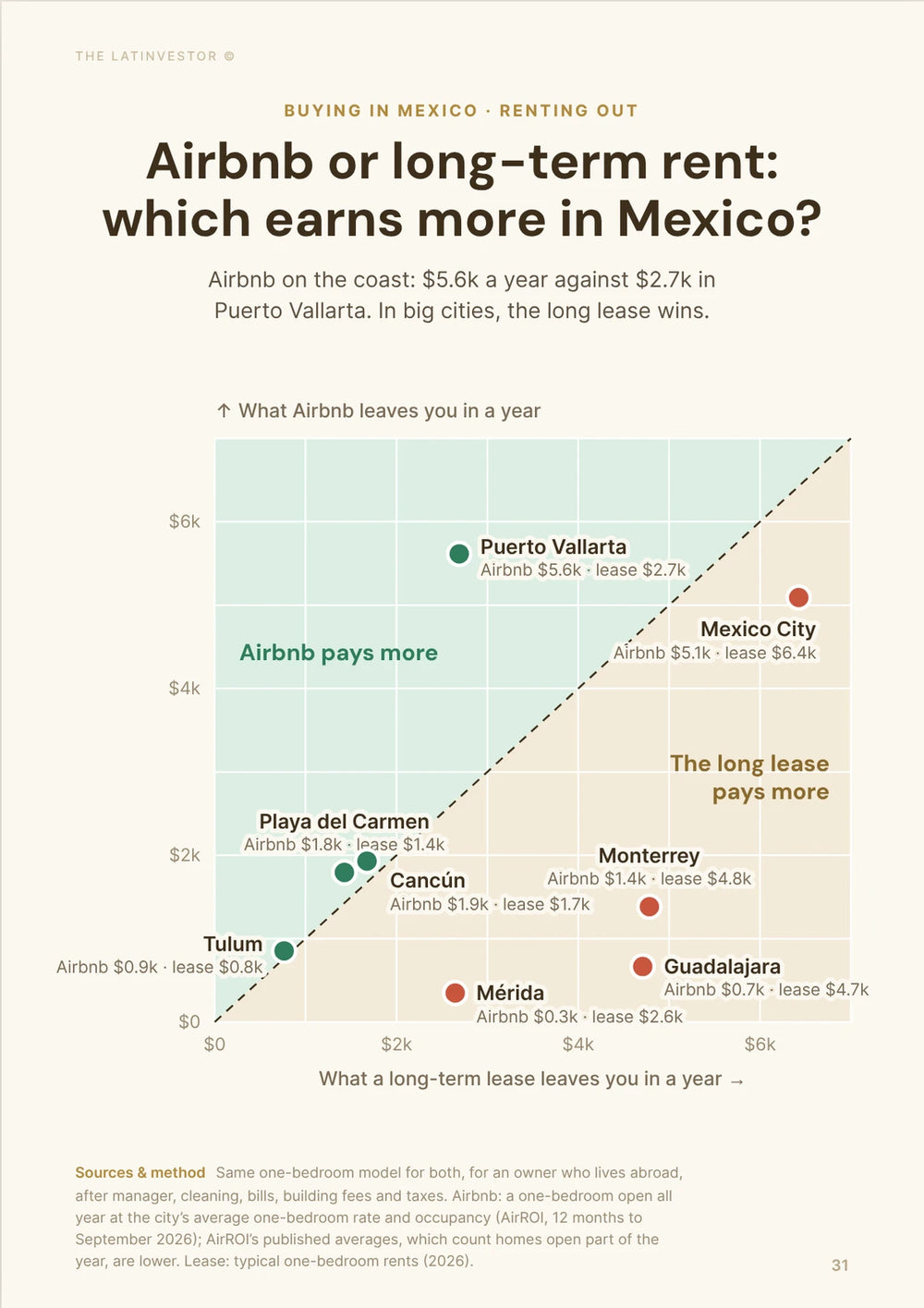
The short-term side grew fast before the tournament. Homie counted short-stay supply up about 50% since 2023, and up to four times more near the Estadio Banorte. AirDNA now counts 6,371 active listings in Guadalajara, with 55% occupancy and an average of $60 a night over the year to September 2026.
That temporary inventory is the main reason Guadalajara rents could slow from here, especially near the stadium and in furnished units. But so far the evidence shows short stays going back to normal, not monthly rents falling.
Are rents falling across Mexico as a whole?
No. National data show rents rising roughly in line with inflation.
INEGI's housing sub-index was up 3.57% year on year in August 2026, and headline inflation was 3.45% in September. That index follows existing leases, so it moves slowly, but it shows no national reversal.
It can't tell you what a Roma Norte apartment costs today. It does tell you that a six-week event in three cities didn't push rents down in Mérida, Puebla, Tijuana or Querétaro.
Are former Airbnbs actually coming back to the long-term rental market?
Yes, especially in Mexico City and Monterrey, and that's the main reason to watch rents from here.
AirDNA counted 25,568 active short-term rentals in Mexico City in September 2026, 27.8% fewer than a year earlier. Monterrey's 4,519 listings are down 17.1%. Guadalajara stands at 6,371.
Not every lost listing is a World Cup effect. Mexico City's host registry, some owners selling, and normal churn all play a part.
Still, the direction is clear: short-term supply is shrinking while more units are offered on normal leases. Availability moved first. Prices are slower.
| Market | Active short-term listings (Sept. 2026) | Year-on-year change | What is changing |
|---|---|---|---|
| Mexico City | 25,568 | -27.8% | Short-term supply shrinking sharply |
| Monterrey | 4,519 | -17.1% | World Cup units looking for tenants |
| Guadalajara | 6,371 | Not published | Big pre-tournament build-up to absorb |
Did Airbnb demand collapse once the World Cup ended?
No. Demand is still decent, which limits how many owners will give up on short stays.
Over the year to September 2026, AirDNA puts Mexico City at 64% occupancy and $91 a night, with average revenue of $19,800 per listing. Guadalajara is at 55% and $60, Monterrey at 53% and $67.
Those 12-month figures include the World Cup weeks, so they flatter a bit. Even so, they don't point to tourists disappearing.
That matters for tenants: if Airbnb had collapsed, far more units would flood back to normal leases at once. Instead, owners face an ordinary choice between short stays, monthly stays and annual leases, so supply should adjust gradually, not suddenly.
Could new Airbnb rules push rents down more than the World Cup did?
Possibly, but none of them is fully in force yet.
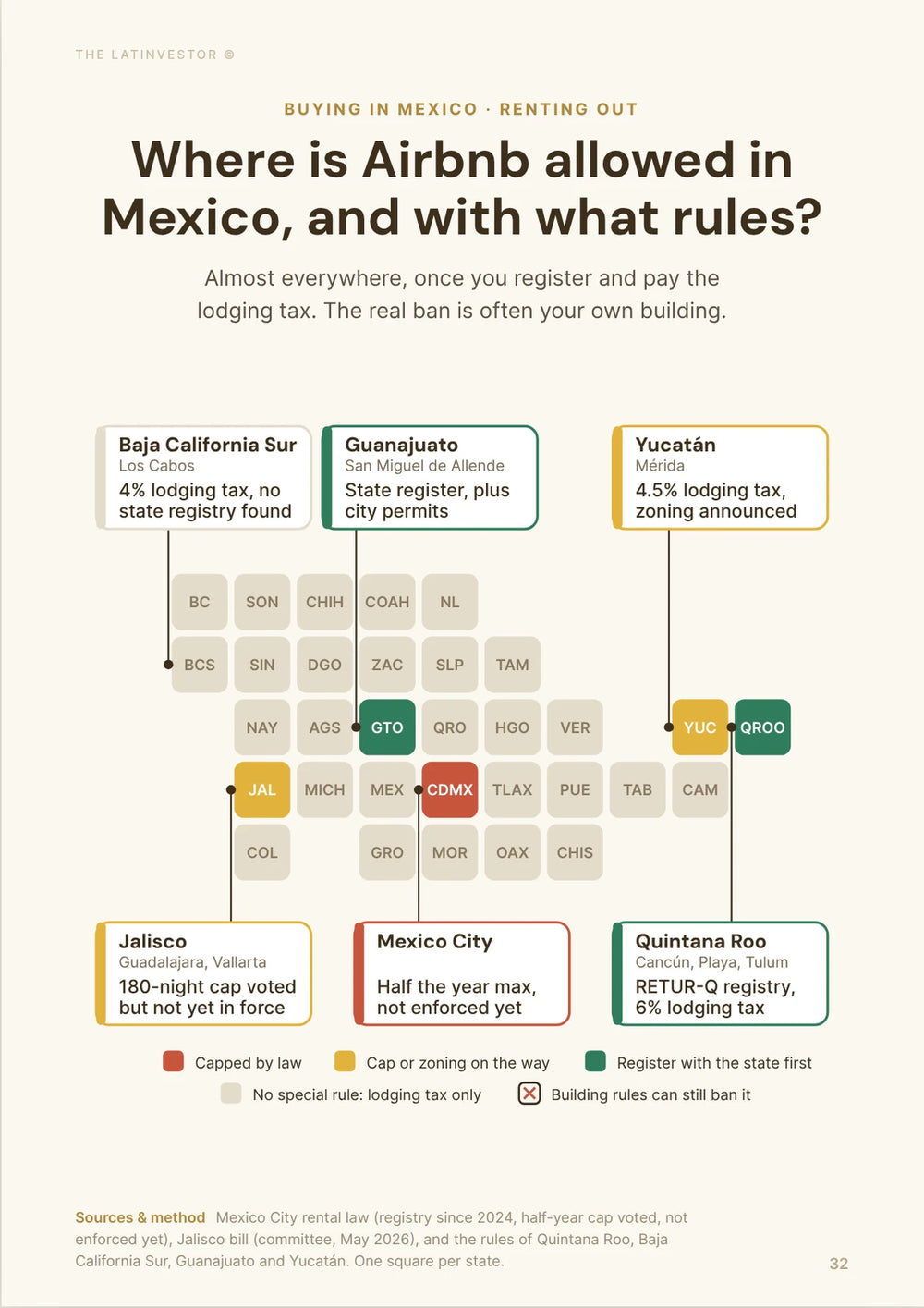
In Mexico City, the host registry opened in May 2026 with a limit of three properties per person, but the registration deadline was pushed to December 2026, and the 50%-of-nights limit is still tied up in amparo cases. In Jalisco, a Congress committee approved a 180-night cap for non-primary homes in high-pressure areas on May 25, 2026, but the plenary hasn't voted. Nuevo León is preparing a tourism law that would bring platforms under state rules.
For sitting tenants, Mexico City already caps renewal increases at last year's inflation, 3.69% for 2026, and the Supreme Court upheld it in February 2026. On October 19, 2026, the city sent Congress a bill with fines of MXN 11,731 to 46,924 for raises above inflation and a compulsory contract registry. Jalisco and Nuevo León have no cap.
The cap doesn't touch the first rent on a vacant apartment. So the bigger effect, if it comes, will be supply: if the rules push professional hosts back to annual leases, tenants get more options.
Why are normal rents still so high after the World Cup?
Because rents were climbing long before the tournament, driven by expensive housing and demand concentrated in the same central areas.
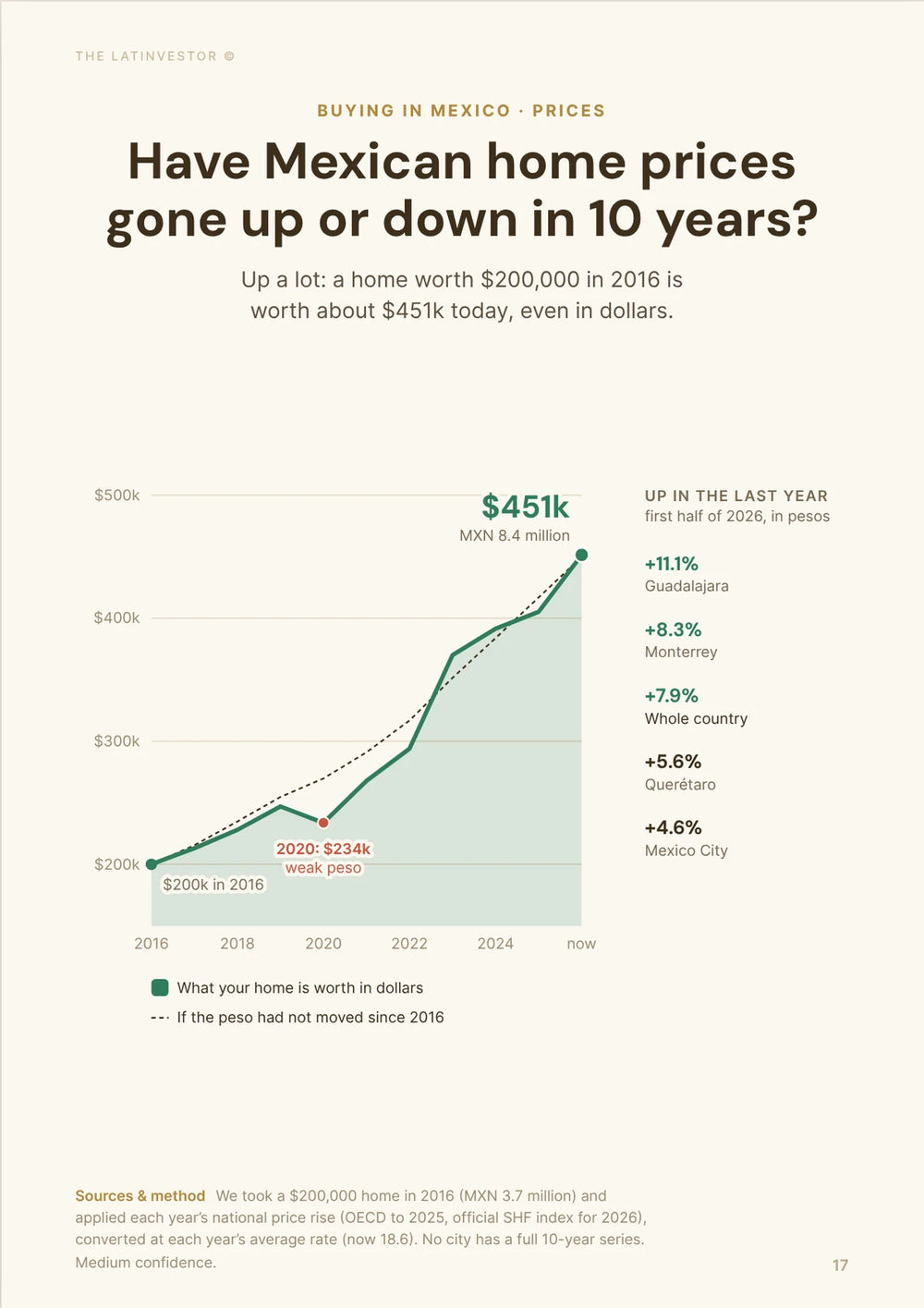
Buying keeps getting pricier. SHF's index of mortgaged homes rose 11.1% in the Guadalajara metro area, 8.3% around Monterrey and 4.6% in the Valley of Mexico in the year to the first half of 2026, and 7.3% nationally in the year to the second quarter. That keeps many households renting longer.
Demand points the same way. Inmuebles24 data cited by Homie show 54% of property searches in Mexico City are for renting, not buying.
The World Cup added a temporary layer on top. Once it left, the same expensive market was still underneath.
Could Mexican rents start falling later?
Some will, mainly overpriced furnished units, but a national drop still looks unlikely.
The conditions for local cuts are there: fewer short-term listings in Mexico City and Monterrey, a big stock of furnished units built for the event in Guadalajara and Monterrey, and Monterrey rents already below inflation.
The biggest discounts should show up on apartments marketed to tourists, units near the stadiums and listings that have been empty for several weeks.
The structural picture hasn't changed, though: purchase prices still rising, a housing shortage in the big cities and decent Airbnb occupancy. Expect more negotiation and slower growth in some neighbourhoods, with citywide averages staying sticky. A real downturn would need several months of falling indexes in several cities. We're not there.
Can tenants negotiate a lower rent right now?
Yes, on the right kind of apartment. Furnished units, anything near the stadiums and listings online for more than a few weeks are where landlords are under pressure.
Use the benchmarks: about MXN 21,900 for a standard two-bedroom in Mexico City, MXN 18,700 in Guadalajara and MXN 25,500 in Monterrey (June 2026 indexes). If a listing is well above that with nothing special to justify it, ask for a lower price, a free first month or a smaller deposit, and offer a longer lease in exchange.
In Mexico City, staying put usually wins: your renewal can't rise more than 3.69% in 2026, while new asking rents rose 9.6% in a year. Ask for any increase in writing and check it against that figure. In Guadalajara and Monterrey there's no cap, so write the yearly increase into the lease before you sign.
Should you still buy an apartment to rent out in a former host city?
Only if the numbers work on a normal lease. Anything built on World Cup nightly rates is fiction now.
The gap is huge: Monterrey's average short-stay quote went from MXN 4,743 per person a night in June to MXN 796 in July. Sellers and developers who pitched "World Cup yields" are now competing with thousands of other short-term units for fewer guests.
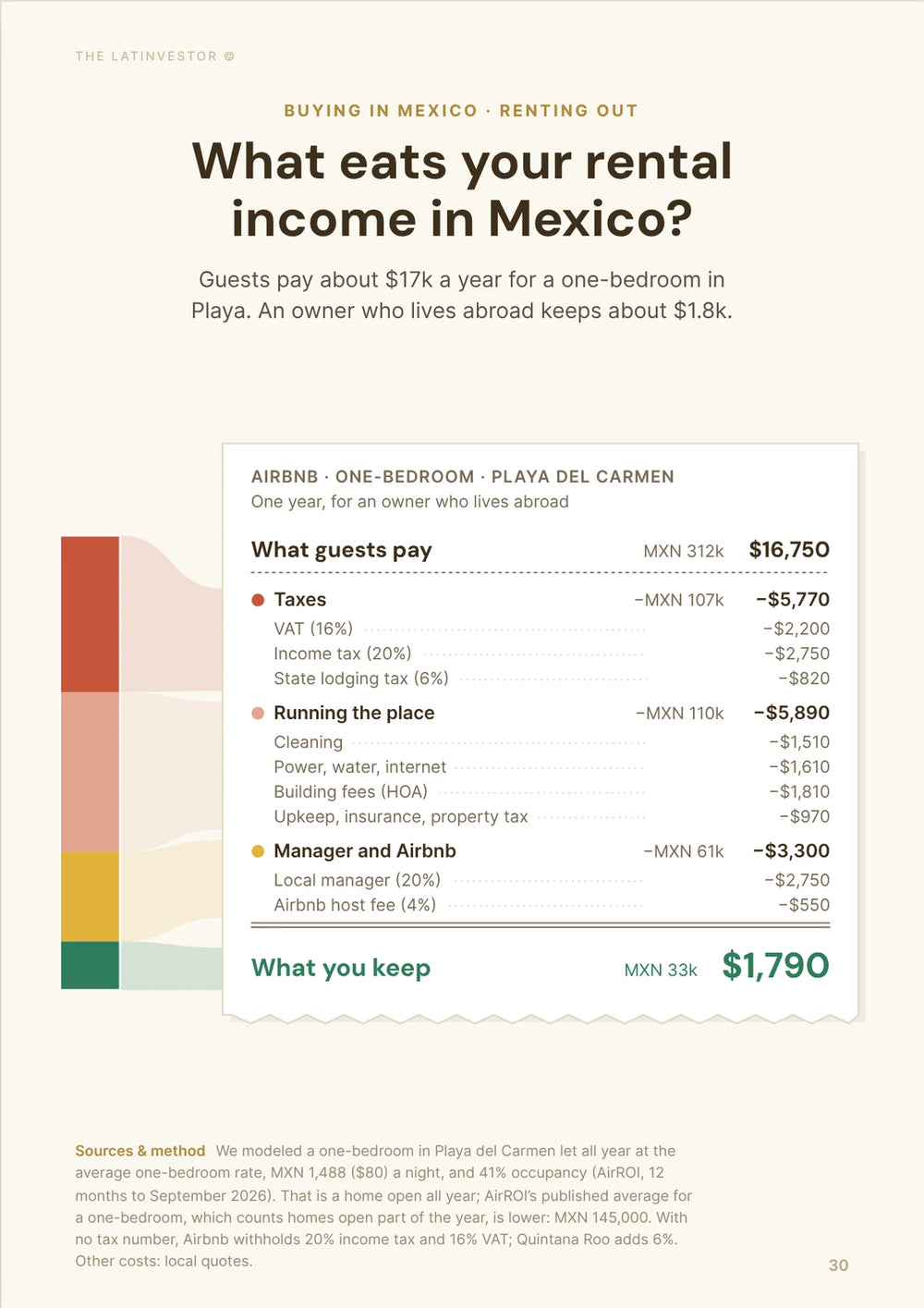
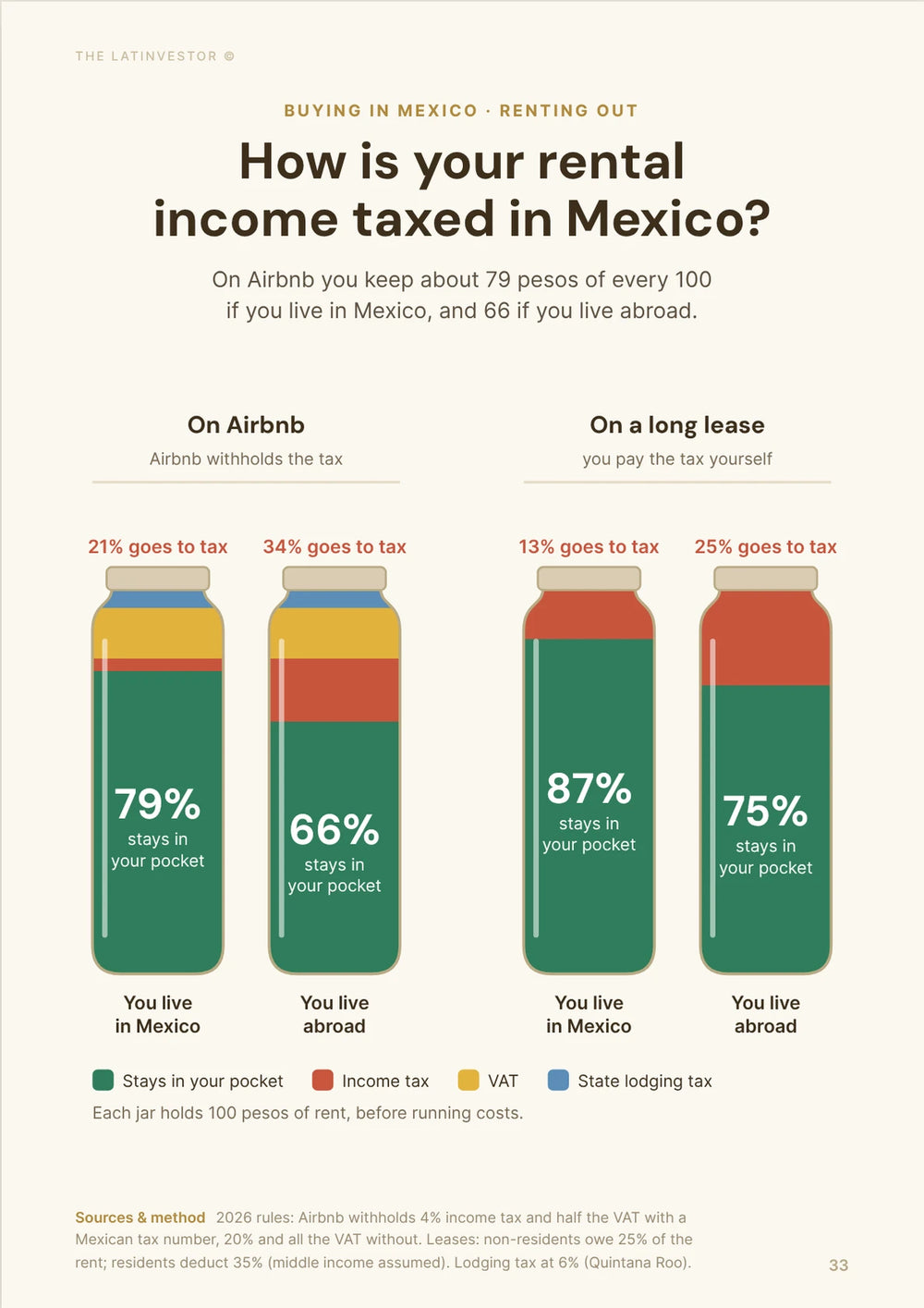
Price the apartment at a standard monthly rent for its area, then take off costs and tax. A non-resident owner pays 25% of the gross rent to the tax authority, with no deduction for expenses. If you plan short stays, run the numbers at 180 nights a year in Guadalajara and check Mexico City's registry status before you sign.
The opportunity, if there is one, is on the buying side: owners of furnished ex-Airbnb units who can't fill them may accept a lower price.
So are rents falling in Mexico after the World Cup?
Only the event prices. The World Cup premium is gone and some landlords are cutting overpriced units, but normal rents were still rising in the latest data.
Short stays took the hit: Monterrey's average quote fell from MXN 4,743 to MXN 796 per person a night between June and July, and Mexico City has 27.8% fewer active short-term listings than a year ago.
Long-term rents haven't followed yet. Mexico City's standard two-bedroom was up 9.6% in a year and Guadalajara's 8.6%. Monterrey, at about MXN 25,500, is the exception, flat after inflation. Nationally, INEGI's housing sub-index was up 3.57%.
For tenants, the change is real but quiet: more apartments to choose from, and overpriced ones are negotiable again. If supply keeps coming back, rents could ease in parts of the three host cities. Calling it a national trend would be premature. The World Cup bubble has deflated; the housing market hasn't.
Our methodology
This article checks whether rents fell in Mexico after the 2026 World Cup by keeping two markets apart: short-stay accommodation, which spiked for the event, and normal monthly leases, which are far bigger and move slowly.
For World Cup prices we use N+'s sample of 90 listings in Mexico City, Guadalajara and Monterrey (May-June 2026), which compares January prices, World Cup quotes, later cuts and bookings. For the tournament's results we use AirDNA's World Cup recap, and for the year to September 2026 AirDNA's city pages (active listings, occupancy, nightly rates, revenue). We don't mix AirDNA with other data providers in any calculation.
For long-term rents we use Inmuebles24's indexes for a standard 65 m² two-bedroom (June 2026, the latest published when we checked), El Economista for rents by borough, and Homie's July 2026 analysis of the three host cities. These are asking rents, not signed leases. For the national picture we use INEGI's consumer prices and housing sub-index, and SHF's index of mortgaged homes for purchase prices.
For the rules we rely on the Supreme Court on Mexico City's rent cap, INEGI's 2025 inflation (3.69%) for 2026 renewals, press coverage of the October 2026 rental bill, the Mexico City host registry, the Jalisco committee vote on short stays and Nuevo León's planned tourism law, and Mexico's income tax law for the 25% tax on non-residents' gross rent.
We checked these figures in October 2026. Conversions use about 18.6 pesos per US dollar and 20.9 pesos per euro.
The limits: portal prices are what landlords ask, not what tenants pay; the rent indexes hadn't covered the post-tournament months yet; and the drop in short-term listings has several causes besides the World Cup.
Key sources used for this analysis include N+ on the 90-listing World Cup sample, AirDNA's 2026 World Cup recap, AirDNA's Mexico City data, AirDNA's Guadalajara data, AirDNA's Monterrey data, Inmuebles24's June 2026 Mexico City index, Inmuebles24's Guadalajara rent index, Inmuebles24's Monterrey rent index, El Economista on rents by borough, El Economista on post-World Cup rental supply, Homie's post-World Cup rental analysis, INEGI's September 2026 inflation release, INEGI's INPC component tables, SHF's housing price index, the Supreme Court on Mexico City's rent cap, Crónica on the October 2026 fair rents bill, Expansión on the host registry delay, Crónica Jalisco on the 180-night committee vote, Publimetro on Nuevo León's tourism law and Article 158 of the Income Tax Law.