Summary
Yes, for a patient cash buyer. A normal Mexico City apartment earns about 6.8% to 7.6% gross in 2026, and the best deals sit in ordinary neighborhoods, not famous ones.
Yields went up because rents ran ahead of prices. The standard 65 m² two-bedroom asked MXN 21,921 a month in June 2026, up 9.6% in a year, while SHF measured prices in the Valle de México up only 4.6%.
Rents are still climbing, but unevenly: Coyoacán asking rents rose 15.5% in a year and Benito Juárez 6.9%. They're about 64% above their 2021 level.
Supply is still tight. Only 72 new residential projects came to market in the first quarter of 2026, against about 100 a quarter in 2017 and 2018.
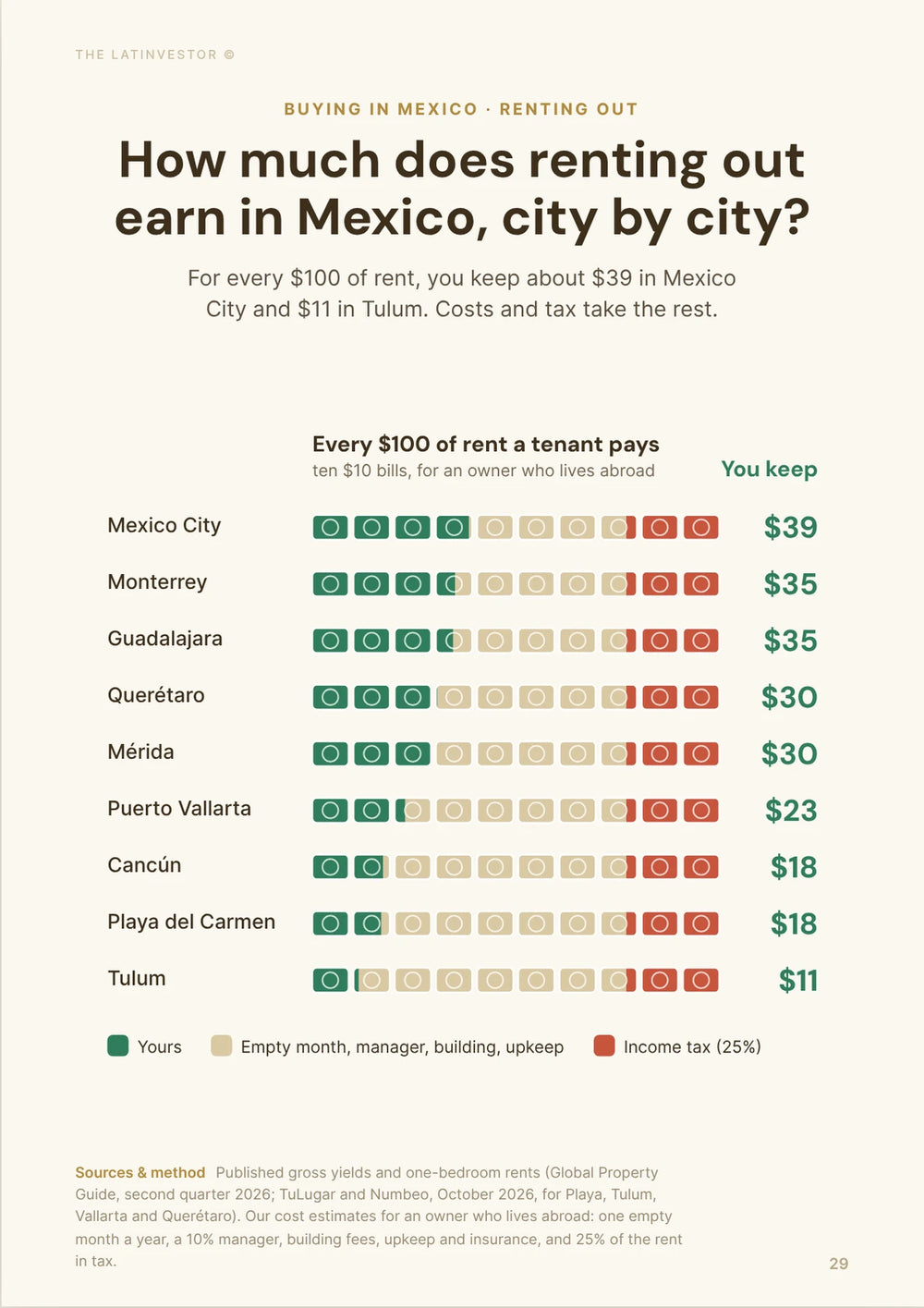
The headline yield isn't what you keep. On a MXN 3.38 million apartment renting at MXN 22,000, the 7.8% gross figure usually ends up around 5% to 6.5% after vacancy, repairs and condo fees. A non-resident then loses about 2 more points to the 25% tax on gross rent, for roughly 3% to 4.5%.
Against CETES, with Banxico's rate at 6.50%, an average rental doesn't win on income alone. You need a better-than-average price or some appreciation.
Mortgages kill most deals. At the 11.31% average quote, an 80% loan on that apartment costs about MXN 28,500 a month, MXN 6,500 more than the rent. Even at the 9.99% banks actually granted on average in June 2026, you're about MXN 4,100 short.
Prime areas yield less. A two-bedroom in Roma Norte returns about 5.2% gross, against 7.5% for a one-bedroom in the same neighborhood. Small units in Cuauhtémoc, Miguel Hidalgo and Coyoacán do better.
New builds are the weakest buy for a landlord. New apartments asked about MXN 80,922 per m² in mid-2026, up 10.8% in a year while sales fell 6.4%, which leaves about 5% gross.
Closing costs of about 6% to 8% mean you need a long hold: a 7% bill drops the 7.8% yield to 7.3% on the cash you actually put in.
Rent increases for sitting tenants are capped at inflation, 3.69% for 2026 renewals, and an October 2026 bill would fine landlords up to MXN 46,924 for going above it.
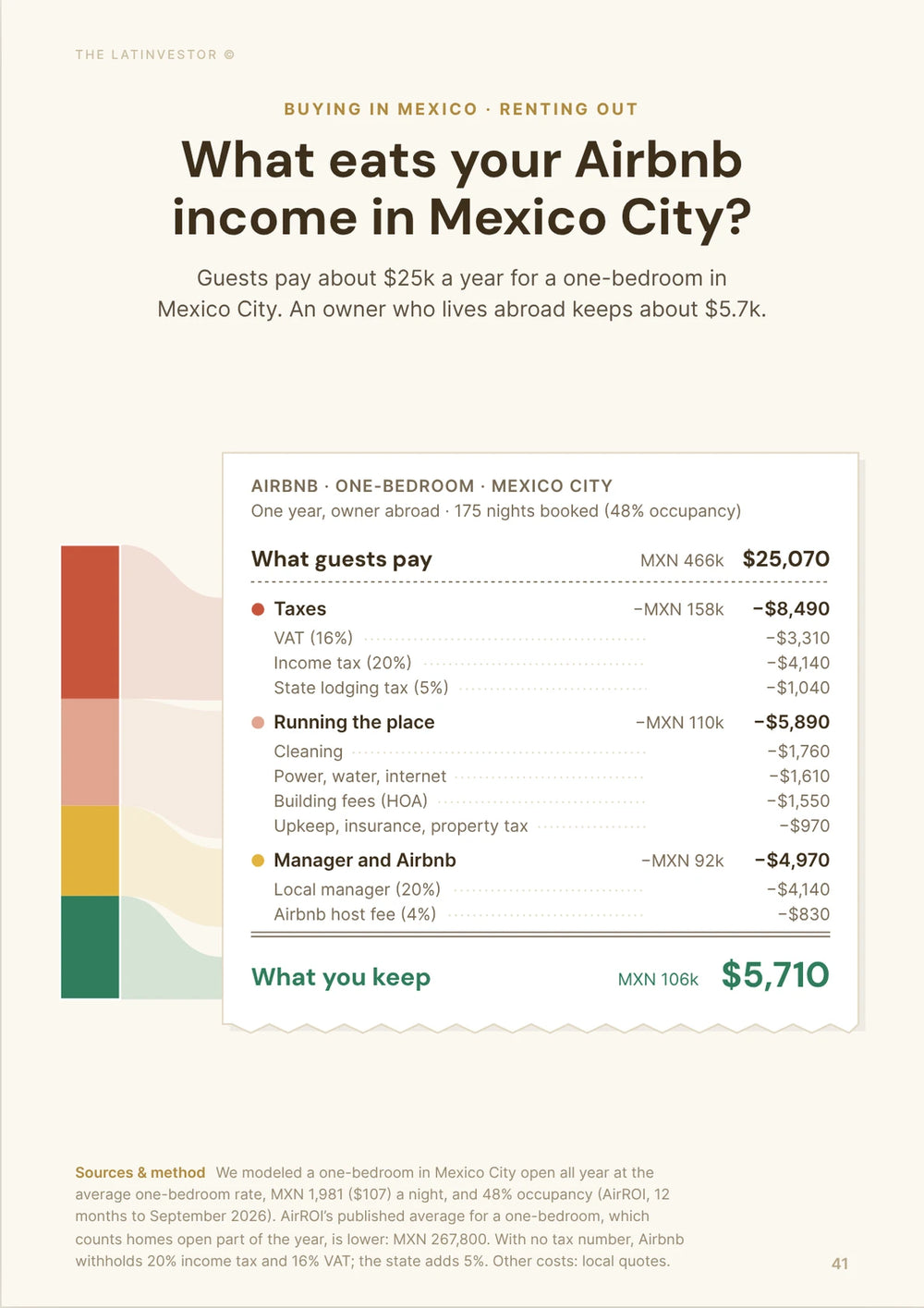
Airbnb is not a rescue plan. AirDNA counts 25,568 active listings, down 27.8% in a year, the registry runs until December 2026, and the 50% night cap is law but not enforced yet, with hosts still fighting it in court.
The World Cup made 2026 look better than it is: Airbnb nightly rates hit MXN 3,898 in June, then fell back to MXN 2,076 in August.
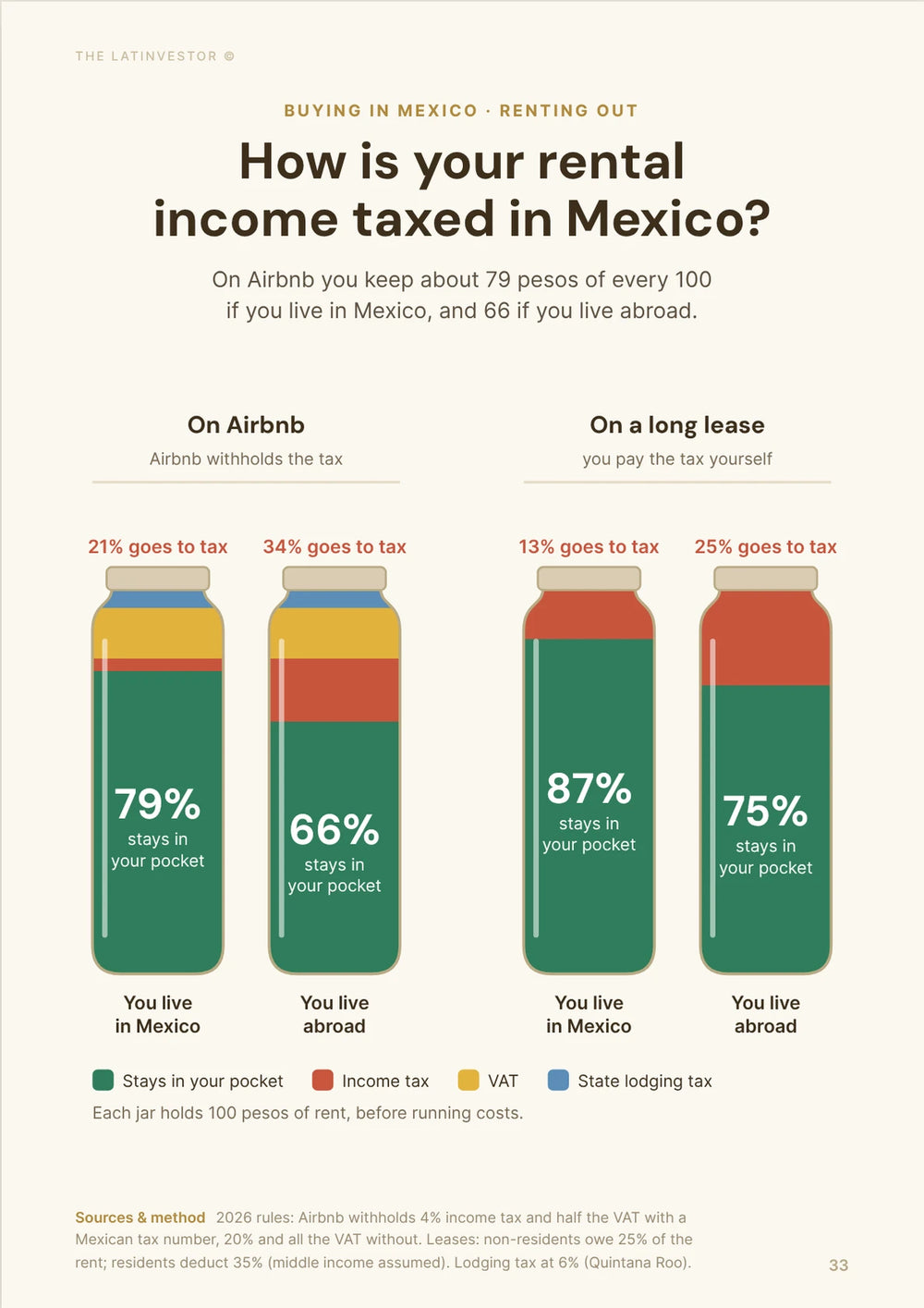
Foreigners can own directly in Mexico City, but non-residents pay 25% of gross rent in tax, about MXN 66,000 a year on our example.
Bottom line: buy a resale apartment that already works as a normal long-term rental at 7.5% to 9% gross, pay cash, and plan to hold seven to ten years.

Why are Mexico City rental yields going up while prices barely move?
Because rents have been rising about twice as fast as prices, so each peso you put into an apartment now buys more rent than it did three years ago.
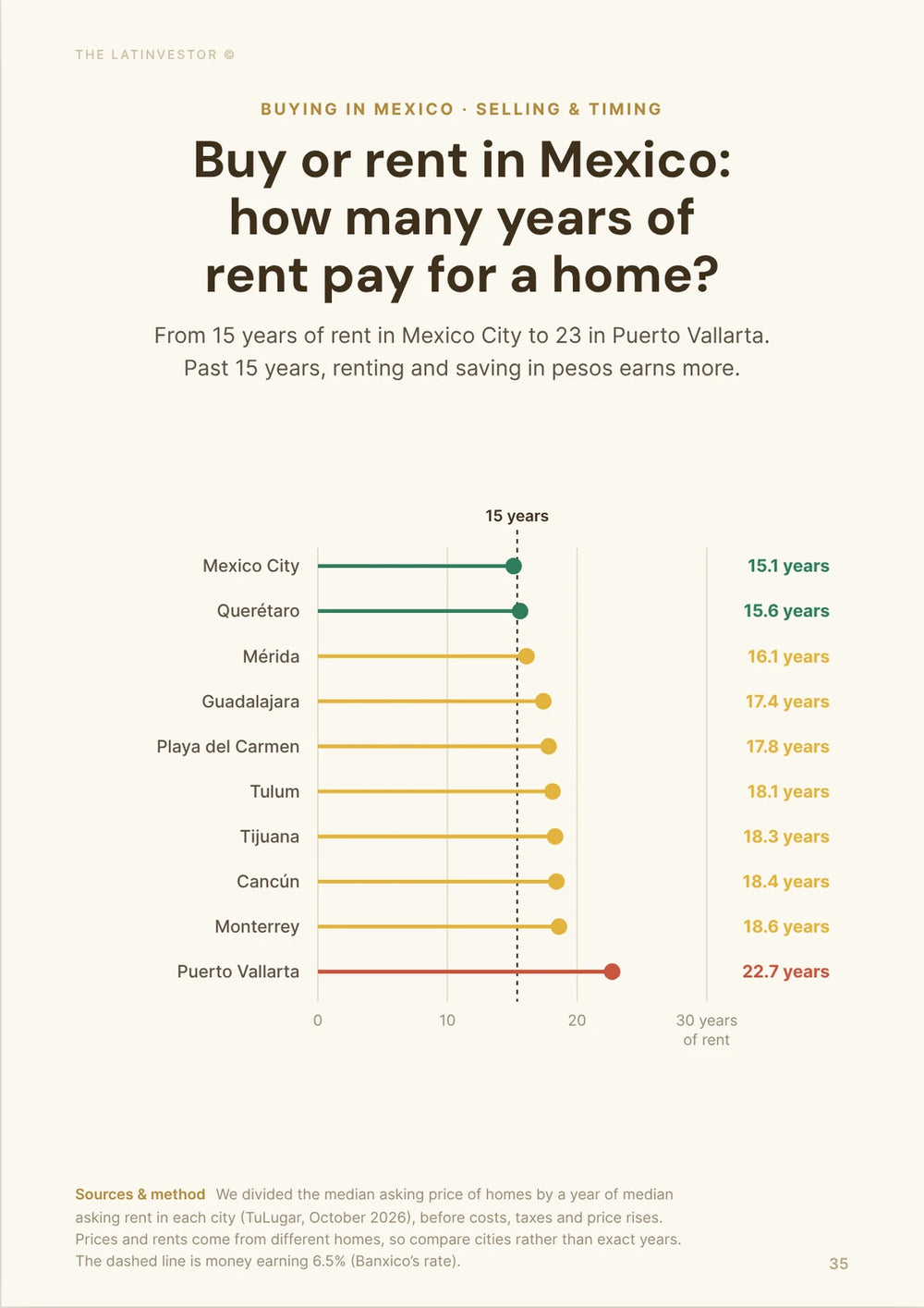
Inmuebles24's June 2026 index puts the city's gross rent-to-price return at 7.64%, which means about 13.1 years of gross rent to pay back the price. The same measure sat close to 6% during parts of 2023 and 2024, or nearly 16 years. Global Property Guide, which works from the same kind of listings but with its own method, gets a lower 6.77% for the second quarter of 2026. Neither is exact, but both point the same way.
The rental side did the work. The standard 65 m² two-bedroom asked MXN 21,921 a month in June 2026 (about USD 1,180), up 9.6% in a year. That's well above inflation, which closed 2025 at 3.69%.
Prices moved more slowly. SHF data show home values in the Valle de México up 4.6% in the first half of 2026, well below the 7.9% national increase and far below Guadalajara's 11.1%.
For a landlord, that's the good news: you earn more rent for the price than you did a few years ago.
| Market indicator | Earlier level | Latest reading | What changed |
|---|---|---|---|
| Gross rental yield (Inmuebles24) | Around 6% in parts of 2023–24 | 7.64% (June 2026) | Rental economics improved |
| Gross rental yield (Global Property Guide) | — | 6.77% (Q2 2026) | A more cautious second reading |
| Years of gross rent to repay the price | Nearly 16 years | 13.1 years | Payback shortened |
| Typical 2-bedroom asking rent | Roughly MXN 13,000–14,000 in 2021–22 | MXN 21,921 (June 2026) | Rents repriced sharply |
| Valle de México home prices (SHF) | — | +4.6% YoY, H1 2026 | Still rising, but slowly |
| National home prices (SHF) | — | +7.9% YoY, H1 2026 | Mexico City lags the country |
Are Mexico City rents still rising, or has the boom already peaked?
They're still rising fast, at 9.6% a year, but the explosive part of the post-2021 rebound is probably behind us.
The long run is clear. Inmuebles24 recorded a typical two-bedroom rent of roughly MXN 13,300 in 2021, MXN 13,700 in 2022, MXN 15,600 in 2023, MXN 18,300 in 2024 and around MXN 20,000 in 2025. It reached MXN 21,921 in June 2026, about 64% above the 2021 level.
The pace now depends a lot on the borough. In the year to June 2026, asking rents for the same 65 m² two-bedroom rose 15.5% in Coyoacán (to MXN 17,306), 13.7% in Cuauhtémoc (MXN 29,149), 10.1% in Miguel Hidalgo (MXN 27,786) and only 6.9% in Benito Juárez (MXN 20,486).
Don't extrapolate from here. A typical two-bedroom already costs close to 60% of average household income in the city, so tenants are moving to smaller units, roommates or cheaper boroughs. In your numbers, assume rent growth slows toward inflation, not another 10% a year.
Is Mexico City actually short of rental housing?
Yes. Rental pressure in Mexico City rests on a real supply problem, especially in the neighborhoods people want.
A Tinsa review counted only 72 new residential projects entering the market in the first quarter of 2026, against about 100 a quarter in 2017 and 2018, and many now have only 10 to 40 units. Data from 4S Real Estate showed about 19,587 apartments available at the end of the third quarter of 2025, down 23% in a year.
Building more is slow. Permits for larger projects can take up to 36 months, land is expensive, and the city's 2026 program aims at about 10,000 lower-cost homes, far from what the market needs.
That's why rent increases have spread well beyond Roma and Condesa, into Benito Juárez, Coyoacán and other boroughs where tenants are mostly local.
Foreign residents and short-term rentals add pressure in a few central neighborhoods, but they don't explain a citywide move on their own. As long as households grow faster than well-located housing, landlords keep pricing power.
What rental yield can a normal Mexico City apartment make today?
About 7% to 8% gross, and usually somewhere in the mid-single digits after ordinary costs.
Take a 65 m² apartment at the city's average asking price. At about MXN 52,000 per m² (Inmuebles24, June 2026), it costs about MXN 3.38 million (about USD 182,000). At MXN 22,000 a month, close to the city's standard two-bedroom rent, it brings in MXN 264,000 a year.
That's about 7.8% before any expense, close to Inmuebles24's 7.64% benchmark.
Then it comes down fast. One empty month removes more than 8% of the year's rent. Repairs, insurance, management and condo fees take another slice. Tax depends on who you are and how you own.
A landlord with twelve full months and almost no repairs stays close to the headline figure. A normal apartment often ends up around 5% to 6.5% before financing and income tax. If you're a non-resident, the 25% tax on gross rent (about MXN 66,000 a year here) takes roughly 2 more points, so expect about 3% to 4.5% net.
The purchase price is where you win or lose. The same MXN 22,000 rent gives 7.3% gross at MXN 3.6 million and 8.3% at MXN 3.2 million. Same apartment, different investment.
| Illustrative apartment | Amount |
|---|---|
| Apartment size | 65 m² |
| Approx. price per m² | MXN 52,000 |
| Approx. purchase price | MXN 3.38M (about USD 182,000) |
| Monthly rent | ~MXN 22,000 |
| Annual gross rent | ~MXN 264,000 |
| Implied gross yield | ~7.8% |
| More realistic pre-financing return | Roughly 5%–6.5% |
Does a Mexico City rental beat CETES right now?
Not on income alone. An average rental needs a better-than-average price, some appreciation, or both to be worth the extra work.
Banxico's policy rate stood at 6.50% in October 2026, and a Citi survey of analysts published on October 20 expects no change in 2026 or 2027. CETES pay roughly in that area, with no vacancies, leaking pipes, condo fees, tenants or closing costs.
A rental at 7.6% gross that ends up around 5% to 6.5% net of costs can easily pay less current income than government paper.
Property has a second source of return, though. If an apartment earns 5.5% net and its value rises 4% in a year, the total is much better than the rental yield alone suggests.
So Mexico City makes more sense for someone after income plus long-term appreciation than for someone chasing the highest yield today. If you only want passive income in cash, look for a gross yield clearly above the city average before picking an apartment over CETES.
Does buying a Mexico City rental with a mortgage make sense today?
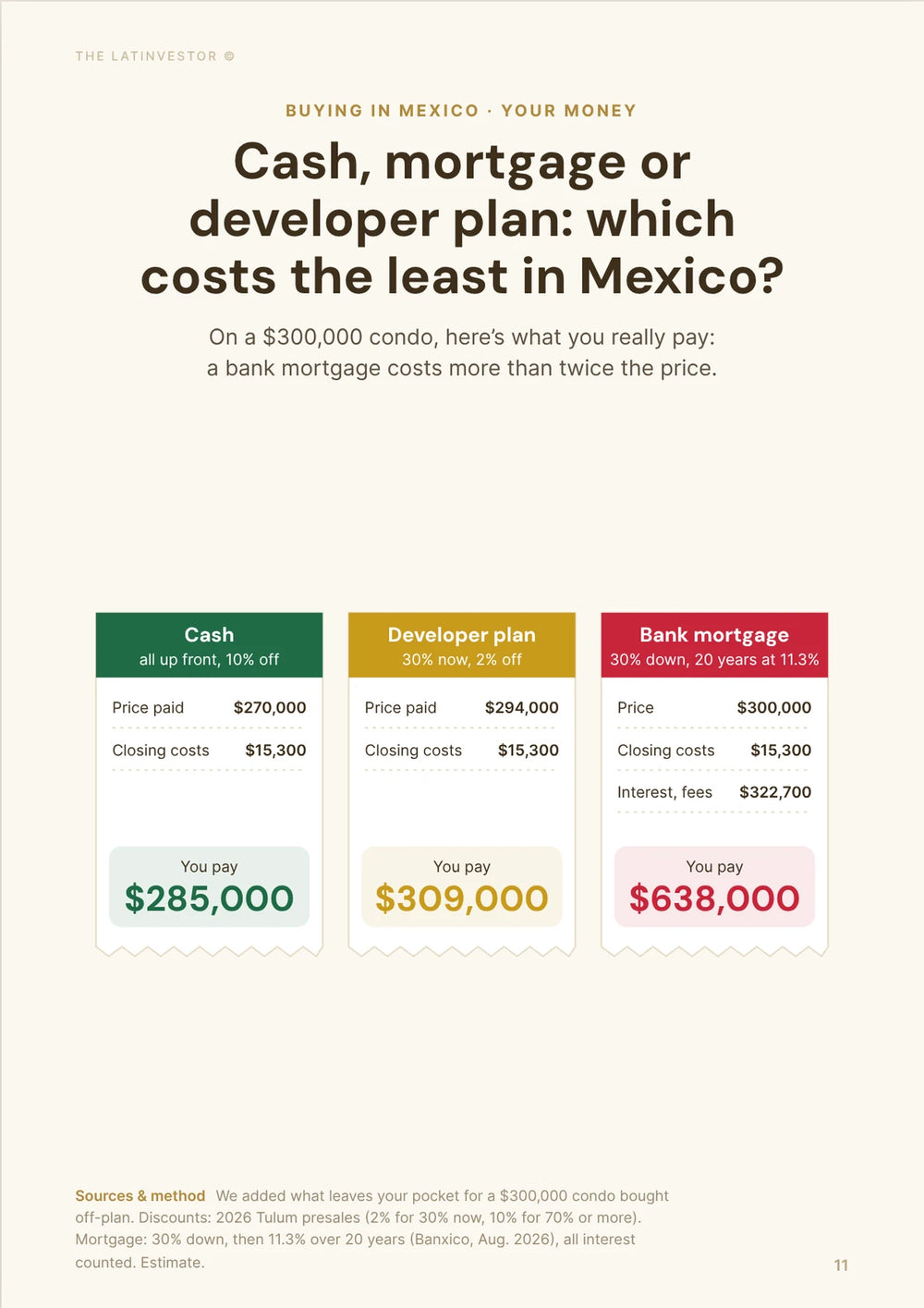
For most buyers, no. At today's rates, financing an average apartment leaves you paying in every month.
Banco de México's average fixed-rate quote was 11.31% in August 2026, and the rate on loans actually granted averaged 9.99% in June 2026, according to the bank association (Crónica). Both sit well above the city's gross yield, even though Banxico's own rate has dropped to 6.50%.
Take the same MXN 3.38 million apartment renting at about MXN 22,000. An 80% loan over 20 years at 11.31% costs about MXN 28,500 a month; at 9.99%, about MXN 26,100.
The rent misses the payment by about MXN 6,500 (MXN 4,100 at 9.99%) before maintenance, vacancy, insurance or tax.
At 60% of the price, the rent barely covers the payment, and you're negative after costs. At 50%, it's close to break-even, with a thin margin.
Debt can work later if rates fall, rents climb or you find an unusually high yield. Today, Mexico City favors cash buyers and those bringing a lot of equity.
| Financing example | Cash | 50% LTV | 60% LTV | 80% LTV |
|---|---|---|---|---|
| Property price | MXN 3.38M | MXN 3.38M | MXN 3.38M | MXN 3.38M |
| Mortgage | 0 | MXN 1.69M | MXN 2.03M | MXN 2.70M |
| Approx. monthly payment (11.31%, 20 years) | 0 | ~MXN 17,800 | ~MXN 21,400 | ~MXN 28,500 |
| Approx. monthly rent | MXN 22,000 | MXN 22,000 | MXN 22,000 | MXN 22,000 |
| Rent minus mortgage | +MXN 22,000 | +MXN 4,200 | +MXN 600 | -MXN 6,500 |
| Likely cash flow after expenses | Strongly positive | Thin | Negative | Clearly negative |
Are Roma and Condesa actually good places to buy a rental?
They're easy places to find tenants, but weak places to chase yield, because you pay upfront for their popularity.
Global Property Guide's Q2 2026 data put a two-bedroom in Roma Norte at about USD 480,900 asking (about MXN 8.94 million) for USD 2,100 a month in rent (about MXN 39,100). That's 5.24% gross, well below the city average.
The same neighborhood looks very different with a one-bedroom: about USD 260,000 for USD 1,620 a month, or 7.48%. In prime areas, the small unit is the investment; the big one is a lifestyle purchase.
Condesa isn't broken out in that data, but the pattern is the same. Its 2-bedroom listings had a median asking price of about USD 532,000 on TuLugar in September 2026.
Demand there is excellent. Vacancy is easier to manage, the international tenant pool is deep, and resale should hold up. You just pay for almost all of it on day one.
| Area (Q2 2026) | 1-bed gross yield | 2-bed gross yield | 2-bed asking price | 2-bed asking rent |
|---|---|---|---|---|
| Miguel Hidalgo | 8.17% | 6.82% | USD 487,600 | USD 2,770 |
| Cuauhtémoc | 7.70% | 6.78% | USD 357,600 | USD 2,020 |
| Coyoacán | 7.61% | 6.81% | USD 208,000 | USD 1,180 |
| Roma Norte | 7.48% | 5.24% | USD 480,900 | USD 2,100 |
| Álvaro Obregón | 7.12% | 6.34% | USD 325,300 | USD 1,720 |
| Benito Juárez | 6.51% | 6.24% | USD 300,100 | USD 1,560 |
| Mexico City average | 6.94% | 7.05% | USD 315,000 | USD 1,850 |
Where can investors still find better rental yields in Mexico City?
In small apartments outside the famous addresses, where prices haven't run as far ahead of local rents.
Global Property Guide's Q2 2026 data show one-bedrooms beating two-bedrooms almost everywhere: 8.17% in Miguel Hidalgo, 7.70% in Cuauhtémoc and 7.61% in Coyoacán, where a one-bedroom asks about USD 137,200 (about MXN 2.55 million). Coyoacán also had the fastest rent growth in the city, 15.5% in a year.
Be careful with extreme portal numbers for a single colonia. Unit size, building age and thin listing samples can easily push an average up.
The broader pattern is more useful. Areas such as San Rafael, Santa María la Ribera, parts of Coyoacán, Escandón and others outside the Roma-Condesa-Polanco triangle tend to offer a better balance of rent, price and transport.
One-bedroom and compact two-bedroom units reach a much bigger tenant pool than family-sized apartments, and they rent for more per square meter.
The sweet spot these days is an ordinary apartment near the metro, offices, hospitals or universities, not a luxury unit in the neighborhood every foreign buyer already knows.
Are new-build apartments in Mexico City worth buying as a rental right now?
Usually not. New apartments are priced for buyers who live in them, and the rent doesn't follow.
Accumin Intelligence put the average asking price of new housing in Mexico City at about MXN 80,922 per m² at the end of the first half of 2026, up 10.8% in a year. Over the same quarter, new-home sales across the Valle de México fell 6.4%, to about 7,084 units. Prices up, sales down: developers are holding their list prices while fewer people buy.
Run the numbers. A 65 m² new apartment at MXN 80,922 per m² costs about MXN 5.26 million. At the same MXN 22,000 rent, that's about 5% gross, before costs. Middle-segment new product, at about MXN 52,136 per m², gets you back to the city average, closer to 7.8%.
What to do: compare any new unit with resale apartments in the same colonia, ask for a written discount (slow sales give you room), and don't pay a pre-sale premium for a rental. If you buy off-plan, check the developer's finished projects and the permits before you sign.
Can Mexico City property prices still rise enough to boost rental returns?
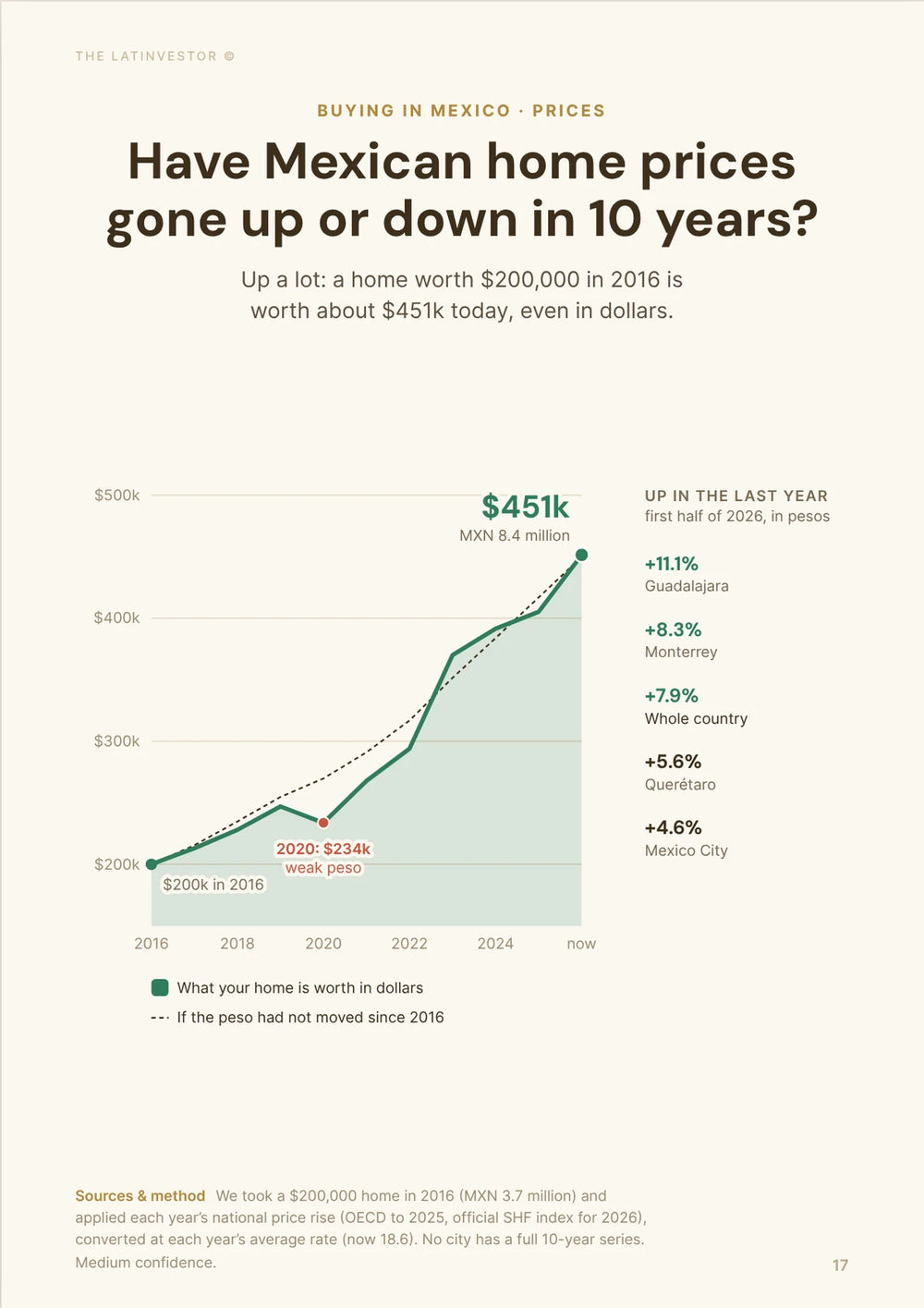
Yes, but don't make appreciation do the heavy lifting. Prices are rising at a moderate pace, which is useful upside, not the reason to buy.
In the first half of 2026, SHF measured home values up 7.9% nationally but only 4.6% in the Valle de México.
Several big markets left the capital behind: Guadalajara at 11.1%, Tijuana at 9.7%, Puebla-Tlaxcala at 8.5% and Monterrey at 8.3%.
So Mexico City still appreciates, but it's no longer one of the fastest-rising markets. For a landlord, that's not bad: rent growth running ahead of prices is exactly what pushed yields up.
Long-term scarcity still helps. Central land is limited, construction is expensive and approvals are slow.
Still, don't buy a weak 5% rental because "Mexico City property always goes up." A building can age badly and a neighborhood can stall even while the citywide index rises. A rental that already works at today's rent is the safer bet; any appreciation is a bonus.
How much do closing costs hurt a Mexico City rental investment?
Enough to punish a short hold, but they fade over seven to ten years.
Budget roughly 6% to 8% on top of the price for transfer tax (ISAI), notary, registry, appraisal and related costs. ISAI alone is progressive: under the 2026 schedule it works out to about 5.07% on a MXN 2.5 million purchase, and the rate rises with the price.
On a MXN 3.38 million apartment, ISAI alone is above 5%, so a 7% bill (about MXN 237,000) is realistic, and you actually put in about MXN 3.62 million.
The MXN 264,000 of annual rent then yields about 7.3% on your real cost, not the 7.8% on the listed price.
Selling quickly is where it hurts. A property that gains 4% in its first year hasn't even covered a 7% purchase bill, let alone the cost of selling.
We wouldn't buy a Mexico City rental with a two- or three-year exit plan. Seven to ten years gives rent growth and appreciation time to absorb the upfront cost.
| Example | Purchase price only | +6% costs | +7% costs | +8% costs |
|---|---|---|---|---|
| Apartment price | MXN 3.38M | MXN 3.38M | MXN 3.38M | MXN 3.38M |
| Actual capital invested | MXN 3.38M | MXN 3.58M | MXN 3.62M | MXN 3.65M |
| Annual gross rent | MXN 264k | MXN 264k | MXN 264k | MXN 264k |
| Gross yield on total cost | 7.8% | 7.4% | 7.3% | 7.2% |
| Holding period we would favor | Long | Long | Long | Very long |
Will Mexico City's rent cap and the new "fair rents" bill hurt landlords?
They limit how fast you can raise rent on a tenant who stays, so they belong in your numbers. They don't touch the starting rent.
The city's Civil Code caps yearly increases on residential leases at the previous year's inflation, which means 3.69% for 2026 renewals. The Supreme Court upheld the rule on February 25, 2026, and confirmed that landlords and tenants still agree freely on the first rent.
On October 19, 2026, Mayor Clara Brugada sent Congress a broader bill on "fair, reasonable and affordable" rents. It would require landlords to register every residential contract in a digital registry, set a one-year minimum term, ban agent and credit-check fees for tenants, and fine raises above inflation with MXN 11,731 to 46,924. It isn't law yet.
Here's what the cap does. An apartment starts at MXN 20,000 a month and rents in the area rise 9% in a year. The market rate is now about MXN 21,800, but your sitting tenant's rent can only go to about MXN 20,740.
Over several strong years, that gap grows. A long-term tenant is still worth a lot, since turnover and empty months cost money, but the starting rent and the tenant you pick matter more than before.
What to do: model rent increases at inflation, not at whatever Inmuebles24 reports each year. Set the first rent at market, sign a proper written contract you'd be happy to register, and take a single, normal guarantee.
Did the World Cup inflate the numbers you're being shown?
Yes, for short-term rentals. Be careful with any 2026 Airbnb figure a seller or agent shows you.
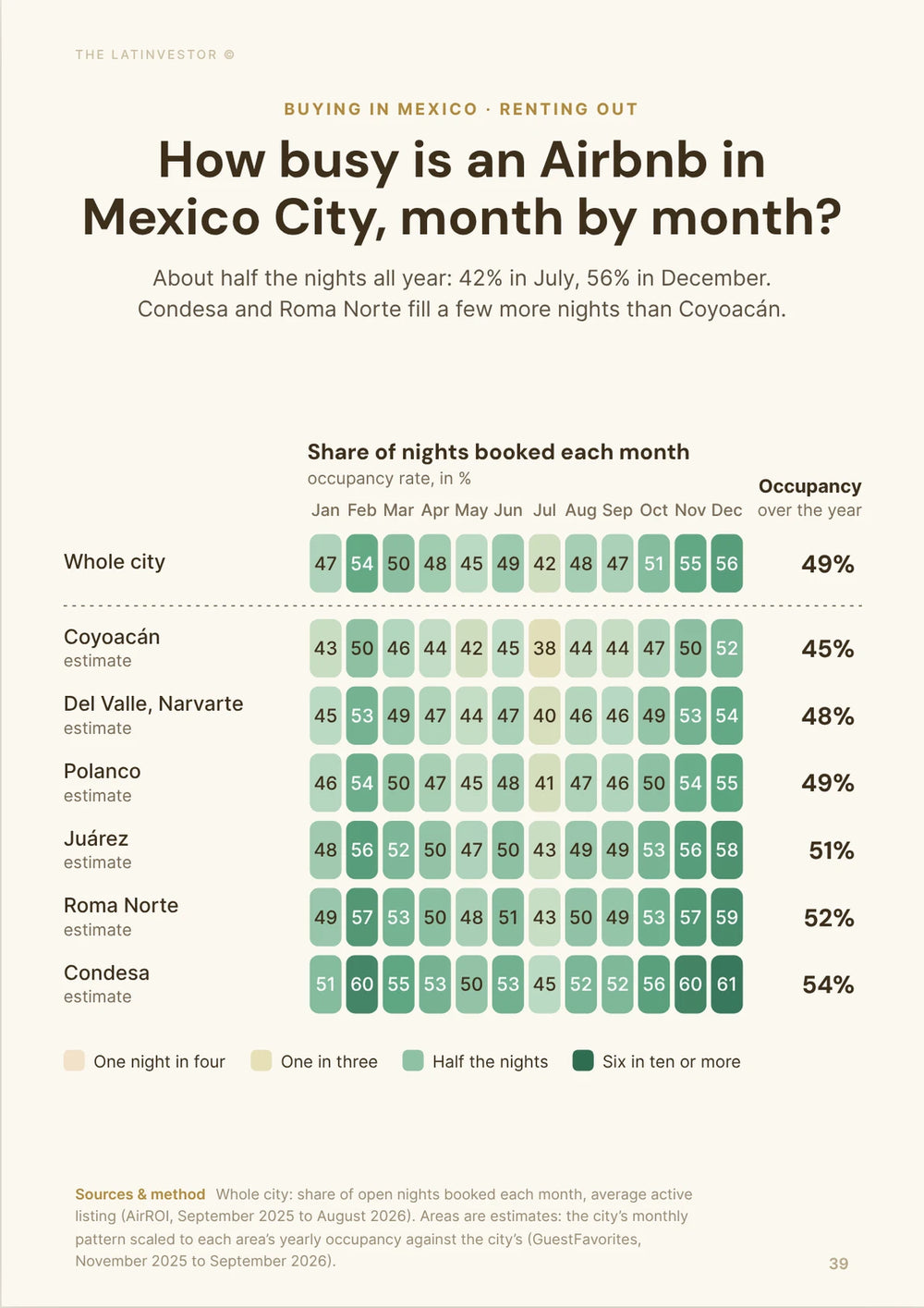
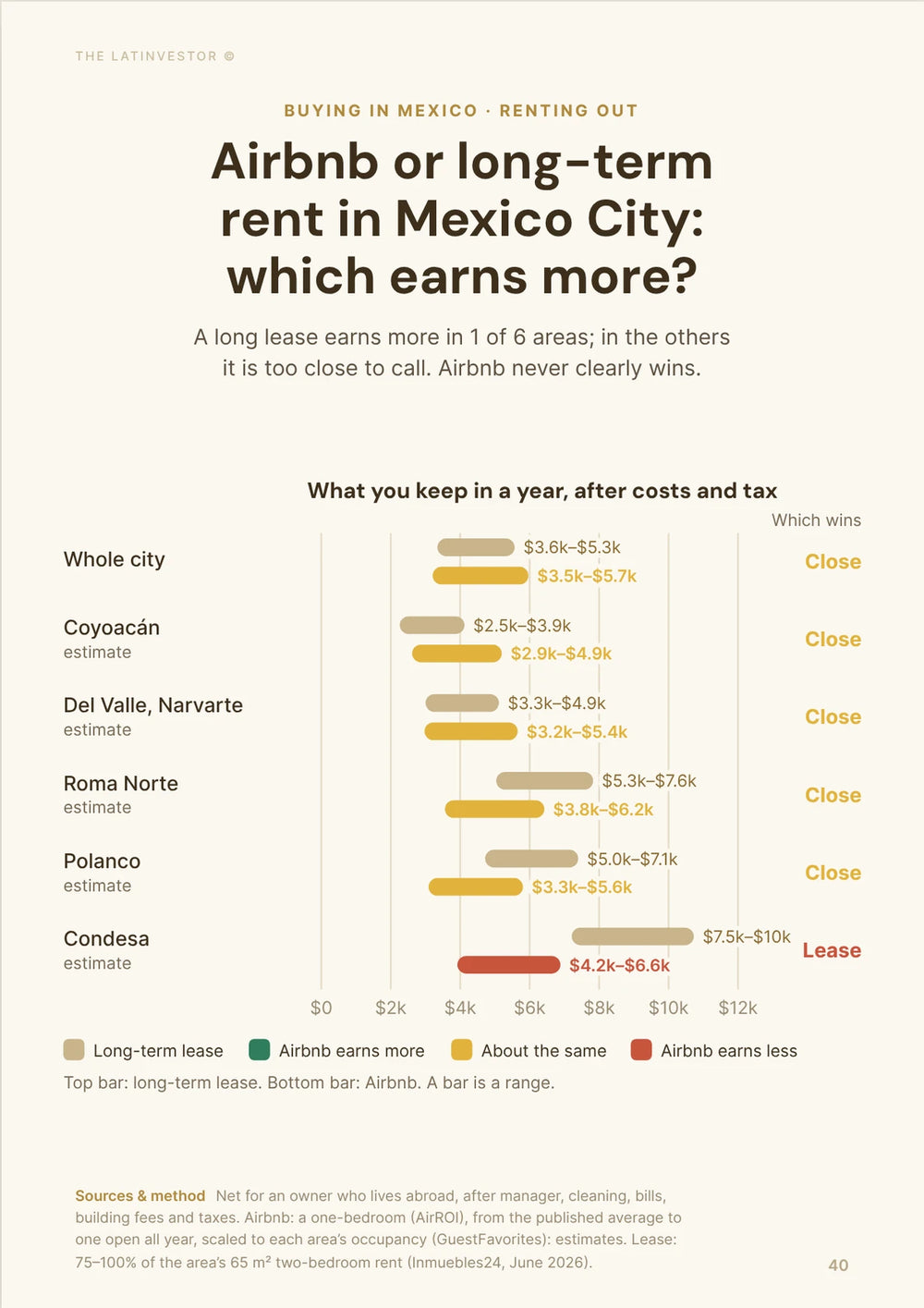
On AirROI's Airbnb data, the average nightly rate in Mexico City jumped to MXN 3,898 in June 2026, during the tournament, from MXN 1,838 in April. By August it was back to MXN 2,076. Occupancy didn't rise with it: 48.6% in June, 41.5% in July.
Hosts say bookings dropped after the World Cup ended, and some have stopped renting short-term altogether, according to El Financiero in October 2026.
What to do: ask for twelve months of booking statements, take out June and July 2026, and judge the property on the other months. Long-term rents don't have this problem: asking rents rose only 0.5% in June itself, so almost all of the 9.6% yearly rise came before the tournament.
Can Airbnb still improve the returns on a Mexico City apartment?
Sometimes, but don't buy a weak rental counting on short-term letting to fix it.
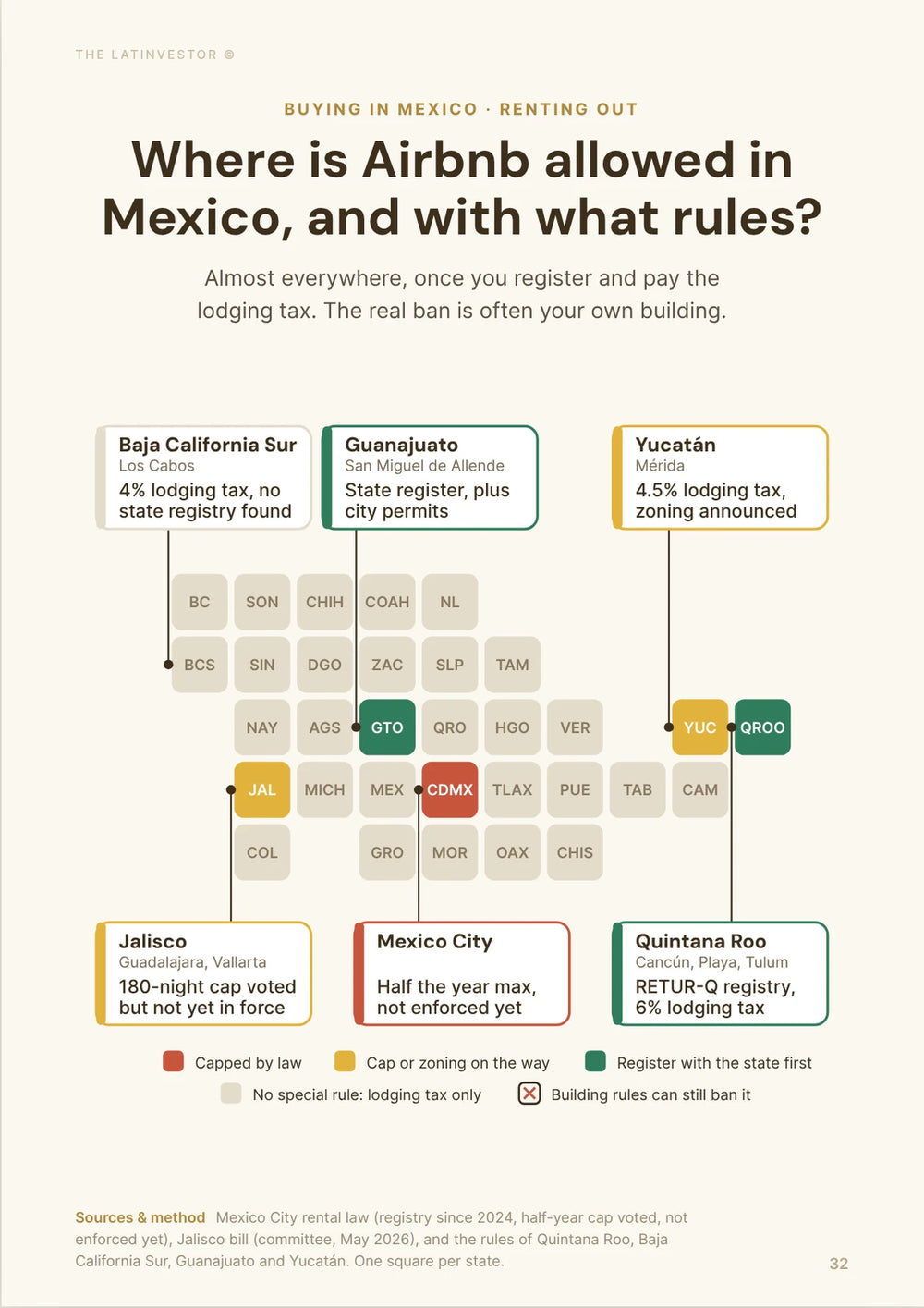
The rules are half in place. The host registry is live, and the deadline to sign up was pushed back to December 2026. In mid-October the city reported only 660 registered properties, against about 30,000 listings in an outside platform count. The 50% annual-occupancy limit (about 182 nights a year) and the three-property cap depend on that registry and on court challenges from hosts and Airbnb, so they aren't enforced yet.
That uncertainty cuts both ways. AirDNA counts 25,568 active short-term rentals in September 2026, down 27.8% in a year, with occupancy up to 64% and an average nightly rate of USD 91 (about MXN 1,690). Less competition helps the hosts who stay, but no one knows how many nights you'll legally be able to rent in 2027.
Costs are also much higher than the nightly rate suggests: furniture, cleaning, platform fees, guest messaging, repairs and empty nights all eat into the gap with a normal lease.
The safe approach: the property must already make sense as a long-term rental. Check the building's rules on short stays, then treat Airbnb as an option, not the plan.
Is Mexico City rental property still attractive for foreign buyers?
Buying is simple; the tax is what can turn a good yield into a mediocre one for non-residents.
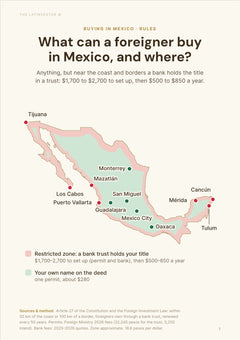
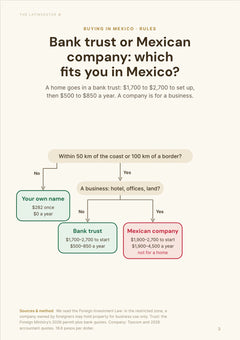
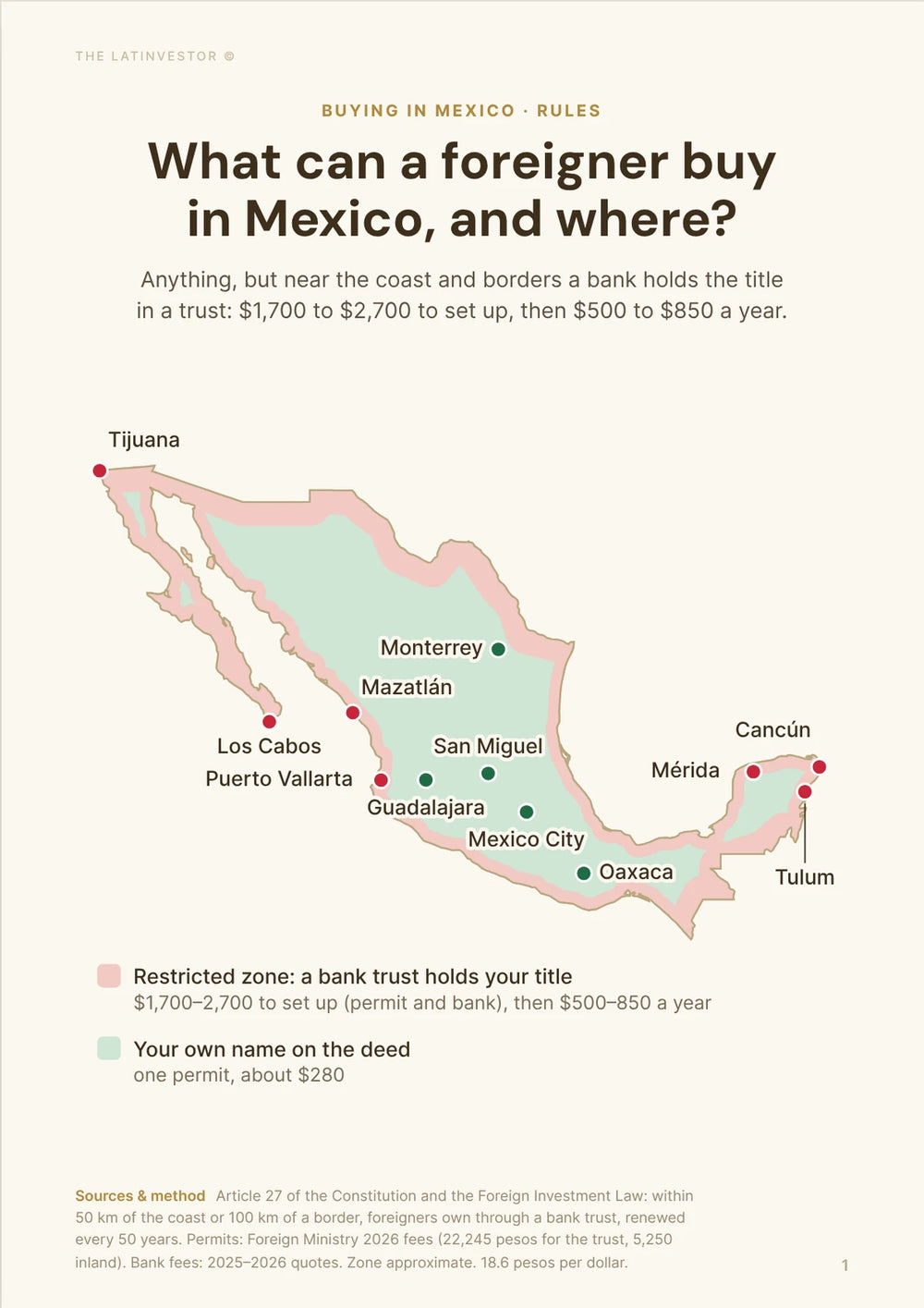
Mexico City is outside the restricted coastal and border zones, so foreigners can own directly, without the bank trust (fideicomiso) used near beaches and borders.
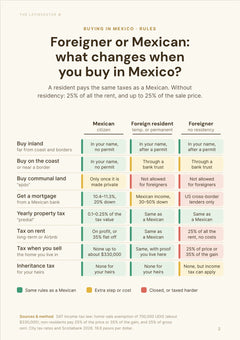
Rental tax deserves more attention than ownership. A non-resident receiving Mexican rent generally pays 25% on gross rent under the Income Tax Law (article 158), with no deduction for expenses. Mexican tax residents can instead deduct costs or take a 35% blind deduction, depending on their situation.
On MXN 264,000 of annual rent, 25% is about MXN 66,000 (about USD 3,550) a year, before repairs, vacancy or management.
That's enough to flip the ranking between two properties. Sort out how you'll own and declare the income before you compare Roma Norte at 5% with Coyoacán at 7%: the tax can move your final return more than the neighborhood does.
| Foreign-buyer issue | Mexico City in 2026 | Effect on the investment |
|---|---|---|
| Restricted-zone trust | Not needed | Direct ownership is simpler |
| Closing costs | Roughly 6%–8% of the price | High upfront cost |
| Non-resident rental tax | 25% of gross rent | Large cut to the return |
| Rent increases for sitting tenants | Capped at inflation (3.69% in 2026) | Limits fast repricing |
| Short-term rentals | Registry live, night cap not enforced yet | Airbnb plan carries extra risk |
What should we check before buying a rental apartment in Mexico City?
The building, almost as carefully as the neighborhood, because one structural or condo problem can wipe out years of rent.
Start with the condo's finances. A nice apartment in a badly funded building may soon face large assessments for the façade, elevators, roof, water system or structure.
Earthquake history matters a lot here. Building age, structural changes and any engineering reports count far more than a new kitchen or a rooftop.
Check the water. The Cutzamala system reached 81% of capacity at the end of August 2026, its best level in a decade, about 87% by late September and 92.35% in mid-October, but supply is still uneven by colonia: some Jardines del Pedregal households reported spending up to MXN 10,500 a month on water trucks in September 2026. Look at the cistern, the pumps and how often the street goes without water.
Verify condo debts, predial, water bills, title and any building rules on rentals. The notary checks a lot of this, but you should know what was checked.
Finally, stress-test the rent. Portal asking rents are a start; signed leases are better evidence. The property should still give an acceptable return with some vacancy, normal repairs and rent increases at inflation.
If the deal needs twelve full months, zero repairs and another 10% jump in rent every year, pass.
So is rental property worth buying in Mexico City right now?
Yes, for selective, patient investors, especially cash buyers who can find a real yield above the city average.
The case has improved. Inmuebles24 puts the citywide gross return at 7.64% and Global Property Guide at 6.77%, against close to 6% a few years ago. Rents rose 9.6% in a year, supply is tight, and prices in the Valle de México rose only 4.6%, which helps yields.
Financing is the biggest problem. Mortgage quotes of 11.31% (and about 10% on loans actually granted) sit far above residential yields, so a heavily leveraged buyer loses money every month before repairs and vacancy.
Prime neighborhoods and new builds are the other traps. A two-bedroom in Roma Norte yields about 5.2% gross, and a new apartment at MXN 80,922 per m² about 5%. We'd rather own a well-located one-bedroom at 7.5% to 8% in a less fashionable area.
Cash buyers with a seven-to-ten-year horizon have the strongest case. The ideal property already works under a standard lease, sits near transport or big employers, and is bought at a price that leaves room for about 7.5% to 9% gross.
Don't count on the World Cup months or on Airbnb, and if you live abroad, take off 25% of gross rent for tax before you trust the headline yield.
Our methodology
This article estimates whether a rental apartment in Mexico City pays in 2026, looking at what drives a landlord's return: rent against price, where both are heading, financing, supply, differences between boroughs, closing costs, rent rules, short-term-rental rules and tax.
Price growth and mortgage rates come from Sociedad Hipotecaria Federal, the official source. Rents, average asking prices and the 7.64% yield come from Inmuebles24's June 2026 Mexico City index; the second yield reading and borough data come from Global Property Guide, which divides median asking rents by median asking prices. Both use listings, so they are gross, pre-expense figures. New-build prices and sales come from Accumin Intelligence, supply from Tinsa and 4S Real Estate, and short-term-rental figures from AirDNA and AirROI, which we never mix in the same calculation.
Our worked examples (a 65 m² apartment at MXN 3.38 million renting at MXN 22,000) are illustrations built on those averages, not forecasts. Mortgage payments assume a 20-year loan at Banxico's 11.31% average quote, with the 9.99% average granted rate (ABM, June 2026) as a second case.
Rules come from the Mexico City Civil Code and the Supreme Court's February 2026 decision for rent increases, INEGI for the 3.69% inflation figure, the Mexico City Congress and press reports for the short-term-rental law and the October 2026 fair-rents bill, the Income Tax Law for non-resident rental tax, and the 2026 CDMX Fiscal Code for transfer tax.
We checked these figures in October 2026. Conversions use about 18.6 pesos per US dollar and 20.9 pesos per euro.
Limits: asking rents and prices are not signed leases or closed sales, borough averages hide big gaps between buildings, and your tax depends on your residency and any treaty. Treat the numbers as a starting point for your own checks.
Key sources used for this analysis include Inmuebles24's June 2026 Mexico City index, SHF's Q2 2026 housing-price release, Global Property Guide's Mexico rental yields, El Economista on rents by borough, La Jornada on rents against inflation, Accumin's H1 2026 new-housing data, Tinsa's Q1 2026 market report, El Economista on 4S Real Estate inventory data, El Economista on the city's 2026 housing program, TuLugar's Condesa market data, Banco de México's CETES auction data, El Financiero on the Citi rate survey, the Supreme Court's February 2026 rent-cap decision, INEGI's December 2025 inflation figure, Crónica on the October 2026 fair-rents bill, the Mexico City Congress on the short-term-rental reform, El Financiero on short-term-rental rules, Expansión on the registry deadline, La Razón on registered properties, AirDNA's Mexico City data, AirROI's Mexico City data, Rivenza's 2026 ISAI calculation, article 158 of the Income Tax Law, SRE rules for foreign buyers outside the restricted zone, SAT guidance for non-residents with Mexican rental income, the Colegio de Notarios de la Ciudad de México, PROSOC's condominium-law material, La Jornada on Cutzamala storage, N+ on Cutzamala levels in late September, UnoTV on Cutzamala in October 2026 and the Mexico City Congress on water shortages by colonia.