
Summary
In October 2026, USD 100,000 buys a median 2-bedroom apartment in the city of Mendoza (about USD 97,000) or roughly 90 m² at the city's median asking price of USD 1,092 per square meter.
At USD 100,000 the best value is in Godoy Cruz (2-bedroom median about USD 87,000), Guaymallén and Las Heras (USD 727 to USD 867/m²); in Chacras de Coria the same money gets only about 45 m².
A comfortable 2-bedroom in a good area costs about USD 100,000 to USD 165,000: a Quinta Sección 2-bedroom has a median asking price of about USD 163,000.
With USD 200,000 you can buy about 125 m² in Quinta Sección, 165 m² in Godoy Cruz, or a typical 3-bedroom house in the city (median about USD 165,000).
USD 300,000 is where Chacras de Coria opens up: about 135 m² of apartment at USD 2,250/m², though the median Chacras 2-bedroom still asks about USD 342,000.
USD 500,000 buys a family house with garden in Chacras de Coria or Vistalba, where the median house asks about USD 350,000.
Luxury starts at about USD 2,000 per square meter for apartments (Chacras de Coria, Los Cerros) and above the Chacras median house price for homes; even Mendoza's dearest area asks less per square meter than the Buenos Aires City average of USD 2,484.
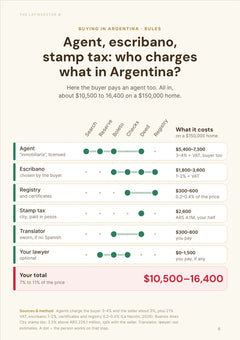
On top of the price, a buyer pays about 6% to 8.5% in stamp tax, notary, registry and agent fees, so about USD 12,000 to USD 17,000 on a USD 200,000 home.
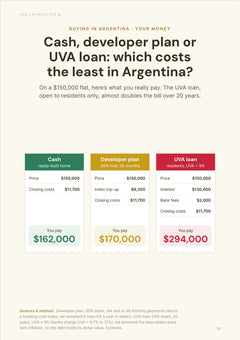
Annual property tax is low, about ARS 80,000 to ARS 300,000 a year for a typical apartment, and mortgages are not a realistic option for non-residents with only foreign income.
Practical apartments resell fastest, in about 2 to 4 months, and selling is now free of income tax for individuals, but a buy-and-sell round trip still costs about 10% to 13%.
Your dollars buy a little less than last year: apartment asking prices in the province rose 6.4% in dollars in the year to September 2026.
But listings for sale rose 19.1%, so there is room to negotiate, especially on houses and tired apartments.
Bottom line: in Mendoza, USD 100,000 already buys a real 2-bedroom, USD 200,000 buys space in a good area, and USD 300,000 to USD 500,000 buys the Chacras lifestyle; budget about 8% extra for costs and offer below asking.

Is $100k enough for a decent home in Mendoza in 2026?
Are there any decent properties for $100k in Mendoza, or is it all scams?
Yes, and more than you might think. In October 2026, the median 2-bedroom apartment in the city of Mendoza asked about USD 97,000 (TuLugar), so USD 100,000 (EUR 89,000) is a normal budget, not a bargain-hunting one.
The money goes furthest in Godoy Cruz, where the median 2-bedroom asks about USD 87,000, and in Guaymallén (about USD 867 per square meter), Las Heras (about USD 727) and Maipú (about USD 970). In the city of Mendoza, apartments ask about USD 1,092 per square meter, so USD 100,000 is roughly 90 m².
Premium areas are tight. In Quinta Sección (about USD 1,580/m²), USD 100,000 is about 65 m², enough for a 1-bedroom (median about USD 97,000). In Chacras de Coria (about USD 2,250/m²), it is only about 45 m².
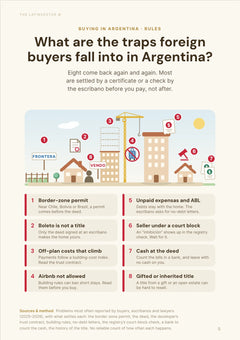
Scams are rare if you stick to licensed brokers. Check that the agent is registered with the CCPIM (the Mendoza brokers' body), never send money before the notary has checked the title, and be wary of listings priced far below the area median.
What property types can I afford for $100k in Mendoza (studio, land, old house)?
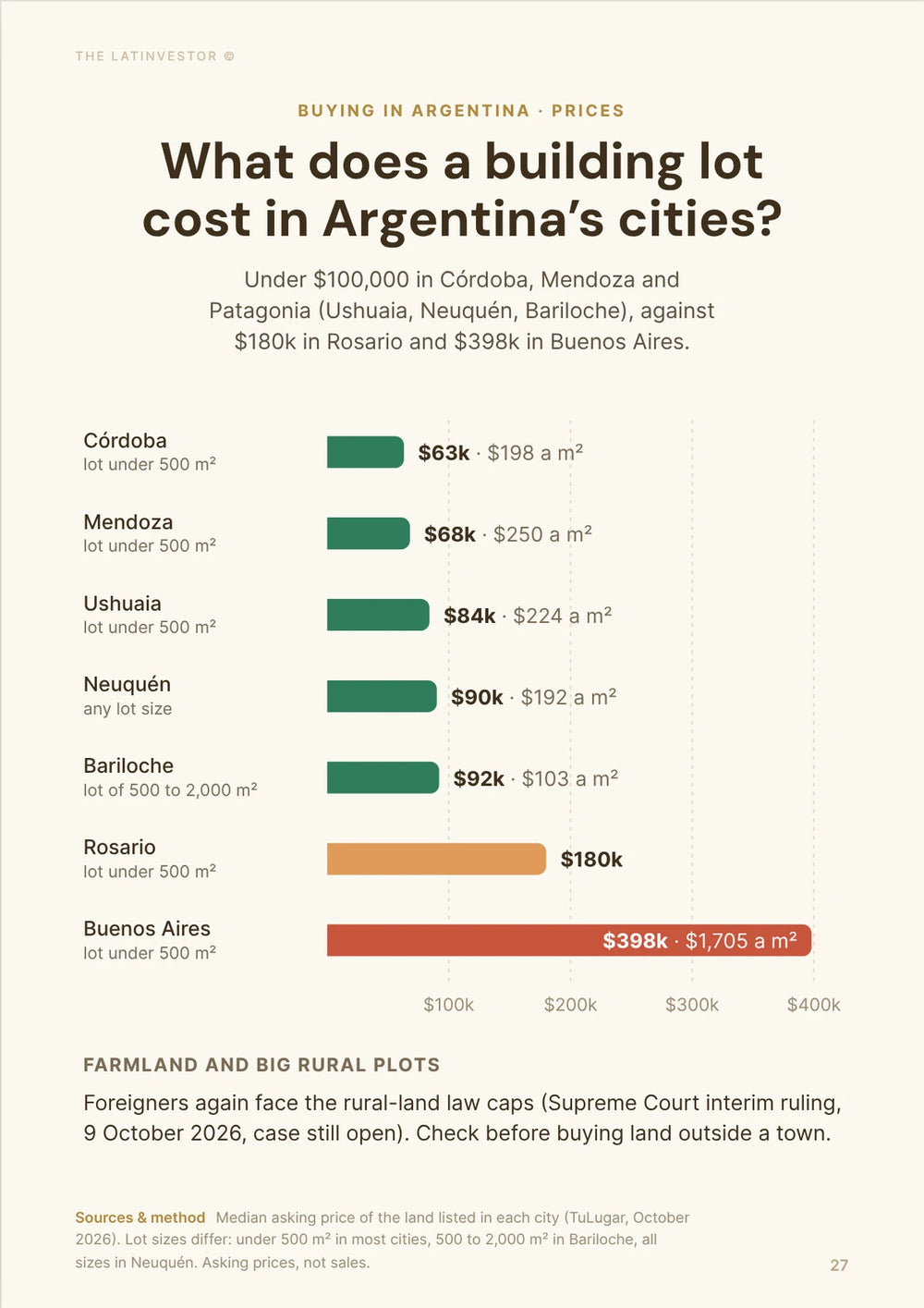
Three realistic options: a 1 to 2-bedroom apartment of about 65 to 90 m² in the city or Godoy Cruz, a small older house in Guaymallén, Maipú or Las Heras, or an urban lot. The median urban lot under 500 m² asks about USD 68,000 (about USD 250 per square meter), which leaves little for building.
Building is expensive: the Centro de Ingenieros de Mendoza puts an economy house at about ARS 1.62 million per square meter in October 2026 (USD 1,050) and a mid-quality house at about ARS 2.1 million (USD 1,360), land not included. A cheap house that needs a new kitchen, bathroom and plumbing can quickly eat a large part of the saving.
For long-term value, a well-located apartment in Godoy Cruz, central Guaymallén or the city is the safer bet: it rents and resells more easily and hides fewer structural surprises than a cheap house on the edge of town. Ask for the building's earthquake-resistant (sismorresistente) construction details: Mendoza is a seismic zone.
What's a realistic budget to get a comfortable property in Mendoza in 2026?
About USD 100,000 to USD 165,000 for a comfortable 2-bedroom apartment. At the low end, that is a median 2-bedroom in the city or Godoy Cruz; at the high end, a median 2-bedroom in Quinta Sección (about USD 163,000). In Luján de Cuyo, the median 2-bedroom asks about USD 111,000.
For a family house, count on about USD 165,000 for a typical 3-bedroom house in the city of Mendoza (TuLugar median), and about USD 350,000 in Chacras de Coria.
"Comfortable" here means a safe area, solid construction, no big repairs waiting, at least two bedrooms and ideally parking or a balcony. Older buildings with high expensas (building charges) or no parking sit at the bottom of these ranges for a reason.
What can I get with a $200k budget in Mendoza in 2026?
What "normal" homes become available at $200k in Mendoza in 2026?
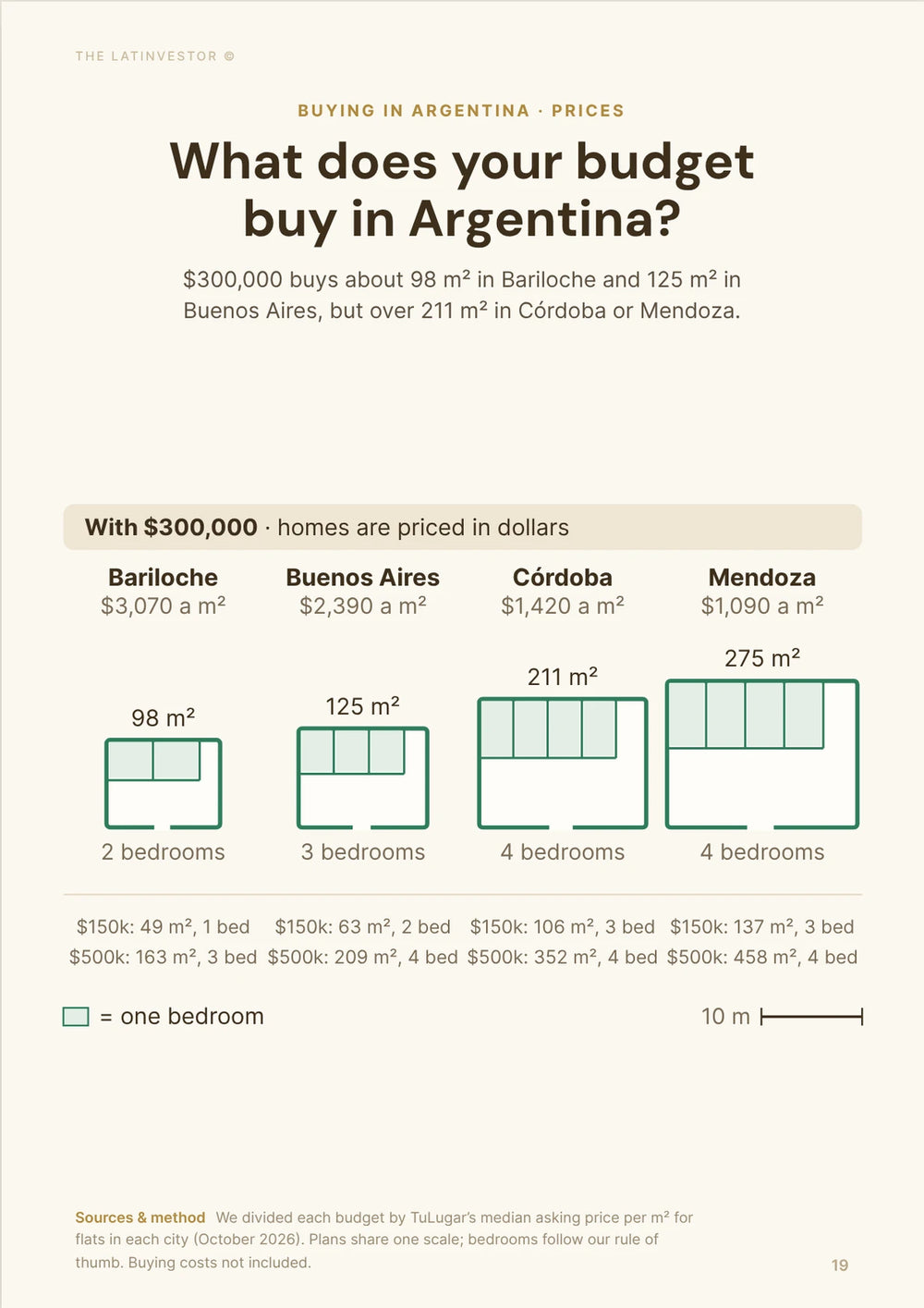
With USD 200,000 (EUR 178,000), you leave the median and move up. At October 2026 median asking prices, that is about 125 m² of apartment in Quinta Sección, about 155 m² in Luján de Cuyo, about 165 m² in Godoy Cruz, and about 180 m² in the city of Mendoza.
In practice, buyers at this level get a large 2 or 3-bedroom apartment in a good building with parking, or a 3-bedroom house with a patio: the city's median 3-bedroom house asks about USD 165,000, and houses ask about USD 869 per square meter, land included.
In Chacras de Coria, USD 200,000 is still only about 90 m² of apartment, below the area's median 2-bedroom price.
What places are the smartest $200k buys in Mendoza in 2026?
Quinta Sección and Barrio Bombal (in Godoy Cruz) for resale, Godoy Cruz and Luján de Cuyo for space, and central Mendoza for renting. At USD 200,000, you can afford a good-sized unit in any of them.
Quinta Sección, next to Parque General San Martín, is the safest bet for resale: people want to live there, and USD 200,000 is above its median 2-bedroom price. Godoy Cruz and Luján de Cuyo give more square meters and are helped by the Metrotranvía (light rail) extension, about 80% built in September 2026.
Demand comes mostly from local families and professionals, not foreigners. That is why practical, mortgage-eligible homes ("apto crédito") sell better than unusual ones: only 24.56% of Mendoza listings qualified for a mortgage in August 2026.
What can I buy with $300k in Mendoza in 2026?
What quality upgrade do I get at $300k in Mendoza in 2026?
At USD 300,000 (EUR 267,000), you choose quality and location rather than size. That is about 190 m² at the Quinta Sección median, or about 135 m² in Chacras de Coria.
Most buyers at this level go for a recent building with parking, good insulation, a modern kitchen and sometimes a shared pool and security, or for a house with a garden in Luján de Cuyo.
Check what "new" means: ask for the final occupancy certificate (final de obra), the earthquake-resistant design, and the expensas, which are higher in buildings with pools and 24-hour security.
Can $300k buy a 2-bedroom in Mendoza in 2026 in good areas?
Yes, easily in most areas. The median 2-bedroom asks about USD 163,000 in Quinta Sección and USD 111,000 in Luján de Cuyo, so USD 300,000 buys an above-average 2 or 3-bedroom there.
The exception is Chacras de Coria, where the median 2-bedroom apartment asks about USD 342,000. There, USD 300,000 means a smaller or older unit, or a hard negotiation.
Good streets to look at include Quinta Sección near the park, Barrio Bombal and Villa Marta in Godoy Cruz, and Carrodilla and La Puntilla in Luján de Cuyo.
Which places become "accessible" at $300k in Mendoza in 2026?
Chacras de Coria, Vistalba and the blocks around Parque General San Martín. Chacras apartments ask about USD 2,250 per square meter, about twice the city median, and houses about USD 1,221 per square meter (median house about USD 350,000).
What you pay for is lifestyle: green streets, wineries and restaurants nearby, and larger plots. The trade-off is that Chacras and Vistalba are mostly car-dependent.
At USD 300,000, expect a well-kept 2 to 3-bedroom apartment or a smaller older house with a garden in these areas, not the large gated-community homes.
What does a $500k budget unlock in Mendoza in 2026?
What's the typical size and location for $500k in Mendoza in 2026?
USD 500,000 (EUR 445,000) is well above the median house price even in Chacras de Coria (about USD 350,000). At Chacras' median of about USD 1,221 per square meter for houses, it represents about 410 m² of built house, land included.
In practice, that means a 3 to 4-bedroom family house with a garden and often a pool in Chacras de Coria, Vistalba or a gated community in Luján de Cuyo, or a large apartment or penthouse in Quinta Sección or Los Cerros (about USD 2,179 per square meter).
Because there are few buyers at this level, this is where prices are most negotiable, and where homes take longest to sell.
Which "premium" neighborhoods open up at $500k in Mendoza in 2026?
Chacras de Coria, Vistalba, the gated communities of Luján de Cuyo such as Palmares, Dalvian (a gated area in the city's hills) and the best blocks of Quinta Sección near the park.
What makes them premium: closeness to the wineries, big plots with old trees and Andes views, security in gated areas, and the best restaurants. Chacras apartments ask about twice the city median per square meter.
For USD 500,000 in these areas, expect a 3 to 4-bedroom house with a garden, possibly a pool and a garage, or a high-end apartment with views and full building services.
What counts as "luxury" in Mendoza in 2026?
At what amount does "luxury" start in Mendoza right now?
No official threshold exists. In our reading of the market, luxury apartments start at about USD 2,000 per square meter, the level of Chacras de Coria (about USD 2,250) and Los Cerros (about USD 2,179). For a 120 m² unit, that is roughly USD 240,000 to USD 270,000.
For houses, luxury starts above the Chacras de Coria median of about USD 350,000, usually from about USD 500,000 for a large house with pool, security and views. Vineyard estates and the top homes in gated communities can pass USD 1 million.
Mendoza is cheap at the top end: its dearest area asks less per square meter than the Buenos Aires City average (USD 2,484 on Zonaprop in September 2026), and Bariloche asks about USD 3,067.
Which areas are truly high-end in Mendoza right now?
Chacras de Coria (the best known), Vistalba (quieter, closer to the vineyards), Dalvian (a gated area in the city's hills), Los Cerros, and the prime blocks of Quinta Sección around Parque General San Martín.
What they share is scarcity: little land left, mature streets, wineries and good restaurants within a short drive, and security.
Buyers are mostly Argentine families, including people from Buenos Aires looking for a second home, wine-industry professionals and some foreigners. Foreign arrivals in Argentina rose 18.4% from January to August 2026, but foreign buyers remain a small part of Mendoza's market.
How much does it really cost to buy, beyond the price, in Mendoza in 2026?
What are the total closing costs in Mendoza in 2026 as a percentage?
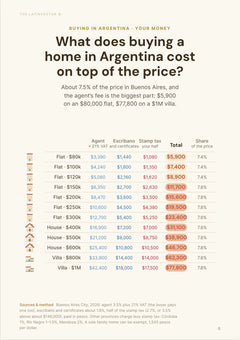
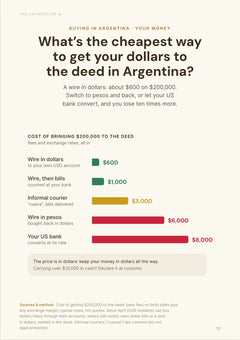
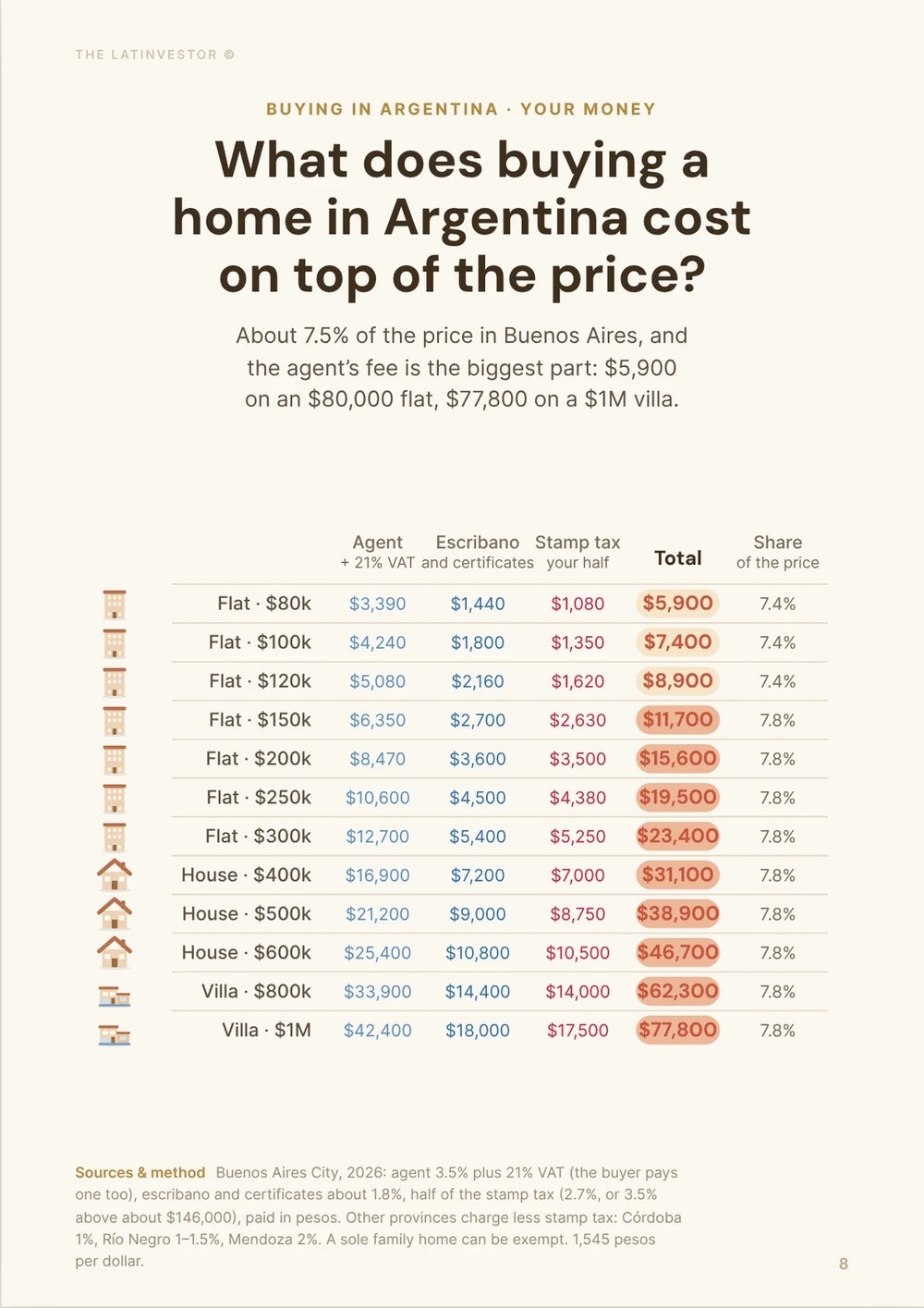
Plan on about 6% to 8.5% of the price on top. On a USD 200,000 home, that is about USD 12,000 to USD 17,000 (EUR 10,700 to EUR 15,100).
The main items: Mendoza's 2% stamp tax (Impuesto de Sellos, usually split between buyer and seller, so 1% each), the notary at about 1% to 2% plus 21% VAT, registry and certificates at about 0.2% to 0.4%, and the buyer's agent fee, usually about 3% plus VAT. The low end assumes a 1% stamp-tax share and a 1% notary fee; the high end, the full 2% stamp tax and 2% for the notary.
Two old costs are gone: the 1.5% ITI transfer tax was abolished in July 2024, and since 1 January 2026 individuals, residents or not, pay no income tax on the gain when they sell.
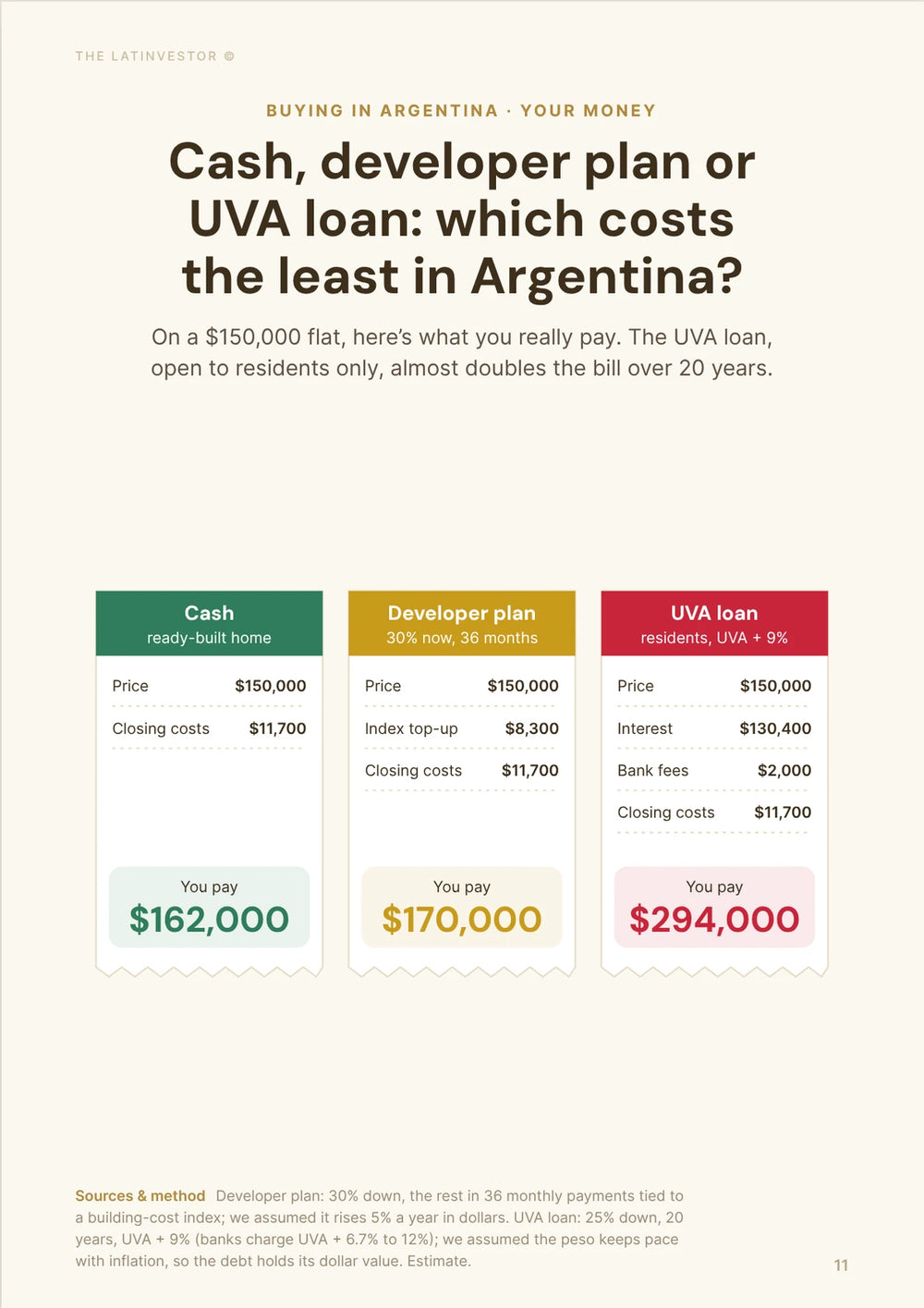
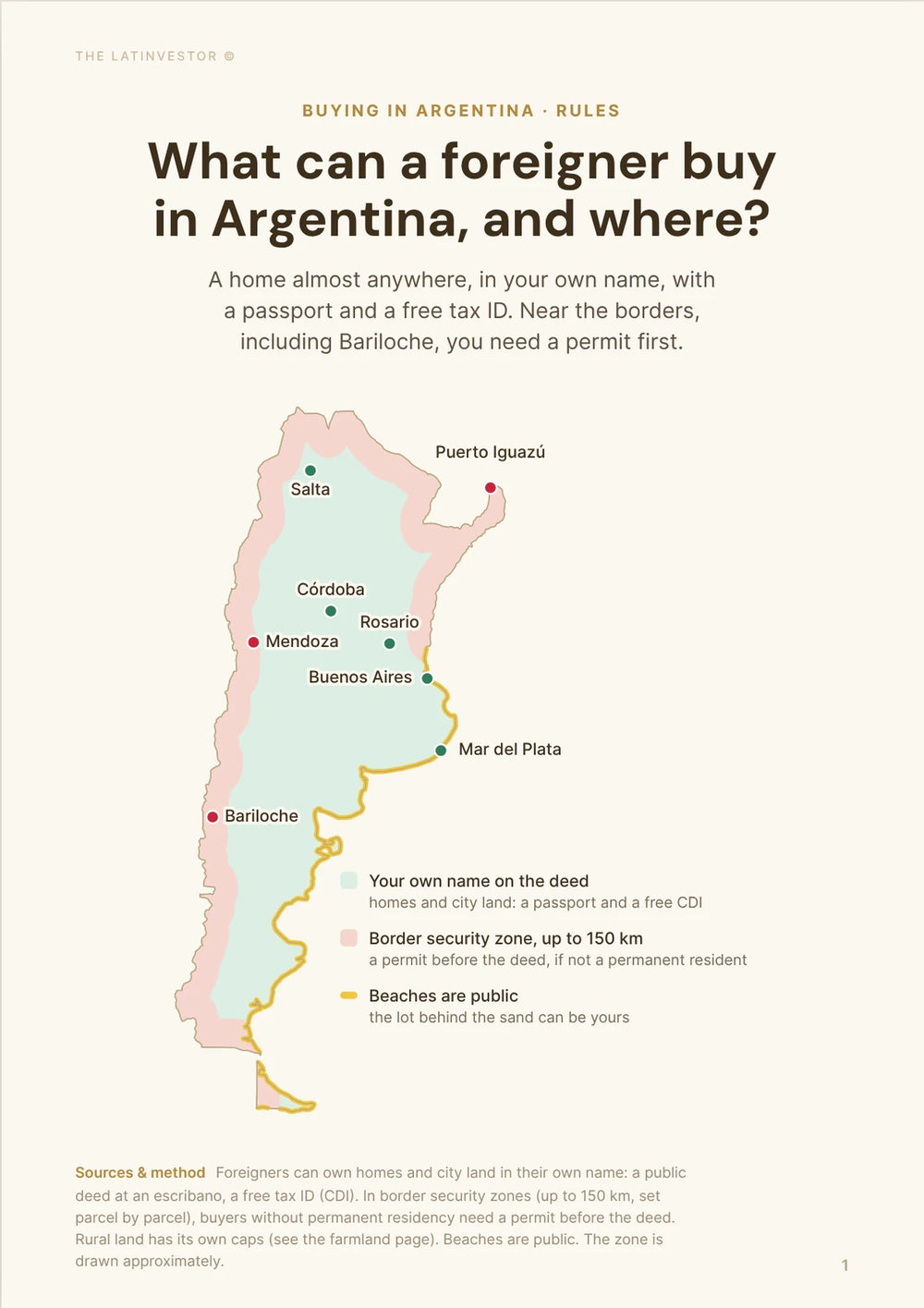
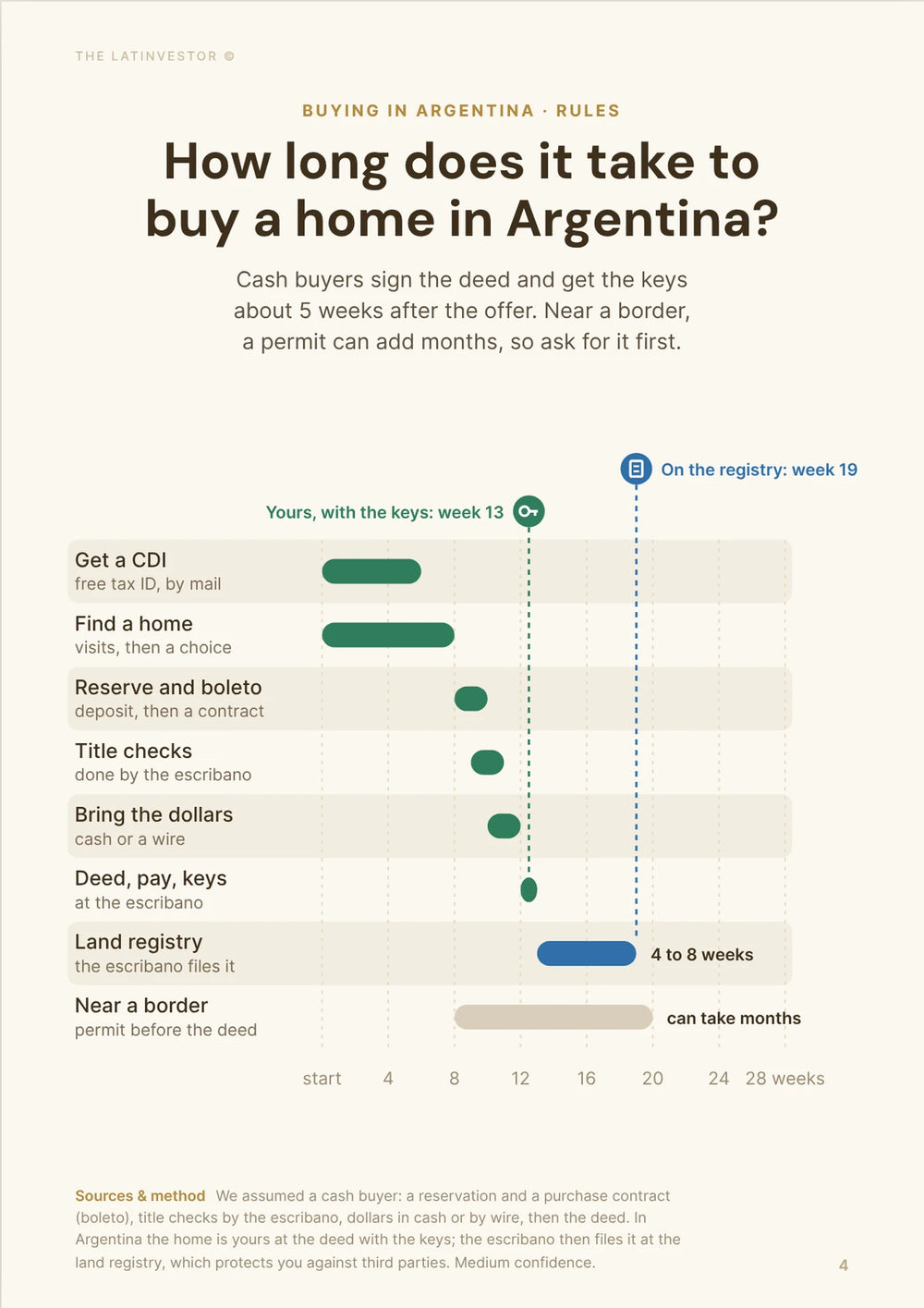
Paying cash? Contracts in dollars must be paid in dollars, and cash deals above ARS 275.85 million (about USD 178,000, July to December 2026) are reported to the UIF, Argentina's financial intelligence unit, so plan on a bank transfer or a notary-supervised payment.
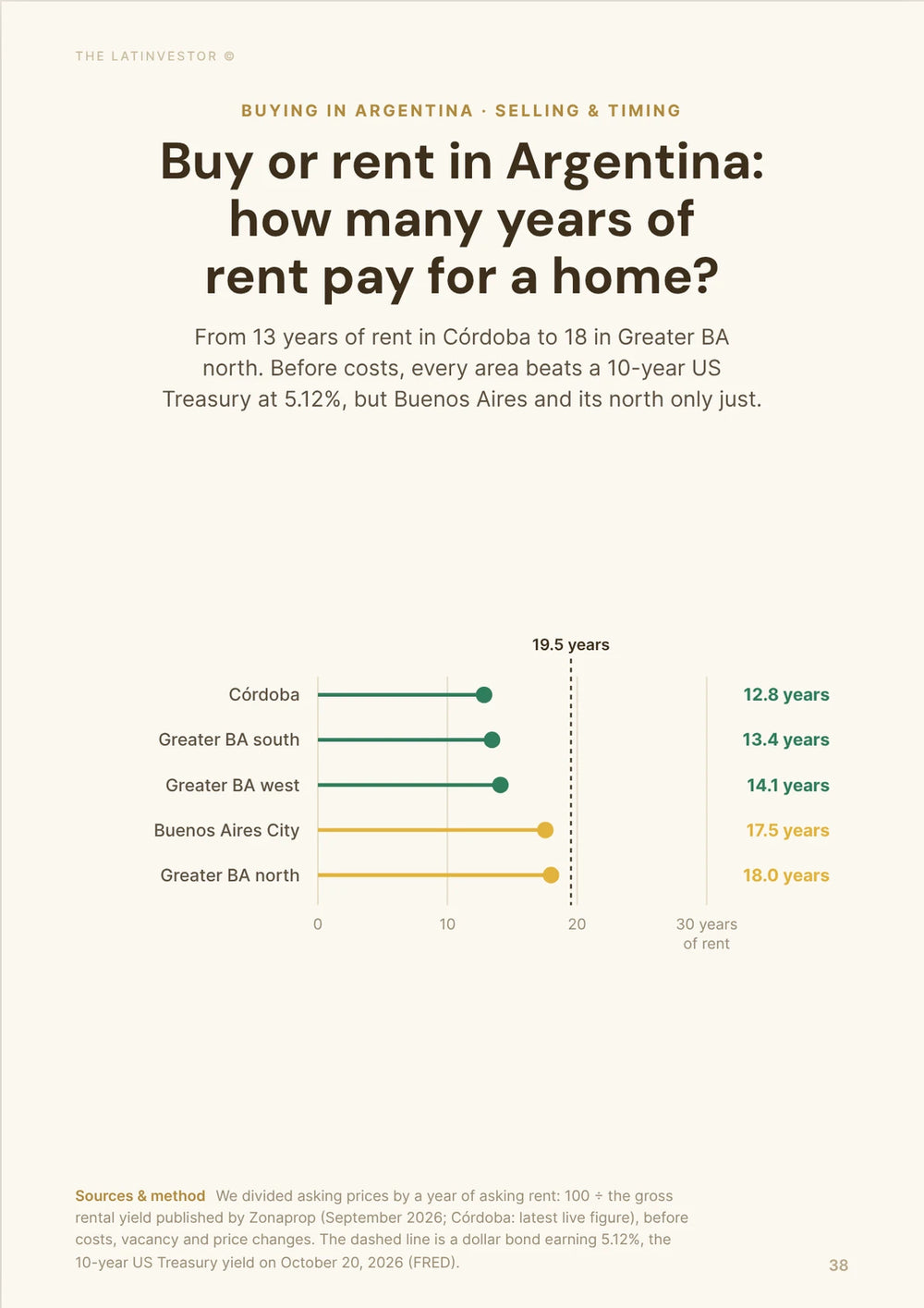
How much are notary, registration, and legal fees in Mendoza in 2026?
Notary and registry together come to about 1.4% to 2.8% of the price, VAT included. On a USD 200,000 home, that is about USD 2,800 to USD 5,600 (ARS 4,340,000 to ARS 8,680,000).
The notary (escribano) is the largest of these items: they check the title and debts, draft the deed and register it. Their fees follow the scale published by the Colegio Notarial de Mendoza, and you can ask for a written quote before signing anything.
An independent lawyer is optional when a good notary handles the deed, but useful for a foreign buyer who does not speak Spanish, for off-plan purchases or for rural land. Ask for a fixed fee in advance.
What annual property taxes should I expect in Mendoza in 2026?
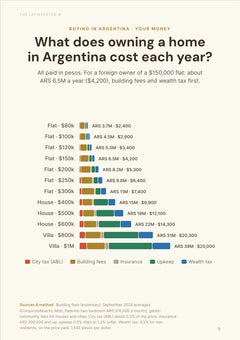
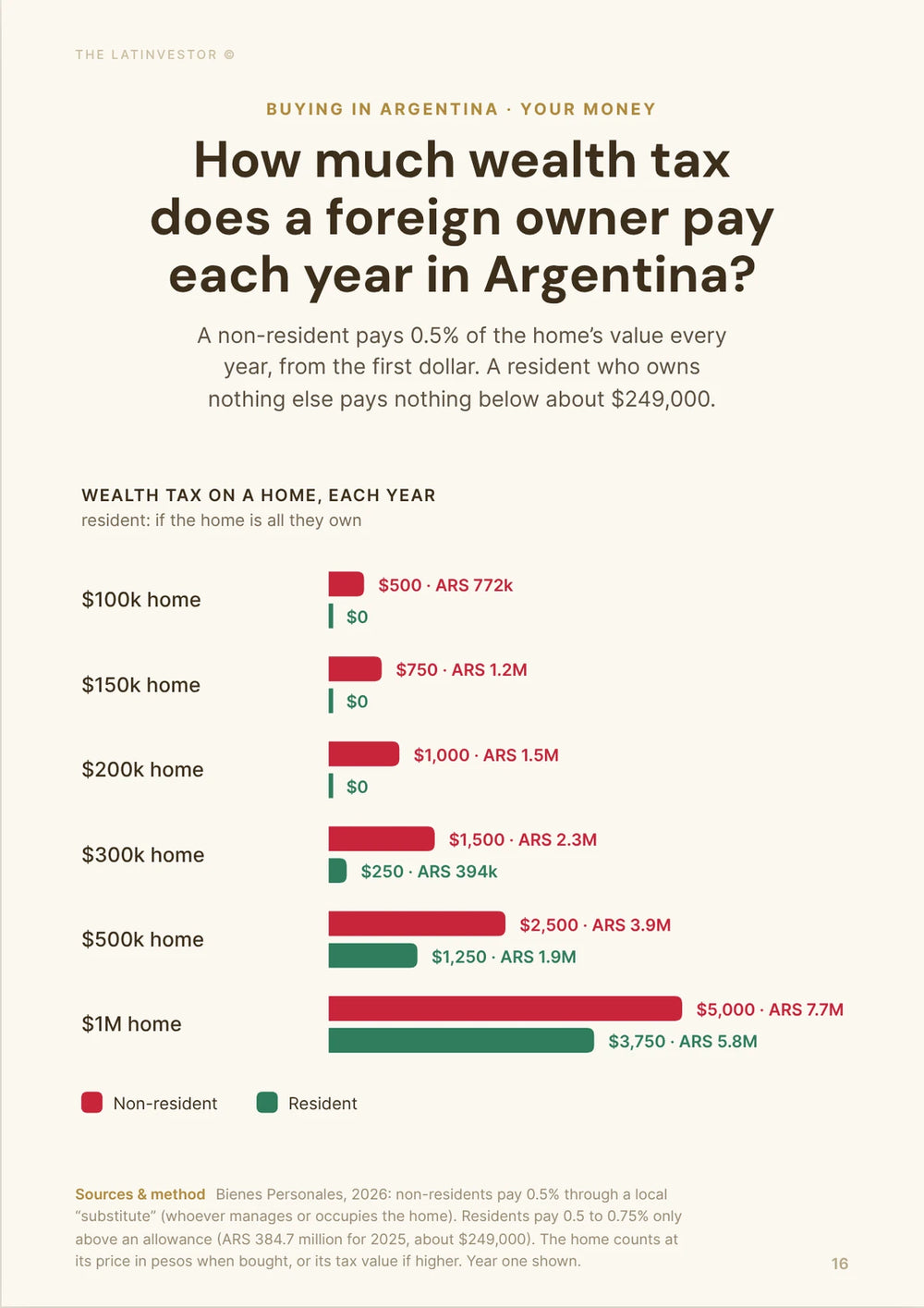
Low by international standards. Our estimate for a typical apartment is about ARS 80,000 to ARS 300,000 a year (USD 52 to USD 195), and more for a large house in Chacras de Coria. No source publishes an average bill.
The provincial property tax (Impuesto Inmobiliario) is based on the fiscal value set by ATM, the provincial tax authority, which is usually far below the market price. It is paid in instalments during the year, with discounts for owners who have no debts.
Add the municipal fees and, in apartments and gated communities, the expensas (building or community charges), which often cost more than the tax itself.
A non-resident owner also pays Bienes Personales (wealth tax) at 0.5% a year on the property's value, through a local representative.
Is mortgage a viable option for foreigners in Mendoza right now?
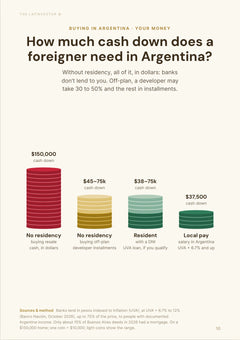
Not for most foreigners. Non-residents with only foreign income have no confirmed access to Argentina's UVA (inflation-indexed) mortgages. Banks lend to people with Argentine income, a tax ID and, often, a salary account at the bank.
For locals, credit is improving slowly. Banco Nación charges UVA+6.7% to eligible salary clients and UVA+12% otherwise, and since September 2026 the state pension fund (FGS) has auctioned two rounds of ARS 200 billion to banks (7 September and 6 October) for loans capped at UVA+7.5% over at least 15 years.
Mendoza recorded 871 mortgages from January to July 2026, 13.1% fewer than a year earlier, against a national drop of about 43%. So plan on paying cash, and remember that local buyers who can borrow will compete with you for the same mortgage-eligible homes.
What should I predict for resale and growth in Mendoza in 2026?
What property types resell fastest in Mendoza in 2026?
Practical 1 to 2-bedroom apartments in the city, Godoy Cruz and Guaymallén, and turnkey houses with good road access. From listings, a good apartment usually resells in about 2 to 4 months, a normal house in about 3 to 6 months, and a luxury home can take 9 to 18 months.
The market is deep: Mendoza recorded 8,334 purchase deeds from January to July 2026, only 4.8% fewer than in the same months of 2025.
The biggest factor is clean paperwork: clear title, registered extensions, no debts and a final occupancy certificate. A home that qualifies for a mortgage can be bought by many more local buyers.
The slowest sellers are large houses on the edge of town, homes with unregistered additions, and older apartments with high expensas. Since 2026, individuals pay no income tax on the gain when they sell, but buying and selling still costs about 10% to 13% in fees, so plan on holding at least 3 to 5 years.
Does your budget buy less in Mendoza than a year ago?
A little. Apartment asking prices in the province of Mendoza rose 6.4% in dollars in the year to September 2026 (InmoUP), so USD 100,000 buys about 85 m² at the provincial median of about USD 1,173 per square meter, against about 91 m² a year earlier.
The strong peso adds to this: the dollar rose only about 4.9% against the peso between January and October 2026, while prices rose about 23.6%. Building costs and expensas, paid in pesos, are much higher in dollars than a year ago: the cost of building an economy house in Mendoza rose 33.86% in a year.
What to do: compare the asking price per square meter with the area median (USD 1,092 in the city, USD 1,200 in Godoy Cruz, USD 1,580 in Quinta Sección), and treat anything well above it as a starting point for negotiation, not a fixed price.
How much below asking can you offer in Mendoza in 2026?
Probably more than in Buenos Aires. Listings for sale in the province rose 19.1% in the year to September 2026, so sellers face more competition than a year ago.
Mendoza has no closing-price series. In Buenos Aires, deals closed about 4.75% under asking in 2026, and in Bariloche about 3.5%. In Mendoza, with more stock, a buyer can often aim for more on tired apartments, large houses and luxury homes, where most of the extra stock sits.
What to check before offering: how long the home has been listed, whether the price has already been cut, whether it is "apto crédito" (only 24.56% of listings were in August 2026), and the expensas. Paying cash in dollars is a real argument in a market where most local buyers need a loan.
Our methodology
This article estimates what a buyer gets in Greater Mendoza for USD 100,000, 200,000, 300,000, 500,000 and in the luxury segment, plus the costs of buying, owning and reselling.
Sizes for each budget are our calculation: the budget divided by October 2026 median asking prices per square meter from TuLugar for the city of Mendoza, its secciones (Quinta Sección, Los Cerros), Godoy Cruz, Luján de Cuyo, Chacras de Coria, Guaymallén, Las Heras and Maipú. Bedroom medians (1, 2 and 3-bedroom) come from the same source, price trends and stock from the InmoUP observatory, building costs from the Centro de Ingenieros de Mendoza, and deeds and mortgages from Diario Mendoza.
Buying costs come from the Mendoza Ley Impositiva 2026 (2% stamp tax), the Colegio Notarial de Mendoza and La Nación (notary and registry); tax rules from Law 27.802, Decree 406/2026 and ARCA; mortgage terms from Banco Nación and the FGS auctions. Buenos Aires and Bariloche comparisons come from Zonaprop and TuLugar.
We checked these figures in October 2026. Peso amounts are converted at about ARS 1,550 per US dollar (official and MEP rates were within 1% of each other on 22 October 2026, the blue rate about ARS 1,570), and euro amounts at about ARS 1,740 per euro.
Where we had no direct figure, we said so: the luxury thresholds, the agent fee, the yearly property tax range, selling times and the Mendoza negotiation margin are our estimates. All prices are asking prices, not closing prices, and Vistalba, Palmares and Dalvian have no published price series.
Key sources used for this analysis include TuLugar Mendoza, TuLugar Chacras de Coria, TuLugar Godoy Cruz, InmoUP observatory, ATM Observatorio de Valores Inmobiliarios, Mendoza Ley Impositiva 2026, Colegio Notarial de Mendoza, Centro de Ingenieros de Mendoza, Diario Mendoza on deeds and mortgages, Banco de la Nación Argentina, Banco Galicia, BCRA reference exchange rate, Decree 406/2026, Zonaprop, Properati, CCPIM, MendozaProp and InfoLEG (Ley 26.737).