

Summary
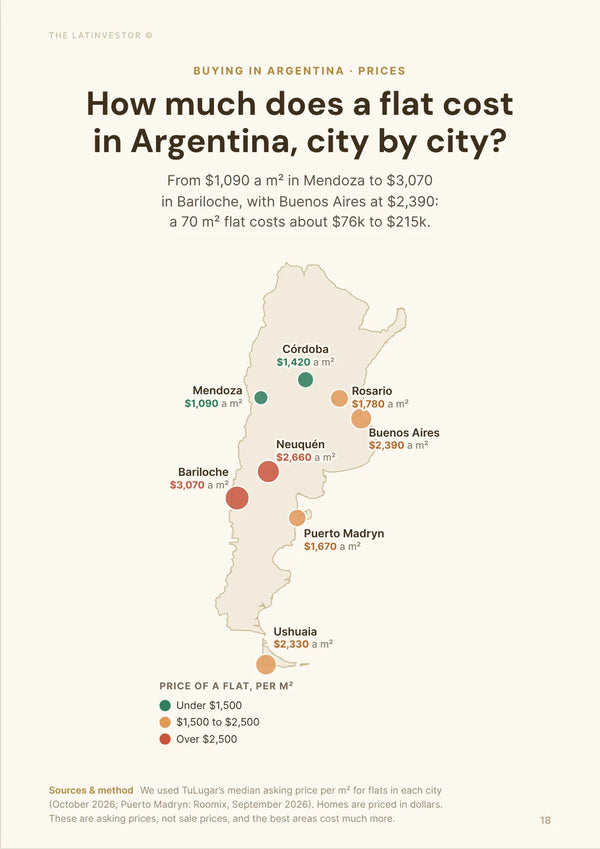
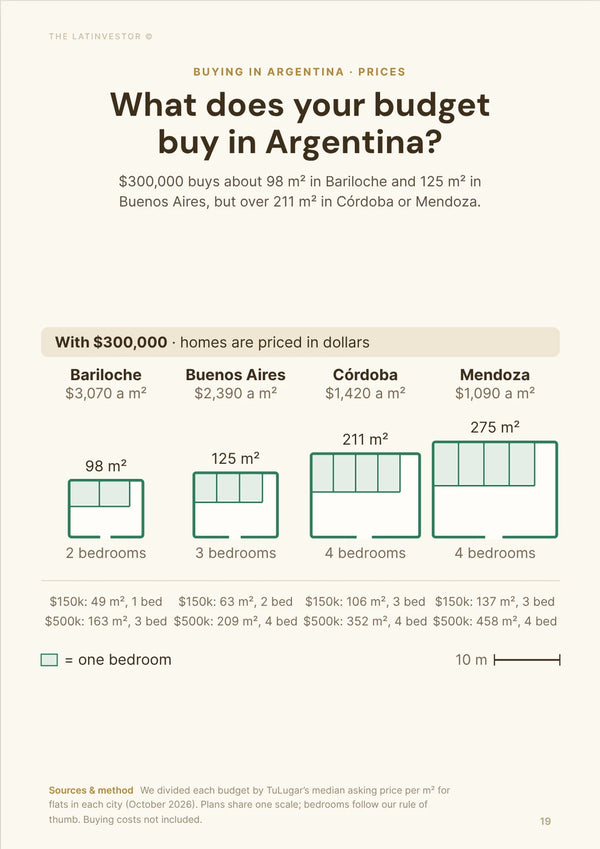
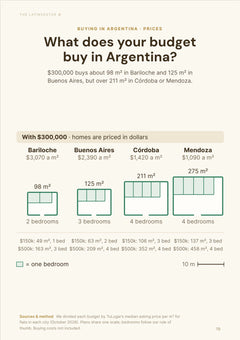
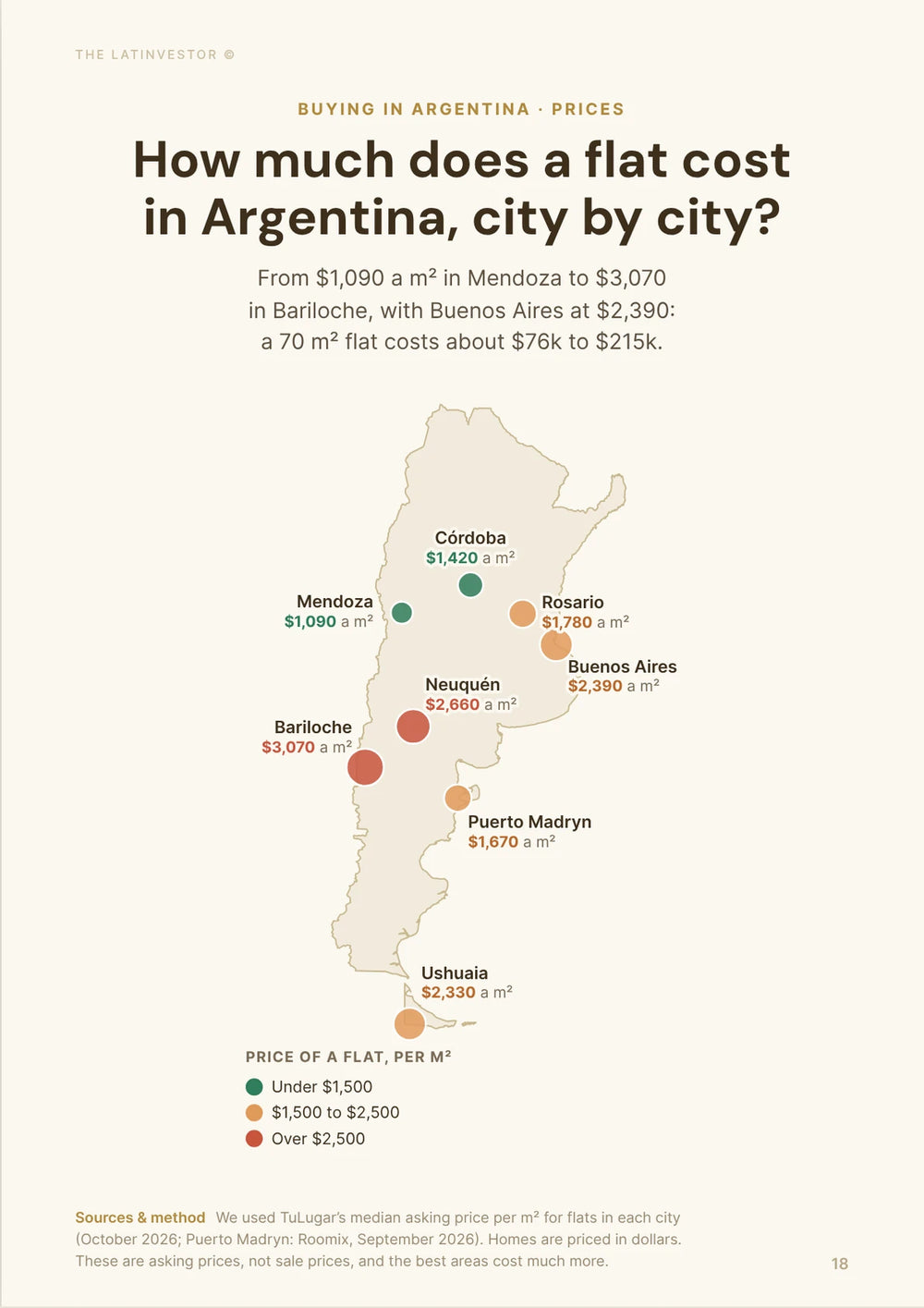
USD 100,000 buys about 33 square meters in Bariloche in October 2026: a studio or a very small 1-bedroom apartment at the city median of about USD 3,067 per square meter.
Your USD 100,000 goes further outside the center: about 54 square meters in Las Victorias (USD 1,867 per square meter) or 47 in Dina Huapi, against only 25 in Melipal.
A comfortable apartment starts at about USD 155,000, the median asking price for a 1-bedroom, and most buyers who want proper space end up between USD 150,000 and USD 250,000.
USD 200,000 buys about 65 square meters at the city median, enough for a compact 2-bedroom apartment in Centro or Belgrano (the 2-bedroom median is USD 215,000) or a small house away from the lake.
USD 300,000 buys a 3-bedroom house (median about USD 305,000) or a 2-bedroom apartment of 75 to 100 square meters in Centro, Belgrano or Melipal, often in a newer building.
USD 500,000 buys a family house of 140 to 200 square meters in Melipal or Lago Gutiérrez, or a smaller home in a gated setting like Arelauquen, but usually not lakefront.
Luxury starts around USD 700,000 for a lake-view or gated house, and about 6% of listings ask more than USD 1 million, mostly in Llao Llao, Arelauquen and along Bustillo.
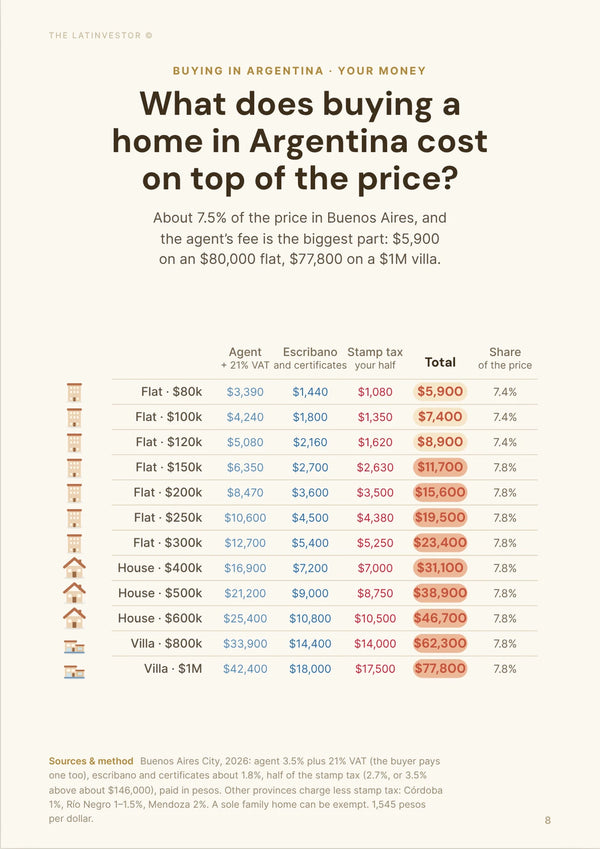
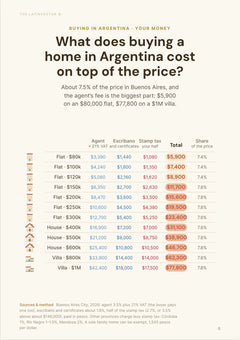
On top of the price, budget about 6% to 9% for agent, notary, registry and Río Negro stamp tax (1% to 1.5%, usually split), so USD 12,000 to USD 18,000 on a USD 200,000 home.
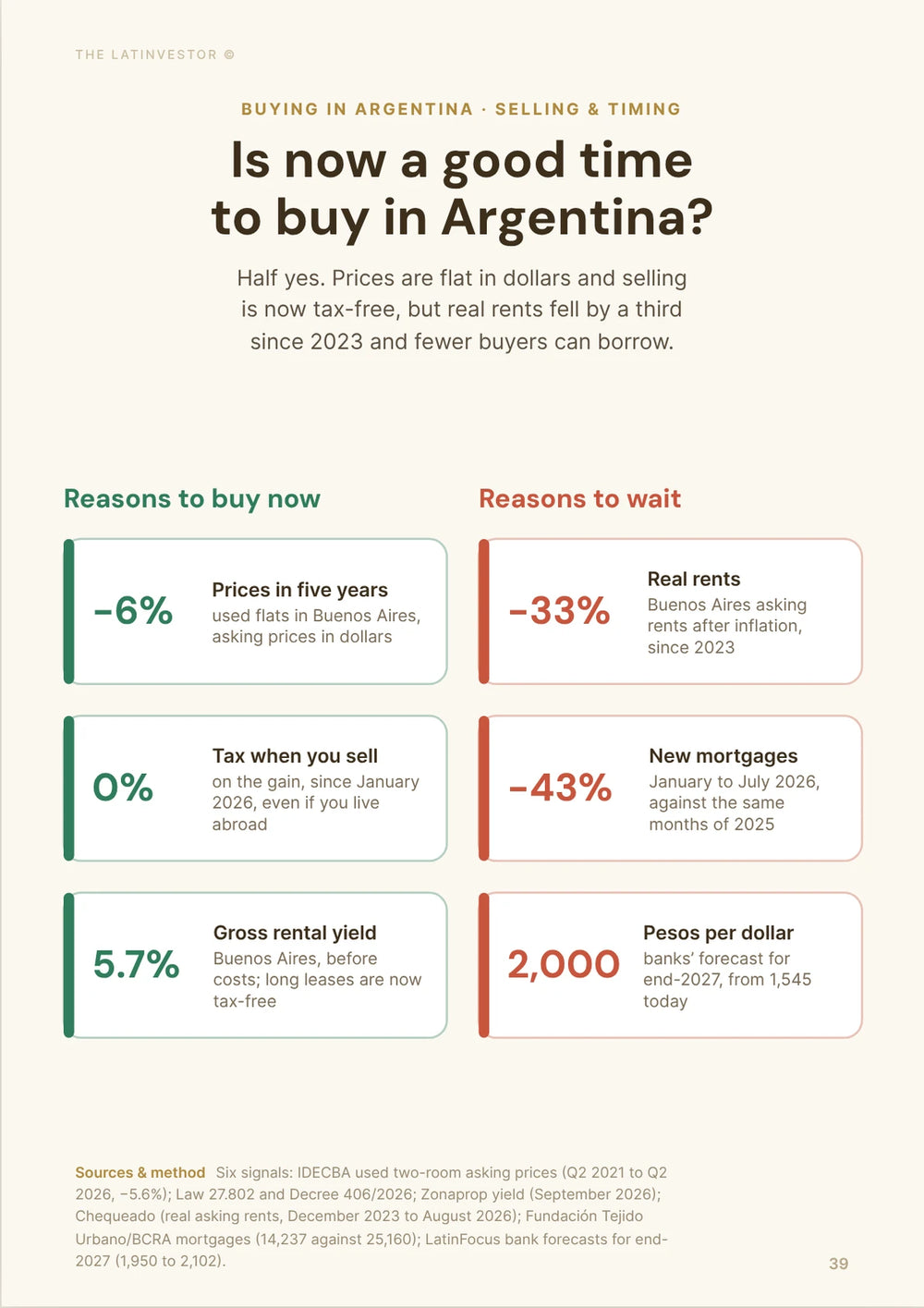
Mortgages will not help most foreign buyers: new home loans in Argentina fell 43% in January–July 2026 and non-residents with only foreign income have no confirmed access, so plan to pay cash.
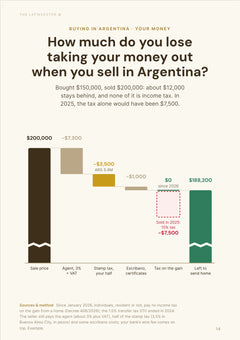
Small, well-located apartments resell most easily, and since January 2026 an individual pays no Argentine income tax on the gain when selling, resident or not.
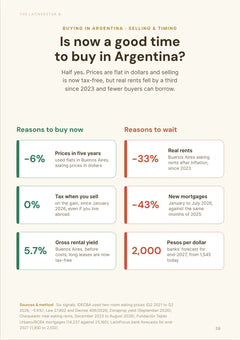
Asking prices are up about 17.8% in dollars over 12 months while the dollar rose only about 4.9% against the peso in 2026, so your dollars buy less than they did in January.
A residential lot (median about USD 92,000) fits a USD 100,000 budget, but since the Supreme Court ruling of 9 October 2026, rural land outside the city again falls under foreign-ownership limits.
Our take: with USD 100,000 aim for Las Victorias, Dina Huapi or an older studio in Centro, and with any budget compare each listing with its neighborhood median and negotiate 3% to 5% off.

How much space do you get for about $100k in Bariloche?
Are there any decent properties for $100k in Bariloche, or is it all scams?
Yes, real and legal homes exist around USD 100,000 in Bariloche. About a quarter of all sale listings (lots included) ask less than that. But at the city median of about USD 3,067 per square meter in October 2026, USD 100,000 buys only about 33 square meters, and small units cost more per square meter (studios list at about USD 3,714), so a studio can be closer to 27 square meters.
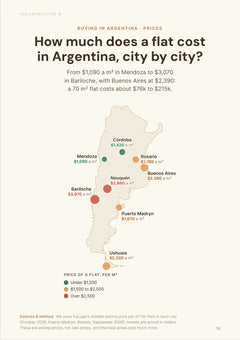
Your money goes furthest east of the center and in cheaper residential areas. At the neighborhood medians, USD 100,000 is about 54 square meters in Las Victorias (USD 1,867 per square meter) and about 47 square meters in Dina Huapi (USD 2,133, a separate town about 15 km east). Ñireco, Alto Bariloche and Jardín Botánico also have older units in this range.
In Centro you can still buy at USD 100,000, but expect a studio of about 27 to 33 square meters, often in an older building without a lift or parking. In Melipal the same money is only about 25 square meters.
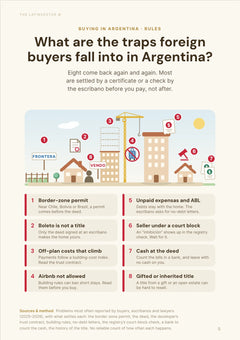
The scam risk is lower than people fear but real: check that the seller is the registered owner at the Río Negro property registry, that the agent is licensed with the Colegio de Martilleros de Río Negro, and that the escribano (notary) runs the title and debt checks before you pay a deposit.
What property types can I afford for $100k in Bariloche (studio, land, old house)?
Three things fit: an older studio (monoambiente) of about 25 to 35 square meters, a small 1-bedroom of 35 to 45 square meters in Ñireco, Jardín Botánico or Las Victorias, or a residential lot. The median studio lists at about USD 112,000, so most of what you will see at USD 100,000 is older or less central.
Lots are the surprise: residential lots of 500 to 2,000 square meters list at a median of about USD 92,000 (about USD 103 per square meter of land). Building on it is another budget: Argentine building costs rose fast in dollars in 2026, so a lot is not a cheap house.
At this level, plan for work. A standard renovation (bathroom, kitchen, paint, heating) usually costs 12% to 25% of the price, so about USD 12,000 to USD 25,000 on a USD 100,000 unit, and more if there is damp, poor insulation or an old roof. Heating matters more here than anywhere else in Argentina.
For resale and renting, a small apartment in a year-round area beats a cheap house far out: it attracts the most local tenants and the most future buyers.
What's a realistic budget to get a comfortable property?
About USD 155,000 (roughly EUR 138,000) is where comfort starts: it is the median asking price for a 1-bedroom apartment in Bariloche in October 2026.
Most buyers who want a proper 1-bedroom or a compact 2-bedroom in a decent area end up between USD 150,000 and USD 250,000 (roughly EUR 134,000 to EUR 223,000). The median 2-bedroom lists at about USD 215,000.
In Bariloche, "comfortable" means 45 to 70 square meters with heating that works, decent insulation and good light. Winters are long, so an older unit with poor heating costs you every month.
Location changes the bill. Centro and Belgrano list at a median of about USD 147,000 and USD 168,000 per apartment, Melipal at about USD 210,000. In Dina Huapi the median 1-bedroom asks about USD 135,000.
 Argentina Property Prices
What can I get with a $200k budget in Bariloche in 2026?
What "normal" homes become available at $200k?
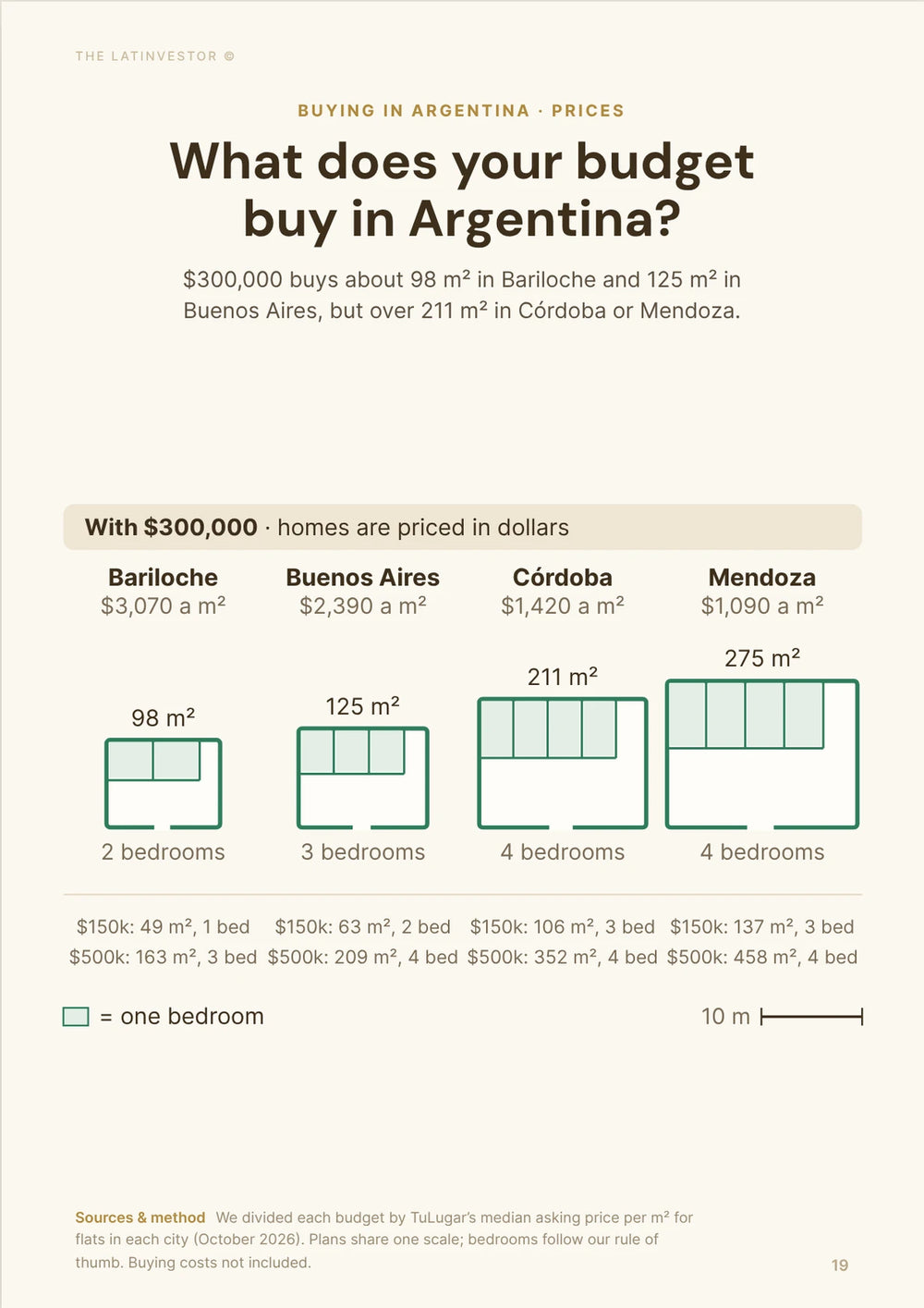
At USD 200,000 (about EUR 178,000) you stop compromising. At the city median, that is about 65 square meters: a roomy 1-bedroom or a compact 2-bedroom apartment in a solid residential area.
The 2-bedroom median is about USD 215,000, so a 2-bedroom at USD 200,000 is within reach with a bit of negotiation, mostly in Centro or Belgrano (about 64 to 65 square meters at their medians). A small 2-bedroom house away from the lake lists at about USD 180,000.
Per square meter, the spread is wide: USD 200,000 is about 51 square meters in Melipal, 94 in Dina Huapi and 107 in Las Victorias. Decide first whether you want the lake and the center, or space.
What places are the smartest $200k buys?
Belgrano, Centro and the lower parts of Melipal are the smartest buys at USD 200,000. Belgrano and Centro list at about USD 3,119 and USD 3,065 per square meter, walkable and easy to rent all year. Melipal is pricier (about USD 3,936 per square meter) but sits close to the lake and Bustillo.
These areas work because people live there all year: local professionals, families and long-term tenants, not only ski and summer tourists. That keeps demand steady in April or May, when Airbnb occupancy in Bariloche drops to about 32% to 33%.
If you want more space for the same money, Las Victorias and Dina Huapi give you nearly twice the surface, but you will need a car and you will find fewer tenants and buyers later.
What can I buy with $300k in Bariloche in 2026?
What quality upgrade do I get at $300k?
Going from USD 200,000 to USD 300,000 (about EUR 267,000) usually buys one big upgrade: a newer building with good heating and insulation, a partial lake or mountain view, parking and security, or a better location closer to the lake without losing space.
New or nearly new homes in Bariloche usually cost roughly 15% to 25% more than similar older ones, so USD 300,000 does open recent 1- and 2-bedroom developments. A new unit with a lake view on prime Bustillo is still above this budget.
The features that start to show up: double glazing, underfloor heating or efficient split units, updated kitchens and bathrooms, covered parking and sometimes a balcony with a view.
Can $300k buy a 2-bedroom in Bariloche in 2026 in good areas?
Yes, comfortably. The 2-bedroom median is about USD 215,000, so USD 300,000 gets you a good 2-bedroom in areas locals want, with room left for a better building or a view.
At the medians, USD 300,000 is about 98 square meters in Centro, 96 in Belgrano and 76 in Melipal. Villa Los Coihues and parts of the Bustillo corridor also have 2-bedroom units at this price.
The exception is the ski village: in Villa Catedral the median 2-bedroom asks about USD 362,000, so USD 300,000 is about 77 square meters there.
Which places become "accessible" at $300k?
At USD 300,000, good-quality stock in Centro, the better stretches of the Bustillo corridor, Villa Los Coihues, Lago Gutiérrez and parts of Cerro Campanario open up without a heavy compromise on size or condition.
It is also the house threshold: the median 3-bedroom house in Bariloche lists at about USD 305,000, mostly in Melipal, Lago Gutiérrez or Pioneros. Houses list at about USD 2,000 per built square meter, cheaper than apartments, because you also pay for land, upkeep and heating a bigger space.
What you gain is the mix that makes Bariloche: the lake, the ski areas and established services, in areas that work for both tourists and people who live there all year.
 70+pages
What does a $500k budget unlock in Bariloche in 2026?
What's the typical size and location for $500k?
USD 500,000 (about EUR 445,000) usually buys a family house of 140 to 200 square meters in Melipal or Lago Gutiérrez, a large apartment or duplex in Villa Catedral, or a premium apartment of about 120 to 160 square meters with views.
A family house with a garden is the normal outcome at this price. The median 4-bedroom house lists at about USD 370,000, so USD 500,000 buys a better one: newer, on a bigger plot, or with a view.
Expect 3 to 4 bedrooms, 2 to 3 bathrooms, a garage and outdoor space. What you usually do not get at USD 500,000 is direct lakefront.
Which "premium" neighborhoods open up at $500k?
At USD 500,000, Arelauquen, Villa Campanario, the better parts of Melipal and Playa Bonita, and some homes on the edges of Llao Llao become possible. In Arelauquen the median apartment lists at about USD 420,000, so USD 500,000 buys a good unit or a smaller house there.
These areas cost more because of the lake and the Andes views, low density, privacy and, in Arelauquen, gated security and golf.
For USD 500,000 in these areas, expect a 3-bedroom house on a modest lot or a high-end 2- to 3-bedroom apartment with partial views. Full lake views in Llao Llao or on Península San Pedro usually start well above this.
What counts as "luxury" in Bariloche in 2026?
At what amount does "luxury" start in Bariloche right now?
Luxury starts around USD 700,000 for a house (about EUR 623,000) and around USD 400,000 to USD 600,000 for an apartment. A typical luxury property, a lake-view house, a gated home in Arelauquen or a villa near Llao Llao, costs about USD 700,000 to USD 2 million.
About 8% of Bariloche listings ask between USD 500,000 and USD 1 million, and about 6% ask more than USD 1 million (roughly 312 listings in October 2026).
What makes it luxury here is the view more than the building: an open lake or mountain view, solid construction with proper Patagonian insulation, high-end finishes, and lake access or a top address.
At the very top, trophy lakefront estates on large plots along Bustillo or in Llao Llao go well above USD 2 million. These sell slowly, to a small pool of buyers.
Which areas are truly high-end in Bariloche right now?
Llao Llao, Península San Pedro, Arelauquen, the lakefront stretches of Avenida Bustillo and the best properties in Villa Catedral for ski access. Melipal and Carihue have the highest apartment prices per square meter among established neighborhoods (about USD 3,936 and USD 4,060).
Each sells something different: Llao Llao the lake views and the famous hotel next door, Arelauquen gated security with golf and horse riding, Península San Pedro calm lakefront, and Villa Catedral the slopes (apartments there list at about USD 3,880 per square meter).
Buyers are mostly Buenos Aires families buying a second home, Argentines with savings in dollars, retirees and some foreign buyers attracted by Patagonia.
 70+pages
How much does it really cost to buy, beyond the price, in Bariloche in 2026?
What are the total closing costs in Bariloche in 2026 as a percentage?
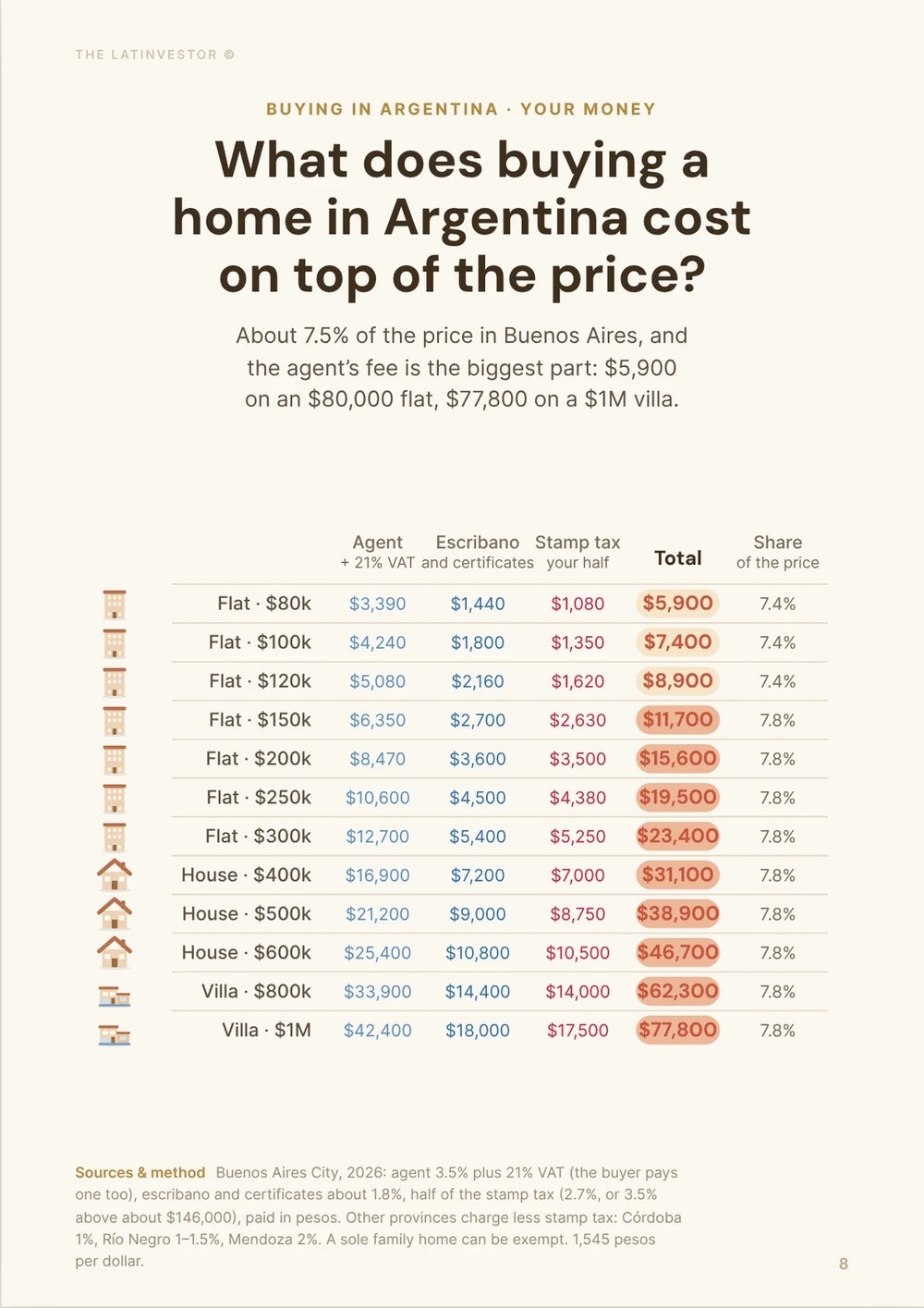
Budget about 6% to 9% of the price on the buyer's side. On a USD 200,000 home, that is about USD 12,000 to USD 18,000; on a USD 500,000 home, about USD 30,000 to USD 45,000.
The main items: the agent (usually 3% to 4% for the buyer, plus 21% VAT), the escribano (1% to 2% plus VAT), registry and certificates (about 0.2% to 0.4%) and Río Negro stamp tax. Buy without an agent and the total falls sharply.
Stamp tax in Río Negro is 1% if the fiscal valuation is up to ARS 55 million (about USD 35,500) and 1.5% above, usually split with the seller. The old 1.5% transfer tax (ITI) was abolished in July 2024. Ask for the fiscal valuation early: it decides your rate.
How much are notary, registration, and legal fees?
Together, notary and registry come to about 1.4% to 2.8% of the price with VAT. On a USD 200,000 home, that is about USD 2,820 to USD 5,640 (roughly EUR 2,510 to EUR 5,020).
The escribano is the biggest line: usually 1% to 2% of the price plus 21% VAT. Registry fees and certificates (title, debts, inhibitions) add about 0.2% to 0.4%. A separate lawyer is optional; many buyers rely on the notary, who is legally responsible for the deed.
The notary's checks are what protect you: ownership, mortgages or liens, unpaid municipal and provincial taxes, and, for land outside the city, the rural and border-zone status of the parcel.
What annual property taxes should I expect?
Roughly ARS 420,000 to ARS 2.1 million a year (USD 270 to USD 1,350) for provincial property tax and municipal charges on a normal home. We found no official typical amount, so ask the seller for the last bills before you sign.
Río Negro property tax is based on a fiscal valuation, usually far below the market price, and the municipality adds its own service fees. Lake-view homes, big plots and gated communities pay more, plus common fees.
A non-resident owner also pays Bienes Personales (wealth tax) at about 0.5% a year with no allowance, through a local representative. On a home valued at USD 200,000 for tax purposes, that is up to about USD 1,000 a year.
Owners who live elsewhere get no primary-home relief, and a property bought as a second home pays standard rates.
Is mortgage a viable option for foreigners in Bariloche right now?
No, for most foreign buyers. Mortgage lending came back in 2025 but slowed sharply: 14,237 home loans were granted in Argentina between January and July 2026, against 25,160 a year earlier (−43%).
Loans are indexed to inflation (UVA) plus a rate: about UVA + 6.5% to 12% depending on the bank and the client (Banco Nación from UVA + 6.7% for eligible salary clients, Banco Ciudad UVA + 6.5% for a first home). A state-funded programme launched in September 2026 caps rates at UVA + 7.5%, but it is for single permanent homes.
These loans require a DNI, Argentine income and a local credit history. Non-residents with only foreign income have no confirmed access, so plan to pay from your own funds. Bariloche homes are priced and paid in US dollars, and a contract in dollars must be paid in dollars (Civil Code, arts. 765–766).
 70+pages
This is just a preview page. Prices and rents move fast: your guide is refreshed every month, and you always get the latest version.
What should I predict for resale and growth in Bariloche in 2026?
What property types resell fastest?
Small, well-located apartments (studios and 1-bedrooms) in Centro and Belgrano resell fastest, followed by practical 2-bedroom apartments in Melipal or Belgrano. They suit the most buyers: locals, Buenos Aires families and investors.
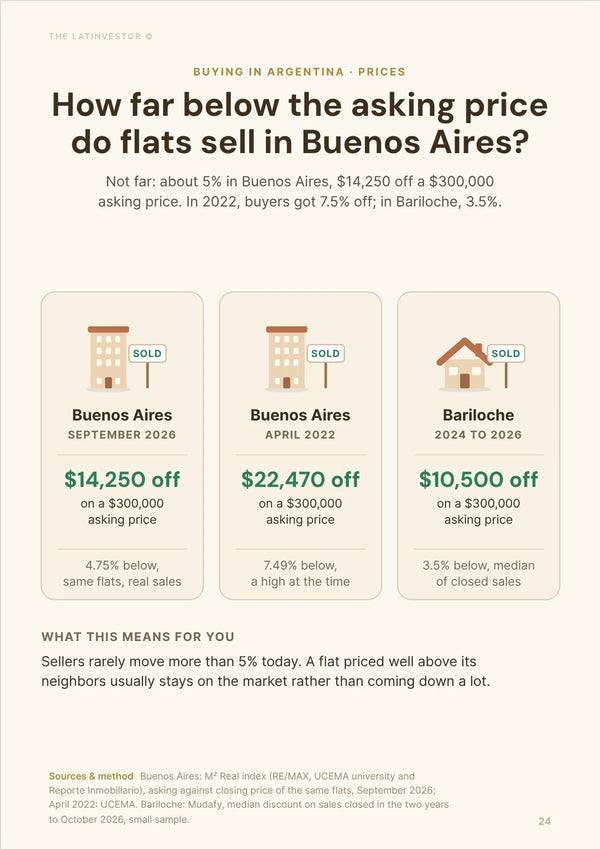
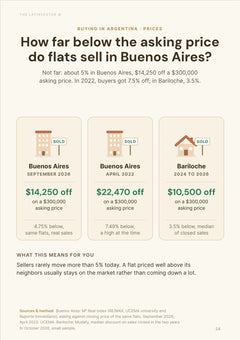
No source publishes time on market for Bariloche. As a rough guide, a well-priced apartment can sell within a few months, while overpriced or luxury homes often sit for a year or more. Real sales close below the listing: Mudafy measured a median negotiated discount of about 3.5% on tracked Bariloche sales.
Homes that can rent in both seasons (ski in July, lake in January, when Airbnb occupancy reaches about 56% to 60%) sell more easily. The slowest are large luxury estates, homes with poor winter access and odd plots.
One thing helps resale in 2026: an individual pays no Argentine income tax on the gain from selling a home since 1 January 2026, resident or not (companies are not covered). But buying and selling still costs about 10% to 13% of the price in total, so plan to hold for several years.
Do your dollars buy less in Bariloche than they did in January 2026?
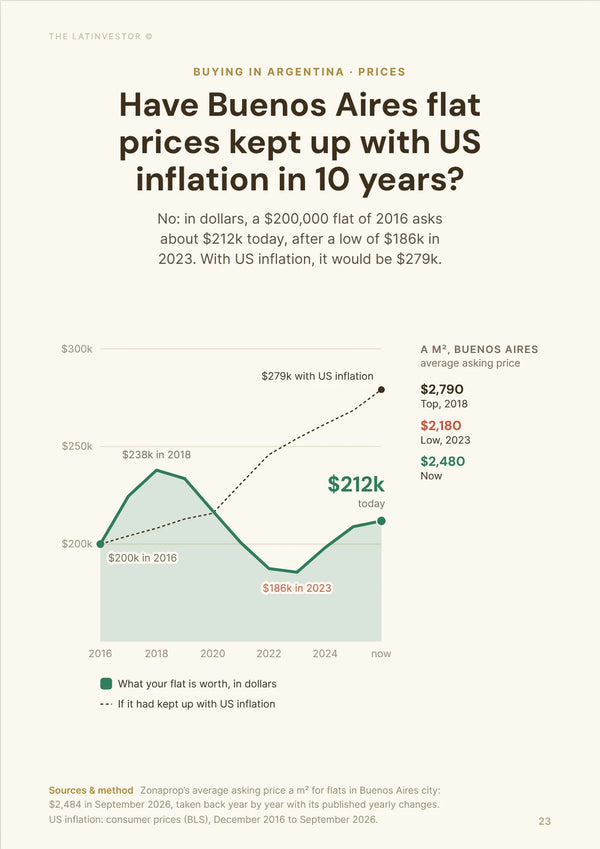
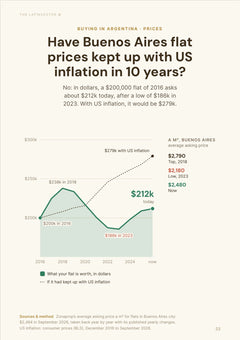
Yes. Bariloche asking prices are up about 17.8% in dollars over 12 months (Roomix Index, October 2026). At the same time the dollar rose only about 4.9% against the peso since January, while consumer prices rose about 23.6% from January to September. Local costs went up in dollars, and sellers followed.
Be careful with that 17.8%: it is asking prices, not deeds. In Buenos Aires, where closing prices are measured, they fell 0.4% over the same 12 months. Some Bariloche sellers are simply asking more than buyers end up paying.
What to do: compare each listing with its neighborhood median (about USD 3,065 per square meter in Centro, USD 3,936 in Melipal, USD 1,867 in Las Victorias). If it asks more than 15% above that without a view or new finishes, it is overpriced. Aim for 3% to 5% off well-priced homes and 5% to 10% off homes listed for months.
Can a foreigner still buy a lot or a chacra near Bariloche after the October 2026 land ruling?
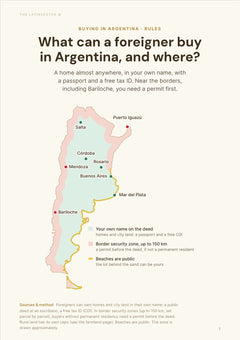
A lot inside the city, yes. Land outside it, check first. On 9 October 2026, the Supreme Court provisionally suspended the repeal of the Rural Land Law (Ley 26.737) made by DNU 70/2023, and sent the case back to the federal court in Bariloche.
Until a final ruling, the old limits apply again: foreigners can own at most 15% of rural land at national, provincial and department level, with extra limits near certain lakes and rivers. Bariloche is also close to the Chilean border, and some parcels fall under border security-zone rules (Decree-Law 15.385), which can require prior authorization from the Interior Ministry.
What to do: an apartment or a house on an urban lot is not rural land, so most budget purchases are not affected. For a chacra, a large lot on the edge of town or a lakefront parcel, ask the escribano to confirm the parcel's classification and border-zone status before you pay any deposit.
Our methodology
This article estimates what different budgets buy in Bariloche in October 2026, from USD 100,000 to luxury homes: size, type and neighborhood, plus buying costs, yearly taxes, financing and resale.
Sizes are each budget divided by TuLugar's median asking price per square meter for the city and for each neighborhood (about 5,000 sale listings, October 2026; September 2026 for Dina Huapi). Medians by bedroom count, house and lot prices and the spread of listings also come from TuLugar. We used the Roomix Index for the 12-month price change, Mudafy for the negotiated discount on sales, AirROI for seasonal Airbnb occupancy, and listings on Argenprop, Zonaprop and Mercado Libre Inmuebles to check what exists at each price.
Buying costs come from the 2026 Río Negro stamp-duty schedule and standard Argentine notary, registry and agent fees; tax rules from Law 27.743 (ITI), Law 27.802 and Decree 406/2026 (capital gains) and the national wealth-tax rule; mortgage volumes from Tejido Urbano's count of BCRA data; the land-law update from Chequeado's coverage of the 9 October 2026 Supreme Court decision; and inflation from INDEC.
We checked these figures in October 2026. Peso amounts are converted at about ARS 1,550 per US dollar (official and MEP rates were within 1% of each other on 22 October 2026, the blue rate about ARS 1,570), and euro amounts at about ARS 1,740 per euro.
Where we had no direct figure, such as renovation costs, the new-build premium, luxury thresholds, property tax or time on market, we give rounded ranges from comparing listings and say so. All portal figures are asking prices, which usually sit above final sale prices, and sizes from medians are a guide, not a promise that a given unit exists.
Key sources used for this analysis include TuLugar, Roomix Index, Mudafy, AirROI, Argenprop, Zonaprop, Mercado Libre Inmuebles, Properstar, Río Negro stamp-duty schedule 2026, Agencia de Recaudación Tributaria de Río Negro, Río Negro property registry, Colegio de Martilleros de Río Negro, BCRA, Ministerio del Interior, Previa Conformidad, Ministerio de Justicia, Tierras Rurales, Chequeado and INDEC.