

Summary
Yes for a well-priced apartment, no for a stretched one: Bariloche apartments ask a median of about USD 3,067 per square meter in October 2026, asking prices are up about 17.8% in dollars over 12 months on one index, and tracked sales still close about 3.5% below the asking price.
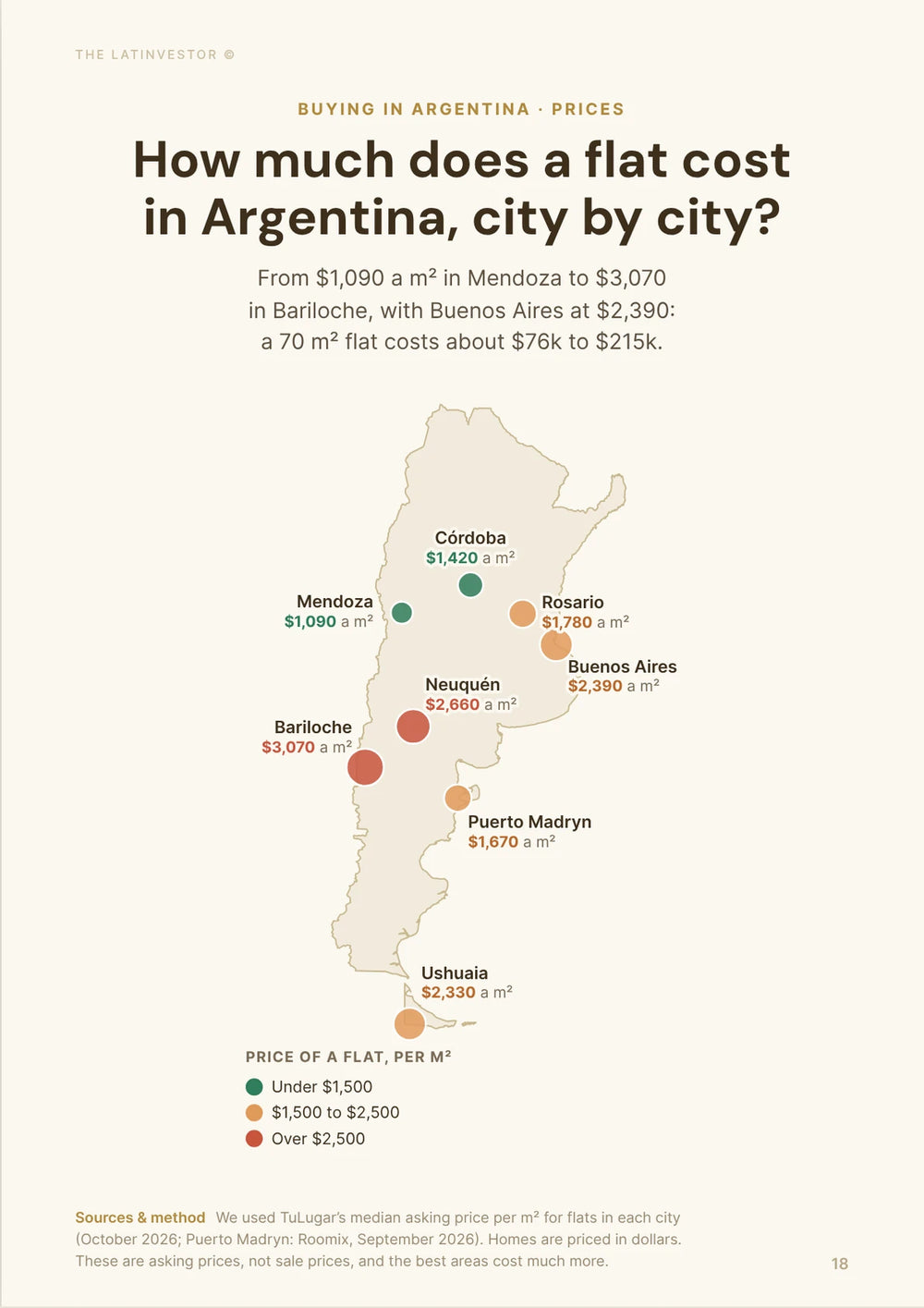
Bariloche is not cheap: its apartment median sits about 23% above the Buenos Aires asking index (USD 2,484 per square meter) and about 46% above what Buenos Aires flats really sell for (USD 2,097).
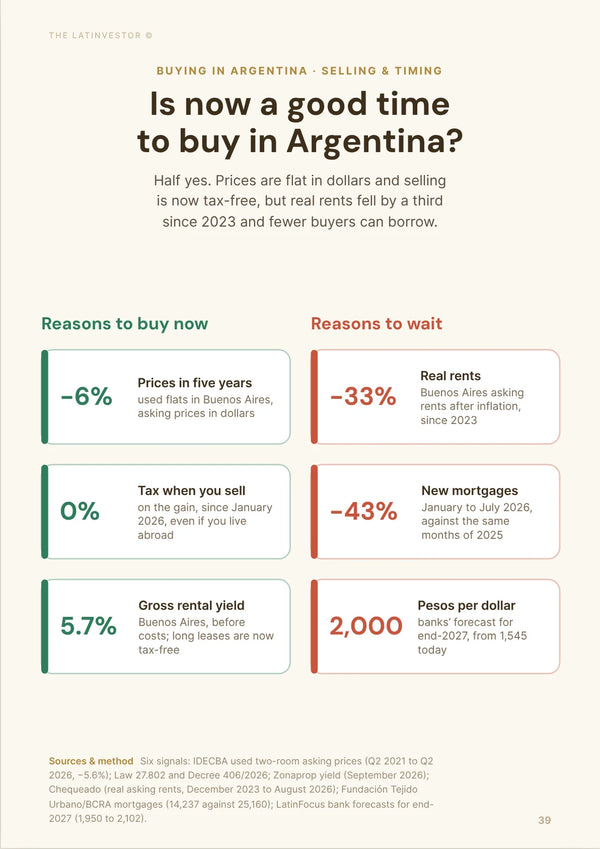
A crash looks unlikely, but so does another fast jump: home loans in Argentina fell 43% in January–July 2026, so most buyers pay cash, and the strong peso has already pushed local costs up in dollars.
It is a two-speed market: well-priced 1- and 2-bedroom apartments in Centro, Belgrano and Melipal sell, while homes online for months can be bought 5% to 10% below their asking price.
Against rents, prices are fair rather than crazy: a median 1-bedroom asks about USD 155,000 and rents for about ARS 1.0 to 1.19 million a month, which means 17 to 20 years of rent, or 5% to 6% gross.
No index tracks Bariloche prices over many years, so nobody can prove prices are above their long-term average; what is measured is the recent rise in asking prices, not deeds.
The infrastructure news is real but slow: 5.6 km of Route 80 to the airport is being rebuilt (ARS 4,475 million, about USD 2,890,000), while the terminal expansion is only in a 2027–2031 national plan.
Rules changed in October 2026: since the Supreme Court decision of 9 October, foreign-ownership limits on rural land apply again, and foreigners with only foreign income still have no confirmed access to UVA mortgages.
Finding a long-term tenant is easy: only about 501 apartments and houses were listed for rent on TuLugar in October 2026, against 4,559 active Airbnb listings.
The short-term side is the one getting crowded: Airbnb listings grew about 23% in a year while average occupancy stayed at 39.7%.
Selling later works for compact central apartments, but plan on about 10% to 13% of the price for a buy-and-sell round trip; the good news is that individuals no longer pay income tax on the gain since January 2026.
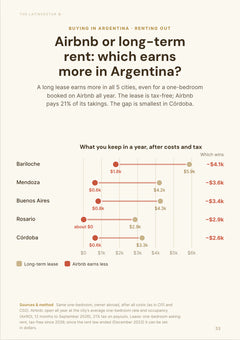
The winter season was strong (about 85% occupancy at the start of the July holidays), but a median 1-bedroom on Airbnb grosses only about USD 6,930 a year before fees and tax.
Our take: buy now only at or below the neighborhood median per square meter, plan on a long lease at 5% to 6% gross, and do not pay extra for airport works or ski-season hype.

Are Bariloche prices too high, or is there still room to rise?
Do real estate prices look too high in Bariloche?
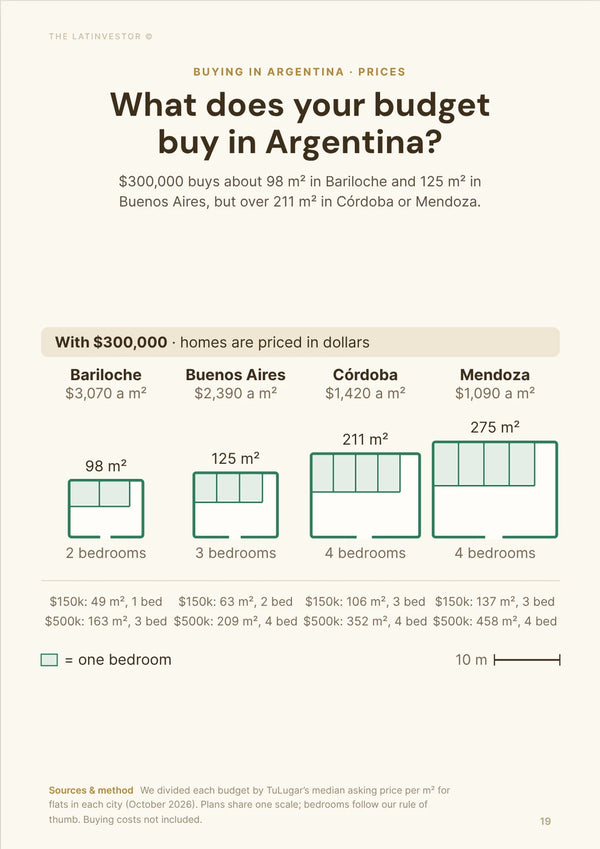
For local buyers, yes. For investors, only somewhat. In October 2026, apartments in Bariloche ask a median of about USD 3,067 per square meter (TuLugar), about 23% more than the Buenos Aires asking index (USD 2,484 on Zonaprop) and about 46% more than Buenos Aires closing prices (USD 2,097).
The rise is recent and fast. The Roomix Index shows the median asking price up about 17.8% in dollars over 12 months, and the TuLugar apartment median went from USD 2,983 to USD 3,039 per square meter between August and September 2026 alone.
Part of it is the strong peso: consumer prices rose about 23.6% from January to September 2026 while the dollar rose only about 4.9%, so wages, building costs and seller expectations went up in dollars. Part of it is simply sellers asking more.
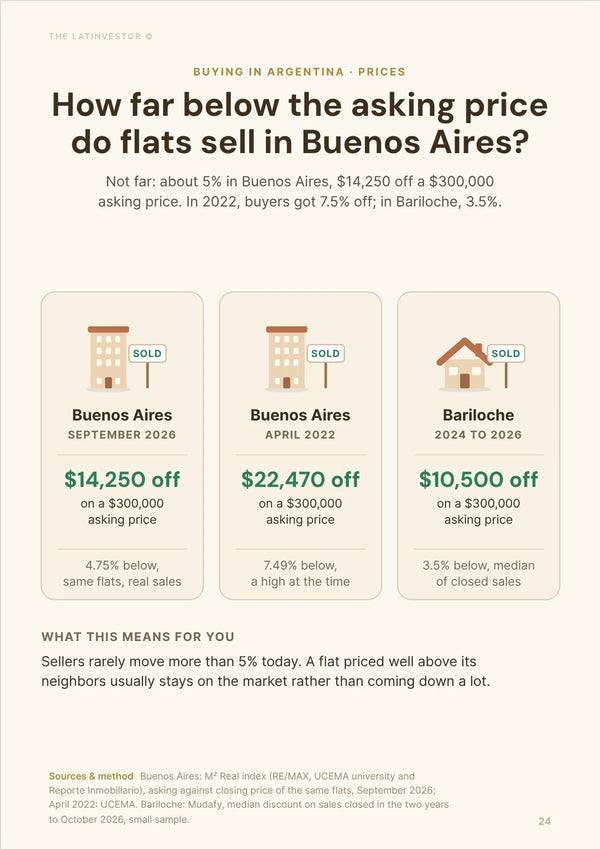
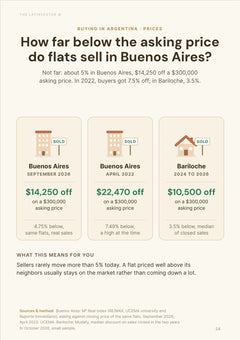
The useful signal: tracked sales close about 3.5% below the asking price (Mudafy), so well-priced homes sell close to their price. Overpriced lake-view houses and big homes sit online much longer.
Does a property price drop look likely?
A real crash looks unlikely. Most buyers in Bariloche pay cash in dollars, so prices do not depend on credit the way they do in many countries. A fall would need forced sellers, and there is no sign of them.
A soft patch is more likely than a crash. Asking prices rose about 17.8% in a year while Buenos Aires closing prices fell 0.4%, so some Bariloche sellers will have to cut prices to sell, especially on houses that need work or lack a view.
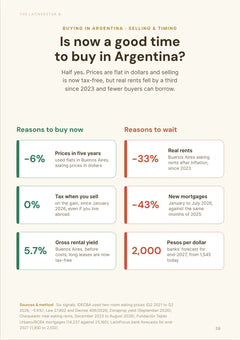
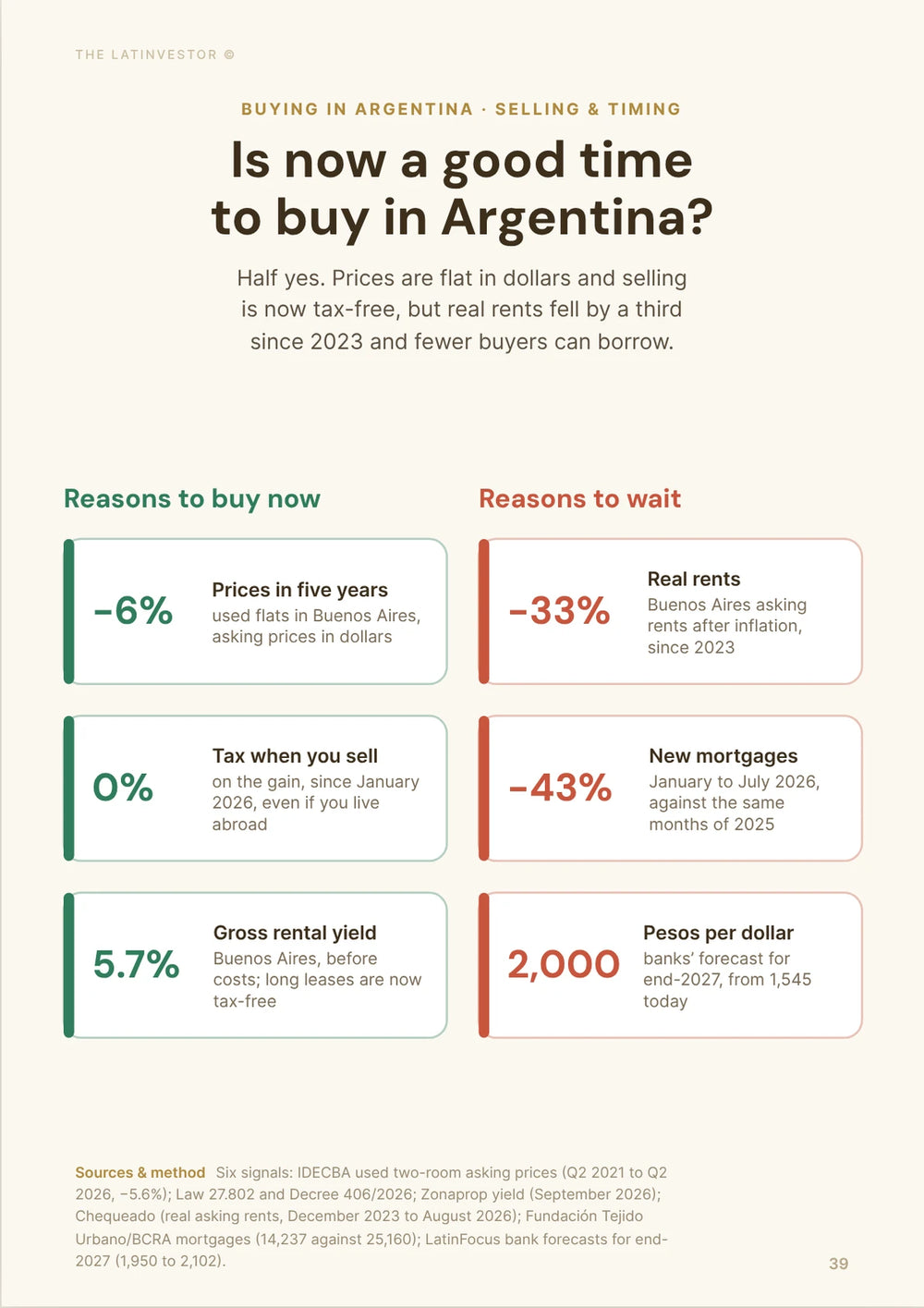
The risk to watch is credit. Banks granted 14,237 home loans across Argentina from January to July 2026, 43% fewer than a year earlier. Fewer local buyers with a mortgage means fewer buyers for ordinary family homes.
The other risk is the peso. If it weakens sharply, peso costs fall in dollars and some local sellers could accept lower dollar prices. The central bank's September survey expects about ARS 1,614 per dollar at the end of 2026, a small move from about ARS 1,550 today.
Could property prices jump again?
Not by much from here. After a rise of about 17.8% in asking prices in one year, a lot of the scarcity story is already in the price. Another jump of that size would need cheap mortgages at scale, which Argentina does not have yet.
The homes with the most room are the ones still near the city median: compact apartments in Centro (median USD 3,065 per square meter) and Belgrano (USD 3,119). Melipal (USD 3,936) and Villa Catedral (USD 3,880) already price in a lot.
The triggers to watch are the state-funded mortgage programme (ARS 200 billion auctioned to banks in September and again in October 2026), tourist arrivals (foreign arrivals to Argentina up 18.4% in January–August 2026) and Buenos Aires families moving south.
Are we in a buyer or a seller market?
It depends on the home. For a well-priced 1- or 2-bedroom apartment in Centro, Belgrano or Melipal, sellers are in control: these units rent easily and the median negotiated discount is only about 3.5%.
For big houses, lake-view homes priced like trophies, and homes far from the center that need heating or roof work, buyers are in control. A 5% to 10% discount is realistic on anything listed for months.
There are plenty of homes to choose from: TuLugar counted about 5,500 sale listings in Bariloche in October 2026, of which about 31% are lots (1,695), with apartments slightly more numerous and houses about a fifth. No source publishes months of inventory or time on market for the city.
 Argentina Property Market
This is just a preview page. Prices and rents move fast: your guide is refreshed every month, and you always get the latest version.
Are homes overpriced, or fairly priced in Bariloche in 2026?
Are homes overpriced versus rents or versus incomes?
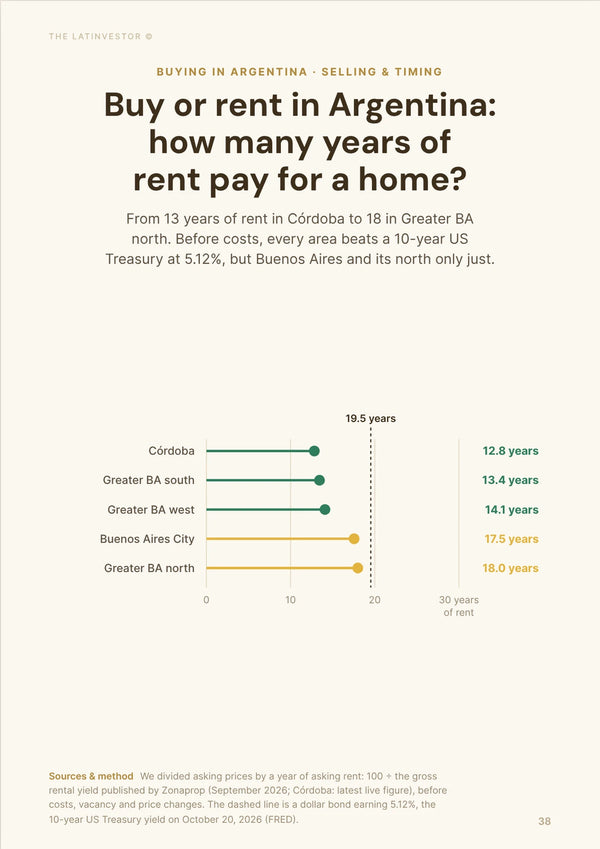
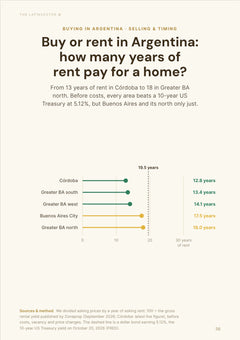
Versus rents, prices are fair. A median 1-bedroom apartment asks about USD 155,000. It rents for about ARS 1,191,665 a month on Reporte Inmobiliario's May survey (USD 770) or about ARS 1 million on Roomix in August (USD 645). That is 17 to 20 years of rent, or about 5% to 6% gross a year.
A 2-bedroom gives a similar picture: about USD 215,000 against ARS 1,575,000 a month (USD 1,020), about 5.7% gross, or 17.6 years of rent. That is in line with Buenos Aires, where Zonaprop measured a 5.70% gross yield in September 2026.
Versus local incomes, prices are stretched. A USD 155,000 apartment is far out of reach for most Bariloche wage earners without a mortgage, and mortgages are scarce. That is why buyers are mostly Buenos Aires families, retirees and investors with savings in dollars.
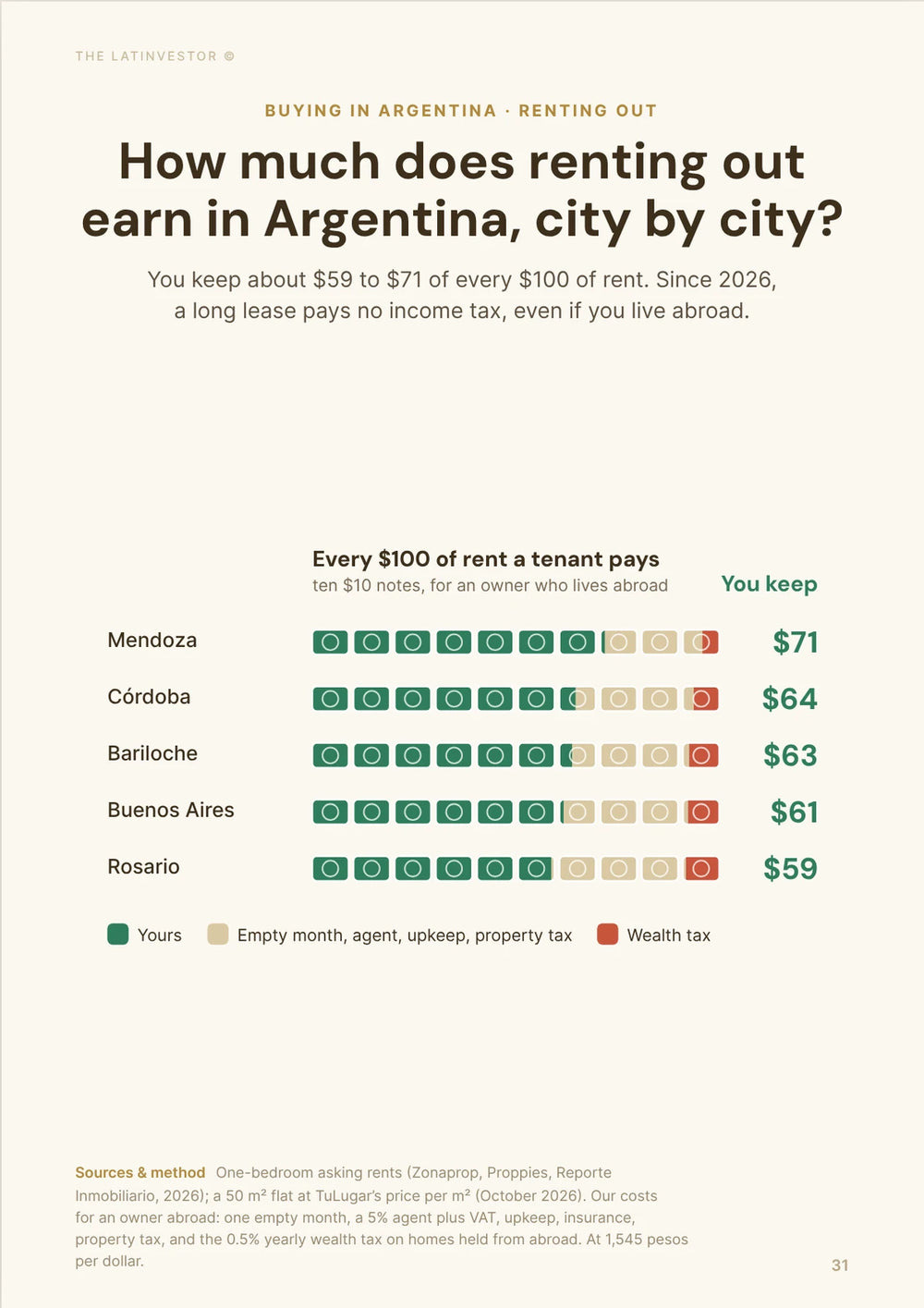
For a foreign landlord, the gross yield is not the net. Unless an adviser confirms the 2026 exemption applies to you, plan on about 21% of gross rent in tax, which brings a 6% gross yield down to about 4.7% before building costs and repairs.
Are home prices above the long-term average?
Nobody can say with a number. No index follows Bariloche prices over 5 or 10 years, and portals changed their samples along the way. What is measured is the last year: asking prices up about 17.8% in dollars.
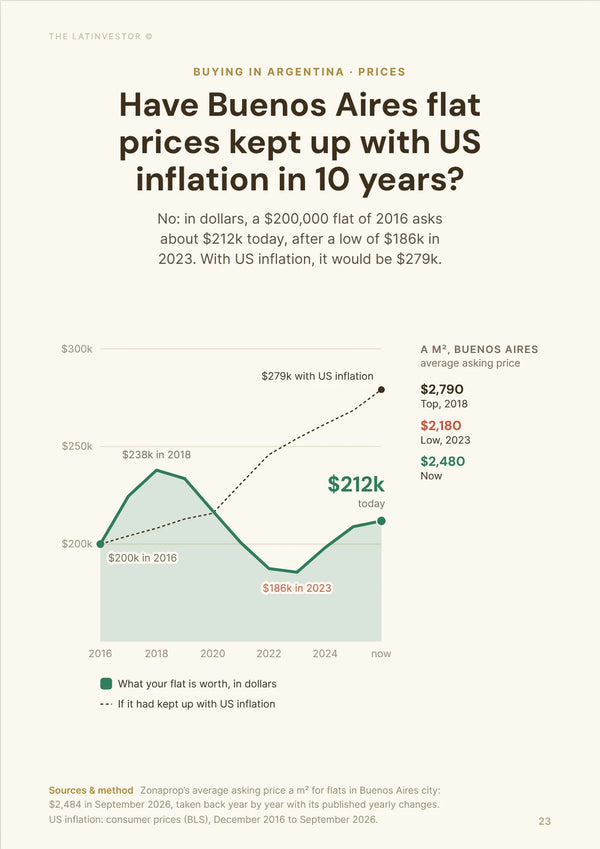
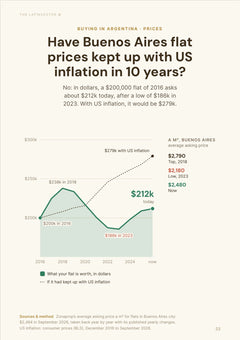
For a reference, Buenos Aires asking prices are still about 11.3% below their old peak, so Argentina as a whole is not at record dollar prices. Bariloche has outperformed the capital this year, which suggests it is closer to its highs than Buenos Aires is.
In practice, compare each listing with today's neighborhood median rather than with a long-term average: about USD 3,065 per square meter in Centro, USD 3,936 in Melipal and USD 1,867 in Las Victorias.
What local changes could move prices in Bariloche in 2026?
Are big infrastructure projects coming to Bariloche?
One is under way, one is only planned. The province is rebuilding 5.6 km of Route 80, the airport access road, with a budget of ARS 4,475 million (about USD 2,890,000), according to a government update of 16 October 2026.
The airport terminal expansion announced in December 2025 (about USD 15 million to 16 million, up to six flights at once) has not started. In October 2026, Bariloche appeared among 14 airports due for terminal works under a USD 1,500 million national plan for 2027 to 2031.
No study measures how much these works lift prices. They help the east side (Las Victorias, the road to Dina Huapi) more than Centro or Melipal. Do not pay extra today for a project that is years away.
Are zoning or building rules changing?
Not citywide. The main open file is the Cerro Catedral urban plan, covering about 77 hectares, which was still waiting for the City Council in mid-2026. If it passes, more units could be built near the ski area over time.
Elsewhere, the limits are physical as much as legal: the lake, slopes, forest, road access and sewage capacity keep good land near Centro, Melipal, Playa Bonita and the Bustillo corridor scarce. That is why lots make up about 31% of listings: many buyers build their own house further out.
Before buying land, check the zoning of the exact parcel on the city's urban code: what you can build varies a lot from one block to the next.
Are foreign-buyer or mortgage rules changing?
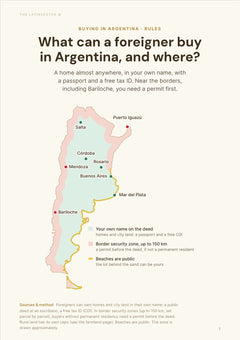
Yes, for land. On 9 October 2026, the Supreme Court provisionally suspended the repeal of the Rural Land Law (Ley 26.737) and sent the case back to the federal court in Bariloche. Until it rules, foreigners can again own at most 15% of rural land at national, provincial and department level, with extra limits near some lakes and border areas.
An apartment in Centro or a house on an urban lot is not rural land, so most purchases are not affected. For a chacra, a large lot on the edge of town or a lakefront parcel, ask the notary to confirm the parcel's classification and border-zone status before paying a deposit.
On mortgages, credit got cheaper for locals (Banco Nación from UVA + 6.7% for eligible clients, state-funded loans capped at UVA + 7.5%), but loan numbers are still down 43% on 2025. A foreigner with only foreign income has no confirmed access to these loans, so plan on paying cash.
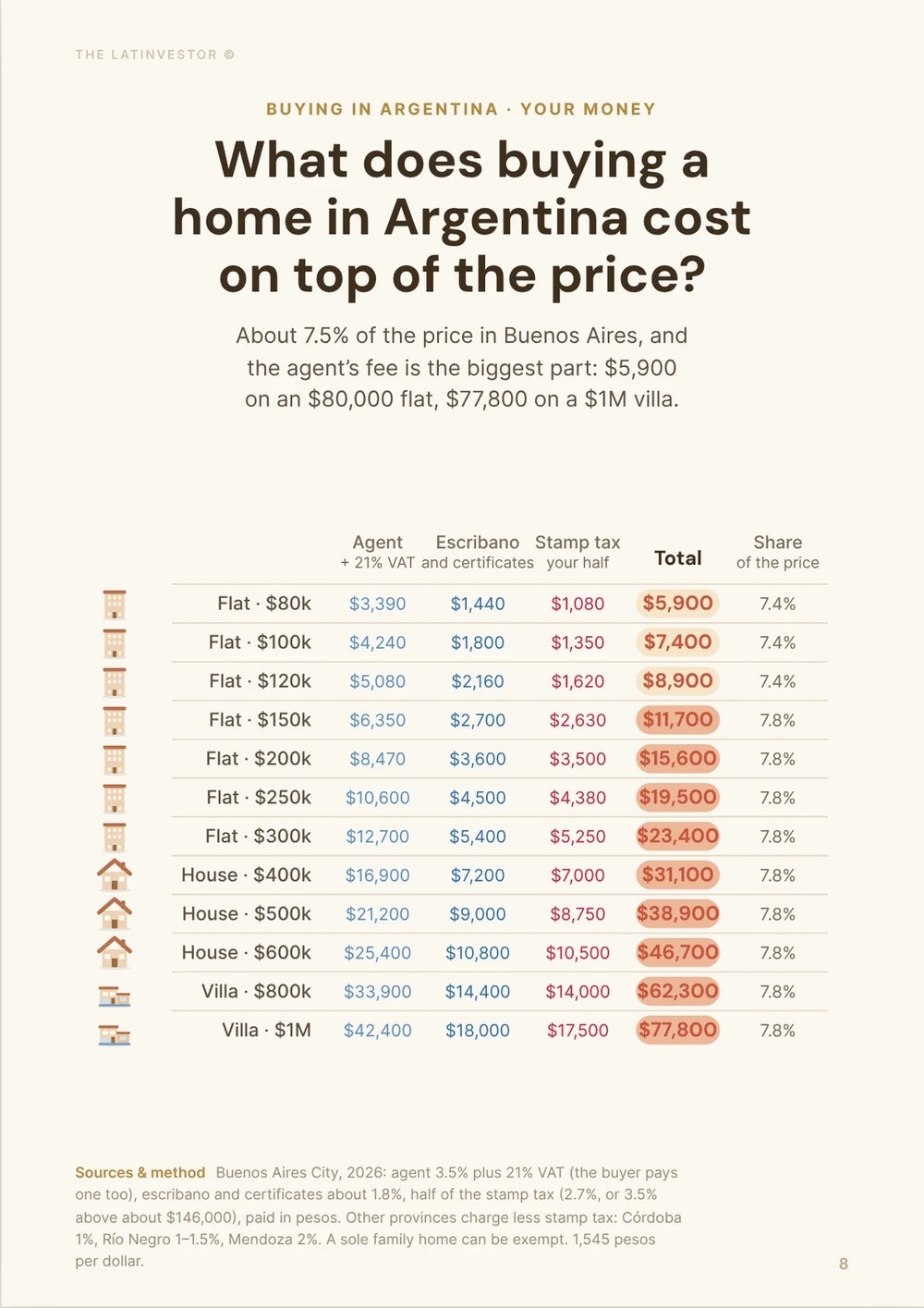
Buying costs are lower than in Buenos Aires: Río Negro stamp tax is 1% if the fiscal valuation is up to ARS 55 million (about USD 35,500) and 1.5% above, usually split with the seller. With agent and notary, budget about 6% to 9% of the price.
 70+pages
Will it be easy to find tenants in Bariloche in 2026?
Is the renter pool growing faster than new supply?
For long leases, yes. Only about 501 apartments and houses were listed for rent on TuLugar in October 2026, against 4,559 active Airbnb listings in the city: about 9 tourist listings for every long-term one.
Demand comes from several groups at once: seasonal workers, UNRN students, professionals moving from Buenos Aires, remote workers and local families who cannot buy. Rents show it: a 1-bedroom asked about ARS 1.19 million a month in May 2026, the highest of any Argentine city Reporte Inmobiliario surveyed.
Long-term supply grows slowly, because many owners prefer short stays in high season and few new buildings target permanent tenants. The end of rent control (DNU 70/2023) helps: owners can now sign shorter contracts with free indexation, which brought some units back to long leases.
Are days-on-market for rentals falling?
No source measures it, so we will not give a number. With so few long-term listings, a well-priced, well-heated apartment in Centro, Belgrano or Melipal usually lets quickly.
Timing matters more than anywhere else in Argentina. Permanent rentals are easiest to fill from March to May and in October and November. In January and July, owners chase tourists: Airbnb occupancy peaked at 59.9% in January 2026 and 56.4% in July 2026.
What slows a rental down: no heating or poor insulation, a steep street with no transport in winter, or an asking rent above ARS 1.2 million for an ordinary 1-bedroom.
Are vacancies dropping in the best areas of Bariloche?
For long leases, vacancy is low wherever the home is warm and well connected, but no official vacancy rate is published for Bariloche.
For short stays, empty nights are the norm: Airbnb occupancy averaged 39.7% over the year to September 2026, from 32.1% in April to 59.9% in January. With 23% more listings than a year earlier, it is getting harder to fill the low season.
Melipal has the highest long-term rents on TuLugar (median about USD 985 a month for all apartment sizes), against USD 754 in Belgrano, USD 720 in Centro and USD 624 in Las Victorias, a sign of where tenants compete hardest.
Am I buying into a tightening market in Bariloche in 2026?
Is for-sale inventory shrinking?
Not overall. TuLugar lists about 5,000 homes and lots for sale in Bariloche in October 2026, and no source shows that number falling. What is tight is the small pool of well-priced, easy-to-rent apartments near the center.
Owners of those units have no reason to rush: they can rent them, long or short, and wait for their price. That is why a good 1-bedroom in Centro rarely sells far below its asking price, while large houses stay online.
Are homes selling faster?
There is no local figure, and the national signals point the other way. Buenos Aires deeds were down 2.3% in January–August 2026 compared with 2025, and mortgage lending fell 43%. Bariloche has no published deed count by month.
The practical reading: compact, well-priced apartments sell in a reasonable time; houses priced above the neighborhood median wait months, sometimes more than a year.
Are new listings slowing down?
We cannot say: no source tracks new sale listings in Bariloche month by month. The supply that clearly grew is on the tourist side, with about 23% more active Airbnb listings than a year earlier.
Good homes in Centro, Melipal, Playa Bonita and the first kilometers of Bustillo stay hard to find at fair prices, because their owners can rent them and wait.
Is new construction failing to keep up?
For central, rentable apartments, yes. National construction activity was down 4.4% year on year in August 2026, and building costs rose 31.3% in pesos over 12 months to September, faster than inflation, which squeezes developers.
Building is also hard in Bariloche itself: slopes, forest, lake, limited sewage and road capacity. New supply goes mostly to the east side, Dina Huapi and lots on the edge of town, not to Centro or Melipal.
For a buyer, this supports resale value of good central apartments. It does not help large houses far out, where the supply of lots (median about USD 92,000) is ample.
 70+pages
Will it be easy to sell later in Bariloche in 2026?
Is resale liquidity strong enough?
For compact, well-located apartments, yes. They appeal to three kinds of buyers at once: local families, Buenos Aires investors and second-home buyers. For oversized, remote or overpriced houses, resale can take a long time.
Ticket size matters most. More than half of Bariloche listings (56%) ask less than USD 200,000, and that is where most buyers are. Above USD 1 million, there are about 312 listings and few buyers.
What helps resale: good heating, parking or walking distance to Centro, a view if possible, and a layout that works both for a long lease and for short stays.
Is selling time getting longer?
Not for well-priced homes. It is getting longer for sellers who raised their price with the 17.8% headline and now face buyers who compare per square meter.
No source publishes selling times for Bariloche, so we do not give a figure. As a rule of thumb, a home listed more than about 15% above its neighborhood median without a view or new finishes tends to sit, and ends up selling 5% to 10% below its asking price.
Is it realistic to exit with profit?
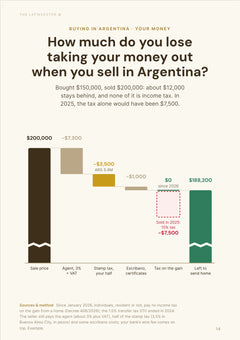
Yes, if you buy well and hold. Plan on about 10% to 13% of the price for the round trip: 6% to 9% to buy (agent, notary, registry, half the stamp tax) and about 4% to 4.4% to sell (agent at 3% plus VAT and half the stamp tax).
On a USD 150,000 apartment, that is about USD 15,000 to USD 20,000 (EUR 13,400 to EUR 17,800). With prices that may move little after this year's jump, you need about 5 years of rent and some price growth to come out clearly ahead.
The tax side improved: since 1 January 2026, individuals, residents and non-residents alike, pay no income tax on the gain when they sell a home (Law 27.802, Decree 406/2026). Companies are not covered.
The best odds go to buyers who pay at or below the neighborhood median for a 1- or 2-bedroom in Centro, Belgrano, Ñireco or Melipal.
Did the strong 2026 ski season make Bariloche Airbnb a better bet?
The season was good: local media reported about 85% occupancy at the start of the July 2026 winter holidays, and AirROI shows Airbnb occupancy at 56.4% for July and 59.9% for January. But over the full year to September 2026, the average was only 39.7%.
Meanwhile supply rose: about 4,559 active listings, 23% more than a year earlier. A median 1-bedroom entire home grossed about ARS 10 million a year, or about USD 6,930 at AirROI's own rate of ARS 1,443 per dollar. On a USD 155,000 apartment, that is about 4.5% gross, before the 15.5% Airbnb fee, cleaning, management and tax.
A long lease on the same 1-bedroom (ARS 1.19 million a month, about USD 9,230 a year) grosses about a third more than that median Airbnb, with far less work. Tourist rentals also need a municipal license (habilitación), and a non-resident pays about 21% of gross rent plus provincial gross-income tax.
What to do: buy for a long lease, and treat ski and summer weeks as a bonus only if you use the place yourself. If a seller quotes Airbnb income, ask for 12 months of payouts, not the July figures.
 70+pages
Do the 2026 tax changes make it a better time to buy in Bariloche?
A bit. Two changes help. Since 1 January 2026, individuals pay no income tax on the gain when they sell a home, residents and non-residents alike. And long rents to a tenant's permanent home are exempt from income tax for resident individuals (Decree 406/2026, published 1 June 2026).
For a non-resident landlord, the rent exemption is not confirmed: the decree is silent. Until an adviser says otherwise, plan on 21% of gross rent (35% withheld on a presumed 60% net), plus about 0.5% a year of wealth tax (Bienes Personales) on the property, paid through a local representative.
What to do: run your numbers with the 21%. If they still work, the tax-free exit is a real plus. Hold the property in your own name if you can, because companies do not get the capital-gains exemption.
With a strong peso, are you overpaying in dollars in Bariloche right now?
Partly. The dollar rose only about 4.9% in 2026 while consumer prices rose about 23.6%, so everything priced in pesos, from building work to rents and municipal rates, costs more in dollars than in January. Sellers priced in dollars followed, and asking prices are up about 17.8% in a year.
That has two effects. Your dollars buy less house today. But rents in pesos are also worth more in dollars, which is why yields still reach 5% to 6% gross.
What to negotiate: compare every listing with its neighborhood median per square meter (USD 3,065 in Centro, USD 3,119 in Belgrano, USD 3,936 in Melipal). Aim for 3% to 5% off a well-priced home and 5% to 10% off a home online for months. Ask early for the fiscal valuation, which decides whether stamp tax is 1% or 1.5%.
Our methodology
This article looks at whether October 2026 is a good time to buy in Bariloche: how high prices are against rents and Buenos Aires, what could push them up or down, how easy it is to rent and resell, and what new rules and taxes change for a buyer.
Prices come from listing portals, since no official closed-sale index exists for Bariloche: TuLugar (about 5,000 sale listings, October 2026) for medians, the Roomix Index for the 12-month change and Mudafy for negotiated discounts. Rents come from Reporte Inmobiliario (via La Nación, May 2026), Roomix (August 2026) and TuLugar; short-term rental data from AirROI only (October 2025 to September 2026); tourism from ANBariloche and INDEC; infrastructure from the Río Negro government and ANBariloche.
Rules and taxes come from the Boletín Oficial (Law 27.802, Decree 406/2026), the 2026 Río Negro stamp-duty schedule, Chequeado on the 9 October 2026 land-law ruling and Estudio Piccinini on non-resident landlords. National comparisons use Zonaprop, the RE/MAX-UCEMA-Reporte Inmobiliario closing-price index, Colegio de Escribanos de la Ciudad de Buenos Aires deed data, BCRA mortgage data and INDEC inflation and construction data.
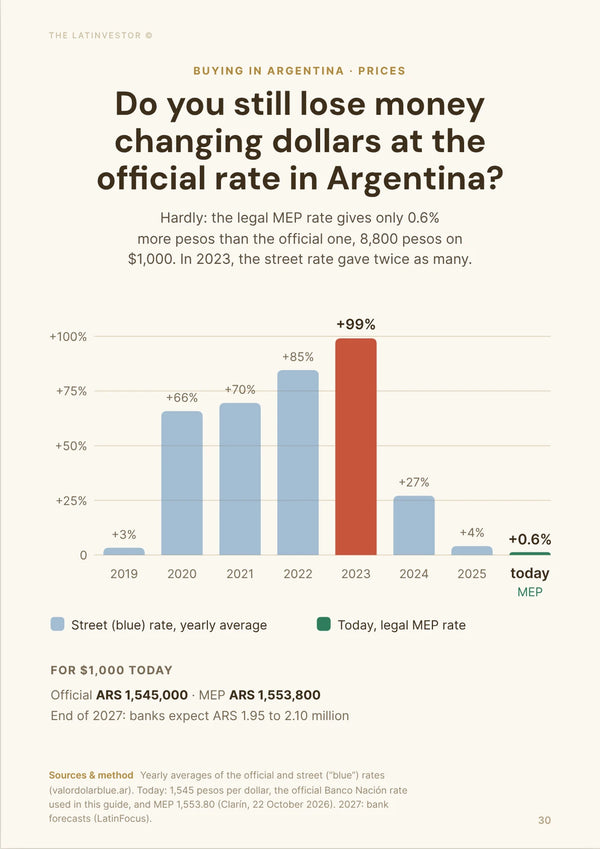
We checked these figures in October 2026. Peso amounts are converted at about ARS 1,550 per US dollar (official and MEP rates were within 1% of each other on 22 October 2026, the blue rate about ARS 1,570), and euro amounts at about ARS 1,740 per euro. AirROI figures are converted back at AirROI's own rate of ARS 1,443 per dollar.
Where we had no direct figure, such as time on market, months of inventory, rental vacancy or a long-term price index for Bariloche, we say so and give a direction rather than a number. All portal prices are asking prices, which usually sit above final sale prices, and yields are gross, before costs and the tax a foreign landlord may owe.
Key sources used for this analysis include TuLugar, Roomix Index, Mudafy, Reporte Inmobiliario via La Nación, AirROI Bariloche Airbnb data, BCRA Estadísticas e Indicadores, INDEC Censo 2022, Municipalidad de Bariloche Censo 2022, Río Negro Dirección de Estadística y Censos, Municipalidad de Bariloche tourism statistics, Río Negro government on Route 80, ANBariloche, Concejo Bariloche Código Urbano, Municipalidad de Bariloche normativa, Digesto Jurídico Municipal, Zonaprop Bariloche sale listings, Zonaprop Bariloche rental listings, Argenprop Bariloche listings, MercadoLibre Inmuebles Bariloche, Río Negro stamp-duty schedule 2026, Chequeado, Estudio Piccinini, Infobae and PG Abogados rental-contract analysis.