

Summary
For most buyers, the best place to buy in San Pedro Sula is the northwest and central belt (Río de Piedras, Los Álamos, Colonia Trejo, Jardines del Valle), where apartments ask about $2,690 per square meter citywide and tenants are easiest to find.
The top of the market is new towers in Río de Piedras: one off-plan unit there asks about $3,330 per square meter, against a citywide house median of about $1,420.
A typical 2-bedroom apartment asks about $230,000 and rents for $700 to $850 a month, so gross yields land near 4%, not the 5% to 8% often quoted.
After the 25% tax withheld on a non-resident landlord's rent, that 4% falls to about 3.1%; once one empty month, the condo fee, property tax, upkeep and a manager are also counted, a non-resident keeps about 0.9% net (about 1.5% for a resident).
Airbnb is a weak plan here: the average San Pedro Sula listing is booked 27.8% of nights and grosses about L 136,214 ($5,070) a year, 20.4% less than a year before, while supply grew 68% in twelve months.
Long-term renting is the safer route, with 2-bedroom asks between L 12,500 and $850 a month in the areas tenants want.
The city's new money is going into about 35 large projects worth roughly L 25 billion, mostly towers in the northwest and southwest, plus an airport terminal that grew from 6,000 to 19,000 square meters in September 2025.
Skip Rivera Hernández, parts of Chamelecón and the low southeast: rain in early October 2026 damaged 282 homes in 13 southeast neighborhoods.
Nobody publishes a credible price index for San Pedro Sula, so any "7% a year" growth claim for a neighborhood is a guess, not data.
The 40 km coastal strip (Article 107) is the legal question to settle before signing: we found no official source saying which side of the line the city sits on, so get it in writing from your notary.
Safety has improved: San Pedro Sula's homicide rate was 23.70 per 100,000 in 2024, and the city has been out of the world's 50 most violent cities for two years running.
Buying costs add roughly 4% to 8% on top of the price, and the yearly property tax is L 3.00 per L 1,000 of cadastral value.
Locals and expats agree on the same handful of gated, guarded areas; buy there, pay a resale-friendly price, and plan for long-term tenants rather than tourists.

What does a square meter cost in each part of San Pedro Sula?
Which areas in San Pedro Sula have the highest property prices per square meter?
The priciest areas in San Pedro Sula in October 2026 are Río de Piedras, Colonia Trejo, Residencial Campisa and the gated developments of the northwest (Zona Noroeste). That's where the security, the new towers and the corporate tenants are.
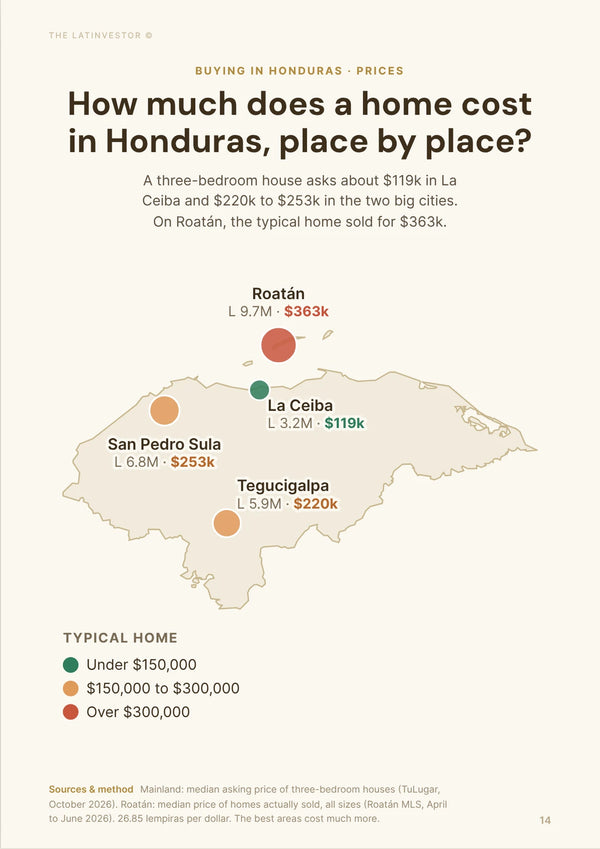
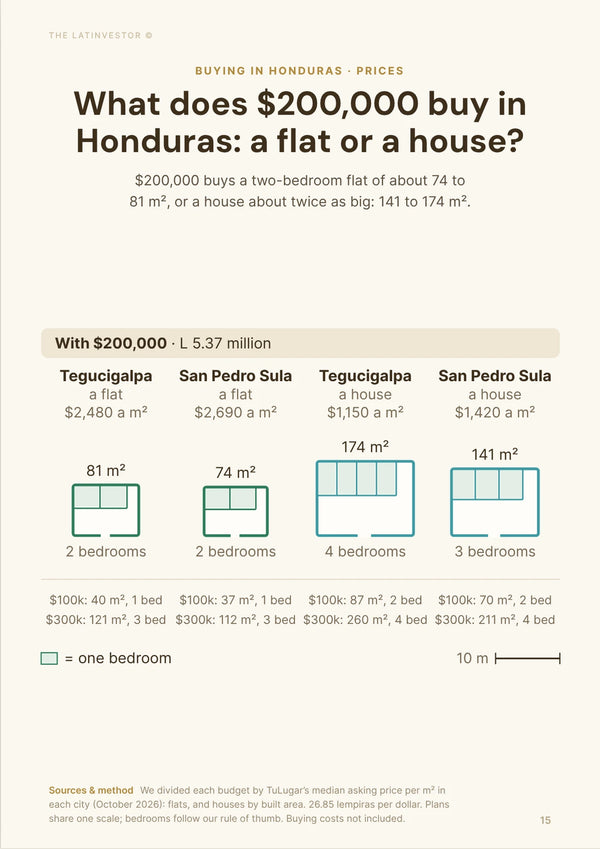
Citywide, apartments ask a median of about $2,690 per square meter (L 72,200) and houses about $1,420 (L 38,200), according to TuLugar's listing tracker on October 19, 2026. These are asking prices, not sale prices, and they lean toward the high end.
New towers push well above that. A 3-bedroom off-plan unit in Río de Piedras asks $403,000 (L 10,820,000) for 121 square meters, about $3,330 per square meter. A new 3-bedroom house in Jardines del Valle asks $330,000 (L 8,860,000) for about 160 square meters, or roughly $2,060 per square meter.
The main factors that push prices so high in these San Pedro Sula neighborhoods vary by location:
- Colonia Trejo: established central area close to shops and services, with townhouses, low-rise homes and newer condos.
- Río de Piedras: the city's main tower district, with pools, gyms, backup power and the highest new-build asks.
- Residencial Campisa: exclusive gated community with large lots and premium single-family homes.
Which areas in San Pedro Sula have the most affordable property prices?
The cheapest square meters in San Pedro Sula are in Colonia Satélite, Rivera Hernández, Chamelecón and the outer colonias near the city limits, plus the low-lying southeast.
We found no reliable per-square-meter figure for these areas in 2026. What listings show is that they sit well below the citywide house median of about $1,420 per square meter, and that the discount is there for a reason.
The trade-offs are real: gang presence in Rivera Hernández and parts of Chamelecón, flooding in the low southeast, and slow resale in older parts of Colonia Satélite. A cheap house you can't rent or resell isn't cheap.
Where do rents pay best against prices?
Which neighborhoods in San Pedro Sula have the highest gross rental yields?
Gross yields in San Pedro Sula's good areas sit around 3% to 4.5%, not the 5% to 8% you often see quoted. A 2-bedroom apartment asks a median of $230,000 (L 6,180,000), and 2-bedroom rents in Colonia Moderna, Los Álamos and Río de Piedras ask $700 to $850 a month.
At $800 a month against $230,000, that's about 4.2% gross. A furnished 2-bedroom in Río de Piedras at $850 against a $275,000 ask comes to about 3.7%. In Jardines del Valle, a seller quotes $600 per 2-bedroom unit, which works out to about 3.1% on a $230,000 price.
Net is lower. A non-resident landlord has 25% of the rent withheld, which takes 4.2% down to about 3.1%. Count one empty month, a $150 condo fee, property tax, upkeep and a manager too, and a 2-bedroom bought at $230,000 and let at $800 keeps about 0.9% net (about 1.5% for a resident). A resident landlord pays 10% once rent passes L 15,000 a month.
Where the yield math works better:
- Colonia Moderna: central, older buildings with lower purchase prices and steady office-worker demand.
- Jardines del Valle: cheaper entry than Río de Piedras, close to shopping and university routes.
- Los Álamos: mid-priced apartments with a deep pool of family tenants.
 Honduras Property Prices

Does Airbnb work in San Pedro Sula, and where?
Which neighborhoods in San Pedro Sula perform best on Airbnb?
San Pedro Sula is a business city, not a beach town, and Airbnb numbers show it. Between October 2025 and September 2026, the average listing was booked 27.8% of nights at about $68 a night (L 1,826) and grossed about L 136,214 ($5,070) for the year, 20.4% less than a year earlier.
The listings that do better sit in Río de Piedras, Colonia Trejo and Jardines del Valle, close to offices, malls and the road to the airport. They live off business travelers, visiting families and corporate stays of a few weeks.
If the unit is registered as tourist lodging, 15% sales tax and the 4% tourism tax come off the top, which leaves about $4,110 of that $5,070 before cleaning, platform fees and management.
Why these three areas do better than the rest:
- Colonia Trejo: condos with easy self check-in and a central address business travelers recognize.
- Jardines del Valle: a good balance of price and security for visiting families.
- Río de Piedras: new furnished units that suit relocations and longer corporate stays.
Which tourist areas in San Pedro Sula are becoming oversaturated with short-term rentals?
The crowded spots are the condo corridors of Colonia Trejo and Río de Piedras, parts of Jardines del Valle, and the apartment clusters near Barrio Guamilito.
San Pedro Sula had 855 active short-term listings over the year to September 2026, 68% more than a year earlier. Demand did not grow anywhere near that fast.
The clearest sign is occupancy: at 27.8% on average, most listings sit empty more than two-thirds of the month. Buying a new condo to put on Airbnb here means competing with hundreds of near-identical units.
Where are long-term tenants easiest to find?
Which neighborhoods in San Pedro Sula have the strongest demand for long-term tenants?
Long-term tenants concentrate in Colonia Trejo, Jardines del Valle, Río de Piedras, Los Álamos and Colonia Moderna. These are the areas working professionals and relocated staff ask for first.
We found no reliable vacancy rate or time-to-rent figure for San Pedro Sula. What listings do show is that owners in these areas advertise one-year minimum leases and bundle water, internet and security into the rent, which tells you tenants have choices.
Who rents where:
- Colonia Trejo: managers and expats looking for furnished units with security.
- Jardines del Valle: young professionals and small families after affordable modern housing.
- Río de Piedras: higher-income tenants and corporate relocations wanting full amenities.
- Colonia Moderna: office and retail workers who want to be central.
The one amenity tenants won't give up is 24-hour gated security with controlled access. Backup power and a water cistern come right after.
What are the average long-term monthly rents by neighborhood in San Pedro Sula?
In October 2026, a 1-bedroom in San Pedro Sula rents for roughly L 11,250 to L 15,000 a month ($420 to $560), and a 2-bedroom in a good area for $700 to $850 (L 18,800 to L 22,800).
Real asks we found: a 45-square-meter 1-bedroom in Los Álamos at L 12,000 ($445); a 65-square-meter 2-bedroom in Los Álamos at L 15,000 ($560) with water, internet and security included; a 2-bedroom in Barandillas at L 12,500 ($465).
Higher up: 2-bedrooms in Colonia Tara at $700 (L 18,800), in Colonia Moderna and Los Álamos at $800 (L 21,500), and a furnished 80-square-meter unit in Río de Piedras at $850 (L 22,800).
In older areas like Colonia Satélite, entry-level units rent for less, but we found no recent listings solid enough to quote a range.
 70+pages
Which areas are moving up, and what's being built?
Which neighborhoods in San Pedro Sula are gentrifying and attracting new investors?
The money is going to Río de Piedras (new towers like the Apolo mixed-use project), the northwest, the southwest and the Jardines del Valle corridor. Around 35 mid-size and large private projects are underway in the city, including 15 to 20 apartment, office and mixed-use towers, worth roughly L 25 billion ($931 million), according to the construction chamber in June 2026.
San Pedro Sula accounts for about 30% of Honduras' private building activity and issues 2,500 to 3,000 building permits a year. No one publishes a price index for these areas, so claims of "5% to 8% a year" growth are guesses, not measured data.
Which areas in San Pedro Sula have major infrastructure projects planned that will boost prices?
The biggest finished project is the Ramón Villeda Morales airport. Its expanded terminals A and B opened on September 9, 2025, after more than L 1.2 billion of public money: gates went from 3 to 7 and the terminal from 6,000 to 19,000 square meters.
The airport expects up to 1.6 million passengers in 2026, against 867,000 in 2023. That helps the road to the airport and nearby commercial corridors, and it supports short corporate stays.
Be careful with the hype. The airport side of the city is also low and flood-prone, and developers marketing "airport corridor" projects rarely show what the city's Plan Maestro actually funds. We found no data showing how much prices rose near past infrastructure projects.
Which areas should you skip as an investor?
Which neighborhoods in San Pedro Sula with lots of problems I should avoid and why?
Investors should generally avoid Rivera Hernández, parts of Chamelecón, and the low-lying southeast near the Chamelecón River.
What goes wrong in each:
- Rivera Hernández: gang control makes collecting rent and managing a property risky.
- Chamelecón (low areas): repeated flood damage from hurricanes and heavy rain.
- Southeast colonias: on the weekend before October 5, 2026, rain damaged 282 homes in 13 neighborhoods there, including Valle de Sula 1 and 2, Barrio Cabañas and Las Delicias.
- Outer fringe zones: weak infrastructure and thin police presence.
For these areas to become investable, you'd need several years of documented security gains and real flood works, not just a new paved road.
Which areas in San Pedro Sula have stagnant or declining property prices as of 2026?
Prices look flat in the older stages of Colonia Satélite, parts of Barrio Medina and the flood-hit southeast. Listings there sit longer and get relisted lower.
We can't put a percentage on it: no comparable sale-price series exists for San Pedro Sula, and TuLugar's tracker only starts in September 2026. Its apartment median moved from $2,649 to $2,690 per square meter between September and October 2026, too short a window to call a trend.
Why these areas lag:
- Older sections of Colonia Satélite: aging infrastructure and few modern amenities.
- Parts of Barrio Medina: nearby crime keeps good tenants away.
- Flood-prone zones: each storm makes insurance harder and resale slower.
 70+pages
Which areas should hold their value best?
Which areas in San Pedro Sula have historically appreciated the most recently?
Over the past decade, the areas that gained most are Colonia Trejo, Jardines del Valle, Río de Piedras and Residencial Campisa. Agents and long-time owners agree on that list.
What we can't give you is an honest percentage. There is no audited price index for San Pedro Sula, and the "50% to 70% over ten years" figures that circulate online are not backed by sale data. For context, national inflation was 6.28% over the year to September 2026, so a flat asking price is a loss in real terms.
What drove the gains was simple: very little secure, modern housing, and steady demand from companies and higher-income families who want safety first.
Which neighborhoods in San Pedro Sula are expected to see price growth in coming years?
The best bets for growth are Río de Piedras and the northwest (new towers), Jardines del Valle (family demand), Colonia Moderna (central location) and, more cautiously, the airport side.
We found no published forecast for San Pedro Sula prices in 2026 or 2027, so we don't give you one. Two things pull in opposite directions: the tower pipeline adds supply, and the central bank raised its policy rate from 5.75% to 6.00% in September 2026, so bank loans (around 13% in lempiras at Ficohsa) are not getting cheaper.
Where to look:
- Río de Piedras and the northwest: the best-located towers should hold up; generic units in a crowded launch won't.
- Jardines del Valle: steady family demand at prices below Río de Piedras.
- Airport side: better access since September 2025, but flood risk caps the upside.
- Colonia Moderna: central, cheaper entry, slower but steadier.
Can a foreigner buy in San Pedro Sula, or is it inside the 40 km zone?
This is the question to settle before you sign. Article 107 of the Constitution reserves land within 40 km of the coasts and land borders, and all island land, to Hondurans by birth. Outside that strip, a foreigner can buy and register property in their own name, without residency.
San Pedro Sula sits inland, roughly 50 to 60 km by road from the Caribbean coast at Puerto Cortés. But the 40 km is not measured by road, the city spreads north toward the coast, and we found no official map or legal source saying which side of the line the city falls on. Don't rely on an agent saying "it's fine."
If a parcel does fall inside the strip, Decree 90-90 still lets a foreigner buy one urban home of up to 3,000 square meters (condos included) for personal use. A vacant plot has to carry a finished house within 36 months. A Honduran company with foreign shareholders does not get around Article 107.
What to do:
- Ask your notary in writing: is this exact parcel inside the Article 107 zone, and under what title will it be registered?
- Check the registry: the Instituto de la Propiedad record must show clear ownership, boundaries and no liens; a notarial deed alone is not a completed registration.
- Budget the costs: 1.5% transfer tax, about 0.15% registry fee and 1% to 2% for notary and lawyer, for 4% to 8% in total on top of the price.
 70+pages
Is San Pedro Sula safer in 2026, and where does it flood?
Yes, it's safer than its old reputation. San Pedro Sula topped the world's most violent cities ranking from 2011 to 2014. For 2024, the same ranking put it at 23.70 homicides per 100,000 people, outside the top 50, and it stayed out for 2025. Honduras as a whole was at 26.2 per 100,000 in 2025.
That city average hides big gaps. Gated areas in the northwest and center feel very different from Rivera Hernández or Chamelecón. Visit at night, ask the guard how access works, and check whether the building has had break-ins.
Flooding is the other risk, and it's concentrated. Early October 2026 rain damaged 282 homes, all in the southeast. Before buying, check the street on ThinkHazard, ask neighbors about Eta and Iota in 2020, and avoid ground-floor units in low areas.
Should you buy off-plan in one of the new towers?
With 15 to 20 towers going up at once, off-plan is what most agents will push. It can work, but you carry the builder's risk and you'll be reselling against a wave of identical units.
Price check: the Río de Piedras off-plan ask of about $3,330 per square meter is about 24% above the citywide apartment median of $2,690. That premium only makes sense for the best-located building with a builder who has finished towers before.
What to negotiate and verify:
- Payment schedule: pay in stages tied to construction milestones, not a big upfront deposit.
- Escrow and title: confirm the land is registered to the developer, free of liens, and that your contract is a promise of sale you can register.
- Running costs: ask for the condo fee and the reserve fund in writing; the yearly property tax is L 3.00 per L 1,000 of cadastral value.
- Rent reality: if a 2-bedroom rents for $800, a price above about $240,000 pushes your gross yield under 4%.
What do locals and expats really think of each area?
Which areas in San Pedro Sula do local residents consider the most desirable to live?
Locals rank Residencial Campisa, Colonia Trejo, Jardines del Valle and Colonia El Pedregal at the top.
Why:
- Residencial Campisa: gated security and big lots for families.
- Colonia Trejo: restaurants and shops close by, plus modern condos.
- Jardines del Valle: family-friendly, with schools and malls nearby.
- Colonia El Pedregal: residential towers with good finishes and views.
The people living there are upper-middle-class families, business owners and professionals from the city's industrial and commercial sectors.
Local and foreign buyers want the same things here: security, modern buildings and utilities that don't fail. That helps resale.
Which neighborhoods in San Pedro Sula have the best reputation among expat communities?
Expats favor Colonia Trejo, Jardines del Valle and Río de Piedras.
Why:
- Colonia Trejo: furnished rentals with utilities and security included.
- Jardines del Valle: modern, affordable housing close to international schools.
- Río de Piedras: new condos with the amenities North Americans expect.
Most expats here are corporate transfers, NGO staff, diplomats and some US retirees. San Pedro Sula is a work city, so the retiree crowd is much smaller than on the coast or in Roatán.
Which areas in San Pedro Sula do locals say are overhyped by foreign buyers?
Locals point at the most expensive towers in Río de Piedras, the top-end homes in Residencial Campisa and "airport corridor" projects sold hard to investors.
Why:
- Top Río de Piedras towers: at about $3,330 per square meter, rents don't keep up; $850 for a furnished 2-bedroom is a 3.7% gross yield on a $275,000 ask.
- Top-tier Residencial Campisa homes: big tickets, few local buyers able to pay them at resale.
- Airport-marketed projects: the terminal is done, but the area's flood risk doesn't make the brochure.
Foreign buyers see a recognizable, secure address. Locals see a premium that the rent never pays back.
Which areas in San Pedro Sula are considered boring or undesirable by residents?
Residents find the outer colonias far from commercial centers dull, and avoid areas where security keeps people indoors after dark.
Why:
- Outer peripheral zones: few restaurants, shops or anything to do.
- Older sections of Colonia Satélite: dated housing and few modern amenities.
- High-risk areas: people don't go out at night.
Related blog posts
- Moving to San Pedro Sula? Here's everything you need to know
- Is buying a rental property in San Pedro Sula worth it?
- What are the rental yields for apartments in San Pedro Sula?
- Moving to Honduras? Here's everything you need to know
Our methodology
This article estimates which areas of San Pedro Sula are worth buying in: what a square meter costs, what rents and Airbnb bring in, which areas are moving up or should be avoided, and the legal and safety checks a foreign buyer should run.
Prices and rents are asking figures, not sale prices, because Honduras publishes no sale data by neighborhood. We used the TuLugar listing tracker for citywide medians and individual Encuentra24 listings, each dated, for neighborhood examples. Yields are 12 months of asking rent divided by asking price, and Airbnb figures come from a single platform, AirROI.
Legal rules come from the Constitution (Article 107), Decree 90-90 and the city's 2026 Plan de Arbitrios; safety and flood figures from the Policía Nacional, the Mexican Citizens' Council ranking reported by El Heraldo, and COPECO via Proceso Digital.
We checked these figures in October 2026 and converted them at about 26.85 lempiras per US dollar.
Limits: asking prices run above what buyers actually pay, single listings are not area averages, and no price index or forecast exists for San Pedro Sula, so we give no growth percentage. We found no official source on whether the city falls inside the 40 km Article 107 strip.
Key sources used for this analysis include TuLugar, Encuentra24, Quierocasa, AirROI, Numbeo, Banco Central de Honduras, La Tribuna, El Heraldo (BCH rate), La Prensa, Bloomberg Línea, El Heraldo (homicide fact-check), Policía Nacional, Proceso Digital, Constitution, Article 107, Decree 90-90, The Rio Times, Trolto, Municipalidad de San Pedro Sula, Plan de Arbitrios 2026, Plan Maestro de Desarrollo Municipal, SEPOL, UNAH-IUDPAS and ThinkHazard (World Bank).