
Summary
Not much right now. San Miguel de Allende had 253 home sales by the end of August 2026, down about 12.5% on the same months of record-setting 2025, though the main local broker now expects the full year to end only about 3% below 2025. Sale prices are flat: the median home sold for about $385,000 (MXN 7.16 million).
Homes take a median of six months to sell, and more than a fifth take over a year. They close at a median of 96% of asking, and 92% of the price changes on the MLS in 2026 were cuts.
Americans are buying while Mexicans are selling: US buyers made up 69% of buyers with a known nationality, and on net Americans added 76 homes in 2026 while Mexican nationals sold off 70.
It's a house market. About 81% of one October 2026 listing sample were houses, and a typical 3-bedroom house asks about $355,000, against $232,000 for a 2-bedroom condo.
Renovated, walkable areas like Guadalupe and San Antonio have gained the most, about 15% to 30% over two to three years by our estimate.
Many locals see homes as overpriced: dollar-priced homes sold for a median of $516,000 in 2026, against about $212,000 for peso-priced ones.
Foreigners can own directly here, with no bank trust, because San Miguel is outside the restricted zone. Mortgages exist but cost about 10% to 11% a year, so most buyers pay cash.
San Miguel is more exposed than Querétaro or León because it runs on foreign cash. In a real downturn, prime walkable homes should hold up, while overpriced luxury homes could need 10% to 15% discounts.
Guanajuato is rated Level 3, "Reconsider Travel", by the US State Department (June 2026). It hasn't stopped American buyers, but it keeps some away and gives you a talking point when you negotiate.
Airbnb is thinning out: AirDNA counted about 2,000 active listings in September 2026, 53% fewer than a year earlier, at 42% occupancy and $163 a night.
A 2-bedroom condo rents for around MXN 20,000 a month (about $1,080) on a long lease.
Over the next 12 months we expect good homes to stay flat or gain up to 5%, while stale luxury listings may need 5% to 10% cuts. Inventory stood at about 25 months of sales in September 2026, with 857 homes for sale.
Bottom line: San Miguel isn't growing in volume or price right now. It's a patient buyer's market: take your time and negotiate, especially on homes that have sat for months.

Is San Miguel de Allende's market slowing down in 2026?
Yes. Realty San Miguel counted 253 closings through the end of August 2026, against 289 in the same period of 2025, a drop of about 12.5%. Homes under contract were down by about the same share. 2025 was a record year for resales, so this is a step back, not a collapse.
Prices have stopped climbing. The median home sold for about $385,000 (MXN 7.16 million) between January and September 2026, based on 327 priced closings on the local MLS, and local brokers describe sale prices as stable. Meanwhile, Mexico's official SHF index rose 7.3% in the year to Q2 2026, so San Miguel is lagging the rest of the country.
Supply keeps growing. Listings rose from about 593 in May 2025 to about 860 in May 2026, and Realty San Miguel counted 814 homes for sale in August and 857 in September. At September's pace, that's about 25 months of sales, against 15 to 18 months in a normal market.
Part of the reason is in the US: many would-be buyers can't sell their American homes, or are waiting for better conditions before they move.
How long does it take to sell a home in San Miguel de Allende?
About six months. That was the median time from listing to closing for homes sold between January and September 2026, and more than half of the sales took six months or more.
The spread is wide. Well-priced, renovated homes in Centro, Guadalupe, San Antonio and Guadiana can still sell in a few months, while more than a fifth of 2026 sales took over a year, mostly oversized or overpriced homes.
This is slower than in the post-pandemic years, because buyers can now compare 2.9 new listings for every sale before making an offer.
Do homes in San Miguel de Allende sell above or below asking?
Mostly below. Homes closed at a median of 96% of their asking price in 2026, so the typical gap is about 4%. Only 21% of sales closed at or above asking.
That 4% comes after earlier cuts: 470 of the 512 price changes recorded on the MLS in 2026 were reductions, with a median cut of 6.3%. So the total discount from the first asking price is often bigger than 4%.
The homes that still sell at or above asking are usually renovated, walkable homes in Centro, Guadalupe, San Antonio and Guadiana, with views, parking or strong colonial character.
Who is buying and who is selling in San Miguel right now?
Americans are buying and Mexicans are selling. Among 2026 buyers with a known nationality, 69% came from the US and 26% were Mexican. On net, Americans added 76 homes to what they own in 2026, while Mexican nationals reduced theirs by 70.
Part of it is the exchange rate. The peso averaged 19.20 per dollar in 2025 and was still under 17 in early September 2026, so for most of the year peso-priced homes cost dollar buyers more, while Mexican owners could sell to foreigners at prices few locals can match. Since September the peso has weakened to about 18.6, which makes peso-priced homes about 9% cheaper in dollars than a few weeks ago.
It also shows in the two price levels: homes listed in dollars sold for a median of $516,000 (MXN 9.6 million) in 2026, and homes listed in pesos for about $212,000 (MXN 3.94 million).
What to do with that: if you're shopping with dollars, look hard at peso-priced homes in residential areas, where the competition is local and the prices are lower. And if a home in a mostly Mexican neighborhood is suddenly listed in dollars, compare it with peso listings nearby before you offer.
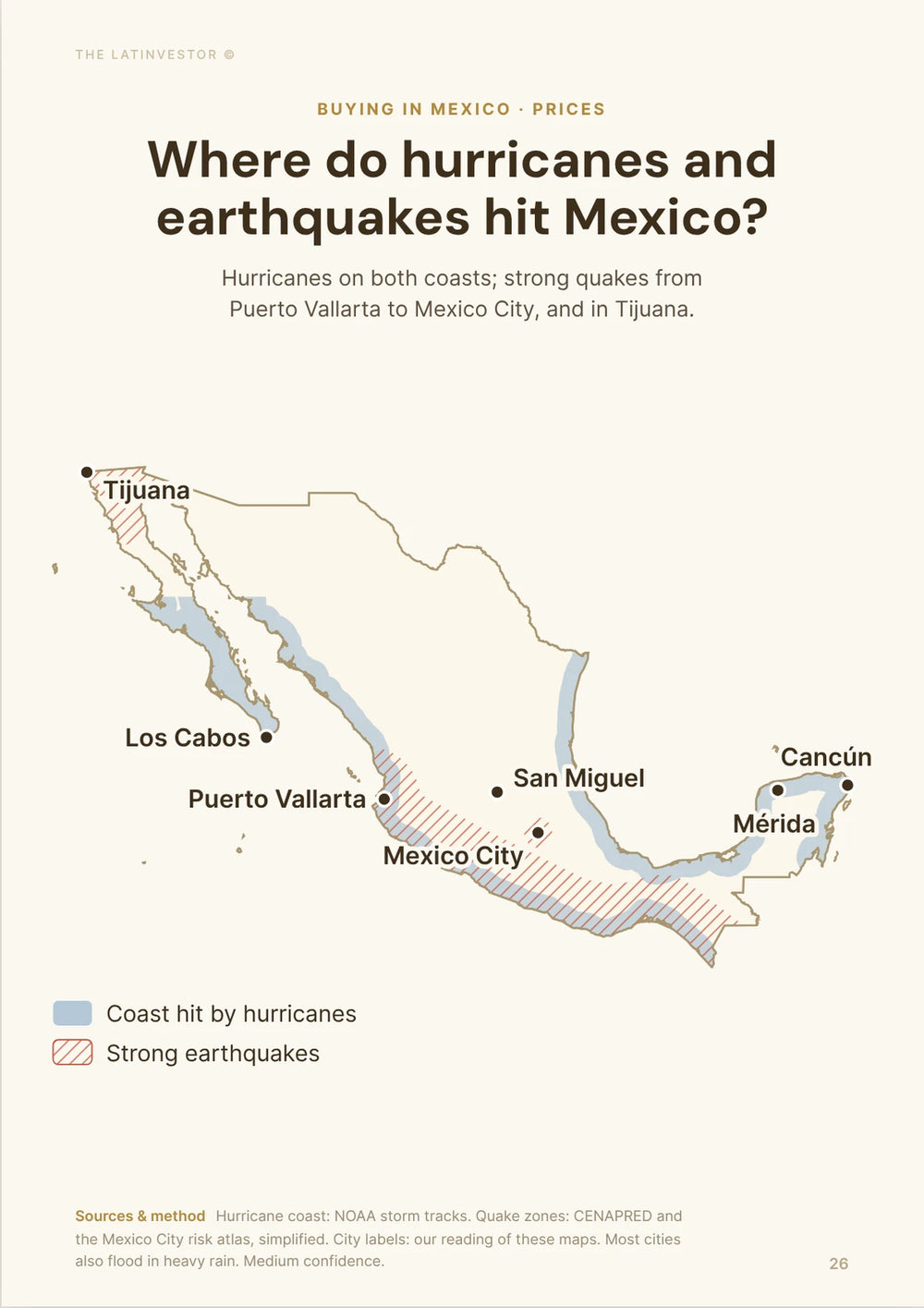
What can you actually buy in San Miguel de Allende, and for how much?
Mostly houses: colonial houses, remodeled townhouses, casitas, gated-community homes and newer houses on the edge of town. Condos are a smaller and newer part of the market.
In October 2026, a typical 3-bedroom house asks about $355,000 (MXN 6.6 million) and a 2-bedroom condo about $232,000 (MXN 4.32 million). Per square meter, houses ask a median of about $1,809 and condos about $2,046. These are asking prices, not sale prices.
The label on the listing matters less than walkability, noise, stairs, parking, water storage and the quality of the renovation.
What property types dominate in San Miguel de Allende right now?
Houses, by far. In one October 2026 listing sample, 158 of 194 homes for sale were houses, about 81%, and 36 were condos.
That's because San Miguel is old, low-rise and built around courtyards, not apartment towers. Centro, San Antonio, Guadalupe, Guadiana and Atascadero grew as traditional neighborhoods long before condos became common in Mexico.
Are new builds easy to find in San Miguel de Allende?
Not in the center. We estimate new builds make up only about 15% to 25% of the homes foreign buyers actually look at.
Most new homes are around Zirándaro, La Lejona, El Milagro, Malanquín, Ventanas, the edges of Los Frailes, Alcocer and the highway corridors.
If you want a modern layout, parking and fewer renovation problems, you'll find more choice outside the protected historic core. Just budget for gated-community fees, often around MXN 2,500 to MXN 5,500 a month.
Which San Miguel neighborhoods are gaining value?
Walkable areas next to Centro, where people are renovating, not the cheapest areas on the edge of town.
Which areas in San Miguel de Allende are gentrifying in 2026?
The clearest cases are Guadalupe, San Antonio, Independencia, Obraje, Ojo de Agua, parts of Atascadero and some pockets near La Lejona.
You can see it on the street: more renovated facades in Guadalupe, more foreign long-stay renters in San Antonio, more cafés around Ancha de San Antonio, and more view-focused remodels in Ojo de Agua and Atascadero.
Over the past two to three years, good homes in these areas likely gained about 15% to 30% in our estimate, mostly the renovated and walkable ones. Most of that came before 2026, when prices across the city went flat.
That doesn't make every home there a good buy: a noisy street, steep stairs, a messy title or a cheap renovation can still hurt resale.
Where are infrastructure projects boosting demand in San Miguel de Allende?
Mostly along the city's edges: Libramiento José Manuel Zavala, Salida a Celaya, Salida a Querétaro, La Lejona, Malanquín, Zirándaro and Alcocer.
Demand there comes from easier driving and parking, better links to Querétaro and Guanajuato International Airport, and new homes being built outside the historic core.
Don't expect a big jump. These are slow, multi-year road and mobility upgrades. In our estimate, an announced project adds maybe 3% to 8% nearby, and a finished one that really makes daily life easier can support a 5% to 15% premium.
Do locals think San Miguel has become too expensive?
Many do, at least for anyone earning in pesos. Prices in the center are set for buyers paying cash in dollars, not for local salaries.
Do people think homes are overpriced in San Miguel de Allende in 2026?
Yes, for local buyers. The gap shows in the sales: dollar-priced homes sold for a median of $516,000 in 2026, more than twice the $212,000 median for peso-priced homes.
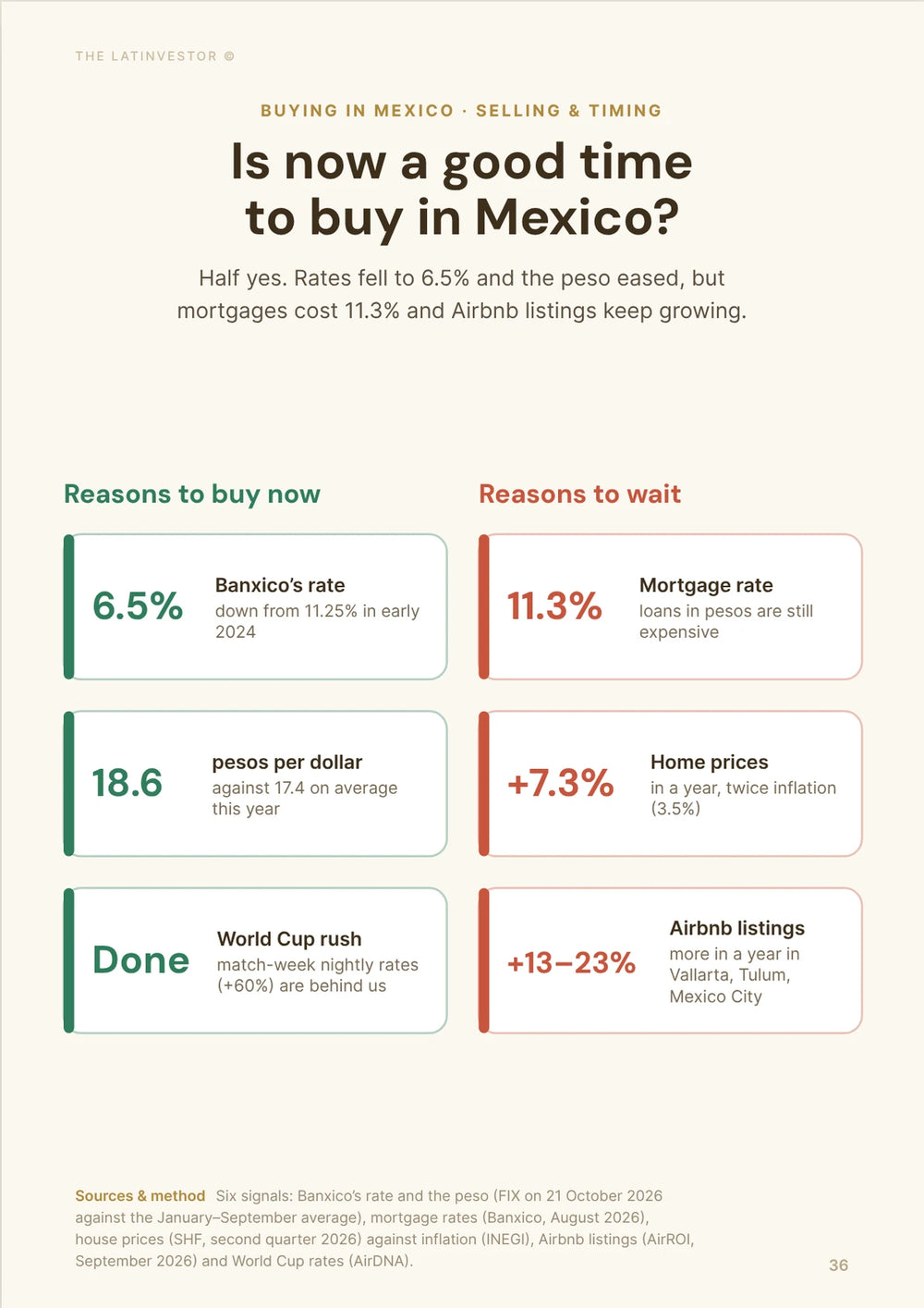
Local wages haven't kept up, and borrowing is expensive: mortgages actually granted averaged 9.99% in June 2026 (ABM). That's one reason Mexican owners are net sellers this year.
The other side of the argument: San Miguel is a UNESCO-listed city with a historic core that can't grow, and its buyers are far more international than in most inland Mexican cities. That's why prices here behave more like an international lifestyle market than a regional city.
What are common buyer mistakes people regret in San Miguel de Allende right now?
Buying too far from Centro or San Antonio without testing it first. Try the taxis, walking routes, traffic, slopes and daily errands at different times of day before you sign.
The second one is underestimating old houses. Colonial charm can come with damp, roof leaks, old plumbing, noise and strict renovation rules in the historic zone.
The third one is water. The aquifer that serves the area is being drained, and some streets get water only on certain days. Ask whether the home has a cistern and rooftop tank, how often water arrives, and whether the SAPASMA account is up to date.
How hard is it for a foreigner to buy in San Miguel de Allende?
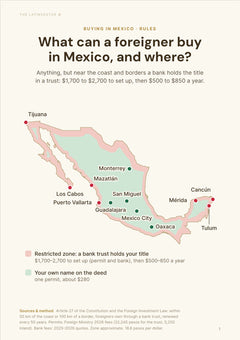
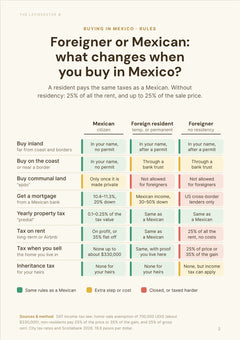
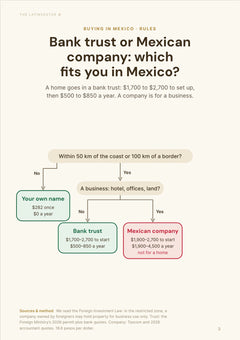
Easier than on the coast. San Miguel is outside Mexico's restricted zone (50 km from the coast, 100 km from the borders), so foreigners can hold the title directly, with no bank trust (fideicomiso) and no yearly trust fee.
Do foreigners face extra challenges in San Miguel de Allende right now?
Some, but they're practical rather than legal. You sign the foreign ministry's agreement not to invoke your home government's protection over the property (the Calvo clause), usually handled by the notary.
The rest is local: Spanish contracts, notary timing, old title histories, renovation permits, proof of funds, the timing of your currency transfer, and photos that hide noise, stairs or access problems. Use your own lawyer, not just the seller's agent.
Do banks lend to foreigners in San Miguel de Allende in 2026?
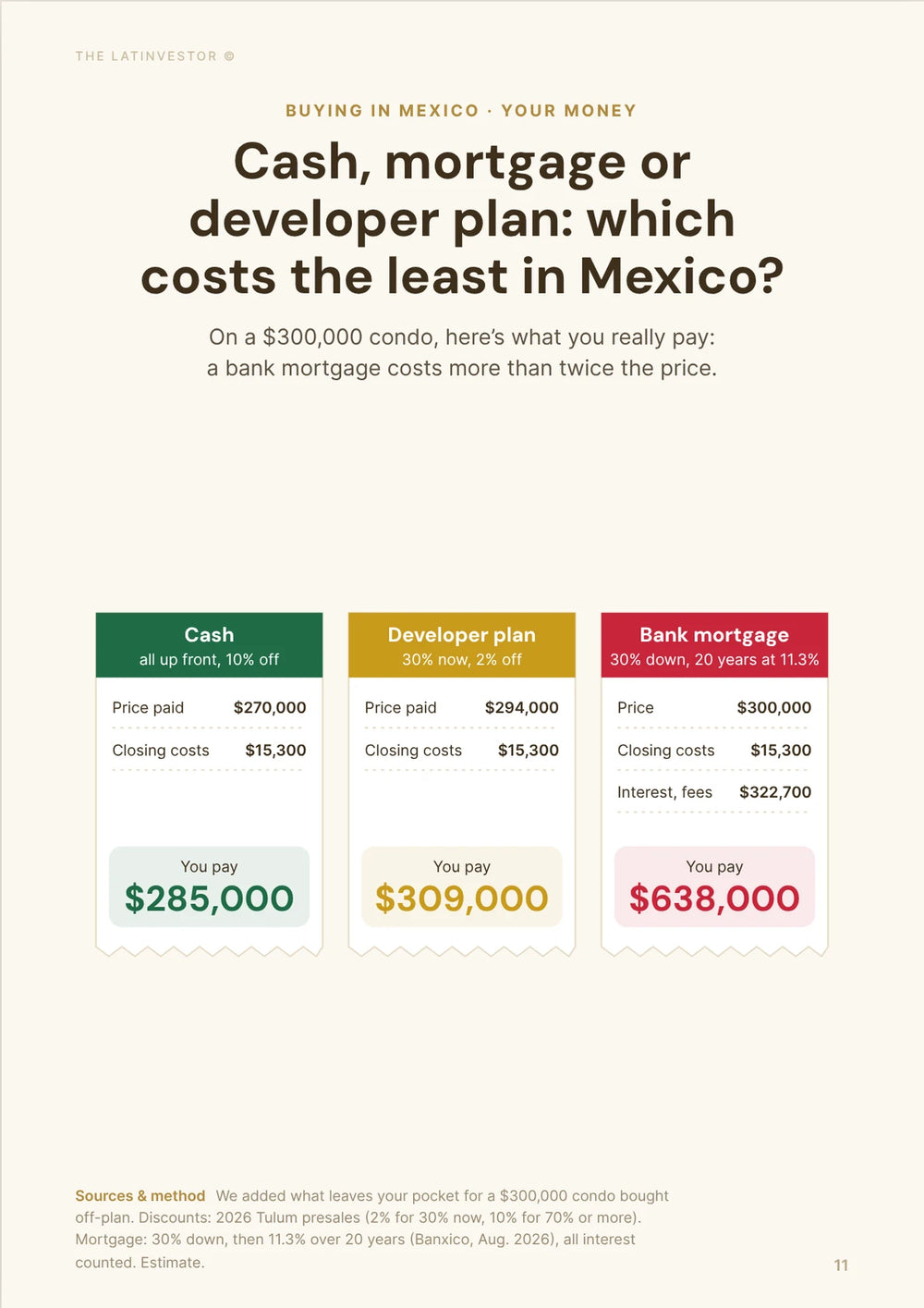
A few do, but most foreign buyers here pay cash. Credit is slow, paperwork-heavy and expensive.
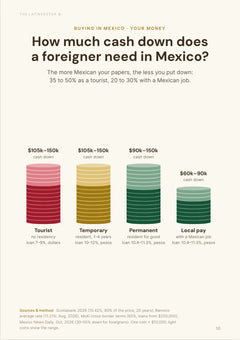
Mortgages actually granted in Mexico averaged 9.99% in June 2026 (ABM), and the average fixed-rate quote was 11.31% in August 2026. Cross-border lenders that work with Americans and Canadians usually ask for 35% to 50% down, so they lend 50% to 65% of the price.
Expect to provide your passport and immigration documents, proof of income, bank statements, tax returns, a credit history and an appraisal, and to show that your foreign income is stable.
Is San Miguel riskier than Querétaro or León?
For luxury second homes, yes. For a well-located home in the center, the risk is more about the street than the city: two homes five minutes apart can behave very differently.
Is San Miguel de Allende more volatile than nearby places in 2026?
Probably more volatile than León and Querétaro, whose markets run on local jobs, industry and Mexican mortgage buyers. San Miguel depends on foreign cash buyers, which is why closings were down 12.5% through August while Mexico's national index kept rising.
It's still less volatile than most beach markets, because the historic core can't expand and many owners are long-stay foreigners in no hurry to sell.
Is San Miguel de Allende resilient during downturns historically?
Fairly. UNESCO status, foreign retirees, tourism, weddings and cash buyers keep demand going even when locals can't afford the center.
In past downturns, sales volume usually fell before prices did. Weaker homes needed discounts, and recovery took roughly one to three years depending on location and price, in our estimate. That's the pattern 2026 looks like so far: fewer sales, flat prices, more cuts.
The homes that hold value best are renovated, walkable houses in Centro, Guadalupe, San Antonio, Guadiana and the good parts of Atascadero, especially with views, parking or outdoor space.
Does Guanajuato's travel warning hurt property in San Miguel?
A little, mostly at the margin. The US State Department rates Guanajuato at Level 3, "Reconsider Travel", in its Mexico advisory updated in June 2026, and San Miguel gets no separate rating. Some American buyers never get past that headline.
It hasn't stopped the ones who come, though: Americans were net buyers of 76 homes in 2026, and brokers say the buyers who do show up are highly committed.
What to do: read the municipal crime data, not just the state rating, and spend time in the neighborhood at night before you buy. Then use the warning in your favor: fewer buyers means more room to negotiate, especially on luxury homes that have been listed for months.
Is rental demand in San Miguel de Allende still growing?
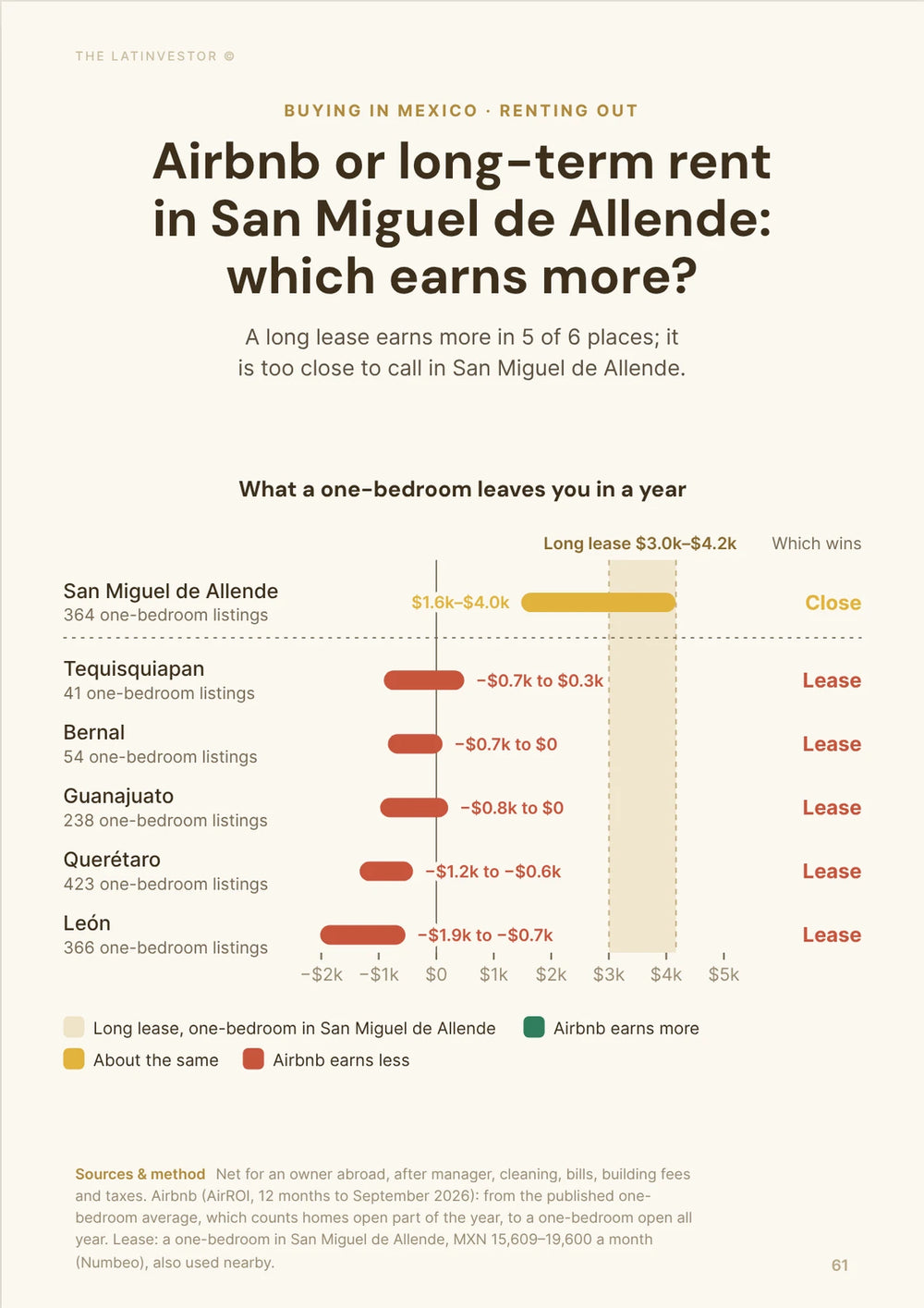
For long leases, yes, steadily. For Airbnb, the market is shrinking: there are far fewer listings than a year ago.
Is long-term rental demand growing in San Miguel de Allende in 2026?
Yes. A 2-bedroom condo rents for around MXN 20,000 a month (about $1,080), and a 1-bedroom from about MXN 11,900 outside the center to MXN 19,300 in Centro. Good furnished units can likely raise rents by about 4% to 7% a year in the stronger neighborhoods, in our estimate, a bit above inflation (3.69% in 2025).
Tenants are foreign retirees testing the city before buying, remote workers, long-stay visitors, local professionals and families priced out of buying in the center.
Demand is strongest in Centro, Guadalupe, San Antonio, Guadiana, Atascadero, Ojo de Agua, La Lejona and the well-connected parts of Los Frailes.
Is short-term rental demand growing in San Miguel de Allende in 2026?
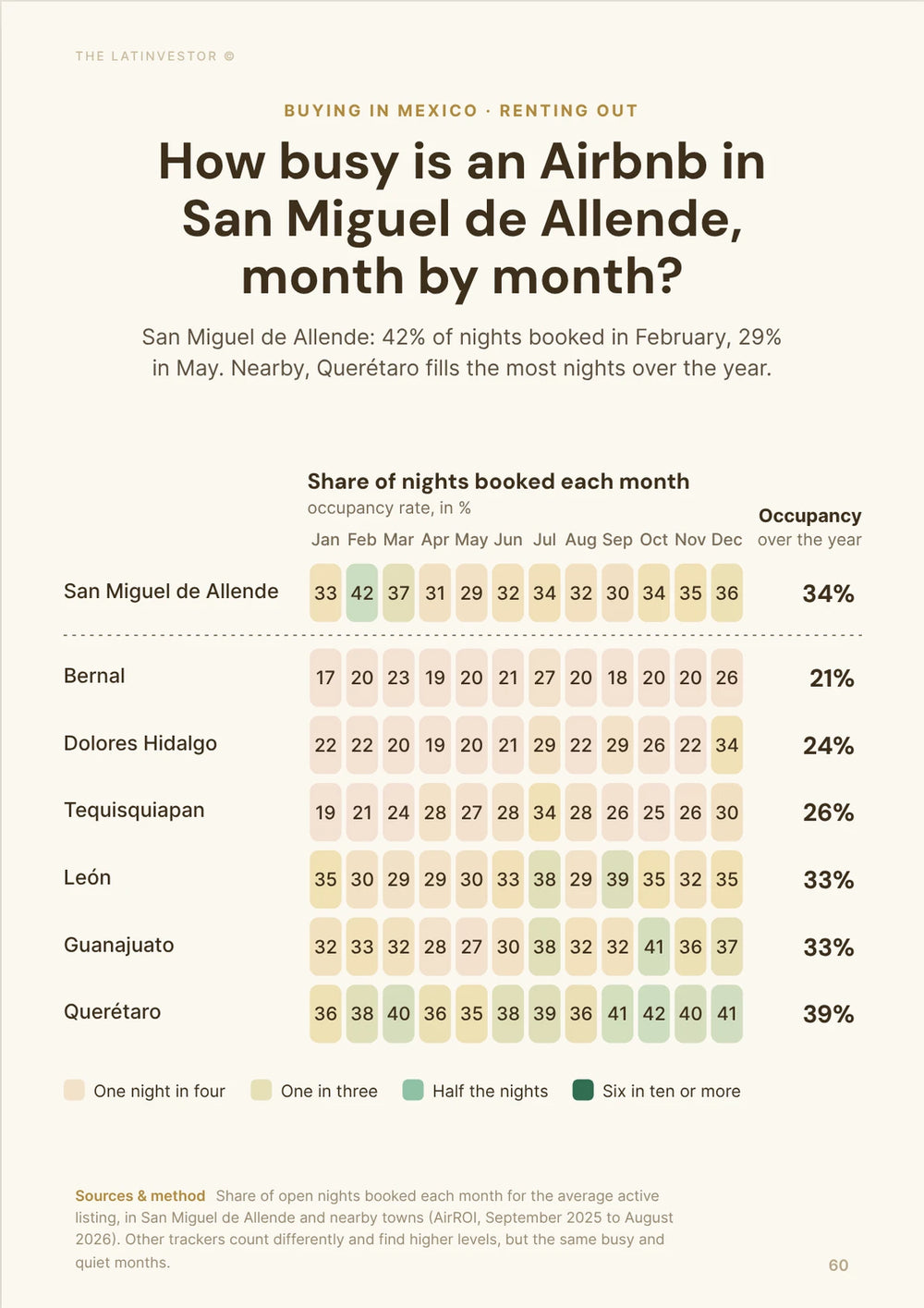
Demand is holding, but supply has dropped. AirDNA counted about 2,000 active listings in September 2026, 53% fewer than a year earlier.
The listings that remain do fine: 42% occupancy, $163 a night on average and about $22,600 (MXN 420,000) in revenue over the 12 months to September 2026. That's an average, and the best homes do much better around weddings, holidays and the dry season.
Airbnb is legal under Guanajuato's platform lodging law, with state registration and a 4% lodging tax collected by the platform. Don't assume every pretty house will work: a quiet street near the center matters more than a pool far out.
Guests are mostly cultural tourists, wedding guests, Americans and Canadians, weekend visitors from Mexico City and Querétaro, and foreigners testing the town before buying.
Where are San Miguel de Allende prices heading next?
Sideways for now. With about 25 months of inventory and closings down 12.5% through August, there's no reason for prices to jump, but no sign of a crash either.
What's the 12-month outlook for San Miguel de Allende?
Flat for most homes. In our estimate, good walkable homes stay flat or gain up to 5%, average overpriced listings stay where they are, and stale luxury homes may need 5% to 10% cuts to sell.
What will move it: American buyers' confidence and their ability to sell at home, the peso (it fell from under 17 to about 18.6 per dollar between early September and late October, which helps dollar buyers on peso-priced homes), security headlines and how fast inventory clears.
So don't wait for a broad crash, but don't overpay either. Use 96% of asking as your starting point and go lower on homes that have been listed for six months or more.
What's the 3 to 5 year outlook for housing in San Miguel de Allende?
Moderately positive for the best homes. In our estimate, prime walkable homes could gain about 15% to 30% in total over 3 to 5 years, once today's extra inventory is absorbed. Poorly located homes will do much less.
What shapes it: the PMDUOET land-use rules, the city's infrastructure priorities, road access and continued protection of the historic core.
The big uncertainty is whether American and Canadian demand comes back strongly enough to clear today's inventory, and where the peso settles after its fall this autumn.
Are demographics or other trends pushing prices up in San Miguel de Allende?
Over the long run, yes. Retirees, people moving for the lifestyle and long-stay visitors keep adding demand in a city where the center can't grow.
The main shifts: an aging North American buyer base (a third of 2026 buyers were in their 60s), foreigners renting before buying, upper-income Mexicans from bigger cities, and local households priced out of the center.
Remote work, weddings, cultural tourism and the UNESCO brand also help. The effect is strongest in Centro, Guadalupe, San Antonio, Guadiana and the view neighborhoods with easy access.
What would cause a real downturn in San Miguel de Allende?
A combined shock: weaker American and Canadian confidence, a peso back near its early-September level (under 17 per dollar), bad security headlines, expensive credit and too much overpriced inventory. Some of these are already here in 2026.
Signs to watch: inventory staying above 20 months of sales, more cuts on homes above $900,000 (MXN 16.7 million), weak sales in outer gated communities, and fewer quick sales in Centro and San Antonio.
Even then, a downturn would probably be mild for prime walkable homes. Overpriced luxury or poorly located homes could need 10% to 15% discounts to sell quickly, in our estimate.
Related blog posts
- Are property prices in San Miguel de Allende likely to rise?
- How expensive is property in San Miguel de Allende?
- Is now a good time to buy property in San Miguel de Allende?
- Are rents still rising in San Miguel de Allende?
- How much does a house cost in San Miguel de Allende?
- Is it worth buying a rental property in San Miguel de Allende?
Our methodology
This article estimates whether San Miguel de Allende's property market is still growing: sales, prices, selling times, discounts, who buys and sells, neighborhoods, rentals, risks and the outlook for the next 1 to 5 years.
Sales, median prices, selling times, sale-to-ask ratios and buyer nationalities come from the local AMPI MLS data published by Live in San Miguel (January to September 2026) and Realty San Miguel's monthly updates. Asking prices come from TuLugar and Laar listings, rents from listing sites, and short-term rental figures from AirDNA. National prices come from SHF, Mexico's federal housing-finance agency, and credit from Banco de México.
Ownership rules come from the foreign ministry (SRE) and the Mexican Constitution, and the lodging tax from Guanajuato's platform law. Neighborhood gains, the share of new builds, rent growth and forecasts are our own estimates from listing reviews, because no public index covers San Miguel alone.
We checked these figures in October 2026. Conversions use about 18.6 pesos per US dollar and 20.9 pesos per euro.
Keep the limits in mind: MLS data only covers homes sold through local brokers, asking prices are not sale prices, months of inventory swing a lot from one month to the next, and AirDNA counts listings its own way.
Key sources used for this analysis include Crónica on ABM mortgage rates, Live in San Miguel, Realty San Miguel, Invest in San Miguel, TuLugar, Laar, SHF, Banco de México, BBVA Research, AirDNA, SRE, PMDUOET San Miguel 2040, INEGI, SESESP Guanajuato, Riviera Maya News and UNESCO.