


Summary
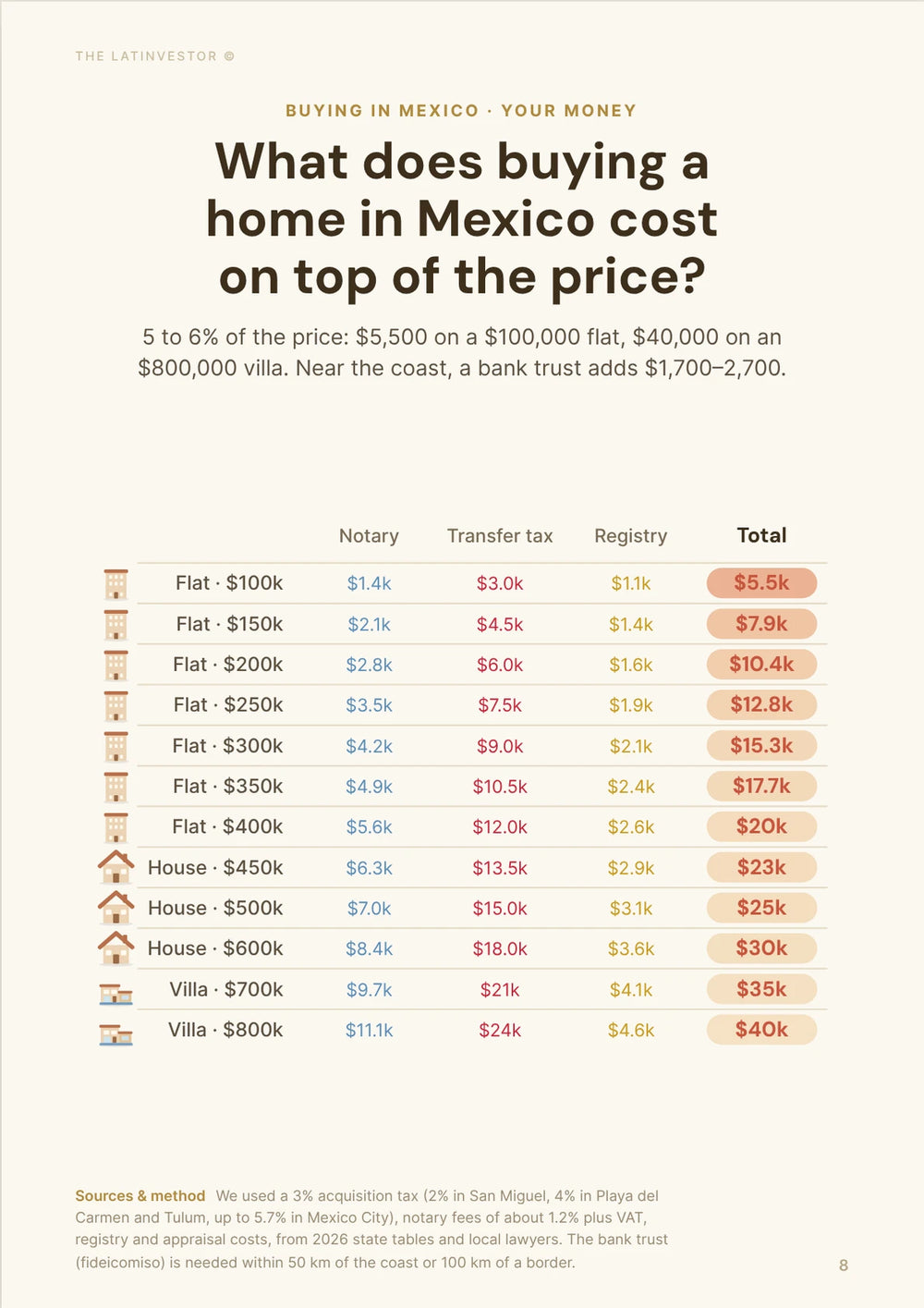
Budget about 5% to 7% on top of the price in San Miguel de Allende. On a MXN 5 million home (about USD 269,000), that's MXN 250,000 to MXN 350,000.
The floor is about 4.5% for a clean cash resale. You reach 8% (MXN 400,000 on that home) with a pricey notary, title fixes and a power of attorney.
The biggest cost is the acquisition tax. The 2026 city law sets brackets from 2% to 4%, which works out at about 3.3% on a MXN 3 million home, 3.58% on MXN 5 million and 3.79% on MXN 10 million.
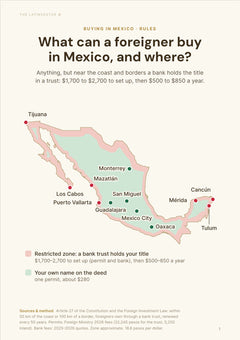
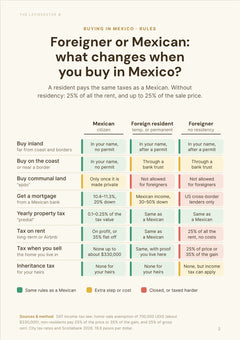
Foreigners pay the same taxes as Mexicans, and San Miguel is outside the restricted zone, so there's no bank trust. The only extra is the SRE foreigner agreement: MXN 5,250 (about USD 282) once.
Notary fees usually run 0.5% to 1.5% of the price, plus 16% VAT. Legal checks cost MXN 2,000 to MXN 10,000 for a clean file.
The usual surprises: tax charged on an appraisal higher than your price, unpaid predial or water bills, and extra notary work when the title history is messy.
Taxes and registry fees are fixed. The price isn't: homes sold for a median 96% of asking in 2026, took six months to sell, and 92% of recorded price changes were cuts.
Owning is cheap on tax. Predial on a home with a MXN 3 million fiscal value is about MXN 9,490 a year, 15% less if you pay in January. Gated-community fees of MXN 2,500 to MXN 5,500 a month often cost more.
Some guides quote predial at 0.10% to 0.16% of the cadastral value. The 2026 city table actually charges 0.234% to 0.354% at the margin, so check the real bill.
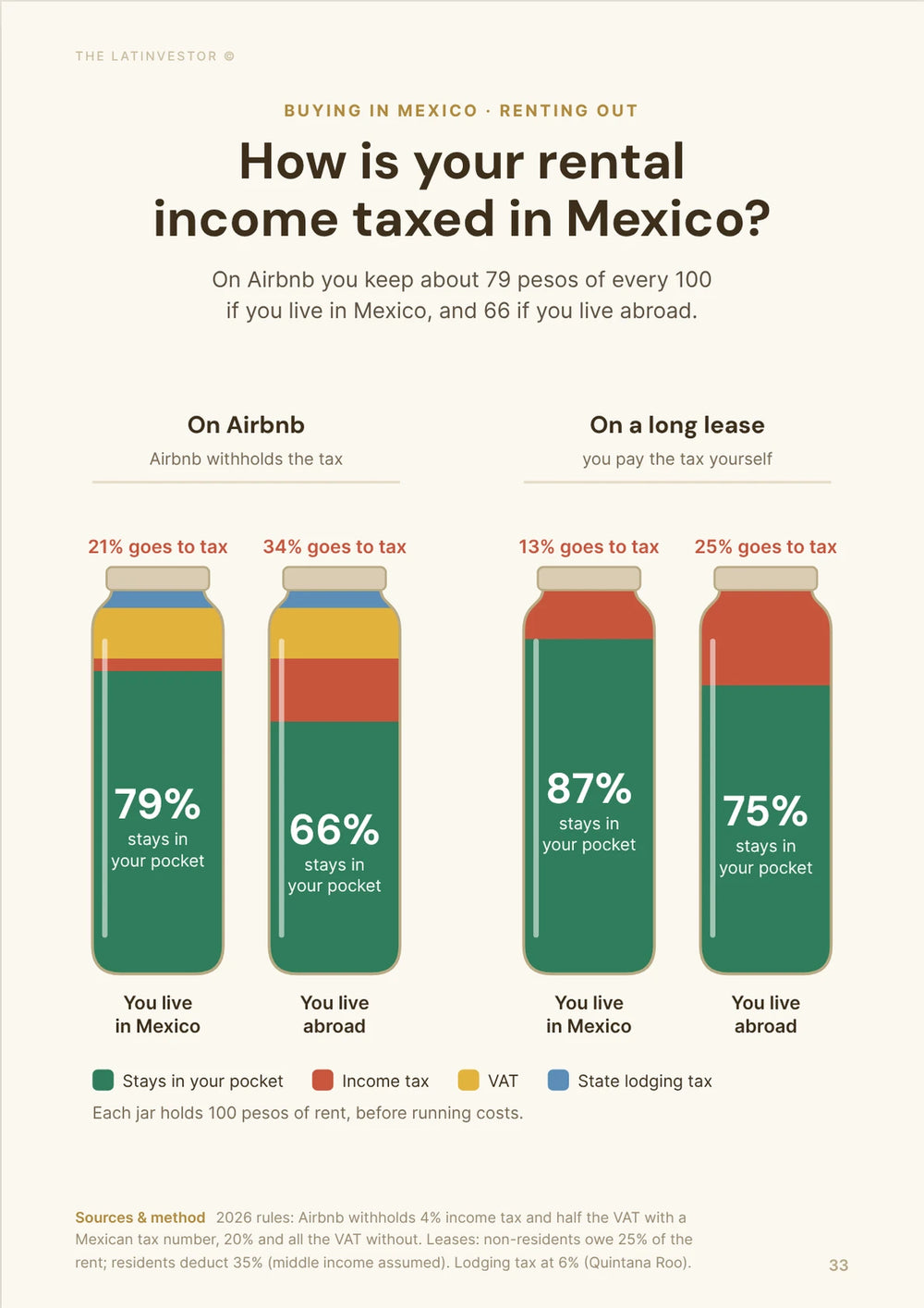
If you don't live in Mexico, rental income is taxed at 25% of the gross rent, with no deductions. Short stays add 16% VAT and Guanajuato's 4% lodging tax.
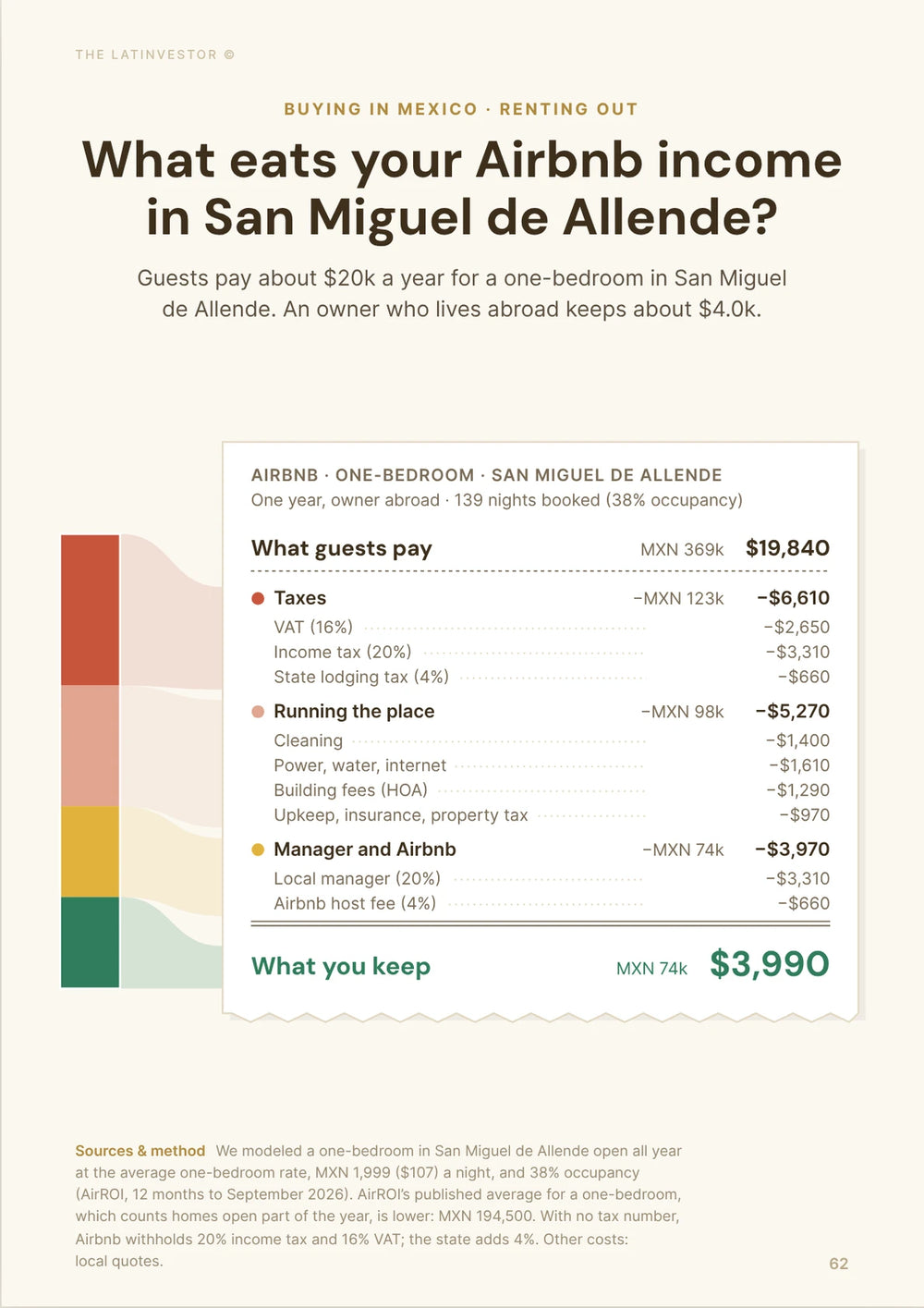
The city's 2026 revenue law also lists a MXN 45,000 yearly land-use permit for properties used for lodging, which can eat a big slice of the average Airbnb's USD 22,600 a year.
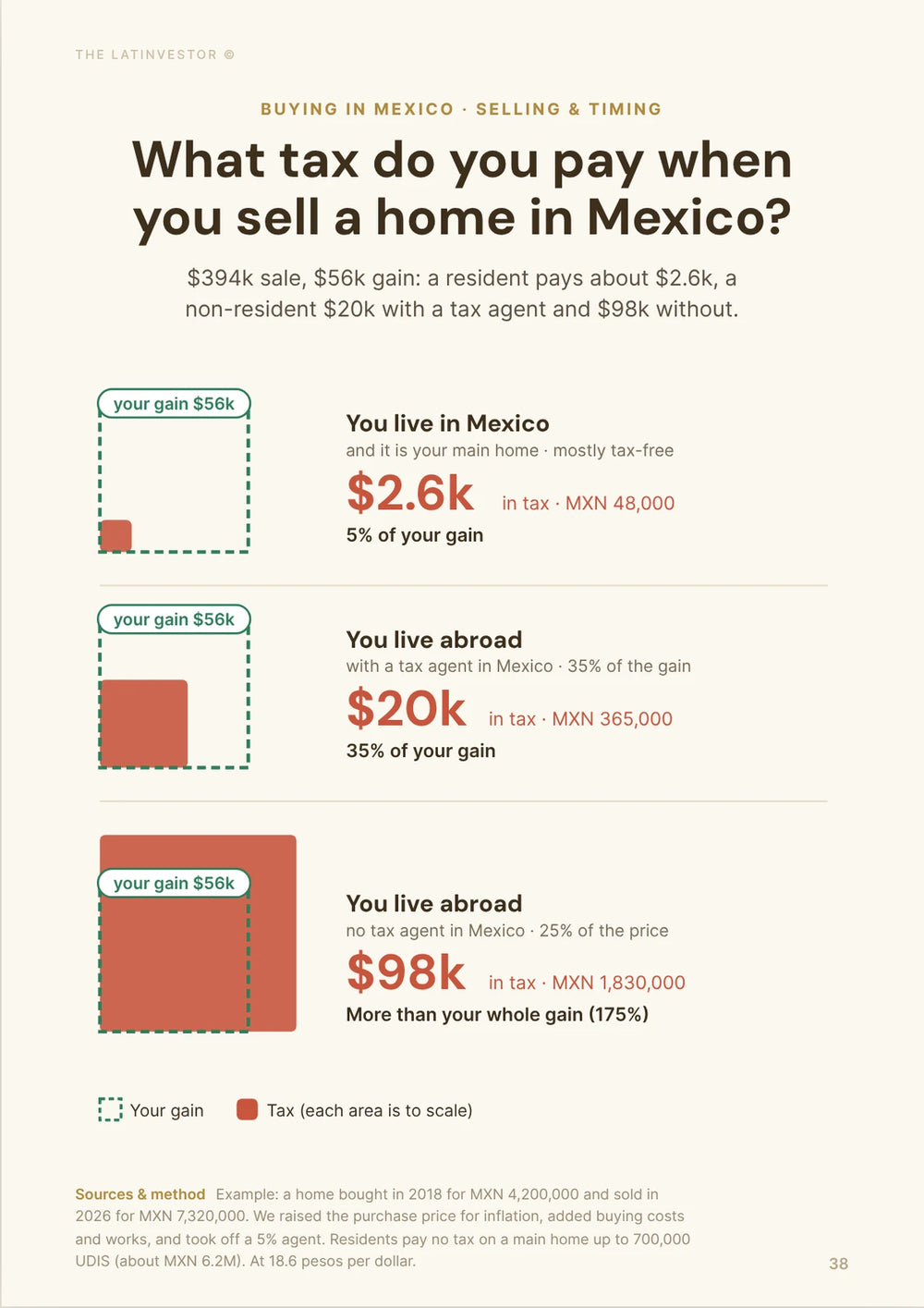
When you sell, non-residents pay 25% of the gross price, or up to 35% of the net gain through a Mexican representative. Selling usually costs 6% to 10% in total.
Bottom line: set aside 7% of the price, get the notary's written acquisition-tax calculation before you sign, and use the slow market to push on price, not on fees.

How much should you budget on top of the price in San Miguel de Allende?
How much are total buyer closing costs in San Miguel de Allende?
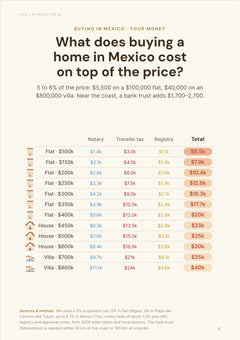
In 2026, budget about 5% to 7% of the price. On a MXN 5,000,000 home (about USD 269,000 or EUR 239,000), that's MXN 250,000 to MXN 350,000 (USD 13,400 to 18,800, or EUR 12,000 to 16,700).
Here's how it adds up on that home: MXN 179,125 of acquisition tax, MXN 29,000 to MXN 87,000 for the notary including VAT, roughly MXN 5,000 to MXN 15,000 for registry rights, an appraisal and certificates, the SRE agreement at MXN 5,250, and USD 300 to 500 as your half of the escrow.
The floor is about 4.5% (MXN 225,000, USD 12,100 or EUR 10,800 on that home) for a clean cash resale with a cheap notary quote. On cheaper homes it can drop near 4%, because the tax rate is lower at the bottom of the table.
You reach 8% (MXN 400,000, USD 21,500 or EUR 19,100) when you add your own lawyer, title corrections, a power of attorney signed abroad and certified translations.
A local agency, Realty San Miguel, gives a similar picture: often just over 5%, up to about 6.5% on more expensive homes.
What's the usual total % of fees and taxes over the purchase price in San Miguel de Allende?
Most standard purchases land between 5% and 7%. The full range runs from about 4% on a cheap, simple resale to 8% when everything goes wrong.
The acquisition tax is most of the bill. On a MXN 5,000,000 home it's 3.58% of the price, roughly two-thirds of a typical total. Notary fees, VAT, registry rights, the appraisal, certificates and the SRE agreement make up the rest.
Watch out for budgets copied from beach towns. They often say 6% to 9% because they include a bank trust, which you don't need here.
What costs are always mandatory when buying in San Miguel de Allende?
You can't avoid the municipal acquisition tax, the notary's fee for the deed, registration at the Public Registry, the certificates proving there are no liens or unpaid bills, and the appraisal. Foreigners also sign the SRE foreigner agreement (MXN 5,250).
Optional but worth paying for: your own lawyer (the notary doesn't work for you), a translator if you don't read Spanish, and an inspection. Old colonial homes often hide humidity, roof and plumbing problems.
What taxes do you pay when you buy in San Miguel de Allende?
What is the property transfer tax rate in San Miguel de Allende in 2026?
The acquisition tax (impuesto sobre adquisición de bienes inmuebles) is progressive. Under article 7 of the 2026 Revenue Law, you pay 2% on the first MXN 500,000, then marginal rates of 2.25%, 2.5%, 2.75%, 3% and 3.5%, and 4% on the part above MXN 1,500,000.
Because the 4% only applies above MXN 1.5 million, the real rate on a typical home is a bit lower:
| Price | Acquisition tax | Effective rate |
|---|---|---|
| MXN 1,500,000 (USD 80,600) | MXN 39,125 (USD 2,100) | 2.61% |
| MXN 3,000,000 (USD 161,000) | MXN 99,125 (USD 5,330) | 3.30% |
| MXN 5,000,000 (USD 269,000) | MXN 179,125 (USD 9,630) | 3.58% |
| MXN 7,160,000 (USD 385,000, the 2026 median sale) | MXN 265,525 (USD 14,300) | 3.71% |
| MXN 10,000,000 (USD 538,000) | MXN 379,125 (USD 20,400) | 3.79% |
The tax is charged on the higher of the price and the official appraisal. Writing a low price in the deed doesn't lower it, and it raises your tax when you sell.
There's no extra rate for foreigners. There's no VAT on the sale of a home either, new or resale, and no stamp duty. VAT shows up on the notary's fees and on developer extras billed separately, so ask for a written breakdown.
Are there tax exemptions or reduced rates for first-time buyers in San Miguel de Allende?
No. The 2026 table depends only on value. The only reduced rate in the law is 0.5% for gifts and inheritances between spouses, parents and children.
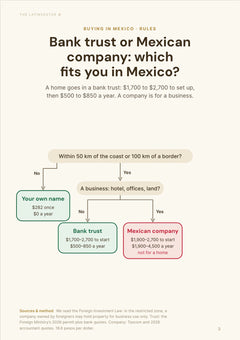
Buying through a company doesn't avoid the acquisition tax. It changes how rental income and a later sale are taxed, and adds accounting costs every year.
New-build or resale makes no difference to the acquisition tax. With a developer, check that furniture or extra parking isn't billed with VAT on top.
Do foreigners pay more to buy in San Miguel de Allende?
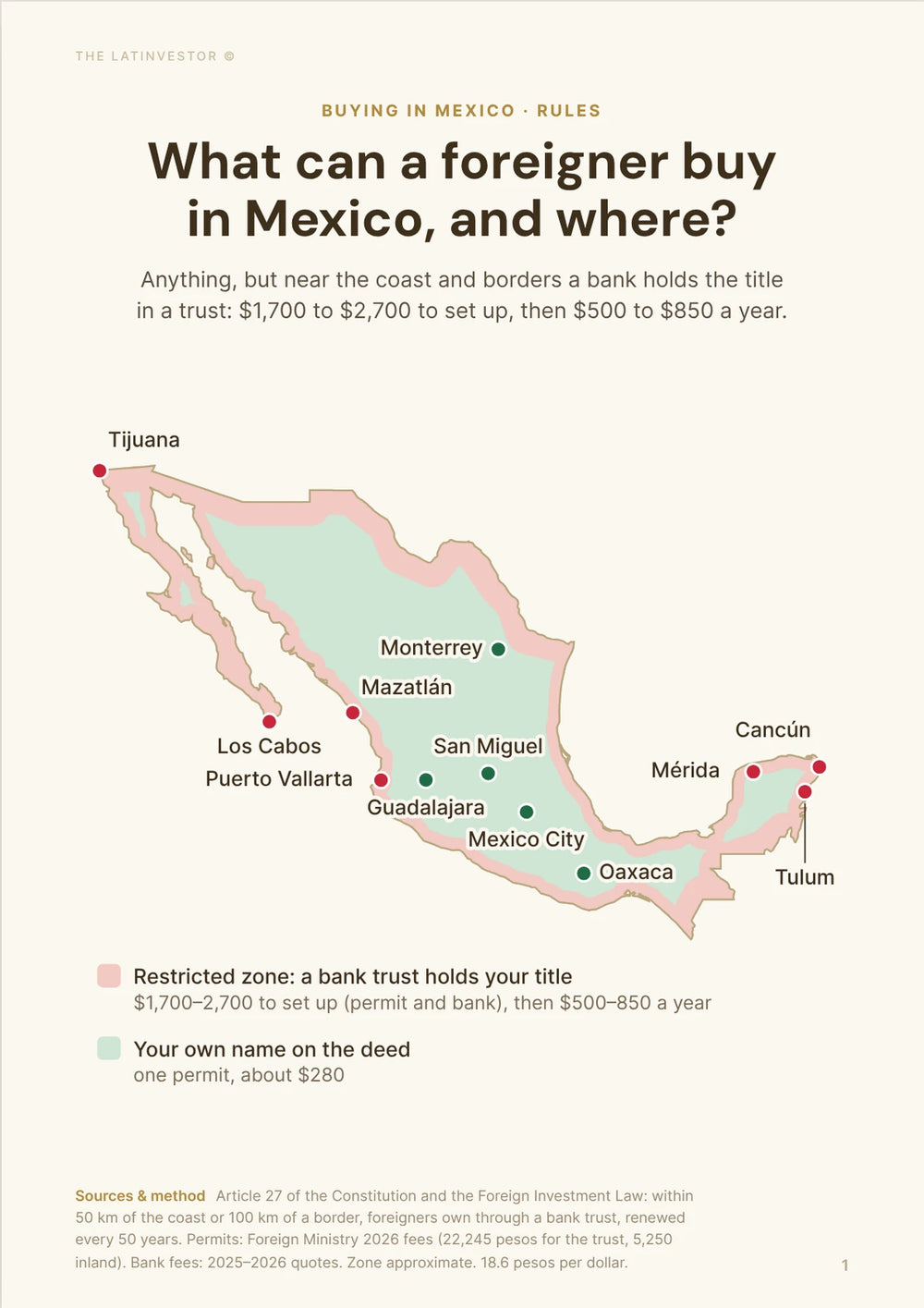
Barely. San Miguel is far from the coast and the border, so you hold the deed in your own name, with no bank trust (fideicomiso). The only extra is the SRE foreigner agreement (convenio de renuncia), MXN 5,250 (about USD 282 or EUR 251) once, and the notary usually files it.
Compare that with the coast: there, the SRE trust permit alone costs MXN 21,650, and banks charge about USD 550 to 800 to open the trust and USD 550 to 700 every year after.
Two things to check. Each foreigner named on the deed needs their own SRE agreement, so a couple pays twice. And if a closing quote for a home in San Miguel lists a fideicomiso, ask why: it's usually a budget copied from a beach town.
Which professional fees will you pay as a buyer in San Miguel de Allende?
How much does a notary or conveyancing lawyer cost in San Miguel de Allende?
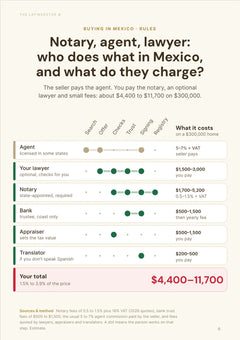
National 2026 guides put the notary's own fee at about 0.5% to 1.5% of the price, plus 16% VAT. On a MXN 5,000,000 home, that's MXN 25,000 to MXN 75,000 (USD 1,340 to 4,030) before VAT, or MXN 29,000 to MXN 87,000 with it.
Most of what passes through the notary isn't the notary's fee: it's the acquisition tax and registry rights, collected and paid on your behalf. Ask for an itemized quote that separates the two, and get quotes from at least two notaries.
Translation and interpreting cost about MXN 3,000 to MXN 25,000 (USD 161 to 1,340), depending on whether you need someone at the signing or certified translations of several documents.
A tax advisor is worth it if you'll rent out or sell later. A one-off session costs about MXN 3,000 to MXN 12,000 (USD 161 to 645).
What's the typical real estate agent fee in San Miguel de Allende?
Agents usually charge 4% to 6% of the sale price, and the seller pays it.
You only pay directly if you sign a separate deal with your own buyer's agent, typically up to about 2% (MXN 100,000, or USD 5,380, on a MXN 5,000,000 home). Get it in writing before you start serious visits.
How much do legal checks cost (title, liens, permits) in San Miguel de Allende?
A basic package (title search, lien certificate, no-debt letters) costs about MXN 2,000 to MXN 10,000 (USD 108 to 538) for a clean file.
The official items are cheap: the city's no-debt certificate costs MXN 217.64 and the water utility's MXN 45.13. The municipal appraisal fee is MXN 138.88 plus 0.6 per thousand of the value, about MXN 3,140 on a MXN 5,000,000 home; a private appraiser's own fee comes on top.
Never skip the lien-free certificate (certificado de libertad de gravamen) from the Public Registry. It shows whether the property carries a mortgage, an embargo or a claim you'd inherit.
What hidden or surprise costs should you watch for in San Miguel de Allende right now?
What are the most common unexpected fees buyers discover in San Miguel de Allende?
The most common surprise is acquisition tax charged on an appraisal higher than your negotiated price. On a MXN 5,000,000 home, every extra MXN 500,000 of appraised value adds MXN 20,000 of tax.
Next come unpaid predial or water bills you could inherit, and "fix-the-file" costs when the title history is messy: missing inheritance paperwork, boundaries that don't match the deed, or work done without permits.
Water is the one to check in person. The aquifer under the city is being drained, and a home without a cistern, a rooftop tank and a pressure pump can mean buying water by truck. Ask for the latest SAPASMA receipt and its no-debt letter before closing.
Fake fees exist too: "deposits to hold the house" sent to personal accounts or invented "government fees". Pay only through the notary, escrow or official receipts.
Are there extra fees if the property has a tenant in San Miguel de Allende?
Buying with a tenant in place usually adds MXN 5,000 to MXN 25,000 (USD 269 to 1,340) for the lease assignment, the deposit transfer and checking that utilities and fees are paid.
You take over the existing lease: same rent, same term. You can't end it right after buying unless the contract has an early-exit clause or the tenant agrees to leave, usually for money.
A sitting tenant puts many buyers off, which is a reason to ask for a lower price.
Which fees can you negotiate in San Miguel de Allende, and who pays what?
Which closing costs are negotiable in San Miguel de Allende right now?
You can negotiate the notary's own fee (not the taxes the notary collects), who pays for certificates and corrections, and repairs or credits from the seller.
The acquisition tax, registry rights and the SRE fee are set by law and can't be negotiated.
Comparing two or three notaries is where you save on fees. Beyond that, the real money is in the price, not the closing costs.
Can I ask the seller to cover some closing costs in San Miguel de Allende?
Yes, and in 2026 you have leverage to ask. Sellers most often agree to pay for fixing what they caused: unpaid predial or water bills, missing permits and title corrections.
Your odds go up when the home has been listed for months, needs work, or the checks turn up a problem any buyer would ask to fix. Put who pays what in the purchase contract.
Can you still bargain on price in San Miguel de Allende's slow 2026 market?
Yes. Homes sold between January and September 2026 closed at a median 96% of the asking price, so about 4% off: MXN 200,000 (USD 10,800) on a MXN 5,000,000 listing.
Stale listings give more. The median home took six months to sell, 92% of the price changes recorded on the local MLS in 2026 were cuts, with a median cut of 6.3%, and listings rose from 593 to 860 between May 2025 and May 2026.
Aim for 4% off a well-priced home, and 6% or more (MXN 315,000 on MXN 5,000,000) on one that has sat for over six months or needs work. A price cut is worth far more than any saving on fees.
What does it cost to own a home in San Miguel de Allende each year?
What's the realistic monthly owner budget in San Miguel de Allende right now?
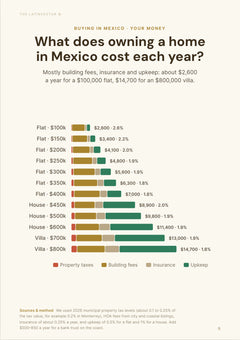
Excluding a mortgage, most owners spend about MXN 5,000 to MXN 15,000 a month (USD 269 to 806) on predial, utilities, upkeep and, in a gated community, HOA fees.
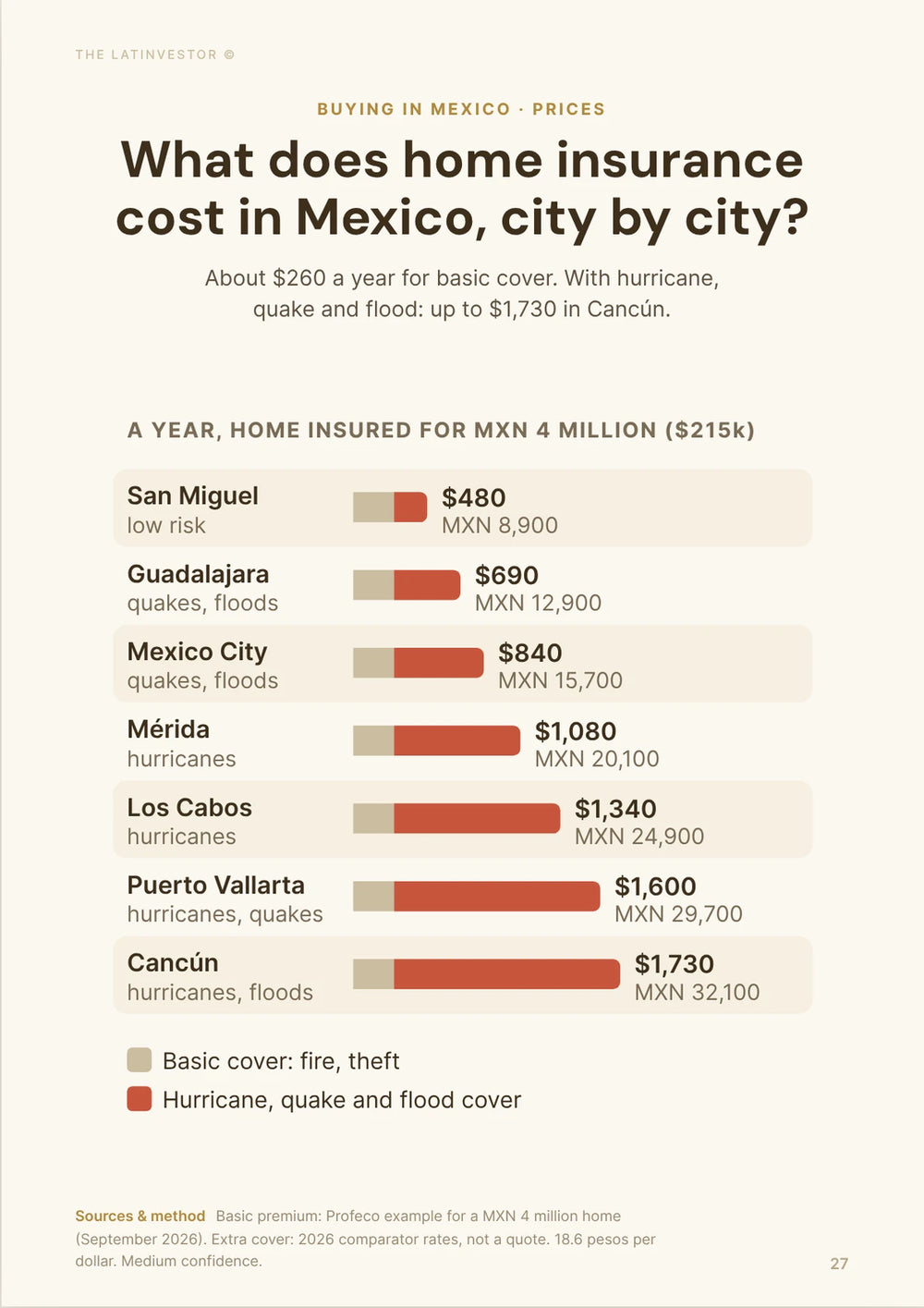
HOA fees for a house in a gated community run about MXN 2,500 to MXN 5,500 a month (USD 134 to 296). Home insurance costs MXN 4,910 to MXN 25,900 a year (USD 264 to 1,390) for a home insured at around MXN 4 million, depending on the insurer.
The full range runs from about MXN 3,000 to MXN 25,000 a month (USD 161 to 1,340), depending on size, age and amenities.
Upkeep varies the most. Old colonial homes need regular waterproofing, roof and plumbing work, and water storage (cistern, tank, pump, filter) is a real cost here.
What is the annual property tax amount in San Miguel de Allende in 2026?
Most foreign-owned homes pay roughly MXN 5,000 to MXN 25,000 a year (USD 269 to 1,340) in predial, by our estimate. High-value homes can pass MXN 34,000 (USD 1,840).
It's calculated on the fiscal value set by the city, not on the price you paid, with a fixed amount plus a marginal rate per bracket. A home with a MXN 3,000,000 fiscal value pays MXN 9,490 a year (USD 510); one at MXN 5,000,000 pays about MXN 16,570 (USD 891). The 2026 minimum is MXN 349.48.
Pay early: the 2026 law gives 15% off if you pay the whole year in January and 10% in February. On a MXN 9,490 bill, January payment brings it to about MXN 8,070.
Is predial in San Miguel de Allende as low as the guides say?
Lower than in the US, yes, but not as low as some guides claim. A 2026 foreign-owner guide puts predial in San Miguel at 0.10% to 0.16% of the cadastral value. The city's own 2026 table charges marginal rates of 0.234% to 0.354% on built urban property.
On a home with a MXN 3,000,000 fiscal value, the gap is real: about MXN 3,000 to MXN 4,800 a year at the guide's rates, against MXN 9,490 under the law. Land without a building pays more, from 0.438% to 0.705% depending on the lot size.
What keeps bills modest is that fiscal values usually sit below market prices. That can change when the city updates its values, and the bill follows.
What to do: ask the seller for the latest predial receipt, check it on the municipal portal, and budget from that number, not from a percentage you read online. If the fiscal value looks far below the price, don't assume the seller's bill will be yours: the appraisal done for your purchase can raise it.
What taxes apply if you rent out your San Miguel de Allende property?
What tax rate applies to rental income in San Miguel de Allende in 2026?
If you don't live in Mexico, rental income is taxed at 25% of the gross rent, with no deductions. On MXN 240,000 of rent a year, that's MXN 60,000 (USD 3,230).
Mexican tax residents pay the normal progressive rates, from 1.92% to 35%. They can deduct real expenses with invoices, or take a flat 35% of the rent, plus predial. Some qualify for the simplified RESICO regime at 1% to 2.5% of income.
Your tax residency changes everything here, so settle it with a Mexican accountant before you sign a lease.
Do I pay tax on short-term rentals in San Miguel de Allende in 2026?
Yes, in three layers. Airbnb and similar platforms withhold 4% income tax if you give them a Mexican tax ID (RFC), and 20% if you don't. Short stays carry 16% VAT. And Guanajuato charges a 4% lodging tax, collected by the platform.
The platform withholding isn't always your final tax. Non-residents and bigger hosts still have to settle their income tax, so keep every receipt.
Does San Miguel de Allende charge extra fees to rent out on Airbnb?
Possibly a big one. The city's 2026 Revenue Law lists a specific land-use permit for properties used for lodging or temporary accommodation at MXN 45,000 a year (about USD 2,420). The same law charges MXN 11,248.64 for the occupancy authorization of buildings used for lodging, which explicitly includes houses and apartments rented out in whole or in part.
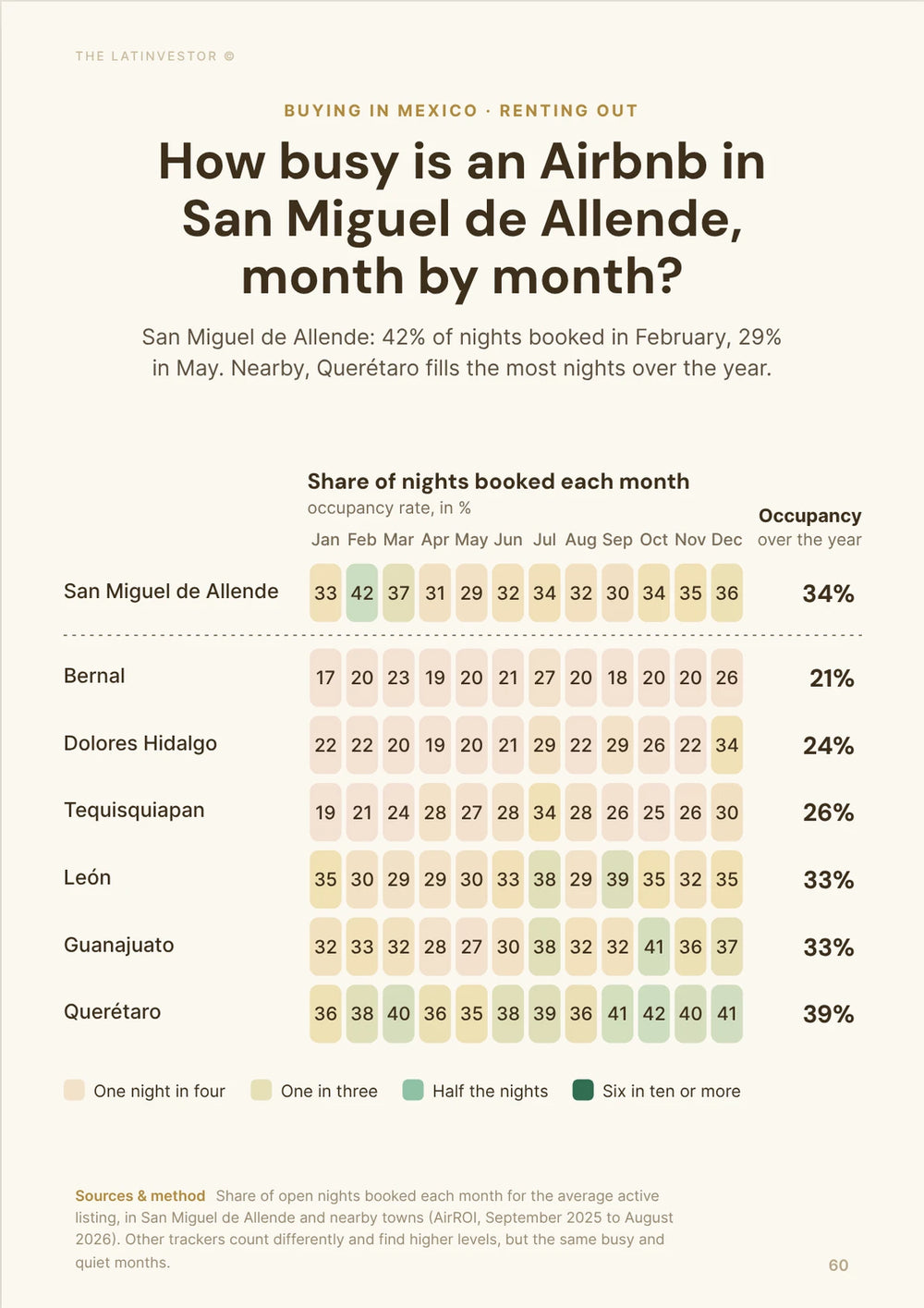
Set that against the money. AirDNA puts the average active listing at USD 22,600 a year (September 2026), at 42% occupancy. A MXN 45,000 permit would take more than a tenth of that before cleaning, management, the 16% platform fee and taxes. We couldn't confirm how strictly the city applies it to individual hosts.
The market has already thinned out: AirDNA counted 2,012 active listings in September 2026, 53% fewer than a year earlier.
What to do: before buying for short-term rental, ask the notary or the city's urban development office whether the home needs this permit and what its land-use status is. Read the HOA rules too, since many gated communities restrict short stays. Run your numbers as a long-term rental first.
How much tax will you pay when you sell in San Miguel de Allende?
What's the total cost of selling as a % of price in San Miguel de Allende in 2026?
Selling usually costs 6% to 10% of the price, including the agent and taxes.
It can drop to about 4% if you sell without an agent and qualify for the main-home exemption, and pass 12% with a full commission and a large taxable gain.
The costs are the agent's commission (usually 4% to 6%, paid by the seller), income tax on the gain, the seller's share of notary costs, and any unpaid predial or water bills, which must be cleared before closing.
The commission is usually the biggest line, unless you have a large gain and no exemption. Then the tax takes over.
What capital gains tax applies when selling in San Miguel de Allende in 2026?
Non-residents pay 25% of the gross sale price by default, with no deductions. Through a Mexican legal representative, you can instead be taxed on the net gain, at rates up to 35%. On a home that hasn't gained much, the two results can be far apart, so run both. The notary calculates and withholds the tax at closing.
Mexican tax residents selling their main home can exempt up to 700,000 UDIS of the gain (an inflation-linked unit the notary converts on the day of sale), normally once every 3 years, if they prove residency and that it was really their main home.
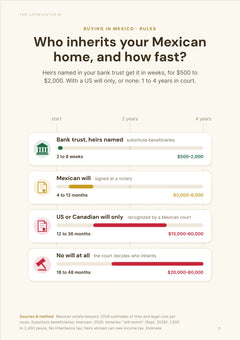
The gain is the sale price minus the purchase price adjusted for inflation, minus documented improvements and deductible costs. Keep every invoice from day one, and make sure the deed shows the real price you paid.
Related blog posts
- Are property prices in San Miguel de Allende likely to rise?
- How expensive is property in San Miguel de Allende?
- Are rents still rising in San Miguel de Allende?
- Is now a good time to buy property in San Miguel de Allende?
- Is it worth buying a rental property in San Miguel de Allende?
Our methodology
This article estimates what a foreign buyer pays on top of the price in San Miguel de Allende, and what owning, renting out and selling cost after that. Most examples use a MXN 5,000,000 home.
We built the closing costs line by line. The acquisition tax, predial, appraisal and certificate fees come straight from the San Miguel de Allende 2026 Revenue Law, and we calculated the examples ourselves. The SRE foreigner agreement comes from the SRE's 2026 fee table. Notary and registry costs come from 2026 national guides, and we compared the total with a local agency's buyer cost guide.
Tax rules for rents and sales come from Mexico's income tax and VAT laws and SAT. The lodging tax comes from a 2026 state-by-state comparison, the land-use permit for lodging from the city's revenue law, short-term rental results from AirDNA, and sale prices, selling times and price cuts from the local MLS data published by Live in San Miguel.
We checked these figures in October 2026. Conversions use about 18.6 pesos per US dollar and 20.9 pesos per euro.
Limits: notary, legal, translation, HOA and tenant-related costs are ranges, not quotes. The acquisition tax can be based on an appraisal higher than your price. Predial depends on each home's fiscal value. Asking prices are not sale prices. Tax treatment depends on your residency, so get advice before you rent out or sell.
Key sources used for this analysis include the San Miguel de Allende 2026 Revenue Law, the municipal predial portal, SAPASMA, the SRE's 2026 fee table, SRE on acquisitions by foreigners, the federal procedure page for foreign buyers, the SRE restricted-zone trust page, BBVA Mexico, Compass Abroad, Cotizador Hipotecario's 2026 closing-cost guide, Realty San Miguel, Live in San Miguel, Invest in San Miguel, AirDNA, Bektu's 2026 predial guide, The Mexico Handbook, PROFECO, Mexico News Daily, the income tax law and its rental chapter, articles 158, 160, 93, 120, 113-A, 113-C and 113-F, SAT's Anexo 8 RMF 2026, the VAT law, Siempre Contable, IDC Online, JA Del Rio and La Silla Rota Guanajuato.