Summary
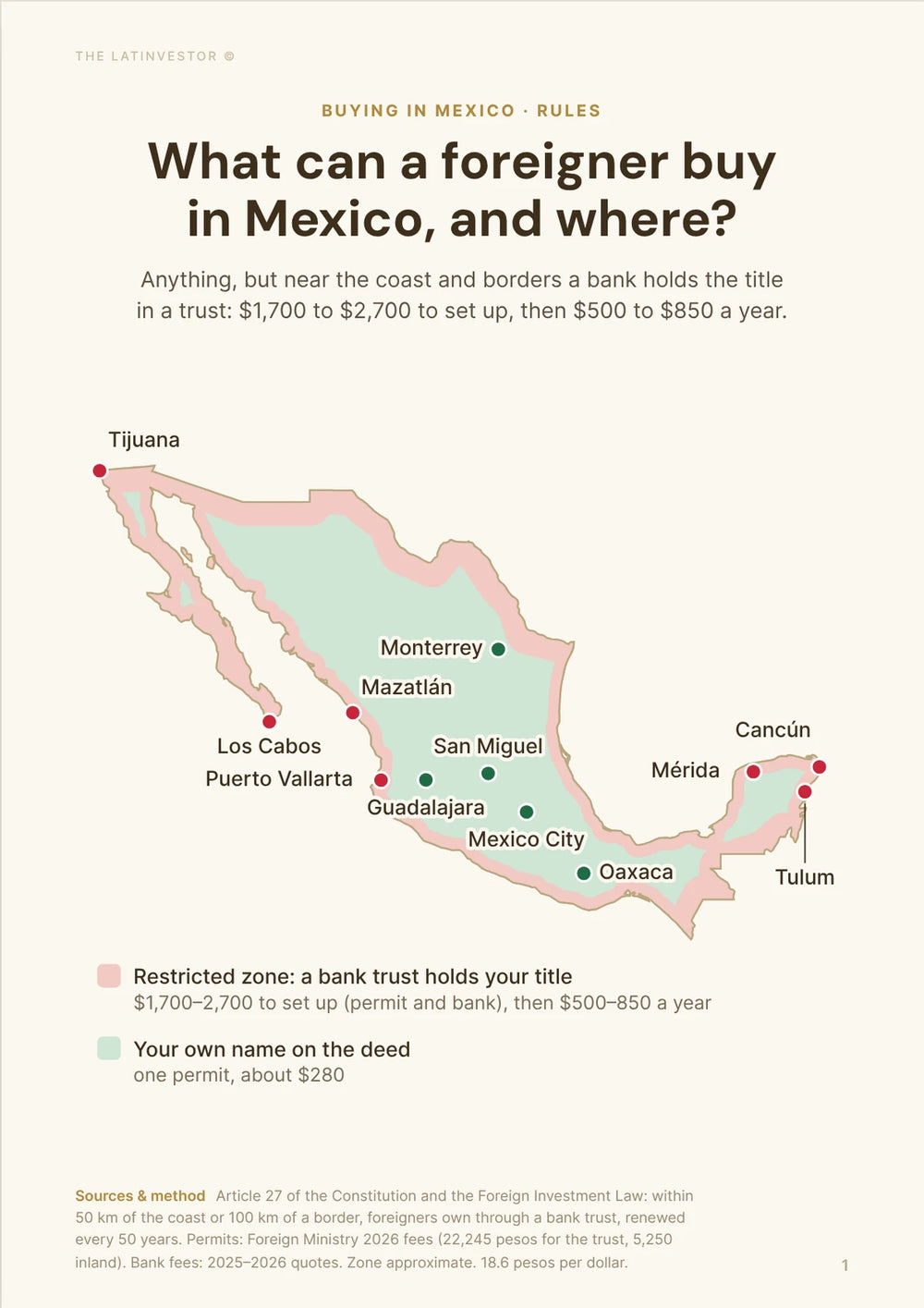
Yes. Foreigners can buy land in Mexico and hold the title in their own name almost everywhere, except within 100 km of a border and 50 km of the coast, where they use a bank trust (fideicomiso).
What matters is where the parcel sits, not the state. Guadalajara and Puerto Vallarta are both in Jalisco, but you get direct title in Guadalajara and a fideicomiso in Puerto Vallarta.
A fideicomiso isn't a 50-year lease. The bank holds title, you hold the rights to use, rent, sell and pass on the property, and the 50-year term can be extended.
Selling or passing on a trust property works through assignments and substitute beneficiaries. An on-time extension costs MXN 9,740 plus MXN 595 for the review.
You don't need residency to buy. It works the other way: a property worth at least about MXN 10.76 million can support a temporary residency application.
A Mexican company can hold coastal land directly only for non-residential use, like a hotel or a warehouse. It doesn't turn your beach house into directly owned property.
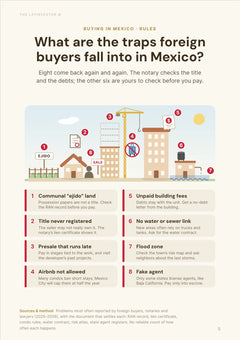
Ejido land is the biggest trap. A parcel certificate or a private contract is not private title, and only a parcel that has finished its dominio pleno conversion and been registered is safe to treat as normal property.
Land scams are the real 2026 story. Quintana Roo had blacklisted 123 irregular developments by August 2026, and one group sold around 10,000 'investment lots' in Yucatán, many without services or environmental approval.
Land isn't always cheap: median asking prices run from about USD 235 per m² in Mérida to USD 1,307 in Mexico City.
Beachfront doesn't include the beach: the 20-meter federal strip (ZOFEMAT) stays government land, used through a separate concession.
Farmland has its own limits. Foreign participation in a company's Serie T land shares is capped at 49%.
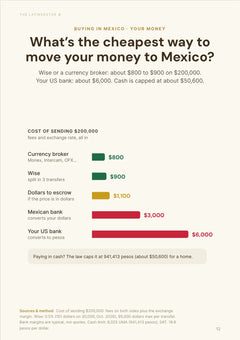
The fideicomiso costs more than the MXN 21,650 SRE permit people quote online: banks charge roughly USD 550 to 800 to set it up and USD 550 to 700 a year.
The rules aren't getting tighter for normal buyers. The SRE cut its trust-permit deadline from 5 to 3 business days in June 2026, and the February 2026 Senate bill on trust oversight isn't law.
It's a well-used system, not a loophole: the SRE issued 59,488 coastal and border trust permits between 2000 and 2016 alone.
Bottom line: being a foreigner is the easy part. Proving the exact parcel is private, registered, permitted and really owned by the seller is where you protect your money.

What do foreigners actually get when they buy land in Mexico?
Outside the coast and border strips, foreigners get the same deed a Mexican buyer gets, in their own name. Not a lease, not a weaker right.
The rule people half-remember comes from Article 27 of the Constitution, and it only covers specific parts of the country.
The buyer signs the Calvo clause with the SRE (Mexico's foreign ministry): you agree to be treated as a Mexican for that property and not to ask your own government for help in a dispute over it. The SRE fee for this step is MXN 5,250 in 2026.
So for an apartment in Mexico City, a house in Guadalajara or most inland property, you hold the title directly.
Where in Mexico can foreigners own land directly?
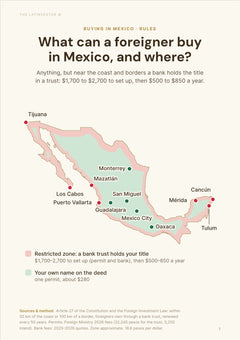
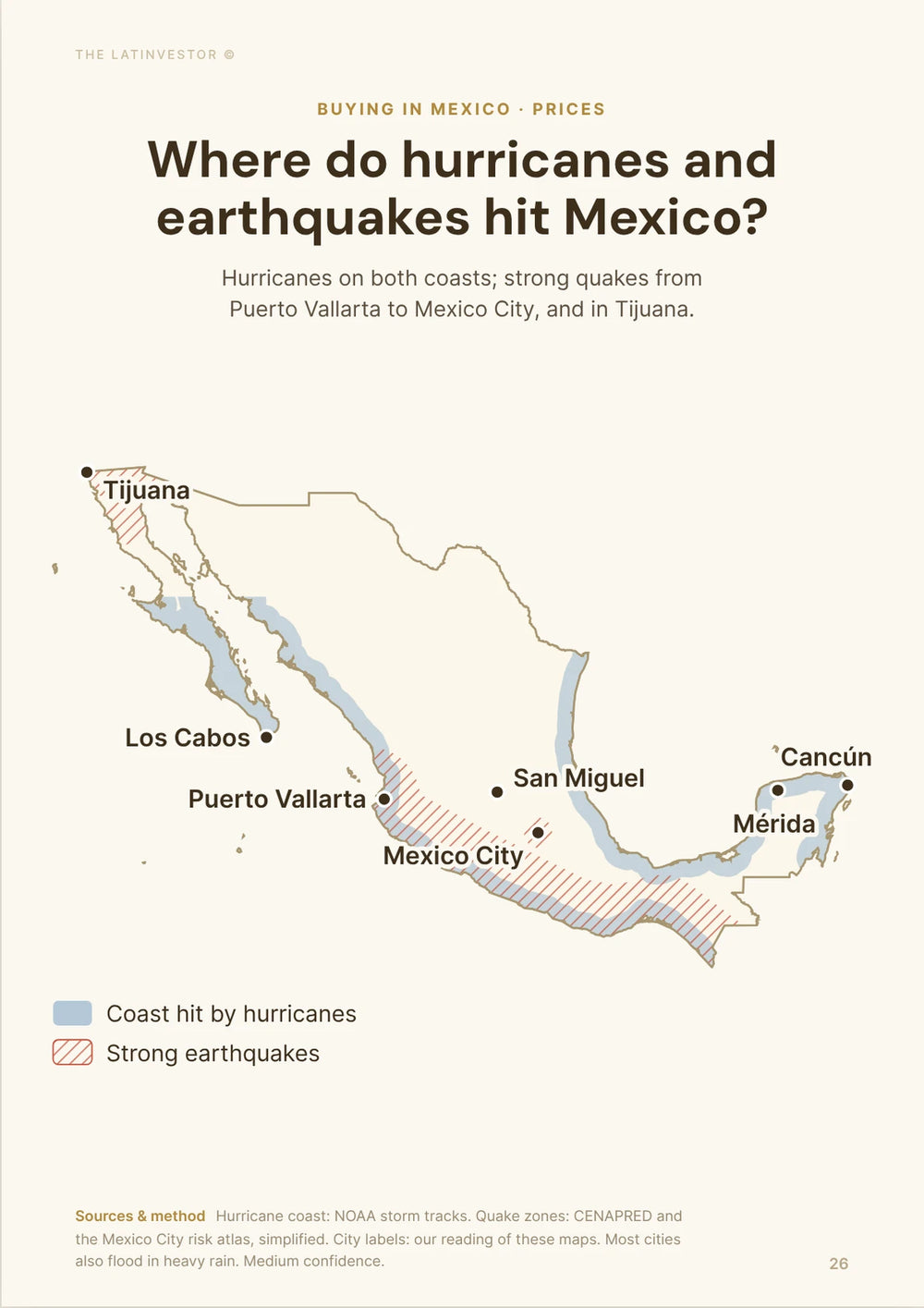
Almost everywhere, except within 100 kilometers of an international border or 50 kilometers of the coast. That strip is the zona restringida, the restricted zone.
The rule follows the exact location of the parcel, not the state. A coastal state can have land you can own directly and land that needs a trust.
That's why Guadalajara is direct ownership while Puerto Vallarta, in the same state of Jalisco, needs a fideicomiso. Same story in Cancún, Playa del Carmen, Tulum and Los Cabos.
Near the line, it can be unclear. In that case the SRE can ask INEGI, the national statistics and geography institute, to place the parcel from its geographic or UTM coordinates. If a seller says a lot is 'just outside' the zone, ask for that answer in writing.
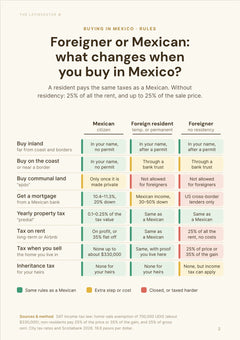
| Property location | Can a foreigner buy? | Direct foreign title? | Usual structure |
|---|---|---|---|
| Mexico City | Yes | Yes | Direct ownership |
| Guadalajara | Yes | Yes | Direct ownership |
| Cancún | Yes | No | Fideicomiso |
| Tulum | Yes | No | Fideicomiso |
| Los Cabos | Yes | No | Fideicomiso |
| Puerto Vallarta | Yes | No | Fideicomiso |
| Within 100 km of an international border | Usually yes | No | Fideicomiso for qualifying property |
Can foreigners buy beachfront property in Mexico?
Yes. Foreigners buy homes and condos in Tulum, Cancún, Puerto Vallarta and Los Cabos all the time, but the land can't be titled in their name.
Residential buyers use a fideicomiso: a Mexican bank holds the title as trustee and you are the beneficiary, with the legal right to use the property and earn from it.
That's much more than renting from the bank. You can live there, rent it out under normal tax and local rules, sell your rights and name who gets them after you.
So 'foreigners can't buy in Tulum' leaves out the important part: they can, through a different structure.
What does a Mexican fideicomiso actually give a foreign buyer?
Control of the property in practice, while the bank holds legal title.
The trust deed names the property, you as beneficiary, the bank, the purpose and who can replace you later.
The bank can't treat the house as its own. Trust law requires the asset to be held for the trust's purpose and kept separate from the bank's own assets, so it isn't simply available to the bank's creditors if the bank gets into trouble. You might face paperwork or a change of trustee bank, but the property stays yours in substance.
| Right | Direct owner outside restricted zone | Fideicomiso beneficiary |
|---|---|---|
| Live in the property | Yes | Yes |
| Improve it subject to local rules | Yes | Yes |
| Earn permitted rental income | Yes | Yes |
| Sell the interest | Yes | Yes |
| Name successors | Yes | Yes |
| Hold direct land title | Yes | No |
| Need a fiduciary bank | No | Yes |
Does a fideicomiso really end after 50 years?
No. A restricted-zone trust runs for up to 50 years and can be extended, so the home doesn't disappear at year 50.
The SRE has a standard extension procedure. In 2026 an on-time extension costs MXN 9,740 plus MXN 595 for the review, and a late one MXN 10,615, so put the renewal date in your calendar rather than ignoring it.
Calling it a '50-year lease' is wrong: you hold renewable rights over the property, you don't rent it from the bank.
Can foreigners sell or inherit property held through a fideicomiso?
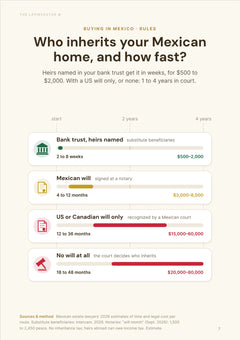
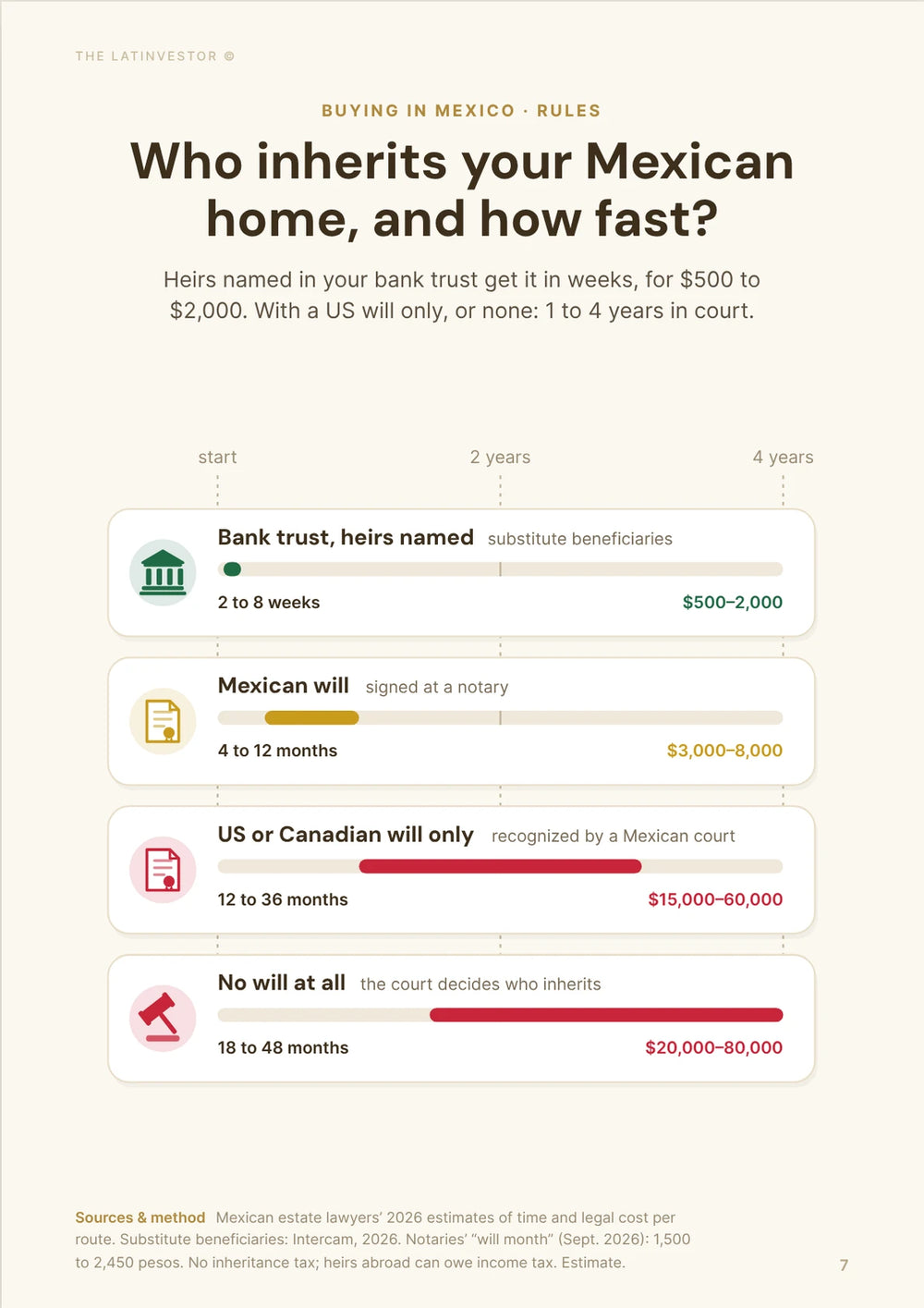
Yes. You can sell your trust rights and name substitute beneficiaries, so the property doesn't get stuck in the trust.
How a sale works depends on the buyer. Another foreigner takes over the rights or opens a new trust. A Mexican buyer can take direct title, since the ban only applies to foreigners.
Naming substitute beneficiaries in the trust is the simplest way to plan for your death. It doesn't solve everything: Mexican and foreign wills, marital property rules and taxes can still complicate things. But your coastal home doesn't go back to the bank or the government when you die.
Do foreigners need Mexican residency to buy land in Mexico?
No. The Migration Law lets foreigners buy urban property whatever their immigration status, as long as the Article 27 rules are respected.
The notary will check that you are in Mexico legally on the day you sign. A tourist entry is enough; you don't need residency first.
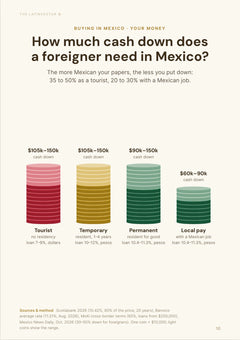
It can work the other way. In 2026, owning property worth at least about MXN 10.76 million (around USD 578,000) can support a temporary residency application at a Mexican consulate. Each consulate applies its own figure, so check with the one you'll use.
Can foreigners use a Mexican company to own coastal land directly?
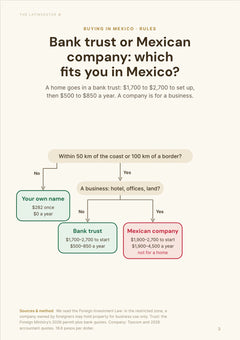
Only for real business use. A Mexican company with foreign shareholders can hold restricted-zone land directly for non-residential activities, not for your beach house.
That works for hotels, factories, shops and warehouses. The company files a notice with the SRE after buying (MXN 1,475 if on time), and since June 2026 that notice is processed immediately.
Putting a Tulum villa you live in into a company doesn't get around the rule, and setting up a company costs around MXN 35,000 to 50,000 before yearly accounting. For a home on the coast, the fideicomiso is the normal route.
| Property | Foreign individual direct title | Fideicomiso | Mexican company with foreign investment |
|---|---|---|---|
| Inland residence | Yes | Usually unnecessary | Possible |
| Coastal personal residence | No | Yes | Not a simple workaround |
| Coastal commercial property | No for foreign individual | Possible | Direct company ownership can be allowed |
| Hotel | Depends on location | Possible | Often relevant |
| Industrial site | Depends on location | Possible | Often relevant |
Can foreigners buy ejido land in Mexico?
Not safely until it has become private property. An ejido parcel is not a normal lot, and this is where purchases go badly wrong.
Ejido land belongs to Mexico's agrarian system. An ejidatario can hold rights over a parcel without owning it. A parcel certificate, a possession document or a private sale contract doesn't give you a registered deed.
A parcel becomes private through dominio pleno: the ejido assembly approves it, the Registro Agrario Nacional (RAN) records it, and a private title is issued and registered.
'The conversion is in progress' is not the same thing as private title. Agrarian courts are still ruling on disputes over how dominio pleno was approved and transferred, so the test is simple: is this exact parcel already registered private property?
| Land status | What the buyer actually has | Normal private title? | Risk if treated like an ordinary property |
|---|---|---|---|
| Ejido parcel certificate | Agrarian rights | No | High |
| Private contract for ejido rights | Contractual claim | No | Very high |
| Assembly approval for dominio pleno | Permission to continue conversion | Not yet necessarily | High until completed |
| Private title issued after conversion | Private property | Yes, subject to verification | Normal due diligence still required |
| Registered private deed | Registered private ownership | Yes | Normal transaction risk |
Are land scams in Quintana Roo and Yucatán getting worse?
They're big enough in 2026 that the president talked about them. In July 2026 Claudia Sheinbaum said some plots in Quintana Roo had been sold six or eight times, some of them federal land, and called for cleaner property registries.
Quintana Roo's urban development agency (Sedetus) had 123 developments on its blacklist by August 2026 that lacked legal papers or broke the rules, mostly in Tulum, Isla Mujeres, Playa del Carmen and Cancún. In Yucatán, one group sold around 10,000 'investment lots' between 2020 and 2024, many with no water, power or road, and some refused environmental approval; local press reports asking prices up to MXN 4,300 per m² (about USD 231). In June 2026, sellers of lots in Seyé were formally charged with fraud.
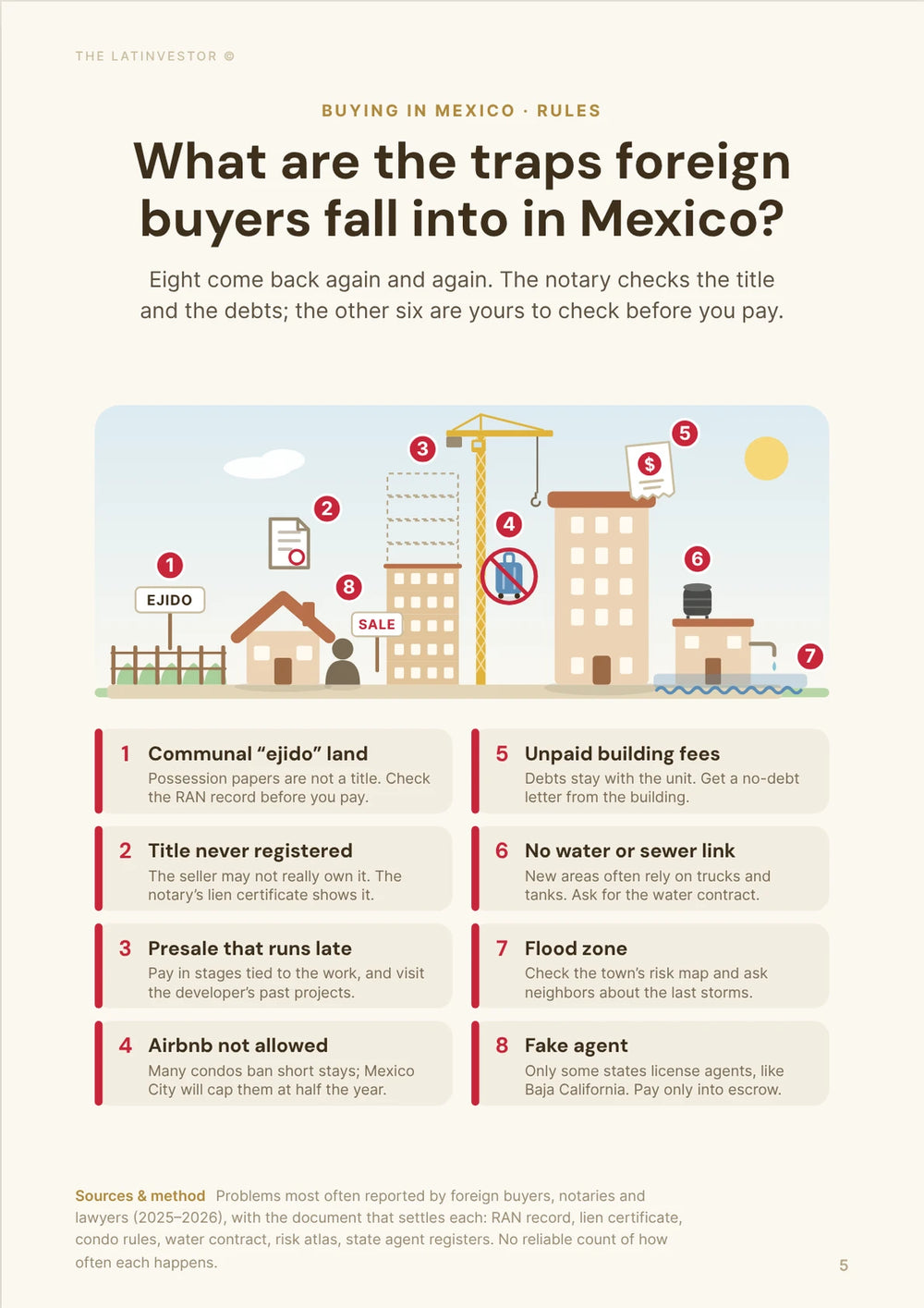
What to do: get a recent certificate of no liens (certificado de libertad de gravamen) from the public property registry, and check that the seller's name matches it. For a former ejido lot, ask for the RAN record and the registered private title, not a promise. For a development, ask Sedetus or the city for the land-use and urban development permits, and look for environmental approval. Pay the seller through the notary at closing, not in cash or to a 'reservation' account.
Avoid lots sold only with a private contract, prices well below the area's, and 'investment lots' far from any town with services 'coming soon'.
How much does land cost in Mexico right now?
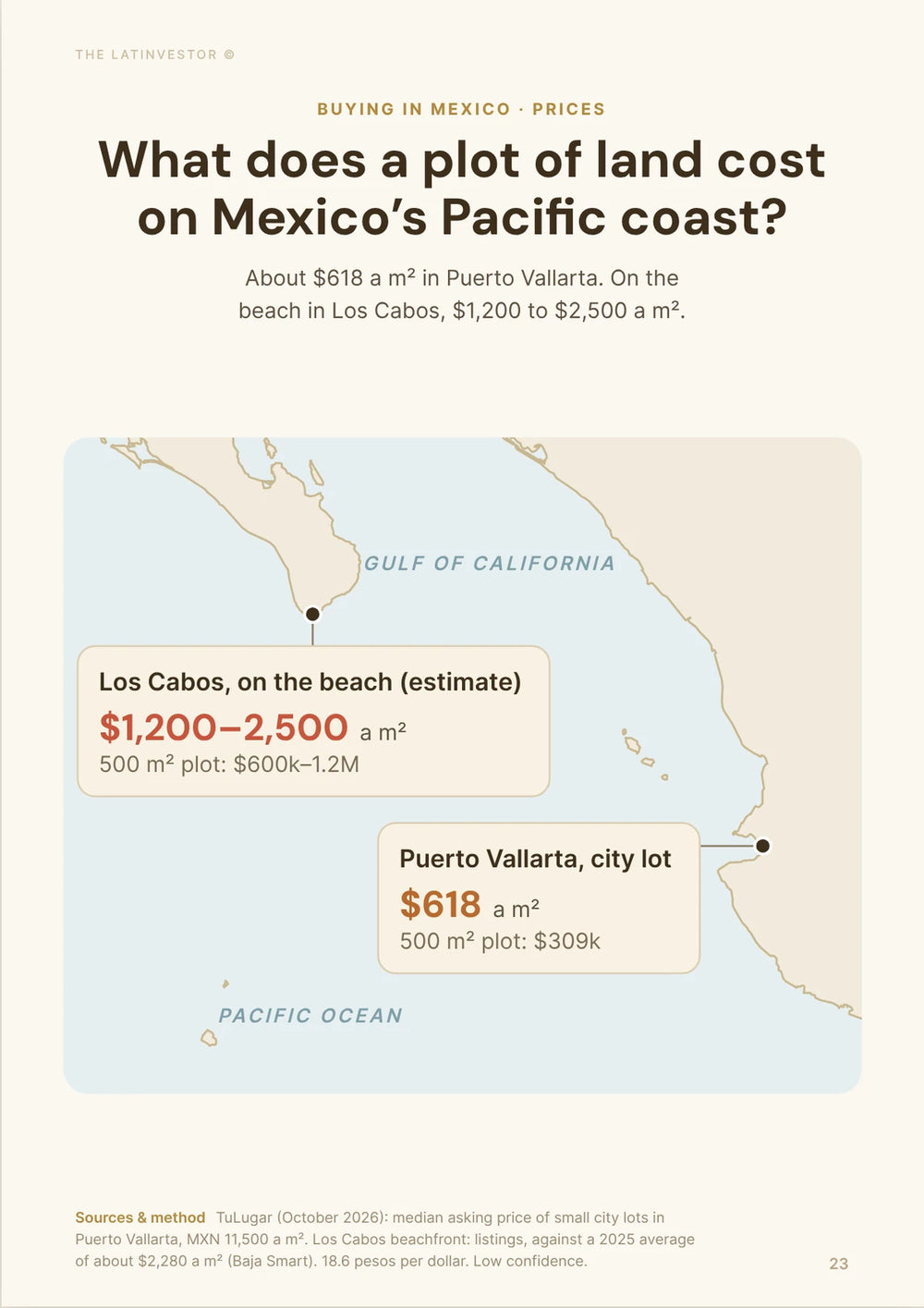
The national median asking price is about USD 278 per m² (MXN 5,170) in October 2026, and a small urban lot under 500 m² has a median asking price of about USD 98,000.
City gaps are huge. Mexico City and Guadalajara are above USD 1,200 per m², while Mérida and Tulum sit around USD 235 to 250 because many listings are on the edge of town or outside it.
These are listing prices from TuLugar, not sale prices, and a cheap per-m² figure often means no services. Before you compare, check whether the lot has water, power and a paved access road.
| Area | Median asking price per m² of land (October 2026) |
|---|---|
| Mexico City | USD 1,307 |
| Guadalajara | USD 1,227 |
| Puerto Vallarta | USD 518 |
| Playa del Carmen | USD 413 |
| Cancún | USD 374 |
| Los Cabos | USD 336 |
| Mexico (national median) | USD 278 |
| San Miguel de Allende | USD 270 |
| Tulum | USD 250 |
| Mérida | USD 235 |
Does buying beachfront property mean owning the beach in Mexico?
No. The beach and the federal strip in front of it aren't part of your property.
Mexico keeps a federal coastal zone called ZOFEMAT (Zona Federal Marítimo Terrestre), commonly a 20-meter strip of land next to the beach. It belongs to the federal government.
Owners can get a concession to use part of it, but a concession isn't ownership. So a beachfront buyer can end up with two layers: the private lot in a fideicomiso, and a federal concession for the strip between the lot and the sea.
'Beachfront' in an ad tells you nothing about where the legal boundary is. Ask for the survey and the concession, if there is one.
Can foreigners buy farms and agricultural land in Mexico?
Yes, but large farms and company-owned farmland follow stricter rules than a house.
Mexico caps how much agricultural, livestock and forestry land one owner can hold as private property (pequeña propiedad).
When a company holds farmland, the land part of its capital must be in special Serie T shares, and foreign participation in those shares is capped at 49%. There are also limits on how much land a company can build up.
A modest, already private rural lot outside the restricted zone is a fairly normal deal. A foreign-controlled company assembling thousands of hectares is a heavily regulated one. Check the land classification, title history, acreage and ownership structure first.
How much does a fideicomiso cost foreigners in 2026?
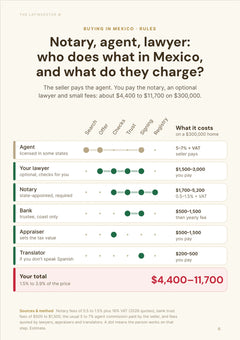
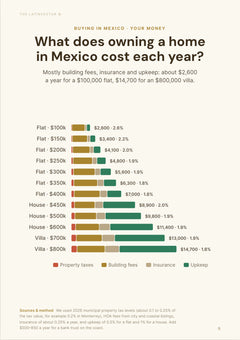
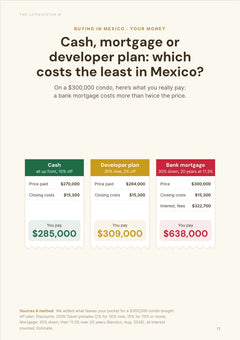
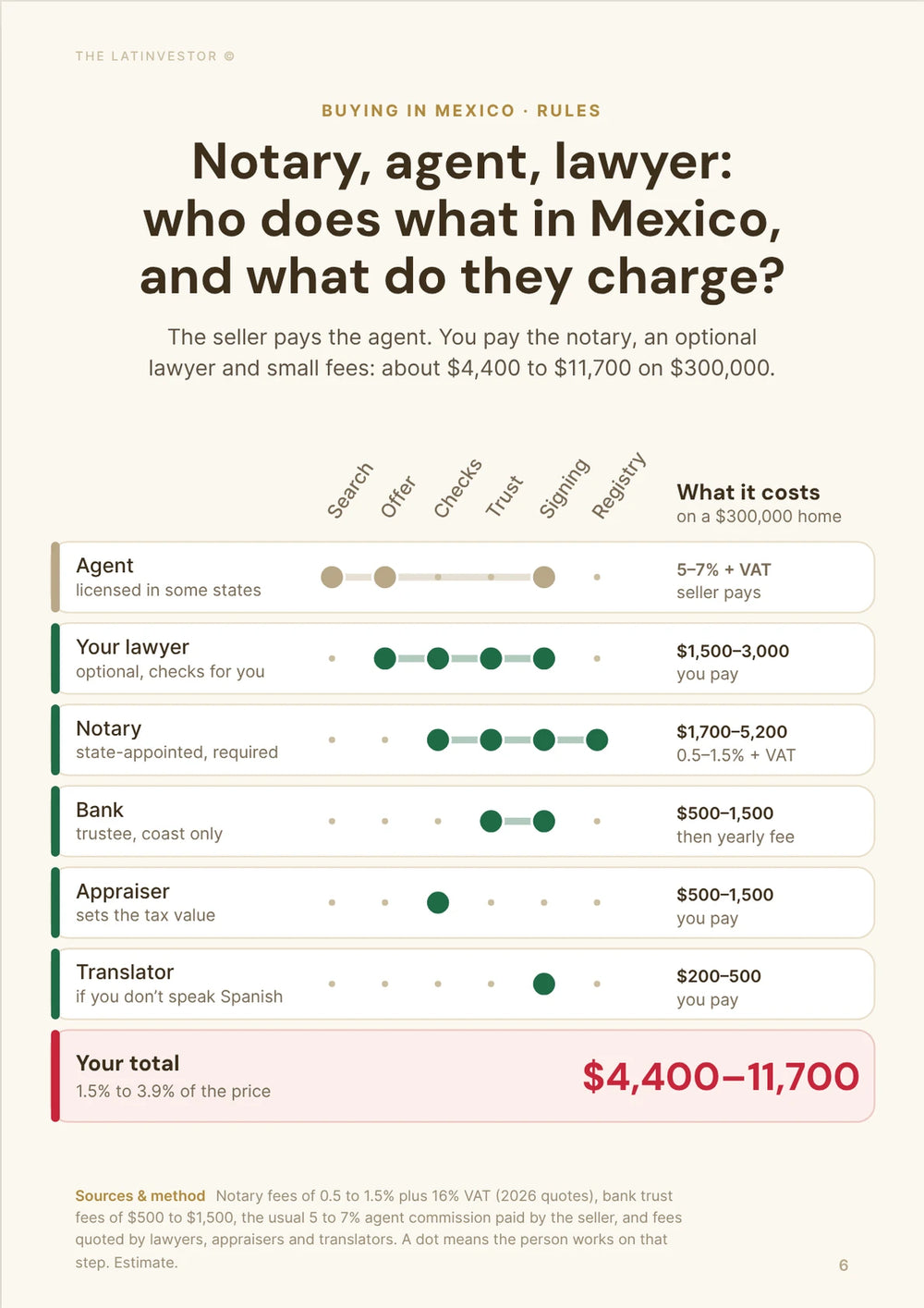
More than the number you see online. The SRE permit is MXN 21,650 (about USD 1,160), and the bank adds roughly USD 550 to 800 to set up the trust and USD 550 to 700 a year.
The bank figures come from a 2026 broker comparison (Banorte at the low end, HSBC at the high end), not from published bank tariffs, so ask two or three banks for a written quote. Fees can come with VAT on top.
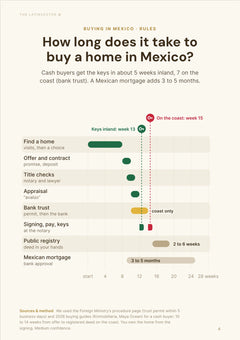
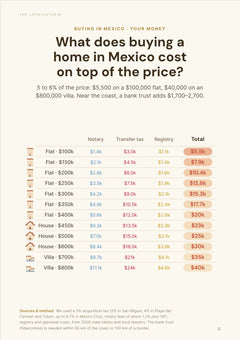
None of this includes the notary, acquisition tax or registration, which usually add up to around 6% to 9% of the price with the trust included.
| Cost item (2026) | Amount |
|---|---|
| SRE: foreign purchase outside the restricted zone | MXN 5,250 |
| SRE: permit to create a restricted-zone fideicomiso | MXN 21,650 |
| SRE: review of a trust extension or modification | MXN 595 |
| SRE: on-time issuance of a trust extension or modification | MXN 9,740 |
| SRE: late issuance of a trust extension | MXN 10,615 |
| SRE: on-time notice of a non-residential purchase by a Mexican company | MXN 1,475 |
| Bank: trust setup fee (broker comparison, not bank tariffs) | About USD 550 to 800 |
| Bank: annual trustee fee (same comparison) | About USD 550 to 700 a year |
Is Mexico making it harder for foreigners to buy land now?
No. In 2026 the rules for normal buyers got simpler, not tighter, even if trusts are under more political scrutiny.
In June 2026 the SRE cut its deadline for a trust permit, a change of purpose and an extension from 5 to 3 business days, moved the requirements into its online SIPAC27 form and dropped several letters. Company notices for non-residential land are now processed immediately.
On the political side, Morena senator Jesús Lucía Trasviña filed a bill in February 2026 for tighter control of restricted-zone trusts: more due diligence, identifying who really owns the rights, cracking down on front men and more duties for trustee banks. We found no sign it has become law. A separate August 2026 government bill on foreign investment targets sensitive sectors like energy and semiconductors, not homes.
What it means for you: expect more questions about who you are and where the money comes from, so keep your bank records and ID papers ready. A ban on foreign coastal ownership isn't on the table.
How common is foreign property ownership in Mexico?
Common. The SRE issued 59,488 restricted-zone trust permits from 2000 to 2016, about 3,500 a year, and recorded 54,197 foreign purchases outside the zone from 2004 to 2016, about 4,170 a year.
The public series stops in 2016, so these aren't today's volumes. They do show the system has been used tens of thousands of times on both sides.
| SRE historical series | Period | Recorded transactions/permits | Approx. annual average |
|---|---|---|---|
| Restricted-zone fideicomiso permits | 2000–2016 | 59,488 | ~3,500 |
| Foreign acquisitions outside restricted zone | 2004–2016 | 54,197 | ~4,170 |
| Combined recorded activity across those series | Different periods | More than 113,000 | Shows institutional-scale use |
What is the biggest risk for foreigners buying land in Mexico?
The land, not your passport. Bad title, an ejido parcel that never finished its conversion, wrong boundaries or federal coastal land cost buyers far more than the foreign-ownership rules.
The rules for foreigners are well known: the zone is mapped, the SRE publishes its procedures, banks run trusts every day and notaries know the drill. A bad parcel is harder to see.
Check that the seller is on the registered title, that there are no liens or lawsuits, that a former ejido lot has its registered private title, that the measured lot matches the deed, and whether ZOFEMAT or another federal concession touches a beachfront parcel.
A fideicomiso can't fix a seller who never owned the land.
So, can foreigners buy land in Mexico?
Yes, and in most of the country they get direct title in their own name.
Within 100 km of a border or 50 km of the coast, they buy through a bank fideicomiso that lasts up to 50 years, can be extended and lets them use, rent, sell and pass on the property. Budget about MXN 21,650 for the SRE permit plus the bank's fees.
Ejido land without registered private title, the federal beach strip, big farms and 'investment lots' without permits are where the rules get strict or the deal turns into a scam. Prove the parcel is private, registered and really the seller's, and the foreigner part is routine.
Our methodology
This article answers whether foreigners can buy land in Mexico by separating what changes the answer: where the parcel is, whether it is private or ejido land, whether the buyer gets direct title or trust rights, and whether coastal, farm or company rules apply.
The rules come from Article 27 of the Constitution, the Foreign Investment Law, the Agrarian Law, the General Law of National Assets, the Migration Law and the trust law, read together with the SRE's current procedures and fee schedule (updated September 21, 2026) and the June 16, 2026 Diario Oficial agreement that shortened SRE deadlines.
Fees are the official 2026 SRE amounts. Bank trust fees come from a 2026 broker comparison, not bank tariffs, and are given as ranges. Land prices are median asking prices from TuLugar in October 2026; the residency threshold comes from 2026 consulate figures; the scam figures come from dated 2026 reports in the regional press.
We checked these figures in October 2026. Conversions use about 18.6 pesos per US dollar and 20.9 pesos per euro.
Limits: asking prices are not sale prices, and cheap land often lacks services. Consulates apply their own residency figures. The February 2026 Senate bill is treated as a proposal, not law. The SRE's historical figures stop in 2016 and are only used to show the scale of foreign ownership.
Key sources used for this analysis include Article 27 of the Mexican Constitution, the Foreign Investment Law, the SRE procedures for foreign purchases outside the restricted zone and restricted-zone trusts, the SRE 2026 fees, the June 2026 Diario Oficial agreement on SRE procedures, the Agrarian Law, the RAN procedures for converting ejido land to private property and issuing private titles, the General Law of National Assets, PROFEPA on ZOFEMAT, the Migration Law, the General Law of Negotiable Instruments and Credit Operations, the February 2026 Senate bill on trusts, IMCO on the August 2026 foreign investment bill, SRE Article 27 statistics, Homia's 2026 comparison of bank trust fees, Compass Abroad on closing costs, Tandazo on company setup costs, Mexperience on 2026 residency thresholds, TuLugar market data, Por Esto on irregular developments in Quintana Roo, Riviera Maya News on the 123 blacklisted developments (August 2026), Riviera Maya News on Sedetus inspections and Por Esto on investment lots in Yucatán.