Summary
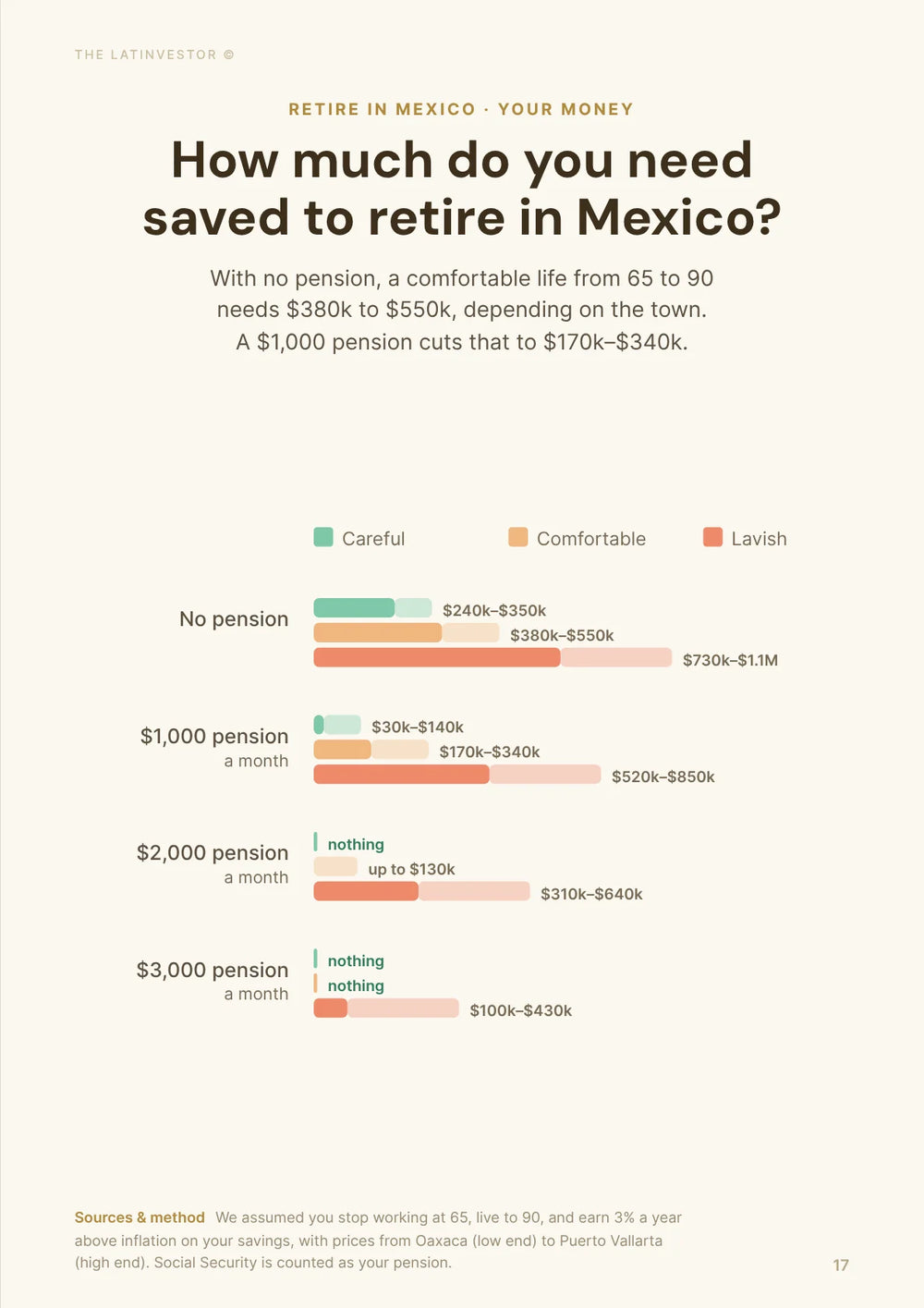
How much money do you need to retire in Riviera Maya? About 50,000 MXN a month ($2,700) for a comfortable life as a single retiree, with air conditioning, private insurance and regular dining out. Keep about 20% more on top for electricity spikes and surprises.
A bare minimum is around 18,500 MXN a month ($1,000) by our estimate: a small place inland in Playa del Carmen, colectivo vans, home cooking and little air conditioning.
At $2,000 a month (about 37,000 MXN), you can rent a one-bedroom in Zazil-Ha, Gonzalo Guerrero or quieter parts of Centro for 15,000 to 20,000 MXN and live simply.
At $3,000 (about 55,500 MXN), you can rent in Playacar or Tulum's La Veleta for 20,000 to 30,000 MXN and keep private insurance. Luxury starts around 115,000 MXN a month ($6,220).
In Playa del Carmen, the median asking rent is about 15,100 MXN for a one-bedroom and 24,900 MXN for a two-bedroom, and it has fallen about 7.6% since early 2025.
Electricity is the bill that moves most: basic utilities average about 1,545 MXN a month for 85 m², but heavy air conditioning in the hot months can push them to 3,000 to 5,000 MXN.
Moving in usually costs one month's deposit plus the first month's rent, and HOA fees in buildings with pools and security often run 5,000 to 8,900 MXN a month.
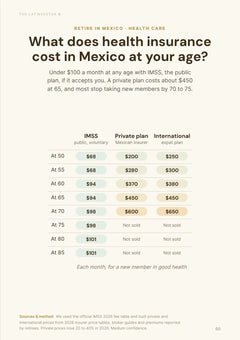
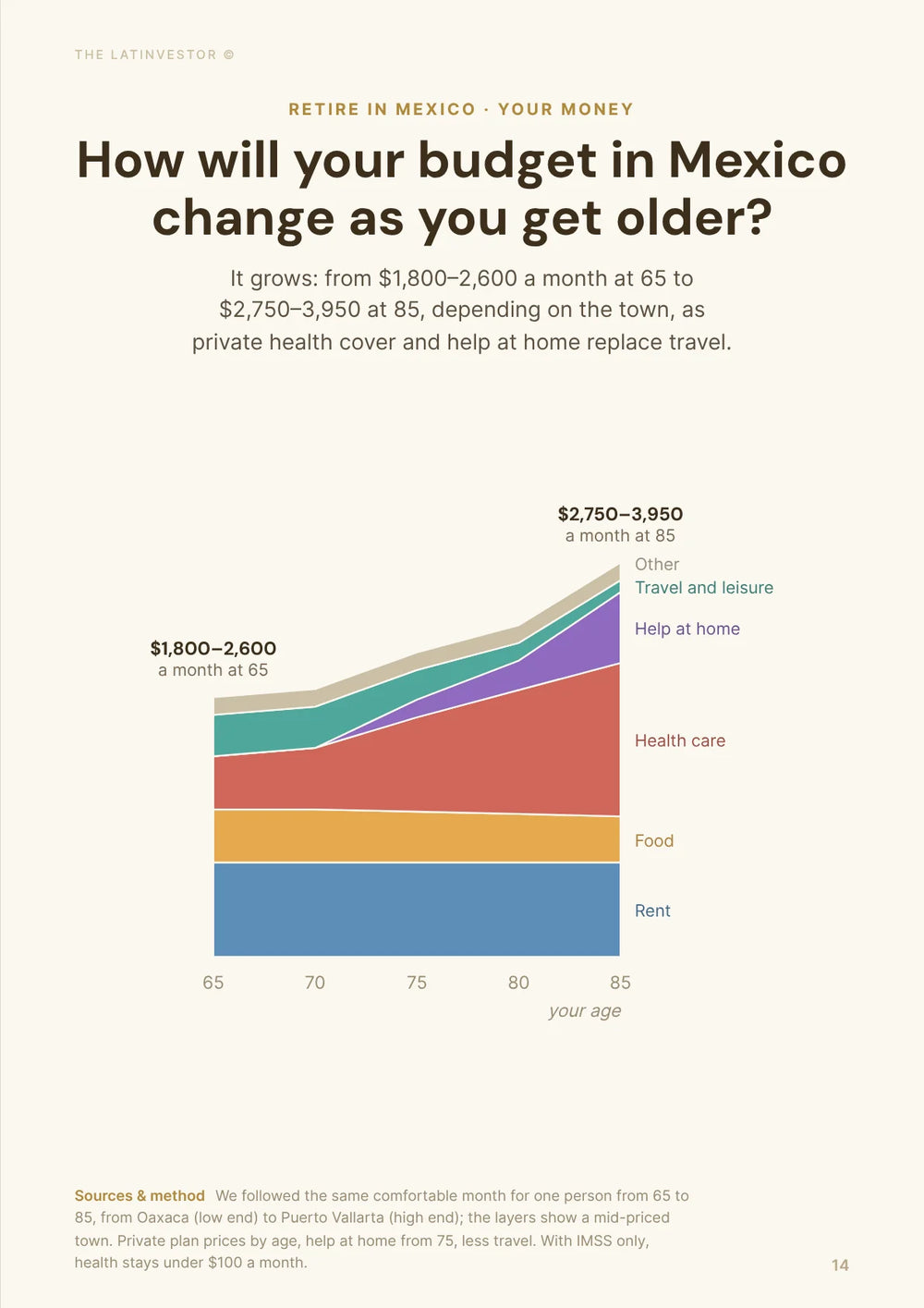
Health care: the public IMSS plan costs 20,600 MXN a year between 60 and 69, while private insurance runs about 58,000 to 90,000 MXN a year at 60 to 64.
The median asking price for an apartment in Playa del Carmen is about 4,000,000 MXN ($216,000), from about 3,420,000 MXN for a one-bedroom to 4,865,000 MXN for a two-bedroom.
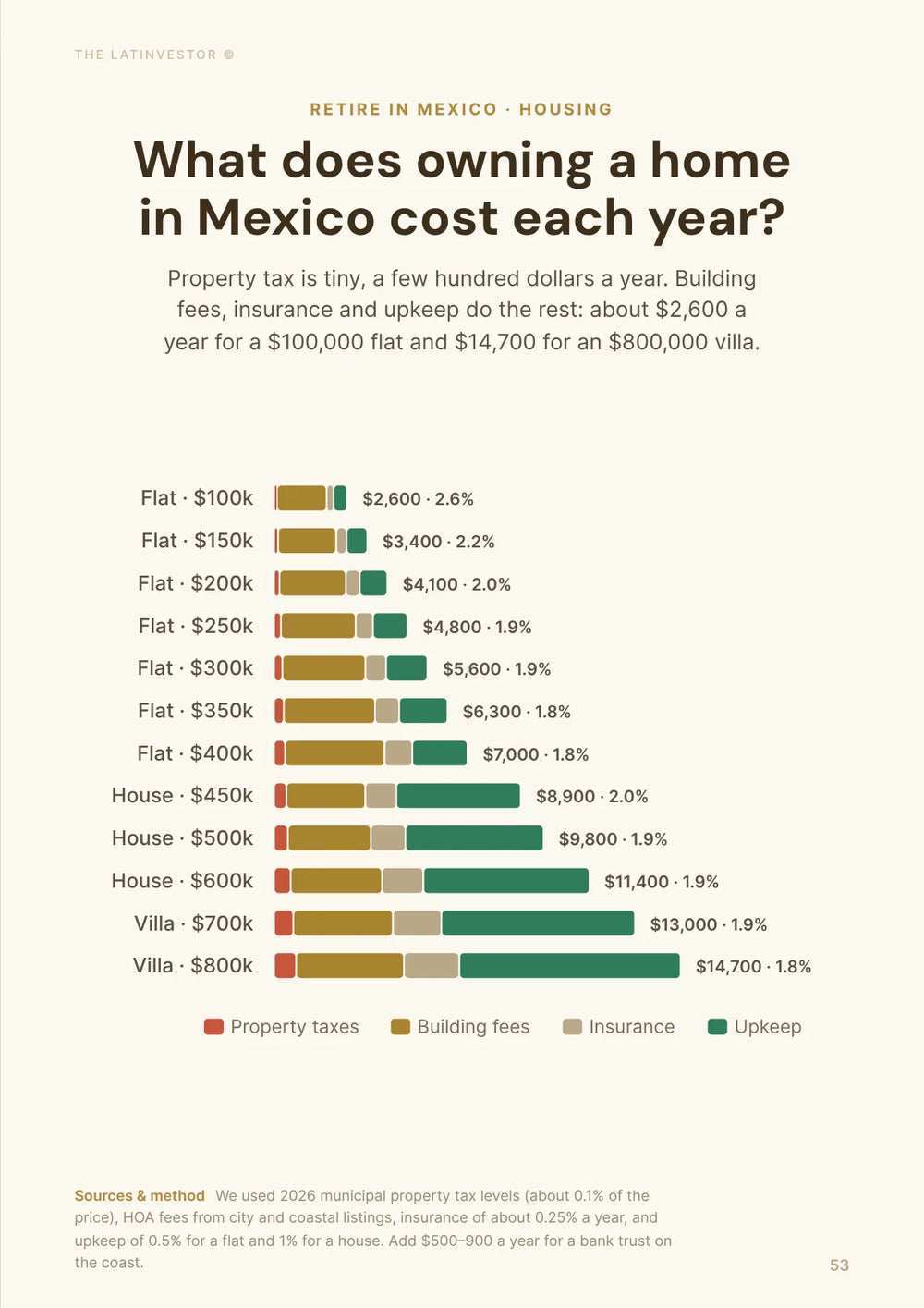
Owning a condo costs about 10,000 to 24,000 MXN a month before any mortgage, including the fideicomiso bank trust (about $500 to $850 a year), so renting is often cheaper month to month.
The Temporary Resident visa asks for about $4,510 a month of income or $75,950 in savings (San Diego consulate, 2026). The one-year card costs 11,141 MXN.
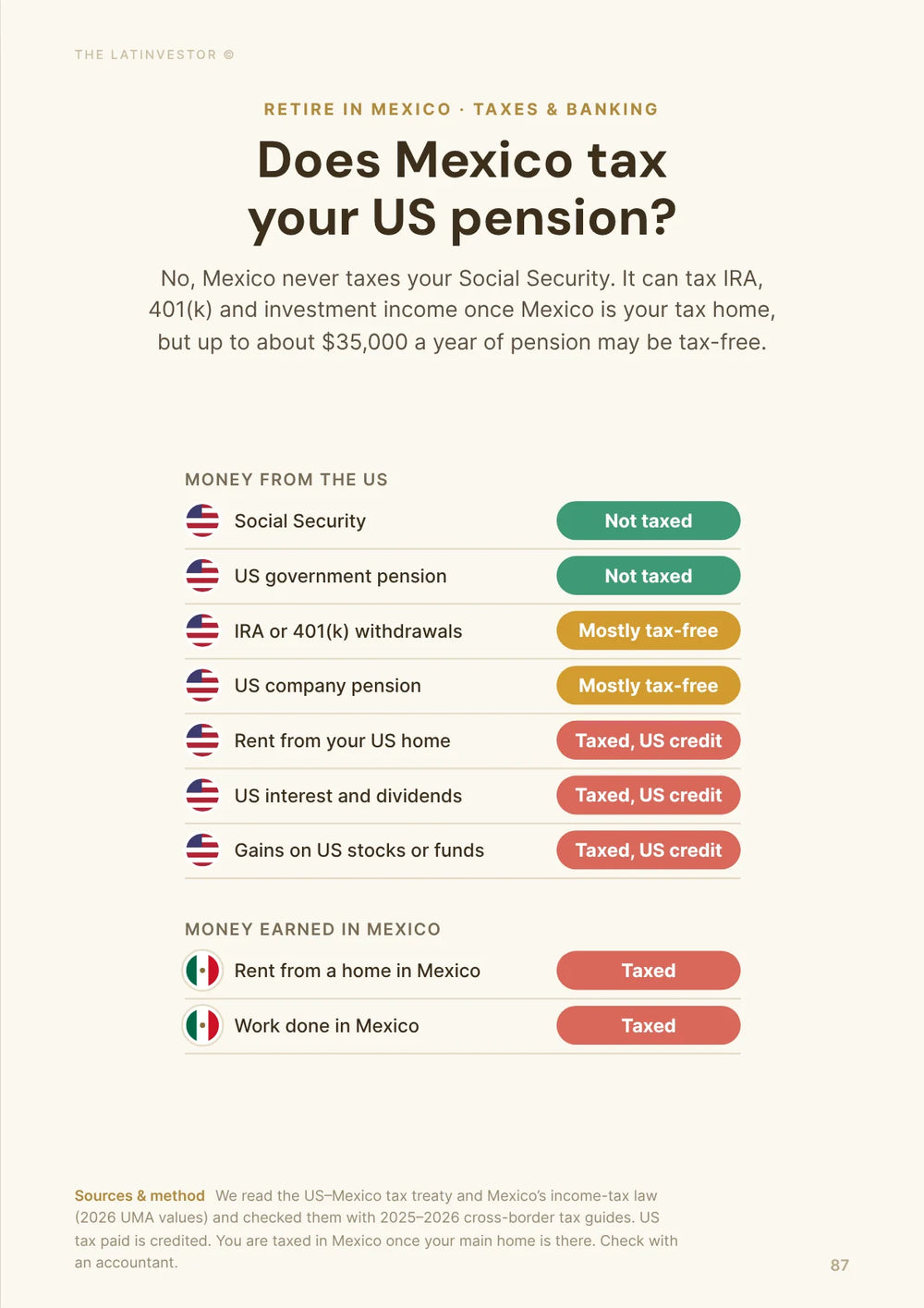
Tax residency depends on where your home is, not on a 183-day rule. US Social Security is generally taxed only in the US, and treaties with about 60 countries can reduce double taxation.

What lifestyle can each budget buy you in Riviera Maya?
What's the absolute minimum monthly budget to survive in Riviera Maya?
A bare-minimum monthly budget for a single foreign retiree to get by in Riviera Maya in 2026 is around 18,500 MXN, which equals roughly $1,000 USD or approximately 890 EUR. It's our estimate: most published budgets for the area start much higher, around 31,500 MXN ($1,700) a month.
At this minimum budget level in Riviera Maya, you can cover basic rent in outer neighborhoods like Ejido or parts of Luis Donaldo Colosio away from the beach, limited groceries, minimal transportation by colectivo buses, and pay-as-you-go healthcare visits.
The biggest sacrifice at this budget is that you will have to limit your air conditioning use to nighttime only, share housing or live in a small studio, skip most restaurants and social activities, and accept that one unexpected expense could throw off your entire month.
What lifestyle do I get with $2,000/month in Riviera Maya in 2026?
In 2026, a retiree with $2,000 per month (about 37,000 MXN) in Riviera Maya can enjoy a comfortable but simple coastal life with regular restaurant meals, gym access, and occasional day trips to cenotes or Cozumel.
On this budget in Riviera Maya, you can realistically afford a decent long-term one-bedroom condo in neighborhoods like Zazil-Ha, Gonzalo Guerrero, or quieter parts of Centro in Playa del Carmen, with rent typically running 15,000 to 20,000 MXN ($810 to $1,080 USD or 720 to 960 EUR) per month.
Social activities in Riviera Maya at this level include beach clubs with day passes, yoga classes, snorkeling trips, and regular dining at local taquerias and mid-range restaurants along Quinta Avenida, though the high-end beach clubs and fine dining spots will still feel like splurges.
The main limitation at $2,000 per month in Riviera Maya is that summer electricity bills can spike hard when you run air conditioning during the hottest months, and sargassum seaweed season can affect beach quality in some areas (in 2026, the federal government put 2,000 million MXN into collecting it along the Quintana Roo coast), so you need to budget for seasonal variability rather than expecting every month to cost the same.
What lifestyle do I get with $3,000/month in Riviera Maya in 2026?
In 2026, a retiree with $3,000 per month (about 55,500 MXN) in Riviera Maya can live comfortably with reliable air conditioning, regular dining out, private health insurance, and enough buffer for unexpected expenses or weekend getaways.
At this budget level in Riviera Maya, you can afford a strong one-bedroom or a good two-bedroom apartment in desirable areas like Playacar Phase I or II, nicer pockets of Zazil-Ha, or Tulum's La Veleta neighborhood, with rent typically ranging from 20,000 to 30,000 MXN ($1,080 to $1,620 USD or 960 to 1,440 EUR) per month.
Dining and entertainment options expand significantly at $3,000 per month in Riviera Maya, giving you access to coworking spaces, regular meals at quality restaurants, weekend stays at boutique hotels in places like Bacalar or Valladolid, and membership at nicer fitness clubs with pools and beach access.
The key upgrade from $2,000 to $3,000 in Riviera Maya is that electricity spikes and seasonal costs no longer stress you out because you have a real buffer, plus you can afford private healthcare coverage that gives you peace of mind instead of relying on pay-as-you-go visits.
What lifestyle do I get with $5,000/month in Riviera Maya in 2026?
In 2026, a retiree with $5,000 per month (about 92,500 MXN) in Riviera Maya can enjoy high-comfort living with premium housing, a car, frequent fine dining, and regular domestic travel, while $10,000 per month (about 185,000 MXN) opens up full luxury with staff help, beachfront living, and top-tier everything.
At $5,000 per month in Riviera Maya, you can rent a premium two-bedroom or townhouse in Playacar, beachfront-adjacent areas near Mamitas Beach, or Tulum's Aldea Zama for 35,000 to 50,000 MXN ($1,890 to $2,700 USD or 1,680 to 2,410 EUR), while $10,000 unlocks luxury condos or villas in Puerto Cancún or branded residences with prices starting at 70,000 MXN and up.
At the $5,000 to $10,000 range in Riviera Maya, you gain access to private beach club memberships, personal trainers, regular spa treatments, a private vehicle with parking, premium international health insurance with low deductibles, and the freedom to fly to Mexico City or Oaxaca for weekend trips without thinking twice about the cost.
How much for a "comfortable" retirement in Riviera Maya in 2026?
In 2026, a comfortable retirement in Riviera Maya requires roughly 50,000 MXN per month, which equals about $2,700 USD or approximately 2,410 EUR, allowing you to rent a nice place, run air conditioning when needed, eat out regularly, and not panic about seasonal cost spikes.
For Riviera Maya specifically, you should add a 20% buffer (about 10,000 MXN, $540 USD, or 480 EUR per month) on top of your comfortable budget to handle electricity spikes during hot months, potential HOA fee increases, and hurricane season preparations without dipping into savings.
A comfortable retirement budget in Riviera Maya covers expenses that a basic budget simply cannot, including reliable private health insurance, regular restaurant meals instead of cooking every night, fitness or yoga memberships, occasional domestic travel, and the ability to use air conditioning freely during the brutally hot summer months from April through September.
How much for a "luxury" retirement in Riviera Maya in 2026?
In 2026, a luxury retirement in Riviera Maya requires roughly 115,000 MXN per month, which equals about $6,220 USD or approximately 5,530 EUR, allowing you to live without ever checking prices at restaurants, travel frequently, and maintain premium housing with full amenities.
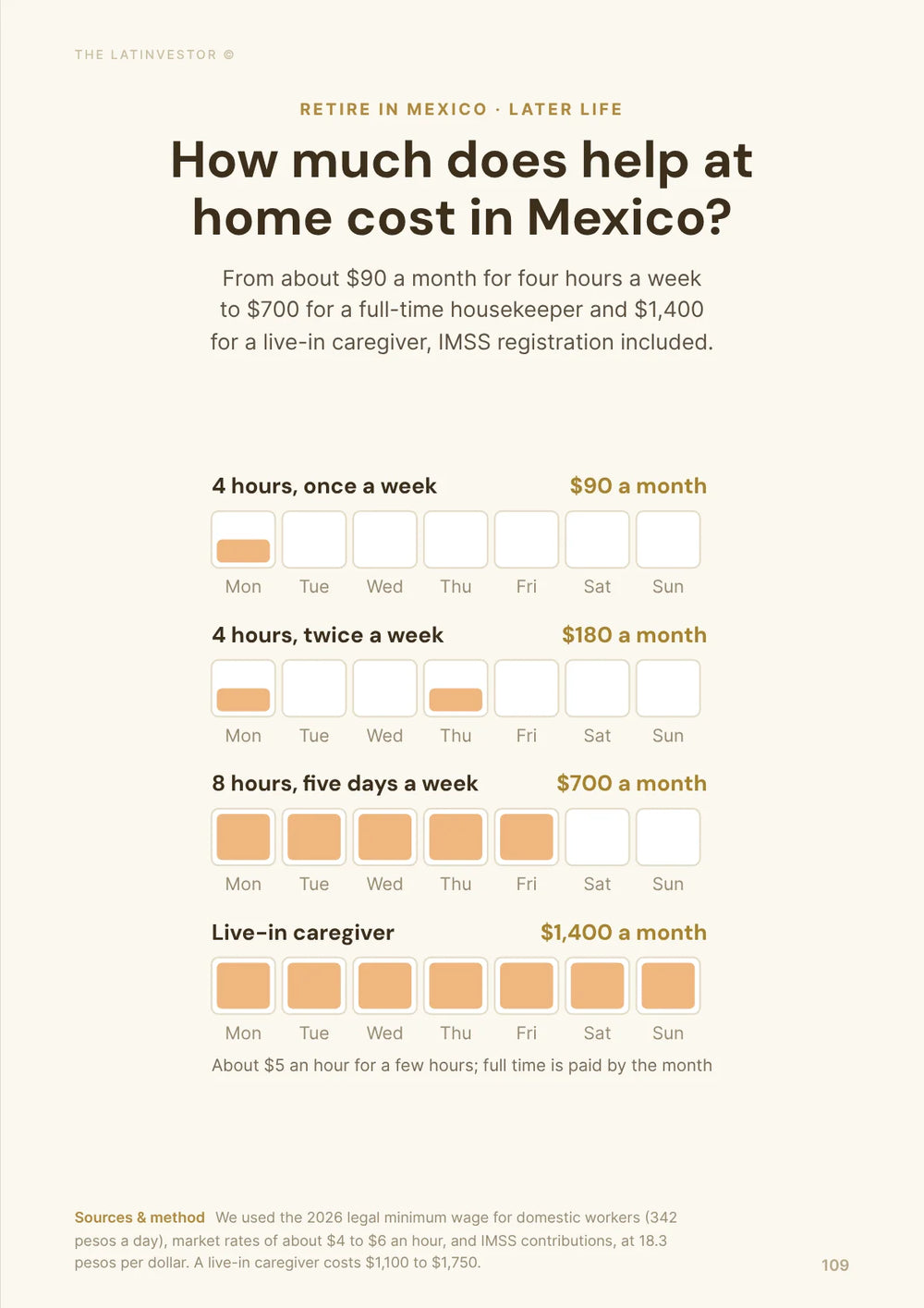
A luxury retirement in Riviera Maya means renting or owning in buildings with resort-style pools and concierge services (50,000 to 80,000 MXN or $2,700 to $4,320 USD per month), having household help for cleaning and property management, driving a quality vehicle, and holding international health insurance with minimal deductibles and access to top hospitals in Cancún or Playa del Carmen.
The most popular neighborhoods for luxury retirees in Riviera Maya include Playacar Phase I for golf course living, Puerto Aventuras for the marina community, Aldea Zama in Tulum for design-forward developments, and Puerto Cancún for those who want proximity to the international airport and higher-end shopping.
The main advantage of a luxury budget in Riviera Maya beyond just comfort is access to properties with better construction quality, which means more effective air conditioning, better soundproofing from party noise in tourist areas, and locations that handle hurricane season flooding better because they were built to higher standards.
What are the real monthly expenses for retirees in Riviera Maya in 2026?
What is a realistic monthly budget breakdown by category in Riviera Maya?
A realistic monthly budget breakdown for a comfortable retiree in Riviera Maya in 2026 looks roughly like this: housing at $1,130 to $1,580 USD (1,010 to 1,410 EUR), utilities at $115 to $255 USD (100 to 225 EUR), food at $450 to $680 USD (400 to 605 EUR), transport at $140 to $340 USD (125 to 305 EUR), healthcare at $200 to $450 USD (180 to 400 EUR), and entertainment at $225 to $565 USD (200 to 505 EUR).
Housing is the biggest line of a retiree's budget in Riviera Maya, because the region's tourism economy pushes rents up, especially for properties within walking distance of beaches or main commercial areas like Quinta Avenida in Playa del Carmen.
Food and groceries in Riviera Maya generally cost 8,000 to 12,000 MXN ($430 to $650 USD or 385 to 575 EUR), with the wide range depending on how often you eat at restaurants versus cooking at home with ingredients from local markets like the Mercado 28 in Cancún.
The budget category that varies most depending on personal lifestyle in Riviera Maya is utilities, specifically electricity, because running air conditioning all day during hot months can triple your bill from 1,500 MXN to over 7,000 MXN, making it the single most unpredictable monthly expense.
What fees surprise foreigners most after moving to Riviera Maya?
The top three hidden fees that surprise foreigners in Riviera Maya are electricity bill spikes during hot months when air conditioning runs constantly, the fideicomiso (bank trust) annual maintenance fee for property owners in the coastal restricted zone, and HOA or condo association fees, often 5,000 to 8,900 MXN ($270 to $480 USD) per month in buildings with pools, security, and elevators.
One-time setup fees that foreigners should budget for when first arriving in Riviera Maya include the deposit and first month's rent (usually one month of each, so about 46,000 MXN or $2,490 USD for a 23,000 MXN apartment, sometimes two months of deposit), a contract fee of around 3,500 MXN, furniture purchases if renting unfurnished, and initial stocking of household supplies, which add up quickly in your first month.
What's the average rent for a 1-bedroom or a 2-bedroom in Riviera Maya in 2026?
In 2026, the median asking rent for a one-bedroom apartment in Riviera Maya's main market of Playa del Carmen is around 15,100 MXN ($815 USD or 725 EUR), while a two-bedroom asks about 24,900 MXN ($1,350 USD or 1,200 EUR). Numbeo puts one-bedrooms at about 18,100 MXN in the center and 7,000 MXN outside it, and the median asking rent has fallen about 7.6% since early 2025, though actual prices vary significantly by neighborhood and proximity to the beach.
For a one-bedroom in Riviera Maya, the realistic rent range spans from 10,000 MXN ($540 USD or 480 EUR) in budget inland areas like Ejido or outer Colosio, up to 25,000 MXN ($1,350 USD or 1,200 EUR) in premium locations like Playacar or beachfront Centro.
For a two-bedroom in Riviera Maya, expect to pay anywhere from 15,000 MXN ($810 USD or 720 EUR) in more affordable neighborhoods to 45,000 MXN ($2,430 USD or 2,160 EUR) in luxury buildings with full amenities in Playacar or Puerto Aventuras.
The neighborhoods offering the best value for retirees seeking affordable rent in Riviera Maya include Gonzalo Guerrero in Playa del Carmen for walkability without beach prices, Puerto Morelos for a quieter fishing village vibe, and the inland parts of Tulum town away from the expensive beach road.
What do utilities cost monthly in Riviera Maya in 2026?
In 2026, basic utilities for an 85 m² apartment in Riviera Maya average about 1,545 MXN a month ($84 USD or 74 EUR), usually between 925 and 3,200 MXN, and 3,000 to 5,000 MXN in the hot months if you run the air conditioning a lot.
The typical monthly breakdown for individual utilities in Riviera Maya is electricity at about 1,800 to 4,500 MXN ($97 to $245 USD or 87 to 215 EUR) for a two-bedroom with A/C, water from about 203 MXN ($11 USD) for the base tariff, which is very affordable, and cooking gas at about 437 MXN ($24 USD) for a 20 kg tank refill that usually lasts several weeks.
Internet and mobile phone service in Riviera Maya typically costs 900 to 1,500 MXN ($49 to $81 USD or 43 to 72 EUR) per month combined, with fiber internet packages from providers like Telmex or TotalPlay running 600 to 1,000 MXN and basic mobile plans from Telcel or AT&T Mexico adding another 300 to 500 MXN.
What's the monthly food and transportation budget for one person in Riviera Maya in 2026?
In 2026, a reasonable monthly food and transportation budget for one person in Riviera Maya totals roughly 10,500 to 18,000 MXN ($570 to $975 USD or 505 to 865 EUR) by our estimate, covering groceries, occasional dining out, and getting around by a mix of buses and taxis. A bus ride costs about 10 MXN.
A single retiree cooking mostly at home in Riviera Maya can expect to spend 5,000 to 8,000 MXN ($270 to $430 USD or 240 to 385 EUR) monthly on groceries, with lower costs if you shop at local markets and Mexican supermarkets like Chedraui rather than imported-goods stores like Costco or La Comer.
Dining out regularly in Riviera Maya adds significantly to your food budget, with a typical meal at a mid-range restaurant costing 200 to 400 MXN ($11 to $22 USD), so retirees who eat out several times per week can easily spend an additional 4,000 to 8,000 MXN ($215 to $430 USD or 190 to 385 EUR) monthly compared to cooking at home.
Transportation costs in Riviera Maya range from 1,500 MXN ($81 USD or 72 EUR) monthly if you rely on colectivo vans and occasional taxis, up to 6,000 MXN ($325 USD or 290 EUR) or more if you own a car and factor in gas, insurance, and parking, with many retirees finding a scooter at around 2,500 MXN monthly (including fuel) to be the sweet spot for independence without car expenses.
Can I retire in Riviera Maya if I want to buy property in 2026?
What's the average home price in Riviera Maya in 2026?
In 2026, the median asking price for an apartment in Playa del Carmen, the main market of Riviera Maya, is around 4,000,000 MXN ($216,000 USD or 190,000 EUR): about 3,420,000 MXN ($185,000) for a one-bedroom and 4,865,000 MXN ($263,000) for a two-bedroom, though this varies considerably depending on location, building age, and amenities.
The realistic price range in Riviera Maya spans from $150,000 USD (2,775,000 MXN or 135,000 EUR) for older or inland properties in Playa del Carmen's less touristy zones, up to $500,000 USD (9,250,000 MXN or 445,000 EUR) or more for newer construction in premium areas like Playacar, Aldea Zama in Tulum, or waterfront units in Puerto Aventuras.
Condos in managed buildings generally offer the best value for retirees in Riviera Maya because they include shared amenities like pools and security, require less personal maintenance than standalone houses, and are easier to lock up and leave when traveling, which is particularly valuable in a region where many retirees split their time between Mexico and their home country.
What down payment do foreigners usually need in Riviera Maya in 2026?
In 2026, there is no fixed down payment rule for foreigners buying in Riviera Maya: it depends on the bank or the seller, and a cash buyer has none. If you finance, plan on at least 25% down, which on a $275,000 USD condo means roughly $68,750 USD (1,275,000 MXN or 61,000 EUR), plus another 5% to 8% for closing costs.
In practice, most foreign retirees in Riviera Maya end up buying in cash, since Mexican mortgage products for non-residents are limited, documentation requirements are complex for cross-border income, and interest rates are typically higher than what buyers are used to in the US or Canada.
What's the all-in monthly cost to own in Riviera Maya in 2026?
In 2026, the all-in monthly cost to own a typical $275,000 USD condo in Riviera Maya (not counting any mortgage) runs between about 10,000 and 24,000 MXN ($540 to $1,300 USD or 480 to 1,150 EUR) by our estimate, covering everything from property tax to maintenance reserves.
The specific costs included in monthly ownership in Riviera Maya are HOA or condo fees at 5,000 to 8,900 MXN ($270 to $480 USD), property tax (predial) at 265 to 1,060 MXN ($14 to $57 USD), insurance and hurricane reserve at 885 to 3,540 MXN ($48 to $190 USD), utilities at 1,500 to 5,000 MXN ($81 to $270 USD), maintenance reserve at 1,770 to 4,420 MXN ($96 to $240 USD), and the fideicomiso annual fee at about 770 to 1,310 MXN ($42 to $71 USD) a month.
Typical monthly property tax (predial) in Riviera Maya is quite low compared to the US or Canada, often just 1,000 to 5,000 MXN ($54 to $270 USD or 48 to 240 EUR) per year, and in 2026 Playa del Carmen gave qualifying retirees and pensioners 50% off if they paid by June 30. HOA fees vary a lot: the listings we checked ran from about 5,000 MXN ($270 USD) to 8,900 MXN ($480 USD) or more for properties with extensive amenities, pools, gyms, and 24-hour security.
The hidden ownership cost that catches new buyers off guard in Riviera Maya is the fideicomiso bank trust fee, which foreigners must pay annually to the Mexican bank that holds their property title in the restricted coastal zone, and these fees commonly run about 9,250 to 15,725 MXN ($500 to $850 USD) per year plus VAT, depending on the bank.
Is buying cheaper than renting in Riviera Maya in 2026?
In 2026, buying in Riviera Maya is often not cheaper than renting on a monthly basis because a $275,000 USD condo has carrying costs of about $540 to $1,300 USD per month before any mortgage, while renting a similar property runs about $1,000 to $1,500 USD (the median asking rent for an apartment in Playa del Carmen is about 18,700 MXN, or $1,010), and when you add opportunity cost on your capital, renting frequently wins financially in the short term.
There is no fixed break-even point in Riviera Maya: it depends on the property, how much prices and rents rise, the buying and selling costs, and what your money would earn elsewhere. Buying only starts to make sense if you stay many years, so if you are not sure you will, renting is usually the safer choice.
The key factors that make buying more attractive in Riviera Maya include wanting full control over your air conditioning system and noise environment (renters are often stuck with whatever the landlord installed), locking in your housing costs against rising rents in a tourism-heavy market, and the psychological benefit of owning your retirement home outright without worrying about lease renewals or landlord decisions.


What visas, taxes, and healthcare costs should I plan for in Riviera Maya in 2026?
What retirement visa options exist in Riviera Maya in 2026?
In 2026, the main retirement visa option for Riviera Maya is Mexico's Temporary Resident Visa, which costs 1,036 MXN ($56 USD) for the consular application, plus 11,141 MXN ($600 USD or 535 EUR) for a one-year resident card when you complete the process at immigration offices in Mexico.
The key financial requirements to qualify for a Temporary Resident Visa in Mexico in 2026 are either a monthly income of about $4,510 USD (83,435 MXN or 4,010 EUR) over the past six months, or savings and investments of about $75,950 USD (1,405,075 MXN or 67,500 EUR) maintained over the past twelve months. These are the San Diego consulate's 2026 figures; each consulate sets its own amount.
Residence card fees went up in 2026: a temporary resident card now costs 11,141 MXN for one year up to 25,058 MXN for four years ($600 to $1,350 USD or 535 to 1,210 EUR) per person, before the permanent residency card at the end.
The most common visa mistake foreign retirees make in Riviera Maya is assuming all Mexican consulates have identical requirements, when in reality each consulate can interpret income documentation differently, require different bank statement formats, and even apply different exchange rates, so you must check with your specific consulate before your appointment.
Do I pay tax on foreign income in Riviera Maya in 2026?
In 2026, whether you pay tax on foreign income in Riviera Maya depends entirely on your tax residency status: if you become a Mexican tax resident (Mexico looks at where your home is and, if you have homes in several countries, where your center of vital interests is; there is no simple 183-day rule), you are generally taxed on worldwide income, but if you remain a non-resident, Mexico only taxes income that originates from Mexican sources.
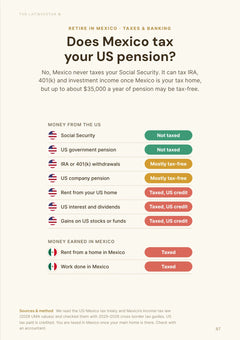
For retirees in Riviera Maya, foreign pensions are typically subject to Mexican income tax if you become a tax resident, though tax treaties can provide credits or exemptions to avoid double taxation. US Social Security is an exception: under the US-Mexico tax treaty, it is generally taxed only in the United States.
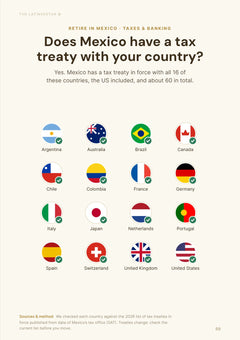
Mexico has tax treaties with about 60 countries, including the United States, Canada, and many European countries, that affect how foreign income is taxed, generally allowing you to claim credits for taxes paid to your home country, but navigating these treaties properly requires working with a cross-border tax professional familiar with both jurisdictions.
The single most important tax rule foreign retirees should understand before moving to Riviera Maya is that the resident versus non-resident distinction determines everything, so before you relocate, you need to decide whether you will spend enough time in Mexico to trigger tax residency and then plan your income sources and reporting accordingly.
What health insurance do retirees need in Riviera Maya in 2026?
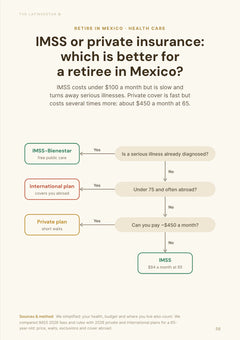
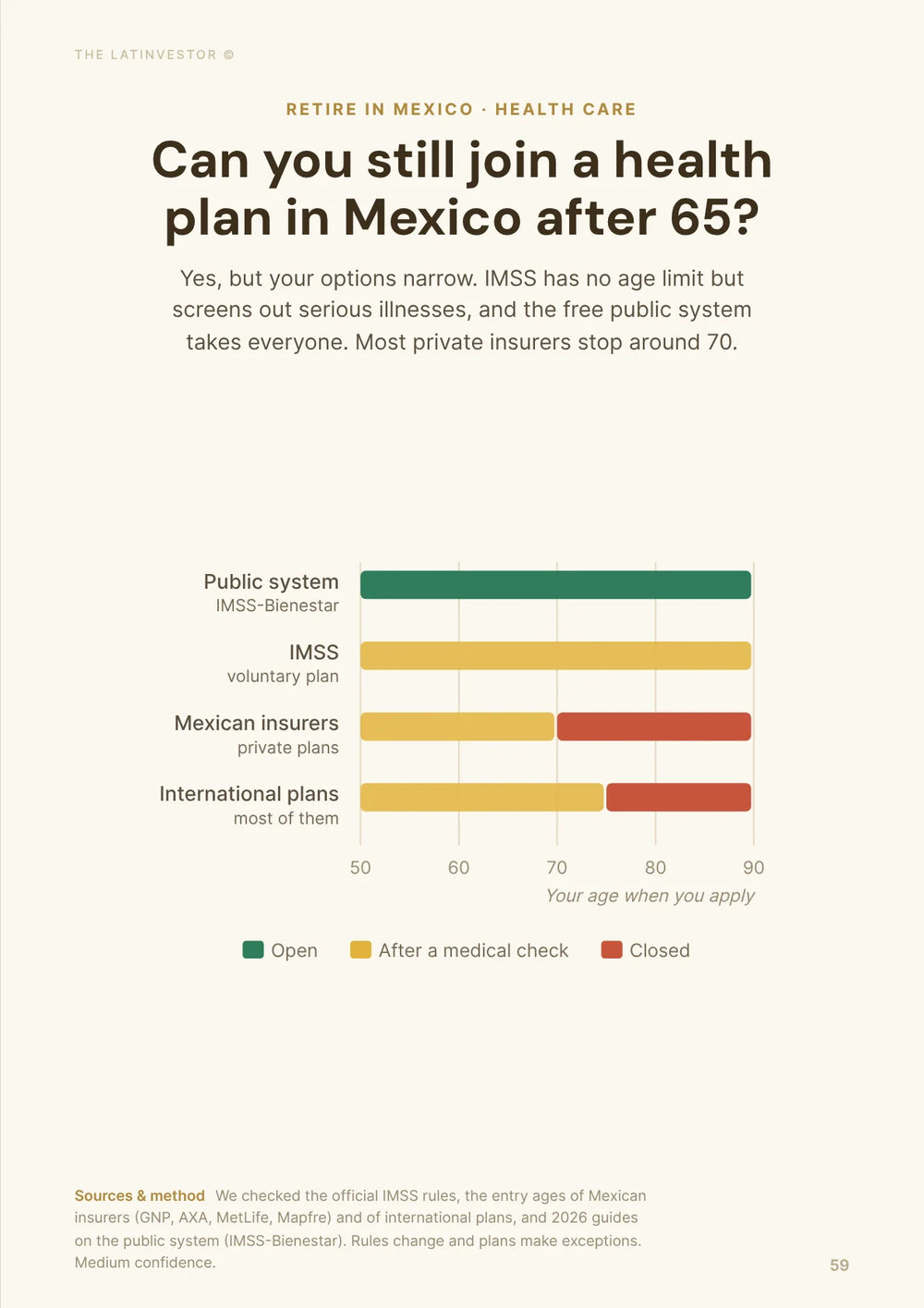
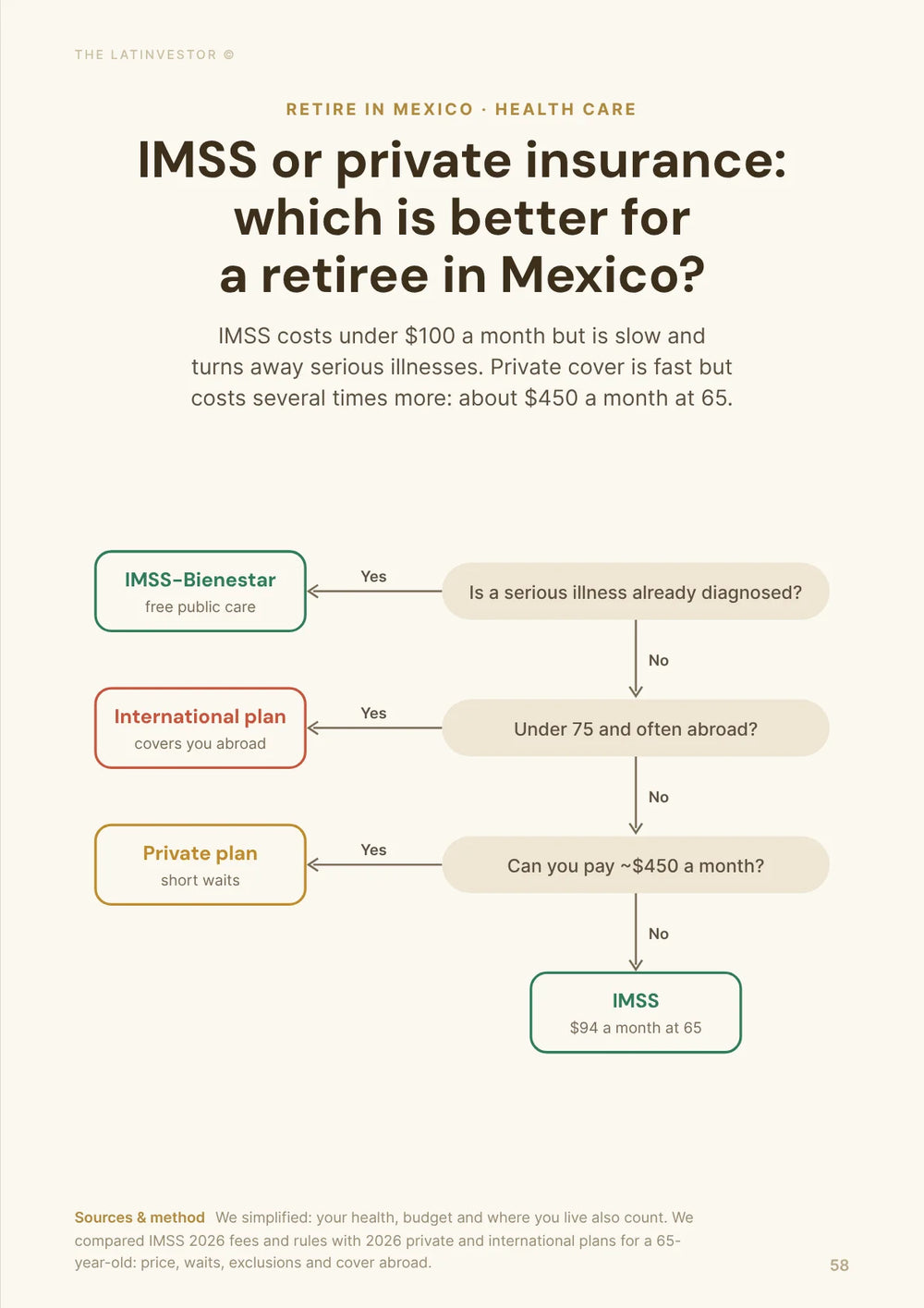
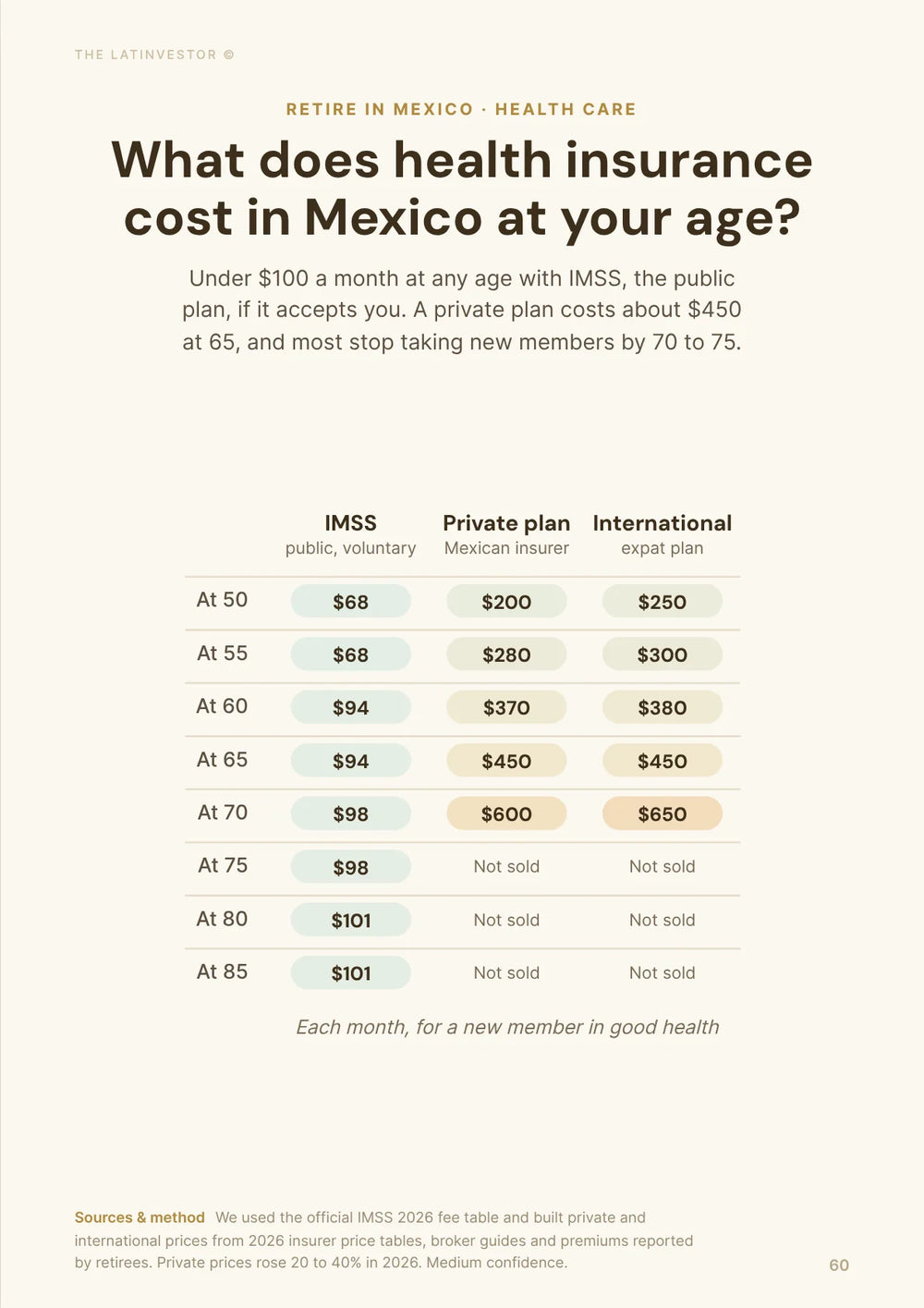
In 2026, most foreign retirees in Riviera Maya need private health insurance, which costs about 4,800 to 7,500 MXN ($260 to $405 USD or 235 to 360 EUR) per month for a woman aged 60 to 64 (58,000 to 90,000 MXN a year), and more after 65, depending on coverage level and deductible choices, with international policies or Mexican private insurers being the most common options.
Foreigners can access Mexico's public healthcare system through IMSS's voluntary enrollment program called Seguro de Salud para la Familia, which costs 20,600 MXN a year between 60 and 69 and 21,500 MXN between 70 and 79 in 2026, much less than private insurance, but it requires navigating Spanish-language processes, accepting longer wait times, and understanding that the care experience differs significantly from private hospitals with English-speaking staff.
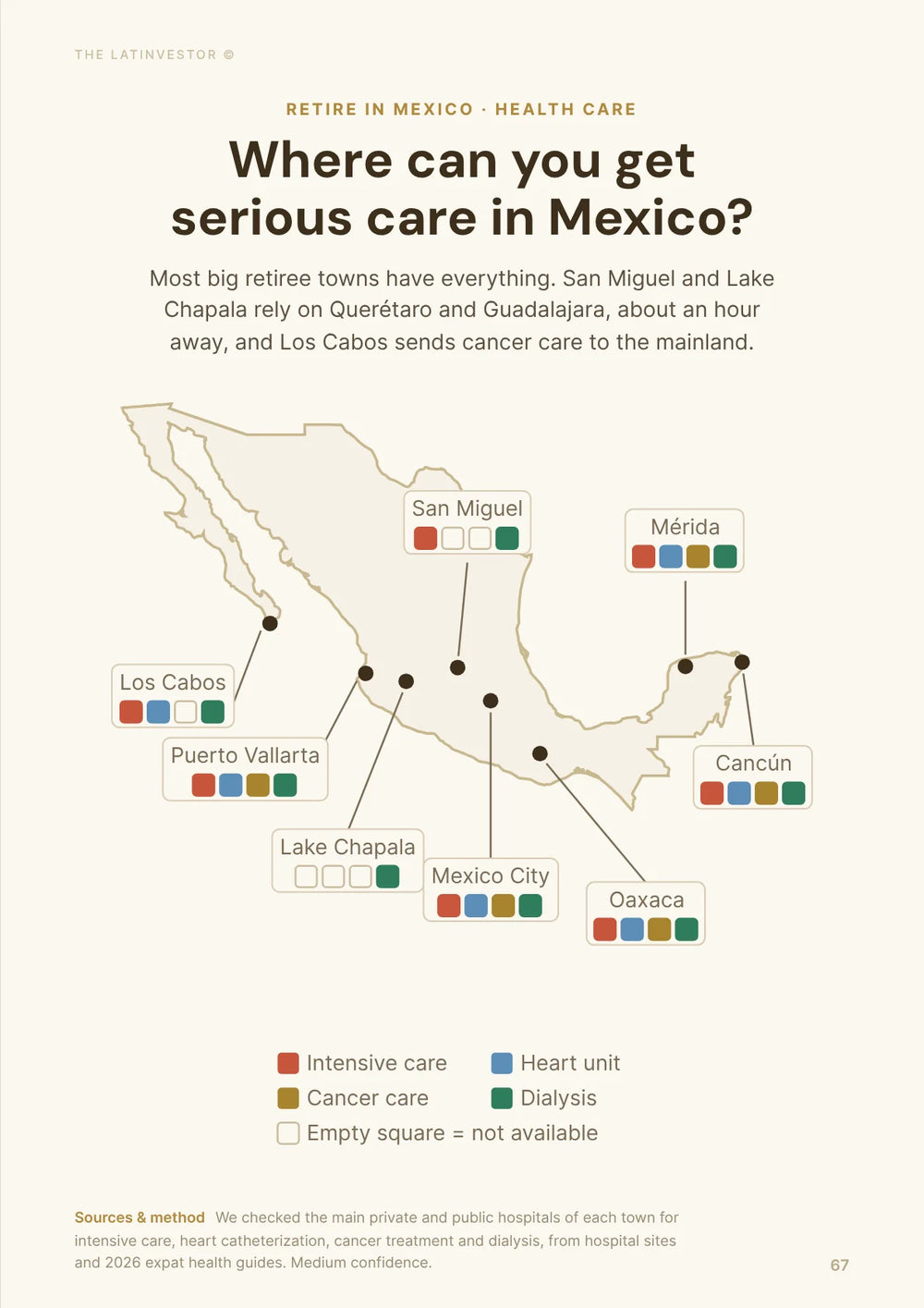
A realistic total annual healthcare budget for a retiree in Riviera Maya including insurance premiums, out-of-pocket costs, medications, and occasional specialist visits runs between about 60,000 and 150,000 MXN ($3,240 to $8,110 USD or 2,890 to 7,220 EUR) by our estimate, since insurance alone often costs 58,000 to 90,000 MXN a year at 60 to 64, with the range depending heavily on your age, pre-existing conditions, and whether you choose a high-deductible or comprehensive plan.
Related blog posts
- Moving to Riviera Maya? Here's everything you need to know (2026)
- What rental yield can you get on an apartment in Riviera Maya?
- Are property prices in the Riviera Maya likely to rise?
- How much money do you need to retire in Mexico?
Our methodology
This article estimates how much a single retiree needs each month to live in Riviera Maya, from a bare-minimum budget to a luxury one, with Playa del Carmen as the main benchmark. We cover rent, utilities, food, transport, health care, the residency visa and taxes, and what changes if you buy a condo instead of renting.
We built each budget line by line. Rents and home prices come from Numbeo, TuLugar, Inmuebles24 and the Deveras rent index (October 2026 listings), with Centro, Zazil-Ha, Gonzalo Guerrero and Playacar as benchmarks. Utility costs come from Numbeo, Aguakan's water tariffs and CFE electricity rates, and everyday prices from Numbeo and Wise.
Health care costs come from the IMSS 2026 fee schedule and 2026 premium estimates for private insurance. Visa costs come from SRE and INM's 2026 fees and the San Diego Mexican consulate's 2026 requirements, and tax rules from the Federal Fiscal Code (article 9) and SAT.
We last checked the figures in October 2026. Dollar amounts use about 18.5 pesos per US dollar (Banxico FIX), and euro amounts about 20.8 pesos per euro. Since most costs are paid in pesos, the dollar figures move with the exchange rate.
Where we had no direct figure, we estimated it from several sources and rounded it. Your own costs will depend on the town, your health and how much you use air conditioning.
Key sources used for this analysis include Diario Oficial de la Federación (DOF), INEGI (National Statistics Institute), CONEVAL, Sociedad Hipotecaria Federal (SHF), Inmuebles24, Lamudi, CFE (Federal Electricity Commission), Secretaría de Relaciones Exteriores (SRE), Instituto Nacional de Migración (INM), PwC Tax Summaries, IMSS and TuLugar.