Summary
Not in real terms: in October 2026, Bariloche asking rents were flat in pesos over 12 months and Neuquén rents rose 25%, both below 33.4% inflation, so tenants pay less in real terms than a year ago.
A 2-bedroom flat lists at about ARS 1.58 million a month (USD 1,020) in both Bariloche and Neuquén, and a 1-bedroom at about ARS 960,000 to 1.19 million.
Per square meter, apartments list at about ARS 23,750 a month in Bariloche and ARS 26,667 in Neuquén, expensas included.
Smaller and cheaper markets exist: the median rent in Puerto Madryn is about ARS 697,500 a month, and the median apartment in El Bolsón lists at about USD 425.
Inside Bariloche, Melipal is the dearest area, with a median apartment rent of about USD 985 a month, against USD 720 in Centro and USD 624 in Las Victorias.
Tenants are mostly local workers, oil and gas staff in Neuquén and tourism staff in the lake towns; in Bariloche, furnished long-term flats list at about ARS 1.1 million, no more than the average ad.
Supply is thin where tourism is strong: Roomix counted about 136 long-term rental ads in Bariloche against 850 homes for sale in October 2026.
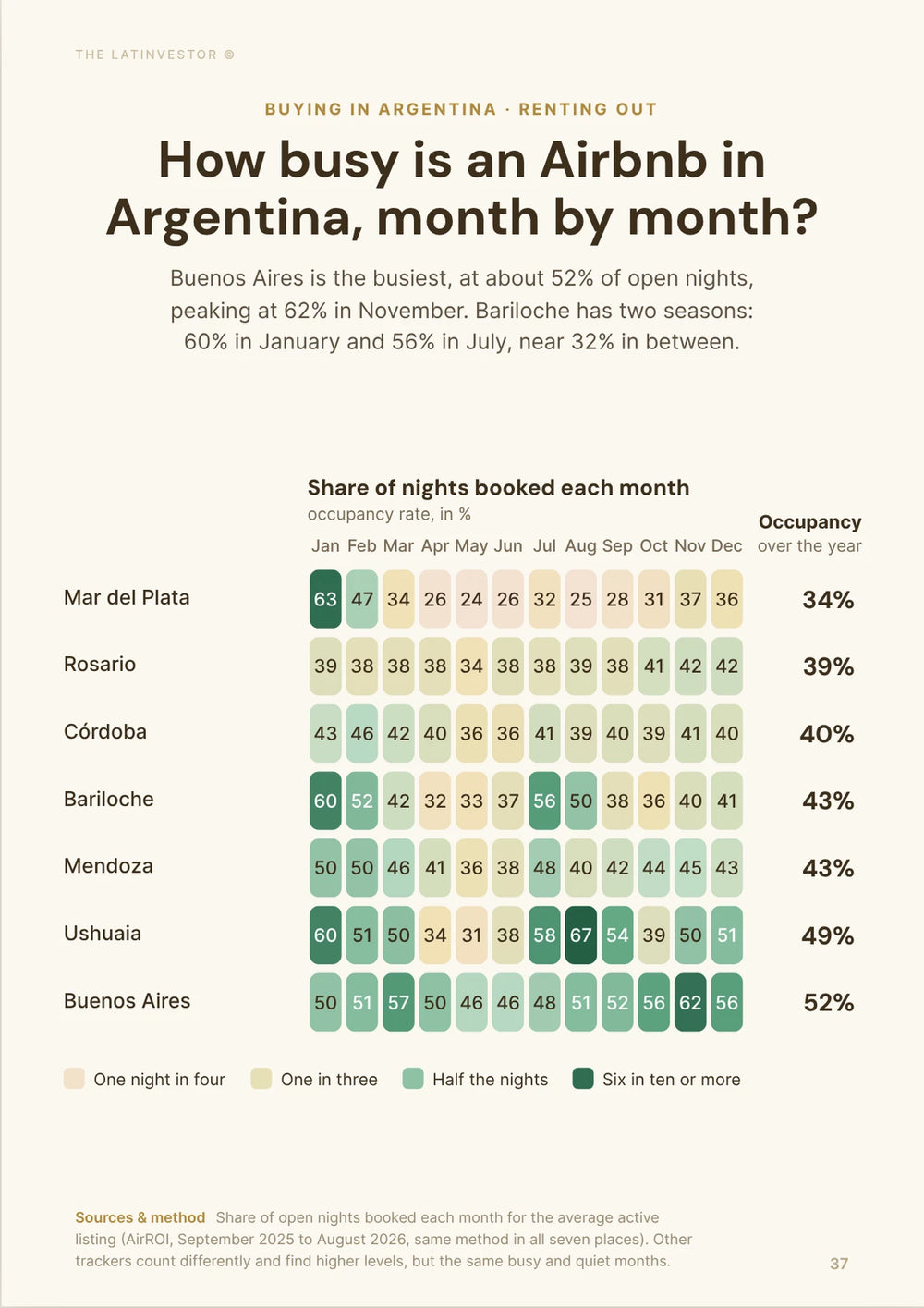
The best months to find or sign a lease are March to May and October to November; January and July are the worst, when Airbnb occupancy in Bariloche peaks near 60% and 56%.
On a typical 2-bedroom, gross yields work out at roughly 5.5% to 5.7% in Bariloche and Neuquén, before costs and before the 21% default withholding on a non-resident's rent.
Expensas average about ARS 220,000 a month in Bariloche and ARS 271,000 in Neuquén; tenants usually pay the ordinary ones, owners the extraordinary ones and the property taxes.
Vaca Muerta is the exception to soft rents: in Añelo, the average apartment listed at about ARS 1.53 million a month in May 2026, and corporate 1-bedroom leases reach about USD 1,350.
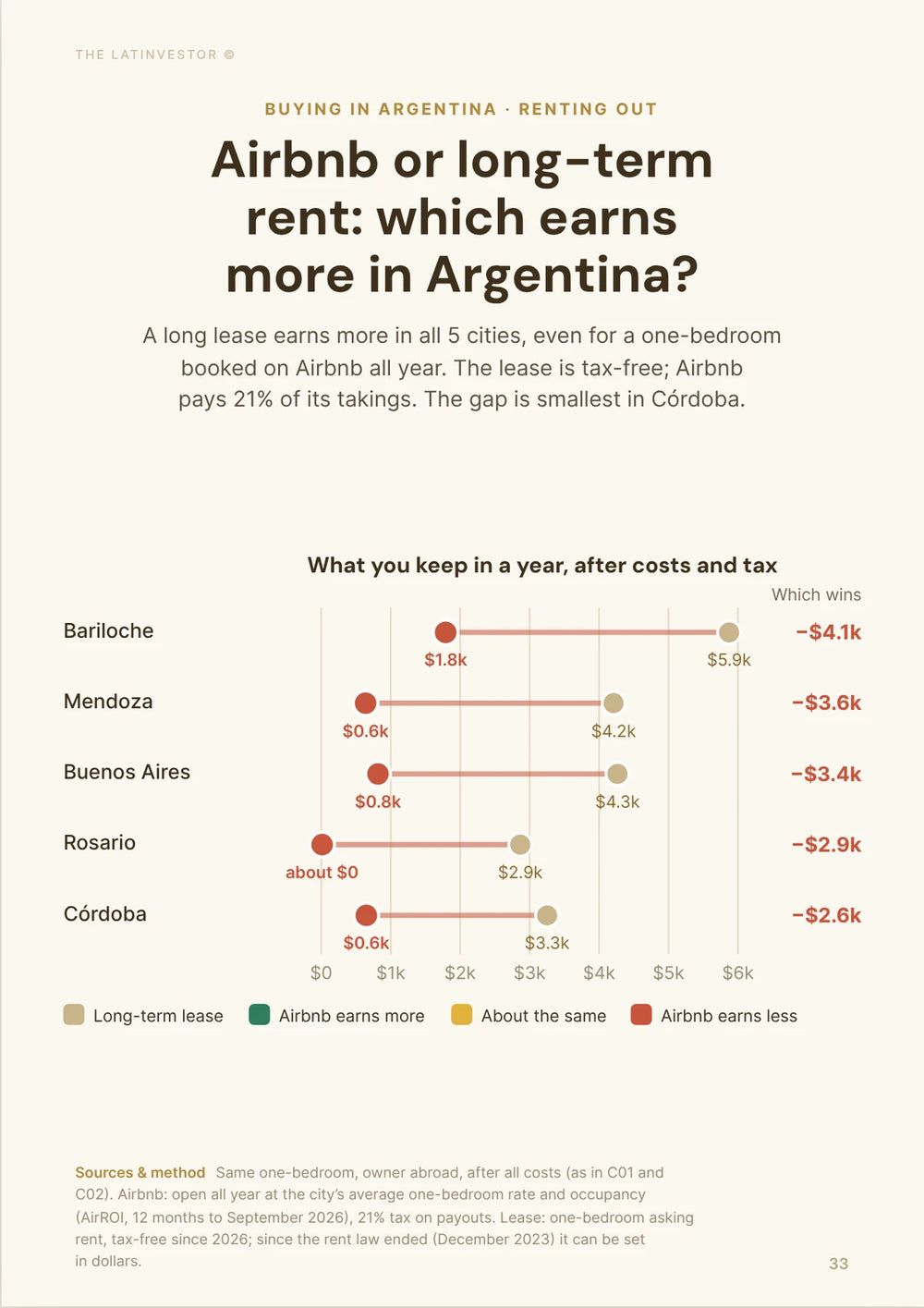
Airbnb does not automatically beat a lease: the median 2-bedroom Airbnb in Bariloche grossed about USD 8,300 over the last 12 months (AirROI), against about USD 12,200 for a year of long-term rent at asking.
Bottom line: price your lease on Roomix and portal medians, index it to inflation (rent control ended in December 2023), and run your numbers with the 21% withholding until a tax adviser confirms you are exempt.

How much does a flat rent for in Bariloche, Neuquén and Ushuaia?
This article covers Argentine Patagonia. Chilean towns such as Puerto Varas or Punta Arenas use pesos chilenos, follow Chilean tax and lease rules and are not in the figures below.
There is no Patagonia-wide rent index either, so we give town-by-town figures from the portals and indices that publish them. Most of them are asking rents, and some include the building charges (expensas), which we say each time.
What's the average monthly rent for a studio in Patagonia in 2026?
In Bariloche, the median studio (monoambiente) listed at about ARS 850,000 a month in August 2026, roughly USD 550 or EUR 490, before expensas, on Roomix's count of live ads.
Studios are rarer in Neuquén, Ushuaia and the smaller towns, and nobody publishes a reliable median for them there. In Añelo, at the heart of Vaca Muerta, studios start around ARS 1.32 million a month (USD 850), because oil companies rent them for their staff.
What moves the price of a studio most is heating and location: a small warm unit in central Bariloche rents far more easily in winter than a cheaper, colder one far from jobs and buses.
What's the average monthly rent for a 1-bedroom in Patagonia in 2026?
A 1-bedroom flat (two rooms, "2 ambientes" in Argentina) listed at about ARS 1,191,665 a month in Bariloche in May 2026, roughly USD 770 or EUR 685, the highest of all the interior cities surveyed. In Neuquén the same flat listed at about ARS 960,000 (USD 620).
Roomix gives a lower Bariloche figure, about ARS 1,000,000 (USD 645) before expensas in August 2026. The gap comes from the sample and from expensas, so a realistic range for a decent 1-bedroom in Bariloche is about ARS 1.0 to 1.2 million.
Cheaper 1-bedroom rents are found in smaller towns such as El Bolsón, Esquel, Trelew or Puerto Madryn, and in the outer areas of Bariloche. The highest are in central Neuquén, Melipal and Centro in Bariloche, and Añelo.
What's the average monthly rent for a 2-bedroom in Patagonia in 2026?
A 2-bedroom flat (three rooms) listed at about ARS 1,575,000 a month in Bariloche and ARS 1,580,250 in Neuquén in May 2026, roughly USD 1,020 or EUR 905 in both cities.
Roomix again comes in lower for Bariloche: about ARS 1,300,000 (USD 840) before expensas in August 2026. So count on about ARS 1.3 to 1.6 million for a 2-bedroom in Bariloche, depending on the area and whether expensas are included.
In Vaca Muerta it is another market: 2-bedroom units in Añelo listed at about ARS 2.0 to 2.9 million a month (USD 1,290 to USD 1,870) in May 2026.
Ushuaia sits in between. The median of all rental ads there was about ARS 1,090,000 a month (USD 705) in October 2026, expensas included, on a small sample of 21 ads, most of them apartments.
Here is a summary of what we found:
| Town | Figure | Monthly rent | Period and source |
|---|---|---|---|
| Bariloche | 1-bedroom (2 ambientes) | ARS 1,191,665 (USD 770) | May 2026, Reporte Inmobiliario |
| Bariloche | 2-bedroom (3 ambientes) | ARS 1,575,000 (USD 1,020) | May 2026, Reporte Inmobiliario |
| Bariloche | Median of all ads, with expensas | ARS 1,162,500 (USD 750) | Oct 2026, Roomix |
| Neuquén | 1-bedroom (2 ambientes) | ARS 960,000 (USD 620) | May 2026, Reporte Inmobiliario |
| Neuquén | 2-bedroom (3 ambientes) | ARS 1,580,250 (USD 1,020) | May 2026, Reporte Inmobiliario |
| Neuquén | Median of all ads, with expensas (incl. houses) | ARS 1,807,500 (USD 1,170) | Oct 2026, Roomix |
| Añelo (Vaca Muerta) | Average apartment | ARS 1,528,620 (USD 985) | May 2026, LM Neuquén |
| Ushuaia | Median of all ads, with expensas | ARS 1,090,000 (USD 705) | Oct 2026, Roomix (21 ads) |
| Comodoro Rivadavia | Median of all ads, with expensas | ARS 1,124,000 (USD 725) | Oct 2026, Roomix (14 ads) |
| Puerto Madryn | Median of all ads, with expensas | ARS 697,500 (USD 450) | Sep 2026, Roomix (22 ads) |
| San Martín de los Andes | Median apartment | USD 785 | Oct 2026, TuLugar |
| El Bolsón | Median apartment | USD 425 | Sep 2026, TuLugar |
What's the average rent per square meter in Patagonia in 2026?
In October 2026, apartments listed at about ARS 23,750 per square meter per month in Bariloche, roughly USD 15 or EUR 14, and about ARS 26,667 in Neuquén (USD 17), expensas included.
Without expensas, Roomix put Bariloche closer to ARS 20,000 per square meter (USD 13) in August 2026. Comodoro Rivadavia comes out far lower, near ARS 12,900 for all property types, but on only 14 ads.
For comparison, a 2-room flat in Buenos Aires listed at about ARS 898,154 a month in September 2026, so a 1-bedroom in Bariloche costs more than one in the capital.
Homes with double glazing, good insulation, efficient heating, parking and a short winter commute rent above these averages in every Patagonian town.
How much have rents changed year-over-year in Patagonia in 2026?
Much less than inflation. In October 2026, Roomix showed Bariloche asking rents flat (0%) over 12 months and Neuquén rents up 25%, while consumer prices rose 33.4% over the 12 months to September 2026.
In real terms, that is a fall of roughly 25% in Bariloche and 6% in Neuquén. Across the interior of Argentina rents rose faster earlier in the year, about 42.6% over 12 months for 2-room flats in May 2026; the October figures for Bariloche and Neuquén are well below that.
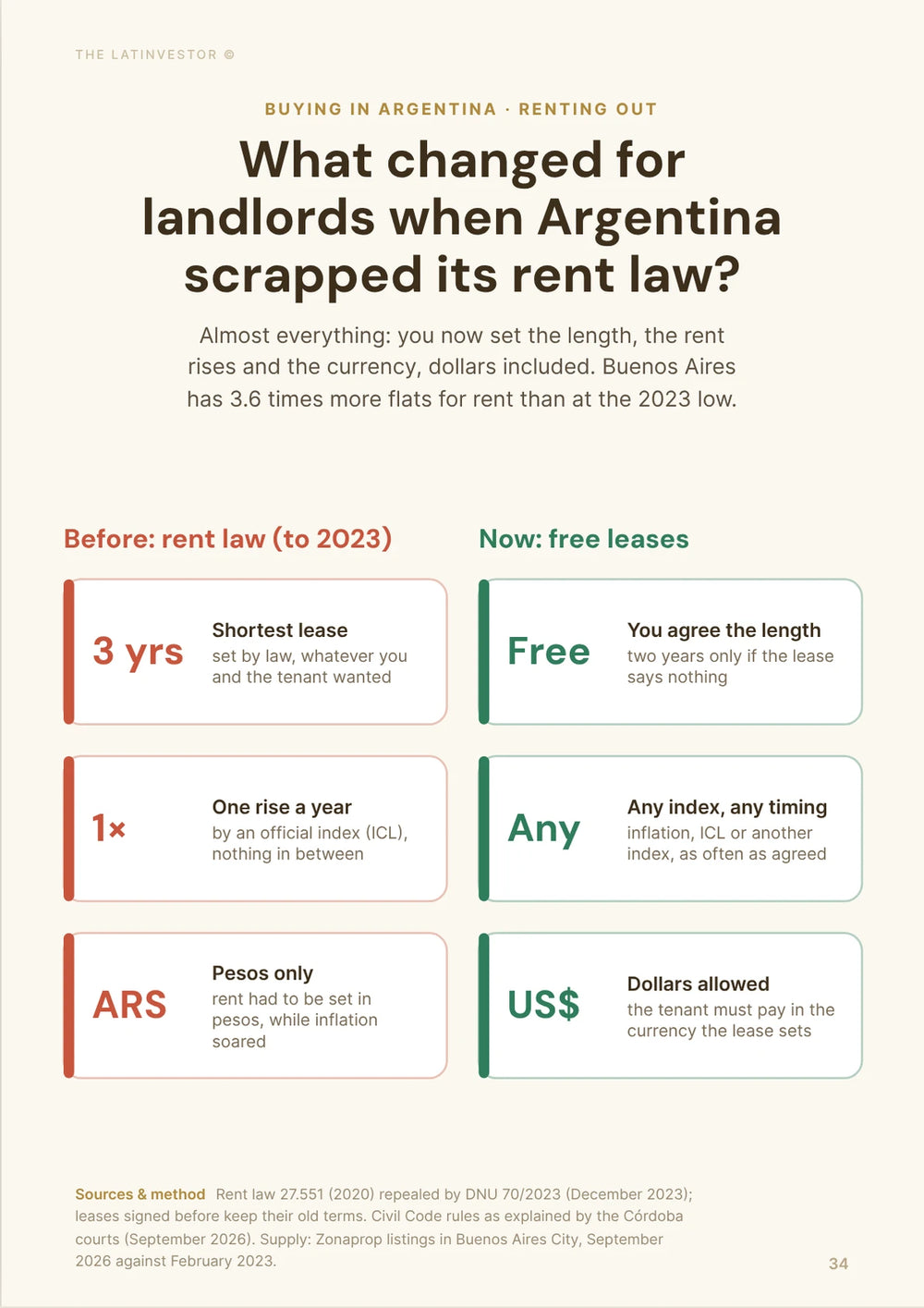
Two things explain it. Since the rent control law was scrapped in December 2023 (DNU 70/2023), owners put many flats back on the long-term market, and tenants now have more choice. And in Bariloche, many owners already charge close to what local salaries can bear.
For a landlord counting in dollars, the picture is better than it looks: the dollar rose only about 4.9% since January, so a rent that held steady in pesos lost little in dollars this year.
What's the outlook for rent growth in Patagonia in 2026?
Expect rents to follow inflation at best, not beat it, for the rest of 2026. Monthly inflation was 1.9% in September 2026, and new leases are now indexed to whatever the two sides agree, usually inflation (IPC) or the ICL index, which rose 31.5% over 12 months.
The exception is the Vaca Muerta belt around Neuquén and Añelo, where oil-company demand for staff housing keeps rents high. Bariloche and the lake towns depend more on tourism, so owners there switch between long leases and short stays depending on the season.
The main risk for landlords is a tenant who cannot follow the indexation, and the main risk for tenants is a contract indexed every month to a high index. Read the adjustment clause before signing.
Which neighborhoods rent best in Patagonia in 2026?
Which neighborhoods have the highest rents in Patagonia in 2026?
In Bariloche, Melipal has the highest median apartment rent, about USD 985 a month in October 2026, against about USD 754 in Belgrano, USD 720 in Centro and USD 624 in Las Victorias. The citywide median is about USD 722.
In Neuquén, the dearest rents are in the center and in residential areas such as Santa Genoveva and Alta Barda, close to offices, clinics and services. No index publishes medians for these areas, so we do not quote one.
The usual tenants in these areas are oil and gas staff, doctors, public-sector workers, tourism managers and families who want a warm, well-located home.
By the way, we've written a blog article detailing what are the current best areas to invest in property in Patagonia.
Where do young professionals prefer to rent in Patagonia right now?
Young professionals mostly rent in Bariloche Centro and in central Neuquén, where work, cafés, buses, hospitals and shops are within walking distance.
Expect to pay about ARS 1.0 to 1.2 million a month for a 1-bedroom in Bariloche (USD 645 to USD 770) and about ARS 960,000 in Neuquén (USD 620).
In Patagonia, good internet, reliable heating and a short commute in the snow matter more to them than nightlife.
Where do families prefer to rent in Patagonia right now?
Families in Bariloche often look in Melipal, Belgrano and the quieter areas along the Bustillo road, or in Dina Huapi, which is cheaper than the center. In Neuquén they favour Santa Genoveva and Alta Barda.
For a 2 or 3-bedroom, count about ARS 1.3 to 1.6 million a month in Bariloche (USD 840 to USD 1,020), and up to about ARS 2 million (USD 1,290) for a 4-room home. In Neuquén, 2-bedroom flats list near ARS 1.58 million.
Families pay for heating, parking, storage, safe streets, nearby schools and less driving in winter. Bilingual private schools in Bariloche, such as Woodville, also pull families toward the western side of town.
Which areas near transit or universities rent faster in Patagonia in 2026?
The areas that rent fastest are central Neuquén, near the Universidad Nacional del Comahue, and Bariloche Centro and the first kilometers of the Bustillo road, near the Universidad Nacional de Río Negro and the main bus lines.
No portal publishes days on market for Patagonia. In practice, a warm, well-priced central flat goes quickly, while a cold, remote or overpriced one can sit for months, especially in Bariloche where supply is small.
Being near a bus line, a hospital or a university helps a flat rent faster more than it raises the price: we found no reliable figure for that premium.
Which neighborhoods are most popular with expats in Patagonia right now?
Expats mostly settle in Bariloche (Centro, Melipal and the Bustillo road), San Martín de los Andes and Villa La Angostura, and to a lesser extent in El Bolsón for a cheaper, rural life.
The median apartment rent is about USD 985 a month in Melipal and USD 785 in San Martín de los Andes, against about USD 425 in El Bolsón.
These towns offer what expats want: nature, safety, furnished flats, cafés, decent internet and an easier social life than isolated towns. The most visible groups are Europeans, North Americans, Brazilians, Chileans and remote workers from Buenos Aires.
And if you are also an expat, you may want to read our exhaustive guide for expats in Patagonia.
Who rents, and what do tenants want in Patagonia right now?
What tenant profiles dominate rentals in Patagonia?
The three main groups are oil, gas and mining workers (Neuquén, Añelo, Comodoro Rivadavia), tourism and hospitality staff (Bariloche, the lake towns, Ushuaia, El Calafate), and public-sector families and professionals in every provincial capital.
No census or survey gives their exact shares, so we do not quote percentages. What we can measure is where oil demand bites: in Añelo, apartments listed about 22% above the Neuquén province average in May 2026.
Energy workers usually want 1 or 2-bedroom flats close to their base, often furnished and paid by the company. Tourism workers want cheap studios or shared flats, and families want warm 2 or 3-bedroom homes with parking.
If you want to optimize your cashflow, you can read our complete guide on how to buy and rent out in Patagonia.
Do tenants prefer furnished or unfurnished in Patagonia?
For a normal long lease, furnished does not pay much. In Bariloche, furnished listings averaged about ARS 1.1 million a month (USD 710) in August 2026, slightly below the all-ads average of about ARS 1,195,000 including expensas.
Furnished pays where tenants come for months, not years: oil staff in Neuquén and Añelo, where a furnished 1-bedroom with services included listed at about ARS 1.6 to 1.8 million plus VAT in May 2026, and seasonal workers or remote workers in the tourist towns.
In Bariloche, many furnished flats are kept for tourists in January and July and only rented long-term the rest of the year, which is why permanent tenants find so few of them.
Which amenities increase rent the most in Patagonia?
The five features that count most are efficient heating, double glazing, insulation, parking and reliable internet. In a cold, windy region, a cheap-to-heat home is the first thing tenants ask about.
Outdoor space also helps. In Bariloche, ads with a garden and grill averaged about ARS 1.3 million a month in August 2026, against about ARS 1.2 million for ads with a garage and ARS 1.15 million with a balcony. Part of that gap is simply that homes with gardens are bigger.
What renovations get the best ROI for rentals in Patagonia?
The best rental upgrades are double-glazed windows, insulation, modern heating, bathroom ventilation and durable flooring. They make the home warmer and cheaper to run, which is what tenants pay for and what keeps them through the winter.
Building costs are paid in pesos, and since prices rose about 23.6% from January to September 2026 while the dollar rose only about 4.9%, works are now much dearer in dollars than a year ago. Get quotes before you count on an upgrade paying for itself.
Poor-ROI renovations are luxury finishes, oversized kitchens and fancy landscaping that look good in photos but do nothing against cold, damp and wind.
How strong is rental demand in Patagonia in 2026?
What's the vacancy rate for rentals in Patagonia in 2026?
Nobody publishes a vacancy rate for Patagonia. The best proxy is how few rental ads there are: in October 2026, Roomix counted about 136 long-term rental ads in Bariloche against 850 homes for sale, and about 426 rental ads in Neuquén.
Few ads does not mean rising rents: Bariloche rents did not rise in a year, which tells you the limit is what local salaries can pay, not the number of flats.
Bariloche has long had a housing emergency: about 6,000 people were on the municipal housing register in late 2024, and business chambers estimated that about 40% of the tourist supply was informal.
How many days do rentals stay listed in Patagonia in 2026?
We found no published days-on-market figure for any Patagonian town, so we do not give one.
What local agents and portals show is simple: a warm, central, fairly priced 1-bedroom rents fast, while an overpriced, poorly heated or remote home can stay online for months. Timing matters too, as the next section shows.
Which months have peak tenant demand in Patagonia?
For tenants, the best months to find a long lease in Bariloche are March to May, after the summer season, and October to November, before winter. January and July are the worst, because owners keep their flats for tourists.
Tourism data shows why. Airbnb occupancy in Bariloche reached 59.9% in January 2026 and 56.4% in July 2026, against 32.1% in April.
In Neuquén and the oil towns, demand follows company hiring rather than the seasons. In provincial capitals, February and March are busy because of the school and university year.
What will my monthly costs be in Patagonia in 2026?
What property taxes should landlords expect in Patagonia in 2026?
The owner pays the provincial property tax (impuesto inmobiliario) and the municipal fee. Both are based on a fiscal value that is usually far below the market price, and each province and town has its own scale. We found no reliable typical amount for an apartment, so ask the seller for the last bills before you buy.
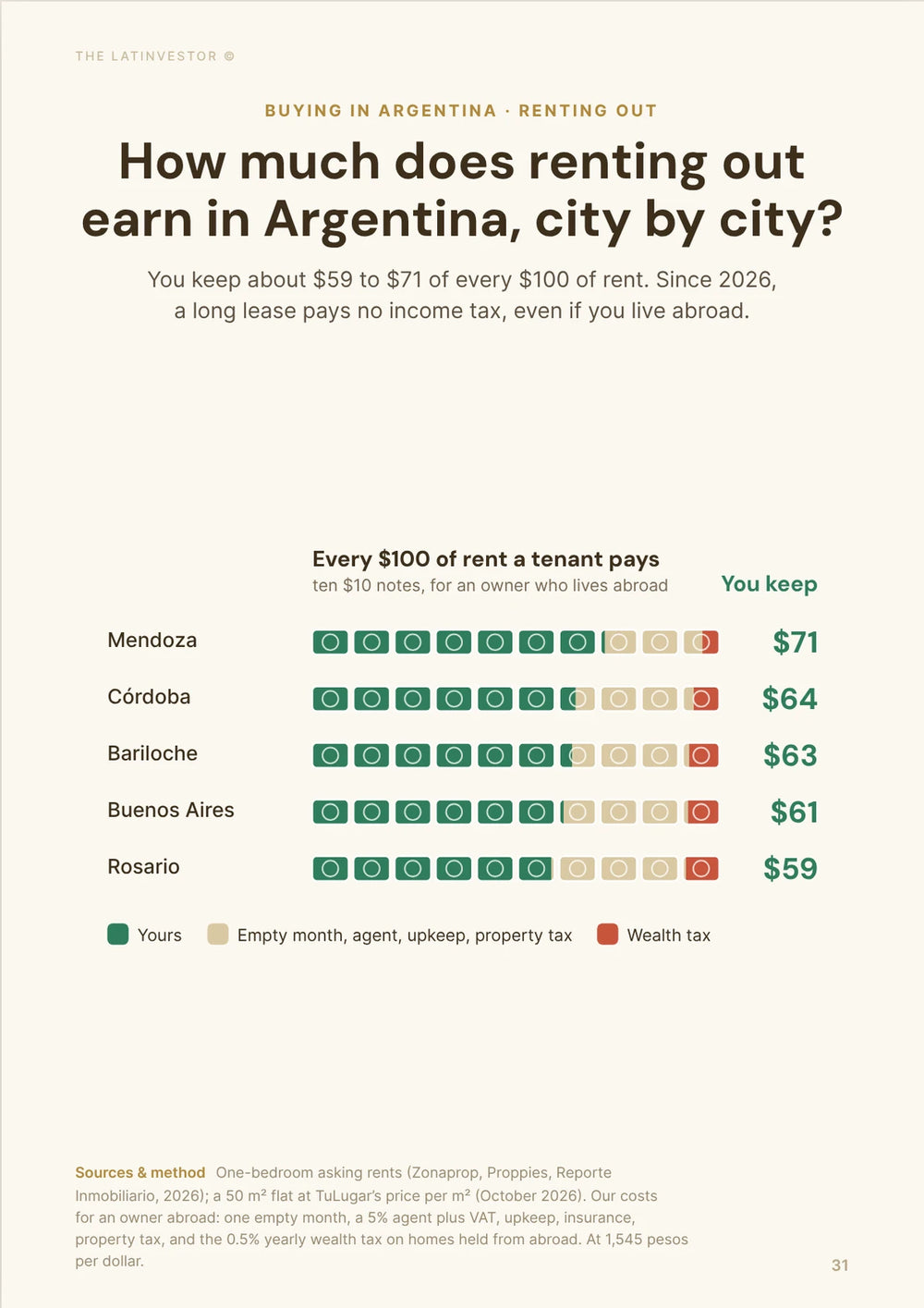
A non-resident also owes the wealth tax (Bienes Personales) on Argentine property, about 0.5% a year of its taxable value with no allowance, paid through a local representative.
Rental income is also taxed (see below), and tourist rentals add provincial gross-income tax.
What utilities do landlords often pay in Patagonia right now?
Tenants usually pay gas, electricity, water, internet and the ordinary expensas. Owners pay the extraordinary expensas (works on the building), property taxes, insurance and big repairs.
Expensas averaged about ARS 220,000 a month in Bariloche (USD 140) and ARS 271,000 in Neuquén (USD 175) in October 2026. Check them before you buy: high expensas make a flat harder to rent.
Furnished or short-stay rentals usually include internet and often utilities, so the owner takes the heating bill, which in a Patagonian winter is large.
How is rental income taxed in Patagonia in 2026?
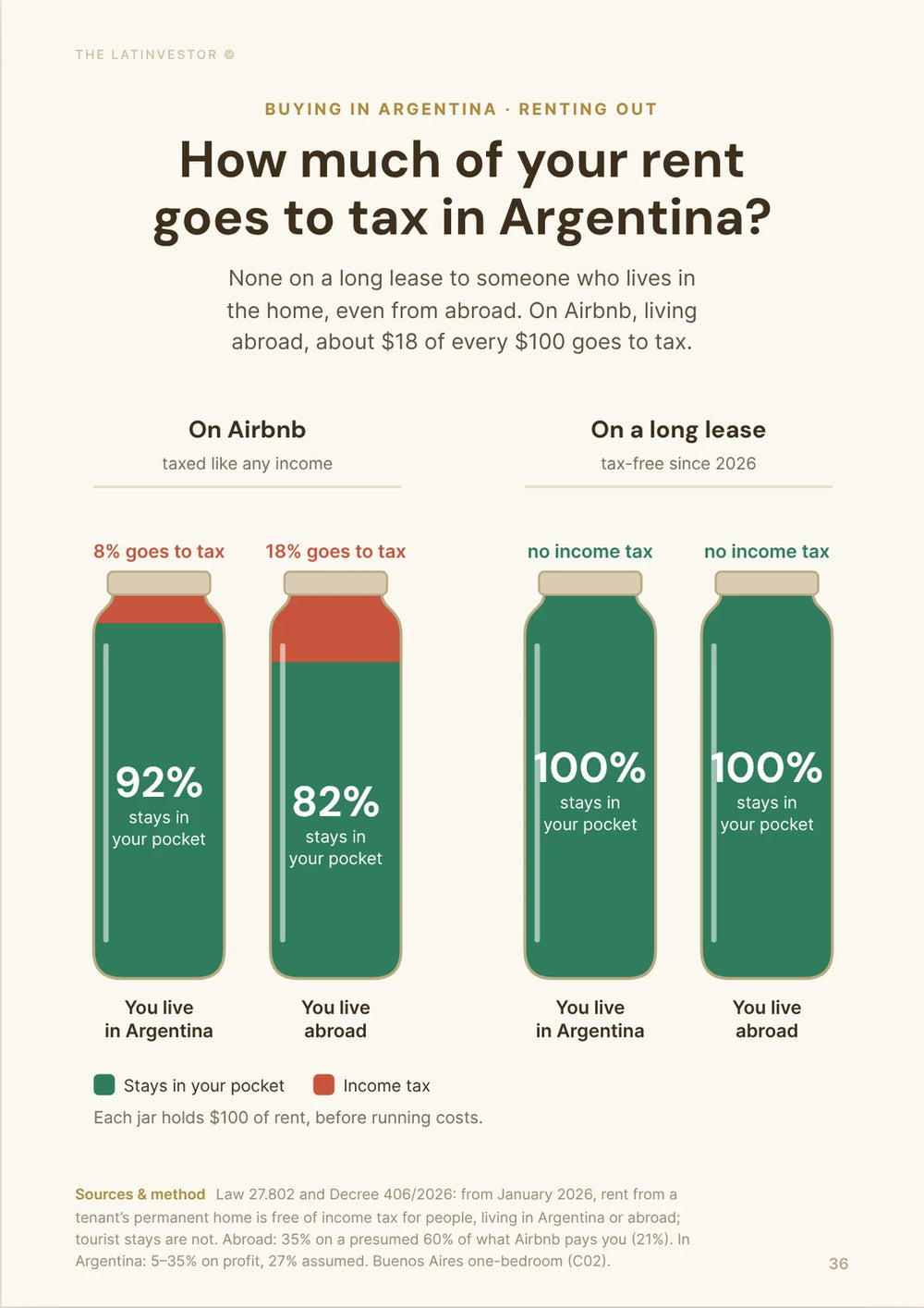
Since 1 January 2026, a resident individual who rents a home to a tenant as their permanent residence pays no income tax on that rent (Decree 406/2026, published 1 June 2026).
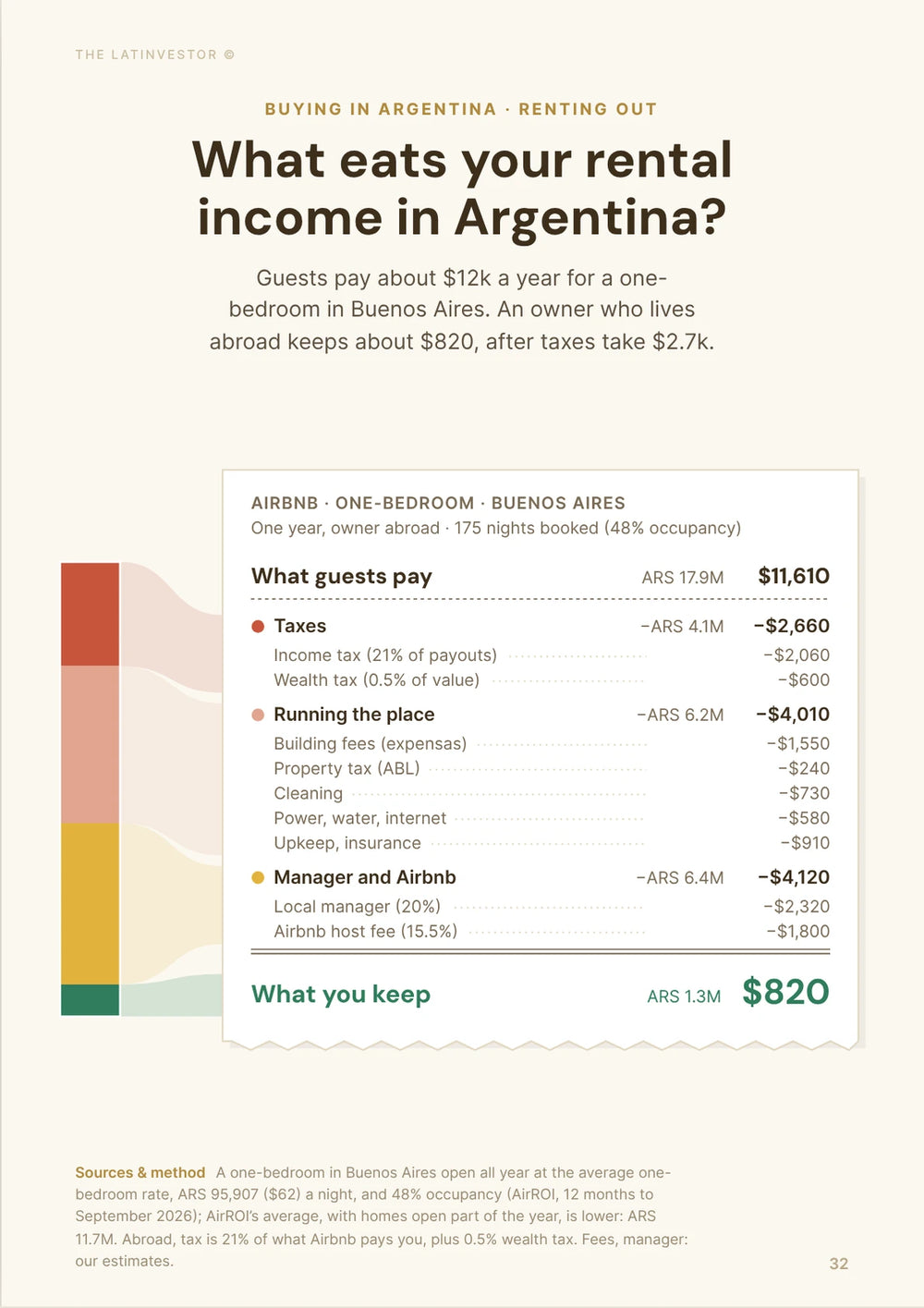
For non-resident landlords the decree is silent. Until that is settled, the safe assumption is the old rule: 35% withholding on a presumed 60% net, which is 21% of the gross rent. On a 2-bedroom yielding about 5.7% gross in Bariloche, that takes you to about 4.5% before other costs.
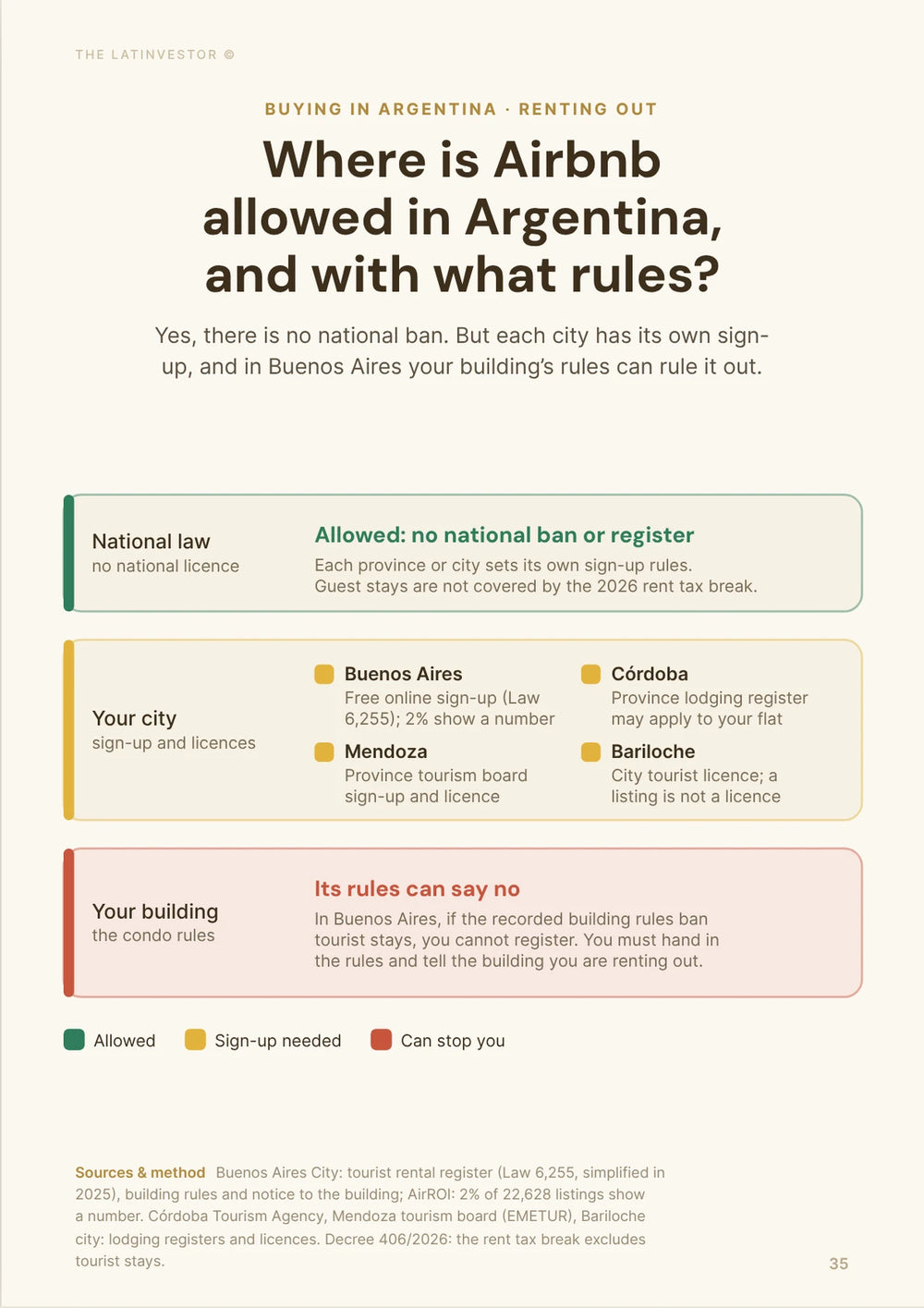
Tourist rentals are not covered by the exemption, for anyone: count 21% of gross for a non-resident, plus provincial gross-income tax and possibly VAT. The most common mistake is treating an Airbnb like a normal lease.
We cover these mistakes, among others, in our list of risks and pitfalls people face when buying property in Patagonia.
What gross yield do Patagonia rents give on today's prices?
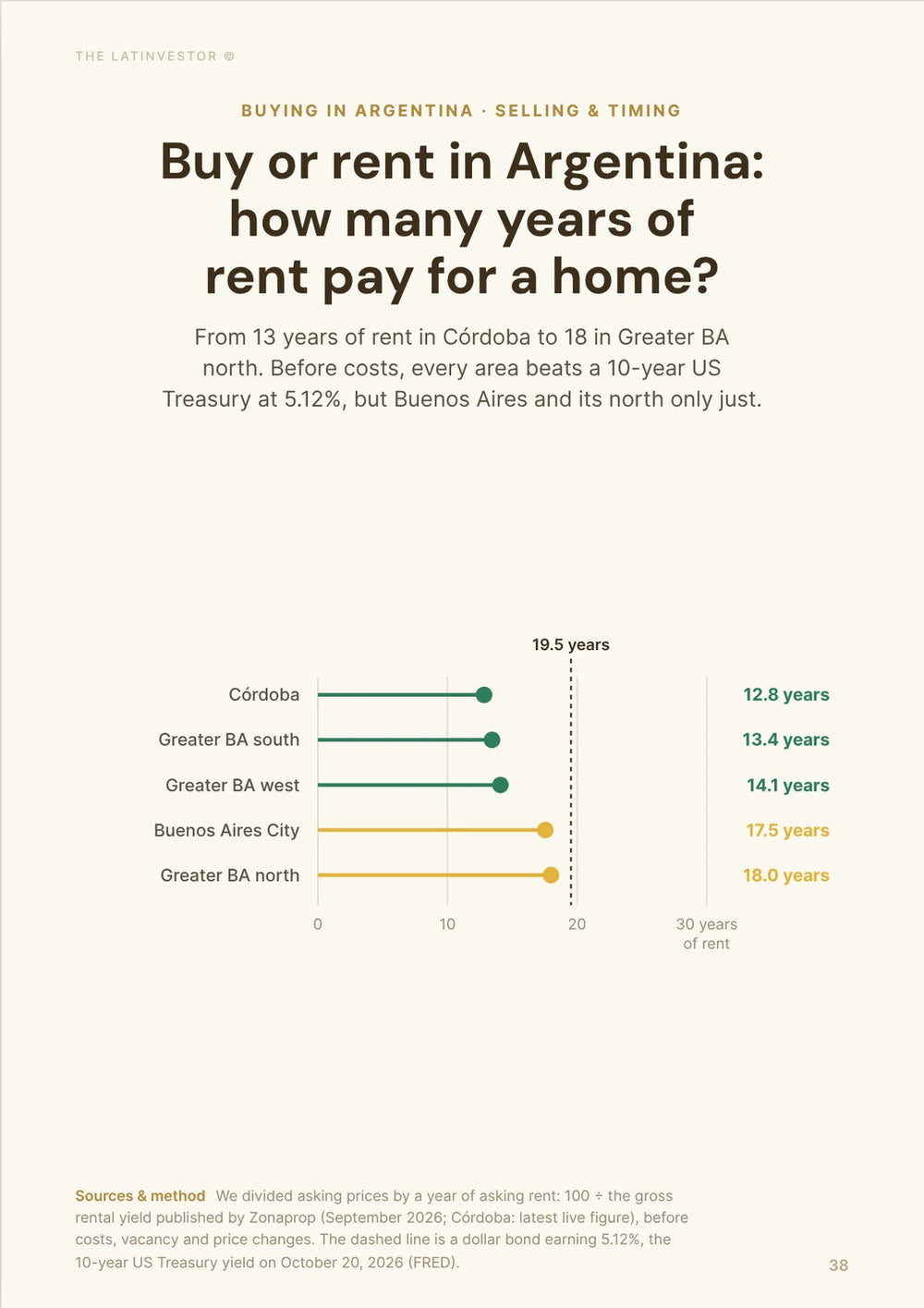
Roughly 5.5% to 6% gross on a typical flat. A 2-bedroom in Bariloche rents for about ARS 1,575,000 a month, or about ARS 18.9 million a year (USD 12,200), against a median asking price of about USD 215,000: about 5.7% gross. A 1-bedroom gives about 6%.
In Neuquén, the same 2-bedroom rent against a median asking price of about USD 223,000 gives about 5.5% gross. That is close to Buenos Aires City, at 5.70% in September 2026.
Net is lower. Take off expensas you cannot pass on, property taxes, vacant months, the agent and, if you live abroad, the 21% withholding and the 0.5% wealth tax. A foreign owner should expect something nearer 3.5% to 4%.
What to do: buy below the median price per square meter (negotiate on stale listings), favour 1-bedrooms in central areas, and do not pay a lake-view premium if you plan a long lease, because tenants do not pay much more for the view.
Is Vaca Muerta pushing rents up in Neuquén and Añelo?
Yes in Añelo, much less in Neuquén city. In May 2026, the average apartment in Añelo listed at about ARS 1,528,620 a month (USD 985), 22% above the province average, and a 32 m² 1-bedroom leased to a company could reach about USD 1,350 a month.
Neuquén city feels the oil boom too, but its rents rose 25% in a year to October 2026, less than inflation. The city has more supply, and many oil workers live in company housing or commute to the fields.
What to check: in Añelo, tenants are mostly companies, so your income depends on a few contracts and on oil activity. Ask for corporate lease terms in dollars, check who pays services, and keep in mind that a slowdown in drilling would empty units fast.
Does Airbnb still beat a long lease in Bariloche and the lake towns?
Not by default. Over October 2025 to September 2026, the median 2-bedroom Airbnb in Bariloche grossed about ARS 12 million, or about USD 8,300 at AirROI's own rate of ARS 1,443 per dollar, and the average one about ARS 16.8 million (USD 11,600). A year of long-term rent at the May 2026 asking price is about ARS 18.9 million, or USD 12,200 at ARS 1,550.
Occupancy is low outside the peaks: 39.7% on average in Bariloche, 36.0% in San Martín de los Andes and 44.7% in Ushuaia. And competition is growing: active listings rose about 52% in a year in San Martín de los Andes, 37% in El Calafate and 17% in Ushuaia.
Short stays also cost more: the Airbnb host fee of 15.5%, cleaning, furniture, heating bills, a tourist licence from the municipality, and taxes the lease exemption does not cover.
What to do: short stays make sense for a well-placed flat you also use yourself, or a property near Cerro Catedral or the lake. For pure income, compare the median, not the best listings, against a long lease, and consider a mixed plan: mid-term stays for workers and students from March to June and September to December, tourists in January and July.
Related blog posts
- Is it a good time to buy property in Patagonia now?
- How expensive is property in Patagonia now?
- Where is the best place to buy in Patagonia?
- How much does a house cost in Patagonia?
- How much does land cost in Patagonia?
- Moving to Patagonia? Here's everything you need to know (2026)
Our methodology
This article estimates long-term rents in Argentine Patagonia: rents by size and per square meter town by town, how they changed over a year, the best areas, tenant demand, landlord costs and taxes, gross yields and how a long lease compares with Airbnb.
Rents by size come from the Reporte Inmobiliario survey published by La Nación (May 2026) and the Roomix Bariloche guide (August 2026); medians, rents per square meter, expensas, ad counts and yearly changes from the Roomix indices (October 2026); area medians from TuLugar (October 2026); Vaca Muerta rents from LM Neuquén (May 2026), which compiled Zonaprop, Argenprop, Properati and iCasas listings; Airbnb figures from AirROI (October 2025 to September 2026). Yields divide asking rents by TuLugar median asking prices.
Rules come from Decree 406/2026, Estudio Piccinini's June 2026 note on non-resident landlords, DNU 70/2023 and the Civil and Commercial Code, the Neuquén and Río Negro tax agencies and the Bariloche municipality. Comparisons use INDEC inflation, Zonaprop for Buenos Aires and Infobae for the dollar.
We checked these figures in October 2026. Peso amounts are converted at about ARS 1,550 per US dollar (official and MEP rates were within 1% of each other on 22 October 2026, the blue rate about ARS 1,570), and euro amounts at about ARS 1,740 per euro.
Where we had no direct figure, we said so: there is no Patagonia-wide rent index, vacancy rate or days-on-market figure, no reliable rent median for Neuquén areas, and no measured premium for furnished flats, amenities or renovations. Some Roomix samples are small (14 to 22 ads). All rents are asking rents, not signed leases, and Chilean Patagonia is not covered.
Key sources used for this analysis include La Nación (Reporte Inmobiliario), Roomix Bariloche, Roomix Neuquén, Roomix Bariloche rent guide, TuLugar Bariloche, LM Neuquén, AirROI Bariloche, Zonaprop Bariloche, Zonaprop Neuquén, Argenprop Bariloche, Mercado Libre Inmuebles Bariloche, Decree 406/2026, Estudio Piccinini, Neuquén tax office, Río Negro tax agency, INDEC, BCRA REM and Infobae.