Summary
Yes, but slowly: Mendoza asking rents for apartments rose only 4.6% to 12.8% between January and August 2026, while inflation was about 21% over the same months (INDEC), so rents are falling in real terms.
A 1-bedroom apartment in the city of Mendoza was listed at about ARS 558,000 a month in August 2026 (USD 360), a studio at about ARS 437,000 and a 2 to 3-bedroom at about ARS 754,000.
Quinta Sección (Sección 5) is the priciest central area for apartments, with a median listing around USD 657 a month in October 2026, against USD 460 for the whole city.
Young professionals usually pay ARS 550,000 to ARS 1 million a month in Ciudad, Quinta Sección and the connected parts of Godoy Cruz.
Families looking at 2 to 3-bedroom houses pay about ARS 1.1 million a month on average across the province, and much more for large homes in Luján de Cuyo.
A furnished apartment usually asks roughly 15% to 30% more than the same unit empty, mainly from expats, students and temporary workers.
Supply is the big story: apartment listings tracked by InmoUP jumped from 1,167 to 1,504 between January and August 2026 (+29%), and house listings rose 58%.
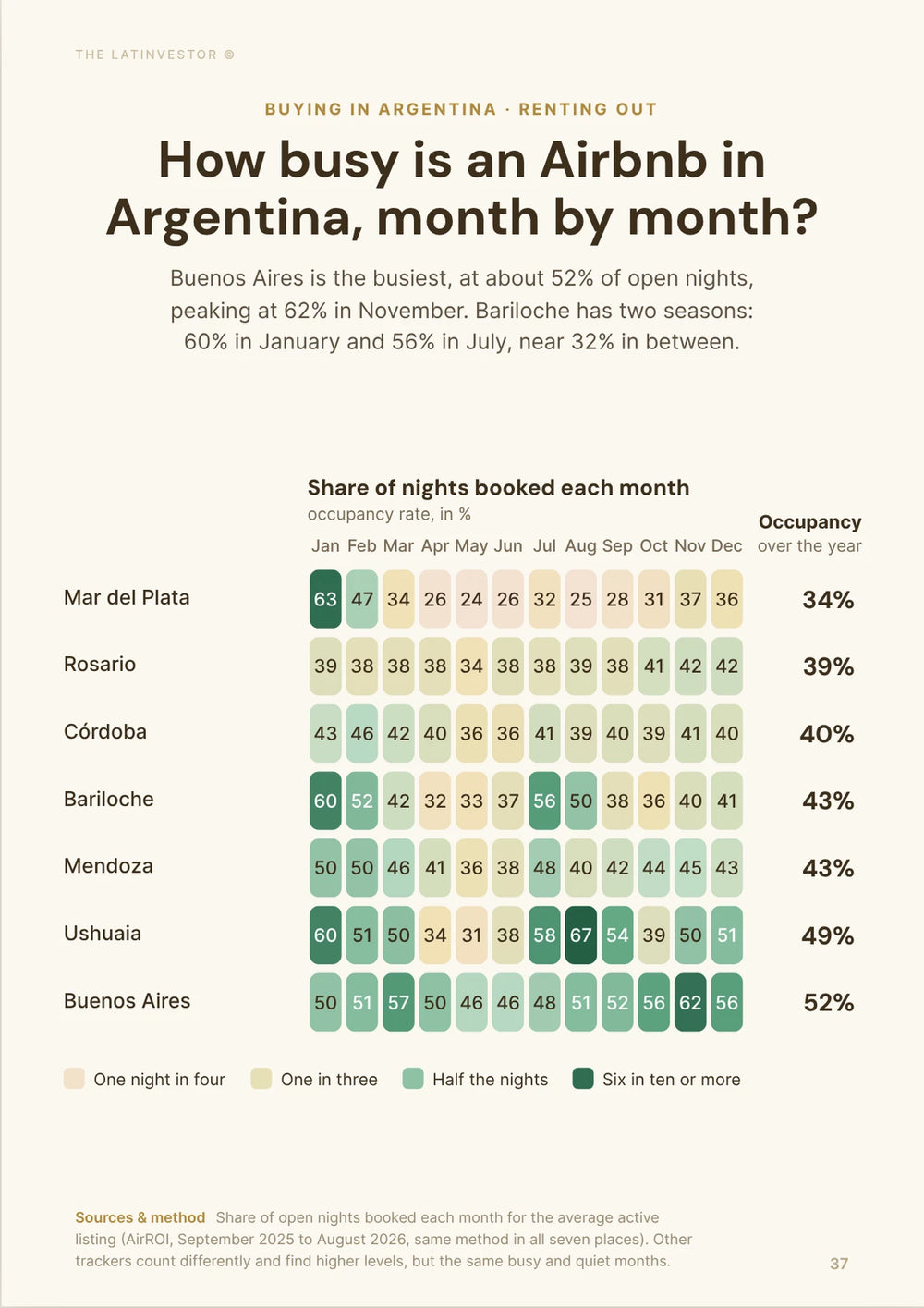
Demand peaks in February and March with the university year, and Airbnb demand peaks in January and February (49.6% occupancy).
A landlord should budget about ARS 80,000 to ARS 300,000 a year of provincial property tax for a typical apartment.
Long rents for a tenant's permanent home are exempt from income tax for resident individuals since 1 January 2026, but a non-resident landlord should plan on about 21% of gross rent unless an adviser confirms the exemption.
At city averages, a 2 to 3-bedroom apartment bought around USD 97,000 earns about 6% gross a year from a long lease.
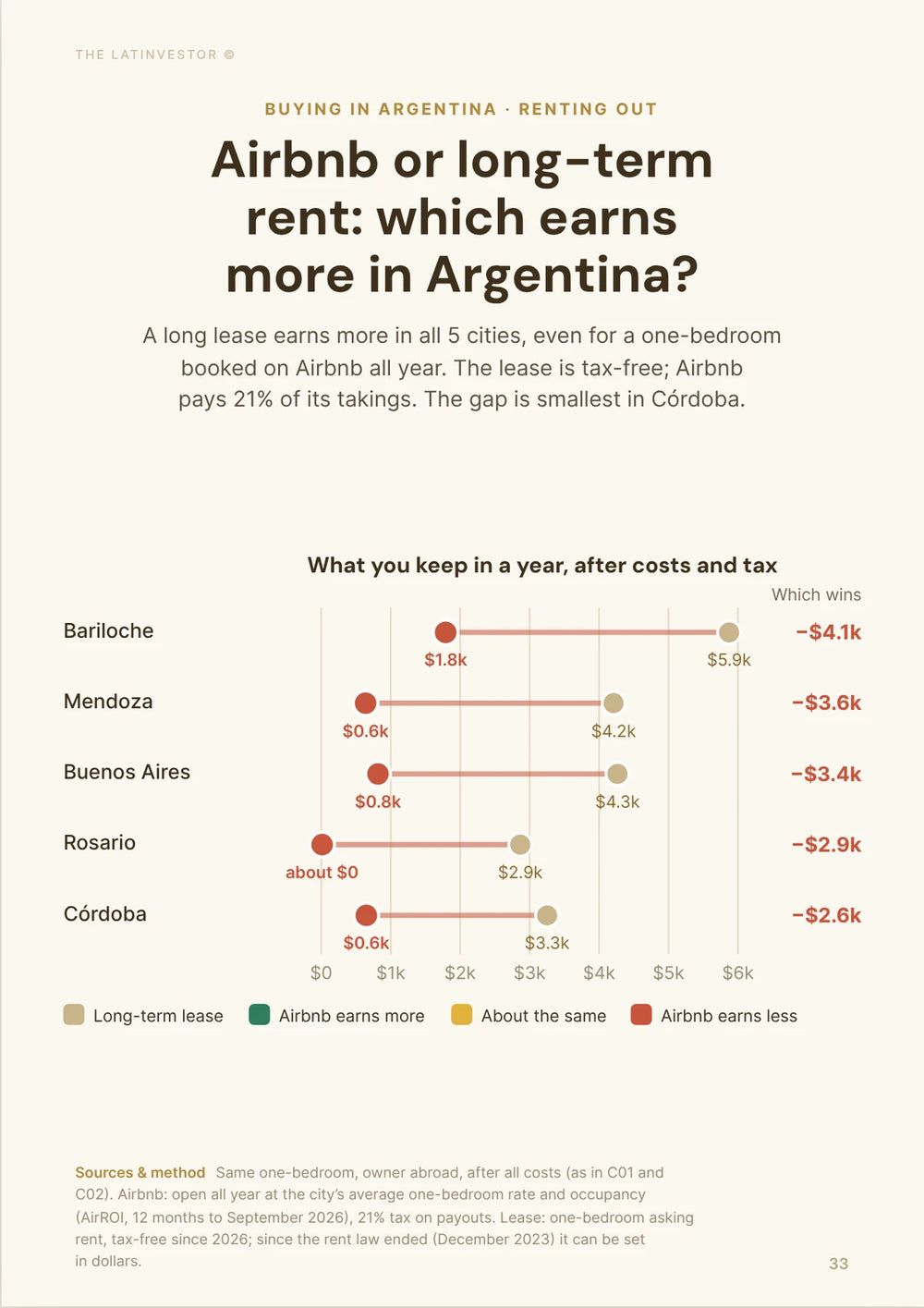
A long lease on a 1-bedroom (about USD 4,320 a year) beats the median Airbnb 1-bedroom in Mendoza (about USD 3,740 a year before fees, AirROI), so short-term only pays if your unit is well above average.
Bottom line: with record supply and stretched tenant budgets, price realistically, expect rent to lag inflation for now, and buy for a gross yield of about 6% rather than for fast rent growth.

How much does an apartment rent for in Mendoza in 2026?
Mendoza is cheap next to Buenos Aires: a 1-bedroom in the city lists for about ARS 558,000 a month against about ARS 898,000 for a 2-room unit in Buenos Aires (Zonaprop, September 2026). Central apartments in Ciudad, Quinta Sección, Godoy Cruz and houses in Chacras de Coria still rent at a clear premium.
What's the average monthly rent for a studio in Mendoza in 2026?
In August 2026, the average asking rent for a studio (monoambiente) in the city of Mendoza was about ARS 437,000 a month, roughly USD 280 or EUR 250.
Across Gran Mendoza, average studio asking rents run from about ARS 437,000 in the city to about ARS 531,000 in Godoy Cruz (USD 280 to USD 345, EUR 250 to EUR 305), with the provincial average at about ARS 454,000.
Studios barely moved this year: +2.8% in the city and +4.6% across the province between January and August 2026. They are the weakest segment because students and single workers have the tightest budgets.
These are listing prices, not signed contracts.
We cross-checked them with live listings on Zonaprop and Mercado Libre Inmuebles.
What's the average monthly rent for a 1-bedroom in Mendoza in 2026?
In August 2026, a 1-bedroom apartment in the city of Mendoza was listed at about ARS 558,000 a month on average, roughly USD 360 or EUR 320.
Across Gran Mendoza, 1-bedroom asking rents run from about ARS 412,000 in Las Heras to about ARS 595,000 in Luján de Cuyo (USD 265 to USD 385, EUR 235 to EUR 340). Godoy Cruz sits around ARS 576,000 and Guaymallén around ARS 471,000.
Another index, Reporte Inmobiliario, put a city 2-room (1-bedroom) unit higher, at about ARS 762,000 in May 2026, because it measures a different sample of listings. Expect well-located, recent buildings near Quinta Sección or Plaza Independencia to ask closer to that figure.
We checked live examples on Argenprop.
What's the average monthly rent for a 2-bedroom in Mendoza in 2026?
In August 2026, a 2 to 3-bedroom apartment in the city of Mendoza was listed at about ARS 754,000 a month on average, roughly USD 485 or EUR 435.
Across Gran Mendoza, the same category runs from about ARS 636,000 in Guaymallén to about ARS 869,000 in Luján de Cuyo (USD 410 to USD 560, EUR 365 to EUR 500). Reporte Inmobiliario had a city 3-room (2-bedroom) unit at about ARS 956,000 in May 2026.
The cheapest 2-bedroom rents are in older buildings in Guaymallén, Las Heras and outer Maipú. The most expensive are in Quinta Sección, premium Ciudad buildings and Luján de Cuyo, where this segment jumped 20.1% in eight months.
We gave more weight to normal long-term apartments than to furnished or dollar-priced listings.
What's the average rent per square meter in Mendoza in 2026?
No portal publishes a clean rent per square meter for Mendoza. Using the August 2026 averages and typical unit sizes (about 45 m² for a 1-bedroom, 65 m² for a 2-bedroom), rents work out to roughly ARS 11,000 to ARS 13,000 per square meter a month, about USD 7 to USD 8 or EUR 6 to EUR 7.
Rent per square meter goes above that when the apartment has air conditioning, good heating, a garage, security, furniture or a location near Quinta Sección or Parque General San Martín. Older, larger units in outer departments go below it.
Treat it as a rough guide, not an index.
How much have rents changed in Mendoza in 2026?
Between January and August 2026, average apartment asking rents in Mendoza rose 4.6% for studios, 12.8% for 1-bedrooms, 8.2% for 2 to 3-bedrooms and 13.1% for larger units. Inflation over the same months was about 21.3%.
So in real terms, asking rents fell by roughly 7% to 14% this year. Tenants have more choice, and wages have not kept up: InmoUP's director summed it up as "families can't make it to the end of the month, and rents can't rise above inflation".
There are exceptions. Luján de Cuyo apartments (+20.1%), Maipú (+16.5%) and cheap units in Las Heras (+45%, catching up from a very low base) rose faster. Some house segments fell in pesos, like 2 to 3-bedroom houses in Godoy Cruz (−10.3%) and Las Heras (−14.6%).
We found no reliable 12-month rent change for Mendoza, so we use the January to August change.
What's the outlook for rent growth in Mendoza in 2026?
Expect new asking rents to keep rising more slowly than inflation until the extra supply is absorbed. Monthly inflation was 1.9% in September 2026, and the new listings keep tenants in a position to negotiate.
Existing contracts are different: most leases signed more than a year ago adjust every three or four months in line with inflation, so sitting tenants keep paying increases close to the inflation rate.
The areas most likely to hold up are Quinta Sección, central Ciudad, Godoy Cruz near the Metrotranvía and Luján de Cuyo, where demand from families and professionals is strongest. The main risk is a sharp change in inflation or the dollar, which can turn any forecast quickly.
Which neighborhoods rent best in Mendoza in 2026?
The best rental areas are not only the most expensive ones. A good rental area also needs enough tenants, easy access, and a rent level that local incomes can pay.
Which neighborhoods have the highest rents in Mendoza in 2026?
Inside the city, TuLugar's October 2026 medians put Sección 5 (Residencial Sur, the Quinta Sección area) at about USD 657 a month, well above the city median of USD 460. Sección 10 (Residencial Los Cerros) is the top at about USD 1,200, mostly larger homes. Another index, Roomix, puts Quinta Sección at about ARS 1.22 million a month including building fees (USD 790).
Outside the city, Luján de Cuyo, which includes Chacras de Coria, has the priciest houses: large homes (more than 3 bedrooms) averaged about ARS 2.58 million a month in August 2026 (USD 1,660 or EUR 1,480).
These areas command premium rents because Quinta Sección has the park and walkability, Chacras de Coria has space and a village feel, and central Ciudad has restaurants, services and short commutes. Tenants are expats, higher-income professionals and families.
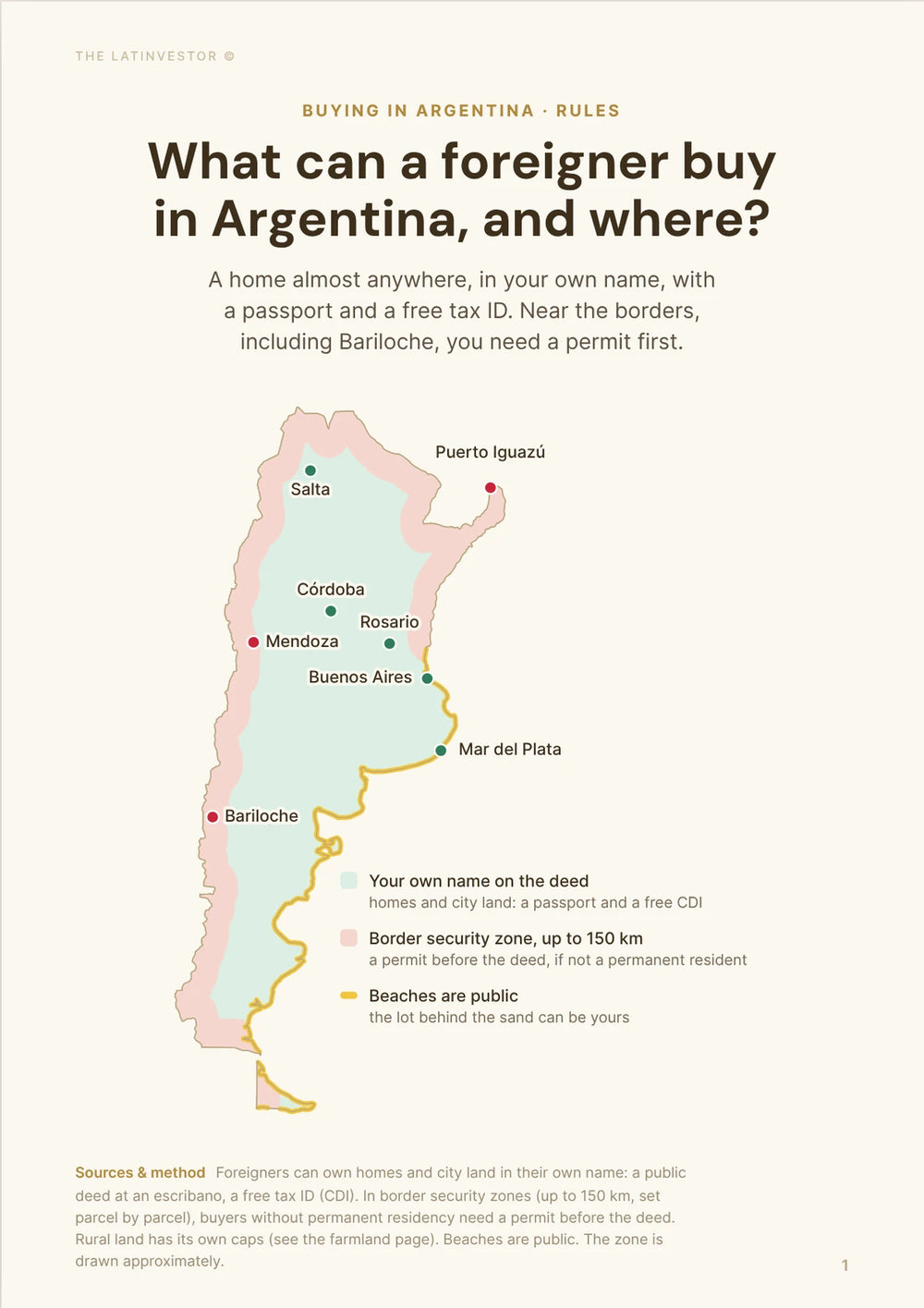
By the way, we've written a blog article detailing what are the current best areas to invest in property in Mendoza.
We separated apartments from houses because Mendoza has two different premium markets.
Where do young professionals prefer to rent in Mendoza right now?
Young professionals mostly rent in Ciudad de Mendoza, Quinta Sección and the connected parts of Godoy Cruz such as Villa Hipódromo and the San Martín Sur and Beltrán corridors.
They usually pay about ARS 550,000 to ARS 1 million a month, or about USD 355 to USD 645 (EUR 315 to EUR 575), from a city 1-bedroom up to a good unit in Quinta Sección.
What they want: cafés, offices, gyms, transport, decent internet and a short commute.
Where do families prefer to rent in Mendoza right now?
Families mostly rent in Godoy Cruz, Luján de Cuyo (including Chacras de Coria), Guaymallén and Maipú, where they get more space for the money.
A 2 to 3-bedroom house averaged about ARS 1.1 million a month across the province in August 2026 (USD 710 or EUR 635), from about ARS 1.08 million in Guaymallén to about ARS 1.32 million in Luján de Cuyo and ARS 1.33 million in the city. A 2 to 3-bedroom apartment in Godoy Cruz is cheaper, around ARS 703,000.
Families want parking, patios, quiet streets, security and schools nearby, with private school options around Godoy Cruz, Luján de Cuyo and Chacras de Coria and the Universidad Nacional de Cuyo near Parque General San Martín.
Which areas near transit or universities rent faster in Mendoza in 2026?
The units that rent fastest are in Quinta Sección near Parque General San Martín and the UNCuyo campus, central Ciudad along the Belgrano corridor, and Godoy Cruz near Metrotranvía stops.
The Metrotranvía extensions toward Godoy Cruz, Luján de Cuyo and the airport were about 80% built in September 2026, which should widen the list of well-connected rental areas once they open.
We found no published figure for the rent premium near stations or the campus. From listings, it is modest: location near transit helps a unit rent faster more than it lifts the rent.
Which neighborhoods are most popular with expats in Mendoza right now?
Expats mostly choose Quinta Sección, Chacras de Coria and central Ciudad around Plaza Independencia and Arístides Villanueva.
Many expat-grade rentals are priced in dollars: the median dollar-priced 2 to 3-bedroom apartment listed in Mendoza was USD 945 a month in August 2026 (EUR 840). Overall, expats usually pay about USD 500 to USD 1,200 a month (EUR 445 to EUR 1,070).
They come for wine country, the mountains, safety and a slower pace, and they want furnished units they can move into quickly. North Americans, Europeans, Brazilians, Chileans and remote workers are the most visible groups.
And if you are also an expat, you may want to read our exhaustive guide for expats in Mendoza.
Who rents, and what do tenants want in Mendoza right now?
Mendoza tenant demand is mixed, which is good for landlords: the market does not depend on a single type of renter.
What tenant profiles dominate rentals in Mendoza?
The three main groups are local workers and couples (the largest group), students and young professionals, and families who want space but are not buying yet. Expats and temporary workers are a small but well-paying slice.
Local workers and couples want studios or 1-bedrooms, students want cheap small units near Ciudad or UNCuyo, and families want 2 to 3-bedroom homes in Godoy Cruz, Guaymallén, Maipú, Chacras de Coria or Luján de Cuyo. 1-bedroom and 2 to 3-bedroom apartments made up over 95% of the apartment listings InmoUP tracked in August 2026.
If you want to optimize your cashflow, you can read our complete guide on how to buy and rent out in Mendoza.
No official source splits Mendoza tenants by profile, so this ranking is our reading of the market.
Do tenants prefer furnished or unfurnished in Mendoza?
Most long-term tenants in Mendoza rent unfurnished. Furnished units are a niche for expats, students, temporary professionals and remote workers who want to move in quickly.
A furnished apartment usually asks roughly 15% to 30% more than the same unit empty. On a city 1-bedroom at about ARS 558,000, that is about ARS 85,000 to ARS 165,000 more a month (USD 55 to USD 105, EUR 49 to EUR 95).
Watch the comparison: furnished listings often include some bills or are for shorter stays, so part of that premium pays for services, not furniture.
The premium is our own estimate from listings; no index tracks it.
Which amenities increase rent the most in Mendoza?
The five amenities that lift rent the most in Mendoza are air conditioning, efficient heating, a garage, security and furniture. Mendoza has hot summers and cold winters, so tenants pay for comfort in both seasons.
From listings, a garage is the biggest single add-on, often worth around ARS 70,000 to ARS 150,000 a month (USD 45 to USD 97). Air conditioning and good heating each add less, but a unit without them can sit empty in January or July.
These are rough listing-based estimates.
What renovations get the best ROI for rentals in Mendoza?
The five renovations that pay back best in a Mendoza rental are a split air-conditioning unit, efficient heating, a refreshed bathroom, a better kitchen, and fresh paint with good lighting.
With rents rising slower than inflation, upgrades mostly help you rent faster and keep a good tenant, not push the rent up much. A furnished premium of 15% to 30% is the clearest gain, but only if you target expats or temporary tenants.
Avoid luxury finishes in weak locations, expensive custom furniture, and big renovations on small units. Spend on heat, cooling, security, storage and daily comfort.
How strong is rental demand in Mendoza in 2026?
Demand is steady, but supply grew faster. Apartment listings tracked by InmoUP rose from 1,167 in January to 1,504 in August 2026 (+29%), and house listings went from 370 to 585 (+58%), a record.
What's the vacancy rate for rentals in Mendoza in 2026?
There is no official vacancy rate for Mendoza rentals. What we know is that listings rose sharply in 2026: +29% for apartments and +58% for houses between January and August.
That means vacancy is clearly higher than in the tight 2023–2024 market. Good apartments in Quinta Sección, Ciudad and Godoy Cruz still rent quickly when the price is realistic, while overpriced units and large houses in outer areas wait.
Without an official vacancy rate, we describe the trend instead of giving a percentage.
How many days do rentals stay listed in Mendoza in 2026?
No portal publishes days on market for Mendoza. From listing patterns, a correctly priced apartment usually rents within about a month, while overpriced furnished units and large houses can wait two to three months.
Rentals take longer than a year ago because tenants have more choice: with listings up 29%, overpricing is the most common reason a unit sits empty.
These durations are practical estimates, not an index.
Which months have peak tenant demand in Mendoza?
Long-term demand peaks in February and March, when the university year and new jobs start, with a second wave in July and August for mid-year moves.
Short-term demand follows tourism: Airbnb occupancy in Mendoza peaked at 49.6% in January and February 2026 and was lowest in May (35.8%). The quieter months for long leases are usually May, June and late December.
What will my monthly costs be in Mendoza in 2026?
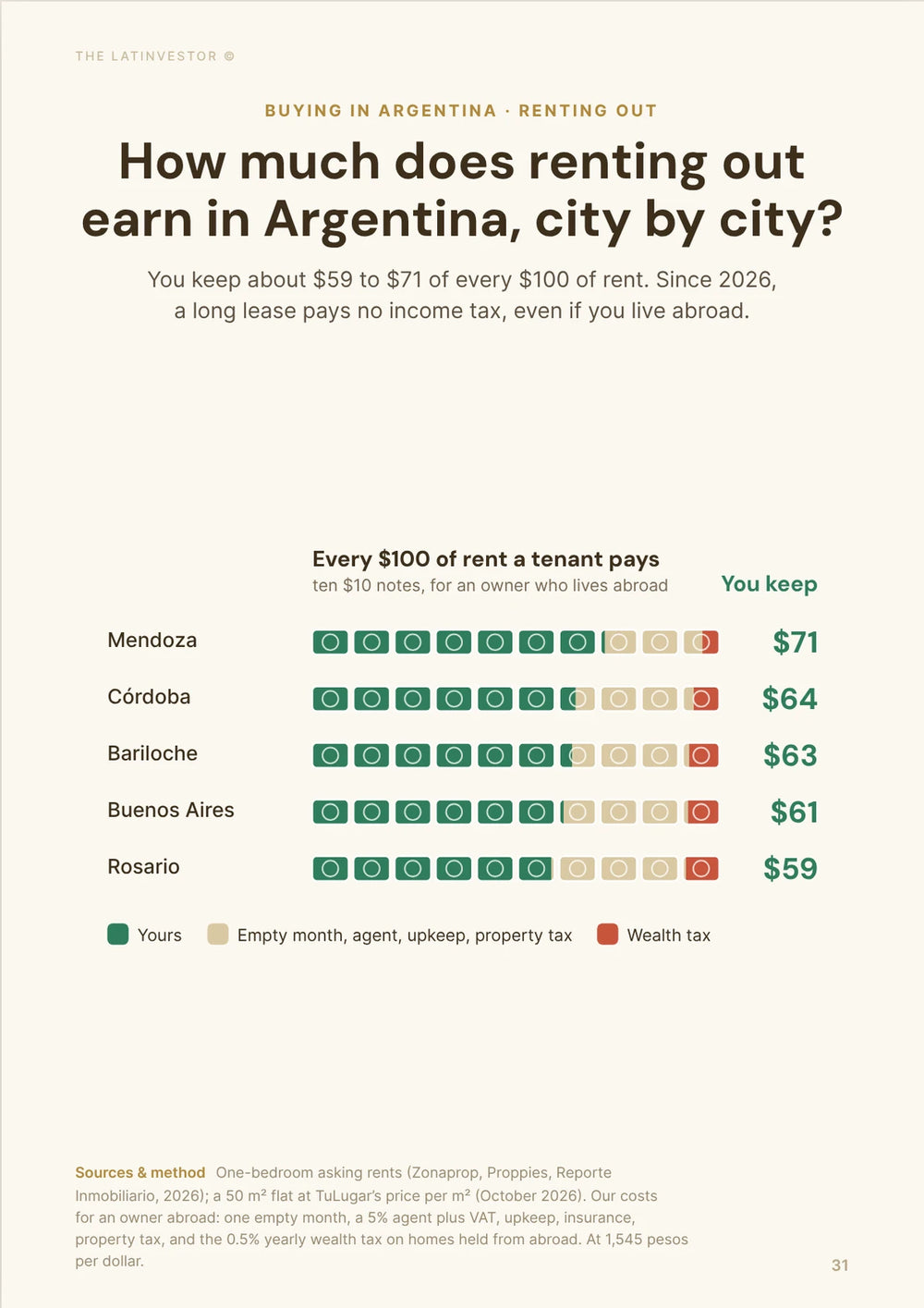
For a normal apartment, a safe recurring-cost budget is about 18% to 28% of gross rent before income tax and financing, covering property tax, insurance, repairs, empty months and letting fees.
What property taxes should landlords expect in Mendoza in 2026?
A typical Mendoza apartment pays roughly ARS 80,000 to ARS 300,000 a year of provincial property tax (impuesto inmobiliario), about USD 52 to USD 195 or EUR 46 to EUR 170.
The tax is based on the fiscal value set by ATM, not on the market price, so two similar apartments can pay quite different bills. Ask the seller for the latest ATM bills before you buy; they are easy to get online.
The range is an estimate: we found no verified typical 2026 bill, because each one depends on the parcel's fiscal value.
What utilities do landlords often pay in Mendoza right now?
In a long-term unfurnished lease, tenants usually pay electricity, gas, water, internet and ordinary building fees (expensas). Landlords pay property tax, insurance, extraordinary building expenses and major repairs.
In furnished or temporary rentals, landlords often include bills. Budget roughly ARS 25,000 to ARS 60,000 a month for internet and ARS 60,000 to ARS 180,000 for ordinary expensas (USD 39 to USD 115), plus electricity and gas, which spike in January and July.
The amounts are rough estimates.
How is rental income taxed in Mendoza in 2026?
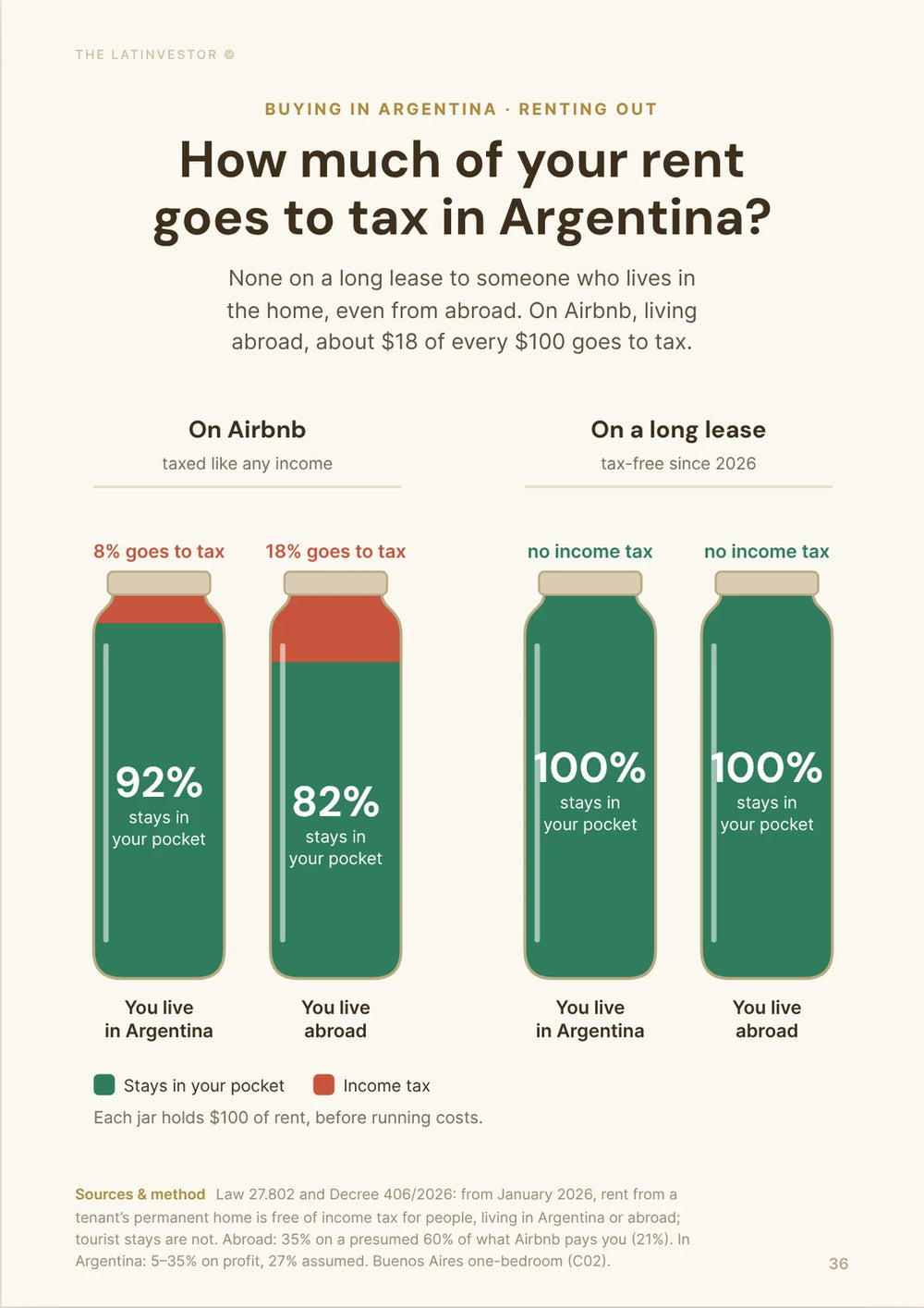
Since 1 January 2026, rent from a home let as the tenant's permanent family home is exempt from income tax for resident individuals (Decree 406/2026, published 1 June 2026). It covers every qualifying unit, not only one.
For non-resident landlords, the decree is silent, so the exemption is not confirmed. Until a tax adviser says otherwise, plan on the old rule: 35% withheld on a presumed 60% net, so about 21% of gross rent. On a 2 to 3-bedroom city apartment at about ARS 754,000 a month, that is about ARS 158,000 a month (USD 100).
Tourist and short stays are not covered by the exemption, and they can add provincial gross-income tax and VAT. Owners also pay Bienes Personales (wealth tax) on Argentine property, through a local representative for non-residents.
The biggest mistakes: treating a furnished or tourist rental like a normal permanent home rental, forgetting provincial property tax, and failing to keep receipts. We cover these mistakes, among others, in our list of risks and pitfalls people face when buying property in Mendoza.
Why are Mendoza rents falling behind inflation in 2026?
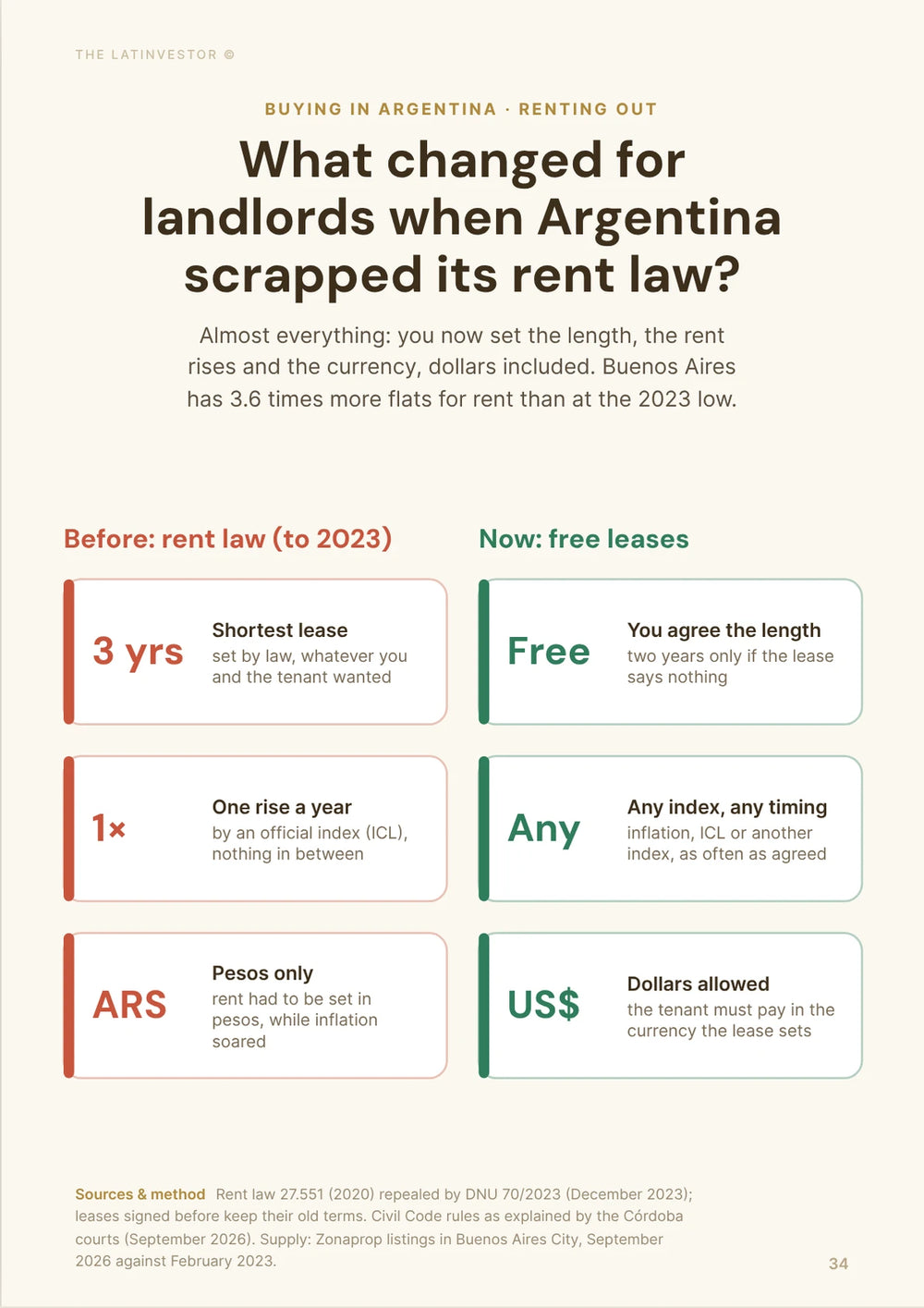
Three things happened at once. Rent control ended with DNU 70/2023, so owners who had kept units empty put them back on the market. Listings then hit records in 2026: +29% for apartments and +58% for houses between January and August. And wages lagged prices, so tenants cannot pay much more.
The result: asking rents rose 4.6% to 13.1% in eight months against about 21% inflation. For tenants, this is the best moment in years to negotiate. For landlords, the rent you can get is set by the 1,504 other apartments listed, not by inflation.
What to do as a landlord: price at or just under the department average (about ARS 558,000 for a city 1-bedroom), offer a quarterly inflation adjustment rather than a high starting rent, and spend on air conditioning and heating before raising the price.
Long lease or Airbnb in Mendoza: which pays more in 2026?
For a typical apartment, the long lease wins. A city 1-bedroom at about ARS 558,000 a month earns about ARS 6.7 million a year (USD 4,320) before empty months. The median entire-home 1-bedroom on Airbnb in Mendoza grossed about ARS 5.4 million over October 2025 to September 2026, and the average one ARS 7 million; AirROI converts at its own ARS 1,443 per dollar, so that is about USD 3,740 and USD 4,860.
Airbnb then takes a 15.5% host fee, and you pay cleaning, utilities and often a co-host (about 10%). Occupancy was only 41% for 1-bedrooms, and active listings fell 16% in a year, a sign that many hosts moved back to long leases.
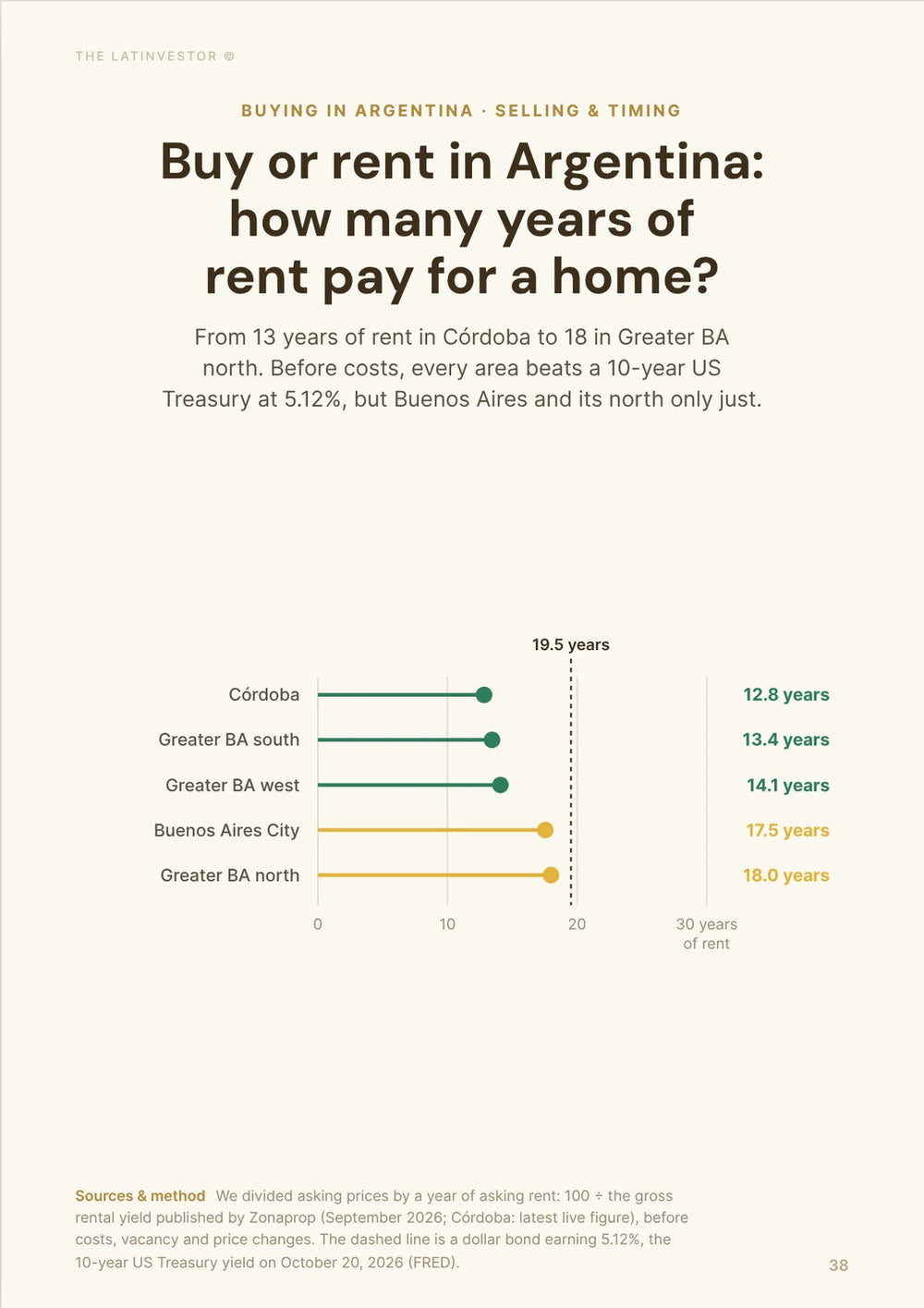
On the purchase side, a city 2-bedroom apartment lists around USD 97,000 (TuLugar, October 2026). Rented at the city average for 2 to 3-bedrooms, it earns about 6% gross a year, before costs and before tax, which can take about 21% of gross rent for a non-resident.
Short-term only makes sense if your unit is clearly above average: great location in Quinta Sección or near the wineries, strong photos and reviews, and EMETUR registration where the provincial lodging rules apply.
The long-lease figure uses asking rents with no vacancy, so the real gap is a bit smaller.
Our methodology
This article estimates long-term residential rents in Mendoza in 2026: studios, 1-bedrooms, 2-bedrooms, neighborhoods, tenant demand, landlord costs, rental tax, and how a long lease compares with Airbnb.
Rents by type and department come from the InmoUP rental observatory (average asking rents, January to August 2026), checked against Reporte Inmobiliario (May 2026) and TuLugar neighborhood medians (October 2026). Sale prices come from TuLugar, Airbnb figures from AirROI, and supply trends from InmoUP, El Sol and Memo. All rents are asking prices, not signed contracts.
Tax rules come from Decree 406/2026, Estudio Piccinini and ARCA for income tax, and ATM Mendoza for provincial property tax. Inflation comes from INDEC and market expectations from the BCRA REM survey.
We checked these figures in October 2026. Peso amounts are converted at about ARS 1,550 per US dollar (official and MEP rates were within 1% of each other on 22 October 2026, the blue rate about ARS 1,570), and euro amounts at about ARS 1,740 per euro.
Where we had no direct figure (rent per square meter, vacancy, days on market, furnished and amenity premiums, typical property tax bill), we give our own estimate from listings and say so in the section. We found no reliable 12-month rent change for Mendoza, so we use the January to August 2026 change.
Key sources used for this analysis include InmoUP rental observatory, Reporte Inmobiliario via La Nación, TuLugar Mendoza, Índice Roomix, AirROI Mendoza, El Sol, Memo, INDEC, INDEC EPH microdata, INDEC Visualizador de Indicadores de Precios, BCRA REM, BCRA exchange-rate data, Properati Mendoza rentals, Zonaprop Mendoza rentals, Mercado Libre Inmuebles Mendoza, Argenprop Mendoza rentals, ATM Mendoza Ley Impositiva 2026, ATM Mendoza property tax FAQ, Decree 406/2026, Estudio Piccinini, ARCA Ganancias, Mendoza Tourism Observatory, STM Metrotranvía, UNCuyo, Diario Mendoza and Inmodata reporting and RUA LAREU.