Summary
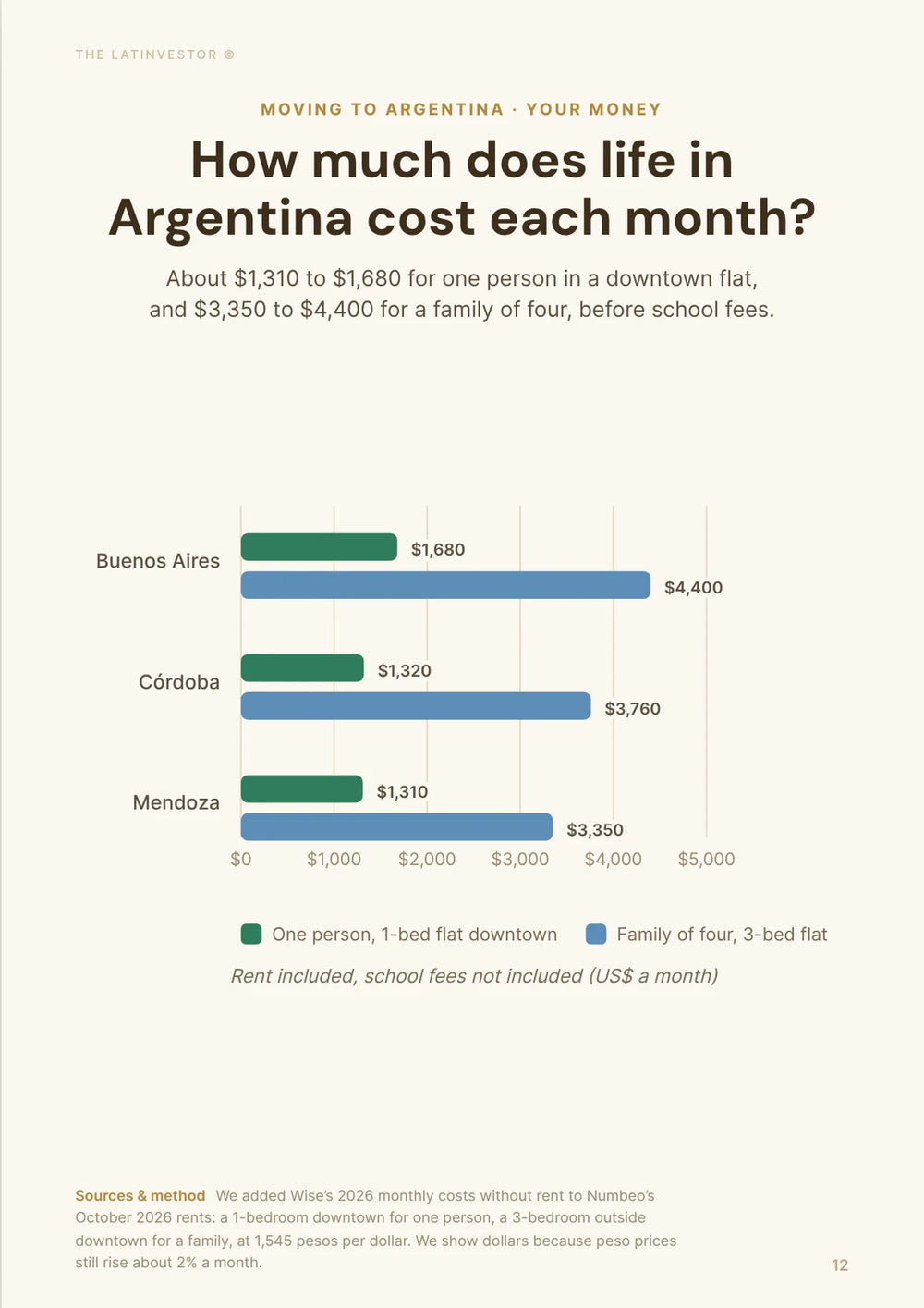
Is Mendoza a good place to live as an expat? Yes, for most people who want wine country, the Andes and a calm city at lower cost than Buenos Aires. By our estimate, a comfortable single life costs about ARS 1,800,000 to ARS 2,400,000 (USD 1,170 to 1,550) a month.
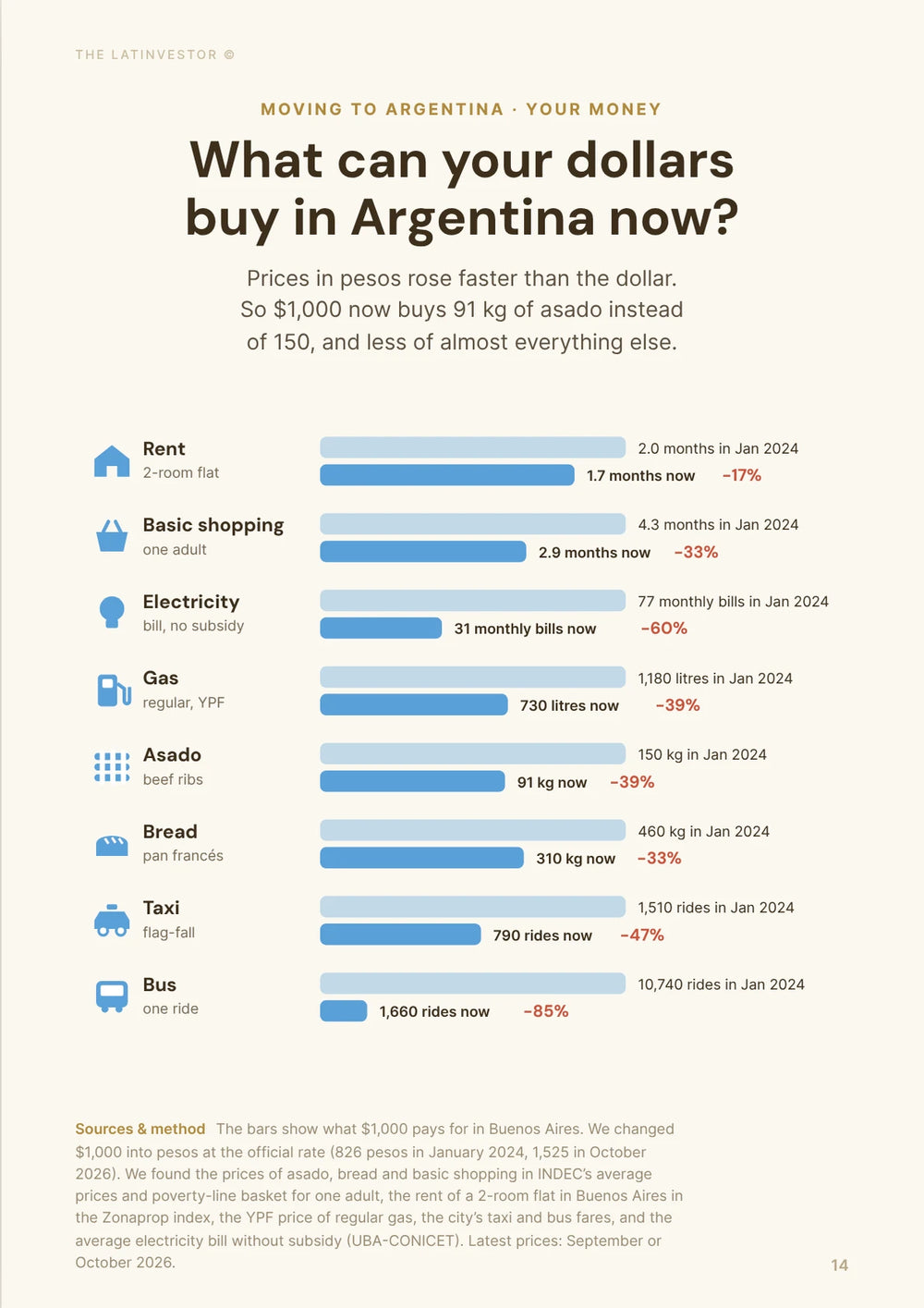
Inflation is far lower than at its peak, at 33.4% over the year to September 2026, but prices still move month to month, and with the peso almost flat against the dollar in 2026, the city got pricier for dollar earners.
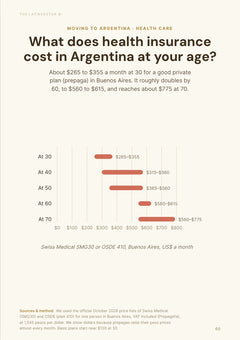
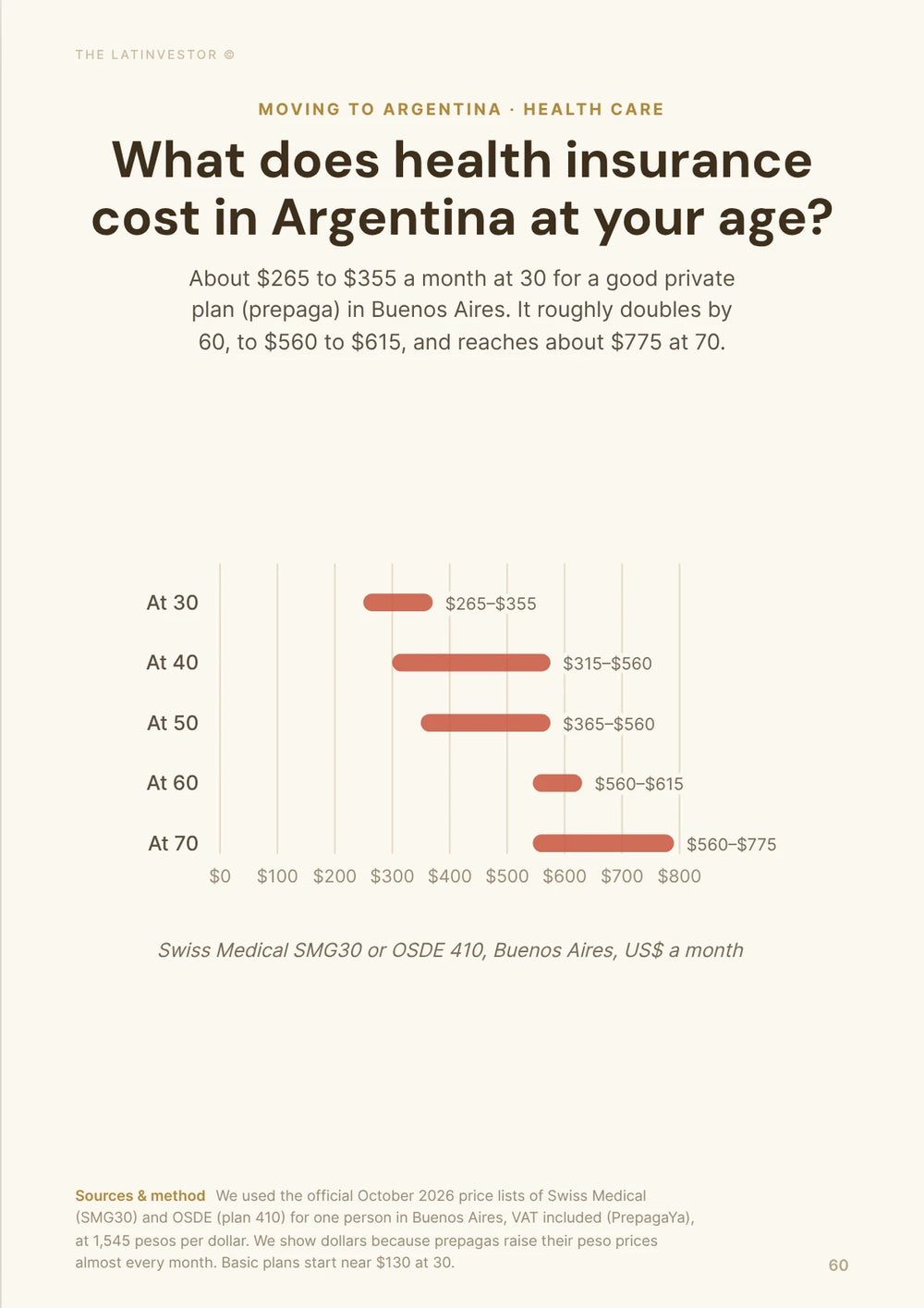
Healthcare is adequate for most needs, with Clínica de Cuyo, Hospital Español and Hospital Central. A private health plan for a 30-year-old lists at roughly ARS 200,000 to ARS 550,000 a month.
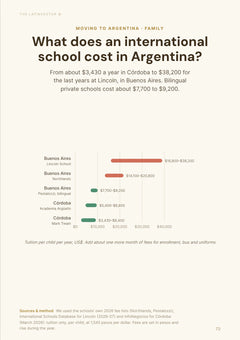
Bilingual schools such as Mendoza English School and Colegio ICEI are few and competitive. Fees are rarely published, the province caps fees at subsidized private schools (new scale from March 2026), and enrollment adds one to two months of tuition.
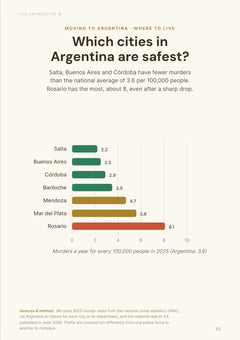
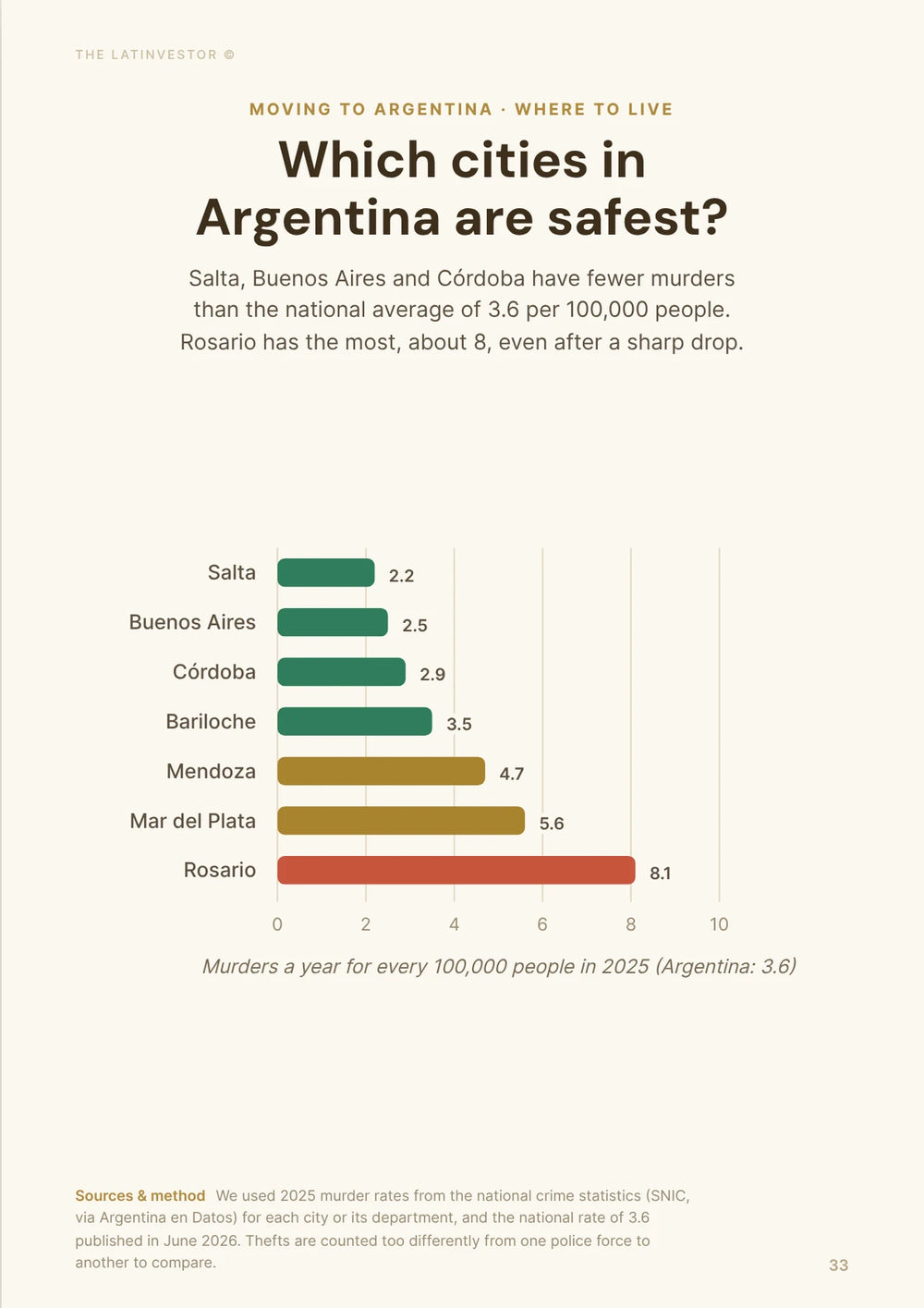
Mendoza feels relaxed, but it is not safer than Buenos Aires on paper: 4.7 homicides per 100,000 in 2025 against 2.5, and a Numbeo crime index of 66.1 against 62.9. Quinta Sección, La Bombal, Chacras de Coria and Dalvian are the usual picks.
Rent takes 35% to 45% of a budget, with a central one-bedroom at about ARS 840,000 a month. A modest single life costs ARS 1,100,000 to ARS 1,500,000, and an upscale couple needs ARS 3,000,000 to ARS 4,000,000.
Income tax is national, from 5% to 35%, and depends on your salary and deductions. Employees also pay 17% in social contributions.
Mendoza province had about 65,700 foreign-born residents in the 2022 census, mostly from Bolivia, Chile and Peru, plus smaller groups from the US and Europe.
Expats live mostly in Centro, Quinta Sección and La Bombal, in Chacras de Coria and parts of Godoy Cruz. Arrivals follow Argentina's economic swings more than in Montevideo or Santiago.
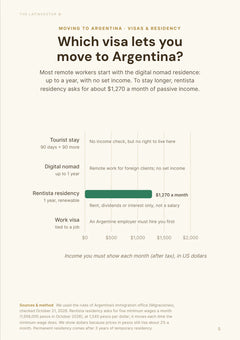
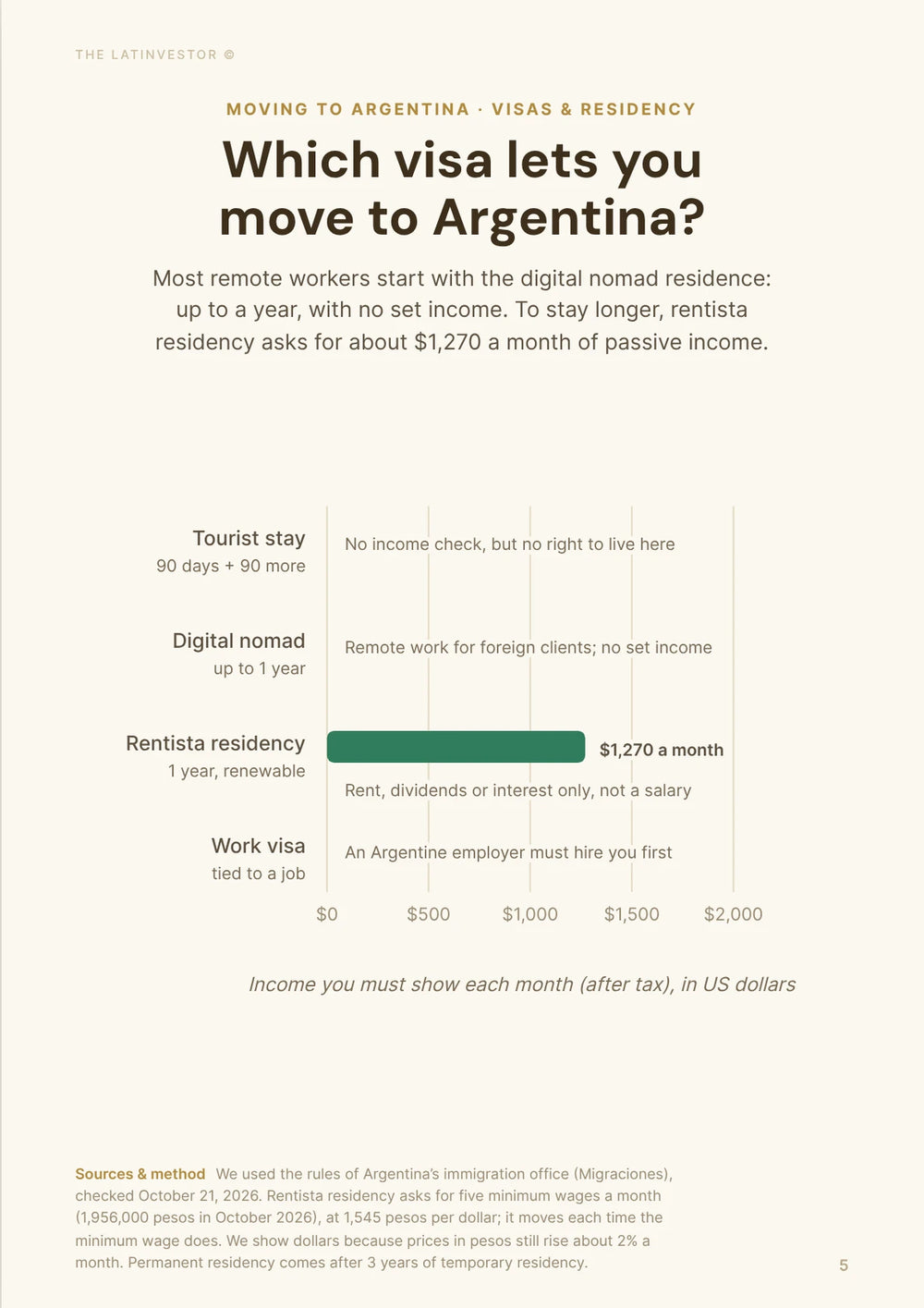
The main visas are MERCOSUR residency (2 years), the worker visa and the digital nomad visa, which gives 180 days plus 180 more for an ARS 32,000 fee and has no official minimum income.
There is no official processing time for residency, and the fee is ARS 100,000 for non-MERCOSUR citizens. Permanent residency comes after 3 years (2 for MERCOSUR citizens), and citizenship after 2 years of continuous legal residence plus a civic exam.
Jobs are in wine, tourism and energy, and Spanish is expected. Local pay starts around the tourism pay scale of about ARS 1,350,000 a month, so most expats earn remotely in foreign currency.
Expats love the Andes, the wine and the parks, and dislike shifting prices, slow bureaucracy and life run on WhatsApp. Dinner rarely starts before 9 pm.
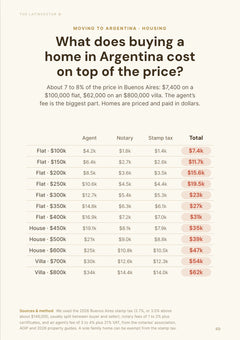
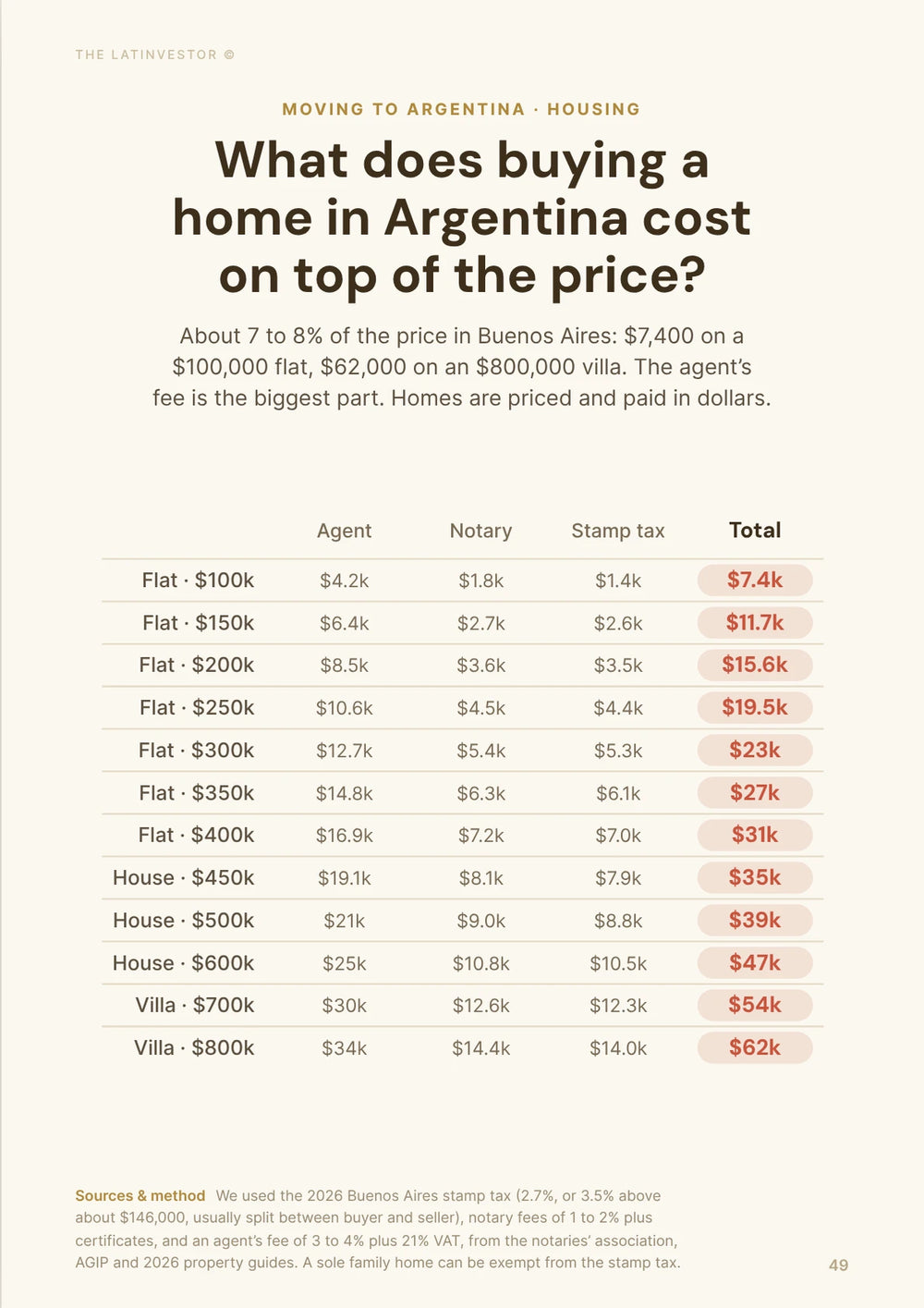
Foreigners can buy urban homes freely. Apartments in Mendoza city list at a median of about USD 1,090 per m², up to about USD 2,180 in Los Cerros. Rural land may again fall under the 15% foreign cap after the Supreme Court ruling of 9 October 2026.
Bottom line: Mendoza works best if you earn in dollars or euros, budget for private health cover, and pay cash for a home, since mortgages are mostly inflation-indexed UVA loans for residents.

What are quality of life, healthcare, schools and safety like in Mendoza?
Is quality of life getting better or worse in Mendoza in 2026?
In 2026, quality of life in Mendoza is showing cautious improvement, mainly because inflation has slowed down compared to the extreme levels Argentina experienced in 2023 and 2024 (33.4% over the year to September 2026, against over 200% at the peak).
The most noticeable improvement in Mendoza over the past two to three years has been the stabilization of the rental market after the government repealed restrictive rent control laws in late 2023, which brought more properties back onto the market and gave landlords and tenants more flexibility in negotiating terms.
On the other hand, the persistent challenge in Mendoza remains the unpredictability of everyday costs, where prices for groceries, utilities, and services can still shift noticeably from month to month, forcing both locals and expats to stay alert with their budgets. If you earn in dollars, Mendoza also got more expensive in 2026: the peso lost only about 4% against the dollar between the end of 2025 (about 1,480 ARS per USD) and October 2026 (about 1,545 ARS), while local prices kept rising much faster.
Are hospitals good in Mendoza in 2026?
In 2026, hospitals in Mendoza are generally adequate for most medical needs, though they typically do not match the standards of top-tier facilities in Western Europe or North America, especially when it comes to wait times and specialized equipment in the public system.
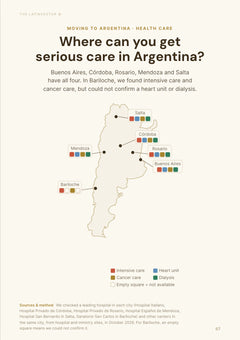
Among the hospitals expats commonly recommend are Hospital Humberto J. Notti for pediatric care, Hospital Central as the main public reference, and the private Clinica de Cuyo for faster service and more comfortable facilities, along with the private Hospital Español and Hospital Santa Isabel de Hungría.
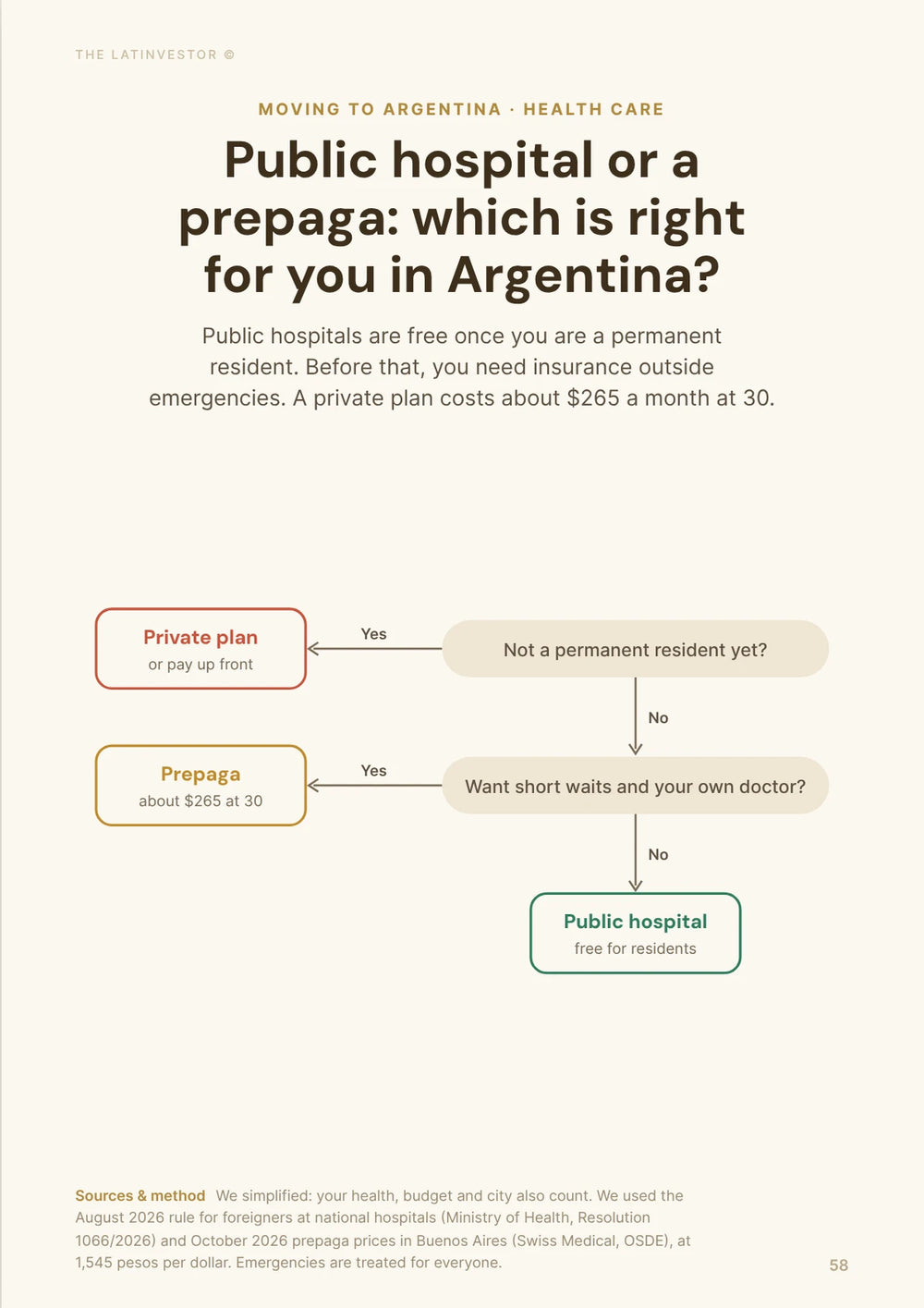
The price of a doctor visit in Mendoza depends on whether you use private insurance, a local health plan, or pay fully out of pocket, and clinics rarely publish their cash prices. Most expats join a private health plan (prepaga): in 2026, individual plans for a 30-year-old list at roughly ARS 200,000 to ARS 550,000 a month (about USD 130 to 360 or EUR 120 to 320), from Medifé to OSDE, with prices quoted for Buenos Aires.
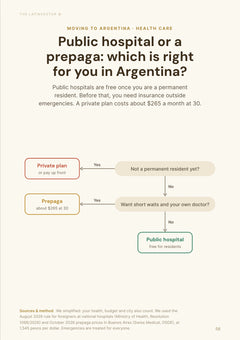
Private health insurance is strongly recommended for expats living in Mendoza, as it provides faster access to care, predictable billing, and is sometimes required for certain visa processes, especially since August 2026, when national public hospitals were allowed to ask foreigners without permanent residence to show insurance or pay for non-emergency care.
Are there any good international schools in Mendoza in 2026?
In 2026, Mendoza has a handful of bilingual and private schools with strong reputations, though it is not a major international school hub like Buenos Aires, meaning options are more limited and admissions can be competitive.
Among the most reputable schools for expat families are Mendoza English School with its bilingual orientation, Colegio ICEI known for its English-Spanish curriculum, and Colegio San Nicolas as a well-regarded private option.
Annual tuition fees at private and bilingual schools in Mendoza vary a lot and most schools do not publish them, so ask each school directly: subsidized private schools follow fee caps set by the province (the latest scale took effect in March 2026), bilingual schools without subsidies charge more, and enrollment fees often add another one to two months' worth of tuition upfront.
Waitlists at popular schools in Mendoza can be long, especially at key entry points like kindergarten and first grade, so starting your search six to ten months ahead is wise, and while public schools vary in quality by area, many expats choose private schools mainly for language continuity and administrative ease rather than because public education is unusable.
Is Mendoza a dangerous place in 2026?
In 2026, Mendoza is generally considered safe by Argentine standards, but its crime figures are not lower than Buenos Aires': 4.7 homicides per 100,000 people in 2025 in Mendoza city (2.5 in Buenos Aires) and a Numbeo crime index of 66.1 (62.9 in Buenos Aires), while petty theft and opportunistic crimes do occur, especially in busier areas and at night.
The most common safety concerns expats should be aware of in Mendoza include pickpocketing in crowded places like bus stations and markets, phone snatching on the street, and occasional break-ins in less-secured buildings or homes, rather than violent crime.
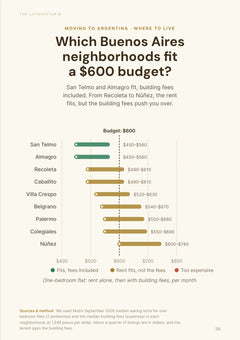
Neighborhoods in Mendoza generally considered safest for expats include Quinta Seccion near Parque General San Martin, parts of Centro and Microcentro in Mendoza Capital, the residential area of La Bombal, the leafy wine-country feel of Chacras de Coria in Lujan de Cuyo, and gated communities like Dalvian for those prioritizing security.
Women can generally live alone safely in Mendoza, particularly in the central and higher-income neighborhoods, as long as they follow standard big-city precautions such as avoiding poorly lit streets at night, staying aware of surroundings, and not displaying expensive items openly.
How much does everyday life cost in Mendoza in 2026?
What monthly budget do I need to live well in Mendoza in 2026?
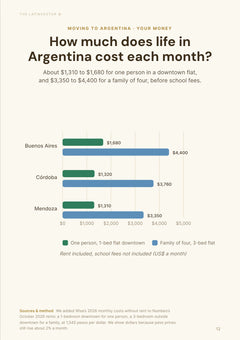
In 2026, by our estimate, a single person can live comfortably in Mendoza on a monthly budget of around ARS 1,800,000 to ARS 2,400,000 (approximately USD 1,170 to 1,550 or EUR 1,040 to 1,390), which covers rent in a decent area, groceries, transport, health insurance, and some lifestyle extras.
For a more modest but still decent lifestyle in Mendoza, a single person can get by on roughly ARS 1,100,000 to ARS 1,500,000 per month (around USD 710 to 970 or EUR 640 to 870), though this means a smaller apartment, less eating out, and careful budgeting.
If you prefer a more comfortable or upscale lifestyle in Mendoza, including a nicer apartment, private health coverage, regular dining out, and weekend trips to wineries or the mountains, you should plan for ARS 3,000,000 to ARS 4,000,000 monthly for a couple (approximately USD 1,940 to 2,600 or EUR 1,740 to 2,300).
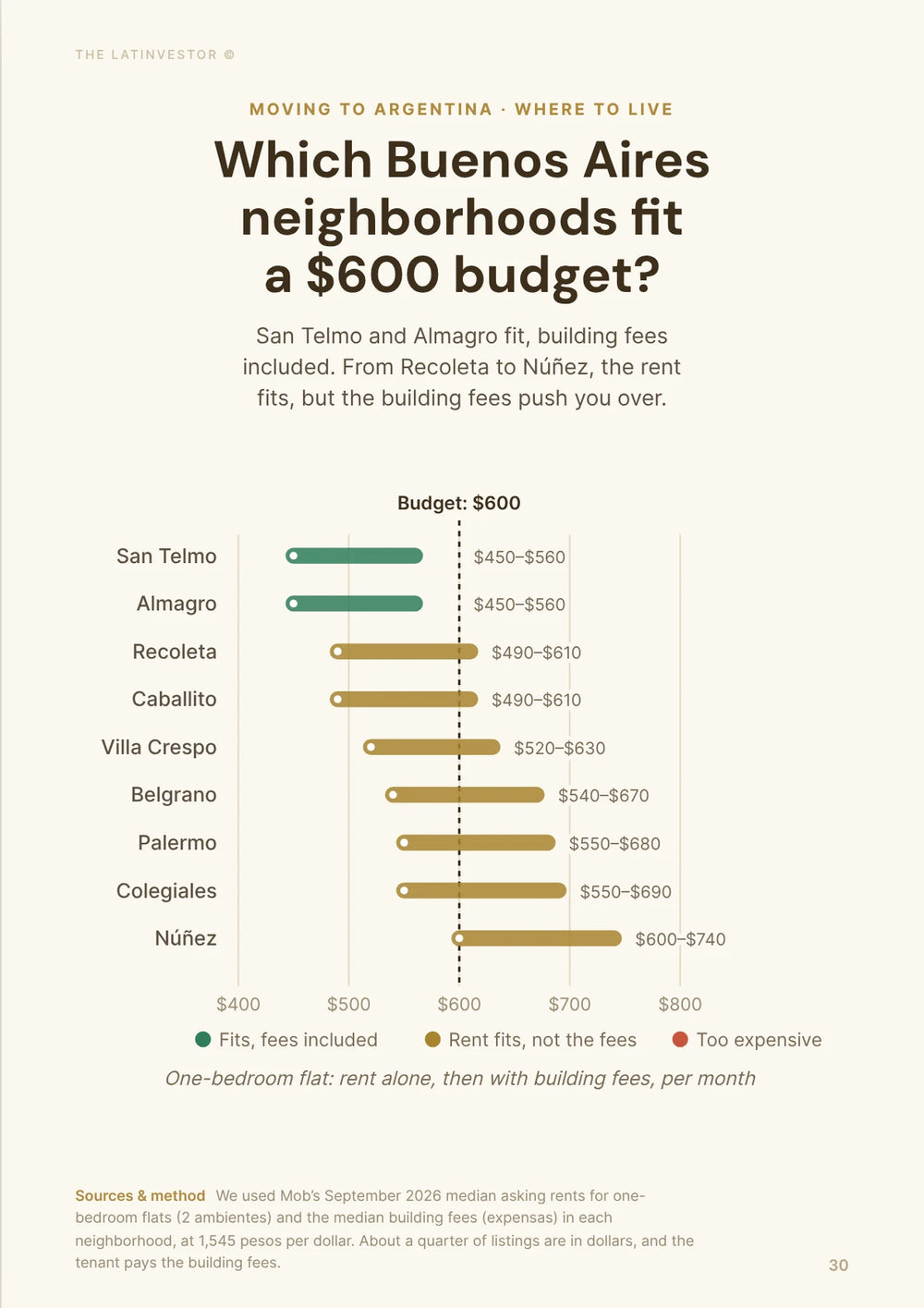
In Mendoza, housing typically takes the largest share of a monthly budget, often between 35% and 45% of total expenses (a central one-bedroom rented for about ARS 840,000 a month, roughly USD 540, on Numbeo in September 2026), which is notably higher than in some other Argentine cities because rents in the most desirable expat-friendly neighborhoods have risen with increased demand from both locals and foreigners.
What is the average income tax rate in Mendoza in 2026?
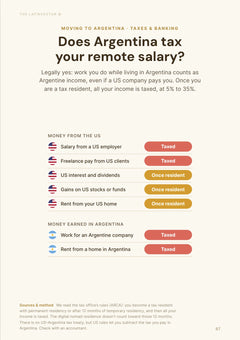
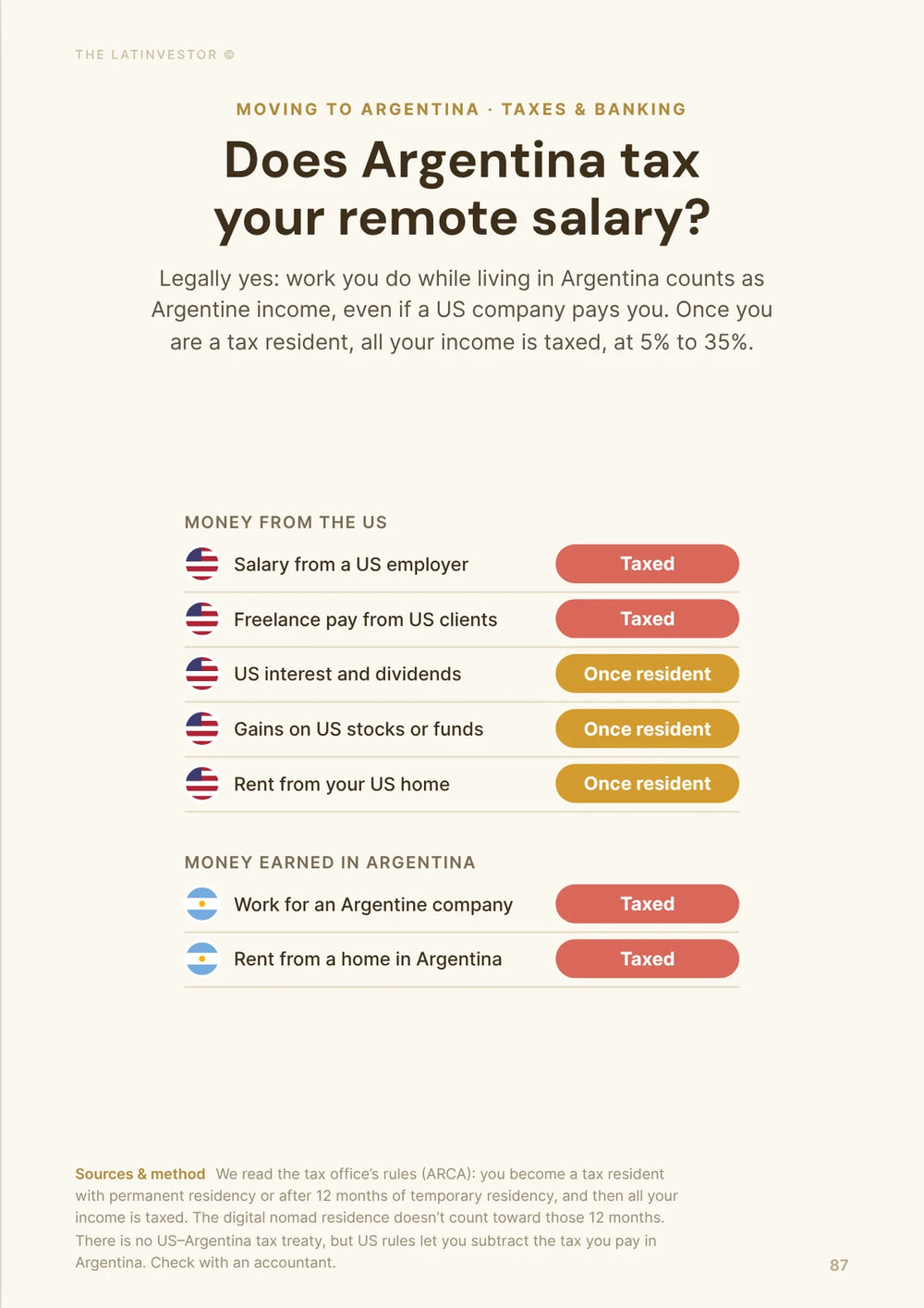
In 2026, how much income tax a middle-income earner pays in Mendoza (the rules are national) depends heavily on the salary level and deductions, since a large part of a middle salary falls under the tax-free allowances, so there is no single typical rate; on top of that, employees pay mandatory social contributions of 17% of gross salary.
Argentina's income tax brackets in 2026 range from a lowest marginal rate of around 5% on the first taxable income band up to a top marginal rate of 35% for the highest earners, and foreigners usually become Argentine tax residents only when they get permanent residence or after 12 months with temporary residence.
What kind of foreigners actually live in Mendoza in 2026?
Where do most expats come from in Mendoza in 2026?
In 2026, the largest groups of foreign residents in Mendoza come from neighboring South American countries like Bolivia, Chile, and Peru, followed by smaller but visible communities from the United States, Spain, and other European nations drawn by wine, lifestyle, and lower costs.
Foreign-born residents make up a relatively small percentage of Mendoza's total population compared to Buenos Aires, but the census and migration data show steady numbers, with the province hosting about 65,700 foreign-born residents in the 2022 census (3.4% of all foreign-born people in Argentina), most of them in the metropolitan area.
Regional expats from South America are mainly drawn to Mendoza by geographic proximity, family ties, and job opportunities in agriculture and services, while expats from North America and Europe tend to come for the wine industry, outdoor lifestyle, and the chance to stretch their retirement savings or remote-work income further.
The expat population in Mendoza is a mix of working professionals in tourism, wine, and agriculture, retirees seeking an affordable and scenic retirement, and a growing number of digital nomads attracted by the low cost of living and the stability of earning in foreign currency.
Where do most expats live in Mendoza in 2026?
In 2026, expats in Mendoza tend to concentrate in Mendoza Capital (especially Centro, Quinta Seccion, and La Bombal), as well as Chacras de Coria and nearby areas of Lujan de Cuyo, plus select pockets of Godoy Cruz where convenience meets affordability.
These neighborhoods attract expats because they combine walkability, access to cafes and restaurants, green spaces like Parque General San Martin, reliable services, and in the case of Chacras de Coria, a more relaxed wine-country atmosphere that feels like a retreat while still being close to the city.
Emerging areas in Mendoza that are starting to draw more expats include parts of Guaymallen for its affordability and improving infrastructure, and certain zones in Maipu and Lujan de Cuyo where wine tourism is driving development and creating new residential options with a rural feel but modern amenities.
Are expats moving in or leaving Mendoza in 2026?
In 2026, the trend for expat migration in Mendoza appears to be a modest net inflow, driven largely by the favorable exchange rate that makes peso costs very affordable for those earning in US dollars or euros, combined with the lifestyle appeal of wine country and Andes access.
The main factor drawing expats to Mendoza right now is affordability, since the combination of a relatively weak peso and Mendoza's lower cost of living compared to Buenos Aires means that remote workers and retirees can enjoy a comfortable lifestyle on budgets that would feel tight in most Western cities.
The main factor causing some expats to leave Mendoza recently is the ongoing economic uncertainty, where concerns about sudden policy changes, inflation spikes, or currency controls can make long-term planning difficult and push some people toward more stable destinations.
Compared to similar destinations in the region like Montevideo or Santiago, Mendoza's expat inflows tend to be more cyclical and tied to Argentina's economic swings, meaning the community grows when the country feels cheap and welcoming, and shrinks when macro instability makes daily life too unpredictable.
What paperwork do I need to move to Mendoza in 2026?
What visa options are popular in Mendoza in 2026?
In 2026, the three most popular visa types for expats moving to Mendoza are the MERCOSUR temporary residency (for nationals of member and associate countries), the worker (trabajador migrante) visa for those with Argentine employment, and the digital nomad visa for remote workers earning income from abroad.
The most commonly used expat visa in Mendoza is the MERCOSUR temporary residency, which requires proof of nationality from a MERCOSUR or associate country, a valid passport, a clean criminal record, and basic documentation like a birth certificate, making it relatively straightforward for eligible applicants.
Argentina does offer a digital nomad visa, introduced in 2022, which allows remote workers to live in the country for up to 180 days (extendable to one year), requires proof of remote employment or freelance work for non-Argentine clients, and has an application fee of ARS 32,000 (about USD 21) for non-MERCOSUR citizens, with no official minimum income.
The MERCOSUR temporary residency is typically valid for two years and can be renewed or converted to permanent residency, while the digital nomad visa lasts 180 days with a possible 180-day extension, requiring a new application or a switch to another visa category for longer stays.
How long does it take to get residency in Mendoza in 2026?
In 2026, Migraciones does not publish a standard processing time for temporary residency, and it can take several months after submitting a complete application (the fee is ARS 100,000, about USD 65, for non-MERCOSUR citizens), though you can often receive interim documentation (called a "precaria") earlier that allows you to stay and work legally while waiting.
Common factors that can delay the residency process in Mendoza include incomplete or incorrectly translated documents, missed appointments, background check delays, and high application volumes at certain times of year, while having all paperwork properly apostilled and working with an immigration lawyer can speed things up.
To become eligible for permanent residency in Argentina, an expat generally needs to hold temporary residency for 3 years (2 years for MERCOSUR citizens), spending at least half of that time in the country, and since the 2025 reform (Decree 366/2025), citizenship requires 2 years of continuous legal residence plus a civic integration exam covering Spanish, Argentine history and democratic values.
How hard is it to find a job in Mendoza in 2026?
Which industries are hiring the most in Mendoza in 2026?
In 2026, the top three industries hiring in Mendoza are the wine and agribusiness sector (including viticulture, export services, and wine tourism), tourism and hospitality (hotels, restaurants, guides, and event services), and oil, gas, and renewable energy operations tied to the region's extractive and green-energy projects.
Getting hired in Mendoza without speaking Spanish is quite difficult for local employers, since most positions require fluent Spanish for daily communication, though remote or global roles that only require English are much more realistic for expats who work for foreign companies while living in Mendoza.
The types of roles most accessible to foreign job seekers in Mendoza include positions in wine tourism and hospitality where international experience is valued, English teaching jobs at language schools or private lessons, and remote tech or professional services roles where you bring skills that local employers or global clients need.
What salary ranges are common for expats in Mendoza in 2026?
In 2026, typical salary ranges for expats working in Mendoza vary widely depending on whether you are employed locally in pesos or remotely in foreign currency, with local salaries starting around the national pay scales (about ARS 1,350,000 a month for tourism staff in September 2026, roughly USD 870 or EUR 780), while remote workers earning in USD can bring in significantly more relative to local costs.
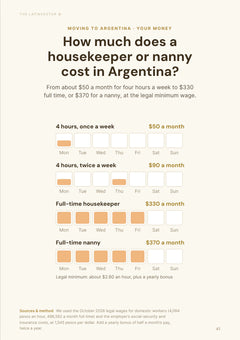
Entry-level or mid-level expat positions in Mendoza, such as hospitality roles, teaching, or administrative jobs, typically pay close to the collective pay scales, around ARS 1,350,000 to ARS 1,400,000 per month for tourism staff (approximately USD 870 to 910 or EUR 780 to 810), against a legal minimum wage of ARS 391,200 in October 2026, which can feel tight but is manageable given lower local living costs.
Senior or specialized expat roles in Mendoza, particularly in wine industry management, engineering, or international business development, can command salaries of ARS 2,700,000 to ARS 4,200,000 or more per month by our estimate (roughly USD 1,750 to 2,700+ or EUR 1,560 to 2,450+), though these positions are less common and often require strong local networks or headhunter placement.
Employers in Mendoza do sometimes sponsor work visas for foreign hires, but it is more common in specialized roles where local talent is scarce, and many foreigners instead use other residency bases like MERCOSUR nationality, family ties, or student status and then work once legally resident.
What's daily life really like for expats in Mendoza right now?
What do expats love most about living in Mendoza right now?
Expats in Mendoza consistently rave about the easy access to the Andes for weekend hikes and ski trips, the world-class wine culture right on their doorstep, and the walkable, park-filled city center that feels relaxed compared to the chaos of bigger capitals.
The lifestyle benefit most frequently praised by expats in Mendoza is the outdoor-oriented quality of life, where you can work during the week and then spend weekends exploring mountain trails, visiting vineyards, or simply enjoying the many sunny days of its dry climate.
From a practical standpoint, expats appreciate that Mendoza offers a high quality of life at a fraction of what it would cost in North America or Europe, with affordable rent, inexpensive dining out, and local produce and wine that are both excellent and budget-friendly.
Socially and culturally, expats enjoy the warm and welcoming nature of mendocinos (local residents), the strong sense of community in neighborhoods, and the slower pace that allows for long lunches, evening asados, and genuine connections rather than the rushed lifestyle of larger cities.
What do expats dislike most about life in Mendoza right now?
The most common complaints expats have about living in Mendoza include the unpredictability of prices and costs from month to month, the administrative friction of dealing with Argentine bureaucracy, and the car-dependence if you choose to live in outer areas like Chacras de Coria where public transport is limited.
The daily inconvenience that frustrates expats the most in Mendoza is the way prices can change suddenly, meaning you might pay one amount for utilities or groceries one month and noticeably more the next, which makes budgeting feel like a moving target even when overall inflation is slowing.
The bureaucratic headache that causes the most frustration for expats in Mendoza is the "come back tomorrow" culture at government offices and banks, where paperwork often takes multiple visits, lines can be long, and processes that seem simple in other countries become time-consuming multi-step ordeals.
Despite these frustrations, most expats find them manageable rather than deal-breakers, viewing the trade-offs as worth it for Mendoza's lifestyle, affordability, and natural beauty, though newcomers should come prepared for a learning curve and a need for patience.
What are the biggest culture shocks in Mendoza right now?
The biggest culture shocks expats experience when moving to Mendoza include how much daily life runs on WhatsApp and personal relationships rather than formal systems, the speed at which prices and contract terms can change, and the relaxed approach to schedules and time that can feel frustrating if you come from a punctuality-focused culture.
The social norm that surprises newcomers the most in Mendoza is the reliance on WhatsApp for absolutely everything, from booking medical appointments and contacting banks to coordinating with landlords and even ordering from restaurants, which means your phone becomes essential for navigating daily life.
The aspect of daily routines that takes the longest for expats to adjust to in Mendoza is the later schedule for meals and activities, where lunch often happens around 1 or 2 pm, dinner rarely starts before 9 pm, and shops or offices may close for several hours in the afternoon, requiring a mental reset if you're used to a 9-to-5 rhythm.
Can I buy a home as a foreigner in Mendoza in 2026?
Can foreigners legally own property in Mendoza in 2026?
In 2026, foreigners can legally own urban property in Mendoza with essentially the same rights as Argentine citizens, making it one of the more accessible real estate markets in South America for international buyers.
The main restrictions for foreigners buying property in Mendoza apply to rural land, where Argentina's Law 26.737 limits foreign ownership to 15% of rural land nationwide and imposes additional checks on properties near borders, major waterways, or designated strategic zones; a decree repealed it at the end of 2023, but on 9 October 2026 the Supreme Court provisionally suspended that repeal while the case continues, so these limits may apply again.
In practical terms, foreigners can freely buy apartments, houses, condos, and commercial properties in urban Mendoza, while purchasing rural land or agricultural estates requires navigating additional authorization processes and may face ownership caps depending on the property's classification and location.
What is the average price per m² in Mendoza in 2026?
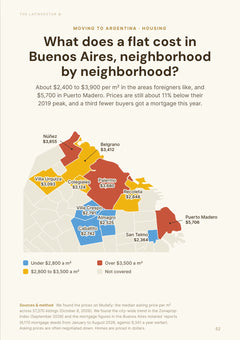
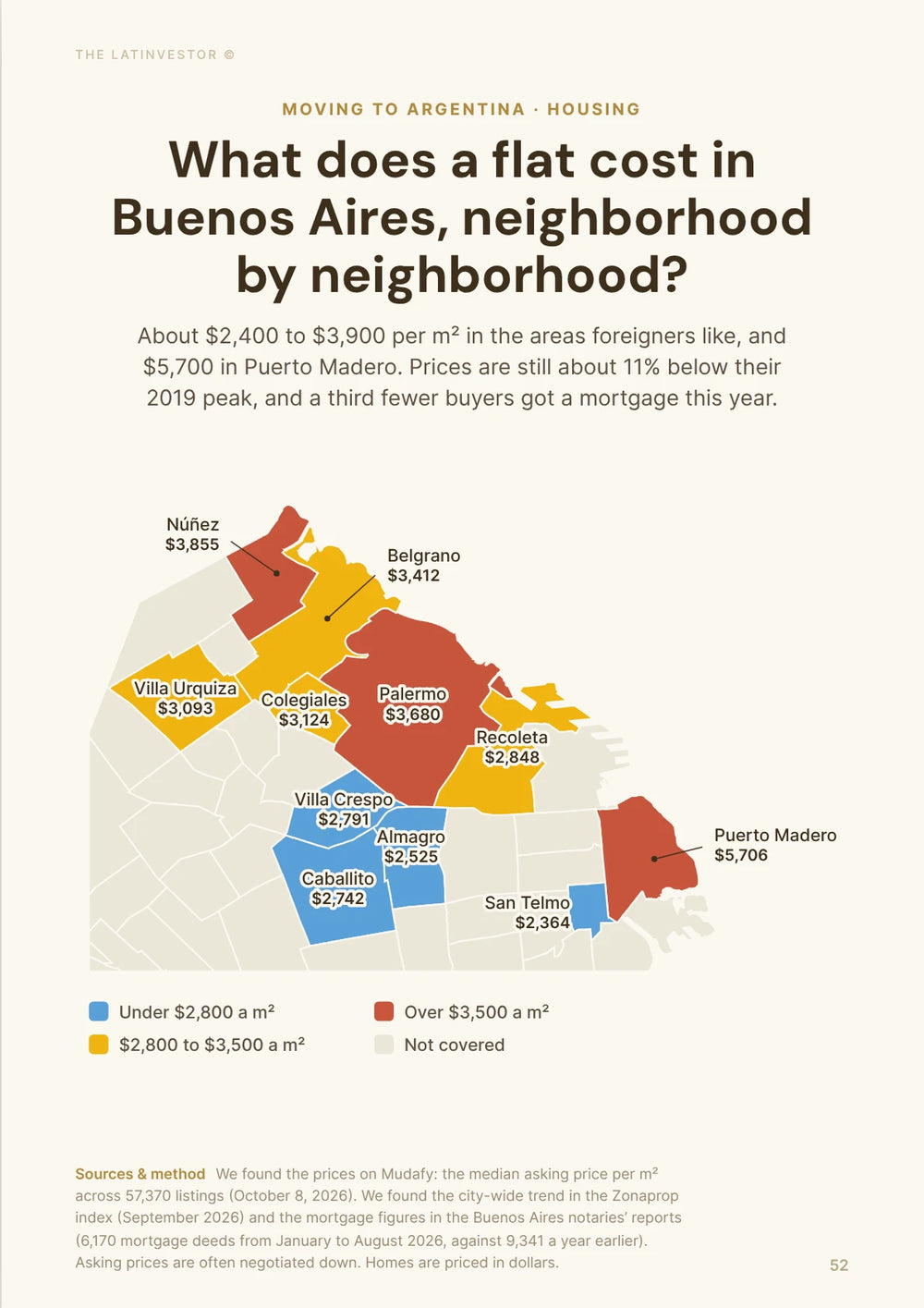
In 2026, the median asking price for apartments in Mendoza city is about USD 1,090 per square meter (roughly EUR 970), from about USD 1,050 in Barrio Cívico and USD 1,580 in Quinta Sección (Residencial Sur) to about USD 2,180 in Los Cerros, depending on the neighborhood, property type, and building age, with premium areas like Chacras de Coria (a separate municipality) also at the higher end and more suburban zones at the lower end.
Property prices in Mendoza have trended modestly upward in USD terms over the past two to three years, driven by growing tourism, wine industry expansion, and increased interest from expats and digital nomads seeking affordable lifestyle destinations.
Do banks give mortgages to foreigners in Mendoza in 2026?
In 2026, mortgages for foreigners in Mendoza are rare and come with restrictive terms, meaning most foreign buyers purchase property with cash, either brought from abroad or secured through international financing rather than Argentine banks.
The few banks in Argentina that may consider mortgage applications from foreigners include BBVA Argentina, Banco Galicia, and Santander Argentina, though approval typically requires established residency, local peso income, and a strong banking relationship.
When mortgages are available in Mendoza, they are mostly UVA loans, whose balance is indexed to inflation with an interest rate on top, with terms of up to 30 years at Banco Nación for eligible residents, while foreigners who qualify usually face a much larger down payment, which makes them unattractive for most international buyers compared to cash purchases.
To qualify for a mortgage as a foreigner in Mendoza, you generally need Argentine residency documentation, proof of stable local income, a tax identification number (CDI), substantial bank deposits in Argentina, and extensive financial documentation, which is why the vast majority of foreign buyers opt for cash transactions instead.
Our methodology
This article looks at what it is like to live in Mendoza as an expat: quality of life, healthcare, schools, safety, monthly budgets, income tax, who the expats are and where they live, visas and residency, jobs and salaries, daily life, and buying a home as a foreigner.
Monthly budgets and senior salaries are our own estimates, built from rents (Numbeo, TuLugar), everyday costs (Wise, DEIE's basic basket) and local pay scales. Home prices are TuLugar median asking prices, inflation comes from INDEC, safety from official homicide data compiled by Argentina en Datos and Numbeo crime indexes, and foreign-born figures from the 2022 census, the latest available.
Visa, residency and citizenship rules come from Argentina's migration office (Migraciones), its 2026 fee schedule and Decree 366/2025. Tax rules come from ARCA and Deloitte. Property rules come from Law 26.737, Decree 70/2023 and the Supreme Court ruling of 9 October 2026.
We checked these figures in October 2026. Peso amounts are converted at about 1,545 pesos per US dollar (official rate, 21 October 2026) and about 1,730 pesos per euro. Home prices, quoted in dollars in Mendoza, are converted to euros at the same rates.
Some points have no reliable figure for Mendoza, such as the price of a doctor visit without insurance, each school's fees, the number of foreign residents in the city itself or a typical expat salary. There we gave a range labeled as our estimate, used a clearly named benchmark, or left the number out. Asking prices are not final sale prices, and your own costs will depend on your neighborhood and habits.
Key sources used for this analysis include DEIE Mendoza, INDEC, INDEC Censo 2022, Argentina.gob.ar Migraciones, ARCA/AFIP, Banco Nacion, Mendoza Official Hospital Directory, Zonaprop, Law 26.737 (Rural Land), Expat.com Mendoza, INDEC inflation, September 2026 (EFE), Indicadores Argentina exchange rates, Numbeo Mendoza, Wise cost of living, TuLugar Mendoza, Argentina en Datos (Mendoza), Numbeo crime index, provincial homicide data (Diario Mendoza), PrepagaYa health plan prices, Resolution 1066/2026, Mendoza private-school fee scale, Deloitte tax update, ARCA tax residence rules, INDEC statistical yearbook, digital nomad residence, Migraciones fee schedule, Migraciones permanent residence, Decree 366/2025 analysis, tourism pay scale (La Nación), minimum wage (Resolution 4/2026), Supreme Court land-law ruling (Infobae), Banco Nación mortgages and UVA mortgage comparison (La Nación).