

Summary
Only a little. Existing colón leases in San José could not legally rise at all for most of the past year, because Costa Rica's inflation was negative, and the cap is just +0.34% for leases renewing from October 2026. New listings ask about $1,100 a month for a 1-bedroom.
A 2-bedroom asks about $1,400 a month and a studio about ₡335,000. These are asking rents on portals, so signed rents are often a bit lower.
No index tracks San José rents. Asking prices for apartments rose 12.5% in a year, while gross yields slipped, so rents are clearly not keeping up with prices.
Leases priced in dollars can't be raised at all during the 3-year legal term. Bill 25465, filed in March 2026 to change that, is still in committee.
The strong colón cut the colón cost of a $1,100 rent by almost 9% since January, from about ₡550,000 to ₡505,000. That helps tenants paid in colones and hurts landlords who spend in dollars.
The priciest areas are Escazú (2-bedroom about $1,800), Rohrmoser ($1,500) and La Sabana-Mata Redonda ($1,450). Curridabat is cheaper at about $1,200.
Young professionals mostly rent in Barrio Escalante, Los Yoses and La Sabana, usually for ₡335,000 to ₡825,000 a month.
Families head to Escazú, Santa Ana and Curridabat, where houses listed with one agency had medians of $2,400 to $3,750 in September 2026.
The main tenants are local professionals (about 35% of demand by our estimate), students and young couples, and expats or executives. Furniture adds about $100 to $300 a month.
We estimate vacancy at about 5% for normal long-term rentals, with well-priced small units letting in 10 to 20 days.
Property tax is 0.25% of the registered value a year, about ₡260,000 on a ₡103,000,000 apartment, and HOA fees in Escazú run $200 to $475 a month.
Rental income is taxed at 12.75% of gross rent, and leases above ₡693,300 a month also owe 13% VAT. After costs, a typical 1-bedroom nets about 3.5% a year, half its 7.8% gross yield.
Takeaway: in 2026, buy for the location and the tenant you can keep, not for rent growth. Price in colones if your tenant earns colones, and model a net yield near 3.5%, not the gross figure.

What does a studio, 1-bedroom or 2-bedroom cost to rent in San José?
What's the average monthly rent for a studio in San José?
In 2026, a normal long-term studio in San José rents for about ₡335,000 a month.
In practice, most studios rent between ₡230,000 and ₡465,000 a month. No portal publishes a clean studio median, so this is our estimate from listings.
The range is wide because a studio in San Pedro or Sabanilla is very different from a furnished studio in Escalante, Nunciatura, Rohrmoser or La Sabana.
What's the average monthly rent for a 1-bedroom in San José?
The median asking rent for a 1-bedroom apartment in San José was $1,100 a month (about ₡505,000) in the second quarter of 2026, according to Global Property Guide's survey of Encuentra24 listings.
That survey leans toward modern, dollar-priced buildings. In the central Carmen district (Barrio Escalante, Amón, Aranjuez), a representative 1-bedroom listed for about ₡506,000 in October 2026 (Anuntico). Older colón-priced units in San Pedro, Zapote or Sabanilla often rent for ₡335,000 to ₡450,000.
Escazú asks a bit more, about $1,200 for a 1-bedroom, while Curridabat asks about $950.
What's the average monthly rent for a 2-bedroom in San José?
The median asking rent for a 2-bedroom apartment in San José was $1,400 a month (about ₡640,000) in the second quarter of 2026 (Global Property Guide).
Other 2026 snapshots land close: apartments listed with the agency INHAUS in central San José had a median of $1,425 in September 2026 (38 listings), and the San Pedro area showed about ₡630,000 in August 2026 (Anuntico).
Most 2-bedroom apartments rent between ₡440,000 and ₡1,190,000 a month. The lower end is in San Pedro, Zapote, San Sebastián and parts of Curridabat; Escalante, Los Yoses, Rohrmoser, La Sabana, Nunciatura, Escazú, Santa Ana and Lindora sit higher.
What's the average rent per square meter in San José?
By our estimate, long-term apartments in San José rent for about ₡8,000 per m² a month in 2026.
Most units sit between ₡4,650 and ₡12,900 per m² a month. That fits the medians above: a $1,100 1-bedroom of about 60 m² works out to roughly ₡8,400 per m².
San José has less tourist pressure than beach towns, but it concentrates jobs, universities, hospitals and embassies, which keeps demand steady.
Rent per m² goes above average when the apartment is modern, furnished, secure, close to jobs, near La Sabana or Escalante, and comes with parking.
How much have rents changed over the past year in San José?
Nobody publishes a reliable rent index for San José, so there's no clean year-on-year figure. What we do know points to slow growth.
For sitting tenants, rents barely moved. Colón leases can only rise by the past 12 months' inflation, and that was negative from May 2025 to August 2026 (for example -2.73% in February 2026, per MIVAH and INEC). Only leases renewing from October 2026 can rise, by up to 0.34%. Dollar leases can't rise at all during the contract.
For new listings, asking prices for San José apartments rose 12.5% between mid-2025 and mid-2026 (Global Property Guide), while Costa Rica's average gross yield slipped from 7.80% in late 2025 to 7.63% in the second quarter of 2026. Rents are going up more slowly than prices.
The gains look concentrated in modern buildings in Escalante, Rohrmoser, Nunciatura, La Sabana, Escazú and Santa Ana.
What's the outlook for rent growth in San José?
We expect new asking rents in San José to keep rising more slowly than apartment prices over the next year. We found no published rent forecast for the city, so this is our view, not a number from a model.
Three things hold rents back: inflation is near zero (+0.34% in September 2026), the legal cap on colón leases follows it, and many tenants earn colones while most new buildings ask for dollars.
Demand should stay firmest in Escazú, Santa Ana, Rohrmoser, Nunciatura, La Sabana, Barrio Escalante and Los Yoses.
The main risk is landlords pricing new apartments too high. Asking prices for new apartments in San José rose 14% in a year (Global Property Guide), and buyers who paid those prices need higher rents than the market may give, which can mean longer vacancies in luxury buildings.
Can a landlord raise the rent in San José in 2026?
Barely. Under Article 67 of the rental law (Ley 7527, amended in 2016), a home lease priced in colones can go up once a year by no more than the past 12 months' inflation, as measured by INEC, when that inflation is 10% or less.
That cap was below zero from May 2025 to August 2026, so a colón lease renewing in that window could not go up at all. With September 2026 inflation at +0.34%, a ₡500,000 rent renewing now can rise by about ₡1,700 a month at most.
A lease priced in dollars can't be raised at all during the contract. Home leases run at least 3 years (Article 70) and renew automatically for another 3 years unless the landlord gives at least 3 months' notice before the end (Article 71). So a dollar rent you sign today can stay fixed for up to 6 years.
Bill 25465, filed on 25 March 2026 by deputy Alejandro Pacheco, would let dollar leases rise with inflation too. In October 2026 it was still in committee, so it isn't law (CR Inteligente).
What to do: as a landlord, set the starting rent right, because you can't fix it later. As a tenant, a dollar lease locks your price in dollars, which is a good deal only if you earn dollars. Either way, get the full term, renewal and currency written into the contract.
Is the strong colón making San José rents more expensive?
It depends on which currency you earn. The colón gained about 9% against the dollar in 2026, from about ₡501 per dollar in January to about ₡457.5 in October.
For a tenant paid in colones, a $1,100 rent now costs about ₡505,000 a month, against about ₡550,000 in January. Dollar rents got cheaper for local renters.
For a landlord who prices in colones and spends in dollars, it works the other way: a ₡500,000 rent is worth about $1,090 today, against roughly $1,000 at the start of the year. HOA fees, maintenance and staff are paid in colones and didn't get cheaper, which squeezes dollar yields.
What to do: if your tenants earn colones (most local professionals and students), pricing in colones keeps the unit easy to let. If you target expats or executives paid in dollars, price in dollars, but remember you can't raise that rent during the lease. Local brokers BN Valores and Mercado de Valores forecast ₡440 to ₡465 per dollar by the end of 2026, so don't count on the colón weakening soon.
Which neighborhoods rent best in San José?
Which neighborhoods have the highest rents in San José?
The three highest-rent areas are Escazú, the Rohrmoser-Nunciatura-La Sabana corridor and Santa Ana. Escazú and Santa Ana are separate cantons west of the city, but tenants treat them as part of San José.
Median asking rents for a 2-bedroom apartment in the second quarter of 2026 were about $1,800 in Escazú, $1,500 in Rohrmoser, $1,450 in Mata Redonda (La Sabana) and $1,400 in Santa Ana (Global Property Guide). Apartments listed with INHAUS in Escazú, all sizes mixed, had a median of $2,450 in September 2026.
Tenants pay for security, parking, newer buildings, private schools, restaurants, office access and a more international lifestyle.
The usual tenants are expat families, regional executives, embassy and NGO staff, higher-income Costa Rican families and remote workers.
By the way, we’ve written a blog article detailing what are the current best areas to invest in property in San José.
Where do young professionals prefer to rent in San José right now?
The top three areas for young professionals are Barrio Escalante, Los Yoses and La Sabana-Rohrmoser, with San Pedro and Barrio Dent strong for lower budgets.
Young professionals there usually pay about ₡335,000 to ₡825,000 a month.
These areas attract them because they offer restaurants, cafés, gyms, nightlife, buses, apartments that work for remote work, parking and quick access to offices.
Where do families prefer to rent in San José right now?
The top three family areas are Escazú, Santa Ana and Curridabat, especially Guachipelín, San Rafael de Escazú, Lindora, Pozos, Granadilla and Pinares.
Families there usually pay about ₡640,000 to ₡1,370,000 a month for a good 2- or 3-bedroom home. Houses listed with INHAUS in September 2026 had medians of $2,400 in Santa Ana, $3,500 in Escazú and $3,750 in Curridabat, but each was based on only 5 to 8 listings.
These areas work for families because they offer gated communities, more space, parking, security, quieter streets, private schools and easy shopping.
Schools anchor demand: international and bilingual schools near Escazú and Santa Ana, plus universities around Curridabat and San Pedro.
Which areas near transit or universities rent faster in San José?
The fastest-letting areas near transit or universities are San Pedro-Barrio Dent, Sabanilla-Curridabat and La Sabana-Contraloría-Rohrmoser.
By our estimate, well-priced units there often find a tenant in about 10 to 25 days, faster than the citywide average of about 32 days.
A walkable spot near a bus line or university can add about ₡50,000 to ₡130,000 a month when the apartment is clean and secure.
Which neighborhoods are most popular with expats in San José right now?
The three most popular areas for expats are Escazú, Santa Ana and Rohrmoser-La Sabana-Nunciatura, with Barrio Escalante popular with younger expats.
Expats there usually pay about ₡595,000 to ₡1,370,000 a month.
They come for the sense of safety, private schools, hospitals, English-speaking services, restaurants, better buildings, parking and easy access to the west side.
The most visible groups are North Americans, Europeans, Latin American professionals and remote workers who prefer city services to beach towns.
And if you are also an expat, you may want to read our exhaustive guide for expats in San José.
Who rents, and what do tenants want in San José right now?
What tenant profiles dominate rentals in San José?
The three main tenant profiles are local young professionals, students and young couples, and expat or executive tenants.
By our estimate, local professionals make up about 35% of demand, students and young couples about 25%, and expats or executives about 20%, with families and others making up the rest.
Local professionals want 1- or 2-bedroom apartments, students prefer studios and shared units, and expats or executives look for furnished modern apartments or secure family homes.
If you want to optimize your cashflow, you can read our complete guide on how to buy and rent out in San José.
Do tenants prefer furnished or unfurnished in San José?
By our estimate, about 45% of San José renters prefer furnished homes and 55% unfurnished, but the split changes a lot by area and tenant.
A furnished apartment usually earns about $100 to $300 more a month (₡46,000 to ₡137,000), if the furniture is useful and decent.
Furnished units suit expats, students, remote workers, embassy staff and professionals on short contracts, while Costa Rican families usually prefer unfurnished homes.
Which amenities increase rent the most in San José?
The five amenities that add the most rent are secure parking, 24/7 security, gym or pool access, a balcony or view, and pet permission.
By our estimate, secure parking can add about ₡50,000 to ₡130,000 a month, 24/7 security ₡40,000 to ₡100,000, gym or pool access ₡35,000 to ₡90,000, a balcony or view ₡25,000 to ₡75,000, and pet permission ₡25,000 to ₡60,000.
What renovations get the best ROI for rentals in San José?
The five best rental renovations are a kitchen refresh, a bathroom refresh, better lighting, built-in storage and a washer-dryer setup.
A kitchen refresh may cost ₡500,000 to ₡2,000,000 and add ₡40,000 to ₡120,000 a month in rent. Lighting, storage or laundry cost less and still help a unit let faster.
Poor-ROI renovations include luxury finishes in weak locations, expensive imported furniture, big kitchens in student areas and design upgrades in buildings without parking or security.
How strong is rental demand in San José?
What's the vacancy rate for rentals in San José?
Costa Rica doesn't publish a rental vacancy rate. By our estimate, it's about 5% for normal long-term rentals in San José in 2026.
We'd put it at 3% to 4% for well-priced small units in Escalante, San Pedro, La Sabana and Rohrmoser, and 6% to 8% for overpriced luxury or large family rentals.
Vacancy looks stable rather than tight: good units move, but overpriced apartments sit. Supply isn't surging either, as construction registered in San José province in the first half of 2026 was up just 1% on a year earlier (CFIA).
How many days do rentals stay listed in San José?
By our estimate, rentals in San José stay listed for about 32 days on average before finding a tenant.
Count 10 to 20 days for well-priced studios and 1-bedrooms in San Pedro, Escalante, Los Yoses and La Sabana, and 30 to 90 days for family houses or luxury units priced high.
Small apartments seem to let a little faster than a year ago, while expensive units are slower because they compete with more new premium supply.
Which months have peak tenant demand in San José?
The peak months for tenant demand in San José are January, February, July and August.
January and February are busy with new jobs, relocations and the start of the university year, while July and August bring mid-year moves.
The slowest months are usually late November and December, when many tenants wait until after the holidays.
What will my monthly costs be as a landlord in San José?
What property taxes should landlords expect in San José?
Municipal property tax in Costa Rica is 0.25% of the registered value a year (Law 7509). On a ₡103,000,000 apartment, that's about ₡260,000 a year.
Most small investor apartments pay roughly ₡130,000 to ₡390,000 a year. The registered value counts, not the rent.
A home whose construction value is above ₡143,000,000 in 2026 also pays the luxury home tax (Impuesto Solidario), from 0.25% to 0.55%. Most rental apartments are below that line.
What utilities do landlords often pay in San José right now?
Landlords usually pay HOA or condo fees, while tenants pay electricity, water and internet on normal long-term leases.
HOA fees in older San José buildings can be as low as ₡35,000 to ₡60,000 a month, but midmarket condos in Escazú and Santa Ana charge $200 to $475, and buildings with many amenities $500 to $700 (Costa Rica Realtor, September 2026). Add ₡15,000 to ₡25,000 if you include water or internet in a small furnished unit, and keep about ₡50,000 a month for repairs.
The usual rule: tenants pay what they use, landlords pay the building, and furnished studios sometimes include internet to let faster.
How is rental income taxed in San José, and what's left after costs?
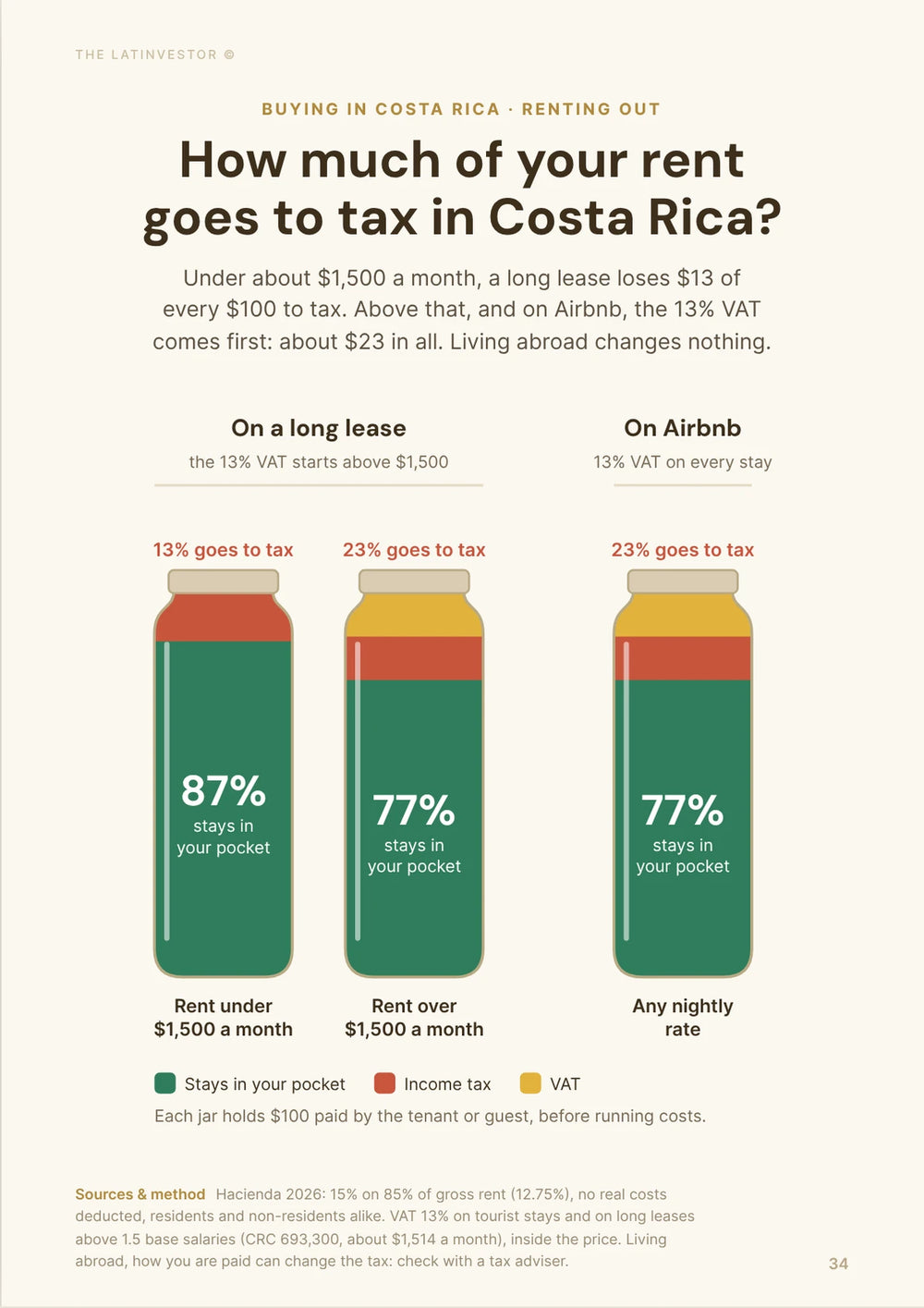
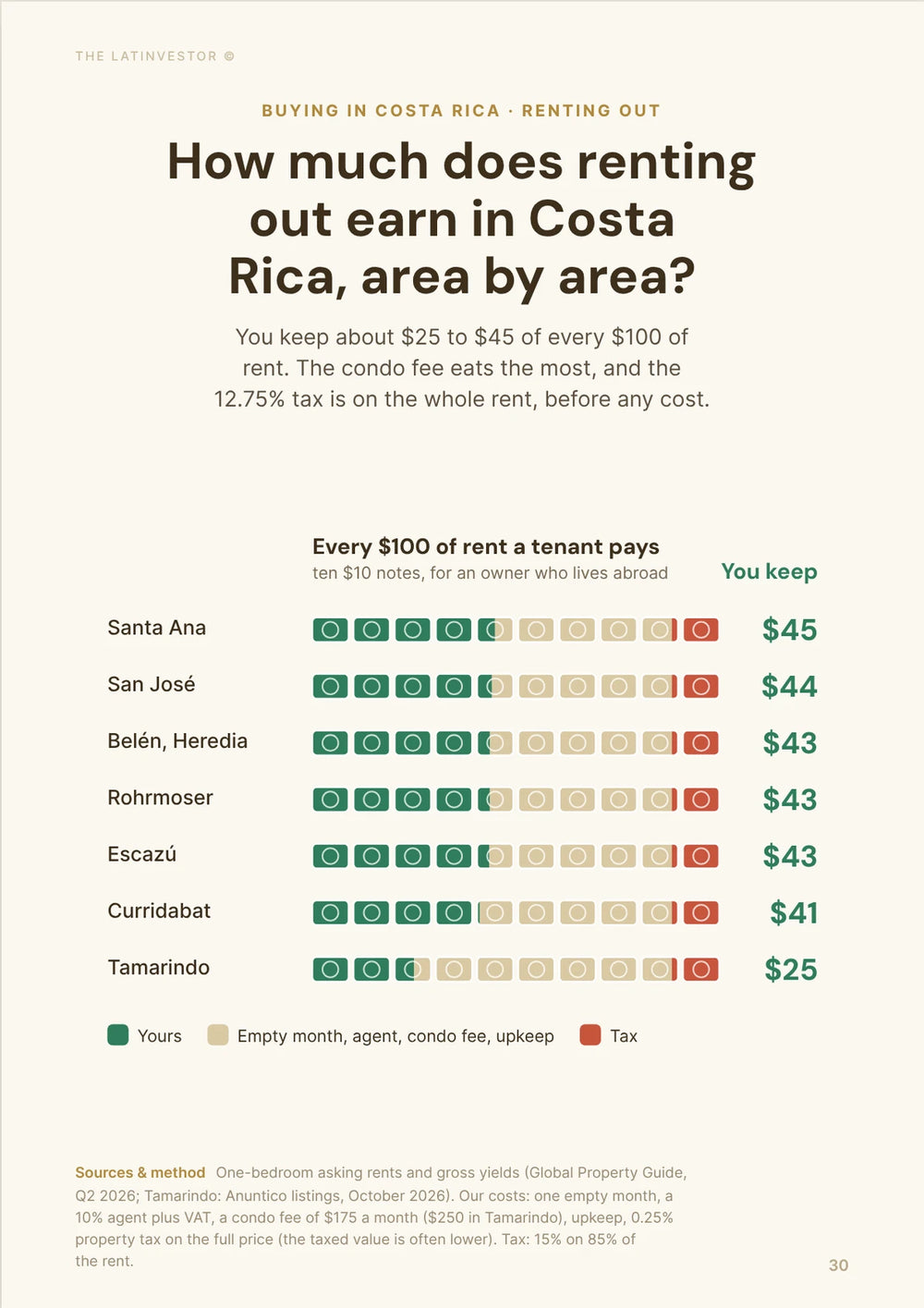
An individual landlord pays 15% tax on 85% of gross rent, which comes to 12.75% of the rent collected. It applies to non-residents too.
Home leases are exempt from 13% VAT only up to 1.5 base salaries a month, ₡693,300 in 2026 (the base salary was kept at ₡462,200). A rent above that, such as many 2-bedrooms in Escazú, owes VAT on the whole amount. Short stays always owe VAT, plus ICT and Hacienda registration.
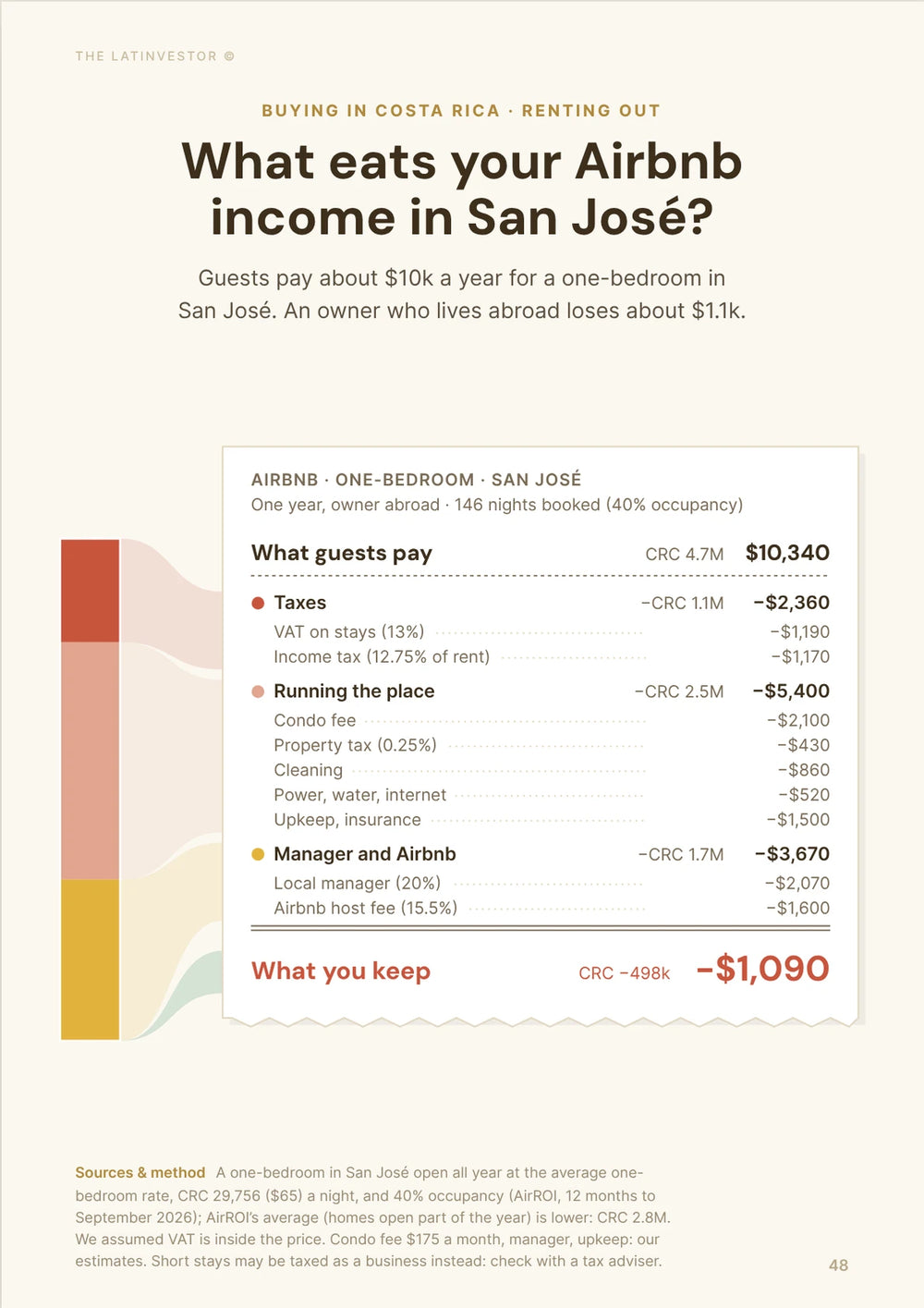
Here's what that leaves, by our estimate, for a typical 1-bedroom bought for $170,000 and let at $1,100 a month (the Global Property Guide medians): $13,200 of gross rent, minus one empty month ($1,100), the 12.75% tax ($1,543), $200 a month of HOA ($2,400), property tax ($425) and 1% a year for repairs ($1,700). That leaves about $6,030, a net yield of about 3.5%, against 7.8% gross.
Common tax mistakes include treating short stays like long leases, forgetting VAT above the threshold, underestimating the 12.75% and mixing personal expenses with property costs. If you own through a company, add ₡69,330 a year of company tax and the beneficial-owner (RTBF) filing.
We cover these mistakes, among others, in our list of risks and pitfalls people face when buying property in San José.
Our methodology
This article estimates what it costs to rent a home long-term in San José in 2026, how fast rents are moving, where they are highest, who rents and what landlords keep after costs. "San José" here means the capital and the suburbs tenants treat as part of it: Escazú, Santa Ana, Curridabat and Montes de Oca.
Rents by bedroom and by area come mainly from Global Property Guide's Q2 2026 survey of Encuentra24 listings, cross-checked with Anuntico district medians (August-October 2026) and the INHAUS inventory (September 2026). Rent changes come from the MIVAH adjustment table and INEC inflation, plus Global Property Guide's San José apartment price index. Studio rents, rent per m², vacancy, days to let, tenant shares and amenity premiums come from our own reading of portal listings.
Lease rules come from the current text of Ley 7527 and the status of bill 25465. Taxes come from Hacienda (12.75% effective tax on rents, 13% VAT above 1.5 base salaries) and the property tax law (0.25% a year). HOA ranges come from Costa Rica Realtor.
We checked these figures in October 2026. Dollar amounts are converted at about 457.5 colones per US dollar and 513 colones per euro (October 2026).
Where we had no direct figure, we estimated it and said so. Portal figures are asking rents, and signed rents are often a little lower. The net yield is our own example, before mortgage costs and the costs of buying.
Key sources used for this analysis include Global Property Guide rental yields, Global Property Guide price index, MIVAH rent adjustments, INEC CPI, INEC CPI May 2026, Ley 7527, bill 25465, Hacienda capital income rates, Hacienda VAT on leases, INHAUS, Anuntico, Costa Rica Realtor, World Bank, INEC construction statistics, Encuentra24, Realtor.com International, Rentberry, Moovit, Universidad Latina, UACA and Migración.