Summary
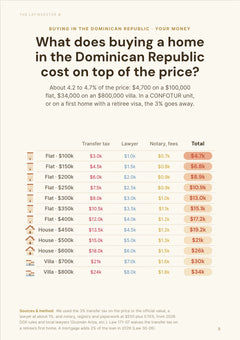
Yes: in 2026 a foreigner can buy a condo, villa, house or titled lot in Punta Cana in their own name, with no residency, no local partner and no quota. Budget about 4.5% to 6.5% of the price in closing costs.
Your protection is the registered title, not the reservation form. Ask for the Certificado de Título and a registry certification (about RD$1,000, or $16) before you pay anything big.
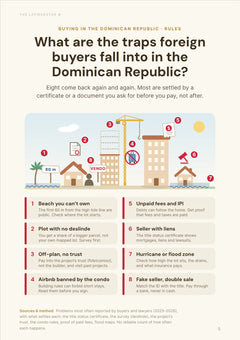
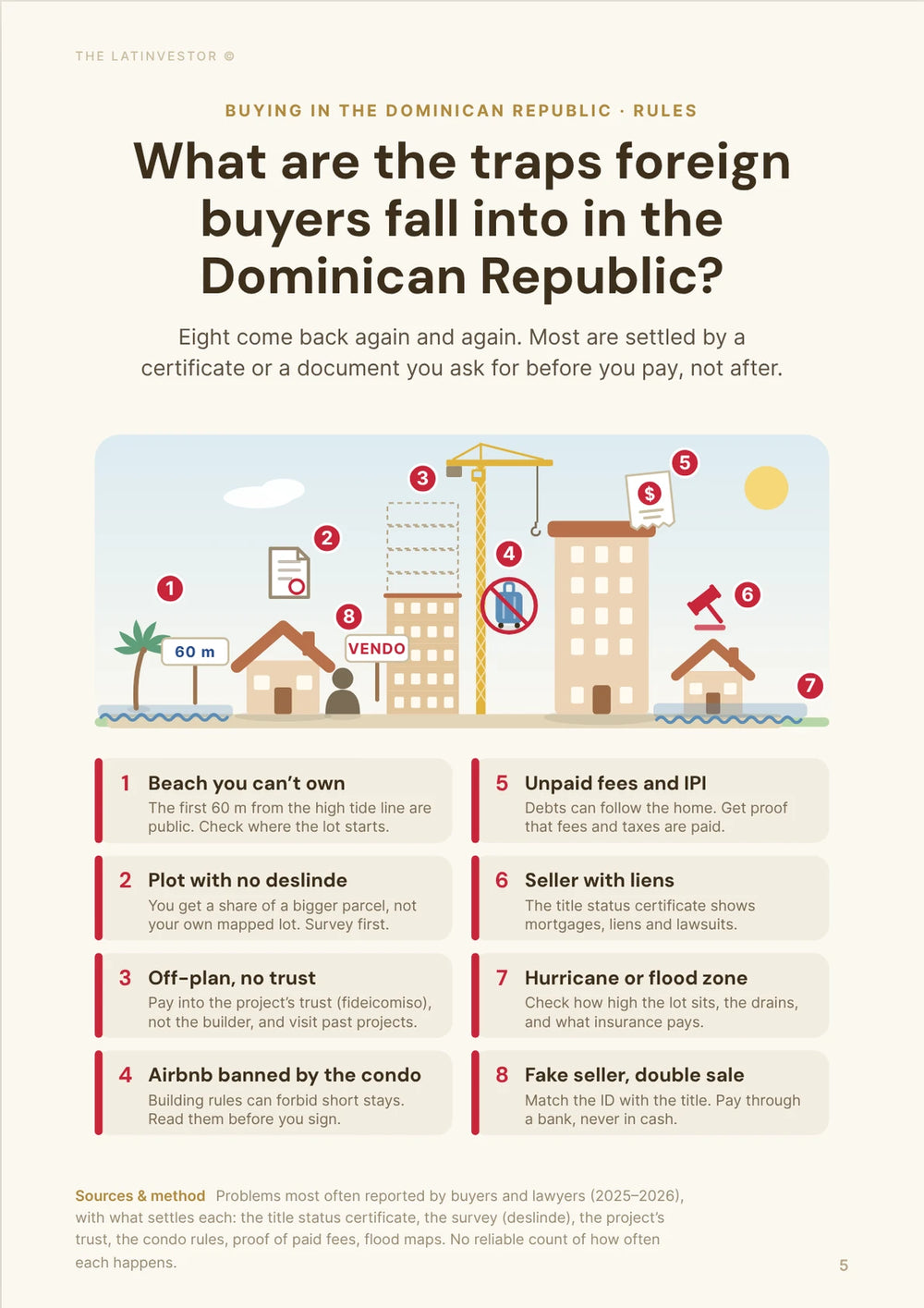
In Cap Cana, Cocotal, Punta Cana Village or a Bávaro condo, the reglamento (Law 5038) can ban short stays. The 60 m strip from the high-tide line is public, even in front of a beach villa.
For land in Vista Cana, Verón or the Macao corridor, check the deslinde. If it is missing, budget RD$18,000 (about $295) to RD$60,000 (about $975) and 30 to 90 days.
You don't need a visa to buy. Buying doesn't give you residency either: the investor route needs a certified investment of at least $200,000, the retiree route a $1,500 monthly pension.
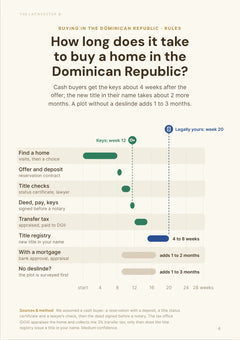
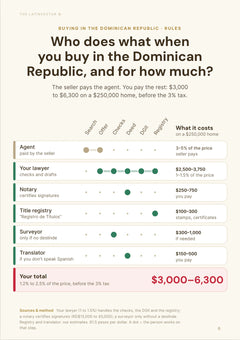
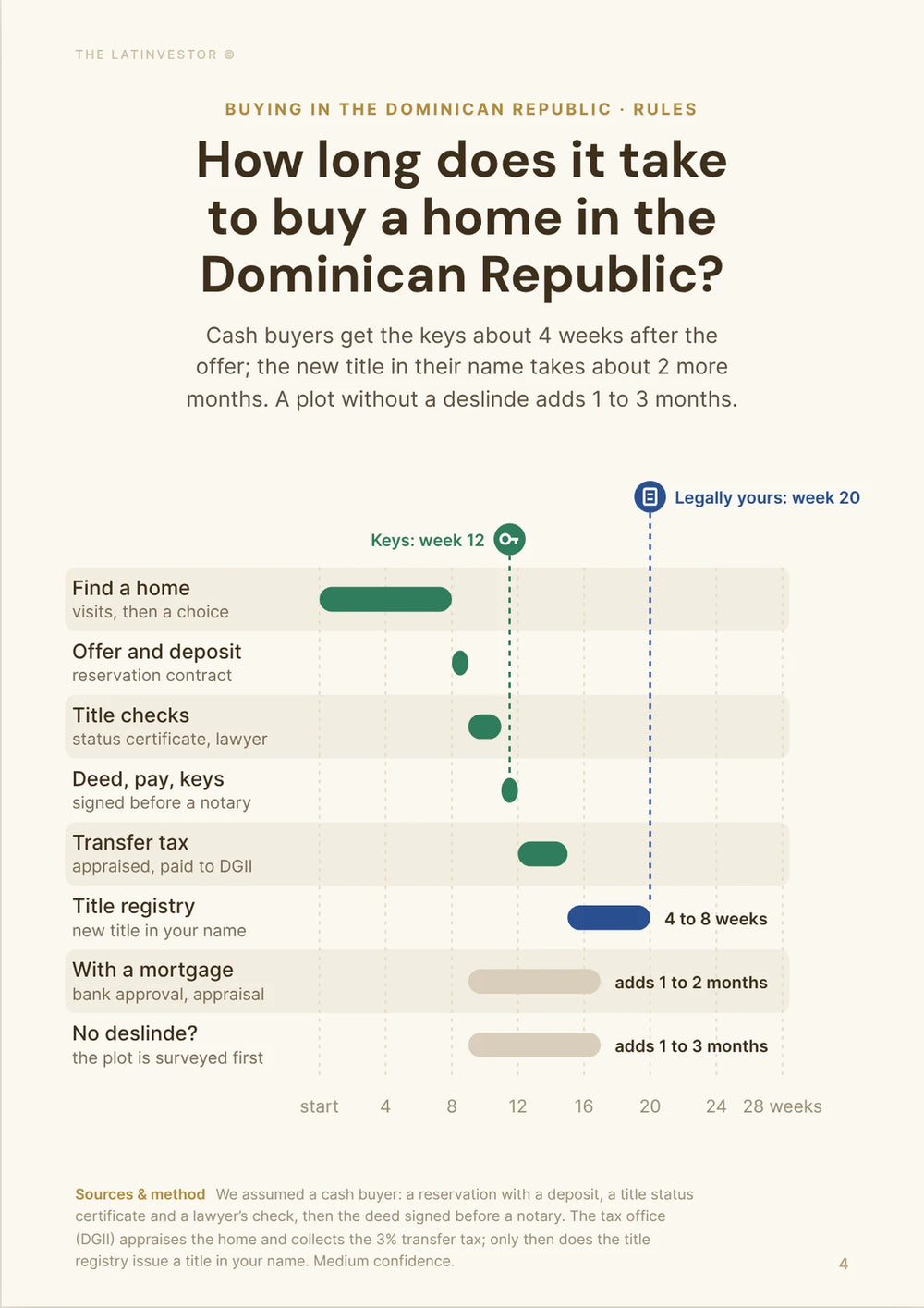
A normal resale takes roughly 45 to 90 days to reach a new title. The notary is part of every deal; your own lawyer usually costs 1% to 1.5%.
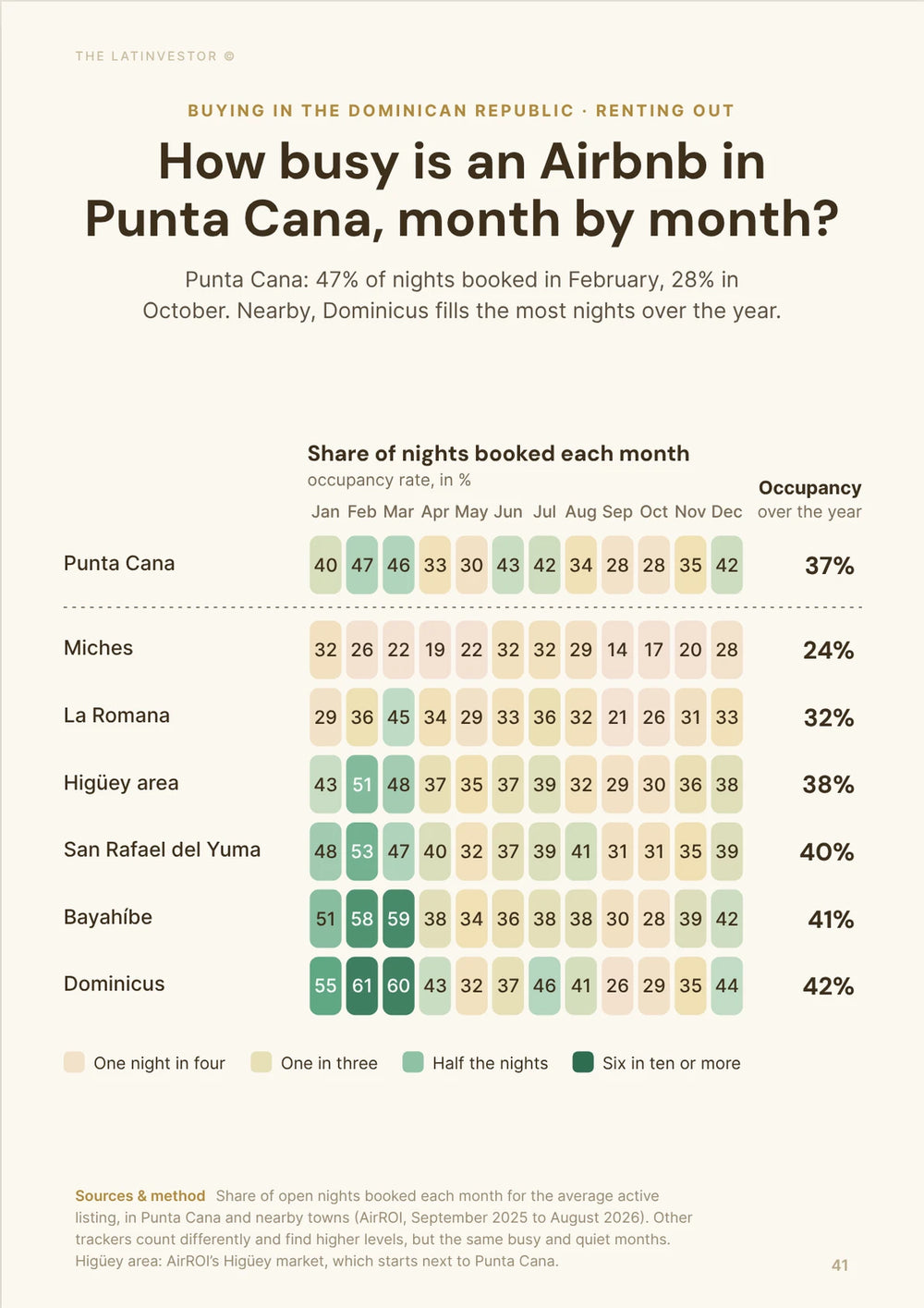
Off-plan is where foreigners lose money in Punta Cana. There is no legal escrow, RE/MAX counts more than 50 off-plan projects in its sample, and Airbnb occupancy was only 36.4% over the year to September 2026.
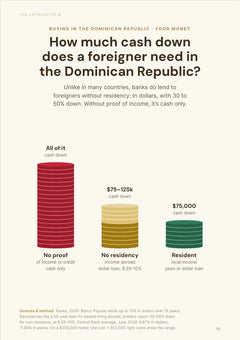
Banks lend to some foreigners, usually 50% to 70% of the price over 10 to 15 years. The BCRD average housing-loan rate was 8.87% in dollars and 11.90% in pesos in June 2026.
On a $250,000 resale, closing costs come to about $11,250 to $16,250. A first purchase in a valid Confotur project skips the 3% transfer tax and costs about 1.5% to 3.5%.
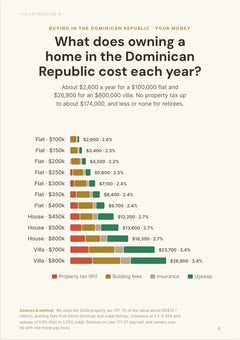
IPI is 1% of the combined appraised value above RD$10,695,494 (about $174,000). A $250,000 condo appraised at its price pays about $760 a year.
Non-residents should budget for Dominican income tax on rental profit (the general rate for non-residents is 27%). Home insurance runs about $750 to $2,100 a year on a $300,000 home.
Law 30-26 cut the tax on an individual's resale gain to a flat 10% and puts the mortgage registration tax at 2% in 2026, 1% in 2027 and 0 from 2028.
Bottom line: buying in Punta Cana as a foreigner is easy. Buying safely means a deslinde title, your own lawyer, a Confotur resolution you checked yourself and an off-plan payment plan tied to construction stages, with at least 30% held back until delivery.


Property types, land and the few limits on what a foreigner can own in Punta Cana
What property types can foreigners legally buy in Punta Cana right now?
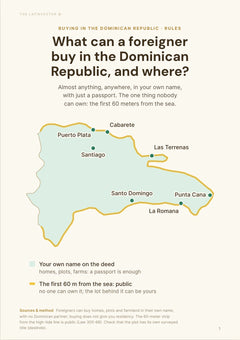
All of them: condos, apartments, penthouses, villas, houses, townhouses and titled residential lots. You get exactly the same title as a Dominican buyer.
The condition is the title. True ownership comes from registration at the Registro de Títulos, not from a private contract.
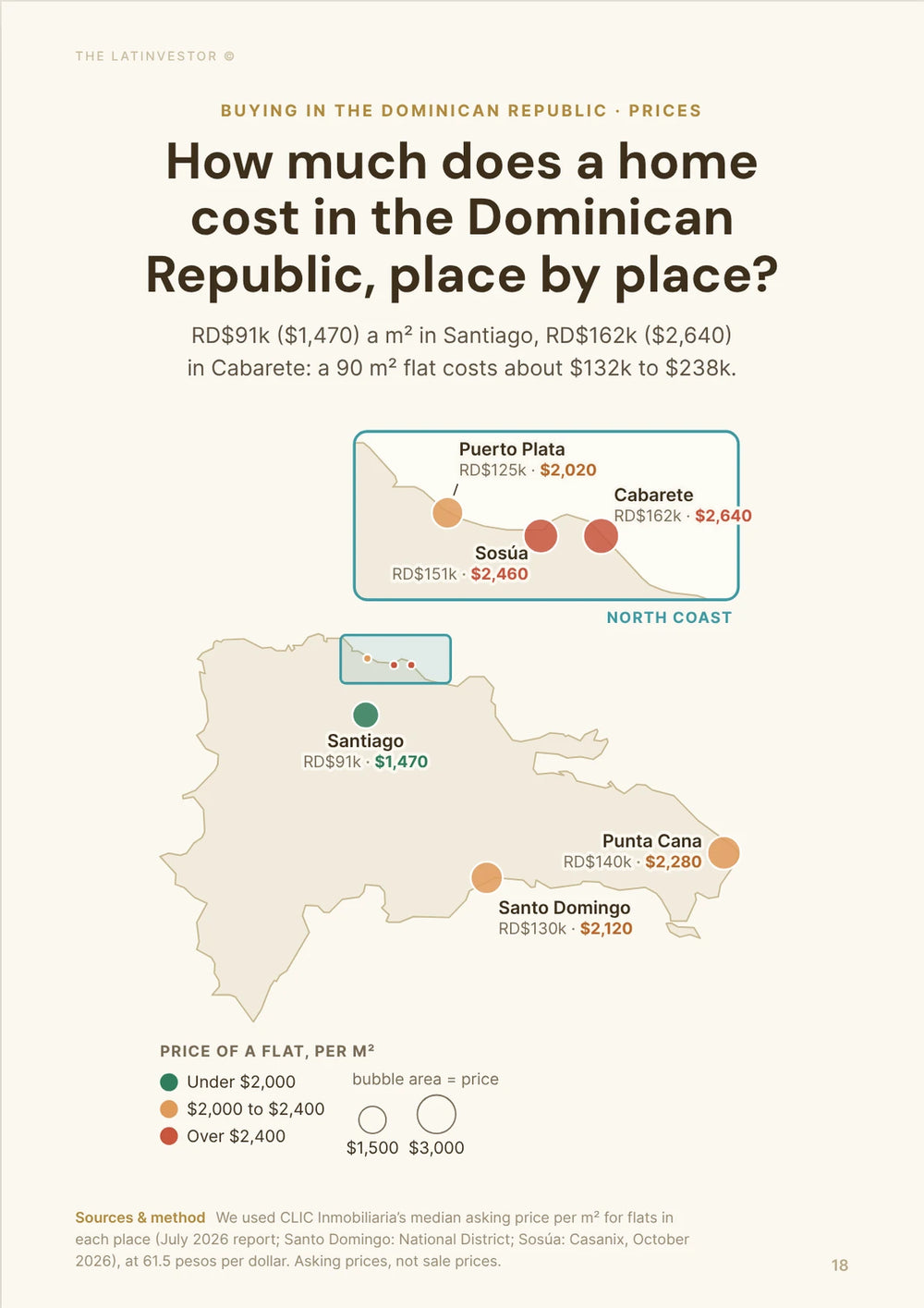
Foreign buyers mostly look at condos in Bávaro, Los Corales, El Cortecito, Downtown Punta Cana and Vista Cana, villas in Cocotal, Cap Cana and Punta Cana Village, and resort residences in Cana Bay. Apartments ask about $2,278 per m² in Punta Cana-Bávaro (CLIC, June 2026, Cap Cana excluded).
The right to buy is broad. What you can do with the property is not: condo bylaws, master-community rules, resort contracts and Confotur documents can limit rentals, renovations and use.
The price per m² comes from CLIC Inmobiliaria's price per m² report.
Can I own land in my own name in Punta Cana right now?
Yes. A foreigner can own titled land in Punta Cana in their own name, as long as the parcel is registered and transferable.
That doesn't make every lot safe. Check the title, the survey, the boundaries, the subdivision status, road access, water and power, and what you're allowed to build.
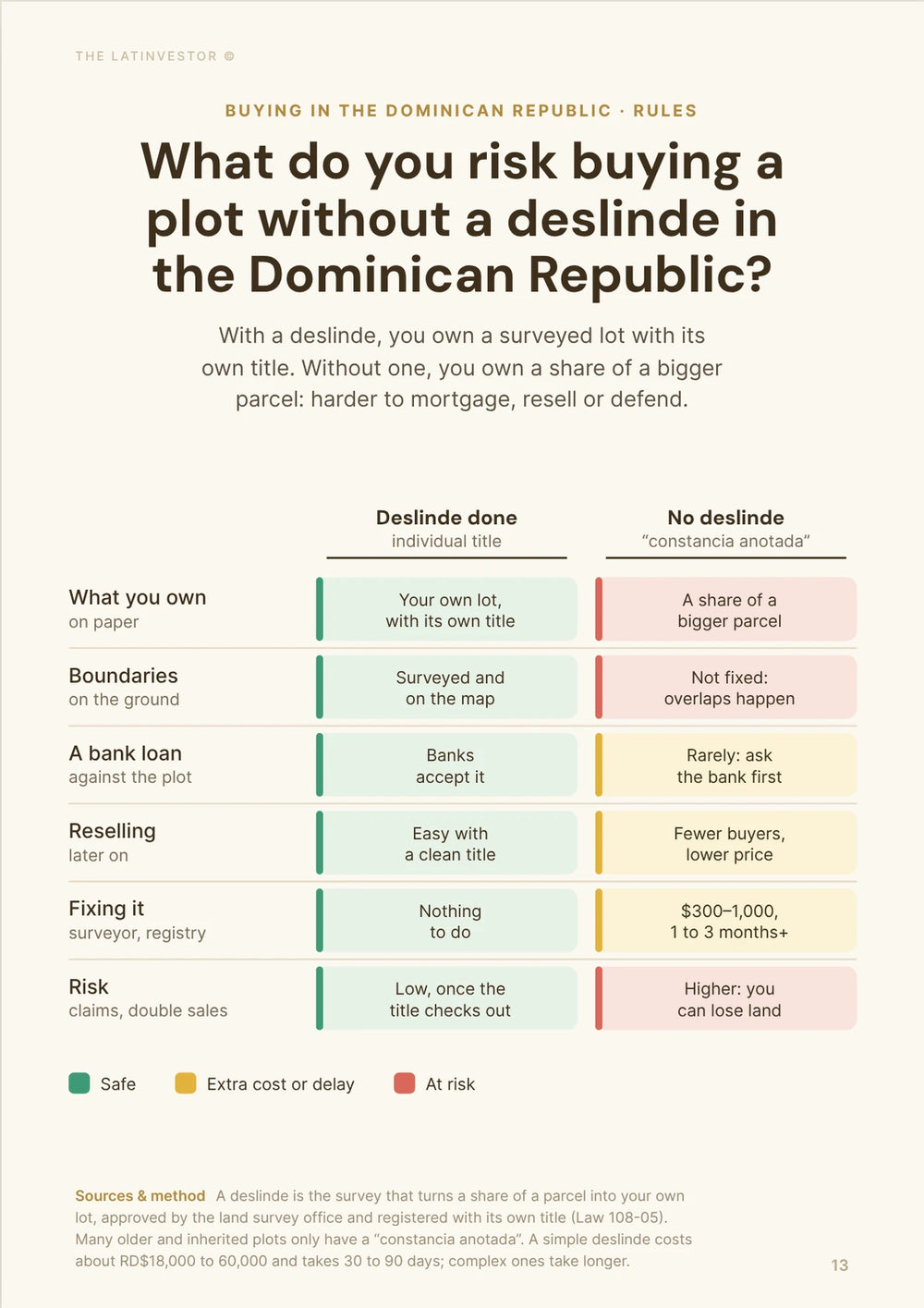
In Vista Cana, Cap Cana, Verón, the Macao corridor and the edges of Bávaro, the risk is rarely your nationality. It is unclear paperwork or weak building permissions. Insist on a lot with its own surveyed title (deslinde) and avoid a "constancia anotada", a share of a bigger parcel without defined limits.
If the deslinde still has to be done, a July 2026 broker guide puts it at RD$18,000 (about $295) to RD$60,000 (about $975) and 30 to 90 days for a simple case. Make the seller pay for it before closing.
Deslinde cost and time come from 1122 Real Estate's July 2026 closing-cost guide.
In 2026, what other key foreign-ownership rules or limits should I know in Punta Cana?
In 2026, the limits that matter in Punta Cana don't come from your passport. They come from condo bylaws, HOA and master-community approvals, source-of-funds checks, transfer formalities and Confotur status.
There is no Thailand-style foreign quota: a condo building doesn't become off-limits because many units are already foreign-owned.
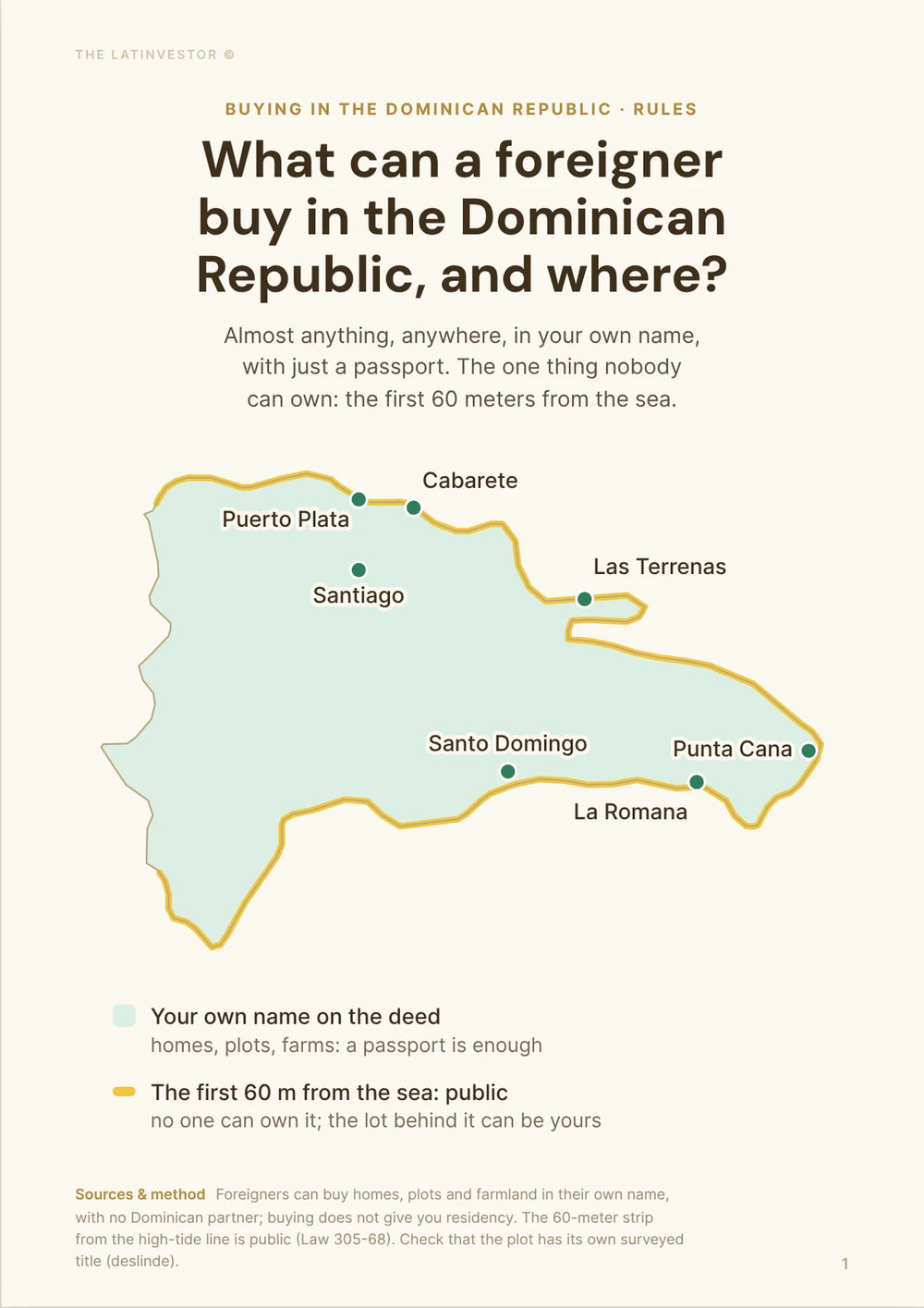
The beach rule surprises people: the 60 m strip measured from the high-tide line is public land (Law 305-68). A beachfront villa owner in Uvero Alto or Cap Cana can't fence it off or build on it.
There is no 2026 rule that bans or limits foreign buyers in Punta Cana. But tax incentives and tourism approvals are granted project by project, so check each one yourself.
The beach rule comes from the Ministry of Environment's page on the 60-meter strip.
What’s the biggest ownership mistake foreigners make in Punta Cana right now?
Thinking that a reservation form, a payment plan or a promise of sale means you already own the property.
Buyers who make that mistake pay deposits before anyone has checked the title, liens, permits, rental rules, the developer's delivery record or how the unit will get its own title.
The other classic Punta Cana mistakes: trusting a developer's Airbnb income projection, ignoring the HOA rules, assuming "Confotur" covers your exact unit, and buying land without a deslinde.
Which visa or residency status changes what I can do in Punta Cana?
Do I need a specific visa to buy property in Punta Cana right now?
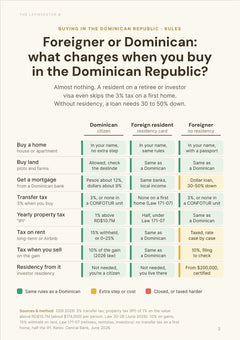
No. You don't need any visa or residency to buy in Punta Cana in 2026. You can buy while visiting as a tourist.
What slows deals down is paperwork, not visas: proof of where your money comes from, apostilled and translated documents, and the bank's compliance checks.
Most foreign buyers close with their passport, and DGII identifies you for the transfer tax. If you later rent the property out, you'll need to be registered with DGII to declare that income.
A typical file holds your passport, marriage documents if relevant, proof of funds, the purchase deed and a power of attorney if you sign from abroad.
Does buying property help me get residency and citizenship in Punta Cana in 2026?
Only if the purchase fits the investor route. Owning a Punta Cana condo never gives you residency or citizenship by itself.
The investor route needs a certified investment of at least $200,000 (about RD$12.3 million), registered as foreign investment, plus police, medical and identity documents. A property can count, so a 1-bedroom at the $190,000 median of finished Punta Cana condos (Evalua, September 2026) falls just short.
Many Punta Cana retirees use other routes: pensionado residency needs a pension of at least $1,500 a month (plus $250 per dependent), and rentista residency a stable income of $2,000 a month. The government advertises 45 working days to process a pensionado file, but gathering documents takes longer.
Citizenship is a separate naturalization process later on, with its own rules and timing.
Income thresholds come from the DGM pages for pensionado and rentista residency; the condo median from Evalua.
Can I legally rent out property on my visa in Punta Cana right now?
Yes, in most cases. Your visa doesn't stop you from renting out a property you own, and you don't need to live in the country: most foreign owners in Punta Cana use a local manager, who usually takes 20% to 25% of short-stay revenue.
There is still no national Airbnb license. MITUR's draft RENATUR registry, put out for consultation on 20 May 2026, would have made every short-term unit register. It was withdrawn on 20 July 2026 and sent to talks with the sector, with no new date.
What matters in practice: rent is Dominican-source income you must declare, and your building's reglamento may ban stays of a few nights. Read it before you buy, not after.
Be realistic about income. An average 2-bedroom Airbnb open all year nets about 1.4% of a $250,000 price before tax, against about 3.7% for the same unit on a long lease at the $1,500 median rent (see our Punta Cana Airbnb and Punta Cana rents articles).
Management fees come from Host My Spot, the RENATUR status from MITUR, Airbnb data from AirROI and long-term rents from CLIC Inmobiliaria (March 2026).
How does the buying process actually work step-by-step in Punta Cana?
What are the exact steps to buy property in Punta Cana right now?
The usual order: offer, reservation, hire your own lawyer, title and lien checks, promise of sale, notarized sale deed, payment of the transfer tax, filing at the Registro de Títulos and a new title in your name.
You don't have to be in Punta Cana for every step. A precise, apostilled and translated power of attorney lets your lawyer sign for you.
The promise of sale is what binds you. But you're only safe once the new title is registered in your name.
A normal resale often takes about 45 to 90 days from accepted offer to new title. Off-plan takes much longer, because the title usually comes after the building is finished and divided into units.
Is it mandatory to get a lawyer or a notary to buy a property in Punta Cana right now?
A notary is part of every formal purchase. A private lawyer isn't mandatory by law, but as a foreign buyer in Punta Cana you should always hire one.
The notary makes the documents official. Your lawyer protects you: title, liens, taxes, permits, contracts, rental rules and closing conditions.
In 2026, lawyers usually charge about 1% to 1.5% of the price, and notaries about RD$15,000 to RD$45,000, or $245 to $730. Get the scope in writing: title and registry checks, tax checks, HOA debts, Confotur verification if the project claims it, and the payment and cancellation clauses.
Pick your own lawyer, not the developer's or the agent's.
Fee ranges come from 1122 Real Estate and Inmobiliaria Puntual (2026).
What checks should I run so I don’t buy a problem property in Punta Cana?
How do I verify title and ownership history in Punta Cana right now?
The official place is the Registro Inmobiliario, through the Registro de Títulos that covers La Altagracia and its cadastral records.
The key document is the Certificado de Título, backed by the cadastral designation, the survey plan, the seller's identity and the registry certifications your lawyer requests.
Lawyers commonly look back at least 10 years, and further when the property is land, inherited, subdivided or newly built.
Walk away from any mismatch between the seller, the title, the cadastral designation, the unit on site and the property in the listing.
How do I confirm there are no liens in Punta Cana right now?
Ask the Registro de Títulos for a certification of the property's legal status (Certificación del Estado Jurídico del Inmueble). It costs about RD$1,000 (about $16) and lists mortgages, annotations, seizures and restrictions.
The most common charge is a bank mortgage. Also check what the registry doesn't show: unpaid HOA fees, unpaid taxes, utility bills and court cases.
Get the certification shortly before closing, ask the HOA and the seller for no-debt letters, and make the seller clear every debt before you sign the deed.
How do I check zoning and permitted use in Punta Cana right now?
Start with the local ayuntamiento (Higüey, or the Verón-Punta Cana municipal district). In a tourism zone, also check MITUR's approvals and the master community's own rules.
Ask for the land-use certification, any MITUR no-objection or project approval, the condo bylaws and the community rules that apply to the property.
The classic Punta Cana trap: buying a unit to rent on Airbnb and finding out later that the condo, the HOA or the resort operator limits short stays.
Is it safe to buy off-plan in Punta Cana as a foreigner in 2026?
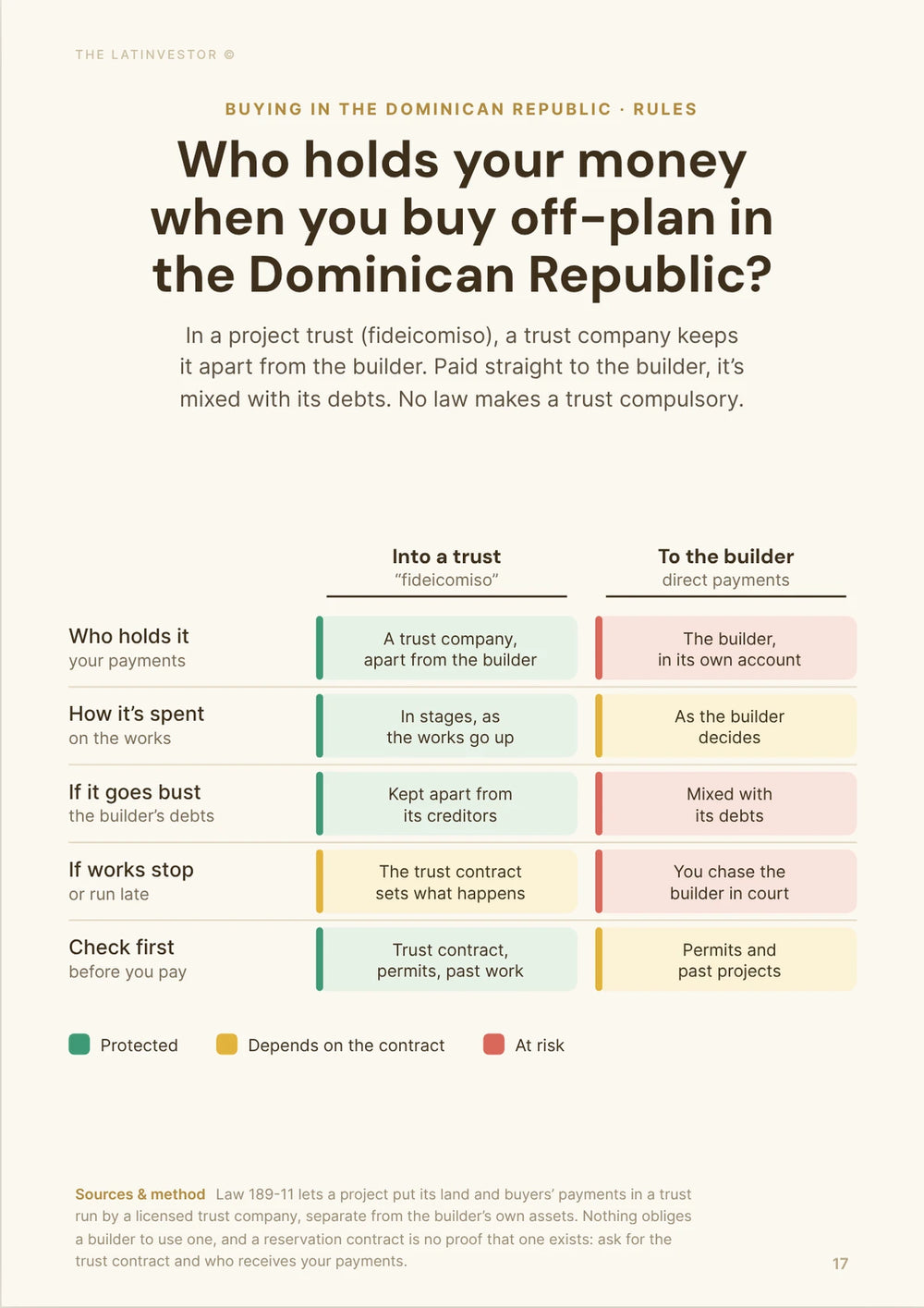
It can be, but the law protects you less than most buyers think. There is no general legal escrow for off-plan deposits in the Dominican Republic: your protection depends on the contract and on whether the project uses a fideicomiso (Law 189-11).
A fideicomiso keeps the project's money and land apart from the developer, and a fiduciary releases payments. That's better than paying the developer directly, but it doesn't guarantee the building gets finished.
Supply is the bigger risk in Punta Cana. RE/MAX counts more than 50 off-plan projects in its Punta Cana sample, and AirROI tracked 2,446 Airbnb listings with only 36.4% occupancy over the year to September 2026, even though the airport handled 6.38 million international passengers in January-June 2026 (+19.3%). On delivery, you'll compete with many similar units for buyers and guests.
What to do: tie payments to construction stages, not dates; check the building permit and the Confotur resolution yourself; get the fiduciary's name and call it; and keep the final 30% or more for delivery. Visit finished projects by the same developer before you sign.
The payment advice is our own checklist for off-plan buyers.
Can I get a mortgage as a foreigner in Punta Cana, and on what terms?
Do banks lend to foreigners for homes in Punta Cana in 2026?
Yes, Dominican banks lend to some foreign buyers in Punta Cana in 2026, but they pick carefully and ask for more paperwork than from locals.
Brokers report that non-residents usually put down 30% to 50%, so they borrow 50% to 70% of the price, over 10 to 15 years. Banco Popular advertises a dollar product up to 70% and 15 years, and Banreservas a product for residents abroad up to 20 years, but neither is guaranteed to a non-resident.
What counts most is stable, provable income and a clean source of funds, then residency status, credit history and the quality of the project. An off-plan unit in a project the bank doesn't already finance can be refused.
We also used Banco Popular, Banreservas and Tropical Assets on financing as a foreigner.
Which banks are most foreigner-friendly in Punta Cana in 2026?
In 2026, foreign buyers in Punta Cana usually start with Banco Popular and Banreservas, then compare BHD, Banco BDI and Scotiabank.
They're the biggest mortgage lenders, they have branches in Bávaro, and they're used to checking income earned abroad.
Non-residents can get a loan, but expect a bigger down payment, more documents and a stricter look at the property than a resident would face. Mortgage lending is growing: the national stock reached RD$466.9 billion (about $7.6 billion) in July 2026, up 11.5% in a year.
The mortgage stock comes from the Superintendencia de Bancos via El Dinero.
What mortgage rates are foreigners offered in Punta Cana in 2026?
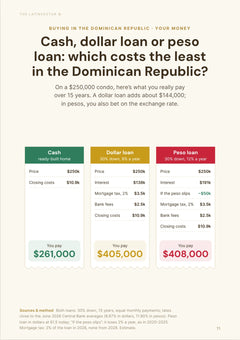
No bank publishes a rate for non-resident foreigners. The best guide is the market: the BCRD average housing-loan rate was 8.87% for dollar loans and 11.90% for peso loans in June 2026.
Banco BDI's May 2026 reference rates were 8.9% to 9.9% for preferred dollar loans, 9.9% to 11.4% for ordinary dollar loans and 14% to 15% in pesos. Since Punta Cana property is priced in dollars, borrow in dollars if you earn in dollars.
Most loans have a rate fixed for a short period, then reviewed by the bank. The Central Bank raised its policy rate to 5.50% in September 2026, so don't count on cheaper loans soon.
Rates come from Banco BDI's 21 May 2026 reference rates, the BCRD June 2026 averages and the BCRD policy-rate decision.
What will taxes, fees, and ongoing costs look like in Punta Cana?
What are the total closing costs as a percent in Punta Cana in 2026?
In 2026, budget about 4.5% to 6.5% of the price for closing costs on a normal Punta Cana purchase.
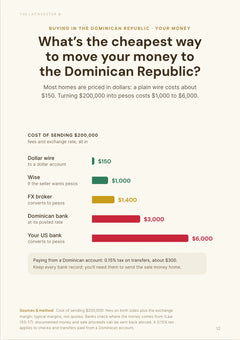
The biggest item is the 3% transfer tax, charged on the higher of the price and DGII's appraisal. Then come the lawyer (about 1% to 1.5%), the notary, small registry fees and, if you borrow, the 2% mortgage registration tax on the loan in 2026 (1% in 2027, nothing from 2028). Borrowing $150,000 on a $250,000 condo adds $3,000 in 2026.
On a $250,000 (about RD$15.4 million) resale, that's roughly $11,250 to $16,250. On a first purchase in a project with a valid Confotur resolution, the 3% transfer tax goes away and total costs fall to about 1.5% to 3.5% ($3,750 to $8,750).
The agent's 3% to 5% commission is usually paid by the seller.
Ranges come from 1122 Real Estate (July 2026) and Law 30-26 for the mortgage tax.
What annual property tax should I budget in Punta Cana in 2026?
In 2026, many Punta Cana condos owe no IPI at all: individuals only pay once the combined DGII-appraised value of all their Dominican property passes RD$10,695,494 (about $174,000).
Above that, the tax is 1% of the part over the threshold. A $250,000 condo appraised at its full price (about RD$15.4 million) pays about RD$46,800, or $760, a year. DGII appraisals are often below the market price, so many owners pay less.
Units in a Confotur project are usually exempt for 15 years, and owners over 65 living in their only home, and some pensionados and rentistas, can get exemptions. Properties held through a fideicomiso or a company don't get the individual threshold.
The $760 is our calculation: 1% of the part above the 2026 threshold.
How is rental income taxed for foreigners in Punta Cana in 2026?
Rent from a Punta Cana property is Dominican-source income, wherever you live. What you pay depends on who pays the rent, your expenses and whether you're a tax resident.
When a company rents from an individual, it must now withhold 15% of the rent (10% before Law 30-26). Residents then pay the normal 0% to 25% income tax scale.
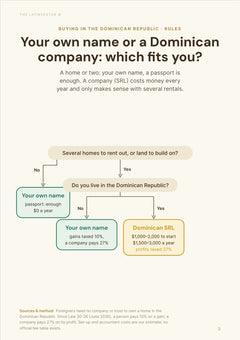
As a non-resident, budget for Dominican income tax on your rental profit: the general rate for non-residents is 27%. Short-stay owners usually file through a local accountant, and 18% ITBIS may apply to tourist lodging. How that applies to an individual's Airbnb isn't settled, so check with an accountant.
The 15% withholding comes from Law 30-26.
What insurance is common and how much in Punta Cana in 2026?
In 2026, a rough home-insurance budget is about 0.25% to 0.70% of the building's insured value a year. On a $300,000 home, that's about $750 to $2,100 (RD$46,100 to RD$129,000). This is our estimate: no one publishes average premiums.
Most owners carry fire and major-damage cover, then add hurricane, windstorm, earthquake, water damage, liability and contents.
Coastal and hurricane exposure move the price the most, so a beachfront villa in Uvero Alto or Cap Cana sits at the top of the range and an inland condo in Vista Cana near the bottom. The hurricane season runs from 1 June to 30 November. In a condo, the building's policy usually doesn't cover your contents or your liability as a landlord.
Hurricane-season dates come from INDOMET.
What does Law 30-26 change for a foreign buyer in Punta Cana?
Law 30-26, the tax reform passed in June 2026, is in force. It didn't change your right to buy, the 3% transfer tax or the IPI rules, but it changes what you pay when you borrow, rent and sell.
Selling: an individual now pays a flat, final 10% on the gain. Before, the gain was taxed at 27% after an inflation adjustment. On a condo bought for $250,000 and sold for $300,000, that's about $5,000. Companies still pay 27%.
Borrowing and renting: the mortgage registration tax drops from 2% of the loan in 2026 to 1% in 2027 and 0 from 2028. Withholding on rent paid by companies to individuals went from 10% to 15%.
Confotur, which most new Punta Cana projects advertise: the law didn't repeal it, but it says you can't use two incentive regimes on the same operation. Lawyers at Pellerano & Herrera say the effect on Confotur is still unclear. Look the project up on MITUR's Confotur search, check your unit is in the resolution, and have your lawyer write into the contract who pays if the exemption is refused.
The resale example is our own calculation.
Our methodology
This article explains what a foreigner can buy and own in Punta Cana in 2026, how visas and residency fit in, how a purchase works, which checks to run, the off-plan risk, how foreigners borrow, and what they pay in closing costs, yearly property tax, rental tax and insurance.
Ownership and title rules come from the Registro Inmobiliario, Law 108-05, Law 5038 on condominiums, Law 16-95 and Law 305-68. Residency thresholds come from the Dirección General de Migración. Mortgage figures come from BCRD averages (June 2026), Banco BDI's May 2026 reference rates and bank product pages. Closing-cost ranges come from 2026 broker guides (1122 Real Estate, Inmobiliaria Puntual). Prices come from CLIC and Evalua, off-plan supply from RE/MAX, Airbnb data from AirROI only, rents from CLIC and airport traffic from Revista Mercado.
Tax rules (transfer tax, IPI, rental tax, capital gains, mortgage tax) come from DGII and the text of Law 30-26. Confotur rules come from MITUR and Law 158-01, with Pellerano & Herrera's reading of the Law 30-26 overlap. The RENATUR status comes from MITUR's July 2026 withdrawal.
We checked these figures in October 2026. Conversions use about 61.5 Dominican pesos per US dollar.
Where we had no direct figure, we estimated it and say so: the 45-to-90-day timeline, the 10-year title look-back and home-insurance premiums. Your own costs will depend on the title, the project, your bank profile and whether you live in the country.
Key sources used for this analysis include Registro Inmobiliario, Registro Inmobiliario FAQ, Law 108-05 on Real Estate Registration, Foreign Investment Law 16-95, U.S. State Department Investment Climate Statement, Ministry of Environment page on the 60-meter strip, DGII property tax page, DGII 2026 IPI threshold, DGII transfer tax answer, DGII income tax page, Dominican tax code income-tax title, Law 30-26, DGII fideicomiso page, DGM residence categories, DGM investor residence, DGM pensionado residency, DGM rentista residency, CONFOTUR official site, CONFOTUR project consultation, MITUR no-objection to land use, MITUR Registro Nacional Turístico, Pellerano & Herrera on Confotur and Law 30-26, Banco Central tourism statistics, Banco Central exchange-rate data, BCRD policy-rate decision, Banco BDI reference rates (May 2026), Banco Popular mortgage page, Banreservas mortgages for residents abroad, Tropical Assets on financing as a foreigner, El Dinero on the mortgage stock, 1122 Real Estate closing costs 2026, Inmobiliaria Puntual closing costs, CLIC Inmobiliaria price per m² report, CLIC Inmobiliaria Punta Cana rents, Evalua Punta Cana condos, RE/MAX Metropolitana Punta Cana, AirROI Punta Cana, Host My Spot, Revista Mercado on airport traffic and INDOMET hurricane season.