Summary
Is Panama City a good place to live as an expat? Yes, especially with a foreign income and a short daily commute. Panama ranks 1st of 31 destinations in InterNations’ 2026 survey, for the third year in a row, and 87% of expats there are happy with life abroad.
The survey covers Panama as a whole, not the capital alone, and 37% of respondents are retired. Still, Panama City holds most of what expats rely on: the best hospitals, international schools, jobs and the main airport.
Panama City is good value, not cheap. A central one-bedroom averages about $1,305 a month, or 142% of the average local net salary of $920.
A single expat can live comfortably on $2,000 to $3,000 a month, with a one-bedroom around $875 outside the center. $3,500 or more buys a much easier version of the city.
For a first move, San Francisco, El Cangrejo and Obarrio make daily life easier than prestige addresses. Punta Pacífica and Costa del Este suit people whose work, school or hospital is nearby. An apartment ten minutes from work or school often beats a grander tower far away.
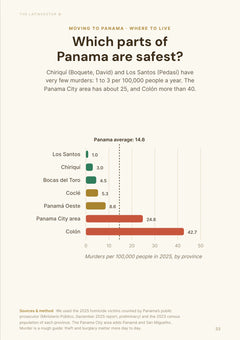
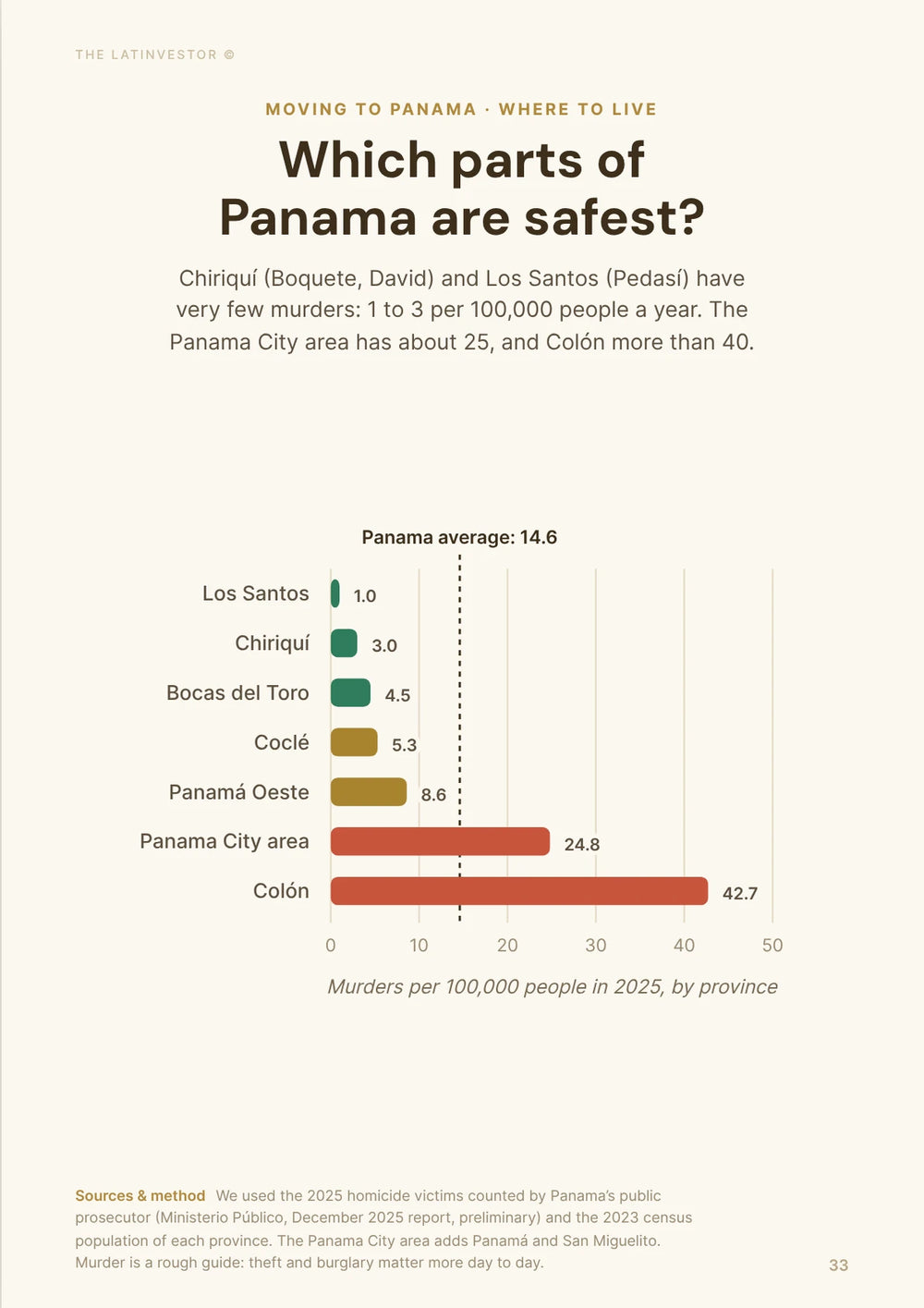
Safety is good enough for normal life: Panama is at Level 2 in the U.S. advisory and ranks 6th for Safety & Security in the 2026 InterNations survey. Petty theft and break-ins remain the main risks.
Traffic is the biggest weakness: Panama ranks last of 31 for infrastructure for cars. Metro Line 3 was about 77% built in June 2026, so it will not fix today’s commutes.
Living without a car is possible near Metro stations in El Cangrejo, Obarrio, Bella Vista and parts of San Francisco, but heat, rain and patchy sidewalks limit walking, and Panama ranks only 17th for Travel and Transit.
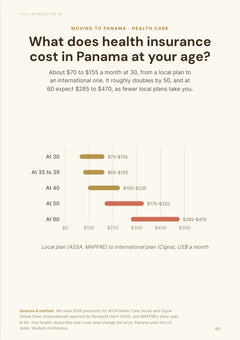
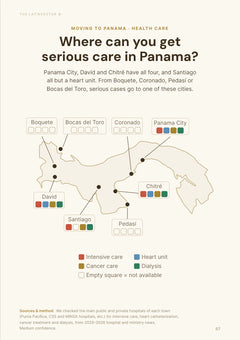
Private healthcare is a real strength, led by Pacífica Salud’s Johns Hopkins-affiliated hospital. A private general consultation costs about $40 to $80, and insurance matters, especially for retirees.
Families pay a lot for schools: the International School of Panama charges $10,204 to $19,328 a year, so two children can cost $32,000 to $38,000 in tuition alone.
English goes a long way at first: 62% of expats say you can live there without Spanish, against 48% globally. But 40% have mostly expat friends, and Spanish opens up the city.
Remote workers get the best version of the city: 94% of expats rate high-speed internet positively, and working from home avoids the rush hour.
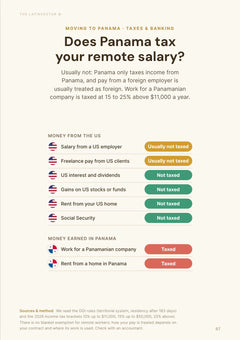
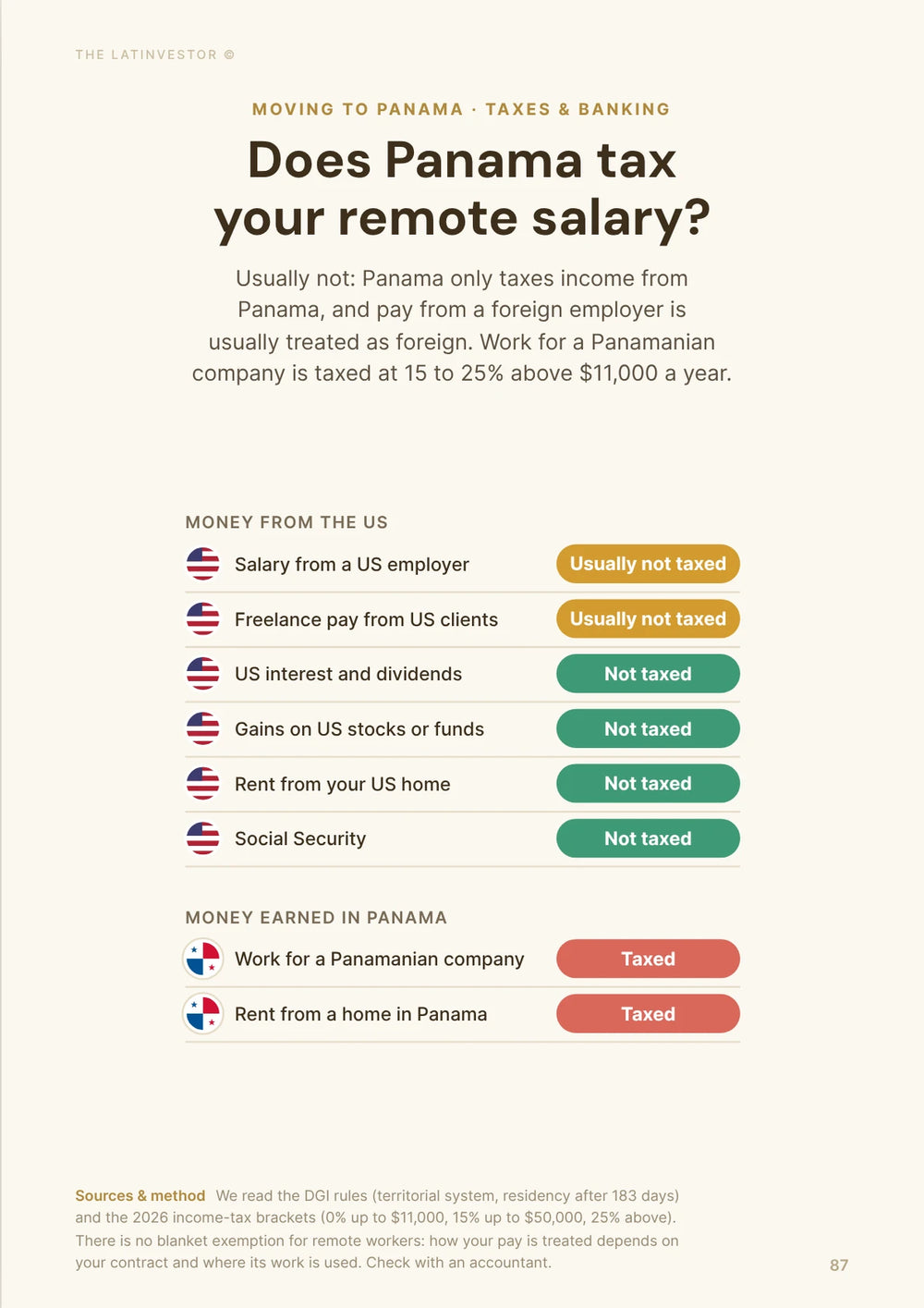
The territorial tax system still helps: local income pays 0% up to $11,000, 15% up to $50,000 and 25% above, while genuine foreign-source income is generally not taxed. Work done physically in Panama needs checking.
The climate is hot all year, in the high 20s to low 30s Celsius, with a long wet season. Flights are a major plus: Tocumen handled about 21 million passengers in 2025, the most international traffic in Latin America.
Bottom line: Panama City works very well for remote workers on $4,000 to $6,000 a month, retirees with solid pensions and executives with benefits. Choose your home around your daily trips, and it is hard to beat in the region.


Are expats actually happy living in Panama City right now?
Yes. Panama City currently sits inside one of the strongest expat environments anywhere in the world, and the latest evidence suggests that satisfaction is broad rather than driven by one unusually good year.
Panama finished first out of 31 destinations in InterNations’ Expat Insider 2026 survey, published in July 2026, its third consecutive year at number one. Some 87% of expats surveyed in Panama said they were happy with life abroad, compared with 70% globally. Panama also ranked first for Personal Finance and Working Abroad, second for Ease of Settling In and second for Expat Essentials.
Three years at the top is much more convincing than a single ranking. The 2026 survey also shows that the satisfaction goes beyond retirees enjoying cheap sunshine: 90% said their disposable household income was enough for a comfortable life, 90% described Panamanians as generally friendly, and Panama ranked sixth for overall quality of life.
We still need to separate Panama City from the rest of Panama. The survey is national, and 37% of Panama respondents are retired. Someone living quietly in Boquete has a very different daily life from someone commuting across Panama City. Even so, the capital contains most of the country's strongest expat assets — its best hospitals, deepest rental market, international schools, largest professional community and main airport hub — so the national result is highly relevant.
| Expat measure (2026 survey) | Panama | Global comparison | What we learn |
|---|---|---|---|
| Overall Expat Insider rank | 1st of 31 | — | Panama remains an unusually strong expat destination |
| Happy with life abroad | 87% | 70% | Satisfaction is well above average |
| Comfortable on disposable income | 90% | 71% | Foreign incomes go relatively far |
| Satisfied with finances | 76% | 55% | Money is a real advantage |
| Ease of Settling In | 2nd | — | Newcomers generally adapt quickly |
| Quality of Life | 6th | — | Strong, although clearly less dominant than finance |
Is Panama City still cheap for expats?
Panama City is still good value for many expats, but these days it makes little sense to describe the capital as cheap.
InterNations still gives Panama an exceptional affordability score. In its 2026 survey, 69% of expats rated the general cost of living positively, versus 39% worldwide, while Panama finished first for Personal Finance. That is a strong result.
Actual Panama City prices explain why the word “cheap” can still mislead newcomers. Numbeo’s October 2026 city data puts the average one-bedroom apartment in the center at about $1,305 a month and a three-bedroom at roughly $2,180. Outside the center, the averages fall to about $875 and $1,555 respectively. These figures come from user-contributed data rather than signed leases, but the dataset included 743 price entries from 65 contributors over the previous 12 months.
The more revealing comparison is with local earnings. Numbeo puts the average monthly net salary around $920. A central one-bedroom therefore costs about 142% of that reported salary. Panama City feels affordable mainly when an expat brings a foreign salary, pension, investment income or a well-paid local package.
That explains a lot of the conflicting descriptions of the city. A remote worker earning $5,000 a month may find a $1,300 apartment and $11.50 restaurant meals excellent value. Someone trying to live on a local middle-income salary faces a completely different equation.
How much money do you need to live comfortably in Panama City?
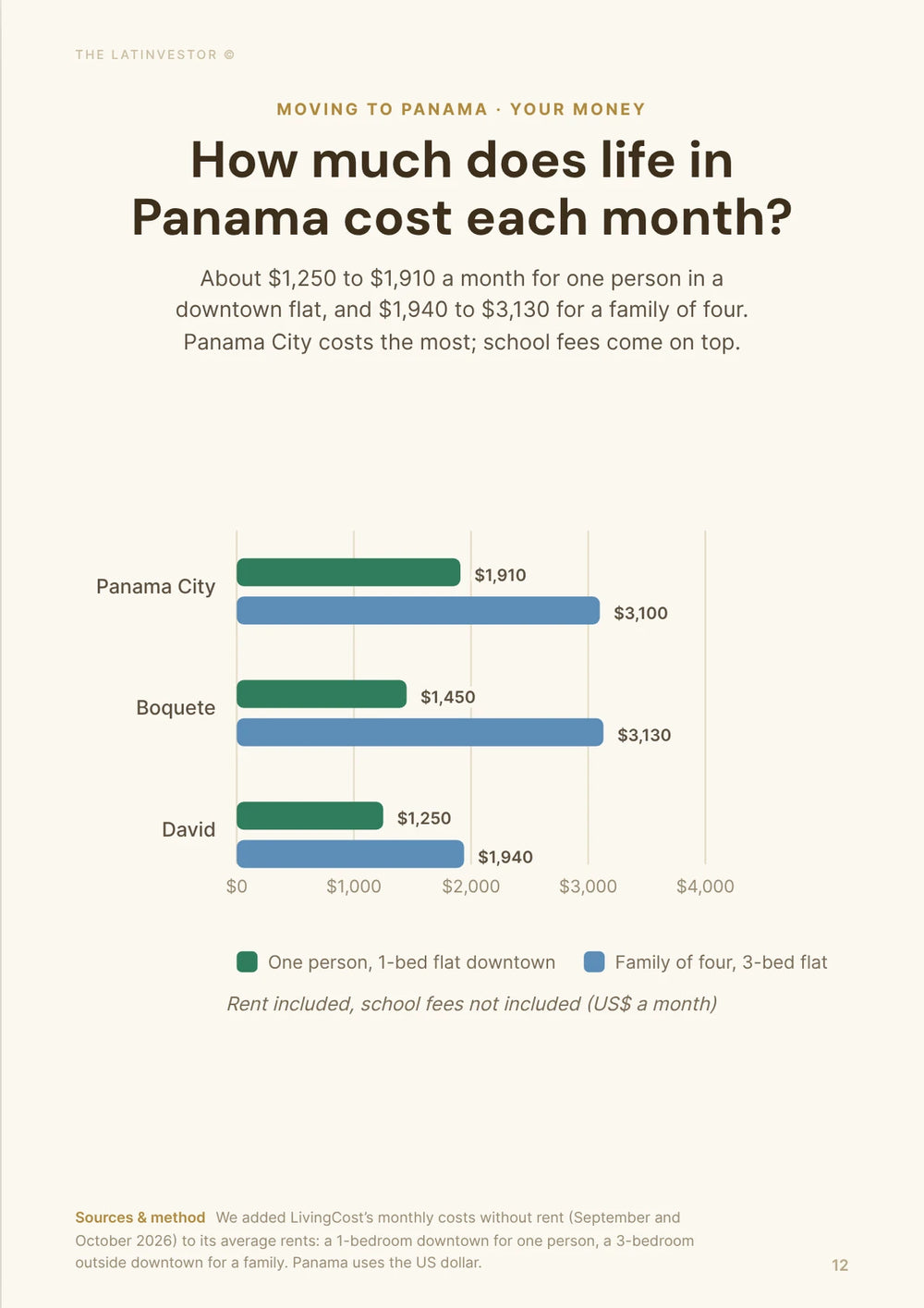
A single expat can live comfortably in Panama City on roughly $2,000 to $3,000 a month, while $3,500 or more buys a much easier version of the city.
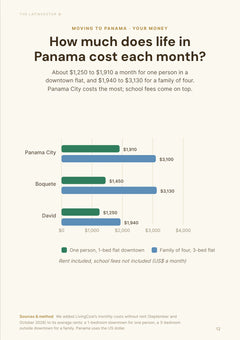
Housing creates most of the difference. With a one-bedroom around $875 outside the center or roughly $1,305 in the center according to Numbeo’s October 2026 data, a single resident can still build a comfortable budget around $2,000-$2,500 if restaurants, ride-hailing and imported groceries stay under control.
Once the apartment moves toward premium high-rise territory, the budget changes quickly. Larger units, newer towers, ocean views, frequent restaurant meals, private insurance and regular Uber use can push a couple well beyond $3,500 a month without anything resembling extreme luxury.
For families, housing stops being the only major expense. International schooling can add well over $1,000 per child every month when annual fees are spread across the year. Two children at a top international school can easily add more than $30,000 in annual tuition before registration, transport and extracurricular costs.
| Expat profile | Housing assumption | Realistic monthly budget | What that lifestyle feels like |
|---|---|---|---|
| Budget-conscious single | $800-$1,000 | $1,500-$2,000 | Comfortable if spending stays local |
| Comfortable single | $1,000-$1,400 | $2,000-$3,000 | Strong value |
| Comfortable couple | $1,300-$1,800 | $2,700-$3,800 | Plenty of room for restaurants and ride-hailing |
| Premium couple | $2,000+ | $4,000-$5,500+ | Newer tower, more convenience, fewer compromises |
| Family using international schools | $1,500-$3,000+ | $4,500-$8,000+ | School choice becomes the biggest swing factor |
Which Panama City neighborhoods actually make expat life easier?
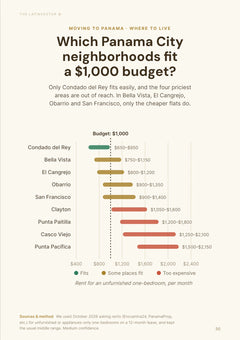
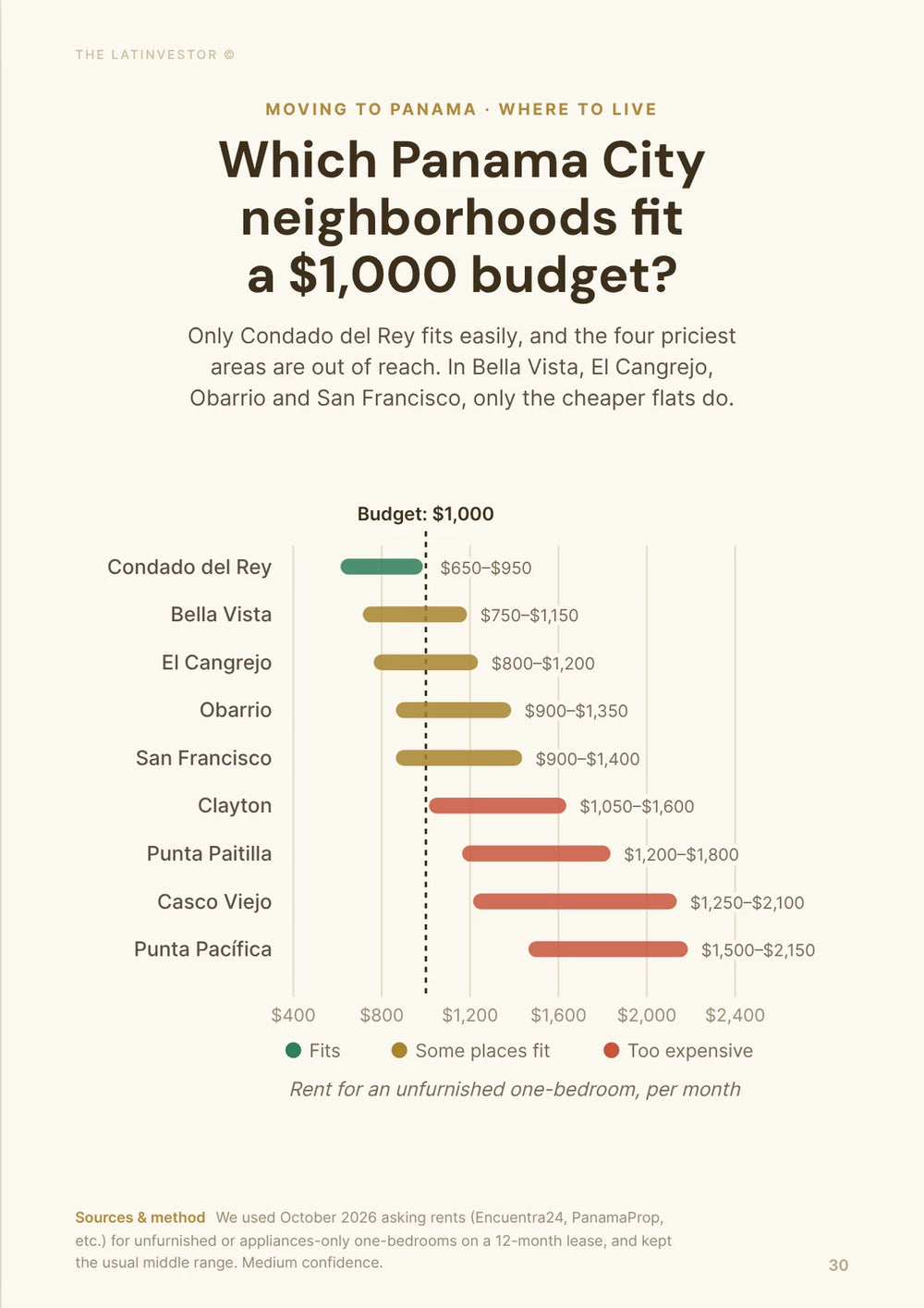
For most newcomers, San Francisco, El Cangrejo and Obarrio make daily life easier than choosing a neighborhood purely for prestige or an ocean view.
San Francisco gives perhaps the best overall compromise. It has supermarkets, restaurants, apartment towers, access to Parque Omar and reasonable reach into several major parts of the city. El Cangrejo feels denser and more walkable around Vía Argentina, with Metro access that can genuinely reduce dependence on a car. Obarrio works well for people who want to stay close to the central business districts.
Punta Pacífica attracts expats who want modern towers, security, sea views and immediate access to Pacífica Salud. Costa del Este offers newer developments, corporate offices and a more planned residential environment, which makes it especially popular with executive families. Both come with higher housing costs and heavier dependence on roads.
Casco Viejo is far more appealing to visit than to recommend automatically as someone's first long-term base. The architecture, nightlife and restaurants are excellent, but tourism, parking, noise and a smaller pool of normal residential apartments can become tiring.
Panama City rewards proximity more than status. A less glamorous apartment ten minutes from work or school can produce a better life than a spectacular tower that creates two long drives every weekday.
| Neighborhood | Works best for | Main advantage | Main compromise |
|---|---|---|---|
| San Francisco | Most first-time expats | Central, practical, restaurants, Parque Omar | Walkability varies by street |
| El Cangrejo | People who dislike driving | Metro access and more street life | Older building stock |
| Obarrio | Professionals | Very central | More commercial atmosphere |
| Punta Pacífica | High-income expats, retirees | Modern towers and major private healthcare | Expensive |
| Costa del Este | Families and executives | Newer, planned, self-contained | Car dependence |
| Casco Viejo | Nightlife and historic-city lovers | Character and restaurants | Noise, tourism and parking |
Is Panama City safe enough for expats today?
Yes. Panama City is safe enough for normal expat life, although petty crime and residential theft remain real enough to justify ordinary big-city precautions.
The U.S. State Department keeps Panama at Level 2, “exercise increased caution,” because of crime. Its latest advisory, from August 2026, mentions theft, residential break-ins, pickpocketing and purse-snatching. The areas placed under “do not travel” warnings are the Mosquito Gulf and parts of Darién, far from Panama City's mainstream expat neighborhoods.
Expat experience points in a fairly reassuring direction. Panama ranks sixth for Safety & Security in InterNations’ 2026 quality-of-life index. That sits unusually high for a Latin American country and fits the experience of many residents in San Francisco, Punta Pacífica, Costa del Este, El Cangrejo and Obarrio.
We would still avoid turning that into a blanket statement about the whole metropolitan area. Security changes quickly between neighborhoods and sometimes between streets. Walking alone late at night with a phone out, displaying expensive jewelry or assuming every area works like Punta Pacífica would be careless.
For most expats, crime is a manageable concern rather than the issue that decides whether Panama City is livable.
Will Panama City traffic ruin your quality of life?
Panama City traffic can absolutely damage quality of life if home, work and school are badly placed.
This is one of the few areas where Panama performs terribly in otherwise excellent expat surveys. InterNations’ 2026 survey ranks Panama last out of 31 countries for infrastructure for cars. Travel and Transit consequently drops to 17th, far below Panama's sixth-place overall quality-of-life ranking.
The government is spending heavily to improve the network. Metro Line 3, which will connect Panama Oeste more effectively with the capital, is moving through construction and testing. Government reporting put overall construction progress around 77% in June 2026, while Metro de Panamá data showed Phase 1 above 84% earlier in 2026. Passenger operations are currently expected in 2028.
That future improvement does not help today's commuter. For now, someone choosing between a slightly nicer apartment and cutting 30 minutes from each daily journey should usually choose the shorter journey.
Remote workers have an especially large advantage here. Removing a rush-hour commute eliminates one of Panama City's worst daily problems while keeping nearly all the benefits of living in the capital.
Can you live in Panama City without a car?
Yes, particularly around El Cangrejo, Obarrio, Bella Vista and selected parts of San Francisco, but Panama City still falls well short of being a genuinely walkable capital.
The Metro makes car-free life far more realistic than the road layout suggests. A resident who lives near a station, works remotely or close to the rail network, orders bulky groceries and uses Uber for occasional longer journeys may have little reason to own a car.
Walking is the weaker part of the equation. Sidewalk quality changes from block to block, large roads cut through central districts, intense heat makes even short walks uncomfortable at certain hours, and tropical downpours can instantly change plans.
The 2026 InterNations data captures that contradiction well: expats rate Panama very highly overall, yet its transport infrastructure remains one of its weakest features.
Panama City therefore works without a car when the location has been chosen around that goal. Moving first and assuming the entire city can later be navigated comfortably on foot usually ends badly.
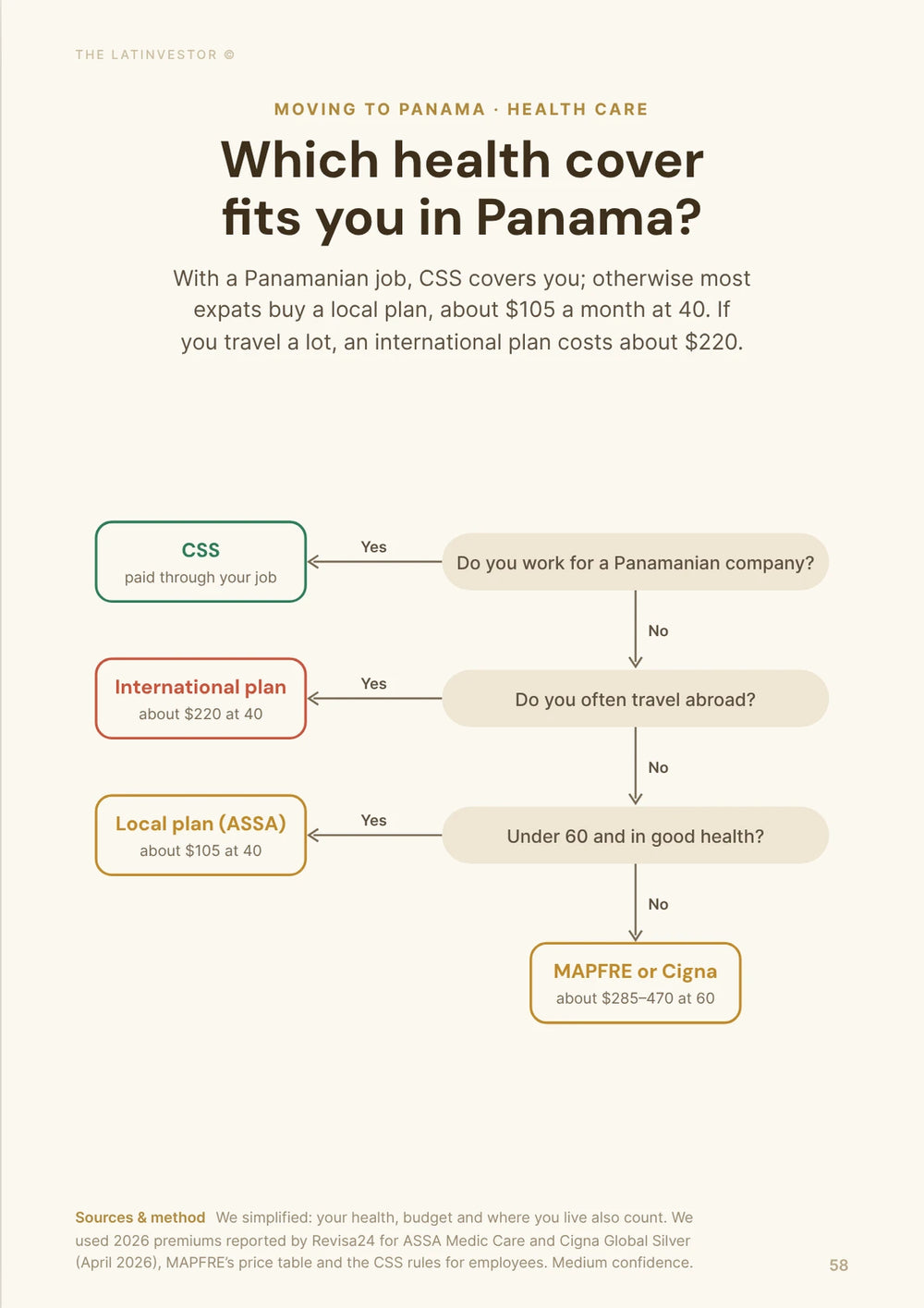
Is private healthcare in Panama City actually good?
Yes. High-quality private healthcare is one of the strongest reasons to live in Panama City rather than in a smaller Panamanian town.
Pacífica Salud Hospital Punta Pacífica has maintained a long-running affiliation with Johns Hopkins Medicine International, covering areas such as clinical programs, training, safety and quality. The capital also has other major private providers, including Hospital Nacional, The Panama Clinic and Hospiten Paitilla.
The advantage comes from concentration. Serious specialists, private hospitals, diagnostic facilities and emergency services are clustered within one metropolitan area. An expat retiree living in Punta Pacífica can be minutes from a major private hospital rather than hours from the country's highest-level care.
InterNations’ 2026 Quality of Life ranking also places Panama sixth overall and sixth for Safety & Security, while healthcare continues to contribute positively to the country's expat appeal.
The main caution is cost. Good private medicine in Panama should not be confused with free or negligible healthcare: indicative 2026 prices put a private general consultation around $40 to $80 and a specialist visit around $100 to $300. Insurance coverage, age and pre-existing conditions can change the budget substantially, especially for retirees.
Is Panama City still a good deal for expat families?
Panama City works very well for higher-income expat families, but international school fees can wipe out much of the city's cost advantage.
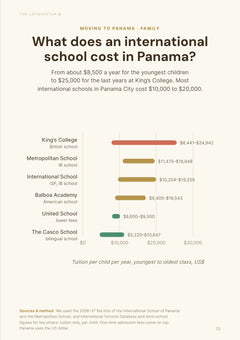
For the 2026-2027 school year, the International School of Panama charges $10,204 a year for PK3, $15,584 for PK4 through fifth grade, $17,092 for grades six through eight and $19,328 for grades nine through twelve.
The Metropolitan School of Panama is similarly expensive. Annual tuition for non-sponsored families in 2026-2027 runs from $11,475 in early childhood to $18,948 in grades nine through twelve, plus annual registration fees. New students can also face a one-time admission payment of $12,000.
Take two children paying around $16,000-$19,000 each and a family is already looking at roughly $32,000-$38,000 a year in tuition alone. That is around $2,700-$3,200 a month before housing, food, transport, health insurance or activities.
Families who receive school fees as part of an employer package get a much better version of Panama City. They can combine international education with private healthcare, modern apartments, household help, strong flight connections and easy weekend access to beaches or nature.
| Family cost | Current level | Why it changes the decision |
|---|---|---|
| ISP annual tuition | $10,204-$19,328 per child | Can rival annual housing costs |
| MET annual tuition | $11,475-$18,948 per child | Similar high-end price range |
| MET one-time admission payment | $12,000 | Makes the first year especially expensive |
| Central 3-bedroom rent | About $2,180 average | Still moderate relative to many global capitals |
| International-school family budget | Often $4,500-$8,000+ monthly | Panama stops looking “cheap” quickly |
Is Panama City easy if you do not speak Spanish?
Yes, you can get established in Panama City without good Spanish, but long-term life becomes noticeably better once you learn it.
The 2026 InterNations survey gives Panama a strong sixth-place result for language within Expat Essentials. Some 62% of expats say it is possible to live there without speaking the local language, compared with 48% globally. Around 51% also consider Spanish relatively easy to learn.
English is common enough in international companies, higher-end hospitals, international schools, hotels and parts of the property market that a newcomer can function surprisingly well at first.
The ceiling appears later. Landlords, building staff, government offices, tradespeople, smaller shops and social situations outside the expat bubble frequently run in Spanish. Someone who never moves beyond English can live comfortably, but the city remains narrower.
Social integration looks strong overall. Panama currently ranks second in the world for Ease of Settling In, with 73% of expats happy with their social lives and 72% saying they have a personal support network. Still, 40% report having mostly expat friends. Learning Spanish is one of the clearest ways to stop that international bubble from becoming permanent.
Is Panama City a good base for remote workers?
Yes. Panama City is currently one of the more practical Latin American bases for remote workers who earn in dollars and want a real city rather than a temporary digital-nomad destination.
Internet infrastructure now scores very well with expats. InterNations reports that 94% of respondents rate access to high-speed internet positively, helping Panama reach ninth place for Digital Life.
The dollar also removes a common headache. Panama uses the U.S. dollar alongside the balboa at one-to-one parity, so people paid in dollars avoid repeated exchange-rate calculations in everyday spending.
Panama City's bigger advantage becomes obvious when travel enters the picture. Remote workers still have direct access to a major international airport, private hospitals, coworking spaces, restaurants, shopping and professional services. They can leave for a client meeting or family visit without first taking a domestic flight out of a resort town.
And because remote workers can avoid rush-hour commuting, they dodge one of the city's worst weaknesses. That makes Panama City considerably more attractive for someone working from home than for someone crossing the metropolitan area twice every weekday.
Are Panama's tax advantages still real for expats?
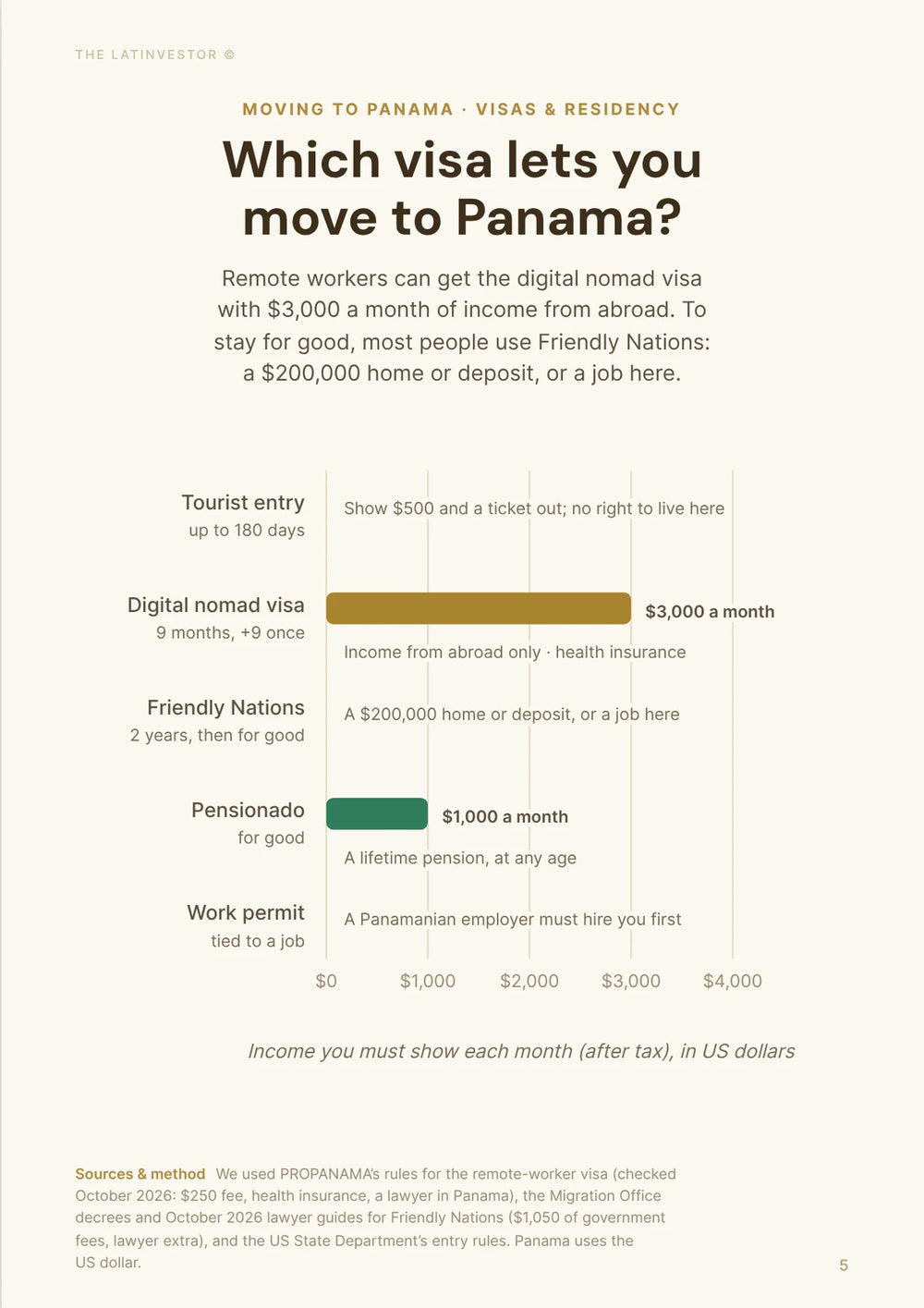
Yes. Panama's territorial tax system remains a serious advantage for some expats, although foreign clients or a foreign bank account do not automatically make income tax-free.
PwC's latest review confirms that Panama still taxes individuals primarily on Panamanian-source income. Residents and citizens pay tax on Panamanian-source income, while personal taxable income up to $11,000 carries a 0% rate, income between $11,000 and $50,000 is taxed at 15%, and income above $50,000 reaches 25%.
There are no local personal income taxes.
The attractive part for internationally mobile people is the territorial principle itself. Foreign-source investment income and other income genuinely sourced outside Panama can receive favorable treatment under the Panamanian system.
Remote work needs more care. Performing work physically from Panama can create source questions even when the client, employer or bank account sits abroad. Home-country tax residence can add another layer.
The tax advantage is real, but the biggest benefits go to people whose income structure actually fits Panama's territorial rules. Anyone moving primarily for tax reasons should model the exact income streams before relocating rather than relying on the usual “foreign income is tax-free” shorthand.
Does Panama City's climate feel good after you actually live there?
Panama City's climate is fantastic for people who hate winter and exhausting for people who dislike humidity.
Temperatures barely move across the year. Days commonly sit around the high 20s to low 30s Celsius, while nights remain warm. There is no meaningful cold season waiting around the corner.
Rain changes much more than temperature. The wet season brings frequent heavy showers and long periods of very humid weather. The practical consequences show up everywhere: air-conditioning runs constantly, short walks can feel much harder at midday than the map suggests, and sudden downpours can complicate commuting.
Some expats love that consistency. No heating bills, no winter clothes and outdoor dining all year can feel like a permanent lifestyle upgrade.
Others discover that “tropical weather” sounded better before they lived through months of heat, moisture and afternoon rain. Climate is probably the most personal variable in the entire Panama City decision, and we would test it during the wet season rather than judging the city after a short dry-season visit.
Does living in Panama City make international travel much easier?
Yes. Panama City's flight connectivity is unusually strong for a metropolitan area of its size and gives expats a practical advantage that is easy to underestimate before moving abroad.
Tocumen International Airport handled roughly 21 million passengers in 2025, around 9% more than in 2024. More importantly, airport and ACI-LAC data show that Tocumen handled 20.7 million international passengers, putting it first in Latin America and the Caribbean for international passenger traffic.
That was ahead of Cancún at roughly 19.5 million, Mexico City at 17.5 million, São Paulo/Guarulhos at 16.8 million and Bogotá at 16.2 million.
Tocumen's network covered 97 international destinations through 17 passenger airlines. Copa Airlines' hub strategy gives Panama City direct access to an unusually dense network across North America, Central America, South America and the Caribbean, with European links on top.
For expats, those numbers turn into something simple: going home, visiting clients or taking a regional trip is easier. Cities that beat Panama on rent or weather can still feel much more isolated after a few years abroad.
| Airport | International passengers | Comparison with Tocumen |
|---|---|---|
| Panama City Tocumen | 20.7m | — |
| Cancún | 19.5m | ~1.3m fewer |
| Mexico City | 17.5m | ~3.3m fewer |
| São Paulo/Guarulhos | 16.8m | ~3.9m fewer |
| Bogotá | 16.2m | ~4.5m fewer |
So, is Panama City a good place to live as an expat?
Yes. Panama City is currently one of the strongest all-round expat cities in Latin America, especially for people bringing foreign income, but the city becomes much less compelling when the budget is tight or daily life requires long commutes.
The strongest evidence is the consistency. Panama has now finished first in InterNations' expat ranking for three consecutive years. In the 2026 survey, 87% of expats were happy with their life abroad, 90% said their disposable income supported a comfortable lifestyle, 90% found locals friendly, and Panama finished near the top for housing, work-life balance, settling in and practical expat essentials.
Panama City then adds advantages that smaller Panamanian destinations cannot match. The capital has several major private hospitals, international schools, a deep apartment market, strong internet, a mature service economy and an airport that currently handles more international passengers than any other in Latin America or the Caribbean.
The weaknesses are equally concrete. Road infrastructure ranks last in the 2026 InterNations survey. Walking is inconsistent. Humidity is relentless. Premium housing is no bargain, and two children in international schools can add more than $30,000 a year before the family pays for anything else.
That creates a fairly clear dividing line. A remote worker on $4,000-$6,000 a month, a retiree with solid pension or investment income, an executive with health and school benefits, or a couple with foreign earnings can get a lot from Panama City. Someone expecting a dirt-cheap tropical capital or hoping to recreate the budgets associated with smaller Panamanian towns will probably be disappointed.
Our judgment is firmly positive. Panama City deserves its strong expat reputation today, and three consecutive years of unusually good survey results make it difficult to dismiss that reputation as marketing. The city works best when income is international and daily travel is kept short. Get those two decisions right and the combination of financial comfort, healthcare, connectivity, housing choice and easy social integration is genuinely hard to beat in the region.
Our methodology
This article tests whether Panama City is a good place to live as an expat. We break the question into the parts most likely to change the answer: expat satisfaction, affordability, budgets, neighborhoods, safety, traffic and getting around, healthcare, family costs, language, remote work, taxes, climate and flights.
Different questions need different evidence. InterNations’ Expat Insider 2026 survey is used for satisfaction, friendliness and how expats rate life in Panama, while rents, school fees, tax rates, Metro progress, healthcare and airport traffic come from sources that measure them directly: Numbeo (October 2026), the schools’ 2026-2027 fee schedules, Panama’s DGI and PwC, Metro de Panamá and the Presidency, and Tocumen and ACI-LAC.
We separate Panama from Panama City whenever it matters. The InterNations survey covers the whole country, so we use city-level data for housing, neighborhoods, commuting, schools, hospitals and flights.
The monthly budgets are our own estimates, built from current rents and living costs and compared with local earnings. Doctor fees are indicative 2026 prices from expat healthcare guides, as hospitals do not publish one tariff.
Panama uses the U.S. dollar, so no currency conversion was needed. We checked these figures in October 2026.
Numbeo rents and salaries are user-reported averages rather than signed leases or payroll data, survey results can move from one year to the next, and future projects such as Metro Line 3 do not help today’s commute. Taxes depend on the real source of your income, so we do not assume foreign clients make income tax-free.
Key sources used for this analysis include InterNations' Panama 2026 country report, InterNations' survey methodology, its Personal Finance Index, Expat Essentials, Ease of Settling In, Quality of Life rankings, Numbeo's Panama City cost-of-living dataset, U.S. Department of State's Panama travel advisory, Metro de Panamá's official project reporting, Presidency of Panama's Line 3 update, Johns Hopkins Medicine International on Pacífica Salud, The Panama Clinic, Hospital Nacional, International School of Panama, Metropolitan School of Panama, Dirección General de Ingresos, PwC Worldwide Tax Summaries, Instituto de Meteorología e Hidrología de Panamá, Tocumen International Airport, Airports Council International Latin America & Caribbean, the International School of Panama’s 2026-2027 tuition, The Rio Times on private healthcare prices (2026) and the Presidency of Panama on Tocumen’s 2025 passengers.