Summary
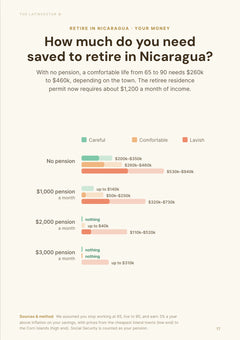
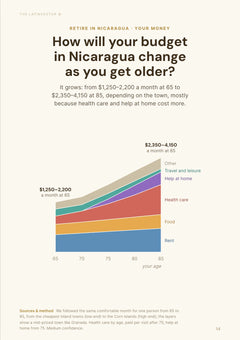
How much money do you need to retire in Nicaragua? About $1,600 a month (C$58,600) for a comfortable life as a single retiree in a mid-priced town like Granada, from about $1,250 in cheaper inland towns to $2,200 on the Corn Islands. Add a 25% buffer, about $400.
The bare minimum is around $900 a month (C$32,950) in Managua and about $800 in Granada or Masaya, cooking at home and taking buses.
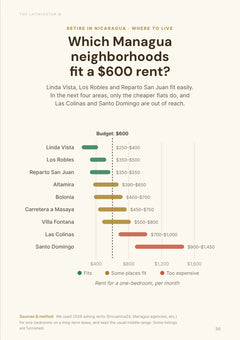
At $2,000 a month, life is comfortable and low-stress. A one-bedroom in Los Robles, Reparto San Juan or Altamira costs $350 to $650, while furnished one-bedrooms in Las Colinas start around $700.
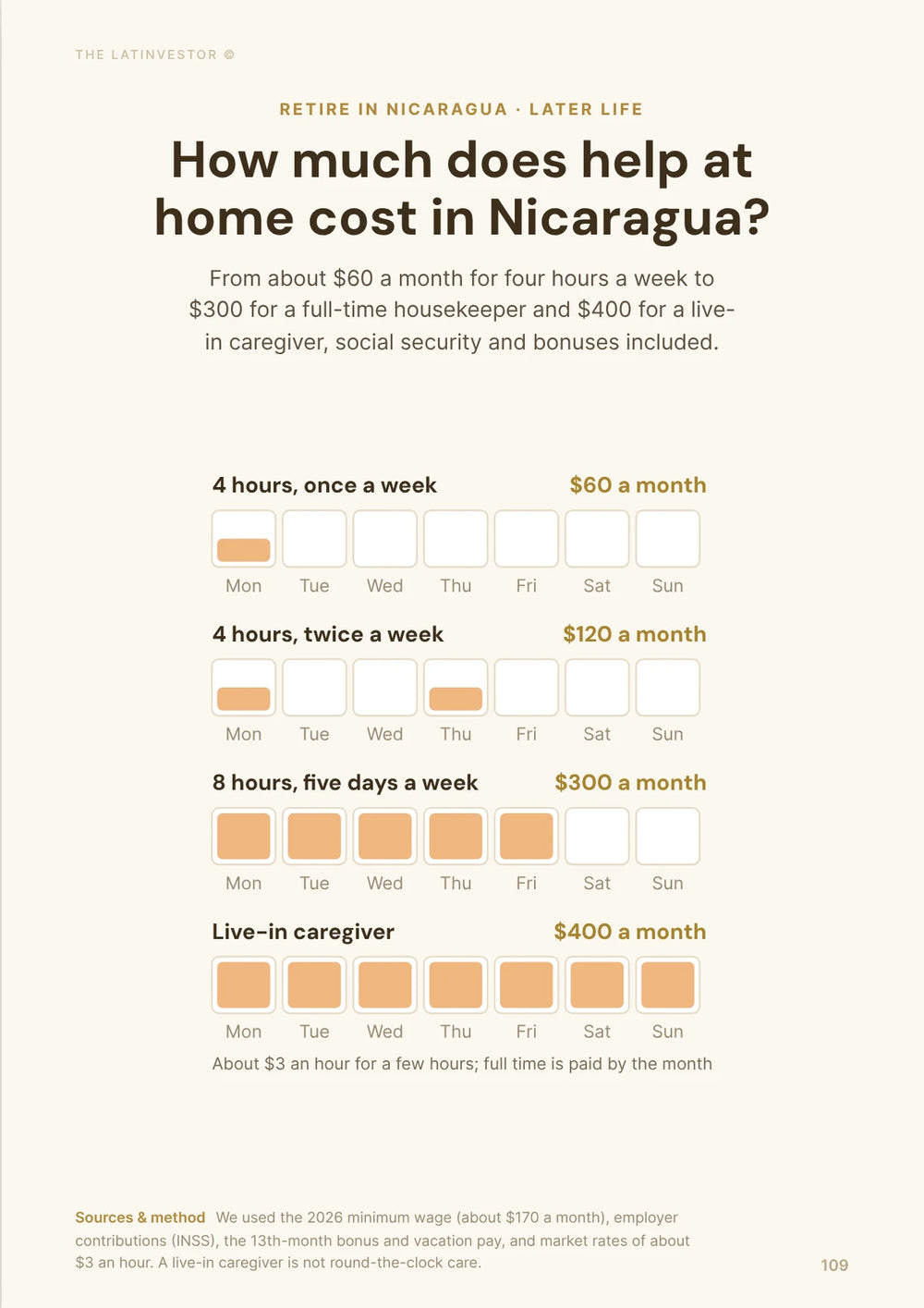
At $3,000, you can rent a two-bedroom in Las Colinas for $1,000 to $1,350, keep a car and hire a part-time housekeeper for about $60 a month. Luxury starts around $4,500 to $6,000 a month in Managua or Granada, more on the beach.
Housing is the biggest line, about $400 to $700 a month. Prices rose 4% in the 12 months to July 2026, but the córdoba has stayed at C$36.62 per dollar all year.
The costs that surprise newcomers: residence fees that come back at each renewal, A/C that pushes power bills past $250 a month, and $500 to $1,000 in deposits when you arrive.
Rents are low on average: about $212 for a one-bedroom outside city centers and $353 in centers. Two-bedrooms go from $300 in León to $1,350 in Las Colinas.
Basic utilities run about $151 a month in Managua for 85 m², and internet about $32. A cheap restaurant meal costs about C$185 ($5) on average, and a monthly bus pass in Managua C$220.
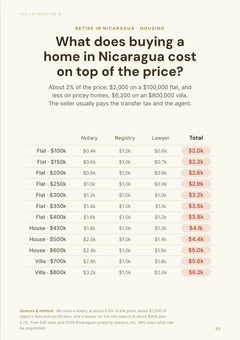
Managua apartments cost about $679 per m² outside the center and $1,194 in the center, so $54,000 to $95,500 for 80 m². Many foreign buyers put down 40% or pay cash, and mortgages run around 12%.
Owning a $100,000 apartment with a mortgage costs about $975 to $1,050 a month all-in, against $181 to $353 to rent a one-bedroom, so renting is usually cheaper.
The old Pensionado and Rentista visas of Law 694 were repealed in 2024. Retirees now get a temporary residence that must be renewed, and the permit asks for about $1,200 a month of proven income.
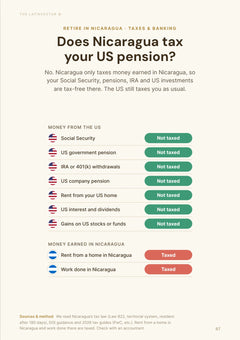
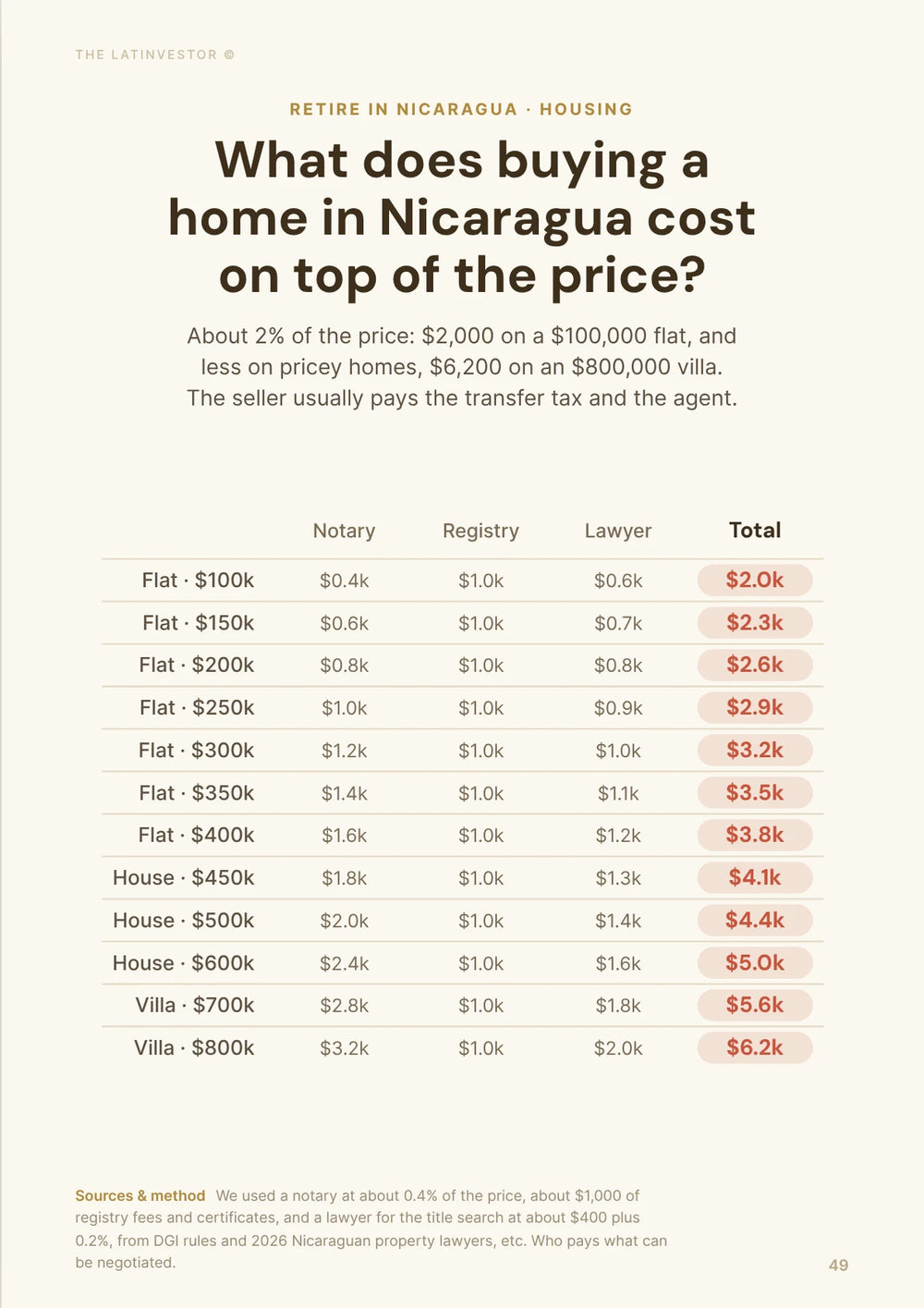
Nicaragua only taxes money earned in the country, so foreign pensions and Social Security aren't taxed there. Selling a property in Nicaragua, though, triggers a 1% to 7% withholding.
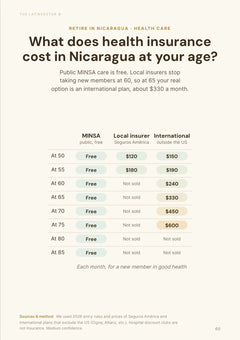
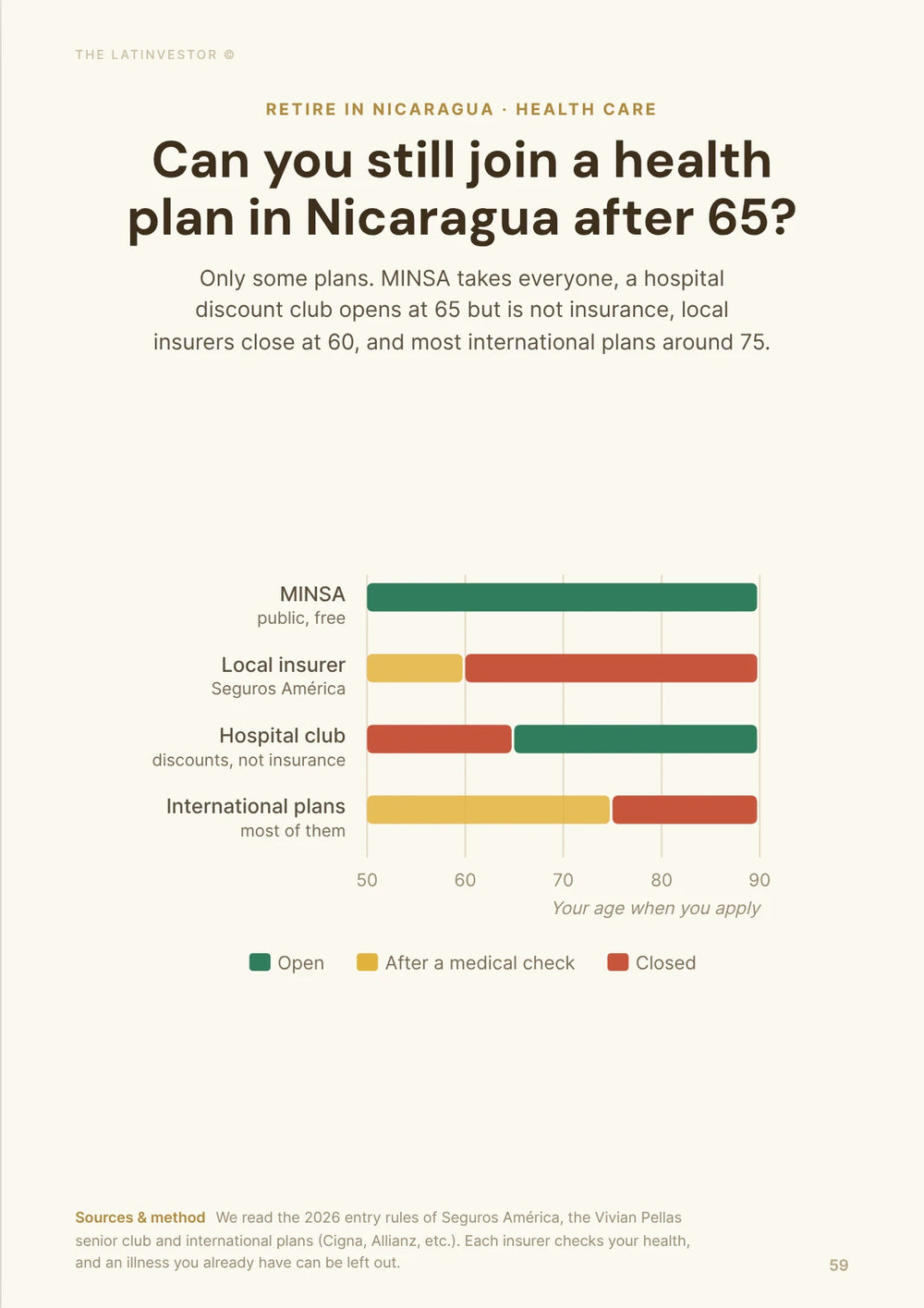
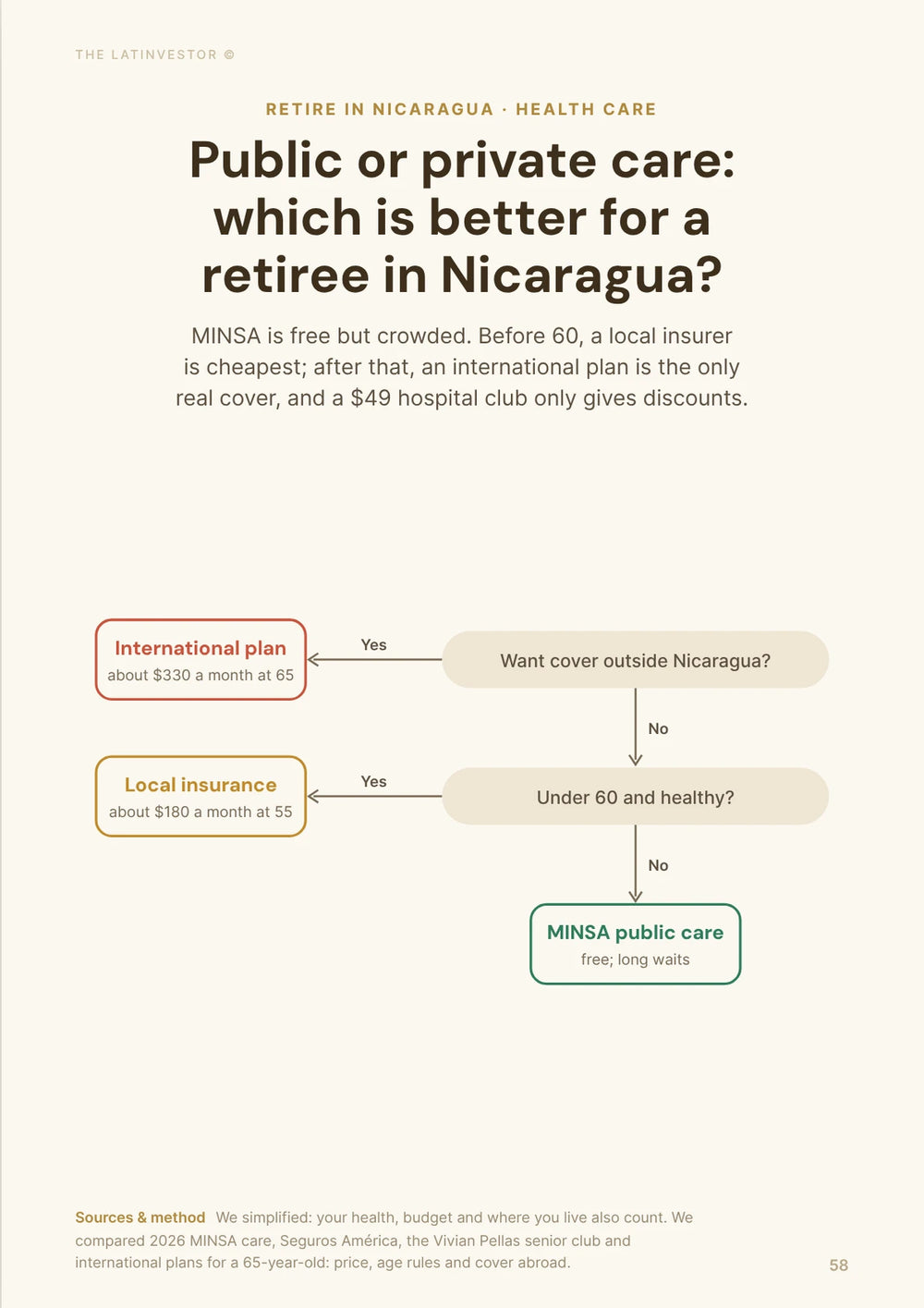
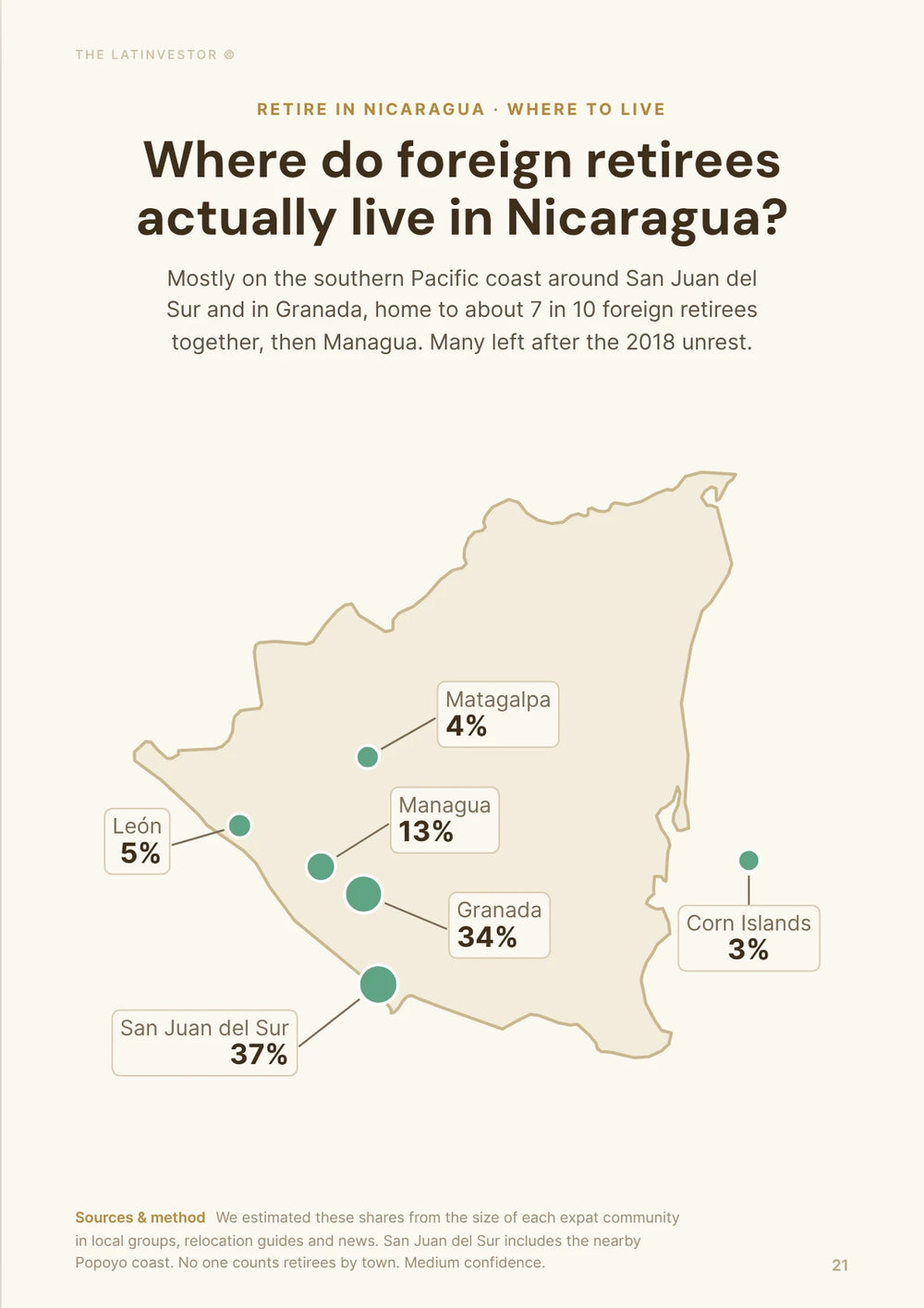
Public MINSA care is free, but local insurers stop taking new members at 60. At 65, an international plan costs about $330 a month, so about $4,000 a year in premiums.

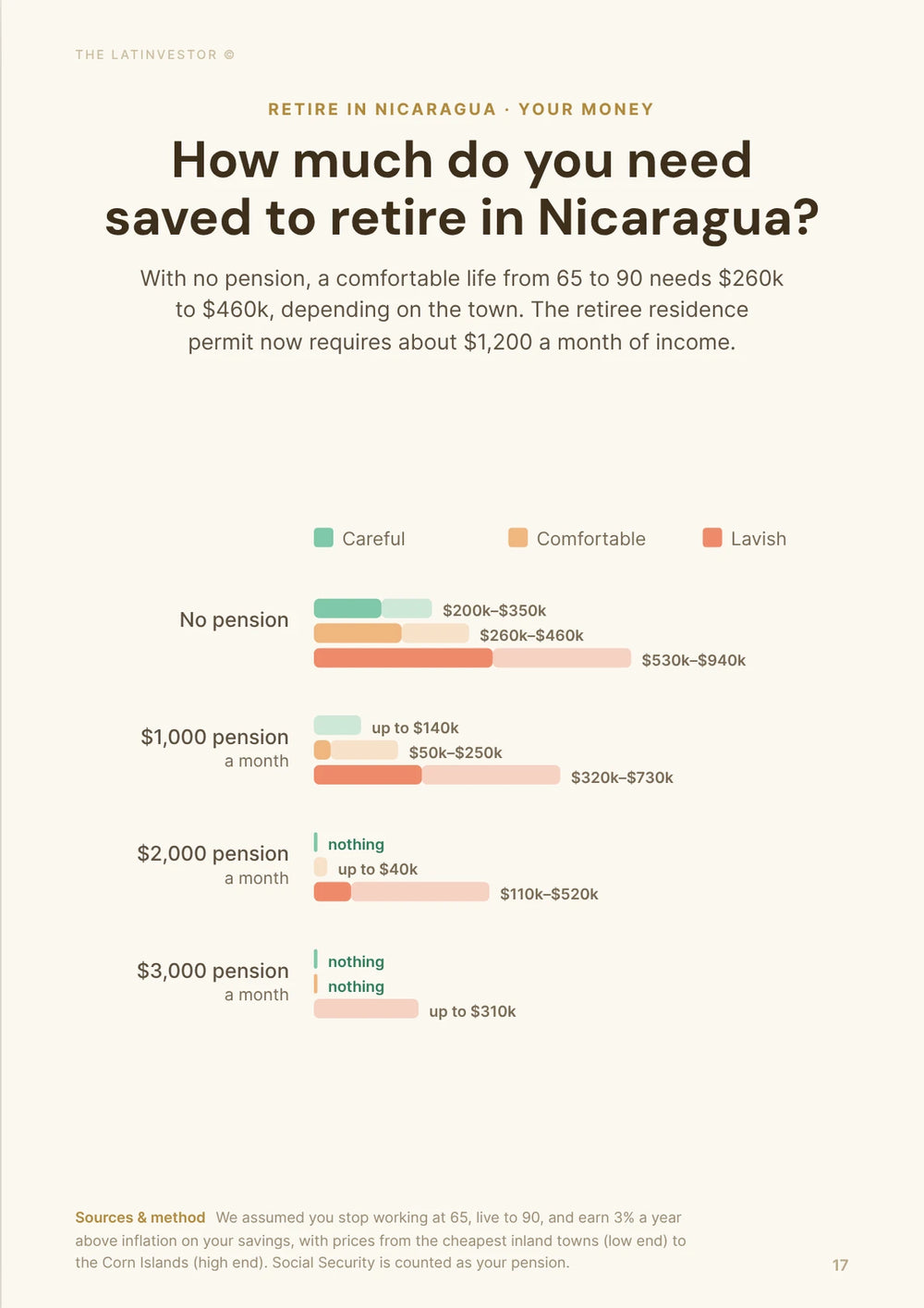
What lifestyle can each budget buy you in Nicaragua?
What's the absolute minimum monthly budget to survive in Nicaragua?
The absolute minimum monthly budget to survive as a foreign retiree in Nicaragua is around C$32,950 ($900) if you settle in Managua, though you could get by on about C$29,300 ($800) in smaller cities like Granada or Masaya.
At this minimum budget level in Nicaragua, you can cover a modest rental in a basic neighborhood, essential utilities, groceries focused on local staples like rice, beans, and vegetables, inexpensive local transportation, and a very basic private health insurance plan.
Living on this survival budget in Nicaragua means you will need to skip dining out almost entirely, avoid imported goods, rely on public buses or walking, and accept housing without air conditioning or in less secure areas, which can be challenging during the hot season from March to May.
What lifestyle do I get with $2,000/month in Nicaragua in 2026?
At the end of 2026, a retiree with $2,000 (C$73,250) a month in Nicaragua can enjoy a comfortable, low-stress middle-class lifestyle that includes a nice apartment in a safe neighborhood, regular restaurant meals, domestic travel, and quality private healthcare coverage.
With this budget, you can afford a one-bedroom apartment in good Managua neighborhoods like Los Robles, Reparto San Juan or Altamira for about C$12,800 to C$23,800 ($350 to $650), or a renovated colonial rental in Granada near Parque Central or Calle La Calzada. Las Colinas and Santo Domingo are mostly out of reach: furnished one-bedrooms in Las Colinas start around C$25,650 ($700).
This budget in Nicaragua allows you to enjoy weekend trips to Laguna de Apoyo, explore the colonial streets of León, dine at local restaurants like El Zaguan or Pita Pita several times a week, and join expat social clubs that gather in Granada and San Juan del Sur.
The main limitation at $2,000 per month in Nicaragua is that you will still need to be mindful about imported goods, international travel, and major unexpected expenses, so building a savings buffer remains important.
What lifestyle do I get with $3,000/month in Nicaragua in 2026?
At the end of 2026, a retiree with $3,000 (C$110,000) a month in Nicaragua can live an upper-comfortable lifestyle with a spacious home in a premium neighborhood, a small car or frequent taxi use, domestic help, and excellent private healthcare.
At this budget level in Nicaragua, you can rent a two-bedroom apartment in Las Colinas for about C$36,600 to C$49,450 ($1,000 to $1,350), or a charming colonial home in Granada with a courtyard, where two-bedroom listings run about C$25,650 to C$29,300 ($700 to $800).
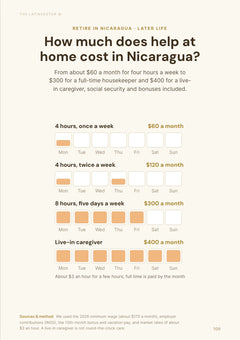
With $3,000 monthly in Nicaragua, you can dine at upscale restaurants like Bocadillos Tapas Kitchen in Managua, take regular weekend getaways to beach towns like San Juan del Sur, join a gym or a country club, and hire a part-time housekeeper, about C$2,200 ($60) a month for four hours a week. Since March 2026, the legal minimum wage for domestic workers is C$8,674.94 a month ($237).
The key upgrade from $2,000 to $3,000 per month in Nicaragua is the ability to own or maintain a car, which opens up easy access to beaches, volcanoes, and rural areas that public transport does not reach conveniently.
What lifestyle do I get with $5,000/month in Nicaragua in 2026?
At the end of 2026, a retiree with $5,000 (C$183,000) a month in Nicaragua lives in expat luxury with premium housing, top-tier healthcare, and full domestic staff, while $10,000 (C$366,000) a month allows for an international executive lifestyle with multiple properties and frequent travel.
At $5,000 monthly in Nicaragua, you can rent a high-end home in gated communities in Santo Domingo or Las Colinas for C$54,950 to C$91,550 ($1,500 to $2,500), with the best two-bedrooms in Santo Domingo listed around C$80,550 ($2,200). At $10,000 a month, you can add a beach home near San Juan del Sur, where two-bedrooms in La Talanguera list at C$43,950 to C$91,550 ($1,200 to $2,500), or on the Tola-Popoyo coast.
At the $5,000 to $10,000 range in Nicaragua, you gain access to concierge medical services at top private hospitals like Hospital Metropolitano Vivian Pellas, private security arrangements, premium imported groceries, regular international flights, and the ability to furnish your home with high-quality appliances and furniture.
How much for a "comfortable" retirement in Nicaragua in 2026?
At the end of 2026, a comfortable retirement in Nicaragua costs about $1,600 (C$58,600) for one person in a mid-priced town like Granada. It goes from about $1,250 in cheaper inland towns to $1,950 in San Juan del Sur and $2,200 on the Corn Islands.
We recommend adding a 25% buffer to your planned monthly spending in Nicaragua. On a $1,600 budget, that means setting aside an extra C$14,650 ($400) a month, so about $2,000 in total, to cover rent increases, health surprises, and the fees that come back each time you renew your residence.
A comfortable retirement budget in Nicaragua covers what the basic budget does not, including a nicer neighborhood with better security, air conditioning, comprehensive private health insurance, regular dining out, leisure activities, and enough flexibility to handle visa renewals and unexpected administrative fees without stress.
How much for a "luxury" retirement in Nicaragua in 2026?
At the end of 2026, a luxury retirement in Nicaragua requires about $4,500 to $6,000 (C$165,000 to C$220,000) a month in Managua or Granada, and $6,000 to $8,000 a month for consistent high-end living in beach hotspots.
A luxury retirement in Nicaragua includes premium gated housing with private pools, full-time domestic staff including a housekeeper and gardener, a late-model SUV, membership at top fitness clubs, imported wines and specialty foods, and VIP healthcare packages at the country's best private hospitals.
The most popular neighborhoods for luxury retirees in Nicaragua include Santo Domingo and the Galerías area in Managua for urban convenience, the hills above San Juan del Sur for ocean views, and restored colonial estates in Granada's historic center near the Parque Central.
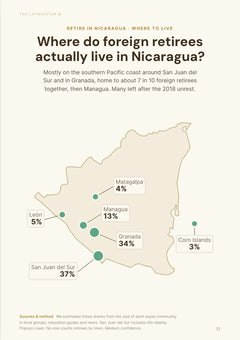
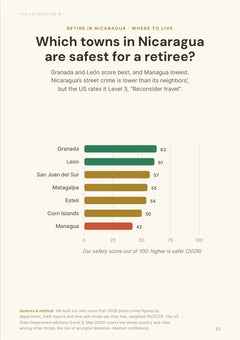
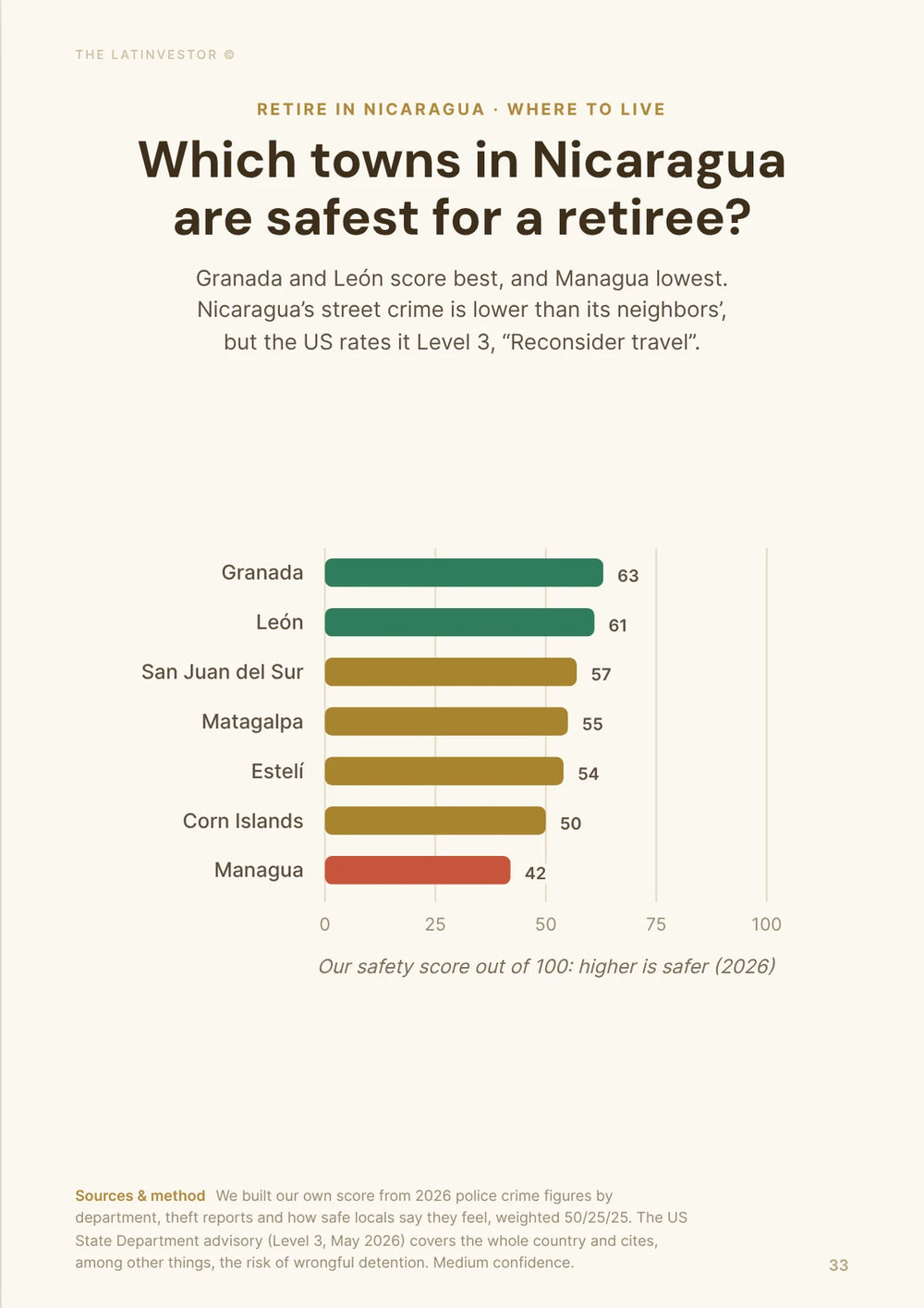
The main advantage of a luxury budget in Nicaragua beyond comfort is the ability to fully insulate yourself from infrastructure challenges, including backup generators, private water filtration, 24-hour security, and the financial cushion to fly to Miami or Panama City for specialized medical procedures if needed. Security matters here: in May 2026, the US State Department kept Nicaragua at Level 3, “Reconsider travel”.
What are the real monthly expenses for retirees in Nicaragua in 2026?
What is a realistic monthly budget breakdown by category in Nicaragua?
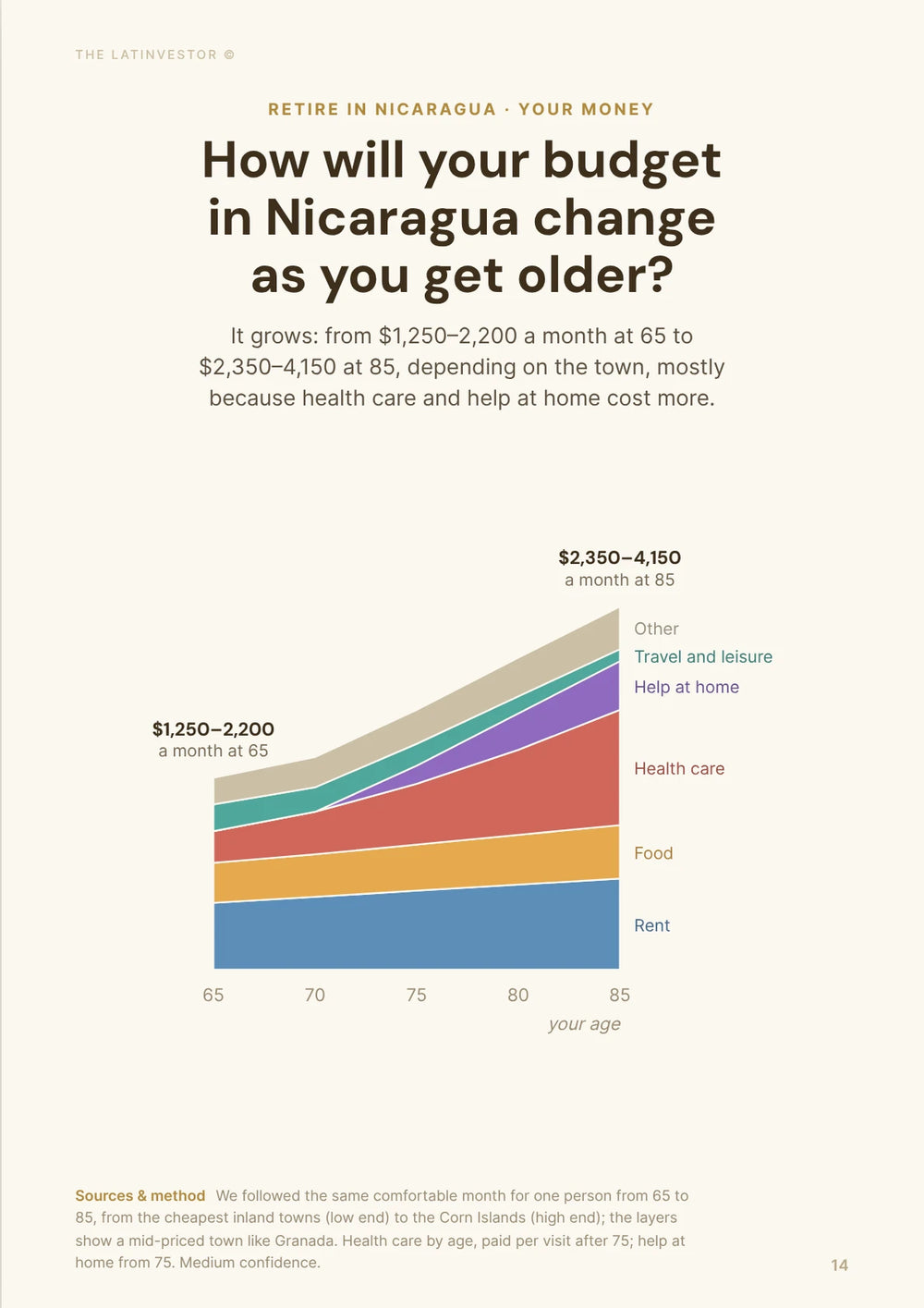
A realistic monthly budget breakdown for a retiree in Nicaragua at the end of 2026 looks roughly like this: housing C$14,650 to C$25,650 ($400 to $700), utilities and communications C$3,650 to C$6,600 ($100 to $180), food and groceries C$11,000 to C$16,500 ($300 to $450), transportation C$1,850 to C$5,500 ($50 to $150), healthcare C$7,300 to C$14,650 ($200 to $400), and other expenses C$5,500 to C$11,000 ($150 to $300). Prices rose 4% in the 12 months to July 2026, according to INIDE, but the córdoba has stayed at C$36.62 per dollar all year, so dollar incomes haven't lost value.
Housing is usually the biggest line, often about a third of the budget: roughly C$14,650 to C$25,650 ($400 to $700) for a decent one or two-bedroom in a safe neighborhood.
Food and groceries in Nicaragua usually take about a fifth of the monthly budget, around C$11,000 to C$16,500 ($300 to $450), with costs staying lower if you shop at local markets like Mercado Oriental rather than imported-goods supermarkets like La Colonia.
The budget category that varies most depending on personal lifestyle choices in Nicaragua is healthcare, which can range from about C$5,500 ($150) a month for basic coverage to C$21,950 ($600) or more if you want comprehensive international insurance or have chronic conditions requiring regular specialist visits.
What fees surprise foreigners most after moving to Nicaragua?
The three hidden fees that surprise foreigners most in Nicaragua are immigration costs (retiree residence is now temporary, so fees and paperwork come back at each renewal), property transaction taxes when buying real estate (withholding from 1% to 7% depending on property value, bands the tax office confirmed in March 2026), and electricity bills that jump sharply when you use air conditioning due to tiered tariff structures.
When first arriving in Nicaragua, foreigners should budget for one-time setup costs, including legal and translation services around C$7,300 to C$18,300 ($200 to $500) and deposits for utilities and rental housing that can total another C$18,300 to C$36,600 ($500 to $1,000). Government residence fees change often, so check the current amount with the migration office (DGME) before you apply.
What's the average rent for a 1-bedroom or a 2-bedroom in Nicaragua in 2026?
At the end of 2026, the average monthly rent for a one-bedroom apartment in Nicaragua is about C$7,750 ($212) outside city centers and C$12,950 ($353) in city centers. Two-bedroom rents vary more, from about C$11,000 to C$13,900 ($300 to $380) in León to C$36,600 to C$49,450 ($1,000 to $1,350) in Managua's Las Colinas.
For a one-bedroom in Nicaragua, the realistic rent range spans from around C$6,650 ($181) outside Managua's center or in smaller cities like Masaya, to C$14,300 to C$23,800 ($390 to $650) in Altamira and C$32,950 to C$53,100 ($900 to $1,450) in Santo Domingo, Managua's priciest area.
For a two-bedroom in Nicaragua, asking rents go from about C$11,000 to C$13,900 ($300 to $380) in León and C$25,650 to C$29,300 ($700 to $800) in Granada, up to C$36,600 to C$49,450 ($1,000 to $1,350) in Las Colinas and around C$80,550 ($2,200) for the best units in Santo Domingo.
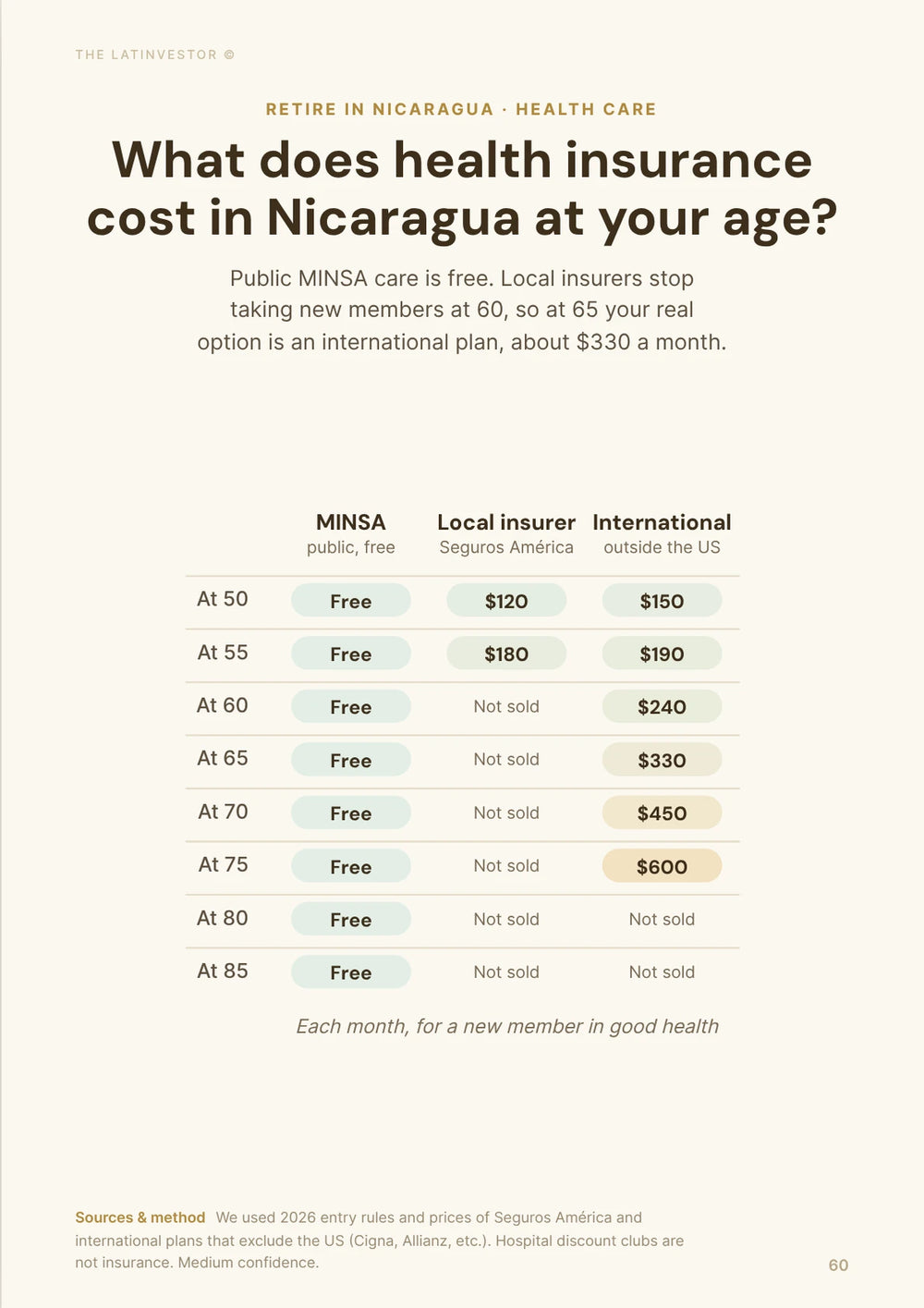
The neighborhoods offering the best value for retirees in Nicaragua include Managua's Linda Vista, Los Robles and Reparto San Juan, where a one-bedroom costs about C$9,150 to C$20,150 ($250 to $550), plus Bello Horizonte and parts of Masaya, where you can find safe housing without paying the premium of tourist-heavy or expat-concentrated zones.
What do utilities cost monthly in Nicaragua in 2026?
At the end of 2026, basic utilities for an 85 m² apartment cost about C$5,550 ($151) a month in Managua and C$4,050 ($111) on average in Nicaragua. Heavy air conditioning can push the bill past C$9,150 ($250).
Electricity is the biggest part of the bill in Nicaragua, and it climbs fast with air conditioning because rates rise with each consumption tier. Water and sewer through ENACAL and cooking gas are small lines in comparison.
Internet service in Nicaragua costs about C$1,150 ($32) a month in Managua and C$1,300 ($36) on average nationwide, while mobile phone plans with data run about C$365 to C$730 ($10 to $20) a month.
What's the monthly food and transportation budget for one person in Nicaragua in 2026?
At the end of 2026, we estimate a combined monthly food and transportation budget for one person in Nicaragua at about C$11,000 to C$18,300 ($300 to $500), with groceries taking the larger share.
A realistic monthly grocery budget for a single retiree cooking at home in Nicaragua is about C$9,150 to C$16,500 ($250 to $450), staying on the lower end if you buy local staples at markets and climbing higher if you purchase imported cheeses, wines, or specialty items from supermarkets like La Colonia or PriceSmart. In Managua, a dozen eggs costs about C$87 and a liter of milk C$45.
Dining out regularly in Nicaragua adds roughly C$3,650 to C$9,150 ($100 to $250) a month to your food budget: a cheap restaurant meal costs about C$185 ($5) on average in Nicaragua and C$365 ($10) in Managua, and a three-course dinner for two about C$1,280 ($35) in Managua.
Monthly transportation costs in Nicaragua range from about C$1,100 to C$3,650 ($30 to $100) using public buses and occasional taxis (in Managua, a bus ticket is about C$5, a monthly pass C$220, and a taxi starts at C$60), while owning a small car adds fuel at about C$49 a liter, insurance, and maintenance, for a total of C$7,300 to C$11,000 ($200 to $300) a month.
Can I retire in Nicaragua if I want to buy property in 2026?
What's the average home price in Nicaragua in 2026?
At the end of 2026, apartments in Managua cost about C$24,850 ($679) per square meter outside the center and C$43,750 ($1,194) in the center, which means a typical 80-square-meter apartment runs from about C$1.98 million to C$3.5 million ($54,000 to $95,500).
Modest apartments outside central Managua or in towns like Masaya cost less than that, while single-family homes in premium neighborhoods like Santo Domingo or Las Colinas, and colonial properties in central Granada, cost much more. Prices vary a lot from one listing to the next, so compare several before you make an offer.
For retirees in Nicaragua, colonial-style homes in Granada often offer the best combination of value, walkability, and community, since many come with charming courtyards, are located near restaurants and services, and sit at price points between new construction in Managua and overpriced beachfront developments.
What down payment do foreigners usually need in Nicaragua in 2026?
At the end of 2026, there's no legal minimum down payment for foreigners in Nicaragua, but many buyers put down around 40% or pay cash. On a $100,000 home, 40% means about C$1.46 million ($40,000) upfront.
Foreigners in Nicaragua generally face higher down payment requirements than locals because local banks are cautious about non-resident borrowers, mortgage rates run around 12% a year (11.9% on a 20-year fixed loan, according to Numbeo), and many foreign buyers end up paying cash or using seller financing rather than traditional bank loans.
What's the all-in monthly cost to own in Nicaragua in 2026?
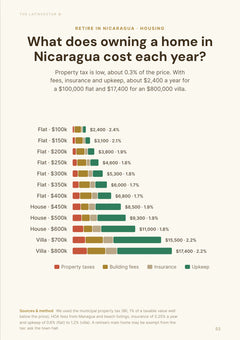
At the end of 2026, the all-in monthly cost to own a typical $100,000 apartment in Nicaragua with a mortgage runs about C$35,700 to C$38,450 ($975 to $1,050), while cash buyers pay far less, about C$7,300 ($200) a month before utilities.
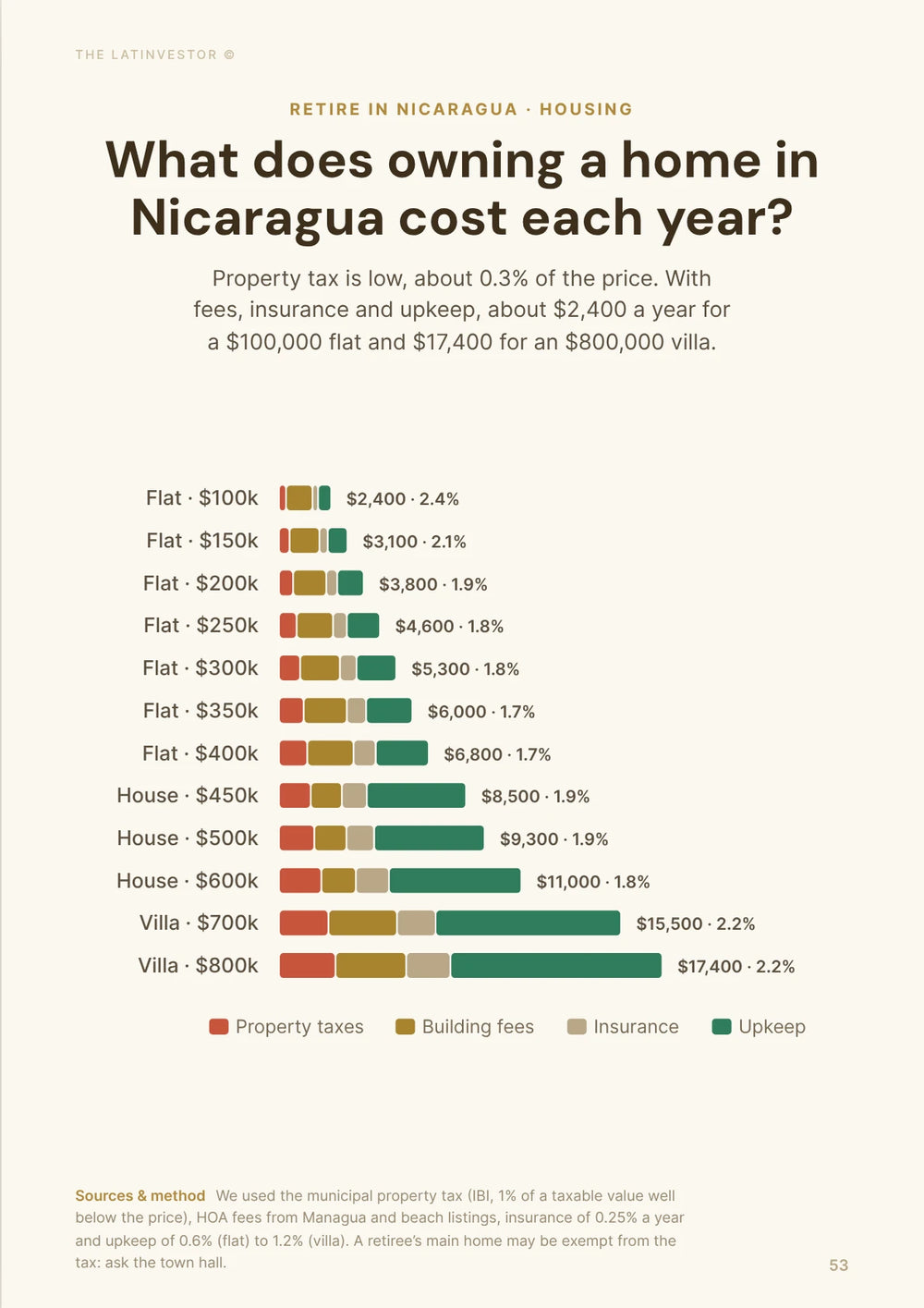
This all-in monthly ownership cost includes a mortgage payment of about C$24,050 ($657) for 60% of the price borrowed at 11.9% over 20 years, condo or HOA fees of about C$3,650 ($100), insurance of about C$730 ($20), upkeep of about C$1,850 ($50), property tax of about C$990 ($27), and utilities of C$4,400 to C$7,300 ($120 to $200).
Property tax in Nicaragua, the IBI (Impuesto sobre Bienes Inmuebles), is set by municipal governments like Managua's under their Plan de Arbitrios. It is 1% of a taxable value that sits well below market prices, so it usually comes to about 0.3% of the price a year, or about C$990 ($27) a month on a $100,000 home. A retiree's main home may be exempt: ask the town hall.
The hidden ownership cost that catches new buyers off guard in Nicaragua is the expense of securing reliable services, including backup generators during power outages, water storage tanks for dry-season shortages, and private security features that many neighborhoods expect you to maintain.
Is buying cheaper than renting in Nicaragua in 2026?
At the end of 2026, renting a one-bedroom in Nicaragua costs about C$6,650 to C$12,950 ($181 to $353) a month, while owning a $100,000 apartment with a mortgage runs about C$35,700 to C$38,450 ($975 to $1,050) all-in, so renting is usually cheaper on a pure cash-flow basis.
Buying only comes out ahead if you stay many years, buy at a fair price, and property values hold steady, because you also give up the return you would get by investing your down payment.
Key factors that make buying more attractive in Nicaragua include the ability to purchase with cash (eliminating the high mortgage interest), finding undervalued colonial properties in Granada that can appreciate as tourism grows, and the security of not facing rent increases or landlord decisions, while renting wins if you value flexibility, plan to stay fewer than five years, or want to avoid Nicaragua's sometimes complex property title verification process.
What visas, taxes, and healthcare costs should I plan for in Nicaragua in 2026?
What retirement visa options exist in Nicaragua in 2026?
At the end of 2026, Law 694, which created the Pensionado visa ($1,000 a month of pension) and the Rentista visa ($1,250 a month), no longer applies: it was repealed in August 2024. Since Law 1228 (November 2024), retirees get a temporary residence that must be renewed, not a permanent one. The retiree permit now asks for about C$43,950 ($1,200) a month of proven income.
To apply, you prove your income with official documents such as pension statements or bank records, and the migration office (DGME) asks for supporting papers like a police record from your home country. The list of documents and the fees change often, so check the current ones with the DGME or a local lawyer before you start.
Because the permit is temporary, you have to renew it, and each renewal means new government fees and updated proof of income, so budget for it every time rather than once.
The most common visa mistake foreign retirees make in Nicaragua is underestimating the paperwork timeline and letting tourist status expire before residency is approved, which can trigger penalty fees and complicate your application, so starting the process well before your initial 90-day tourist entry expires is essential.
Do I pay tax on foreign income in Nicaragua in 2026?
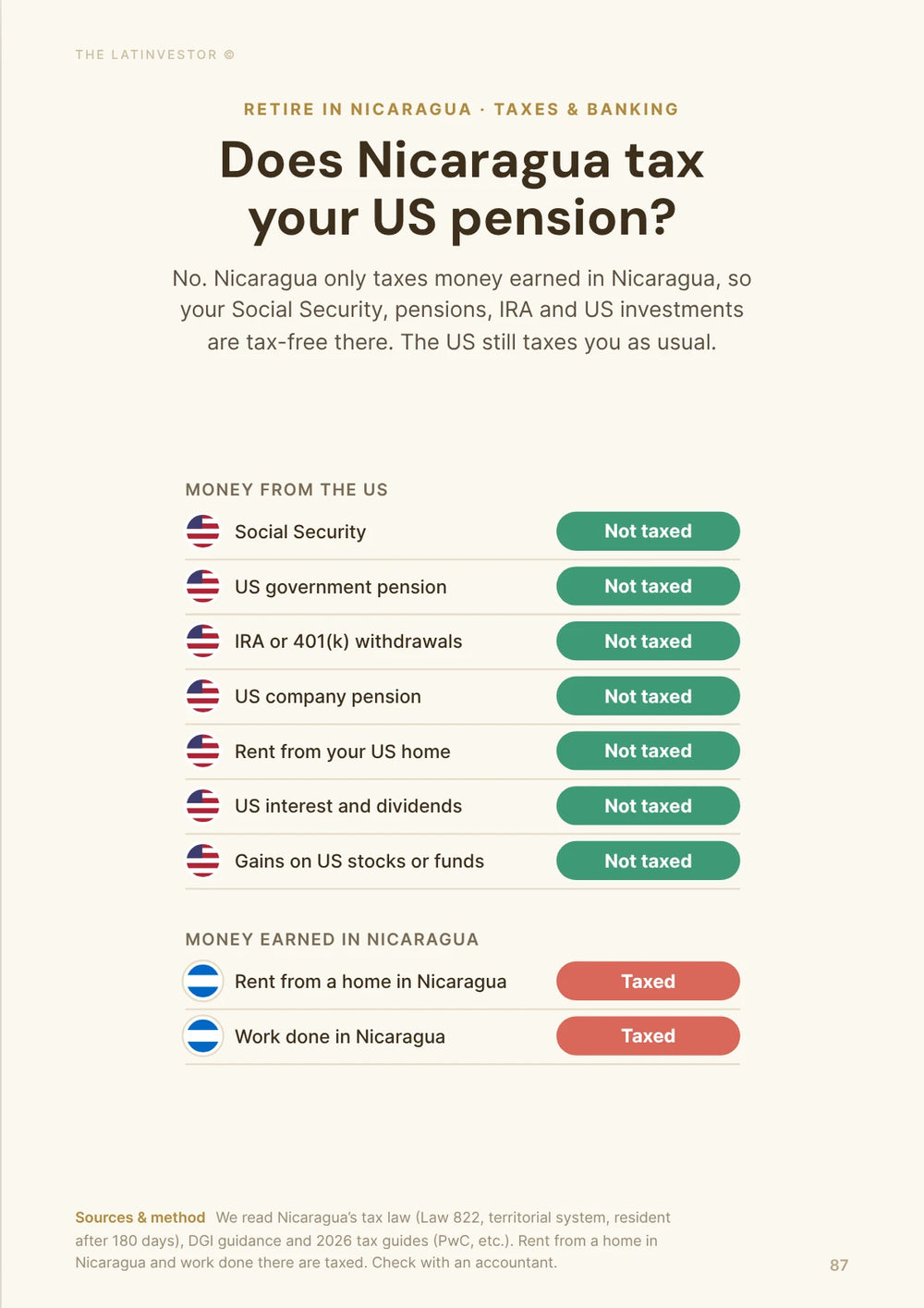
At the end of 2026, Nicaragua operates on a territorial tax system, which means the country generally taxes only income that originates from Nicaraguan sources, so foreign pensions, overseas rental income, and dividends from non-Nicaraguan investments are typically not subject to Nicaraguan income tax.
Foreign pensions, Social Security payments, investment dividends from abroad, and rental income from properties outside Nicaragua are generally exempt from Nicaraguan taxation under the territorial principle, though you should still report your residency status correctly and understand that your home country may continue taxing this income.
Nicaragua does not have extensive tax treaties with major countries like the United States, Canada, or most European nations, which means you cannot rely on treaty provisions to avoid double taxation and should instead work with a tax professional who understands both Nicaraguan rules and your home country's requirements.
The single most important tax rule foreign retirees should understand before moving to Nicaragua is that while foreign-source income is generally not taxed locally, any income you earn inside Nicaragua, such as rental income from Nicaraguan property or local business profits, is fully taxable, and property sales trigger withholding taxes of 1% to 7% depending on value.
What health insurance do retirees need in Nicaragua in 2026?
At the end of 2026, public MINSA care is free, but most foreign retirees in Nicaragua also want private cover. Local insurers stop taking new members at 60, so at 65 your real option is an international plan, about C$12,100 ($330) a month, while before 60 a local plan costs about C$4,400 to C$6,600 ($120 to $180).
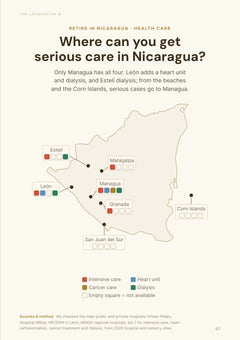
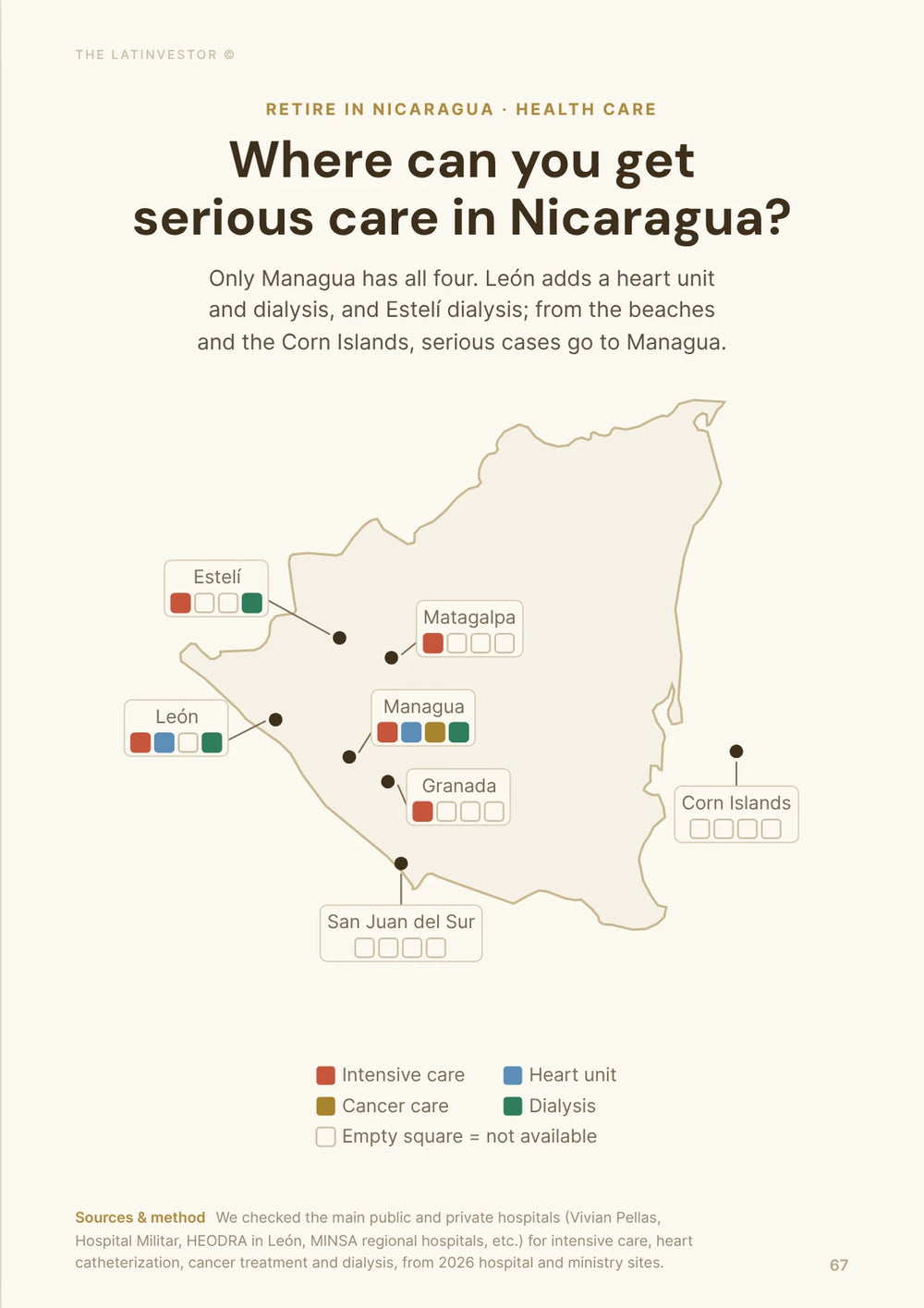
Foreigners in Nicaragua can access public healthcare through the MINSA system, but in practice most retirees use private clinics and hospitals like Hospital Metropolitano Vivian Pellas or Hospital Bautista because wait times are shorter, facilities are more modern, and staff are more likely to speak English. A hospital discount club, like the senior club at Vivian Pellas, gives discounts but is not insurance.
A realistic healthcare budget at 65 starts with about C$146,000 ($4,000) a year in premiums for an international plan, before dental care, medicines, deductibles, and specialist visits that insurance doesn't fully cover.
Related blog posts
- What are the best areas for real estate in Nicaragua? (2026)
- Is right now a good time to buy a property in Nicaragua? (2026)
- How much should a land really cost in Nicaragua today? (2026)
- Moving to Nicaragua? Here's everything you need to know (2026)
- How much do houses cost in Nicaragua today? (2026)
- What properties can you buy in Nicaragua with $100k, $300k, $500k and more? (2026)
Our methodology
This article estimates how much a single retiree needs each month to live in Nicaragua, from a bare-minimum budget to a luxury one. We cover rent, utilities, food, transport, health care, residence permits and taxes, and what changes if you buy a home instead of renting.
We built each budget line by line. Average rents, home prices, utilities, everyday prices and mortgage rates come from Numbeo for Managua and Nicaragua. Neighborhood rents come from asking rents on Encuentra24 in Managua, Granada, León and San Juan del Sur. Inflation and the basic basket come from INIDE, and utility rules from INE and ENACAL.
Residence rules come from the National Assembly, La Gaceta (Law 1228) and legal summaries of the 2024 reform. Tax rules come from the DGI and PwC, and property transfer bands from the DGI notice confirmed in March 2026. Health costs combine PAHO and World Bank data with 2026 prices of local and international insurers.
We checked these figures at the end of 2026. Córdoba amounts use the official Banco Central de Nicaragua rate of C$36.62 per US dollar, which is fixed for all of 2026, so it is the same as in January.
Where we had no direct figure, we estimated it from several sources and rounded it. Listing rents are asking prices, and Numbeo figures come from its users. Your own costs will depend on the town, your health and your habits, and residence rules in Nicaragua can change quickly.
Key sources used for this analysis include INIDE (canasta básica), Banco Central de Nicaragua (BCN), Numbeo Managua, PAHO (Pan American Health Organization), PwC Worldwide Tax Summaries, DGI (transfer tax notice), INE (electricity tariffs), ENACAL (water rates), Numbeo Nicaragua, Encuentra24, INIDE consumer prices, Asamblea Nacional (repeal of Law 694), La Gaceta (Law 1228), Consortium Legal, Orbitax (DGI notice, March 2026), WageIndicator and US State Department.