
Summary
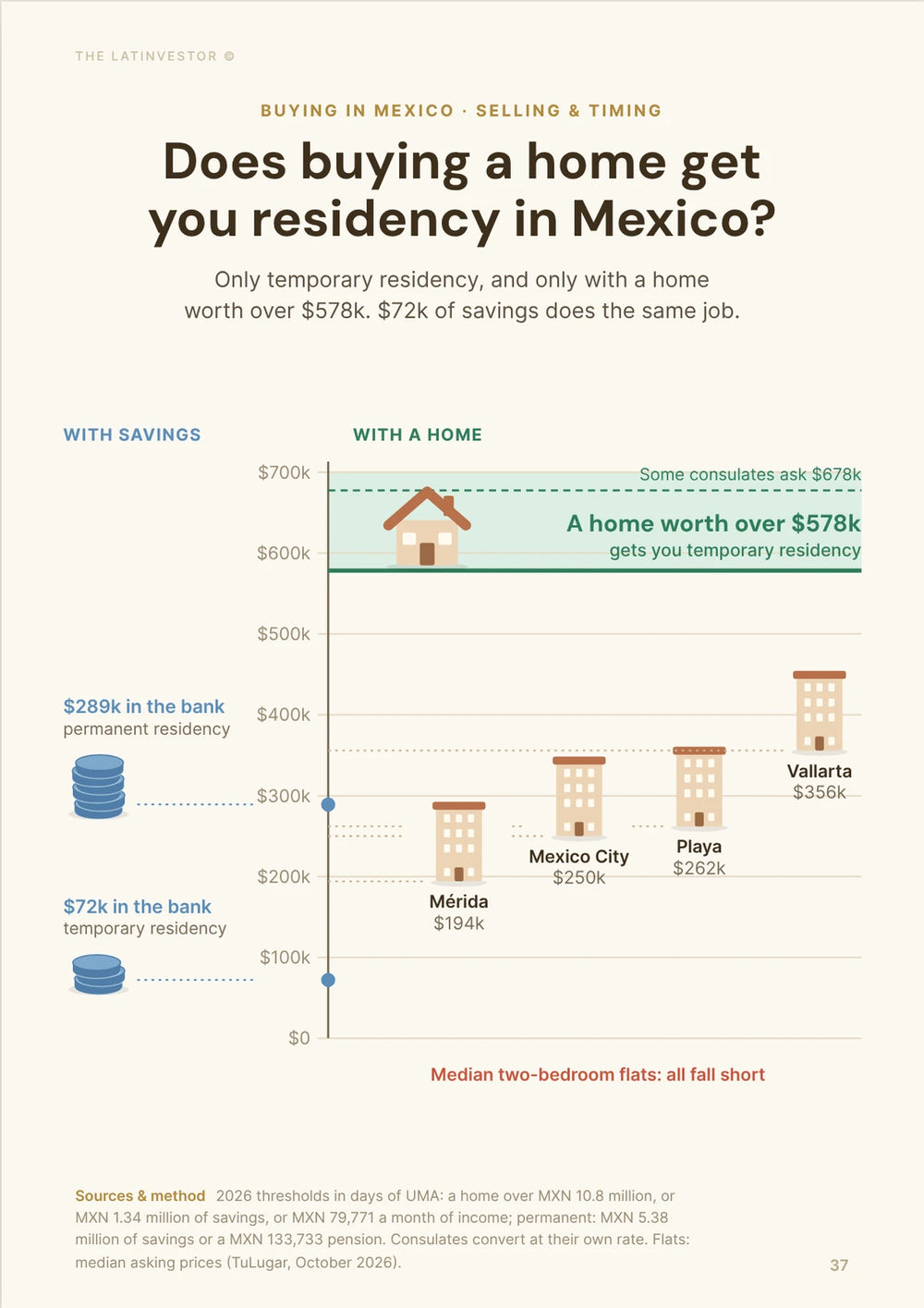
Yes, but only temporary residency at first, and only with an expensive property: the 2026 line is 91,710 days of UMA, about MXN 10.76 million (about USD 578,000). Buying never makes you a resident automatically; it lets you apply.
This is not a golden visa. Property ownership is one of several ways to qualify for ordinary temporary residence, which covers stays beyond 180 days and up to four years.
Consulates don't all show the same number. San Diego, Barcelona, London, Milan, Vancouver and Montreal all land on about MXN 10.76 million, while Toronto's page, last updated in August 2025, still says MXN 12.49 million, roughly 16% more.
The value written on your deed is what gets checked. If the deed shows less than about MXN 10.76 million, a higher market price won't help, and the line moves up every year with the UMA (it was about MXN 10.38 million in 2025).
The timing of the deed can matter too. San Diego asks for a public deed signed within the six months before the application, so an older purchase may need extra paperwork or a different consulate.
You need completed ownership, not a reservation or a presale contract. Consulates ask for the original public deed.
Beach property in Cancún, Puerto Vallarta or Los Cabos can qualify, but it is held through a fideicomiso, with a 2026 SRE permit of MXN 21,650 plus bank fees of roughly USD 550 to 800 to set up.
Residency itself got more expensive in 2026: the INM card now costs MXN 11,141 for one year and MXN 25,058 for four years, on top of the consular fee (USD 56 at San Diego).
After the visa is approved, you enter Mexico and have 30 calendar days to swap it for a residence card at INM.
Property doesn't give permanent residency right away. Four years as a temporary resident usually opens the change to permanent status.
Selling the property early, working for a Mexican employer and bringing family each come with their own rules, so plan them before you buy.
For most people the property route is the expensive one: the 2026 savings route asks for about MXN 1.34 million, about one eighth of the property line.
The temporary residency can count toward the five years of residence needed for naturalization, but a bigger house doesn't speed that up.
Bottom line: buy for residency only if you already want a home worth well over MXN 10.76 million, make sure the deed shows the full price, and confirm the figure with your consulate before you sign.

Is a property purchase a real path to Mexican residency?
Yes. Owning real estate worth more than 91,710 UMA days (about MXN 10.76 million in 2026) can qualify a foreigner for temporary residency.
Mexican consulates list "ownership of real estate in Mexican territory" as its own category for a Temporary Resident Visa. It's an official route, not a sales pitch made up by developers.
The catch is the status. The property route starts with temporary residency, which covers stays of more than 180 days and up to four years. Permanent residency comes later, through a separate step.
So the claim "buy a property, get residency" is basically true. What usually gets left out is the word "temporary" and the size of the minimum property value.
| What the property can do | Current position |
|---|---|
| Support a Mexican residency application | Yes |
| Initial status | Temporary resident |
| Cover stays beyond 180 days | Yes |
| Lead eventually to permanent residency | Yes |
| Give permanent residency immediately | No |
| Give citizenship immediately | No |
Does Mexico actually have a golden visa for property buyers?
No, not in the usual sense. Mexico has a property-based route into ordinary temporary residence, but no dedicated investor permit with its own fast track.
In practice you buy the property, get the deed, apply at a Mexican consulate abroad, enter Mexico with the visa and finish the process with the National Migration Institute (INM).
There is also no passport shortcut for people who spend more. An expensive house gets you into the residence system; permanent residence and citizenship then follow the normal rules.
How much property do you need to buy to qualify for Mexican residency?
In 2026 you need real estate worth more than 91,710 UMA days, which is MXN 10,758,500 at the 2026 daily UMA of MXN 117.31 (about USD 578,000 or EUR 515,000). This is a route for wealthy buyers.
Most consulates now land on the same figure. San Diego's 2026 requirements sheet, Barcelona and London use 91,710 UMA days, and Milan, Vancouver and Montreal publish the same MXN 10,758,500. Euro figures vary with each consulate's rate: Milan says EUR 545,000, Barcelona about EUR 539,000.
Toronto is the outlier. Its page, last updated in August 2025, still asks for more than MXN 12,490,240 (CAD 921,904), about USD 672,000.
The rules don't spell out how a mortgaged property is treated, or whether several cheaper properties can be added together. If your plan depends on either, get the consulate's answer in writing before you close.
| Mexican consulate | Current published approach | Approximate threshold |
|---|---|---|
| San Diego | 91,710 UMA days (2026 sheet) | About MXN 10.76m |
| Barcelona | 91,710 UMA days | About MXN 10.76m |
| London | 91,710 UMA days | About MXN 10.76m |
| Vancouver | Fixed peso value | MXN 10.76m |
| Montreal | Fixed peso value | MXN 10.76m |
| Milan | Fixed peso value (or EUR 545,000) | MXN 10.76m |
| Toronto | Fixed peso value (page from August 2025) | MXN 12.49m |
Why do Mexican consulates give different property-residency thresholds?
Mostly because consulates update their pages at different times, and the gap is big enough to matter.
Toronto's figure is MXN 1,731,740 higher than the UMA-based one (about USD 93,100), roughly 16% more property for the same route. Its page was last updated in August 2025, while San Diego's sheet is labelled 2026.
The UMA-based line also moves every year. With the 2025 UMA of MXN 113.14, 91,710 days came to about MXN 10.38 million; with the 2026 UMA of MXN 117.31, it's MXN 10.76 million, up 3.69%.
What to do: check the page of the consulate that will process your file, not a generic "Mexico residency minimum" found online. If its number looks old, email them and ask which figure they apply today.
Will the price on your deed be high enough to qualify?
Only if the deed itself shows more than about MXN 10.76 million. Consulates look at the public deed, not at what you think the home is worth or what you paid in dollars.
This is where buyers trip up. A seller may push to write a lower price on the deed to cut their own capital gains tax. If you're buying partly for residency, refuse it: a deed below the line can sink the application, even if the real price was higher.
Leave a margin. The line is in UMA, and the UMA goes up every year (3.69% in 2026). A deed at MXN 10.8 million clears the bar today but might not if you apply after the next UMA update.
The exchange rate matters for dollar-priced homes too. At about 18.6 pesos per dollar, MXN 10.76 million is about USD 578,000. The peso has weakened since early September (it was under 17), which raises the peso value of a dollar-priced home; if it went back to 17, a property priced at USD 600,000 would be worth only about MXN 10.2 million and fall below the line.
Do you need to own the Mexican property before applying for residency?
Yes. You need to show completed ownership, not a promise to buy.
Consulates ask for the original public deed showing that you own the property. London, Milan, Barcelona, San Diego, Vancouver and Montreal all ask for this.
A reservation contract, a deposit on a presale condo or a signed offer doesn't count. If residency is part of the reason you're buying, check the consulate's requirements before you choose the property, and apply after closing.
Does an older purchase still count, or does the deed need to be recent?
It depends on the consulate, and at least one is strict. San Diego's 2026 sheet asks for a public deed "otorgada dentro de los seis meses previos a la solicitud", meaning signed within the six months before you apply.
Most other consulates, including Barcelona, simply ask for the original public deed with no date limit on their pages.
If you bought years ago: ask your consulate in writing whether it accepts an older deed, and if not, what recent document it wants instead. If you're buying now: plan your consular appointment within six months of signing, so you're covered whichever rule applies.
Can a beach condo in Cancún or Puerto Vallarta qualify for Mexican residency?
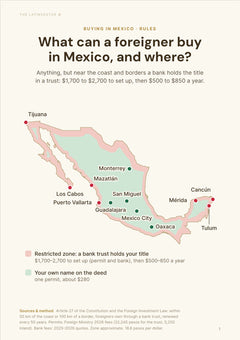
Yes. A qualifying beach property can support temporary residency, but near the coast foreigners hold it through a fideicomiso (a bank trust).
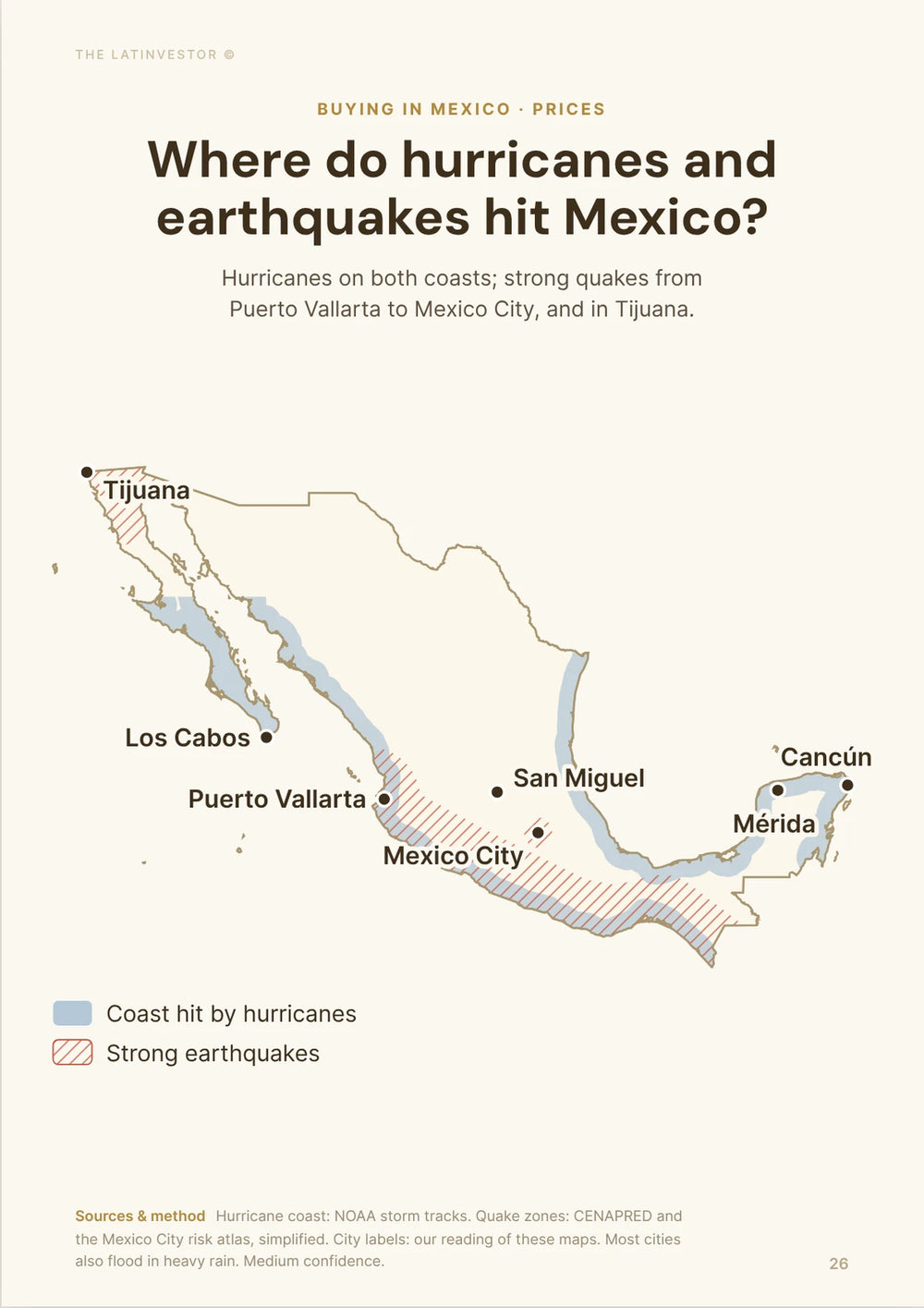
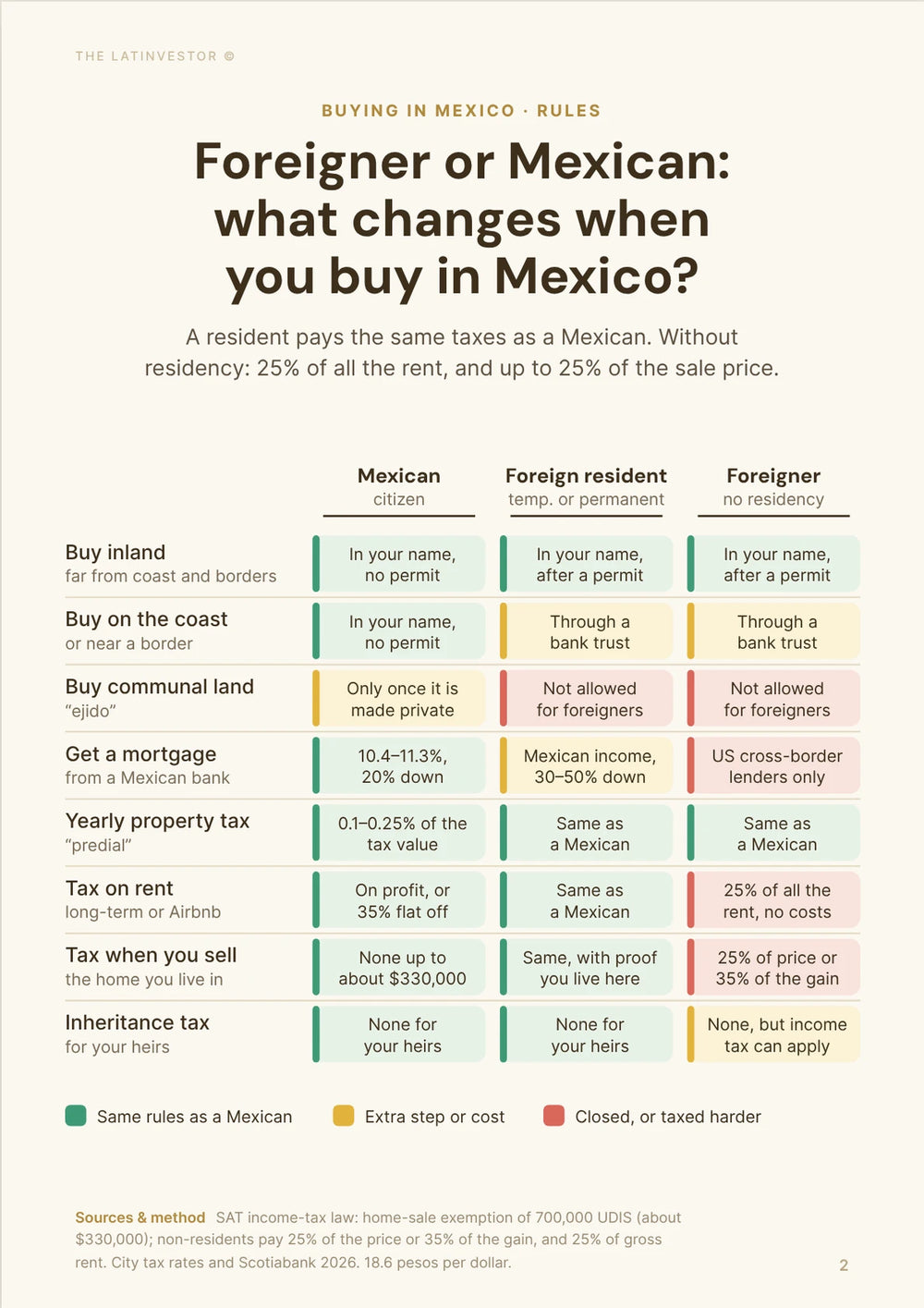
Foreigners can't hold direct title to residential property within 50 kilometres of the coast or 100 kilometres of a land border. In those zones the property goes into a bank trust, for up to 50 years, renewable, and the trust is formalized by a public deed.
That covers most foreign-buyer markets: Cancún, Playa del Carmen, Tulum, Puerto Vallarta and Los Cabos. In 2026 the SRE permit costs MXN 21,650 (about USD 1,160), and banks charge roughly USD 550 to 800 to set up the trust and USD 550 to 700 a year after that.
For residency, the question is paperwork: ask the consulate exactly which trust documents it accepts as proof that the property is yours.
| Example market | Restricted zone? | Typical foreign ownership setup |
|---|---|---|
| Mexico City | No | Direct ownership |
| Guadalajara | No | Direct ownership |
| San Miguel de Allende | No | Direct ownership |
| Cancún | Yes | Fideicomiso |
| Puerto Vallarta | Yes | Fideicomiso |
| Los Cabos | Yes | Fideicomiso |
Does buying a house automatically make you a Mexican resident?
No. Owning property in Mexico doesn't change your immigration status on its own.
The property gives you a basis to apply. You still apply at a Mexican consulate outside Mexico, and once the visa is approved you enter Mexico and have 30 calendar days to get your residence card from INM.
Plenty of foreigners own Mexican homes as tourists, and plenty of residents qualified through savings, income, work or family without owning anything.
What happens after Mexico approves a property-based residency visa?
You enter Mexico with the visa and swap it for a residence card at INM within 30 calendar days.
The first card is usually issued for one year. Temporary residence can then be renewed up to a total of four years, in person at an INM office, and renewals can start up to 30 days before the card expires.
The card is the document that proves your status and lets you stay beyond 180 days.
| Step | What the applicant does |
|---|---|
| Buy qualifying property | Complete ownership and obtain the public deed |
| Apply abroad | Submit Temporary Resident Visa application (USD 56 fee at San Diego) |
| Receive visa | Enter Mexico using the approved visa |
| Within 30 calendar days | Complete the INM residence-card procedure |
| Following years | Renew temporary residence at INM |
| After 4 years | Permanent-residence conversion can become available |
How much does Mexican residency cost on top of the property in 2026?
Many INM fees doubled on 1 January 2026: a one-year temporary resident card now costs MXN 11,141 (about USD 599), and a four-year card MXN 25,058 (about USD 1,350).
The permanent resident card costs MXN 13,579 (about USD 730). Add the consular visa fee (USD 56 at San Diego), which isn't refunded if the visa is refused.
Some family-unity cases pay a 50% rate under the 2026 INM tariff, which helps when a spouse or children join you.
Next to a MXN 10.76 million property these fees are small, but they add up over four years of renewals. Budget them, and check the current INM tariff before paying, since peso amounts change each January.
Can buying property give you permanent residency in Mexico right away?
No. Property gets you temporary residency first; permanent residency normally comes after four years.
INM's procedure still treats four years as a temporary resident as grounds to change to permanent status. You don't need a second, bigger property to make that change; what matters is your time as a resident.
The direct route to permanent residency from abroad goes through income, not property: retirees with a pension of about MXN 133,733 a month (about USD 7,190) can apply for it straight away.
Could selling the Mexican property cause problems with your residency?
Yes, it can, especially in the first years while the property is still the reason you hold the card.
Mexican immigration rules let the authorities check whether the conditions behind your status still apply. If the property was your proof and you sell it, a renewal can become harder to justify.
The risk shrinks once you reach four years and can change to permanent residence based on your time as a resident.
If you might sell before then, check the consequences with an immigration lawyer first. It depends on your card, your renewal stage and how you originally qualified.
Can someone with property-based Mexican residency work in Mexico?
Not automatically. Property-based temporary residency doesn't give you the right to take paid work in Mexico.
Consulates describe this visa as being for people who will live in Mexico without earning money there; London's page says so explicitly. Temporary residents can apply separately for permission to work when they meet the requirements.
If you live on foreign savings, investments or a pension, this won't affect you. If you plan to take a Mexican salary, it will.
Is buying property the easiest way to get Mexican temporary residency?
Usually not. If you can qualify through income or savings, buying a property just for residency is the expensive route.
In 2026 the solvency route asks for about MXN 79,771 a month in income over six months (about USD 4,290) or about MXN 1.34 million in average savings over twelve months (about USD 72,300). The property line is roughly eight times that savings figure.
These solvency figures also vary by consulate and exchange rate, and some applicants have been refused for falling just short. Keep a margin, as with the property value.
Property-based residency makes sense if you already want a home worth well over MXN 10.76 million. Then the same purchase covers both.
| Residency route | Mexican property required? | Main basis (2026) |
|---|---|---|
| Real-estate ownership | Yes | Property worth more than about MXN 10.76m |
| Economic solvency | No | About MXN 79,771 a month income or MXN 1.34m savings |
| Employment | No | Authorized Mexican work |
| Family unity | No | Qualifying family relationship |
| Investor route | Not necessarily | Qualifying Mexican investment |
Can your spouse and children get Mexican residency if you buy the property?
Yes, usually through family unity once you hold residence, so a couple doesn't need two MXN 10.76 million properties.
Spouses, partners, children and some other close relatives can apply based on their link to the resident. Each person still needs their own documents, and some family-unity cases pay half the INM fee in 2026.
Plan the family applications together with yours, so the documents and appointments line up.
Do property-based residents have to stay in Mexico all year?
No. Temporary residency allows multiple entries and exits, so you don't need to spend every day in Mexico.
That changes if you want citizenship later: naturalization looks at actual residence, and the Foreign Affairs Ministry asks applicants to document their travel history.
Can buying property eventually lead to Mexican citizenship?
Indirectly, yes. The temporary residency you get through property can count toward the five years of residence normally needed for naturalization.
The Foreign Affairs Ministry asks standard applicants to prove at least five years of residence right before applying. Temporary and permanent resident cards both count; student residence doesn't.
So the timeline looks like this: temporary residency first, a change to permanent residence after four years, and possibly naturalization after a fifth qualifying year. Spending more on property doesn't shorten it.
| Stage | What property ownership can contribute |
|---|---|
| Qualifying property purchase | Basis for temporary-residence application |
| Temporary residency | Starts qualifying immigration residence |
| 4 years of temporary residency | Can support change to permanent residence |
| 5 years of qualifying residence | Standard naturalization residence threshold |
| More expensive property | Does not buy faster citizenship |
So, should you buy property to get residency in Mexico?
Only if you already want a home worth well over MXN 10.76 million. It's a real route to temporary residency, but an expensive one.
Before you sign: check your consulate's current figure (Toronto still shows MXN 12.49 million), make sure the deed states the full price with a margin above the line, and time your application within six months of the deed if your consulate asks for that.
After that it's the normal process: the visa abroad, the INM card within 30 days, about MXN 11,141 for a one-year card, permanent residence after four years, and possibly citizenship after five.
If residency is your main goal, the savings or income route costs far less capital.
Our methodology
This article answers whether buying property in Mexico can get you residency, and what it takes in 2026: the minimum property value, the documents, the costs and the steps toward permanent residence and citizenship.
We used official sources first. Mexican consulates for the property route, thresholds and documents (we compared San Diego, Barcelona, London, Milan, Vancouver, Montreal and Toronto); INM and the 2026 fee tariff for residence cards and changes of status; the Foreign Affairs Ministry (SRE) for restricted-zone trusts, the 2026 trust permit fee and naturalization; INEGI for the 2026 UMA.
The property threshold is 91,710 UMA days, which we multiplied by the 2026 daily UMA of MXN 117.31. Toronto's higher figure is shown as published rather than averaged in, because the consulate handling your file is the one that counts. Income and savings thresholds and the bank trust fees come from 2026 market guides, not official tariffs, and are shown as approximate.
We checked these figures in October 2026. Conversions use about 18.6 pesos per US dollar and 20.9 pesos per euro.
Limits: consulates update their pages at different times and apply some discretion, the rules don't say how mortgaged or combined properties are treated, and peso amounts change each year with the UMA and the INM tariff. Confirm with your consulate before buying for residency.
Key sources used for this analysis include: Mexican Consulate in San Diego, property-based temporary residence requirements 2026, Mexican Consulate in Barcelona on residence through property, Mexican Consulate in the United Kingdom on the UMA-based property route, Mexican Consulate in Milan on property-based residence, Mexican Consulate in Vancouver on temporary residence, Mexican Consulate in Montreal on temporary residence, Mexican Consulate in Toronto on its published property threshold, INEGI on the 2026 UMA, INM on exchanging the visa for a residence card, INM on changing from temporary to permanent residence, Envoy Global on the 2026 INM fees, SRE on fideicomisos in the restricted zone, SRE on 2026 trust permit costs, Homia on 2026 bank trust fees, NorthAmericans on 2026 solvency thresholds, Expat Insurance on the 2026 residency changes and SRE on naturalization by residence.