Summary
Yes, but only once a year and by no more than last year's inflation if the tenant stays. For 2026 renewals that cap is 3.69%, so a MXN 20,000 rent can go to about MXN 20,738, not more.
The Supreme Court upheld the cap (Article 2448 D of the city's Civil Code) on February 25, 2026. The old 10% ceiling is gone, and a lease clause saying "10% a year" doesn't override it.
The cap only covers sitting tenants. When a new tenant moves in, the landlord sets the starting rent freely, which is why advertised rents rose 9.6% in the year to June 2026 while the cap was 3.69%.
For renewals from January 2027, the cap will be December 2026 inflation, which INEGI publishes in early January. Inflation was 3.45% in September 2026, so expect a cap around 3.5%.
Five years at 10% would take a MXN 20,000 rent to about MXN 32,210; five years at 4% only to about MXN 24,333. That gap is why the change matters.
Before a year has passed, a landlord can't reprice the same tenancy at all, even if a lease signed at MXN 20,000 now sits below what similar apartments are advertised for.
If your landlord asks for more than 3.69%, answer in writing, offer the capped amount and keep proof of every payment. Signing a new contract at the higher rent weakens your position.
Signing a "new" contract every year with the same tenant doesn't clearly reset the cap. A real change of tenant does.
The cap is for homes only. Shops, offices and warehouses follow their contracts.
A higher property value doesn't justify a bigger increase either: a sitting tenant at MXN 20,000 can't be pushed to MXN 26,000 because new listings are there.
Enforcement is the weak point: there are no fines today. A bill sent on October 19, 2026 would fine raises above inflation with MXN 11,731 to 46,924, force a contract registry within 30 days and ban agent and credit-check fees for tenants. It isn't law yet.
If you buy to rent out, the cap is a real cost: with asking rents up 9.6% a year and increases capped at 3.69%, a sitting tenant would pay about 18% below market after three years.
Bottom line: tenants who stay are well protected; landlords get their pricing power back only when the apartment changes hands. Set the first rent right, because that's the one you control.

What does Mexico City's rent cap actually allow?
One increase a year on an existing residential rent, and no more than the previous year's inflation. The starting rent of a new lease stays free.
That is the rule under Article 2448 D of Mexico City's Civil Code. The city changed the law in 2024, replacing the previous system that allowed much larger annual increases with an inflation-based ceiling.
The rule is much harder to challenge today than it was when the reform first appeared. Mexico's Supreme Court reviewed Article 2448 D and upheld it on February 25, 2026. The Court found that Mexico City can limit annual residential rent increases to protect access to housing while still allowing landlords and tenants to negotiate the starting rent freely.
That distinction drives everything else in this article. Mexico City strongly limits how fast an existing residential rent can rise, while landlords still have much more freedom when they are genuinely setting the rent for a new tenancy.
| Situation | Can the landlord raise the rent? | Main rule | What matters most |
|---|---|---|---|
| Existing residential tenancy before one year passes | Generally no | Annual increases only | Timing |
| Existing residential tenancy at annual adjustment | Yes | Previous year's inflation | Percentage |
| New tenant entering a genuinely new lease | Yes | Starting rent remains negotiable | New tenancy |
| Commercial property | Different rules | Residential cap does not automatically apply | Property use |
| Large increase during the same tenancy | Generally no | Inflation ceiling | Continuity of tenancy |
How much can a landlord raise the rent in Mexico City now?
For a residential rent being adjusted in 2026, the practical ceiling is 3.69%, because INEGI reported annual Mexican inflation of 3.69% at the end of 2025.
That gives us a simple benchmark.
A tenant paying MXN 15,000 a month could see the rent rise to roughly MXN 15,553.50.
MXN 20,000 becomes about MXN 20,738.
MXN 25,000 becomes about MXN 25,922.50.
MXN 30,000 becomes about MXN 31,107.
A landlord asking to move a MXN 20,000 rent to MXN 22,000 would be demanding a 10% increase. For an ordinary annual adjustment of the same residential tenancy, that is far above the current inflation-based ceiling.
And 10% is roughly what the market is doing. Inmuebles24's index for a standard 65 m² two-bedroom reached MXN 21,921 a month citywide in June 2026, up 9.6% in a year. That's the pressure landlords are feeling, and the reason so many still try their luck at renewal.
| Current monthly rent | 3.69% increase | New monthly rent | Extra over 12 months |
|---|---|---|---|
| MXN 15,000 | MXN 553.50 | MXN 15,553.50 | MXN 6,642 |
| MXN 20,000 | MXN 738 | MXN 20,738 | MXN 8,856 |
| MXN 25,000 | MXN 922.50 | MXN 25,922.50 | MXN 11,070 |
| MXN 30,000 | MXN 1,107 | MXN 31,107 | MXN 13,284 |
| MXN 40,000 | MXN 1,476 | MXN 41,476 | MXN 17,712 |
What will the rent cap be for 2027 renewals?
Probably around 3.5%. The cap for any renewal in 2027 will be the official inflation rate for 2026, which INEGI will publish in early January 2027.
Inflation has been steady: INEGI put it at 3.45% in September 2026. Nothing points to a big jump before December, so a MXN 20,000 rent would likely be capped near MXN 20,690 next year.
Until then, any renewal date that falls in November or December 2026 still uses 3.69%. Don't let a landlord apply a guessed 2027 figure early, and don't accept a "provisional" increase above 3.69% to be "corrected later".
Didn't Mexico City landlords used to be able to raise rent by 10%?
Yes. Older explanations mentioning a 10% annual limit are now outdated for ordinary residential rent increases in Mexico City.
Before the 2024 reform, Article 2448 D allowed annual increases of up to 10% under the previous framework. Mexico City replaced that ceiling with the previous year's inflation rate.
The difference compounds quickly.
Take a MXN 20,000 apartment. Five consecutive 10% annual increases would push the monthly rent to roughly MXN 32,210. Five annual increases of 4% would bring it to around MXN 24,333.
The first path raises the rent by about 61% in five years. The second raises it by about 22%.
That gap explains why the change was significant. A few percentage points each year turn into several thousand pesos a month once they compound for long enough.
Can a Mexico City landlord raise rent before one year has passed?
Generally no. Mexico City's residential rent rule allows increases annually, so landlords cannot normally reprice the same tenancy every few months.
Imagine a lease begins at MXN 20,000. The landlord then notices that comparable apartments in Roma Norte are being advertised for MXN 23,000 six months later.
That stronger market does not create a right to increase the existing tenant's rent immediately.
The landlord still has to work within the timing rule governing that tenancy. Even when the annual adjustment point arrives, the percentage increase remains subject to the inflation ceiling.
This can create a wide gap in popular neighborhoods. A sitting tenant may be paying far less than a newly advertised apartment next door, especially after several years in the same home.
What if the lease says the landlord can raise the rent by 10%?
A clause saying the rent rises by 10% every year does not give a Mexico City landlord a free pass around the current inflation ceiling for an existing residential tenancy.
This issue comes up because rental contracts often outlive the templates used to draft them.
Some landlords still use agreements written when the previous 10% framework applied. Others use standard clauses saying the rent rises by 10%, 15% or according to “market conditions.”
Today, those clauses have to be read together with Article 2448 D.
If the applicable annual ceiling is 3.69%, writing “10% annual increase” into the lease does not turn the legal ceiling into 10%.
The same basic problem applies to clauses allowing very broad repricing based on market value. Contractual freedom remains important, but it operates inside the mandatory rules governing residential rent increases.
What should you do if your landlord asks for more than 3.69%?
Push back in writing and keep paying the legal amount. Most landlords back down once they see the tenant knows the rule.
Check the math first: take your current rent, add 3.69%, and that's the ceiling for a 2026 renewal. Then reply by email or message, not just over the phone, citing Article 2448 D of the Civil Code and the Supreme Court ruling of February 25, 2026. Offer to pay the capped amount from the renewal date.
Pay by bank transfer so every month is on record. If the landlord refuses the payment, a lawyer can deposit the rent with a court (a "consignación"), so you're never in arrears. Today there's no dedicated tenant office to complain to; a dispute goes to the civil courts, which is exactly the gap the October 2026 bill tries to close.
Be careful before signing a "new" contract at the higher rent. Your signature makes it harder to argue later that the increase was imposed. If you do want to move anyway, use the borough benchmarks to negotiate your next place: Benito Juárez listed at MXN 20,486 for a standard two-bedroom in June 2026, Cuauhtémoc at MXN 29,149.
Does a Mexico City landlord have to raise rent by the full inflation rate?
No. The inflation rate is the maximum annual increase, so a landlord can raise the rent by less or leave it unchanged.
For a MXN 20,000 rent with a 3.69% ceiling, several outcomes are possible.
The landlord could leave the rent at MXN 20,000.
An increase to MXN 20,300 would equal 1.5%.
MXN 20,500 would be 2.5%.
MXN 20,738 would reach the 3.69% ceiling.
An increase to MXN 21,000 would be 5%, which would go above that ceiling for an ordinary annual adjustment.
The law therefore gives landlords a maximum. It does not automatically index every Mexico City residential lease to inflation.
| Existing rent | Proposed rent | Increase | Within a 3.69% ceiling? |
|---|---|---|---|
| MXN 20,000 | MXN 20,000 | 0% | Yes |
| MXN 20,000 | MXN 20,300 | 1.50% | Yes |
| MXN 20,000 | MXN 20,500 | 2.50% | Yes |
| MXN 20,000 | MXN 20,738 | 3.69% | Yes |
| MXN 20,000 | MXN 21,000 | 5.00% | No for a normal annual increase |
| MXN 20,000 | MXN 22,000 | 10.00% | No for a normal annual increase |
Can a landlord charge much more when a new tenant moves in?
Yes. A Mexico City landlord has much more freedom to set the starting rent when a genuinely new tenant moves into a vacant apartment.
This is the biggest limit of the current rent-control system.
The Supreme Court made the distinction clear when it upheld Article 2448 D. Landlords and tenants remain free to negotiate the initial rent even though later annual increases are capped.
Suppose a long-term tenant is paying MXN 20,000. Under a 3.69% annual ceiling, the next adjustment would take that rent to about MXN 20,738.
If the tenant moves out and an unrelated new tenant takes the apartment, the landlord does not have to advertise it at MXN 20,738. The owner could ask MXN 24,000, MXN 27,000 or MXN 30,000 and see whether someone accepts.
This creates two rental markets inside the same building: regulated increases for existing tenants and market-driven starting prices for new ones.
That gap can become large in neighborhoods where asking rents rise much faster than national inflation.
| Scenario | Previous rent | Pricing freedom |
|---|---|---|
| Same tenancy, annual adjustment | MXN 20,000 | Inflation-capped |
| Same tenant, tenancy clearly continues | MXN 20,000 | Strong case for inflation cap |
| Tenant leaves and another tenant moves in | MXN 20,000 | New starting rent can be negotiated |
| Vacant apartment newly listed | N/A | Market-driven asking rent |
| Same tenant kept in place under artificial yearly “new” contracts | MXN 20,000 | Legally more questionable |
Can a landlord avoid the Mexico City rent cap by signing a new contract every year?
Calling every annual renewal a “new contract” does not automatically make a large rent increase safe.
This is probably the trickiest gray area in the current system.
The Supreme Court considered the possibility that a landlord could terminate a one-year agreement on paper and immediately sign another agreement with the same person at a much higher rent.
The problem is pretty obvious in practice.
Suppose a tenant has lived continuously in the same apartment for three years. The tenant never moves out, keeps possession of the property and simply signs a fresh document each year.
If every document could be treated as a completely unrelated tenancy, the inflation ceiling would be extremely easy to bypass.
A genuine change of tenant is much clearer. One renter leaves, another renter takes possession and the landlord negotiates a new starting price.
Keeping the same occupant in the same apartment while repeatedly resetting the rent through paperwork is much less straightforward.
We would therefore be very cautious about any claim that “the lease expired, so the landlord can now charge anything” when the same tenant remains continuously in the home.
What happens when a Mexico City lease expires?
Lease expiry does not automatically give a landlord unlimited freedom to raise the rent for the same person who stays in the apartment.
What happens next depends heavily on what happens in reality.
If the tenant leaves, hands back the property and another person later rents it, the landlord clearly has more freedom to set a new starting rent.
If the same tenant remains in possession and both sides simply extend the relationship, the situation looks much closer to a continuing tenancy.
The difficult cases sit between those two examples. A landlord may formally end one contract and issue another while nothing meaningful changes on the ground.
That is where the distinction between “initial rent” and “annual increase” becomes important.
Tenants facing a very large increase at renewal should therefore look at the continuity of the actual tenancy, including whether they stayed in possession, whether the landlord ever recovered the apartment and whether the new agreement really created a separate rental relationship.
The name placed on the contract helps, but the underlying facts can matter more.
Does the Mexico City rent cap apply to every rental property?
No. The inflation cap we are discussing applies to residential housing, so landlords should not assume the exact same rule governs shops, offices, warehouses or other commercial leases.
The use of the property is the starting point.
An apartment rented as someone's home clearly falls inside the residential framework.
A storefront rented to operate a restaurant sits in a different legal category.
The same is true for an office or warehouse.
Mixed-use properties can be harder to classify when somebody genuinely lives and works in the same place.
This is also why broad statements such as “Mexico limits all rent increases to inflation” are misleading. The rule comes from Mexico City's local Civil Code and applies to residential renting in the capital.
Can a landlord raise the rent because the apartment is worth more now?
No. Rising property values do not let a Mexico City landlord bypass the inflation cap on an existing residential rent.
Imagine an owner bought an apartment for MXN 4 million and similar apartments later begin selling for MXN 6 million.
That 50% increase in property value may affect the owner's return expectations. It may also influence the price the owner eventually asks from a future tenant.
The existing residential rent still follows its own rules.
The same applies when apartments elsewhere in the building suddenly rent for much more.
If a sitting tenant pays MXN 20,000 while newly listed units reach MXN 26,000, the landlord may genuinely be receiving less than the current market asking price.
That gap alone does not justify a 30% increase for the existing tenant.
Over time, this can produce a large difference between what long-term tenants pay and what newcomers see on listing websites.
Are Mexico City landlords actually following the rent cap?
Not consistently, as far as anyone can tell. There's no official data on compliance, and today breaking the cap carries no fine.
The law is clear. Enforcement is the weak point: a tenant who's asked for 10% has to push back alone, and many just pay or move.
The 2024 reform also created a digital rental-contract registry, and the Supreme Court upheld it in February 2026 while limiting what it can collect: the rent, the agreed increase, the colonia and the borough. More detailed contract data must stay out of it.
That registry could eventually show how real contract rents move, instead of portal ads. But without a deadline or penalties, few landlords have a reason to use it. The October 2026 bill would change that with a 30-day registration deadline and fines.
So the legal ceiling is real and has survived the Supreme Court, while actual compliance can't be measured yet.
Why is Mexico City tightening rent rules so much?
Mexico City is tightening rent rules because rents have moved much faster than many residents can comfortably absorb, particularly in central neighborhoods.
The government's 2026 rent-reform proposal cites an average Mexico City rent of roughly MXN 14,500 in January 2020 and close to MXN 20,000 by January 2025.
That is an increase of around 38% in five years. And it hasn't slowed much: Inmuebles24 measured asking rents up 9.6% in the year to June 2026, about 2.7 times inflation, with Coyoacán up 15.5% and Cuauhtémoc 13.7%.
The pressure is uneven. Areas such as Roma, Condesa, Doctores and Santa María la Ribera have repeatedly appeared in public debates around rising rents, displacement and gentrification.
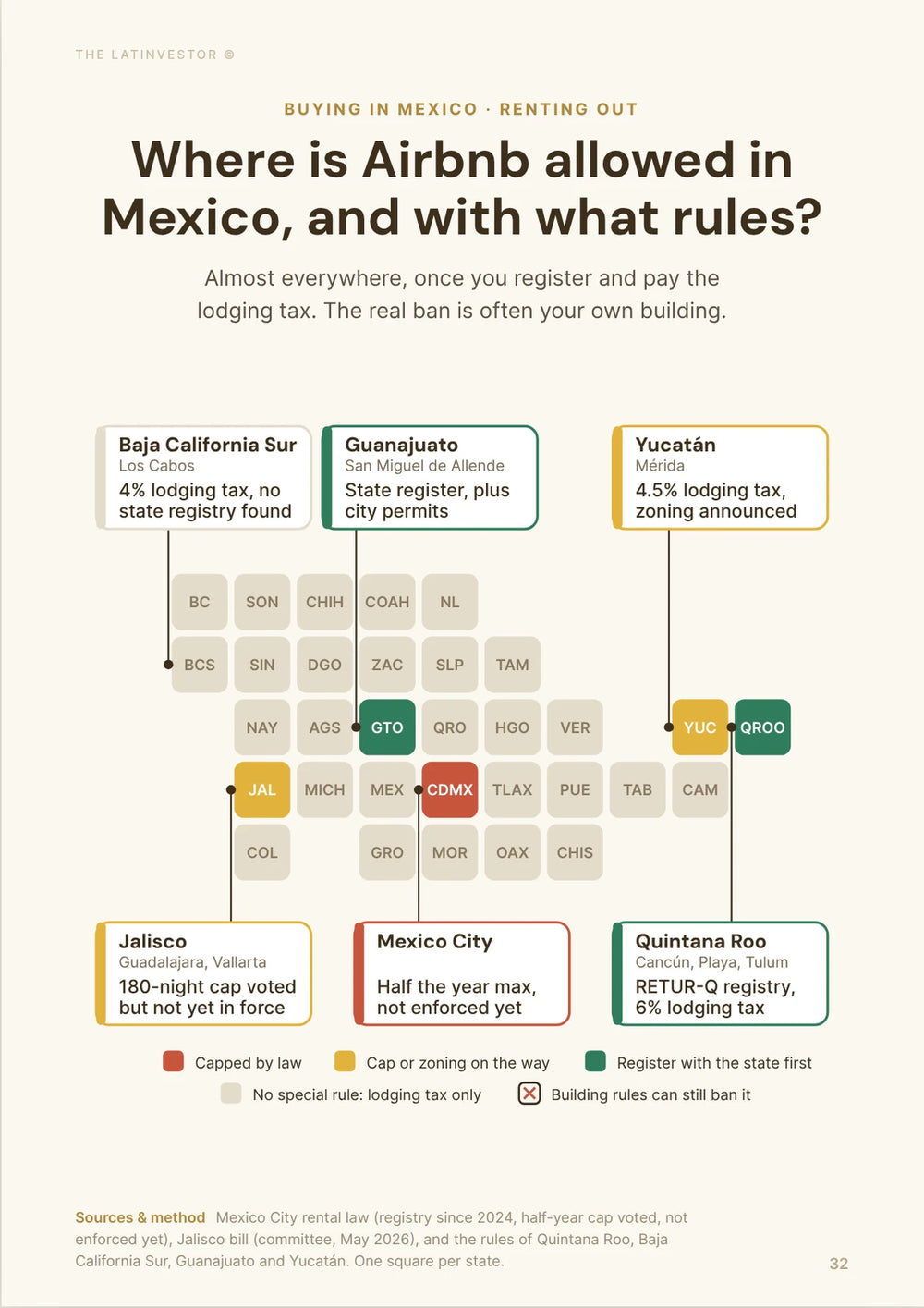
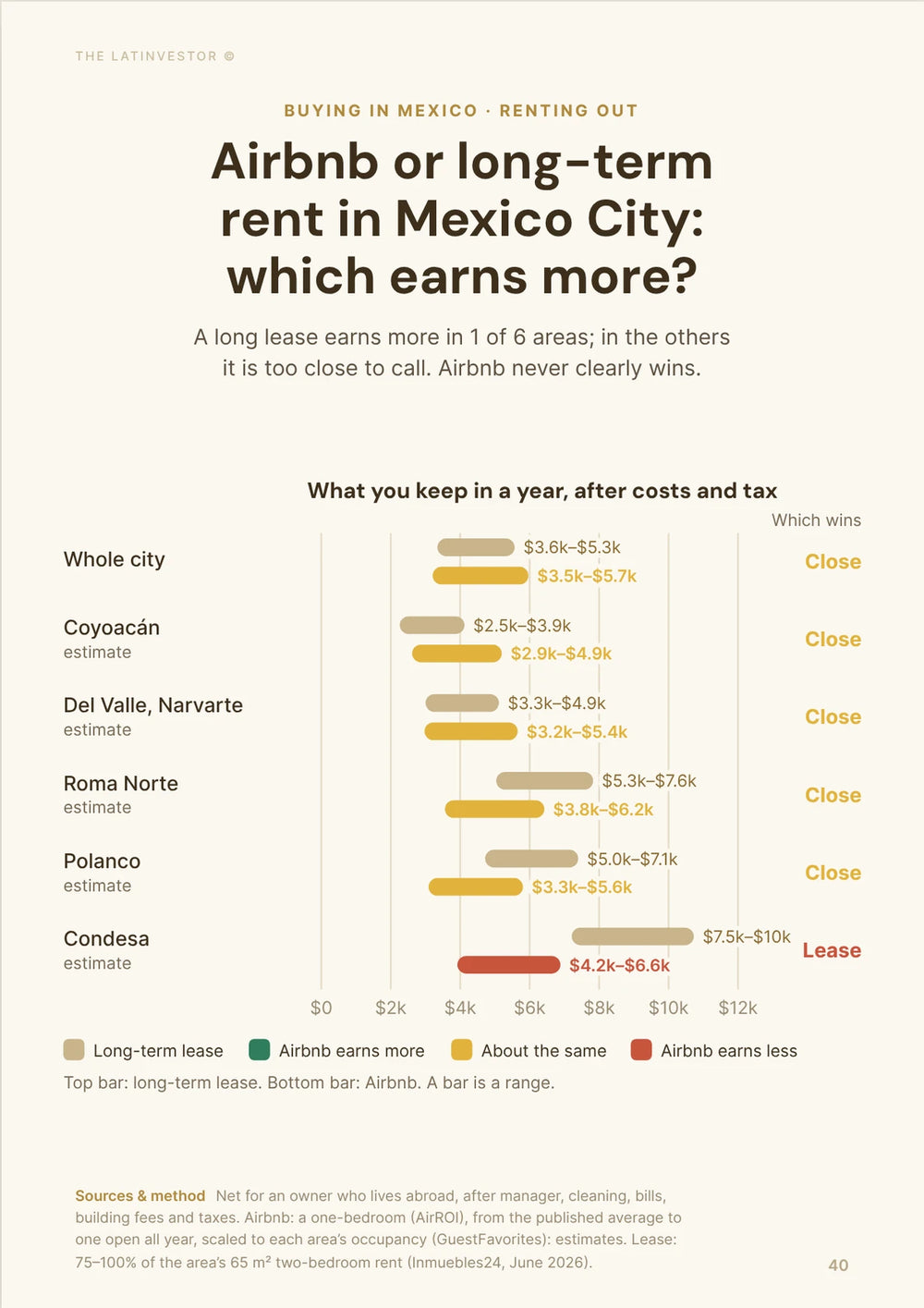
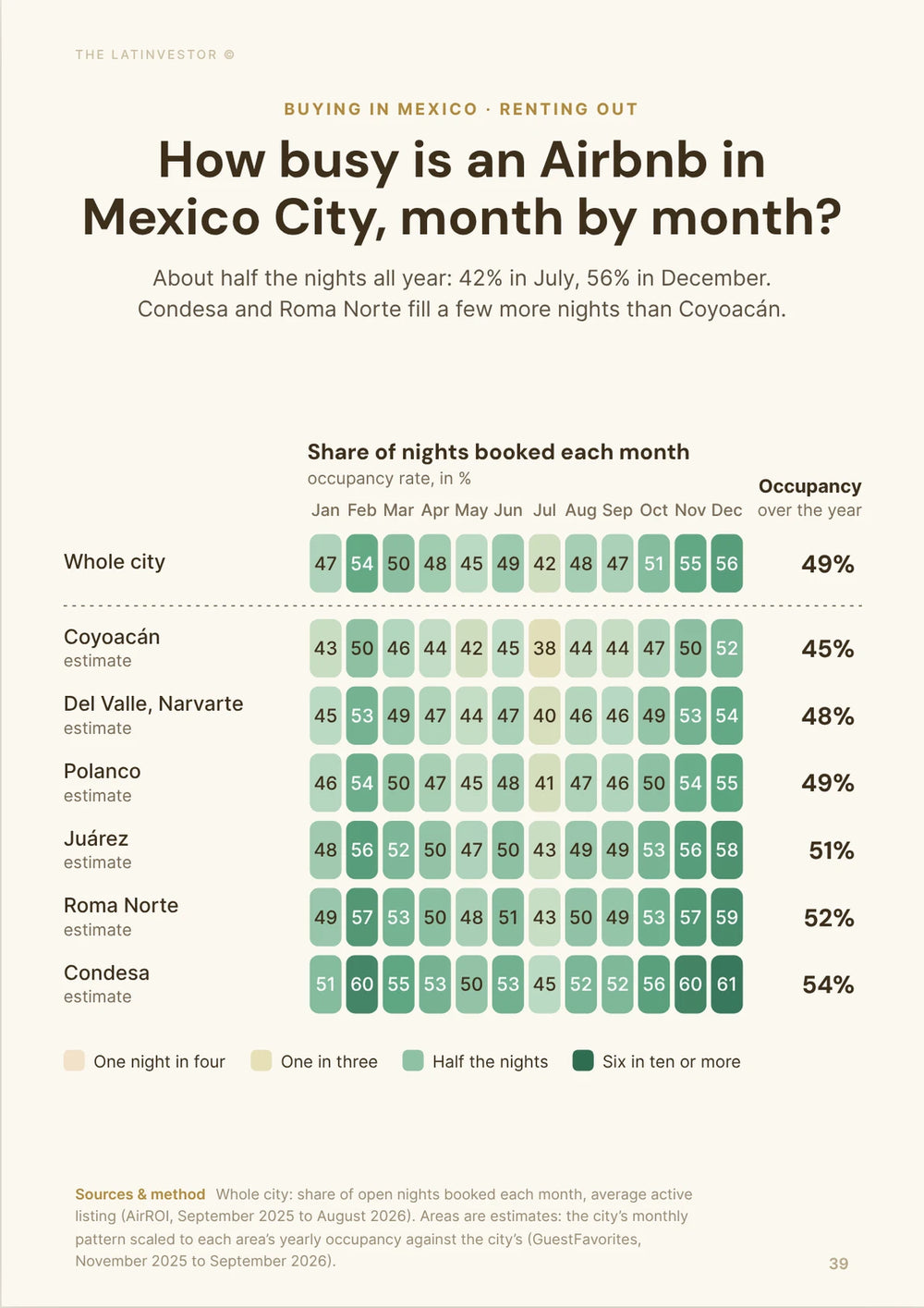
Short-term rentals add another layer. An analysis referenced by Mexico's construction-industry chamber put about 85% of the city's Airbnb listings in Cuauhtémoc, Miguel Hidalgo, Benito Juárez and Coyoacán at the end of 2024. Supply is now shrinking after the World Cup: AirDNA counted 25,568 active listings in September 2026, 27.8% fewer than a year earlier, but asking rents haven't fallen with them so far.
Those forces help explain why policymakers have kept pushing beyond the original 2024 Civil Code change.
The latest proposals include stronger tenant protections, policies to increase affordable housing, measures aimed at areas facing intense real-estate pressure and a dedicated institution for rental disputes.
Is Mexico City introducing even stricter rent controls now?
It's trying. On October 19, 2026, Mayor Clara Brugada sent the city Congress a full rental law, the "Ley de Relaciones Inquilinarias y Rentas Justas, Razonables y Asequibles". It isn't law yet.
It follows the constitutional reform on "fair, reasonable and affordable rents" she sent in April 2026, which would write the inflation cap into the city's constitution. The October bill is the part with teeth.
It would fine landlords 100 to 400 UMA, so MXN 11,731 to 46,924 (about USD 631 to 2,520), for raising rent above last year's inflation. If a landlord demands too much when a contract ends, the tenant could keep paying the old rent plus the allowed increase, the contract would be extended by a year, and the tenant could claim back any overpayment.
It also sets a one-year minimum term, a 30-day deadline for the landlord to register the contract with the city's digital agency (ADIP), a single guarantee, and a ban on charging tenants for agents, contract drafting, credit checks or legal insurance. A landlord who makes substantial improvements could ask for permission to go above the cap. Disputes would go to a new free tenant office, the Defensoría de las Relaciones Inquilinarias, under the Procuraduría Social.
Timing: committees have 45 working days to report, extendable by another 45, after an open consultation. Realistically, nothing changes before 2027, and the opposition PAN called the April reform an attack on private property.
| Measure | Current position (October 2026) | What it means now |
|---|---|---|
| Inflation ceiling on annual residential increases | In force, upheld by the Supreme Court | 3.69% for 2026 renewals |
| Digital rental-contract registry | Created in 2024, upheld | No deadline or fines yet |
| Fines for raises above inflation | Bill sent October 19, 2026 | No fine today |
| One-year minimum lease, single guarantee, no agent or credit-check fees | Bill sent October 19, 2026 | Still negotiable today |
| Constitutional rent reform | Sent April 2026, under review | No new constitutional rule yet |
| Free tenant office (Defensoría) | Proposed | Disputes still go to the civil courts |
If you buy to rent out, how much does the cap cost you?
More than most buyers model. Your first rent is free, but every increase after that tracks inflation while market rents have been running at two to three times that.
Take an apartment let at MXN 20,000. If asking rents kept rising 9.6% a year and inflation stayed at 3.69%, the market rent would be about MXN 26,331 after three years, while your sitting tenant would pay about MXN 22,297. That's roughly MXN 4,000 a month, or 18%, below market.
That doesn't make long tenants bad: turnover, empty months and agent fees cost money too. But it changes what to do. Model increases at inflation, not at whatever Inmuebles24 reports. Price the first rent at market, not below to fill it fast. And sign a proper written contract you'd be happy to register, because the October bill would make an unregistered one a liability.
So can a landlord raise the rent in Mexico City?
Yes. A Mexico City landlord can raise the rent on an existing residential tenancy, but the ordinary annual increase is currently limited to the previous year's inflation.
For a 2026 adjustment, that means roughly 3.69%.
A landlord therefore cannot take a continuing MXN 20,000 residential rent to MXN 22,000 simply because nearby apartments are more expensive, property values have risen or an old lease mentions a 10% adjustment.
The biggest exception appears when a genuinely new tenancy begins.
Once one tenant leaves and another tenant moves in, the owner has much more freedom to negotiate a new starting rent. That is why advertised rents across Mexico City can keep rising much faster than the rents of long-term tenants.
Renewals involving the same tenant deserve more caution. If someone stays continuously in the same apartment while the landlord simply replaces the paperwork every year, calling the document “new” does not settle whether the inflation cap can be avoided.
If the October 2026 bill passes, raises above inflation will also cost landlords a fine, which would finally give the cap teeth.
The conclusion is pretty sharp: landlords in Mexico City still have pricing power, but much less of it once a residential tenant is already in place. The strongest protection belongs to the tenant who stays in the same home; the landlord recovers far more pricing freedom when that tenancy genuinely ends.
Our methodology
We approached the question “Can a landlord raise the rent in Mexico City?” by separating the situations that actually change the answer: an annual increase during an existing residential tenancy, a lease renewal involving the same occupant, a genuinely new tenant, and a property being used for something other than housing.
We prioritized the current legal framework rather than older rental guides. The main legal anchor is Article 2448 D of Mexico City's Civil Code as amended by the 28 August 2024 reform, which replaced the previous framework allowing increases of up to 10% with a ceiling linked to the previous year's inflation. We then checked it against the Supreme Court's February 2026 decision, which upheld the cap while confirming that the starting rent of a new lease stays free. That's why we treat a genuine new tenancy differently from a renewal with the same occupant, and stay cautious when contracts are replaced on paper without a real change in possession.
For the 2026 examples, we use the official 3.69% annual inflation reading for December 2025. The calculations are illustrations of what that ceiling means for common monthly rents; they are not estimates of what an individual landlord will actually choose to charge.
We also separate measures already in force from proposals. The Civil Code ceiling and the registry exist today. The April 2026 constitutional reform and the October 19, 2026 rental bill are treated as proposals, described from the bill's published content and press coverage.
For market context we use Inmuebles24's asking-rent index as reported by El Economista (June 2026) and AirDNA's count of active short-term rentals (September 2026). These are asking prices and active listings, not signed contracts. The three-year landlord example assumes rents and inflation keep their recent pace; it's an illustration, not a forecast.
We checked these figures in October 2026. Dollar amounts use about 18.6 pesos per US dollar and 20.9 pesos per euro. This article explains the rules; it isn't legal advice for a specific dispute.
Key sources used for this analysis include the Official Gazette of Mexico City containing the 28 August 2024 reform, the Mexico City Congress legal framework portal, the Supreme Court's February 2026 communication on Article 2448 D, the Supreme Court judgment in Amparo en Revisión 546/2025, INEGI's official consumer-price data, the December 2025 INPC summary, Banco de México's year-end 2025 inflation data, El Contribuyente on September 2026 inflation, the Mexico City government's 2026 Fair Rents proposal, the Mexico City Congress record on the constitutional proposal, Crónica on the October 2026 fair rents bill, Crónica on party reactions, Excélsior on the rental contract registry, El Economista on rents by borough, and AirDNA's Mexico City market overview.