


Summary
Not yet. Medellín new-home sales jumped 56% in 2025, but sales in the Medellín area then fell about 15% in the first half of 2026: this is a strong recovery that has stalled, not a citywide boom.
The 2025 rebound started from a very low base: Antioquia sold only 18,039 new homes in 2024, the weakest year since 2011. Even after it, the 23,762 sold in 2025 were about 24% below the 31,204 of 2021.
Medellín recovered faster than its region (+56% against +31.7% for Antioquia), and nearly seven in ten new homes sold in the city in 2025 were outside El Poblado.
Prices did speed up in 2026. DANE's new-home index for the Medellín metro area rose 9.14% over the year to Q2 2026, against 7.04% local inflation, so the real gain is only about 2 points.
The market runs at two speeds. In Medellín city, high-end new homes rose 7.43% in a year while middle-income ones fell 1.92%.
Rents are still climbing: advertised apartment rents averaged COP 4.92 million a month in mid-2026, up 8.7% in a year, even if more units are now sitting empty for longer.
Airbnb is not adding fuel. AirDNA counts 14,957 active listings with 63% occupancy, but nightly rates fell 16.4% to $72.
Foreign buyers move prices only at the margin: foreign non-residents bought 3.28% of new homes sold in Antioquia (Camacol, December 2025).
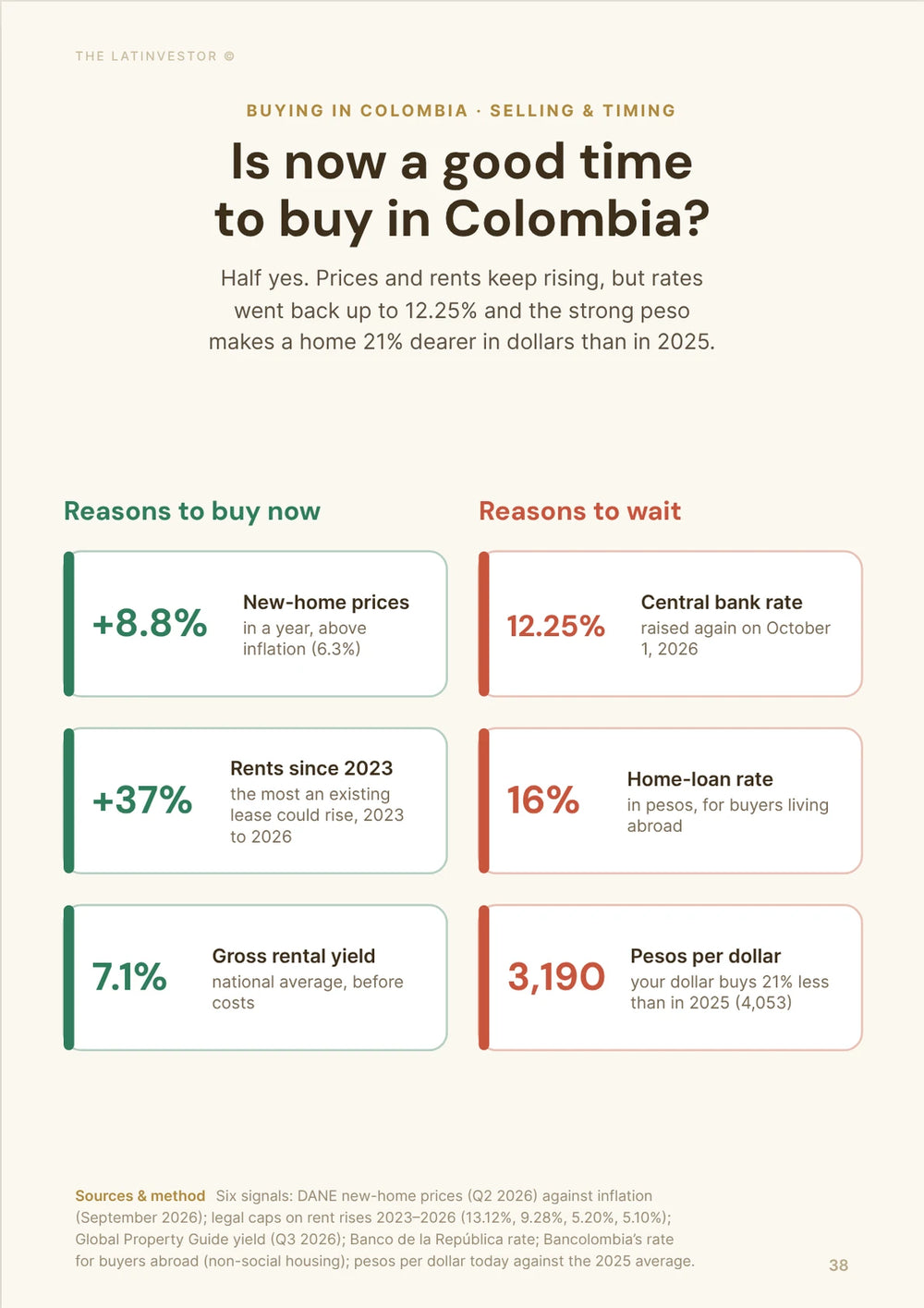
Credit got more expensive, not cheaper. The policy rate is 12.25% after a 300-basis-point climb since early 2026, and the average mortgage rate was 15.02% in September 2026.
Developers launched 22,641 homes in Antioquia in 2025 but started only 17,187, so supply on paper ran ahead of construction.
Underlying demand is real: Camacol Antioquia estimates about 38,000 new households a year in the department, against 24,240 new homes sold per year on average over 2021–2025.
The 2021 comparison does not hold, and 2026 went backwards: Antioquia's sales fell about 17.5% in the first half and national sales 11.9% from January to September.
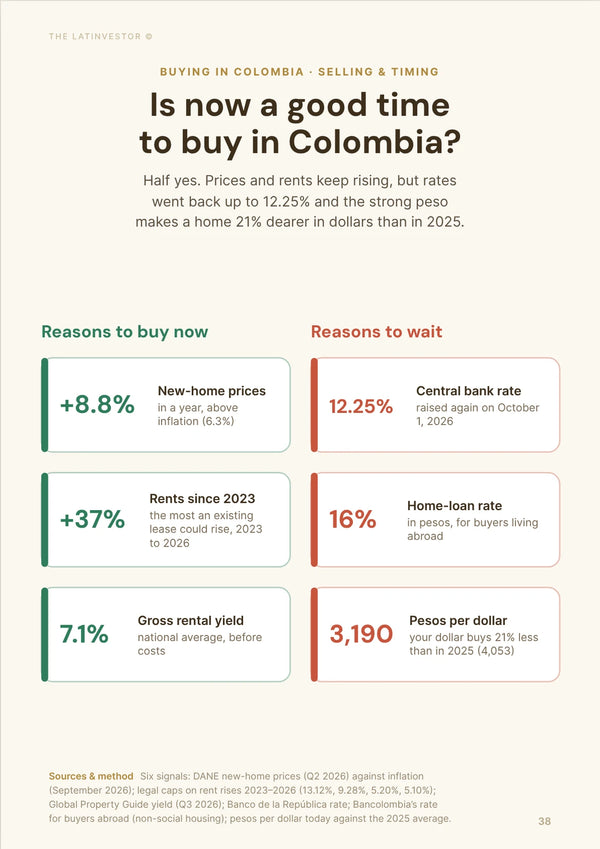
The peso changed the maths for foreigners: the average used apartment of COP 871 million costs about $273,000 today, roughly 18% more in dollars than at the start of 2026, with no change in the peso price.
Resale is where the value is: about COP 8.7 million per m² in El Poblado against COP 13.85 million for new builds in the same area.
Our answer: no broad boom. With sales down about 15% and mortgages near 15%, expect a slower, uneven market where premium pockets stay firm and cash buyers negotiating in pesos have room to push the price down.

Why did Medellín suddenly look like a booming property market again?
Medellín looked hot in 2025 because buyers came back very quickly after one of the weakest housing periods in years.
According to La Lonja's review of Galería Inmobiliaria data, 6,371 new homes were sold inside Medellín in 2025, 56% more than a year earlier. Across the Valle de Aburrá, sales reached 17,350 units, up 44%. Camacol Antioquia recorded the same rebound at the departmental level: 23,762 new homes sold, up 31.7%.
Growth rates like that change how a market feels. Sales offices filled up again and activity returned in several parts of Medellín at once. El Poblado sold 1,915 new homes, Buenos Aires 1,141 and Robledo 1,016.
The important context is where this rebound started. Antioquia sold only 18,039 new homes in 2024, the lowest annual figure in Camacol's series going back to 2011. That makes the 2025 recovery percentages look spectacular.
So yes, something changed in 2025. The harder question is whether it lasted long enough to deserve the word "boom". The 2026 numbers below say it did not.
Is Medellín's housing sales rebound actually a boom?
Medellín's housing sales recovery is strong, but the longer history still falls short of a genuine boom.
Antioquia gives us the longest useful series. Camacol recorded 23,762 new-home sales in 2025, compared with 31,033 in 2015, 31,603 in 2016 and 31,204 in 2021. The latest full-year total therefore remained roughly 24% to 25% below previous peaks.
Another comparison makes the recovery easier to understand. Sales fell from 28,513 units in 2022 to 19,685 in 2023 and then 18,039 in 2024. The rebound to 23,762 in 2025 recovered around 5,700 annual sales. The preceding downturn had erased roughly 10,500.
Roughly half of the fall from 2022 to the 2024 bottom was recovered in 2025. Then 2026 went the wrong way: Camacol Antioquia counted 8,551 new homes sold in the first half of 2026, against 10,368 a year earlier, down about 17.5%.
| Year | Antioquia new-home sales | Change from 2025 |
|---|---|---|
| 2015 | 31,033 | 2025 was 23% lower |
| 2016 | 31,603 | 2025 was 25% lower |
| 2021 | 31,204 | 2025 was 24% lower |
| 2022 | 28,513 | 2025 was 17% lower |
| 2024 | 18,039 | 2025 was 32% higher |
| 2025 | 23,762 | — |
Is Medellín hotter than the rest of Antioquia?
Yes, in 2025 Medellín recovered much faster than the broader Antioquia housing market.
The differences are large enough to matter. New-home sales rose 56% inside Medellín during 2025, compared with 44% across the Valle de Aburrá and 31.7% across Antioquia.
That helps explain why Medellín itself suddenly felt so hot. The strongest recovery sat at the center of the metropolitan area rather than being spread evenly across the department.
Inside Medellín, however, demand is less concentrated than the usual foreign-investor narrative suggests. El Poblado accounted for around 30% of new-home sales, while Buenos Aires and Robledo together contributed another 34%. Nearly seven in ten Medellín new homes were therefore sold outside El Poblado.
This is a broad city recovery with an especially hot premium component, rather than one luxury neighborhood creating the entire story.
 Colombia Property Market
This is just a preview page. Prices and rents move fast: your guide is refreshed every month, and you always get the latest version.
Are Medellín property prices accelerating right now?
Yes, on paper. After a weak start to 2026, new-home prices around Medellín jumped in the second quarter, but most of the gain is inflation.
DANE's new-housing index for Q2 2026 (published in August) puts the Medellín metro area 9.14% higher than a year earlier, slightly above the national +8.80%. Prices rose 3.09% in the quarter alone.
Three months earlier the picture was the opposite: in Q1 2026 DANE's index for Medellín city had slipped 0.76% in the quarter and annual growth had fallen to 6.51%. One weak quarter followed by one strong quarter is a choppy market, not a runaway one.
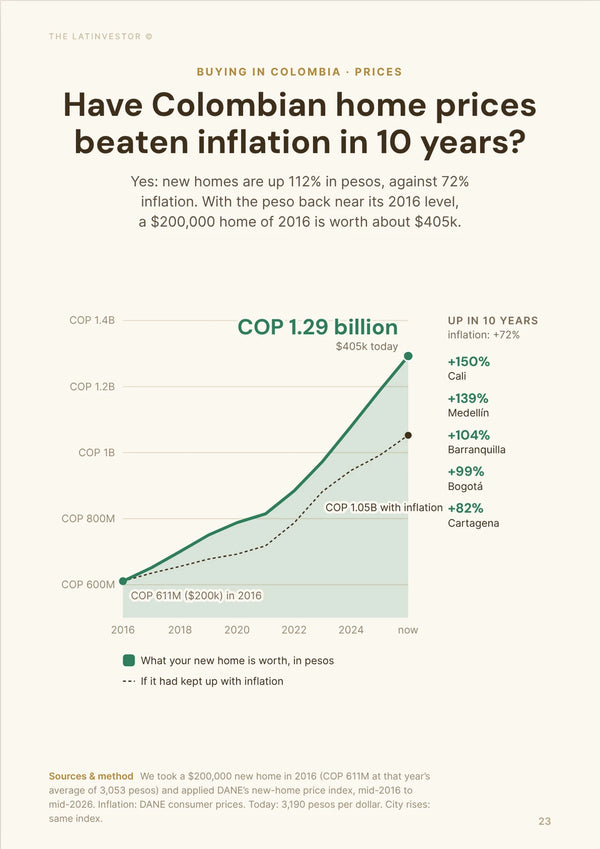
Inflation eats most of the gain. Consumer prices in Medellín rose 7.04% in the year to September 2026, the highest of Colombia's big cities (national CPI: 6.29%). Real new-home price growth is therefore only about 2 points a year.
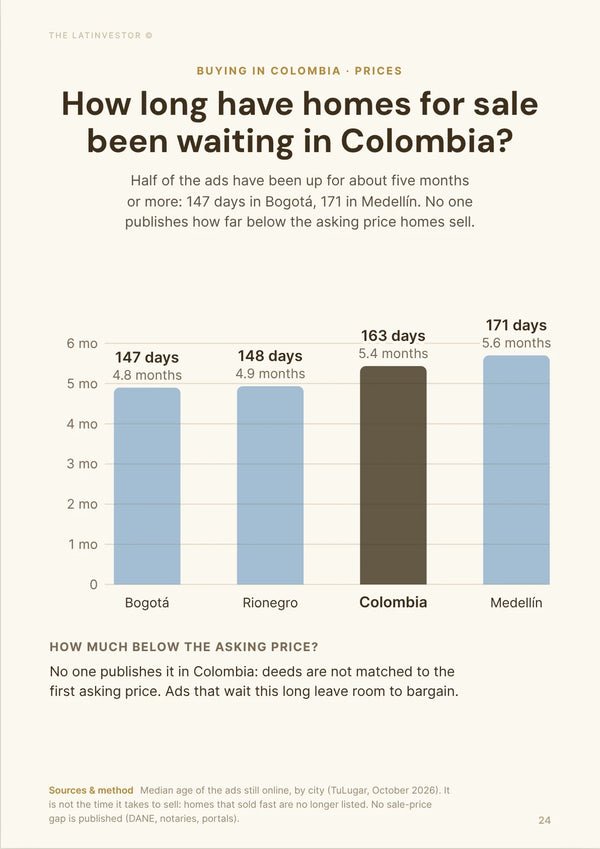
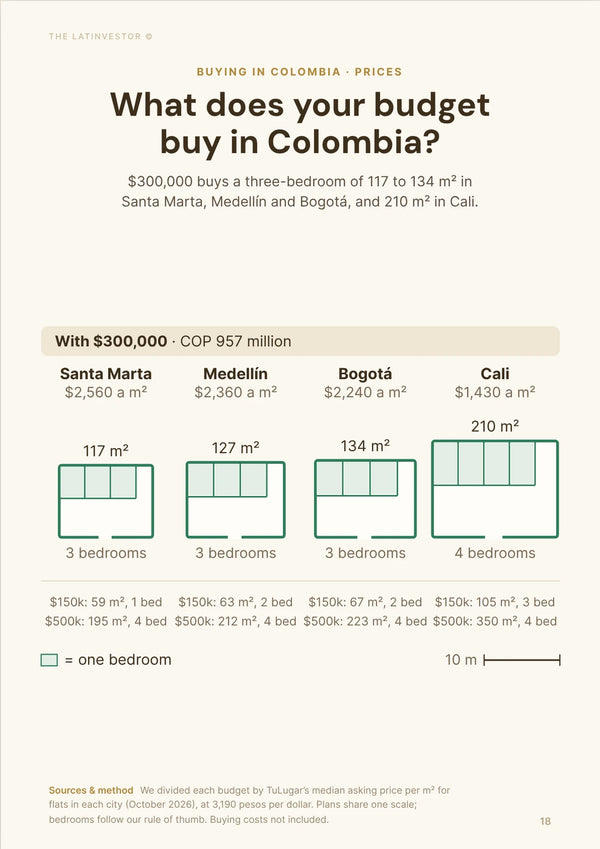
Used homes are holding up too. The 2026 Ciencuadras–El Libertador review put the average advertised used apartment in Medellín at about COP 871 million (about $273,000), or COP 6.47 million per m², above Bogotá's COP 817 million.
| Price measure | Change |
|---|---|
| New homes, Medellín metro area, year to Q2 2026 | +9.14% |
| New homes, Medellín metro area, Q2 2026 vs Q1 2026 | +3.09% |
| New homes, Medellín city, Q1 2026 vs Q4 2025 | -0.76% |
| New homes, Colombia, year to Q2 2026 | +8.80% |
| Consumer prices, Medellín, year to September 2026 | +7.04% |
| Consumer prices, Colombia, year to September 2026 | +6.29% |
Is expensive Medellín property already in a mini-boom?
Yes, premium Medellín currently looks much hotter than the city's middle and lower housing segments.
DANE's breakdown by income segment shows a big gap. In Q2 2026, high-end new homes in Medellín city were 7.43% more expensive than a year earlier (+4.1% in the quarter alone). Middle-income new homes fell 1.92%, and lower-income ones rose 5.58%.
That gap says more than the citywide average. The middle of the market, where most local families buy with a mortgage, is where buyers are pushing back hardest.
El Poblado's sales help complete the picture. The neighborhood accounted for 1,915 new-home transactions in 2025, making it Medellín's largest individual new-build market. La Lonja also measured roughly 7.5% annual rental growth there.
New builds there are priced like it: Zonario lists 34 El Poblado projects at an average of COP 13.85 million per m² (about $4,350), against about COP 8.7 million for resale apartments in the same area (PropFound, October 2026). A buyer of a modern apartment in El Poblado sees a market that feels overheated; a buyer of an ordinary flat elsewhere sees something much calmer.
Medellín has two speeds right now. Premium property is already much closer to boom territory than the broader city.
 70+pages
Are Medellín rents still running hot?
Rents are still rising faster than inflation, although tenants are starting to regain some bargaining power.
La Lonja measured average residential rent increases of around 6.5% across the Valle de Aburrá during 2025. El Poblado reached approximately 7.5% and Laureles 7.1%. At the same time, placements of used rental homes in strata 4, 5 and 6 increased 33% while available supply contracted by roughly 6%.
That was a tight rental market, and 2026 asking rents kept climbing. The Ciencuadras–El Libertador review found advertised apartment rents averaging COP 4.92 million a month (about $1,550, for about 111 m²), up 8.7% between June 2025 and June 2026. Medellín is now the most expensive big city in Colombia to rent in.
The newer evidence is more mixed. In La Lonja's 2026 real-estate survey, 78% of respondents said they were renting out more properties than a year earlier. Yet 55% also said more rental properties were available, and 83% reported that homes were taking longer to rent, especially older ones.
Demand is still healthy, but landlords can no longer assume almost any apartment will move quickly. Tenants have more alternatives and weaker properties are sitting for longer.
The rental market still supports property values. It simply looks less frantic now than it did during the sharpest part of Medellín's rental squeeze.
| Medellín / Valle de Aburrá rental indicator | Latest reading |
|---|---|
| Average residential rent growth during 2025 (Valle de Aburrá) | +6.5% |
| El Poblado rent growth | +7.5% |
| Laureles rent growth | +7.1% |
| Advertised apartment rents, June 2025 to June 2026 | +8.7% |
| Realtors reporting more rental activity in 2026 survey | 78% |
| Realtors seeing more available supply | 55% |
| Realtors seeing longer rental times | 83% |
Is Airbnb pushing Medellín property higher again?
No. Airbnb demand in Medellín is steady, but hosts are cutting prices and the city is tightening its grip on tourist rentals.
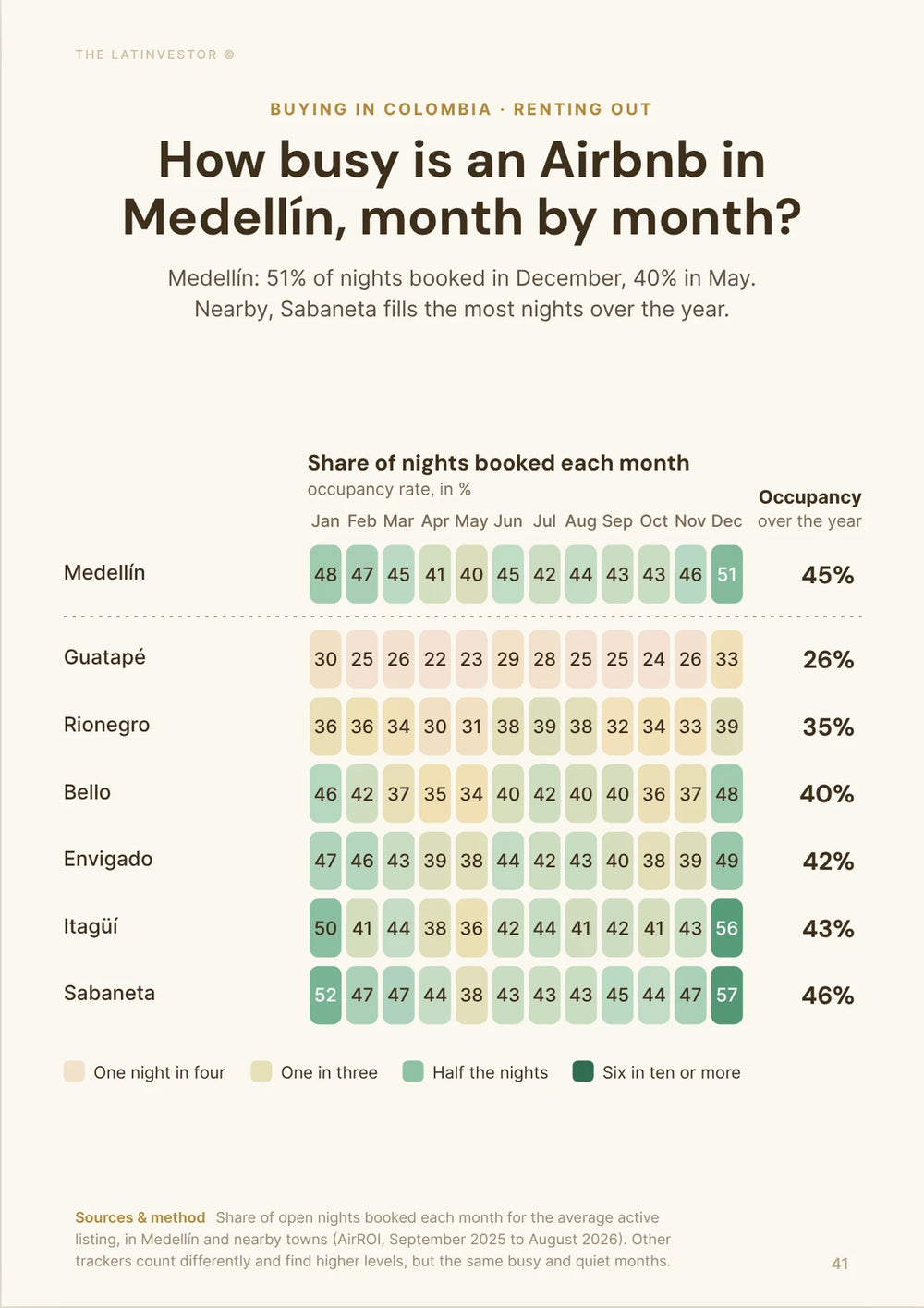
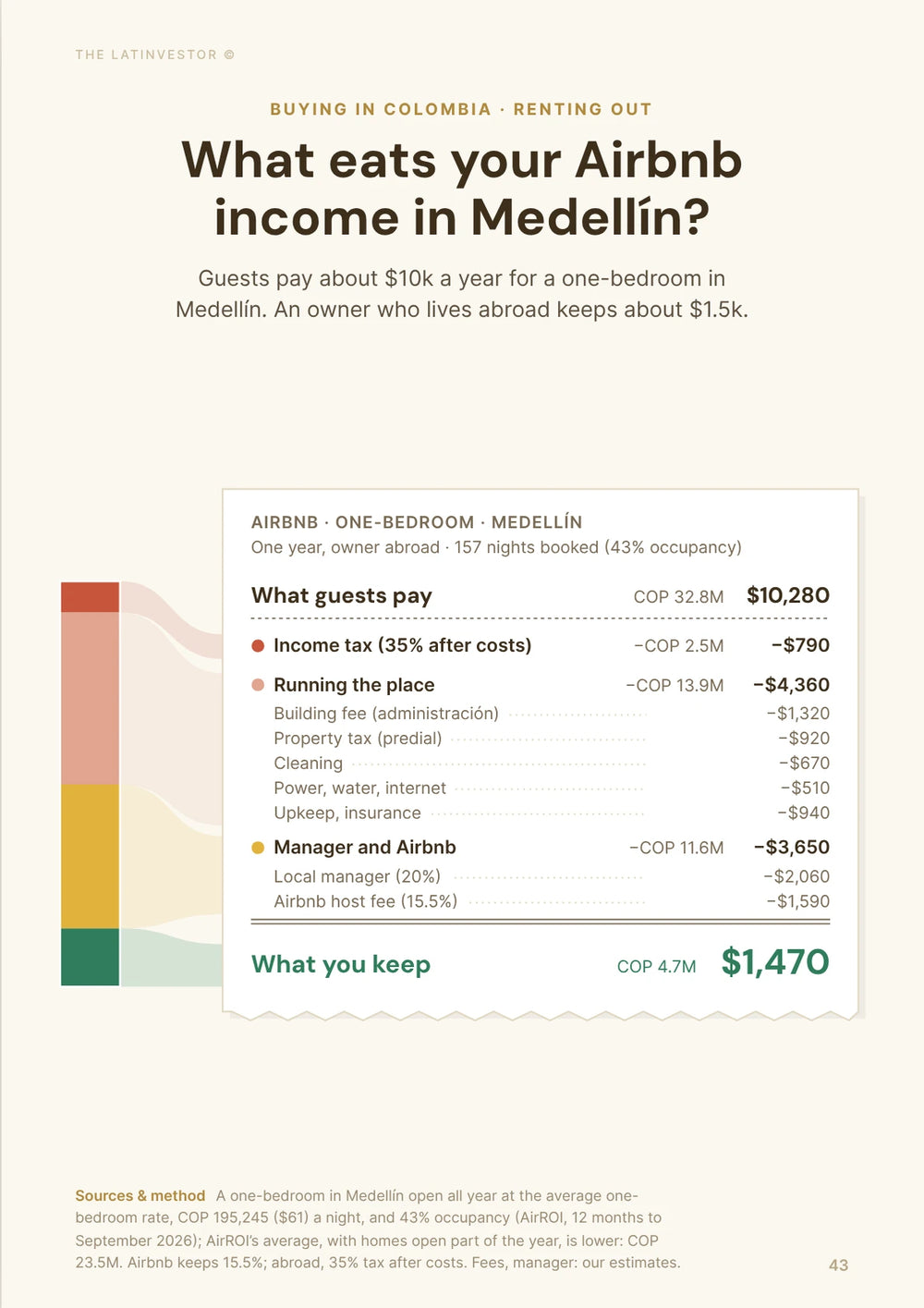
AirDNA's data through September 2026 give Medellín 14,957 active short-term-rental listings, 37.5% fewer than a year earlier. Average occupancy is 63%, and the average daily rate fell 16.4% to $72.
That listing drop needs caution: changes in how AirDNA defines an active listing and removes duplicates can create big swings, so it is not proof that hosts are leaving. But lower nightly rates are a clear signal that hosts compete harder on price.
Average annual revenue per active listing is about $15,500. Market averages hide huge differences between neighborhoods, building rules and professionally managed units.
The city side matters more for buyers. Only 8,322 tourist homes hold an RNT registration in 2026, far fewer than AirDNA's active listings. The Alcaldía carried out 408 tourist-housing inspections between 2024 and September 2026, which led to 105 temporary suspensions, and the POT revision proposed in September 2026 would define where tourist housing is allowed (it is already banned in low-mix residential zones). Fines can reach 2,000 minimum wages.
None of this points to a wave of Airbnb buyers pushing prices up. If anything, an apartment bought for short lets now needs a building that allows it, a zone that allows it and an RNT.
| Medellín short-term rentals | AirDNA, data through Sept 2026 | Year-on-year change |
|---|---|---|
| Active listings | 14,957 | -37.5% |
| Occupancy | 63% | — |
| Average daily rate | $72 | -16.4% |
| Average annual revenue per listing | $15,500 | — |
 70+pages
Are foreign buyers actually driving Medellín real estate?
No. Foreign buyers matter in parts of Medellín, but they are a small slice of the market.
Camacol's buyer census (December 2025) found that foreign non-residents bought 3.28% of new homes sold in Antioquia, against 2.1% nationally. Counting Colombians living abroad too, about 14% of new homes sold in Medellín go to buyers abroad (Camacol via Blu Radio, May 2026). There is no comparable series for resale homes.
What we can measure is the ecosystem around those buyers. José María Córdova Airport handled more than 14 million passengers in 2025, over 4.2 million of them international, and recorded 1,003,756 international arrivals in the first half of 2026, the first half-year above one million.
That large visitor base matters particularly for El Poblado, Laureles and furnished-rental properties. Foreigners can buy without being Colombian residents, so the path from repeated visits to renting and then buying is short.
Citywide sales show why the claim still needs restraint. El Poblado is hugely important, but most new Medellín homes are sold elsewhere.
Foreign demand can push prices higher in specific buildings because a cash buyer earning dollars does not care about a 15% mortgage rate. We see that effect most clearly in premium Medellín, where price growth has separated sharply from the middle market.
Are high interest rates still blocking a bigger Medellín property boom?
Yes, expensive credit is currently one of the biggest things stopping Medellín's housing recovery from turning into a broad boom.
Banco de la República raised its policy rate to 12.25% from 1 October 2026, after a split vote on 30 September. It was 9.25% at the start of 2026, so borrowing costs have climbed 300 basis points in a year. The average peso mortgage rate across 11 major lenders was 15.02% a year in September 2026.
That reversal is important because part of Antioquia's 2025 recovery happened while mortgage conditions were improving. Camacol Antioquia explicitly pointed to lower mortgage rates, local subsidies and accumulated demand from the previous housing downturn as reasons buyers had returned.
That support has gone into reverse. A Colombian household buying with a mortgage feels every rate rise in the monthly payment, even when the apartment itself barely changes price. With inflation expected around 6.8% at the end of 2026, analysts do not see quick cuts.
This is also why Medellín can look contradictory. Cash investors and buyers earning foreign income can keep moving into attractive properties while local households remain sensitive to financing costs. Premium neighborhoods can run hot without pulling the whole city into the same cycle.
Cheaper credit would be the clearest way for this recovery to broaden. Right now, credit is holding it back, and the first-half 2026 sales drop shows it.
Are Medellín developers building enough homes for all this demand?
Developers brought a lot of property back to market in 2025, but construction was much slower to follow, and 2026 sales are now too weak to push it.
During 2025, Antioquia recorded 22,641 newly launched housing units, 23,762 sales and 17,187 housing starts, according to Camacol Antioquia. The gap between what was launched and what actually started construction was roughly 5,450 units.
The earlier acceleration was even more dramatic. In the first nine months of 2025, launches jumped 91.6% year over year to 17,336 units while housing starts fell 12.4% to 12,715.
Developers became much more confident about marketing projects before they became equally aggressive about breaking ground.
Supply on paper is certainly large. Expoinmobiliaria 2026 presented 518 new real-estate projects, the highest total in the event's history, and attracted more than 19,000 visitors. Around 60% of the projects shown were located in the Valle de Aburrá.
The pipeline is still there: Camacol Antioquia expected at least 208 housing projects to start in the department over the next 24 months, including about 7,290 units in Medellín and 7,312 in Bello (El Tiempo, 4 August 2026). With sales down about 17.5% in the first half of 2026, many of those starts will depend on reaching presales targets. If they slip, future supply gets tighter; if they go ahead while demand stays soft, buyers keep the upper hand.
| Antioquia construction indicator | Latest 2025 total |
|---|---|
| New homes sold | 23,762 |
| Housing units launched | 22,641 |
| Housing starts | 17,187 |
| Launches minus starts | 5,454 |
| Projects shown at Expoinmobiliaria 2026 | 518 |
 70+pages
Is Medellín actually running short of housing?
Antioquia has a real underlying housing gap, and that gives Medellín's recovery more staying power than a purely speculative rebound would have.
Camacol Antioquia estimates that roughly 38,000 new households are formed in the department each year. Average annual new-home sales over the previous five years were 24,240 units.
The simple difference is almost 14,000 households per year.
We should not call that a 14,000-home physical shortage. New households can move into existing properties, live with relatives, rent, leave the region or use housing produced outside Camacol's new-build market. But the comparison still shows why demand can reappear quickly after a housing slump.
Camacol also estimates that about 45% of Antioquia households rent. A large pool of renters combined with continuous household formation means potential buyers do not disappear when interest rates rise. Many simply postpone the purchase.
This is one reason Medellín deserves to be watched closely. If mortgage conditions eventually improve before construction catches up, several years of delayed demand could return much faster than developers can add finished homes.
Does Medellín property today look like the 2021 boom?
Medellín is still well short of the kind of housing cycle Antioquia experienced around 2021.
Antioquia sold 31,204 new homes in 2021. The 2025 total was 23,762, leaving a gap of about 7,400 transactions.
Financing is also far less friendly. The 12.25% policy rate and mortgages around 15% are a different world from the cheap money of 2021.
Prices give another difference. New-home prices are up 9.14% in a year, but that is only about 2 points above local inflation, and middle-income new homes in the city are actually cheaper than a year ago (-1.92%).
So when people say Medellín "feels like 2021 again," the comparison works better for sentiment than for the actual numbers. Sales have recovered sharply and investors are interested again, yet the volume, credit and broad real price growth needed to repeat that cycle have not lined up.
Could the latest housing slowdown stop Medellín's boom before it starts?
It already has, for now. The 2026 data show Medellín losing momentum faster than the country.
Nationally, Camacol counted 118,844 new homes sold between January and September 2026, down 11.9% on a year earlier. Launches fell 18.1% and housing starts 11.2%.
Around Medellín the drop is sharper. New-home sales in the Medellín area fell to 8,596 in the first half of 2026 from 10,054 a year earlier, down about 15% (El Colombiano, 25 August 2026), and Camacol Antioquia's count for the whole department fell about 17.5%.
So the "second acceleration" a boom would need has not come. The market went from a 2025 rebound to a 2026 pullback, with higher rates and a weak national cycle on top.
| New-home sales | 2026 | Change vs 2025 |
|---|---|---|
| Medellín area, first half | 8,596 | -15% |
| Antioquia, first half | 8,551 | -17.5% |
| Colombia, January to September | 118,844 | -11.9% |
 70+pages
Is the strong peso making Medellín more expensive for dollar buyers?
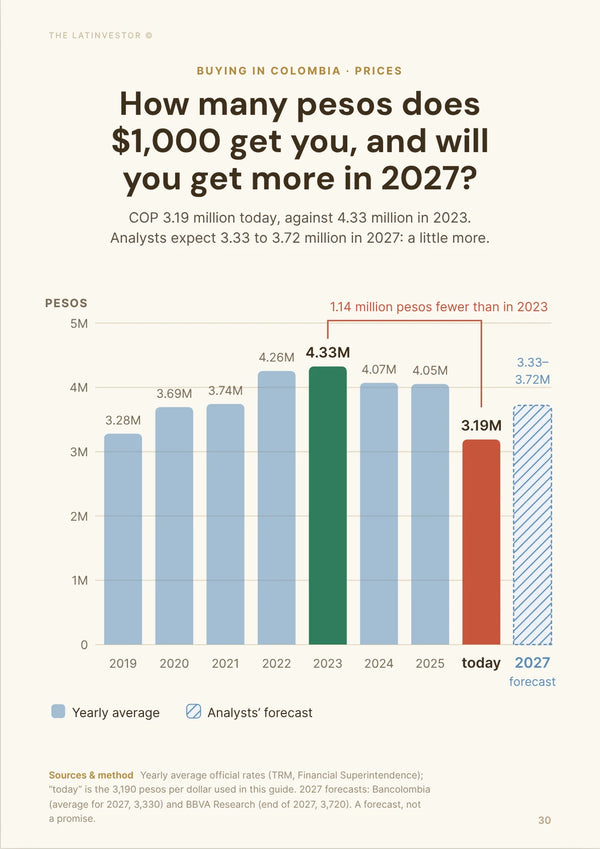
Yes, and by more than local prices. The dollar closed 2025 at about COP 3,757 and was worth about COP 3,190 on 22 October 2026, so each dollar buys about 15% fewer pesos.
Take the average used apartment at COP 871 million. At the end-2025 rate it cost about $232,000; today it costs about $273,000. That is roughly 18% more in dollars with zero change in the peso price, before any rise in peso prices (new homes: +9.14% in a year).
Do not buy on the hope that the peso falls back soon. Forecasts disagree: BBVA expected about COP 3,640 at the end of 2026 (June 2026), Bancolombia about COP 3,420 on average for the year. If you are buying anyway, negotiate in pesos, compare offers in pesos, and consider moving your money in several transfers instead of one.
What price should you aim for if you buy in Medellín now?
With sales down and buyers scarcer, resale homes give you the most room, and the gap with new builds is huge.
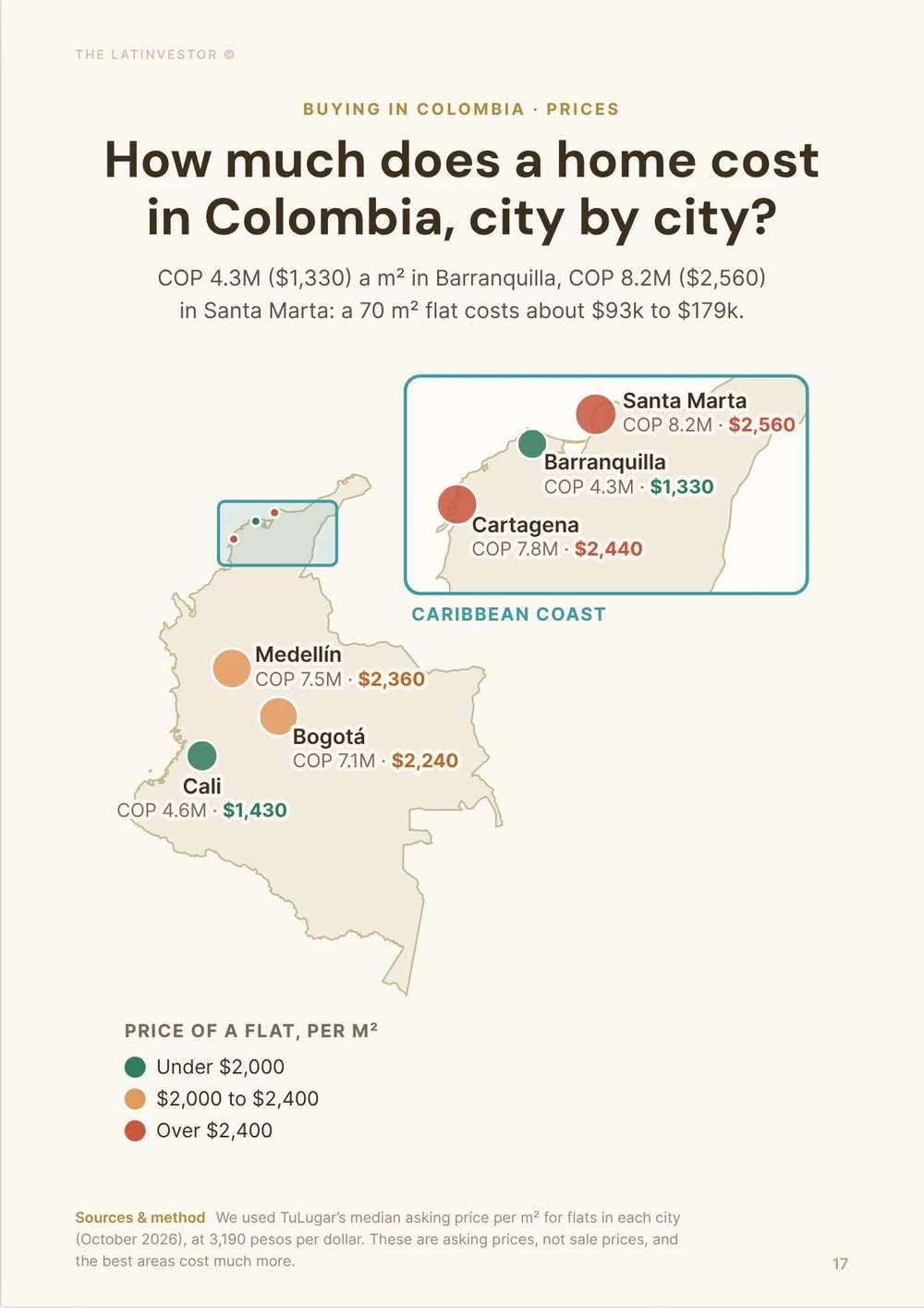
Resale medians (PropFound, October 2026) are about COP 8.7 million per m² in El Poblado (about $2,750), COP 8.2 million in Envigado, about COP 7.5 million in Belén and COP 6.7 million in Laureles (about $2,100). New builds cost far more: Zonario's 118 Medellín projects average COP 11.93 million per m² (about $3,750), with El Poblado at COP 13.85 million and Laureles at COP 15.28 million.
Price your offer against these medians, not against the developer's brochure. Check how long the flat has been listed and the building's administración fee, which rose 17.14% nationally in the year to September 2026. Ask for the building's structural paperwork too: the August 2026 earthquake caused no major building damage in Medellín, but a recent technical report on the structure is a fair thing to ask for in any older tower.
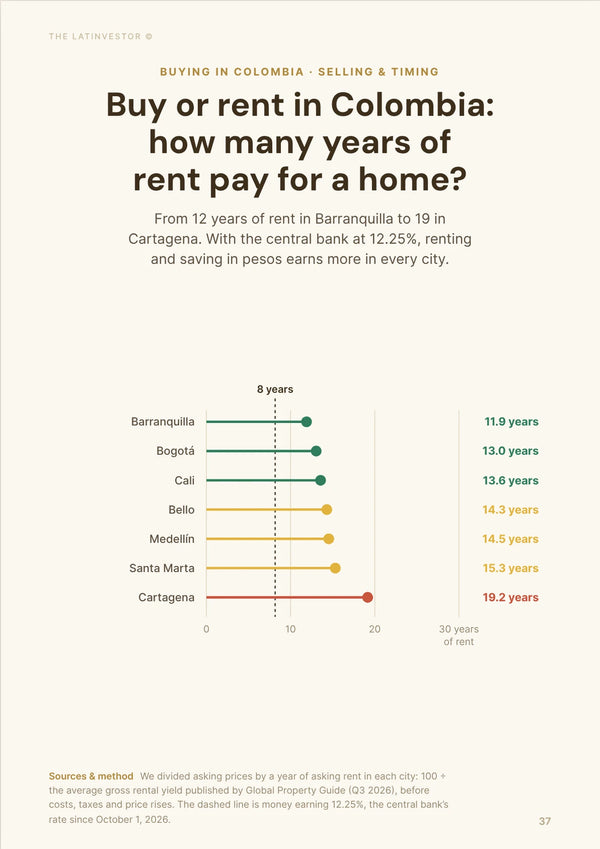
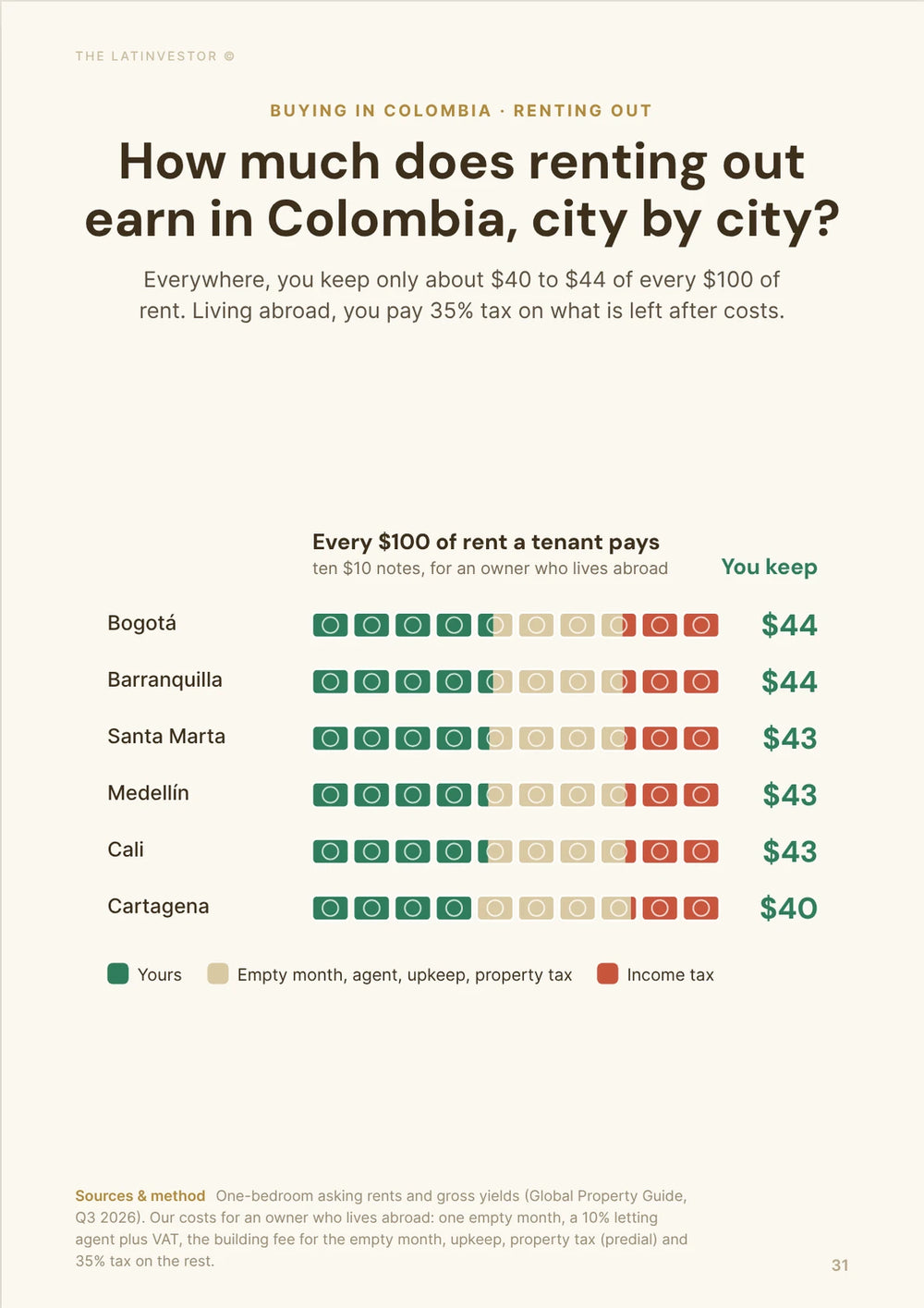
Keep yield expectations modest. Global Property Guide puts Medellín's gross long-term rental yield at 6.88% (Q3 2026); after building fees, property tax, vacancy, management and the 35% tax on a non-resident's rental income, that is roughly 3% net.
| Area | Resale, COP per m² | New build, COP per m² |
|---|---|---|
| El Poblado | 8.7 million | 13.85 million |
| Laureles | 6.7 million | 15.28 million |
| Envigado | 8.2 million | — |
| Belén | about 7.5 million | — |
| Medellín average | 6.47 million (used apartments, advertised) | 11.93 million |
So is Medellín entering another property boom?
No. Medellín had a strong recovery in 2025 that produced a mini-boom in parts of the premium market, but 2026 sales have fallen back.
The case for a boom has real substance. Medellín new-home sales jumped 56% in 2025, several neighborhoods saw heavy transaction activity, new-home prices are up 9.14% in a year, rents are up 8.7%, international arrivals passed one million in the first half of 2026 and household formation keeps creating demand.
But once we move beyond the headline sales rebound, the picture cools quickly.
Medellín's 2025 recovery began from an exceptionally low base. Antioquia's annual sales are still roughly one-quarter below its strongest historical years. Real price growth is only about 2 points a year, and middle-income new homes got cheaper. Mortgages cost about 15%. Sales in the Medellín area fell about 15% in the first half of 2026. And for dollar buyers, the strong peso added roughly 18% to the price this year.
El Poblado and some other premium or investment-oriented properties are already behaving differently. Buyers with cash or foreign income face fewer financing constraints, rental economics remain attractive in the best locations, and high-end prices have clearly separated from the rest of Medellín.
The broader city has not crossed that line.
Our answer is "not now." A real boom would need sales growing again without the low-base effect, price growth well above inflation and cheaper mortgages. None of those is happening in late 2026.
For a buyer, that is not bad news. A slower market with unsold stock gives cash buyers room to negotiate, especially on resale flats outside the premium towers. Just do the maths in pesos, aim near the resale medians, and don't count on a quick price run or a weaker peso to bail you out.
Our methodology
This article tests whether Medellín is entering another property boom by checking whether the things that move together in a real boom are moving together now: sales volumes, prices, credit, rents, investor demand and new supply.
We did not take the 56% rise in Medellín new-home sales in 2025 at face value. We set it against Antioquia's sales history since 2011 (Camacol Antioquia) and against the first-half 2026 figures for the Medellín area and the department, plus Camacol's national tables to September 2026. Where possible we kept Medellín city, the Valle de Aburrá and Antioquia apart, because they moved at different speeds.
Prices come from DANE's new-housing price index (Q2 2026, compared with Q1 2026), by metro area and by income segment for the city, compared with DANE's September 2026 consumer price index. Price levels come from the Ciencuadras–El Libertador review (via El Colombiano, 25 August 2026), PropFound resale medians and Zonario new-build data (October 2026). Rents come from La Lonja's 2025 balance and 2026 survey and the Ciencuadras–El Libertador review.
Credit uses Banco de la República's policy decisions and Superfinanciera-based mortgage averages (September 2026). Short-term rentals use AirDNA data through September 2026 and the Alcaldía's inspection, RNT and POT announcements (September and October 2026). Foreign demand uses Camacol's buyer censuses and airport figures from the Alcaldía.
We checked these figures in October 2026. Dollar amounts use about COP 3,190 per US dollar (official TRM of 22 October 2026); the start-of-year comparison uses the end-2025 rate of about COP 3,757.
Limits: DANE's index covers new homes only; portal figures are asking prices, not closing prices; the Medellín-area and Antioquia sales series use different geographies; and there is no buyer-nationality series for resale homes.
Key sources used for this analysis include: La Lonja's 2025 real-estate market balance, La Lonja's 2026 Real Estate Opinion Survey, Camacol Antioquia's 2025 Management Report, El Colombiano on Antioquia's 2025 sales, launches and starts, Camacol Antioquia on Expoinmobiliaria 2026, El Tiempo on Antioquia's first-half 2026 sales and project pipeline, El Colombiano on the 2026 Ciencuadras–El Libertador review, Camacol's tables to September 2026, DANE's Q2 2026 New Housing Price Index, DANE's September 2026 CPI, Banco de la República, ZumoCash mortgage rate tracker, the official TRM of 22 October 2026, PropFound's Medellín market data, Zonario's Medellín new-build data, Global Property Guide on Colombian rental yields, AirDNA's Medellín market data, the Alcaldía on tourist-housing inspections and RNT, the city's tourist-housing Q&A, the Alcaldía on first-half 2026 tourism, Blu Radio on buyers from abroad and El Colombiano on the August 2026 earthquake.