Summary
Is Medellín a good place to live as an expat? Yes, for most people earning abroad, though it is now a quality-of-life choice more than a bargain. More than two million Colombians abroad and foreigners arrived through its airport in 2025.
Americans lead the foreign boom: 310,517 U.S. visitors in 2025, and 194,488 again in the first half of 2026.
It is no longer cheap by Colombian standards. A central one-bedroom rents for about COP3.3 million ($1,050) a month, and the median El Poblado one-bedroom asks about COP4.35 million.
The peso gained roughly 19% against the dollar in 2026, so a dollar now buys about 3,175 pesos and stretches less far than in 2025.
Security is improving: 39 homicides by the end of February 2026, 13% fewer than a year earlier. But theft remains common, with 24,839 thefts from people in 2025.
Foreign men using dating apps face a riskier city: scopolamine-related thefts reached 566 by mid-October 2026, against 299 in all of 2025.
The weather deserves its reputation, with average temperatures around 21°C to 22.5°C, but it rains a lot: around 221 mm in October.
Air pollution is a real downside: during bad episodes, daily PM2.5 averages at some stations reach 40 to 60 µg/m³.
You do not need a car: the Metro carried 310.2 million trips in 2025 on a network of about 85 kilometers.
Remote workers get cheap broadband, about COP91,000 a month, and North American working hours on UTC-5.
Some English is available, with an EF score of 516, ahead of Bogotá’s 513, but long-term life needs Spanish.
Healthcare is strong: Hospital Pablo Tobón Uribe ranks 17th in Latin America in the 2026 IntelLat ranking, though insurance paperwork can be slow.
Families pay much more: private preschool costs about COP2.5 million a month and a central three-bedroom about COP6 million.
Tourism is concentrated, not citywide: Carrera 70 drew about 1.29 million visits in 2025, and five areas hold around 80% of short-term rentals. Visas are easy, but more than 183 days a year can make you tax resident.
Bottom line: Medellín remains one of the strongest expat bases in Latin America for people earning abroad, as long as they accept its trade-offs. One person spends about COP5.9 million a month, rent included, by Expatistan’s estimate.

Why are so many expats still moving to Medellín?
Medellín is still attracting foreigners at a remarkable rate, and the latest data show that its international boom has not run out of steam.
Medellín received more than two million arrivals by Colombians and foreigners living abroad through José María Córdova airport in 2025, according to Migración Colombia data published by the city. During the first three months of the following year alone, another 509,886 passengers arrived through the same airport.
The longer-term change is even bigger. Passenger entries through the airport's immigration point increased 234.9% between 2014 and 2024. Back in 2014, foreign visitors and Colombians living overseas accounted for 36% of those arrivals. By 2024, they represented 58.7%.
Americans have played an outsized role in that change. Medellín's tourism-intelligence system counted 310,517 visitors from the United States in 2025, making the U.S. the city's largest individual foreign market. Panama, the Dominican Republic, Mexico, Peru and Spain followed. In the first half of 2026, the U.S. again led by far, with 194,488 visitors, ahead of Mexico (40,045) and Costa Rica (37,980).
The economic footprint has become too large to dismiss as a digital-nomad niche. Medellín's tourism-intelligence system estimates that tourism generated around COP9 trillion of spending in 2025 once card transactions outside the processor's own network are extrapolated. International visitors accounted for almost half of the directly measured card spending.
That scale now supports a large ecosystem of coworking spaces, furnished apartments, international restaurants, English-speaking services and foreign social groups. It also helps explain why housing pressure and tourism backlash have become much more visible.
Is Medellín still cheap for expats, or have El Poblado and Laureles become too expensive?
Medellín can still feel cheap on a strong dollar or euro income, but the famous bargain version of Medellín has largely disappeared from El Poblado and Laureles.
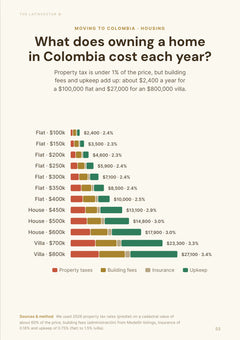
Numbeo’s October 2026 data put a one-bedroom apartment at roughly COP3.3 million (about $1,050) a month in central areas and COP2 million (about $630) outside them. An 85 m² apartment carries around COP540,000 (about $170) in basic monthly utilities, while broadband internet is close to COP91,000 (about $29).
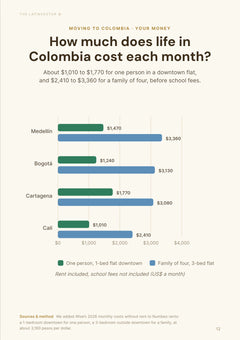
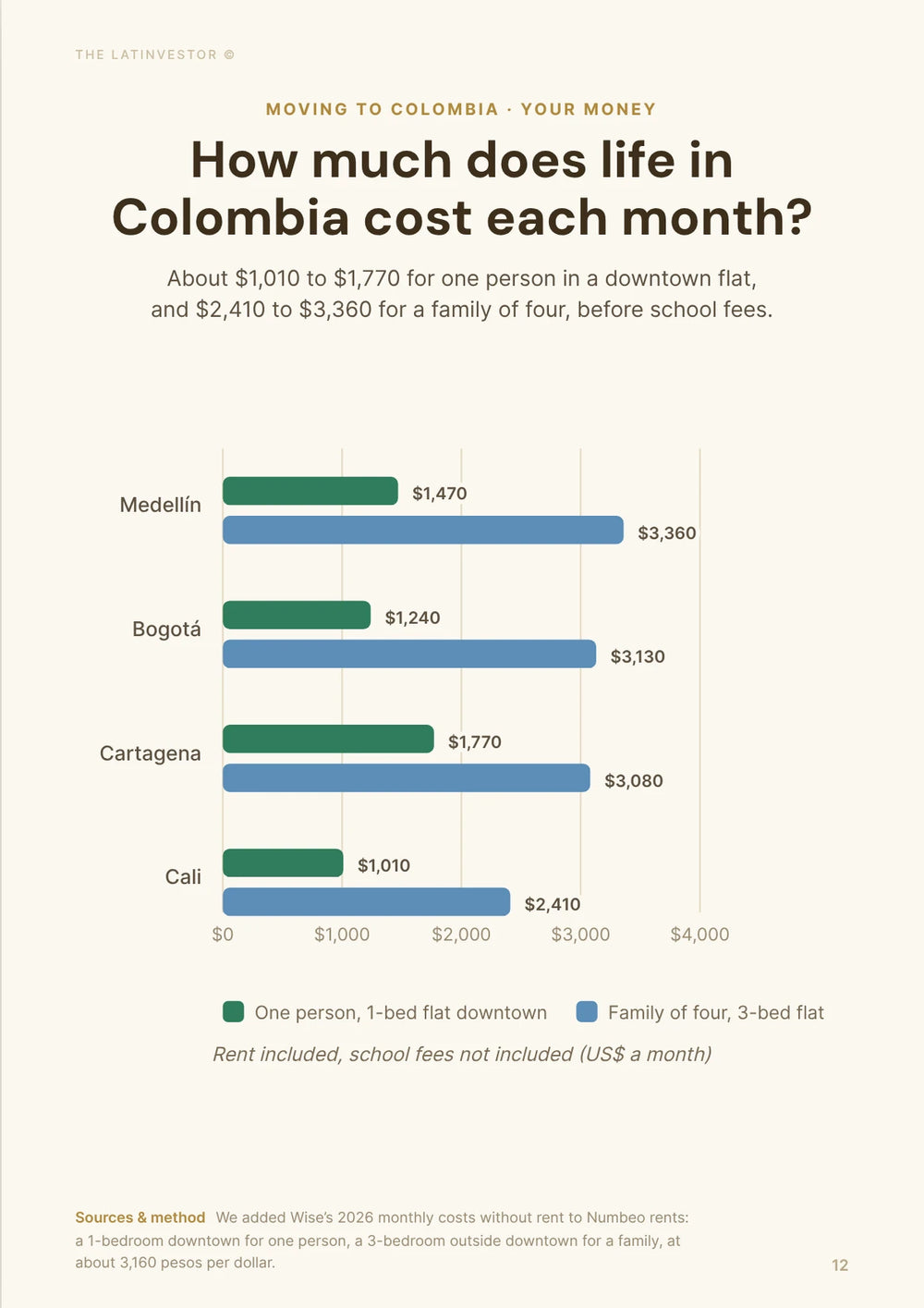
Recent independent comparisons tell the same story from another angle. Geomaxxing's latest dataset estimated basic monthly living costs for one person in Medellín—rent outside the center, bills, food and transport—at around US$1,178. Across the 11 Colombian cities in its comparison, the median was US$964. Expatistan’s October 2026 estimate, rent included, is about COP5.9 million (about $1,850) a month for one person, now slightly above Bogotá’s COP5.3 million.
Housing creates most of that gap. The same dataset put a one-bedroom apartment outside central Medellín around one-third above the 11-city Colombian median.
The pressure becomes even clearer in the neighborhoods foreigners actually target. Medellín's real-estate observatory says El Poblado, Laureles, Belén, La Candelaria and Santa Elena contain roughly 80% of the city's short-term-rental supply. These are also some of the places most frequently considered by foreigners looking for somewhere to live.
Local tenants are therefore competing with visitors paying nightly or monthly furnished rates. The issue has become serious enough for Medellín to tighten enforcement in El Poblado after complaints from residential buildings about apartments being used as short-term accommodation. Officials are now cross-checking information with Migración Colombia to identify potentially non-compliant stays of less than 30 days.
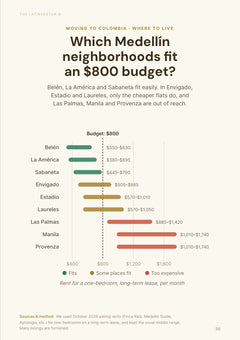
Laureles has followed a similar path. It remains generally calmer, flatter and more traditionally residential than the tourist core of El Poblado, but foreign demand is hardly hidden there anymore. In October 2026 listings, the median one-bedroom asked about COP2.6 million (about $820) a month in Laureles and COP4.35 million (about $1,370) in El Poblado.
Someone earning US$4,000 or US$5,000 remotely can still live very comfortably in Medellín. The city simply looks much less cheap when we compare it with the rest of Colombia rather than with New York, Miami, London or Paris.
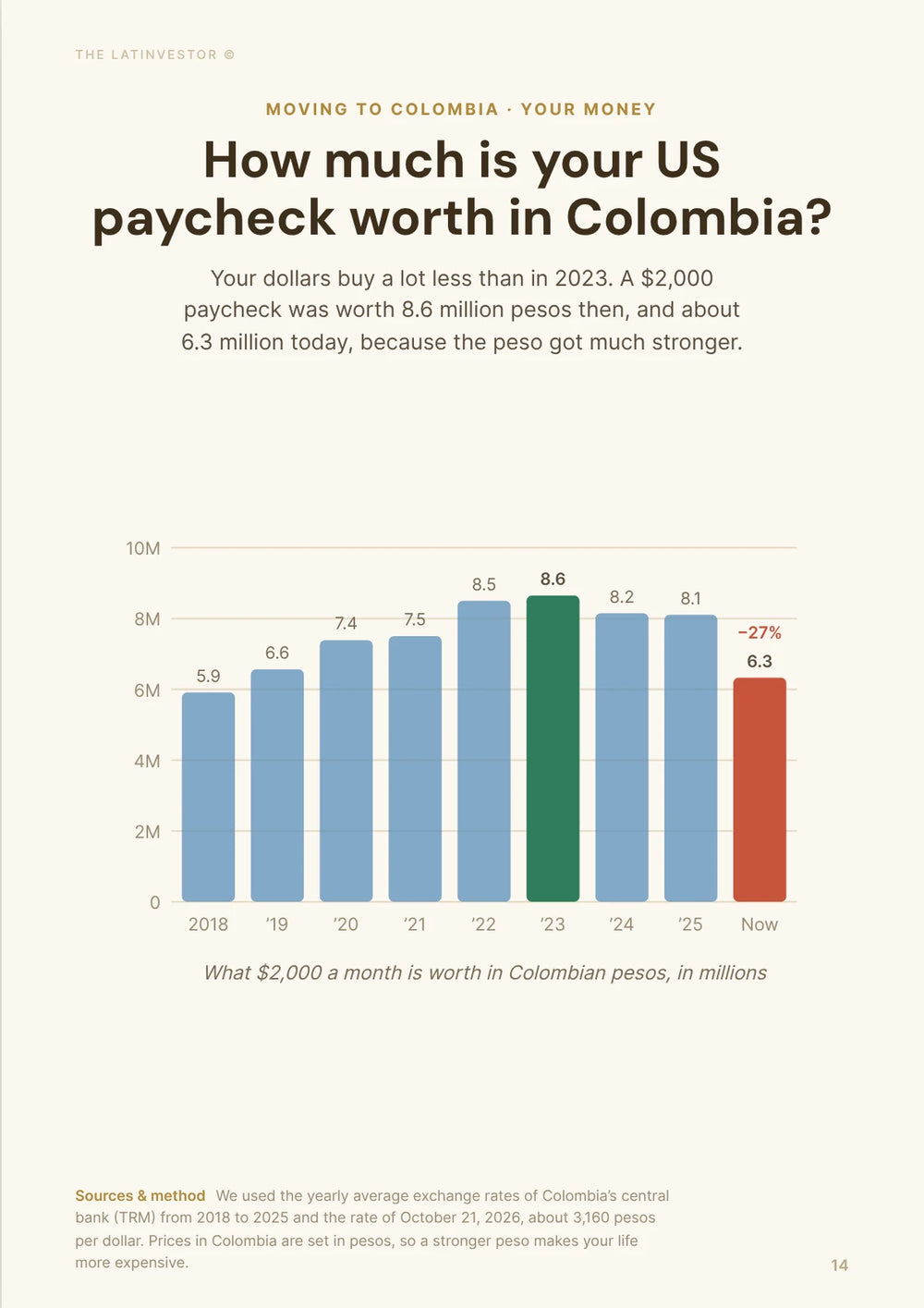
The strong peso adds to that. It gained roughly 19% against the dollar in 2026 up to September, and a dollar now buys about 3,175 pesos (October 2026), so a dollar income stretches less far than it did in 2025.
| Typical Medellín expense | Current benchmark | What it means |
|---|---|---|
| 1-bedroom apartment, central area | ~COP3.3m/month | Affordable on a strong foreign salary, expensive locally |
| 1-bedroom apartment, outside centre | ~COP2.0m/month | Cheaper, but still high by Colombian-city standards |
| Basic utilities, 85 m² | ~COP540k/month | Still relatively inexpensive |
| Broadband internet | ~COP91k/month | Very manageable for remote workers |
| Private preschool | ~COP2.5m/month | Family costs rise quickly |
| International primary school | ~COP28.6m/year | A major expense for expat families |
Is Medellín safe enough for expats right now?
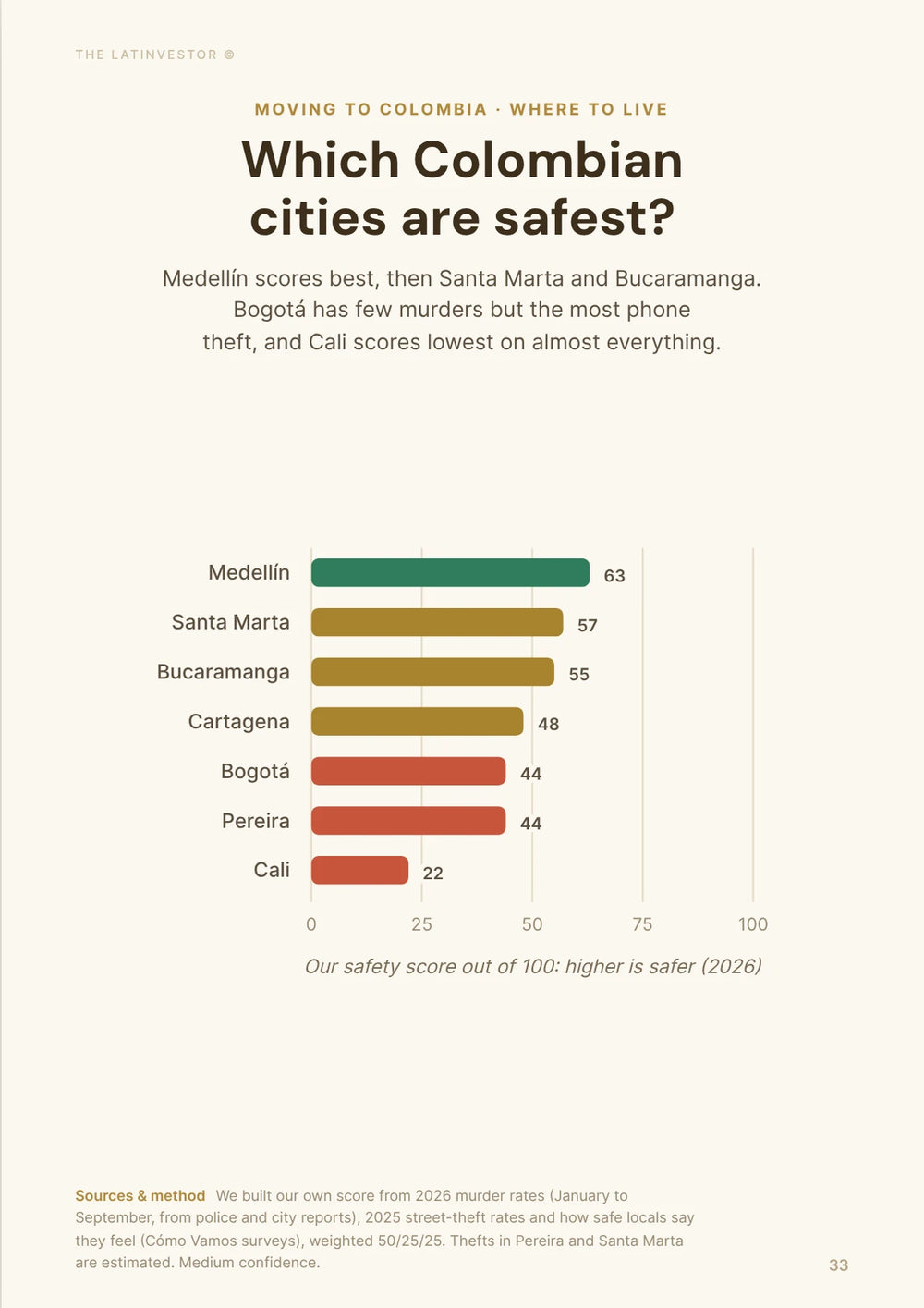
Medellín is currently safe enough for many expats to build a normal life, but personal security still changes how people behave there.
Recent homicide data are genuinely encouraging. Medellín recorded only 11 homicides during February 2026, its lowest February figure in around half a century. By the end of that month, the city had recorded 39 homicides for the year, 13% fewer than during the comparable period a year earlier. The projected homicide rate was around 10 per 100,000 residents.
Other recent interventions have also coincided with lower theft in some parts of the city. In central Medellín, for example, authorities reported a 25% year-on-year reduction in theft from people during the early part of 2026.
But annual data from 2025 show why we would not translate that improvement into “Medellín is now a low-risk city.” Police recorded 24,839 thefts from people during the year and 347 homicides. Several theft categories improved substantially, including robbery, motorcycle theft, car theft and commercial theft, while reported scopolamine-related thefts moved in the opposite direction.
Medellín has clearly improved, including in several recent indicators. Street theft, opportunistic crime and targeted situations involving foreigners still deserve more attention than they would in a genuinely low-crime destination.
| Medellín crime indicator | 2024 | 2025 | Change |
|---|---|---|---|
| Homicides | 329 | 347 | +5% |
| Theft from people | 25,152 | 24,839 | -1% |
| Robberies | 9,957 | 8,425 | -15% |
| Motorcycle theft | 6,516 | 4,940 | -24% |
| Car theft | 1,102 | 823 | -25% |
| Residential theft | 1,633 | 1,444 | -12% |
| Commercial theft | 2,621 | 1,374 | -48% |
Is Medellín more dangerous for foreign men using dating apps?
Foreign men who combine Medellín's nightlife with dating apps face a much higher-risk version of the city than the average expat does.
This is one of the few lifestyle differences that can completely change someone's experience of Medellín.
The U.S. Embassy has repeatedly warned travelers about criminals using dating applications to arrange meetings before robbing, drugging or kidnapping victims. The warning became particularly prominent after a cluster of deaths involving Americans forced much greater attention onto crimes targeting foreigners.
The local data give us another reason to keep taking that risk seriously. Medellín’s security information system counted 299 scopolamine-related thefts in 2025 and already 566 by mid-October 2026, according to El Espectador. Counts differ from one source to another, but the direction is clearly up, while many conventional theft categories were falling.
Scopolamine cases and dating-app crimes are not interchangeable datasets, and many victims are Colombian. Still, drug-assisted theft has clearly not vanished just because broader security indicators have improved.
Recent police activity also shows that opportunistic theft remains active in areas foreigners use. Authorities dismantled a cellphone-theft group after an eight-month investigation and said its members targeted passengers around Metro stations including Poblado, San Antonio, Parque Berrío, Prado and La Candelaria.
An expat with a fairly ordinary daytime routine can therefore experience Medellín very differently from someone repeatedly meeting strangers late at night.
Is Medellín's weather really that good?
Medellín's weather deserves most of its reputation: temperatures stay remarkably comfortable throughout the year, although the city is considerably wetter than the phrase “eternal spring” suggests.
Historical IDEAM measurements at Medellín's Olaya Herrera station show average temperatures generally sitting between roughly 21°C and 22.5°C across the year. Average daytime highs tend to stay around 27°C to 28°C, with nighttime lows around 16.5°C to 17.5°C.
For everyday life, that is difficult to beat. There is no cold winter to endure, while prolonged periods above 35°C are also unusual.
Rain is the part people underestimate. Historical IDEAM observations show around 12 rainy days in the driest part of the year, while the wetter periods can bring rain on more than 20 days in a month. October has historically averaged around 221 mm of precipitation.
Tropical showers frequently arrive hard and then clear, but umbrellas and sudden downpours are part of normal life. Even with that caveat, climate remains one of Medellín's strongest everyday advantages.
| Medellín climate measure | Typical pattern |
|---|---|
| Average temperature | ~21–22.5°C |
| Average daytime high | ~27–28°C |
| Average nighttime low | ~16.5–17.5°C |
| Rainy days in a relatively dry month | ~12 |
| Rainy days in wetter months | 20+ |
| Historical October rainfall | ~221 mm |
Is Medellín's air pollution bad enough to affect daily life?
Medellín's air pollution is a real downside, especially for runners, cyclists and people with respiratory sensitivities.
The city's location in the Aburrá Valley gives Medellín its spectacular mountain backdrop, but the surrounding terrain also makes it harder for pollutants to disperse.
SIATA operates an extensive air-monitoring network across Medellín and the wider valley, with multiple stations tracking PM2.5 and other pollutants continuously. Current monitoring confirms that air quality can vary substantially from one place and period to another rather than staying uniformly bad.
The recurring problem comes during atmospheric conditions that trap pollution in the valley. Previous monitoring episodes have pushed daily PM2.5 averages at some stations from normal readings in the teens or twenties into the 40–60 µg/m³ range, with individual daily observations climbing beyond 100 µg/m³.
For most healthy expats, air quality is unlikely to outweigh Medellín's other advantages. For people with asthma, cardiovascular concerns or a heavy outdoor-sports routine, it deserves real weight in the decision.
Can you live in Medellín without owning a car?
Medellín is one of the easiest large Colombian cities for an expat to live in without a car, as long as the apartment is chosen around actual daily journeys.
The Metro system carried 310.2 million passenger trips in 2025, up from 308.3 million the previous year. Its network stretches for roughly 85 kilometers and combines two rail lines, six Metrocable lines, a tram and three BRT corridors.
Those numbers make the system much more than a tourist convenience. According to Metro de Medellín's latest sustainability report, passengers collectively saved an estimated 151 million hours of travel during 2025.
That advantage becomes especially visible once Medellín's geography is understood. The city stretches along a narrow valley and climbs steeply toward the surrounding mountains. Two addresses that look close on Google Maps can produce very different daily journeys.
El Poblado is the classic example. Parts of the neighborhood offer beautiful views and expensive apartments but require steep walks or frequent cars. A less glamorous apartment close to a Metro station can be dramatically easier to live in.
The Metro de la 80, a new light-rail line under construction along Avenida 80 in western Medellín, should add another option, but its works are disrupting traffic there in 2026.
Ride-hailing fills many of the gaps, and fares remain inexpensive for people earning in stronger foreign currencies.
For most newcomers, buying a car adds traffic, parking and administrative friction without solving enough problems to justify it.
| Metro de Medellín indicator | Latest reported figure |
|---|---|
| Passenger trips in 2025 | 310.2m |
| Passenger trips in 2024 | 308.3m |
| Integrated network | ~85 km |
| Rail lines | 2 |
| Metrocable lines | 6 |
| User travel time saved in 2025 | 151m hours |
Is Medellín still one of the best cities for remote workers?
Medellín remains an unusually strong city for remote workers because cheap connectivity, North American working hours and a mature coworking scene still work together.
Home internet is one of the easy wins. Numbeo’s October 2026 crowd-sourced pricing puts an unlimited broadband connection of at least 60 Mbps around COP91,000 (about $29) a month.
The timezone is arguably more valuable. Colombia operates on UTC-5 throughout the year. Someone working with New York, Miami, Toronto or other North American teams can keep normal office hours rather than restructuring an entire day around calls.
Medellín also has something many cheaper cities lack: the remote-work ecosystem has existed long enough to become ordinary. Coworking spaces, furnished monthly apartments, cafés designed for laptop workers and professional communities are easy to find.
The main trap is staying entirely inside that ecosystem. Medellín makes it very easy to work for an American company, socialize mostly with foreigners and spend surprisingly little time engaging with Colombia itself.
Can you live in Medellín without speaking Spanish?
An expat can get established in Medellín with weak Spanish, but staying for years without learning the language cuts off a huge part of the city.
Medellín performs relatively well within Colombia on English proficiency. EF's latest major city comparison gave Medellín a score of 516, slightly ahead of Bogotá at 513, while Colombia as a whole scored 480.
That still leaves a large gap between “some English is available” and “daily life works in English.”
Poblado hotels, coworking spaces, international restaurants and private clinics accustomed to foreigners may have English-speaking staff. Building administrators, landlords, tradespeople, drivers, government employees and ordinary neighborhood shops frequently will not.
The social effect is even bigger. English naturally pushes newcomers toward Colombians who already have international connections and toward other foreigners.
No one needs fluent Spanish before arriving. For anyone staying long term, basic conversational Spanish quickly becomes one of the most useful skills they can develop.
Is healthcare in Medellín good enough for expats?
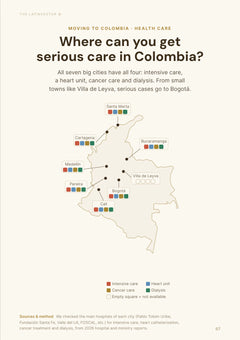
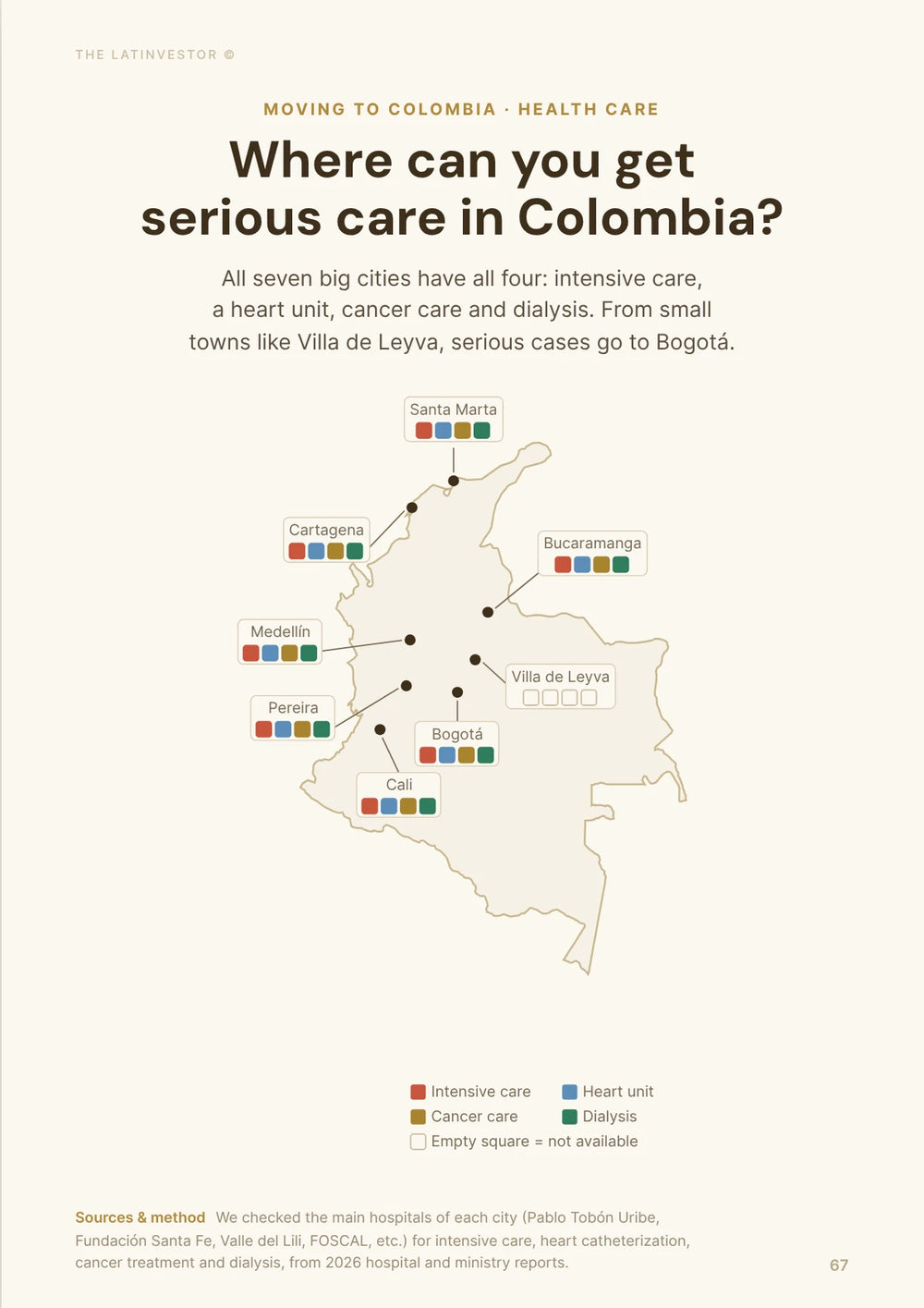
Medellín has good enough healthcare for long-term expat life, including several hospitals that rank among the stronger medical institutions in Latin America.
Hospital Pablo Tobón Uribe placed 17th in IntelLat's 2026 ranking of Latin American hospitals, published in September 2026. Hospital San Vicente Fundación ranked 24th, while Clínica Las Américas AUNA was 34th.
Having three Medellín institutions inside the regional top 35 is a much stronger indication than simply saying Colombia has inexpensive private doctors.
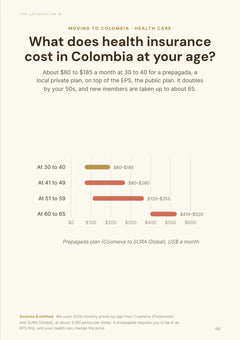
The country's healthcare system itself is more complicated. Colombian residents use the EPS insurance system, with healthcare delivered through networks of providers, while many foreigners add private insurance or supplementary plans.
Hospital quality is the easy part; bureaucracy is where the frustration usually starts. Medellín can offer excellent specialists, sophisticated hospitals and relatively accessible private care, while authorizations and insurer networks still slow people down.
Expats paying privately also experience a different system from lower-income Colombians depending entirely on public coverage, so broad claims about Colombian healthcare can hide very different experiences.
For someone choosing a long-term base, the useful question is whether Medellín can handle a serious medical problem without requiring a flight to Miami or another capital.
In most common scenarios, the answer is comfortably yes.
Is Medellín a good city for expat families?
Medellín can be a very good family base, but international schooling and larger housing quickly erase much of the city's low-cost appeal.
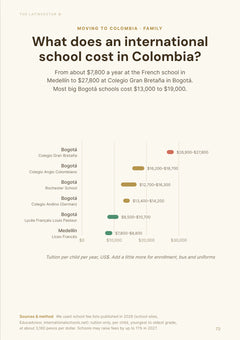
Numbeo’s October 2026 data put private full-day preschool around COP2.5 million (about $790) per child each month. Reported international-primary-school tuition averages about COP28.6 million (about $9,000) a year, with individual schools varying considerably around that figure: The Columbus School in Envigado starts at about COP39.1 million a year for 2026-2027.
Housing also changes once a family needs three bedrooms. Numbeo’s October 2026 citywide estimates put a three-bedroom apartment around COP6 million (about $1,880) monthly in central areas and approximately COP3.2 million (about $1,010) outside them.
Add private healthcare, transport, extracurricular activities and travel, and a foreign family can easily spend several times what a single remote worker does.
Families also face a different version of the safety question. School location, traffic, walkability, playgrounds, air quality and commuting time become much more important than nightlife-related risks.
That often pushes parents toward Envigado, quieter parts of El Poblado, Belén or other residential areas.
Has mass tourism changed Medellín too much for expats?
Tourism has clearly changed parts of Medellín, but most of the city still feels overwhelmingly Colombian once we leave a handful of internationally saturated neighborhoods.
Carrera 70 gives us a good idea of the scale tourism has reached. Medellín's tourism-intelligence system counted roughly 1.29 million visits to that corridor during 2025, with visitors from 64 countries and an estimated average flow of 6,852 people a day.
El Poblado offers an even more obvious version of that internationalization. Provenza and the streets around Parque Lleras now contain restaurants, accommodation and nightlife aimed heavily at outsiders.
The pressure extends into the housing market. As seen above, five areas account for around 80% of Medellín's short-term-rental inventory, and the city has intensified enforcement after complaints about residential apartments being repeatedly converted into tourist accommodation.
That concentration creates two very different Medellíns. A newcomer staying in Manila or Provenza can feel surrounded by Americans and Europeans, while a resident living elsewhere can spend most of a week hearing almost no English.
Local frustration also deserves a more careful reading than “Medellín hates expats.” The strongest public criticism tends to focus on housing pressure, disruptive short-term rentals, sex tourism, drugs and foreigners behaving as though local rules do not apply to them.
Medellín has responded by increasing rental inspections and creating a 2026–2030 tourism-security plan. During major events, the city has even expanded cooperation with the FBI, Homeland Security Investigations, U.S. Marshals, Interpol and Colombian authorities to screen higher-risk visitors and tackle tourism-related crime.
For a foreigner planning to settle rather than party through a short stay, that distinction is important. The backlash is aimed far more at the effects of certain kinds of tourism than at foreign residents as a group.
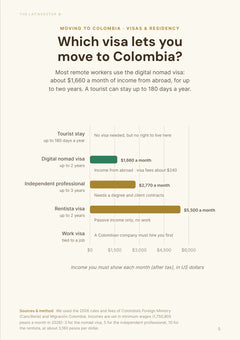
Are Medellín's visa and tax rules easy for expats?
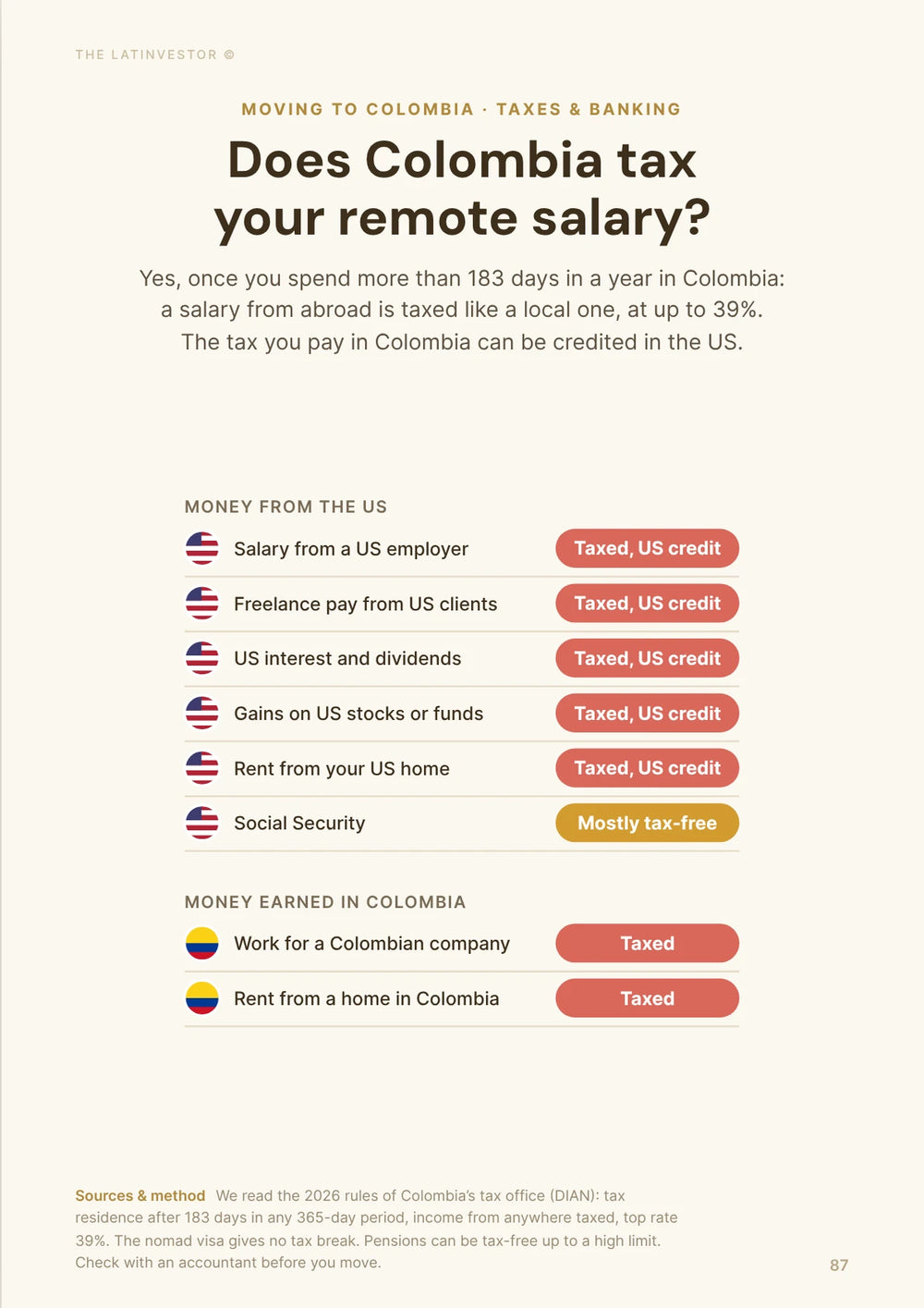
Colombia makes it fairly easy for remote workers to stay in Medellín, but anyone living there for most of the year needs to think seriously about tax residency.
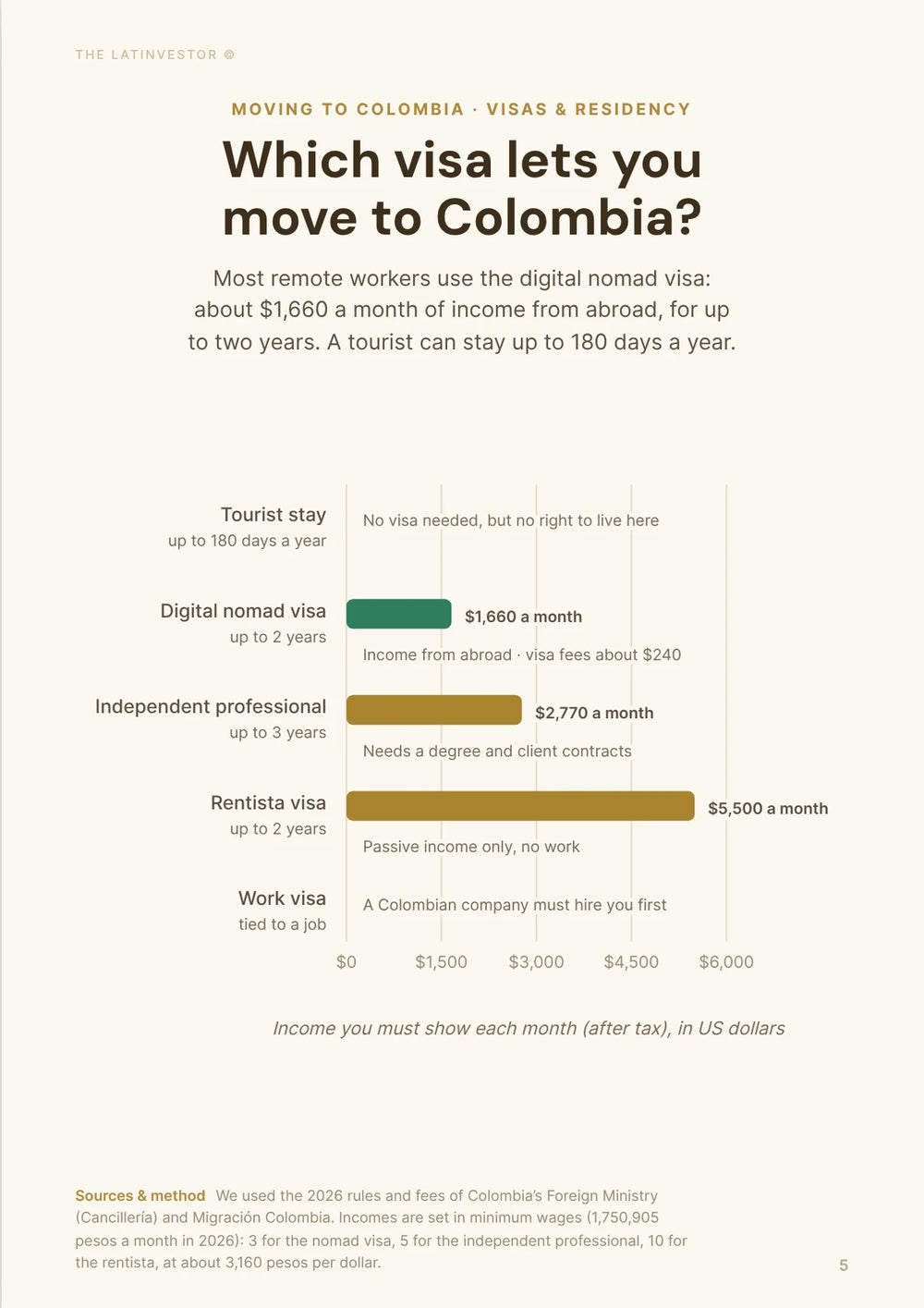
The digital-nomad visa is genuinely useful. Colombia's Foreign Ministry says it can be granted for up to two years to people working remotely for foreign businesses or carrying out qualifying digital activities, if they earned at least three minimum wages a month over the past three months: COP5,252,715 (about $1,650) in 2026. Beneficiaries such as family members can also be included.
The restriction is straightforward: the visa does not authorize paid work for Colombian companies or individuals based in Colombia.
Many nationalities can test Medellín before applying. Visa-exempt remote workers can generally enter for 90 days and may be able to extend their stay up to 180 days within the calendar year, provided their work does not generate payment from Colombian businesses.
Tax is where long stays become more complicated.
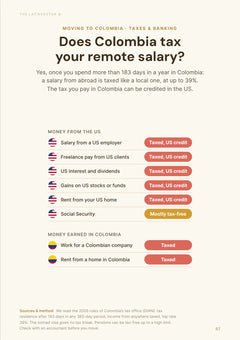
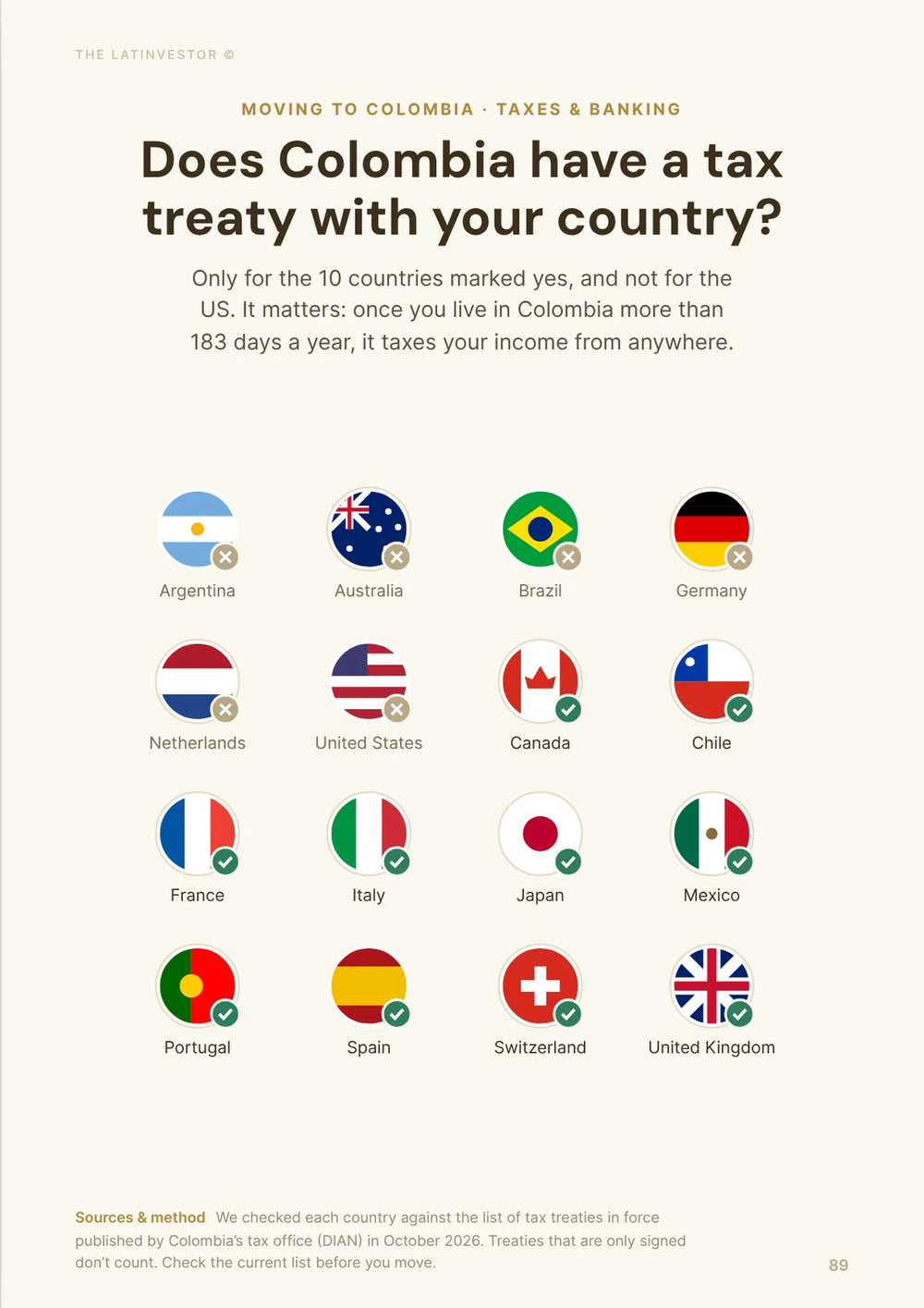
DIAN's rules treat more than 183 days spent in Colombia during any consecutive 365-day period as a key test for tax residency, with entry and departure days included. DIAN reinforced the interpretation again in recent guidance dealing with foreigners whose stays cross the threshold.
That creates an easy trap. A two-year immigration visa does not mean someone can live in Colombia for two years while remaining automatically outside the Colombian tax system.
For an employee with one foreign salary, the issue may be manageable. For someone owning foreign companies, investments, rental properties or substantial assets, professional cross-border tax advice becomes much more important before the 183-day threshold is crossed.
| Medellín expat issue | Current rule |
|---|---|
| Visa-exempt initial stay | Generally up to 90 days |
| Possible visitor extension | Up to 180 days within applicable rules |
| Digital-nomad visa | Up to 2 years |
| Work for Colombian clients under nomad visa | Not permitted |
| Family beneficiaries | Permitted |
| Main Colombian tax-residency threshold | More than 183 days in a rolling 365-day period |
| Entry and departure days | Count toward the test |
| Immigration status = tax status | No |
Which Medellín neighborhood is best for expats?
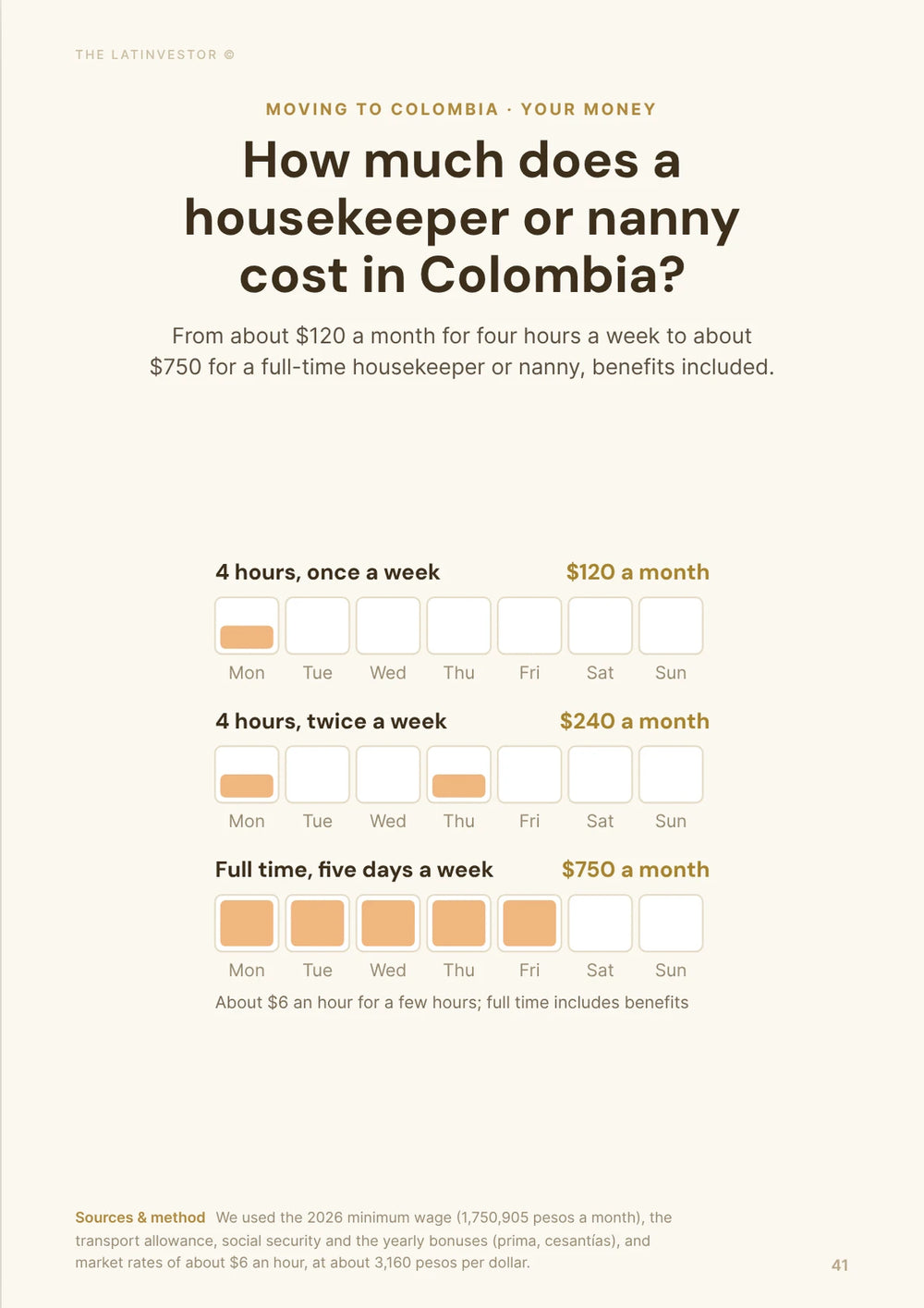
Laureles is currently the best all-round starting point for many expats, while El Poblado remains easier for newcomers and Envigado often works better once someone settles into everyday life.
El Poblado wins on immediate convenience. The neighborhood has the highest concentration of foreign-oriented restaurants, nightlife, coworking spaces, furnished apartments and services. Someone arriving alone can build a social routine quickly.
The compromises are obvious after a while. Rents are high, many streets are steep, some areas are noisy and tourism is much more visible than elsewhere in Medellín.
Laureles gives up some of that international convenience in exchange for a flatter, more walkable and more traditionally residential environment. It now attracts plenty of foreigners itself, so prices have followed, but daily life generally feels less dominated by tourism than in central Poblado.
Belén deserves more attention than it usually receives in expat content. It is large, varied, relatively central and offers more opportunities to live inside an ordinary Colombian neighborhood.
Envigado, although technically a separate municipality, becomes increasingly attractive for couples and families. It offers a calmer feel while remaining integrated into the southern metropolitan area.
Sabaneta pushes further in that direction. Housing can provide more space for the money, although extra distance from central Medellín becomes noticeable if someone travels north regularly.
The biggest mistake is choosing an apartment from a map. Hills, traffic and Metro access matter too much.
We would rather live ten minutes on foot from the places used every day than have a spectacular valley view requiring a car for every coffee, grocery run and workout.
So, is Medellín actually a good place to live as an expat?
Yes. Medellín is currently a very good place to live for the right expat, but its strongest advantages now come from quality of life rather than extreme cheapness.
After looking across housing, crime, tourism, transport, healthcare, climate, visas and day-to-day infrastructure, we think the city's appeal remains substantial.
The weather genuinely is unusually comfortable. High-quality hospitals are available. Remote workers have cheap broadband, North American working hours and a mature professional ecosystem. The Metro carried more than 310 million passenger trips last year. International demand continues to grow, which means foreigners arrive in a city already used to serving them rather than having to build a life from scratch.
Medellín also remains financially attractive for someone earning a strong foreign income. Paying roughly COP2–3.3 million for a one-bedroom apartment or COP91,000 for broadband can still look excellent compared with prices in major U.S. or Western European cities.
But the old sales pitch needs updating.
Housing in El Poblado and Laureles has become much more expensive. Short-term rentals are now important enough for the city to tighten enforcement. Street crime has improved across several categories, while foreigner-specific risks around nightlife and drug-assisted theft continue to deserve attention. Poor air-quality episodes are real. Spending most of the year in Colombia can also create tax obligations that a short-term visitor never has to consider.
Taken together, those drawbacks make Medellín a more selective choice than it used to be.
A remote worker, entrepreneur or retiree earning from abroad, willing to learn Spanish and comfortable using sensible security precautions can still get an exceptional combination of climate, healthcare, urban life and spending power.
Someone prioritizing extremely low crime, completely carefree nightlife, clean air throughout the year or bargain housing in the city's trendiest neighborhoods should probably look elsewhere.
Medellín remains one of the stronger expat bases in Latin America today. It simply makes much more sense as a real city with trade-offs than as the effortless tropical bargain it was once sold as online.
Our methodology
This article looks at whether Medellín is a good place to live as an expat. We cover foreign demand, housing and cost of living, security, climate and air quality, transport, remote work, language, healthcare, family life, tourism pressure, visas and tax, and neighborhood choice.
We gave the most weight to recent official and first-hand data. The Mayor’s Office and Migración Colombia give arrivals, tourism and security figures; Metro de Medellín gives network use; SIATA and the Área Metropolitana give air quality; IDEAM gives long-term climate. Airport arrivals show foreign demand, not the number of expats who live there.
Costs come from Numbeo (October 2026), Expatistan, Geomaxxing and listing medians, compared with other Colombian cities so that a strong foreign income does not make Medellín look cheaper than it is locally. Hospitals come from IntelLat’s 2026 ranking and English levels from EF’s 2025 EPI.
Visa rules come from Colombia’s Foreign Ministry and Migración Colombia (the digital nomad visa asks for three times the 2026 minimum wage), and the tax-residency test from DIAN. We checked these figures in October 2026. Peso amounts are converted at about 3,175 pesos per US dollar (October 2026).
Crime figures differ by source, especially for scopolamine thefts, so we show the trend rather than one exact count. Rents are asking prices, and neighborhood recommendations are our judgment, weighing hills, Metro access, tourism pressure, cost and family needs.
Key sources used for this analysis include Medellín Mayor’s Office on 2025 and 2026 international arrivals, Medellín Mayor’s Office on long-term growth in airport immigration entries, Medellín’s tourism-intelligence data on 2025 tourism spending, Medellín’s Real Estate Observatory and Mayor’s Office on short-term-rental concentration, Medellín’s official 2025 crime-indicator report, the U.S. Department of State Colombia travel advisory, IDEAM’s climatological profile for Medellín, Área Metropolitana del Valle de Aburrá on 2026 air-quality management, Metro de Medellín’s 2025 operating figures, EF’s 2025 English Proficiency Index for Colombia, IntelLat’s hospital rankings, Colombia’s Ministry of Foreign Affairs on digital-nomad visas, Migración Colombia on visitor-stay extensions, DIAN on Colombian tax residency, Numbeo Medellín (October 2026), Expatistan Medellín, Expatistan Bogotá, Find Home Colombia 2026 rent survey, Medellín’s tourism figures for the first half of 2026, El Espectador on scopolamine thefts (October 2026), Semana on the 2026 IntelLat ranking, the Health Ministry on the 2026 IntelLat ranking, Metro de la 80 works, the Foreign Ministry’s 2026 digital nomad visa rules and Portafolio on the peso’s rise in 2026.