
Summary
Not quickly, and not everywhere. Our estimate for Guanacaste beach homes and condos is -5% to +3% in dollars over the next 12 months, after the province's median asking price fell 5% in August 2026 alone.
Prices are still high: in October 2026 the median house in the province was listed at $679,000 and the median condo at $425,000, with houses asking about $2,792 per square meter.
No index measures sale prices in Guanacaste. The old figure of +6% in a year had no source behind it, and brokers now describe a market cooling after a luxury correction, with listings online a median 153 days.
Flamingo-Potrero and Nosara ask the most, about $3,850 per square meter for houses, but no source shows them still rising in 2026.
Ultra-luxury villas are the weakest segment, while well-priced condos and townhouses near services hold up best. Brokers forecast 3% to 7% for beach condos in 2026; we stay below that.
On anything listed for more than six months, open about 10% below asking: brokers report 5% to 10% discounts as normal.
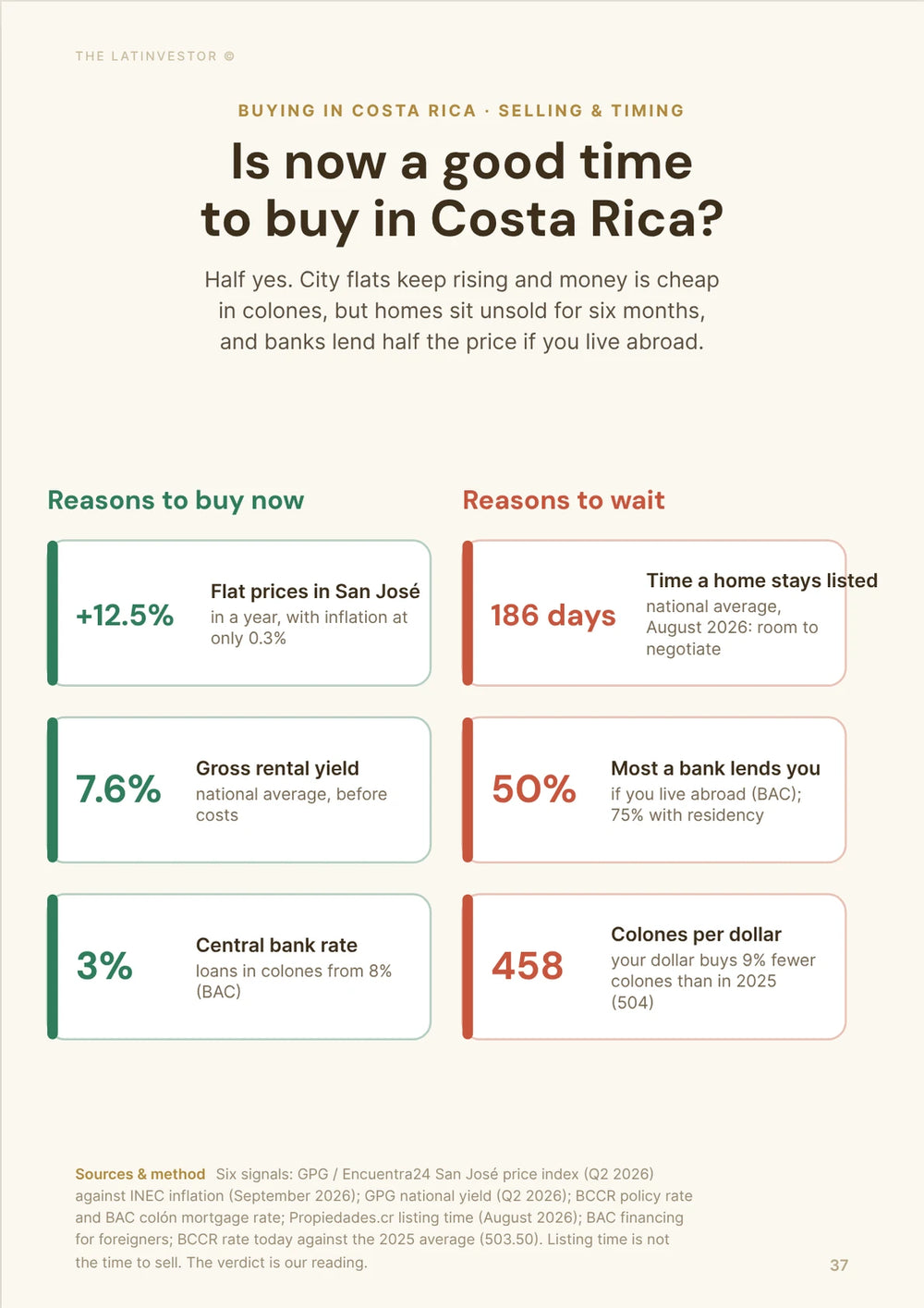
Rates help a little: the central bank's policy rate is 3.00%, but dollar mortgages start at 7.25% and most coastal buyers pay cash.
Water is the biggest local risk: 22 coastal water boards could not give new connections in 2024, and the El Niño drought is expected to last until March 2027.
Demand hasn't gone away: Liberia airport's international arrivals rose 11.9% from January to September 2026, against 4.8% for the country.
Over five years, our central estimate is +5% to +20% by 2031, about 1% to 3.7% a year, with the Liberia corridor and walkable beach towns with secure water doing better.
Over ten years, we expect about +15% to +45% by 2036, roughly 1.4% to 3.8% a year, far below the 70% to 110% this article used to quote.
The takeaway: buy in Guanacaste for use and rent, at a price backed by recent sales, with a clean title and a water letter. Count any price gain as a bonus.

Where are Guanacaste prices today, and how have they moved?
Before any forecast, here is where prices stand: what a home costs now, what changed over the past year, which areas and property types did best, and what pushes prices up or down.
The short version: Guanacaste is not one market. Luxury resort zones, rental towns, retiree areas and inland towns move at different speeds, and in 2026 the top of the beach market has cooled.
What does a home cost in Guanacaste today?
On 5 October 2026, Costa Rica Realtor's listings put the median house in Guanacaste province at $679,000 (₡311,000,000, €605,000) and the median condo at $425,000 (₡194,000,000, €380,000). These are asking prices, not sale prices.
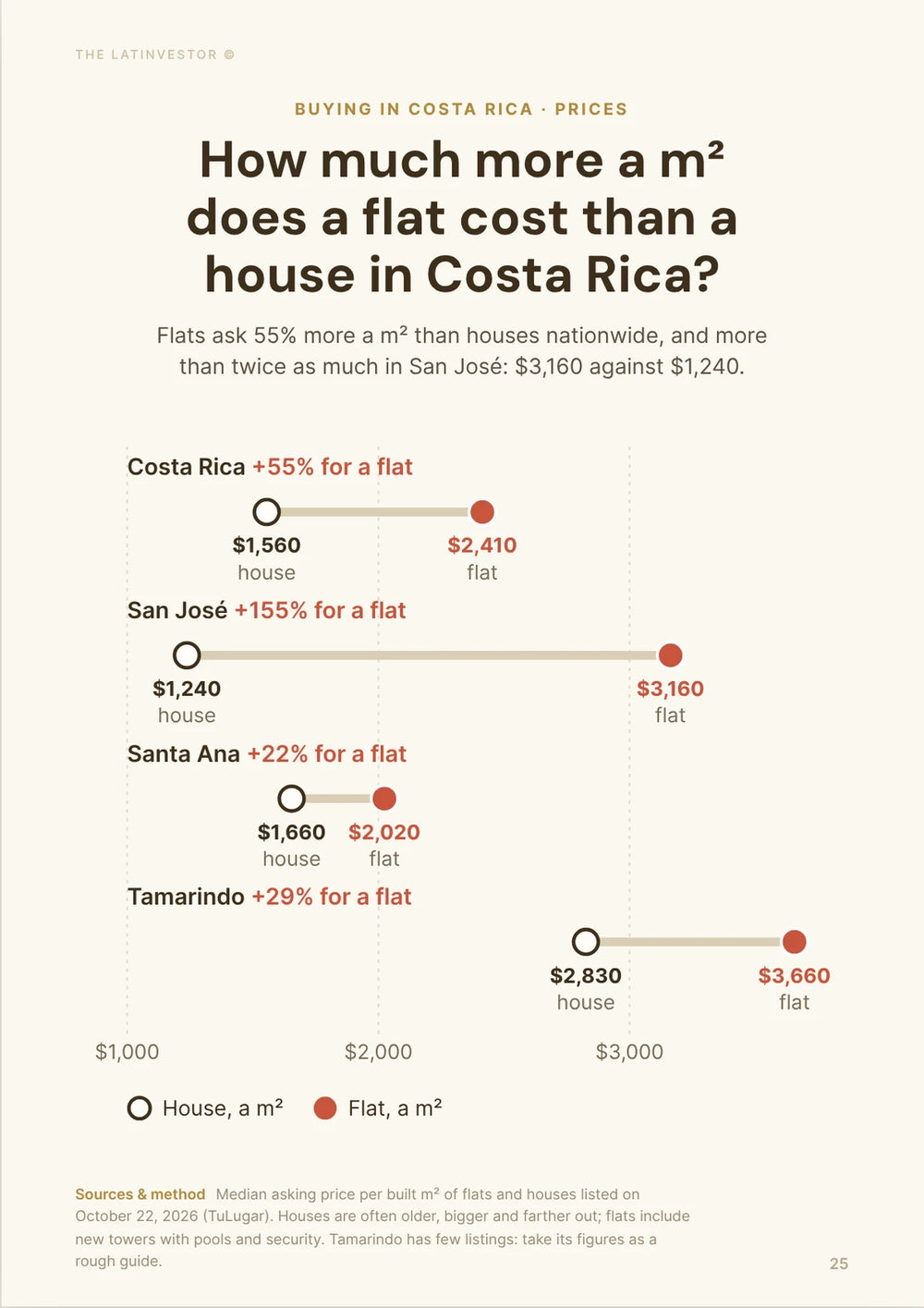
Per square meter of built area, the median house asked about $2,792 (₡1,275,000, €2,500). In August 2026, Propiedades.cr showed a slightly lower province median of $655,250, across all property types.
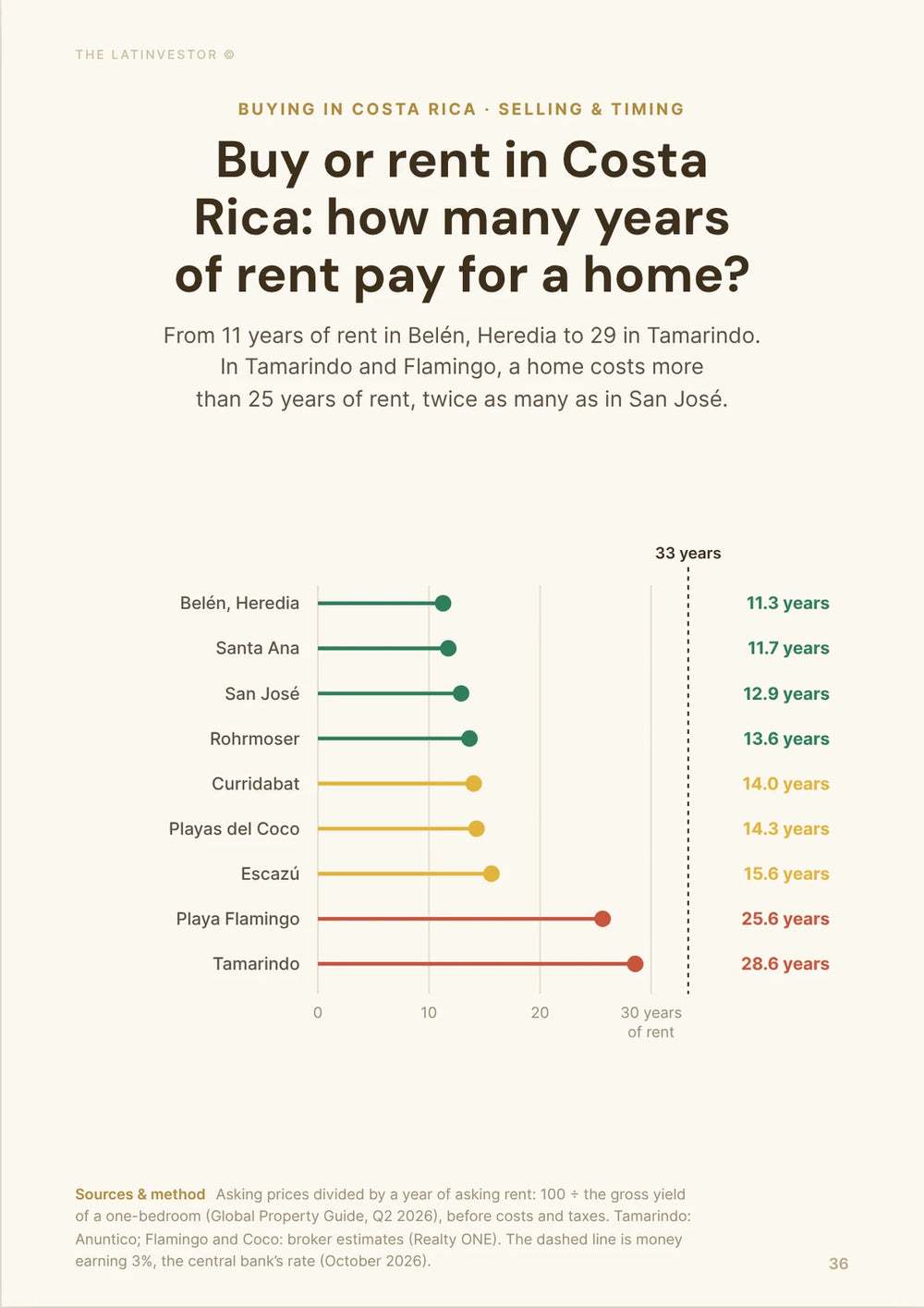
The spread is wide. Of 13,421 listings counted by Costa Rica Realtor, 3,549 (about 26%) asked $1 million or more, while inland towns like Liberia, Nicoya and Santa Cruz list mostly between ₡450,000 and ₡900,000 per square meter (about $980 to $1,970).
How much have prices changed in Guanacaste over the past 12 months?
Nobody can give one honest figure: Costa Rica has no public register of sale prices and no price index for Guanacaste. An earlier version of this article said +6%; no measured series supports it, so we removed it.
What we can see points down at the top. The median asking price in Guanacaste fell 5.0% in August 2026 alone, while active listings rose slightly to 3,388 (Propiedades.cr). Black Coast Estates says median home values in the province fell from peaks above $900,000 in 2024 to about $533,000 in early 2025; part of that is a cheaper mix of homes sold, but big-villa sellers have clearly lost pricing power.
Inflation is no excuse either way: consumer prices rose only 0.34% in the year to September 2026 (INEC), so any small nominal change is close to a real one.
Which areas in Guanacaste are holding their prices best?
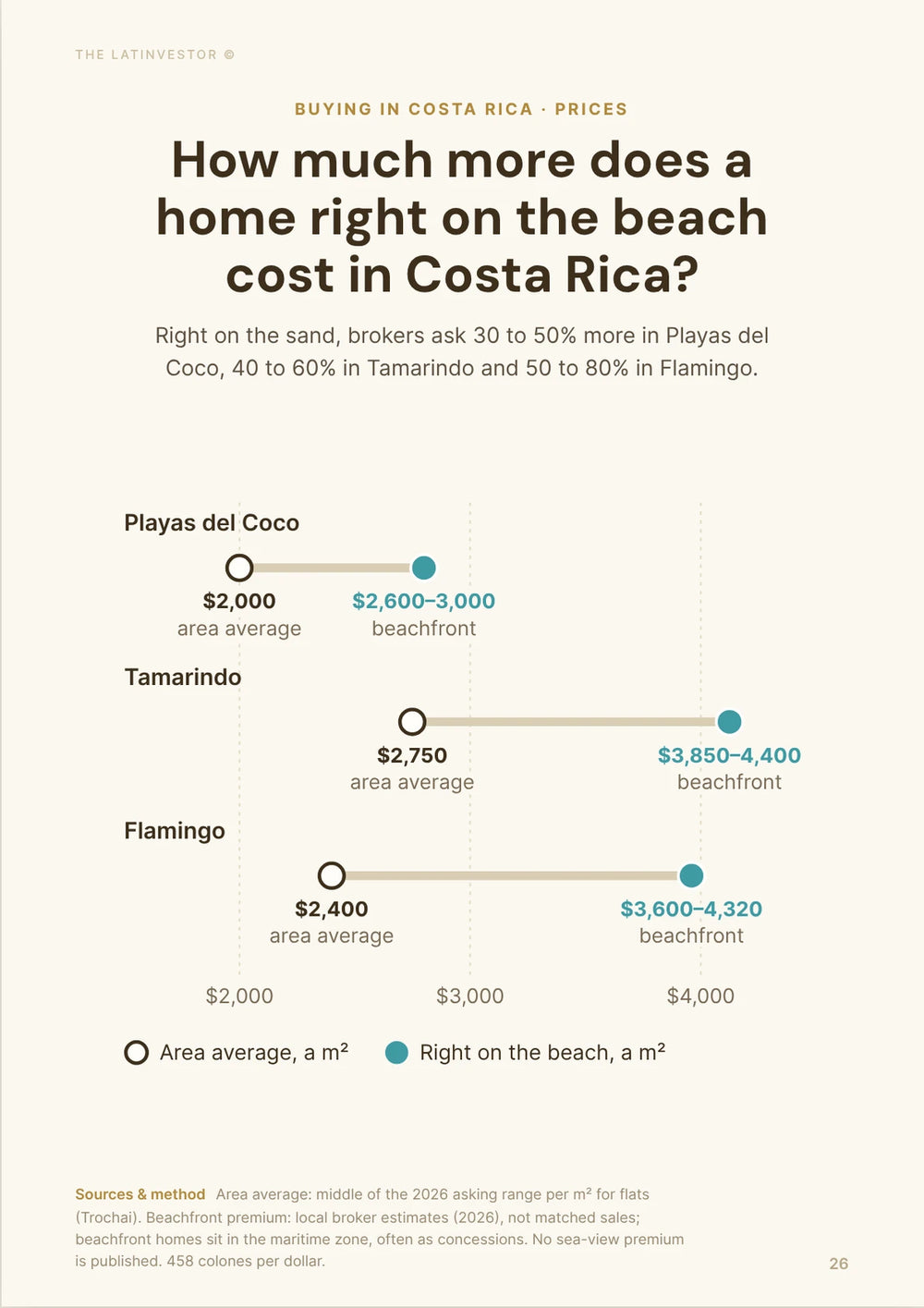
No area has a measured price rise in 2026. The most expensive are Flamingo-Potrero (about $3,863 per square meter for houses), Nosara ($3,836), Tamarindo ($3,226) and Sámara ($2,724), according to Costa Rica Realtor in October 2026.
The old claim that Flamingo, Coco, Hermosa and Sámara were rising 7% to 12% a year came from the 2021-2023 boom. Today, brokers describe flat or slipping prices in some Flamingo luxury developments and in overpriced central Tamarindo condos.
What holds up best are homes priced in line with recent sales in places with real demand: walkable parts of Tamarindo and Playas del Coco, Sámara, and the Liberia airport corridor, where homes cost a fraction of beach prices.
Which property types are holding their value best in Guanacaste?
Our ranking for 2026: well-priced 2- and 3-bedroom condos and townhouses near services first, small villas second, detached houses inland third, ultra-luxury villas last.
Condos are easier to rent, manage from abroad and resell, and the median condo ($425,000) is far cheaper than the median house ($679,000). The catch is supply: apartment and condo units approved nationally jumped 46.2% in 2025, and many target the same foreign buyers.
Ultra-luxury villas depend on a small pool of buyers and are where most price cuts happen.
What is pushing Guanacaste prices up or down?
Pushing up: foreign buyers, mostly from the United States and Canada, and tourism through Liberia. The airport's international arrivals reached 769,716 from January to September 2026, up 11.9%, against 4.8% for the whole country.
Pushing down: more supply and more choice. Guanacaste and Puntarenas are the provinces where the number of homes has grown the most (UCR, September 2026), and AirROI counted 1,448 active holiday rentals in Tamarindo, up 28% in a year. The strong colón also makes building, labor and upkeep about 9% dearer in dollars than a year ago.
Are Guanacaste asking prices already falling?
At the top of the market, yes, slowly. The 5.0% drop in the province's median asking price in August 2026 came with slightly more listings (3,388) and a median of 153 days online. In June 2026, the Tamarindo Guide wrote that inventory had grown, listings sat longer and price cuts were more common, especially for homes priced as if the boom never ended.
This is a correction of overpriced listings, not a crash. Demand is still there (Liberia arrivals +11.9% in 2026), and well-priced condos still sell. What changed is that buyers can choose: more condos, more holiday rentals and more listings than three years ago.
Brokers report 5% to 10% discounts off asking prices as normal, and some estimate around 340 days from listing to sale. That gives you time and room to negotiate.
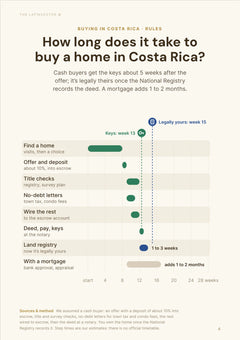
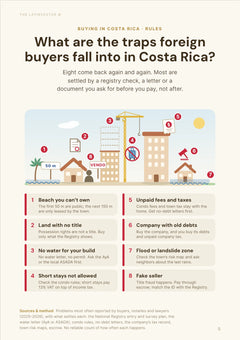
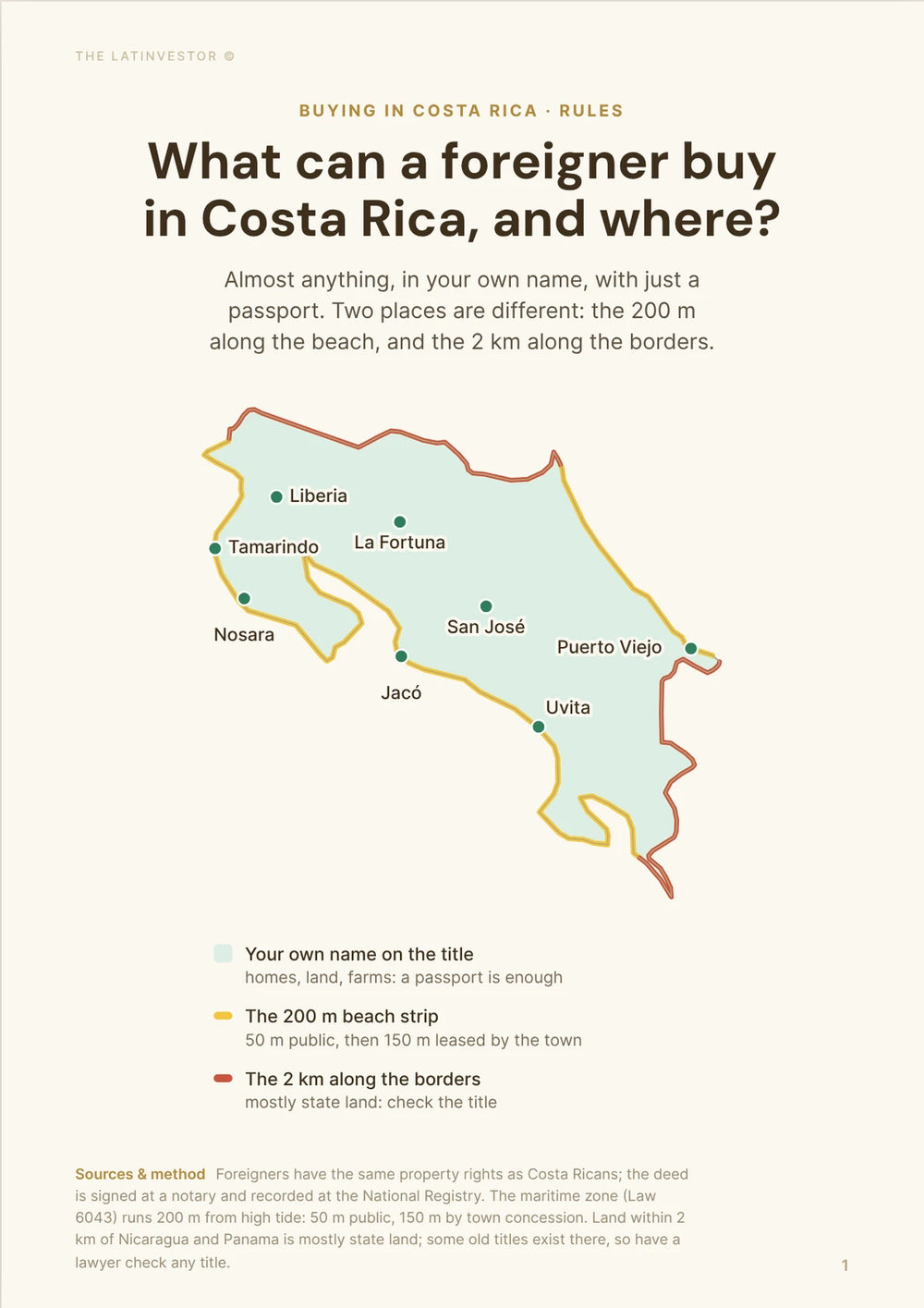
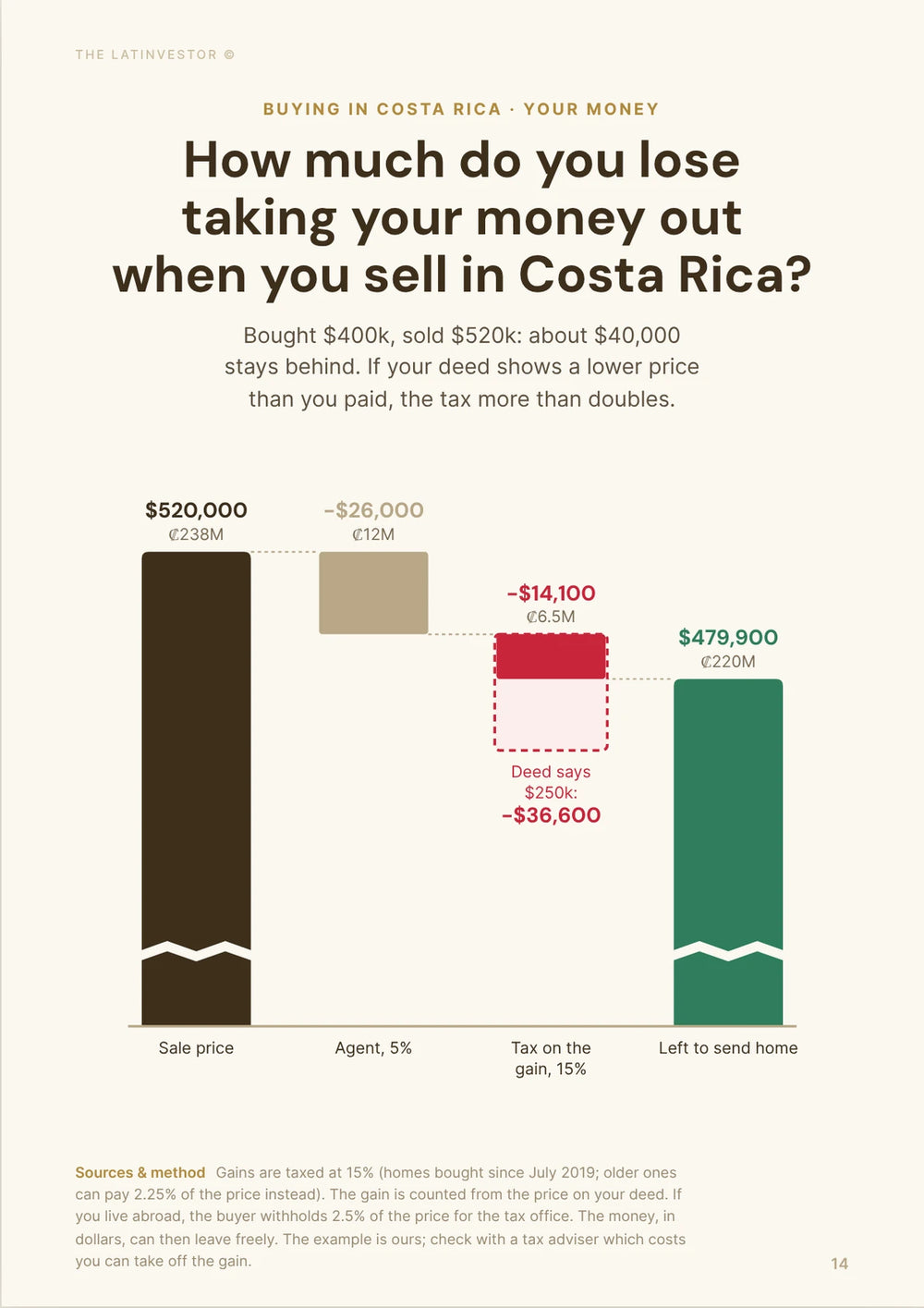
What to do: ask how long the home has been listed and whether the price was already cut. Start about 10% below asking on anything online for more than six months, and use missing paperwork (water letter, permits, a pool not in the plans) to push further. Check the title at the Registro Nacional and whether the land sits in the Maritime Zone, where you get a concession, not ownership.
What should you expect for the rest of 2026 and for 2027?
With 2026 almost over, the useful question is the next 12 months. The 6% rise this article used to predict for 2026 did not show up anywhere, so we rebuilt the forecast segment by segment.
Demand from foreign buyers and tourists is still solid, but it now has to absorb a lot of new condos and holiday rentals, so sellers have less room to push prices.
How much could Guanacaste prices change over the next 12 months?
Our central estimate for Guanacaste beach homes and condos is -5% to +3% in dollar asking prices, with bigger cuts on overpriced listings. That matches our national forecast for the coast.
Black Coast Estates forecasts 3% to 7% for beachfront property and condos in 2026, without a published method. We stay below that because the province's median asking price fell in August and listings are growing.
| Segment | Last measured signal | Our estimate for the next 12 months |
|---|---|---|
| Beach condos priced in line with sales | Median condo $425,000 (October 2026) | 0% to +3% |
| Luxury villas, Flamingo, Papagayo, Nosara | Province median -5.0% in August 2026 | -5% to 0%, more on overpriced listings |
| Liberia and inland towns | No index; airport arrivals +11.9% | 0% to +3%, tracking local wages |
| Guanacaste as a whole | 153 days median online (August 2026) | -5% to +3% |
Which areas of Guanacaste could do best next year?
The Liberia corridor (Liberia, Guardia, Comunidad, Sardinal) has the best chance of small gains. Its airport is growing faster than the rest of the country, the transport ministry started an apron expansion worth more than ₡3 billion in June 2026, and homes there are still far cheaper than on the beach.
In the beach towns (Playas del Coco, Hermosa, Sámara, Tamarindo, Flamingo-Potrero), only homes priced in line with recent sales, with clean title and water, are likely to gain. Huacas and Brasilito, behind Tamarindo and Flamingo, attract long-term tenants and buyers priced out of the beach.
Overpriced luxury listings in Flamingo, Papagayo and Nosara are the most likely to be cut.
Which property types should hold up best in 2027?
Well-located 2- and 3-bedroom condos and townhouses in managed communities near services: they are what foreign buyers who don't live here full time want, and they are the easiest to rent and resell.
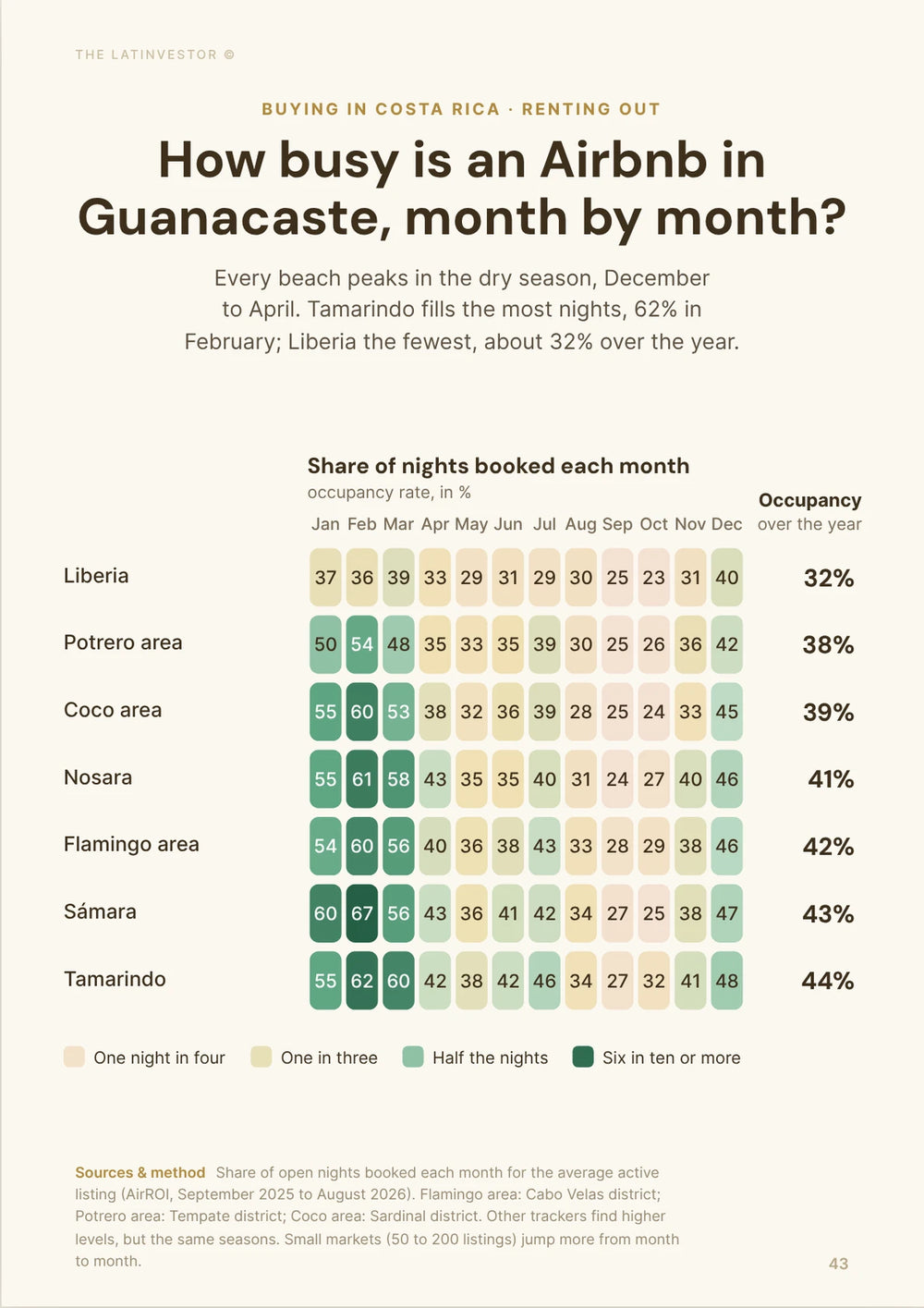
Be careful with generic condos far from the beach. Holiday-rental supply keeps growing (Tamarindo +28% in a year, Sámara +16%, Nosara +15% on AirROI), and occupancy in Guanacaste beach towns sits between 38% and 47%, so every new unit competes for the same guests.
Ultra-luxury villas are expected to underperform: many are already priced at the ceiling and depend on very few buyers.
How will interest rates affect Guanacaste prices?
Only a little. The central bank cut its policy rate to 3.00% in July 2026 and held it there on 24 September 2026, but mortgages stay far above that: BAC advertises dollar mortgages from 7.25%, foreigners are typically quoted 7% to 10%, and non-residents usually get only up to 50% of the price financed.
On a 25-year loan, a 1-point drop in the mortgage rate raises what the same monthly payment can borrow by about 8% to 9% (our calculation at 7% to 10%). In Guanacaste, though, most coastal buyers pay cash or borrow at home, so rates matter mainly for Costa Ricans buying in Liberia and the inland towns.
What are the biggest risks for Guanacaste prices?
Water first: without a water availability letter a lot can't be built on, and a home with water a few hours a day is hard to rent or resell (see the next section).
Then too much supply: more condos and holiday rentals compete for the same buyers and guests, which keeps pressure on overpriced listings.
Then security and legal risk. Guanacaste recorded 79 homicides in 2025, out of 873 nationally, the third most violent year on record. On the coast, bill 25.157 on special concessions for owners whose titles fall inside the Maritime Zone was approved in committee in March 2026 and contested in September 2026; it has not been voted, so any title near the beach needs a careful check.
Is it a good time to buy a rental property in Guanacaste?
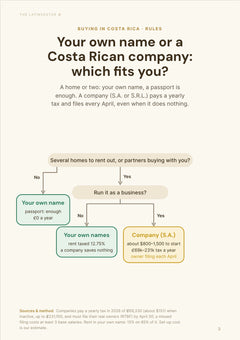
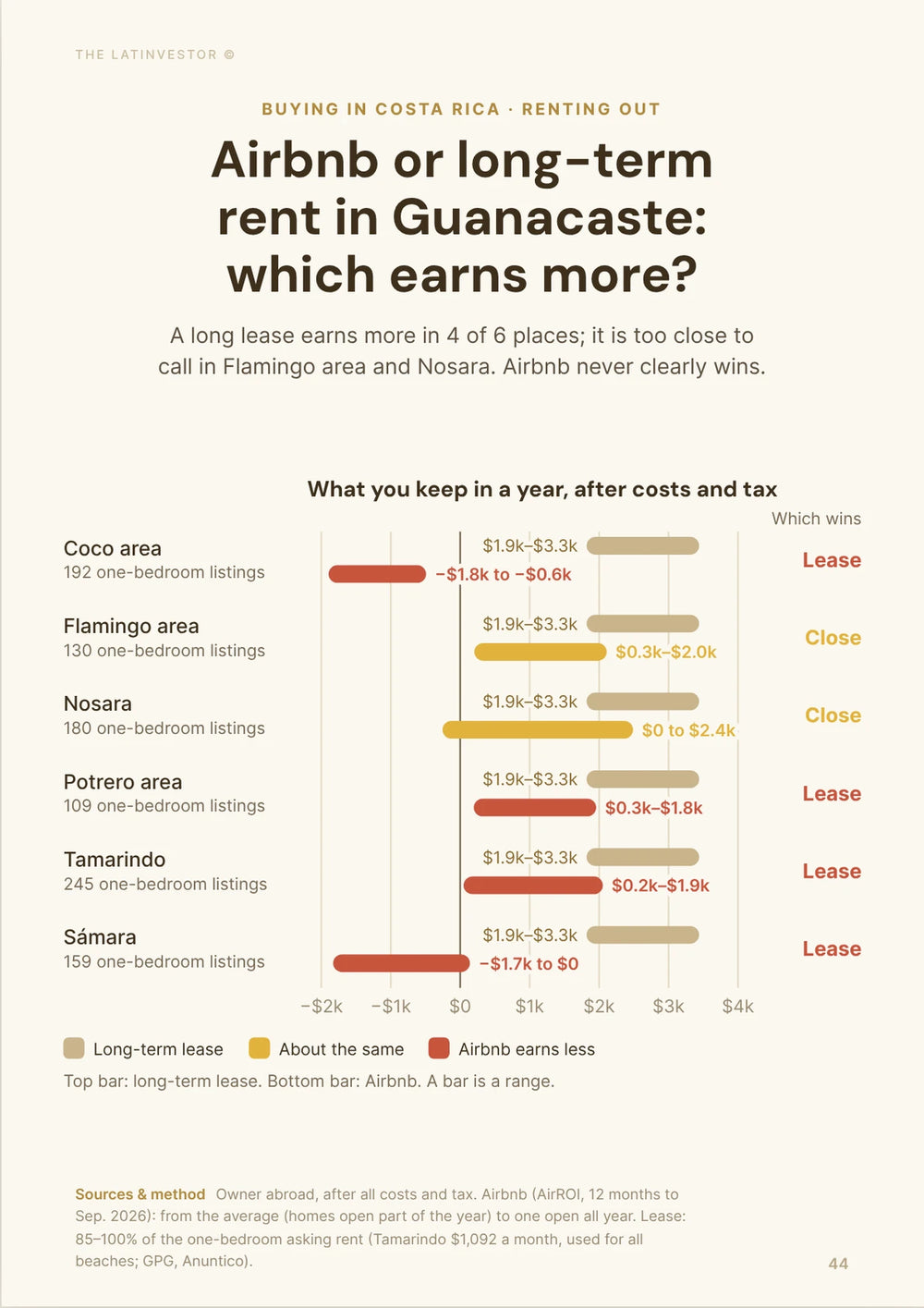
Only if the numbers work without price gains. Long-term rents are thin against beach prices: about 3.5% to 4% gross for condos at Tamarindo and Flamingo asking prices (houses and villas: about 4.7% in Tamarindo, 3.9% in Flamingo), about 7% in the Coco-Liberia area. After the rental income tax (12.75% of gross rent for an individual landlord, non-residents included), the 0.25% municipal tax, HOA, management, vacancy and upkeep, that leaves about 3% net in the best case, by our estimate.
Holiday rentals earn more gross but net little once you take out the 13% VAT charged to guests, platform fees, cleaning and utilities: about 1.4% to 2.5% for a Tamarindo 2-bedroom on our estimates.
The case for buying now: sellers are negotiating and you can choose. The case for waiting: prices at the top are still being cut, and supply keeps growing.
Will the El Niño drought hit Guanacaste property prices?
It already weighs on some areas. In 2024, 22 Guanacaste water boards (ASADAs) had no capacity for new connections, including around Coco, Tamarindo, Potrero and Flamingo. In June 2026, the weather service forecast much less rain for the North Pacific and a drought lasting until March 2027, and by September 2026, 32 ASADAs nationally reported rationing.
For prices, this splits the market. Homes with a reliable connection, or a legal well, keep their value and may gain a premium. Lots and projects without a water availability letter can't get building permits, which is why some cheap land on the coast is cheap.
The engineers' association (CFIA) warned in May 2026 that lack of water capacity was already delaying housing and big projects. That limits new supply in the best areas, which supports existing homes with water, but it also slows the growth that brokers count on.
What to check: get the water availability letter from the ASADA or AyA in writing, ask how many hours a day water ran during the last dry season, check the well permit if there is one, and never pay a "future development" price for land without water.
Where could Guanacaste prices be in five years?
This part covers our five-year estimate, the areas and property types most likely to do well, and how infrastructure and population trends could change the picture.
The outlook is positive but modest: the best gains should come from places that combine access, services and secure water, at prices not already at the ceiling.
What is our five-year price forecast for Guanacaste?
Our central estimate is that Guanacaste asking prices in dollars end about 5% to 20% higher by 2031, roughly 1% to 3.7% a year. A cautious scenario is -10% to 0% if the luxury correction continues; the best locations could reach 20% to 35% (about 3.7% to 6.2% a year).
That is well below the 30% to 45% this article used to forecast, and slightly below our national range (10% to 25%), because the beach towns start from high prices and face more new supply.
The key assumptions: tourism keeps growing through Liberia, no deep recession in the United States and Canada, and water and permits don't get much worse.
Which areas in Guanacaste could grow the most over five years?
The Liberia corridor has the strongest case: airport growth, jobs, hospitals and prices a fraction of the beach. Playas del Coco and Playa Hermosa come next, close to the airport and cheaper than Flamingo or Papagayo.
Sámara and the towns behind Tamarindo and Flamingo (Huacas, Brasilito, Villarreal) can gain if water and roads keep up. Flamingo-Potrero, Nosara and central Tamarindo can still gain, but from already high prices, so we would not count on more than the province range there.
What property type could give the best return in Guanacaste over five years?
A 2- or 3-bedroom condo or townhouse in a managed community near services, bought at a price backed by recent sales.
For that kind of property, our estimate of the total return over five years is about 13% to 36% before resale costs and capital gains tax: about 2.5% a year in net long-term rent plus 0% to 3.7% a year in price growth. That is far below the 55% to 85% this article used to quote, which ignored taxes and running costs.
Holiday rentals can beat that in a good location, but net returns depend heavily on management and occupancy, which sits below 50% in most beach towns.
How will new infrastructure affect Guanacaste prices over five years?
Three things matter: Liberia airport (apron expansion of more than ₡3 billion, started June 2026), road works on Route 21 and the coastal roads, and water infrastructure such as new wells and aqueducts for the coastal ASADAs.
No study measures how much these projects add to home prices in Guanacaste; the old 5% to 15% premium had no source, so we removed it. Our advice: pay for infrastructure that exists, not for what has been announced.
The areas most likely to benefit are Liberia, Guardia, Comunidad, Sardinal, Playas del Coco, Playa Hermosa, Flamingo, Potrero, Huacas and Brasilito.
How will population and other trends affect Guanacaste values in five years?
Local population growth will support prices only slowly: INEC projects Costa Rica's population growing more and more slowly and starting to shrink in the 2040s.
What matters more is who comes: foreign retirees, remote workers and Costa Ricans with jobs in tourism and services. Arrivals from Canada at Liberia rose 33% in the first five months of 2026, a sign of where demand comes from.
That favors condos, townhouses and small villas in Playas del Coco, Playa Hermosa, Sámara, Flamingo, Potrero and the Liberia corridor, where daily life is practical.
What about the next ten years in Guanacaste?
Over ten years, the gap between good and bad locations will matter more than the province average. Below are our ten-year estimate and the long-term factors that will decide it.
Guanacaste should remain one of Costa Rica's strongest markets for foreign buyers if water, roads and security keep up with tourism.
What is our 10-year price estimate for Guanacaste?
Our central estimate is that Guanacaste asking prices in dollars end about 15% to 45% higher by 2036, roughly 1.4% to 3.8% a year. A cautious scenario is 0% to 15%; the best locations could reach 50% to 80% (about 4.1% to 6% a year).
That is far below the 70% to 110% this article used to forecast, which assumed the boom years would simply continue.
The biggest unknowns are water, roads, security and how much new supply the coast adds.
What long-term factors will shape Guanacaste prices?
Tourism access is the main strength: Liberia airport handled 1.92 million passengers in 2024 and keeps growing faster than San José, which supports rentals, second homes and retirees.
The colón is the wild card. It gained about 9% against the dollar in 2026 (about 457.5 per dollar in October), which makes upkeep and building dearer for foreigners. If it weakens again, owning on the coast gets cheaper in dollars.
The greatest structural risk is water: even a beautiful property loses value if water is uncertain or permits get harder.
Our methodology
This article estimates whether home prices will keep rising in Guanacaste province: where prices stand today, how they moved over the past year, and our scenarios for the next 12 months, five years and ten years, by area and property type, plus the effect of rates, water and the 2026 slowdown at the top of the market.
Current prices come from Costa Rica Realtor's listing medians (5 October 2026) and the Propiedades.cr report (August 2026), with Anuntico listings for inland towns. Recent changes come from Propiedades.cr, Black Coast Estates and the Tamarindo Guide; supply from INEC building approvals and AirROI listing counts; tourism from ICT arrival figures; rates and growth from the central bank (July and September 2026); inflation from INEC.
Tax rules come from Hacienda (rental income tax and VAT), coastal rules from the Maritime Zone law (Law 6043), water from AyA, CFIA and press reports on the ASADAs, and security from OIJ figures. We compared everything with our national forecasts for Costa Rica.
We checked these figures in October 2026. Dollar amounts are converted at about 457.5 colones per US dollar and 513 colones per euro (October 2026).
All forecasts in this article are our own estimates, not measured data, and they apply to asking prices in US dollars. Where we had no direct figure, we estimated it and said so: net yields, the five-year total return, the inland price range and every forecast range. Listing prices are asking prices, not sale prices, and there is no public register of closed sales in Guanacaste.
Key sources used for this analysis include Costa Rica Realtor, Propiedades.cr, Black Coast Estates, Tamarindo Guide, Encuentra24, Global Property Guide, AirROI, Banco Central de Costa Rica rate data, IMF, INEC construction statistics, INEC population projections, ICT, CFIA, MOPT, AyA, El Observador, Hacienda and Law 6043.