
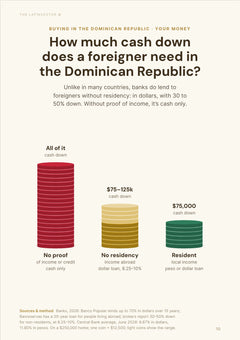
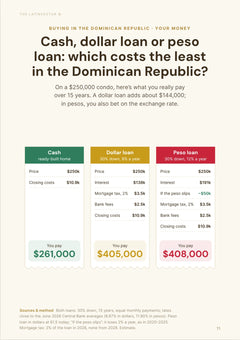
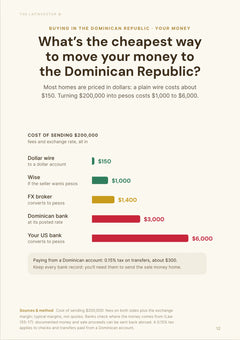
Summary
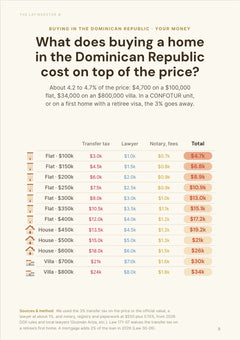
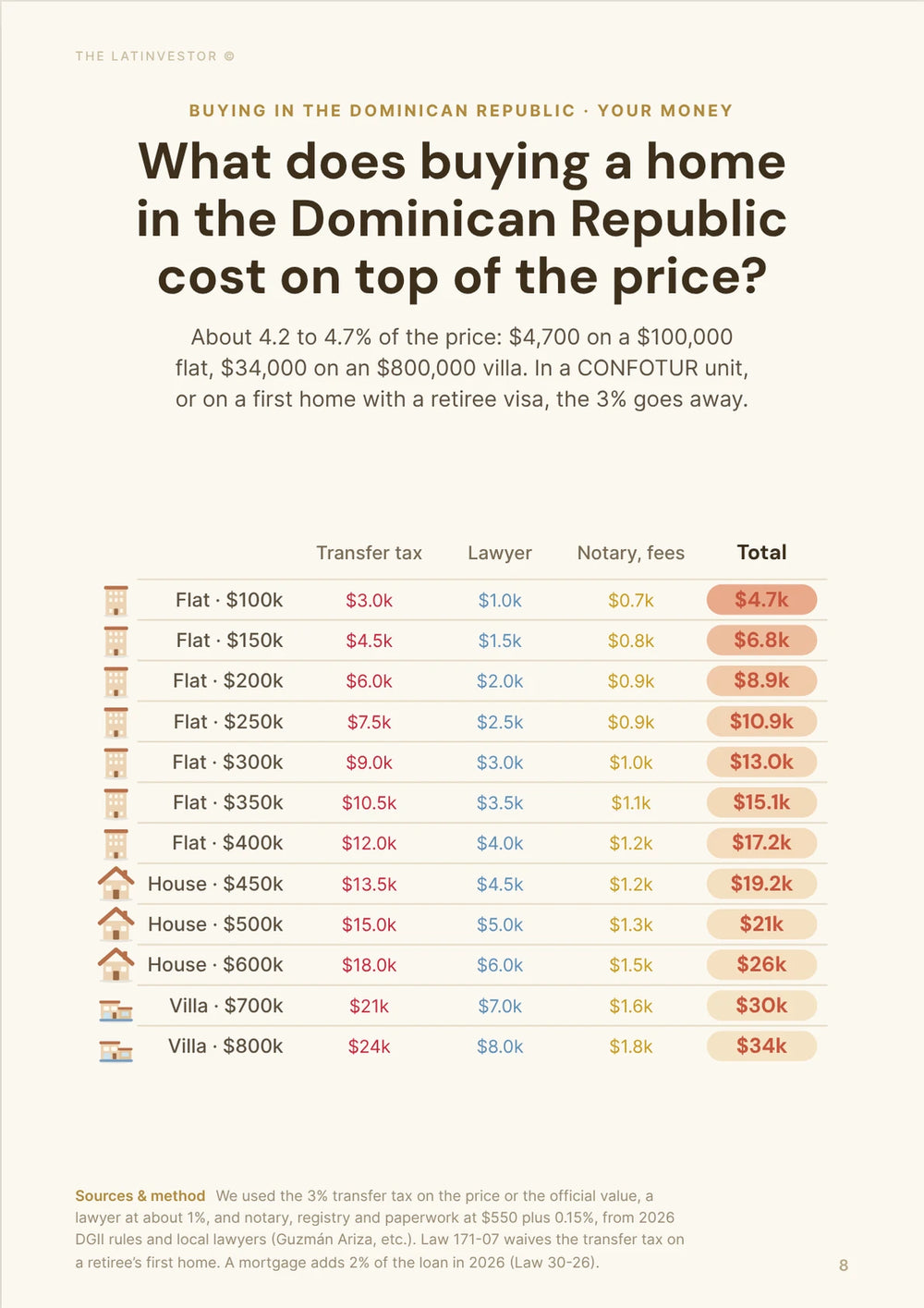
In 2026, budget about 4.5% to 6.5% on top of the price when you buy property in the Dominican Republic: $9,000 to $13,000 on a $200,000 home. In a valid Confotur project bought new, it drops to about 1.5% to 3.5%.
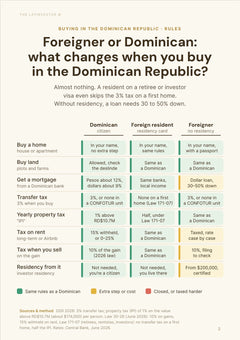
The biggest item is the 3% transfer tax, charged on the higher of your price and the DGII appraisal. Foreigners pay the same rate as Dominicans.
If you take a mortgage, add the 2% mortgage registration tax on the loan in 2026. Law 30-26 cuts it to 1% in 2027 and 0 from 2028.
Confotur is the only real exemption: it waives the 3% transfer tax on the first purchase of a unit in an approved tourism project, and usually the IPI for 15 years. Resales don't get it.
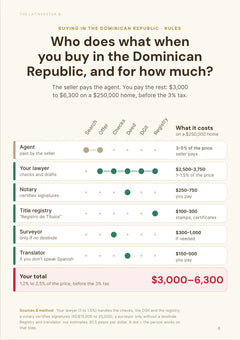
A lawyer usually charges 1% to 1.5% of the price, plus 18% ITBIS on the invoice. The notary is about RD$15,000 to RD$45,000 (about $245 to $730).
The agent commission is usually 3% to 5% and the seller normally pays it.
If the land needs a deslinde (individual survey), add RD$18,000 to RD$60,000 (about $295 to $975) and 30 to 90 days.
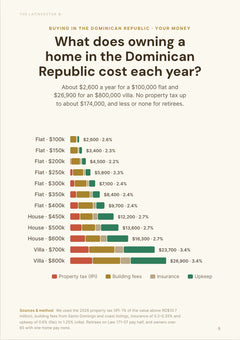
Yearly, the IPI property tax is 1% of the combined DGII value above RD$10,695,494 (about $174,000). A home appraised at RD$14 million pays about RD$33,000 (about $535) a year.
Condo fees vary the most: $185 a month for a 2-bedroom in Bávaro and $350 in Cana Bay in two 2026 listings we checked.
If you rent to a company, it must withhold 15% of the rent since Law 30-26 (it was 10%). As a non-resident, budget for the 27% non-resident rate on your Dominican rental profit.
When you sell, plan about 4% to 6% in agent and legal costs. Since June 2026, individuals pay a flat 10% tax on the gain, instead of up to 27% before.
Bottom line: on a $200,000 resale, keep $13,000 aside for closing, get your lawyer to quote with ITBIS included, and if you buy new in a tourist zone, check the project on MITUR's Confotur search before you sign.


Overall, how much extra should I budget on top of the purchase price in the Dominican Republic in 2026?
How much are total buyer closing costs in the Dominican Republic in 2026?
In 2026, total buyer closing costs in the Dominican Republic usually run from about 4.5% to 6.5% of the purchase price. On a $200,000 property, that's $9,000 (about RD$554,000) to $13,000 (about RD$800,000) extra.
The low end, around 4.5%, covers the 3% transfer tax, a lawyer at about 1% and the small notary and registry fees. You can't really go below that unless the purchase qualifies for Confotur.
The high end, around 6.5%, is what you pay with a 1.5% lawyer fee plus the 18% ITBIS on it, extra registry steps, translations and a survey. A mortgage adds 2% of the loan on top in 2026: $2,800 (about RD$172,000) on a $140,000 loan.
With a valid Confotur exemption on a first purchase, the transfer tax disappears and total costs fall to about 1.5% to 3.5%. On $200,000, that is $3,000 (about RD$184,000) to $7,000 (about RD$430,000).
What pushes you to the high end: a messy title history, a property that needs a deslinde, certified translations, a mortgage, and a DGII appraisal that comes in above your price.
What's the usual total % of fees and taxes over the purchase price in the Dominican Republic?
For a normal resale or new apartment bought in your own name, cash, the usual total is about 4.5% to 5.5% of the price in 2026.
The full range that covers most deals is 4.5% to 6.5% without Confotur, and 1.5% to 3.5% with it. One local broker quotes a lower 3% to 4% rule of thumb, but that doesn't add up once you count the 3% tax and a 1% to 1.5% lawyer, so we don't use it.
Government taxes make up 3 points of that total (the transfer tax), plus 2% of the loan if you have a mortgage. Lawyer, notary, ITBIS on services and registry fees make up the remaining 1.5 to 3.5 points.
What costs are always mandatory when buying in the Dominican Republic in 2026?
In 2026, the mandatory costs are the 3% transfer tax (unless Confotur applies), the notary's fee for the contract and deed (about RD$15,000 (about $245) to RD$45,000 (about $730), or 0.10% to 0.25% of the price), and the registry filing at the Registro de Títulos, including small items like the RD$1,000 cartulina. With a mortgage, the 2% registration tax on the loan is mandatory too.
Optional but strongly recommended: your own lawyer for due diligence (title, liens, permits, the seller's taxes and condo dues), a survey or deslinde if the plot isn't individually titled, and translations if you don't read Spanish. A certification of the property's legal status from the Registro de Títulos costs about RD$1,000 (about $16). Skipping it to save that is a bad idea.
What taxes do I pay when buying a property in the Dominican Republic in 2026?
What is the property transfer tax rate in the Dominican Republic in 2026?
In 2026, the transfer tax is 3%, calculated on the higher of your purchase price and the DGII appraisal. If the DGII values the property above your price, you pay 3% of the DGII value.
There is no extra transfer tax for foreigners. The 3% is the same for Dominicans and foreign buyers. Law 30-26 (June 2026) did not change it.
You don't pay VAT (ITBIS) on the property itself: the DGII confirms that sales of real estate are not subject to the 18% ITBIS.
There is no separate stamp duty. Apart from the 3%, you only see small stamp and document fees during the filing. If you borrow, the 2% tax on registering the mortgage is the other real purchase tax in 2026.


Are there tax exemptions or reduced rates for first-time buyers in the Dominican Republic?
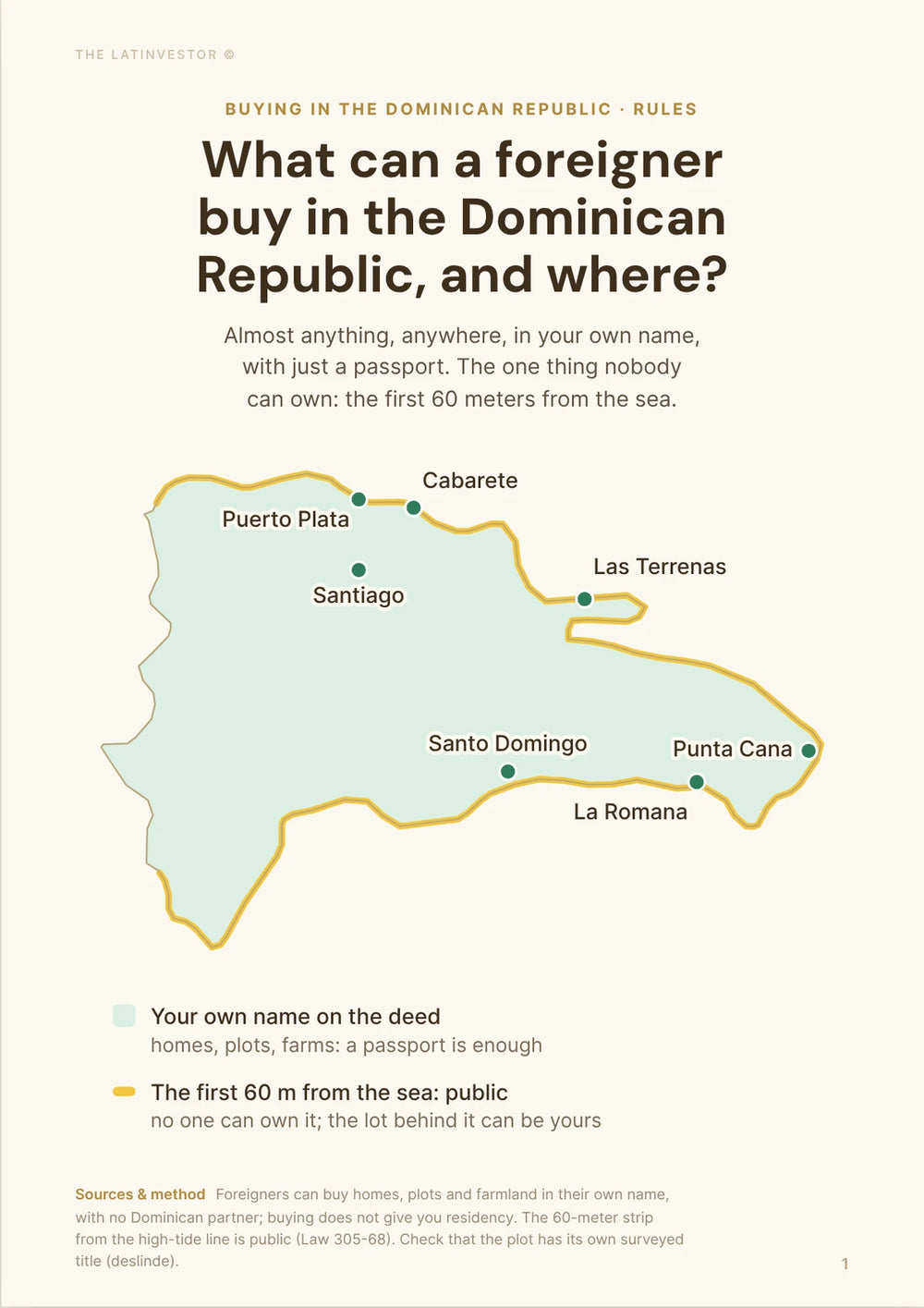
There is no general first-time buyer exemption. The 3% applies to every purchase unless a specific law or program grants an exoneration.
The exemption that matters for foreigners is Confotur (Law 158-01). It waives the 3% transfer tax on the first purchase of a unit in an approved tourism project, and usually the IPI for 15 years. It only covers the units listed in the project's resolution. Resales, unapproved units and expired resolutions don't qualify.
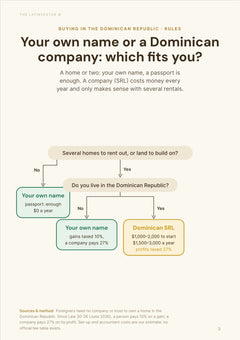
Buying through a company doesn't change the 3% rate. It changes the yearly side: companies don't get the individual IPI threshold, and you pay to set up and keep accounts for the company.
New-build or resale: both pay the same 3%, and neither pays ITBIS on the property. The difference is that only a new unit bought directly in an approved Confotur project can get the exemption.
Other exonerations go through the Ministry of Hacienda's process and depend on the law that grants them. You can't just declare yourself exempt.
Does Confotur still save you 3% after Law 30-26?
Yes, for now. Law 30-26, signed on 18 June 2026, did not repeal Confotur (Law 158-01) and did not touch the 3% transfer tax. A first purchase in an approved project can still skip the 3%: that's $6,000 on a $200,000 unit.
The catch is a new rule in the Tax Code: a taxpayer can't use two incentive regimes on the same investment or transaction. The law doesn't mention Confotur, and in August 2026 the law firm Pellerano & Herrera wrote that key terms are undefined and will need DGII guidance. Nobody knows yet exactly how it will be applied.
What to check before you pay a deposit: look up the project on MITUR's Confotur search (confotur.mitur.gob.do/consulta), ask for the resolution number, and check that your unit is covered and the approval isn't expired or only provisional.
What to negotiate: if the developer sells "Confotur" but the exemption isn't confirmed for your unit, ask for a clause that the developer pays the 3% if the DGII refuses it. And don't pay a Confotur premium on a resale: the exemption doesn't pass to a second buyer for the transfer tax.
Which professional fees will I pay as a buyer in the Dominican Republic in 2026?
How much does a notary or conveyancing lawyer cost in the Dominican Republic in 2026?
In 2026, a lawyer usually charges 1% to 1.5% of the price: $2,000 (about RD$123,000) to $3,000 (about RD$184,000) on a $200,000 property. Lawyers add 18% ITBIS to their invoice, so ask for a quote with ITBIS included.
The notary is a separate, smaller cost: about RD$15,000 (about $245) to RD$45,000 (about $730), or 0.10% to 0.25% of the price.
Most lawyers charge a percentage rather than a flat fee, often with a minimum for cheaper properties.
Translations and an interpreter for meetings usually cost a few hundred dollars, more if you need certified translations of many documents. We found no published price list, so get a quote.
You don't need a tax advisor for a simple purchase. If you plan to rent out or buy through a company, a local accountant is worth it: rental filings and company accounts are yearly costs, not one-off.
What's the typical real estate agent fee in the Dominican Republic in 2026?
In 2026, the usual agent commission is 3% to 5% of the sale price: $6,000 to $10,000 on a $200,000 property. When two agents are involved, they split it.
The seller normally pays it out of the sale proceeds. As a buyer you usually pay nothing, unless you hire your own buyer's agent on separate terms.
There is no legal rate. The figure depends on the property, the area and how hard you negotiate.
How much do legal checks cost (title, liens, permits) in the Dominican Republic?
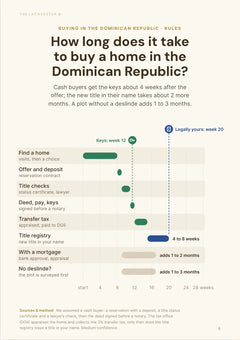
The basic check is cheap: a certification of the property's legal status from the Registro de Títulos costs about RD$1,000 (about $16). Full due diligence (title, liens, permits, seller's tax and condo debts) is usually part of your lawyer's 1% to 1.5%. Ask whether it's included.
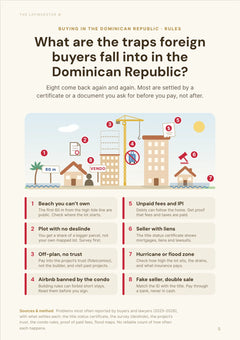
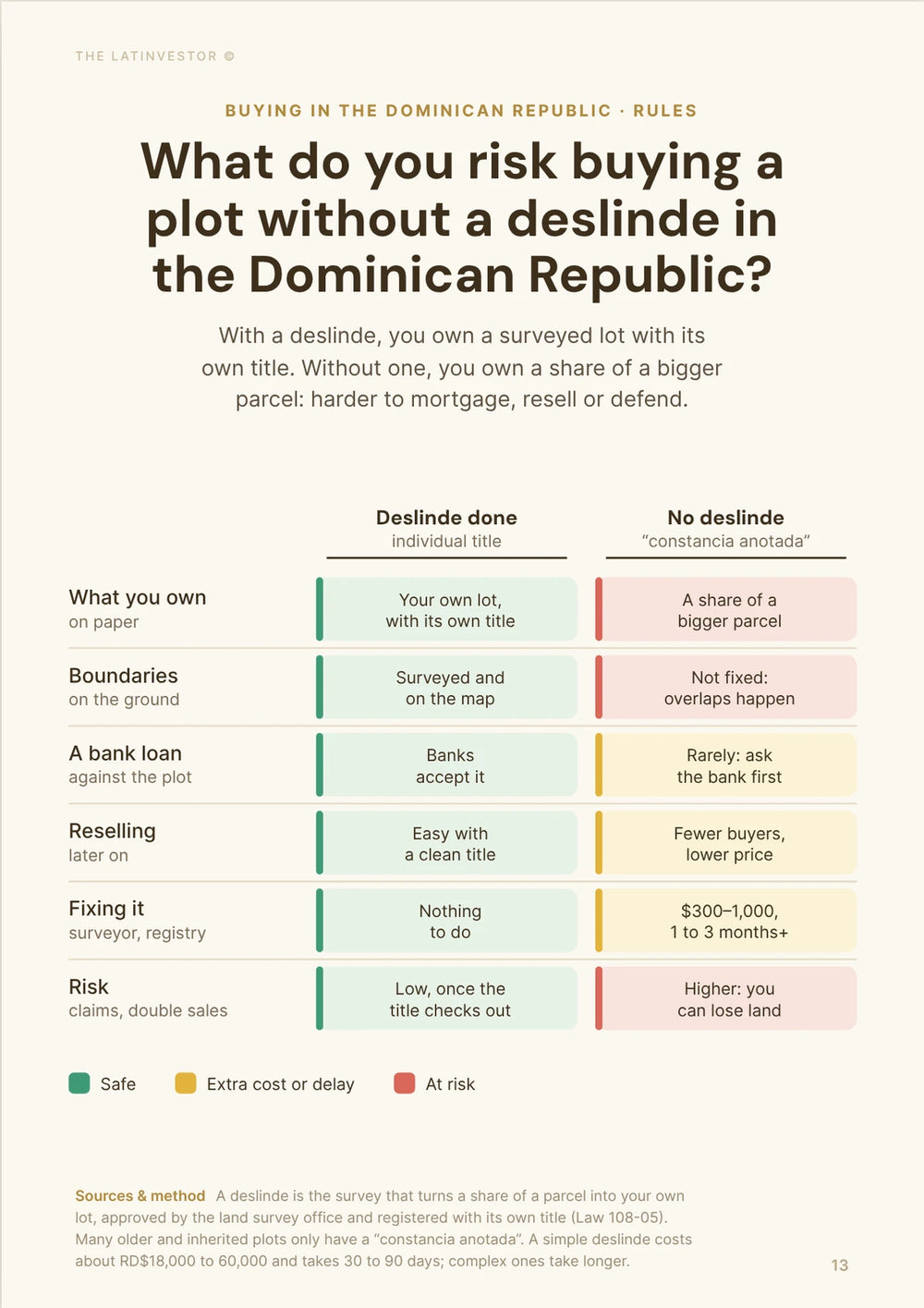
If the plot has no individual survey, a deslinde costs about RD$18,000 (about $295) to RD$60,000 (about $975) and takes 30 to 90 days. Avoid buying on a "constancia anotada" (a share of a larger plot without its own surveyed title).
A private appraisal usually costs a few hundred dollars. Banks require one if you take a mortgage.
The check you should never skip is the title status at the Registro de Títulos. Rushing past it is how most foreign buyers end up with legal problems.
What hidden or surprise costs should I watch for in the Dominican Republic right now?
What are the most common unexpected fees buyers discover in the Dominican Republic?
The most common surprises: a DGII appraisal above your price (so the 3% is bigger than planned), unpaid condo dues (common in resort areas), extra registry steps for a messy title, the 18% ITBIS on your lawyer's invoice, and the 2% mortgage tax if you borrow.
Yes, you can inherit a seller's debts on the property. Ask for proof that the IPI is paid and a certificate from the condo administration that dues are up to date before closing.
Fake listings and rushed closings exist. Check ownership at the Registro de Títulos yourself, and never pay a deposit before your own lawyer has reviewed the title.
Small costs rarely shown upfront: stamps and certified checks, translations and apostilles, extra registry corrections, and the deslinde if the plot needs one. In off-plan, the developer's own contract fees and the cost of furnishing are also easy to miss.
Are there extra fees if the property has a tenant in the Dominican Republic?
Buying with a tenant mostly means more legal work: reviewing the lease, transferring the deposit and notifying the tenant. Expect your lawyer to bill extra for it; we found no standard price.
You take over the existing lease and must respect it until it ends. Law 85-25, in force since August 2025, sets the rules: deposits are capped at 2 months, a lease with no written term is presumed to run 1 year, and you must give 90 days' notice before the end of the term.
You generally can't end the lease right after buying because you want to live there. Eviction goes through the courts and can be slow and costly.
A sitting tenant gives you room to negotiate the price, especially if the rent is below market.
Which fees are negotiable, and who really pays what in the Dominican Republic?
Which closing costs are negotiable in the Dominican Republic right now?
Negotiable: your lawyer's fee (within reason), who pays some administrative and registry charges, and the agent commission between seller and agent (3% to 5%).
Not negotiable: the 3% transfer tax and the 2% mortgage registration tax in 2026. Both are set by law.
On legal fees, a modest discount is possible on simple or high-value deals, but don't push so hard that the lawyer skips checks. We found no published data on typical discounts.
Can I ask the seller to cover some closing costs in the Dominican Republic?
Yes, you can ask, and it happens. Whether the seller agrees depends on how long the property has been listed and how many similar units compete with it.
Sellers most often agree to cover some legal or registry charges, or give a credit at closing. Developers sometimes offer to pay part of the closing costs, or include furniture, instead of cutting the price.
You have the most room when the property has been listed for months, when your lawyer finds a problem, or in areas with a lot of new supply. RE/MAX counts more than 50 off-plan projects in its Punta Cana sample, so developers there compete for buyers.
Is price bargaining common in the Dominican Republic in 2026?
Yes. In 2026, bargaining is normal, especially on resales and when due diligence finds a title issue, repairs or unpaid condo dues.
There is no public data on final sale prices, only asking prices, so nobody can give you a reliable average discount. On resales that have been listed for a long time, buyers often get several percent off. Developers rarely cut the list price but more often give better payment plans, furniture or closing-cost help.
What monthly, quarterly or annual costs will I pay as an owner in the Dominican Republic?
What's the realistic monthly owner budget in the Dominican Republic right now?
For an apartment, we estimate roughly $200 to $700 a month (about RD$12,300 to RD$43,000), before any mortgage payment.
That covers condo (HOA) fees, insurance, electricity, water and internet, and a maintenance reserve.
Condo fees vary the most. In two 2026 listings we checked, a 112 m² 2-bedroom in Bávaro charged $185 a month and a 2-bedroom in Cana Bay $350. Buildings with pools, gyms, 24-hour security and generators charge the most.
Electricity: residential tariffs were frozen in October 2026 (Edesur RD$6.09/kWh in the low block, RD$13.09/kWh above it). Outages still happen, so a generator or inverter is an extra cost, either in the condo fee or your own.
Insurance matters more than many buyers think: hurricane season runs from 1 June to 30 November, and the east coast also deals with record sargassum in 2026, which hits beachfront upkeep.
What is the annual property tax amount in the Dominican Republic in 2026?
In 2026, the annual property tax (IPI, Impuesto al Patrimonio Inmobiliario) is 1% of the value above an exemption threshold of RD$10,695,494 (about $174,000), for individuals. The threshold applies to all your properties combined, at DGII-appraised values.
Below the threshold you pay nothing. Above it, a home appraised at RD$14 million pays about RD$33,045 (about $535) a year, and one appraised at RD$18 million about RD$73,045 (about $1,190).
The DGII appraisal is often below the market price, so many foreign-owned apartments pay little or no IPI. You can check your value with the DGII.
Beyond the threshold, there are other reliefs: retirees and rentistas, and owners over 65 of their only home, can get exemptions or reductions, and units in a Confotur project usually pay no IPI for 15 years. Companies and fideicomisos don't get the individual threshold.
If I rent it out, what extra taxes and fees apply in the Dominican Republic in 2026?
What tax rate applies to rental income in the Dominican Republic in 2026?
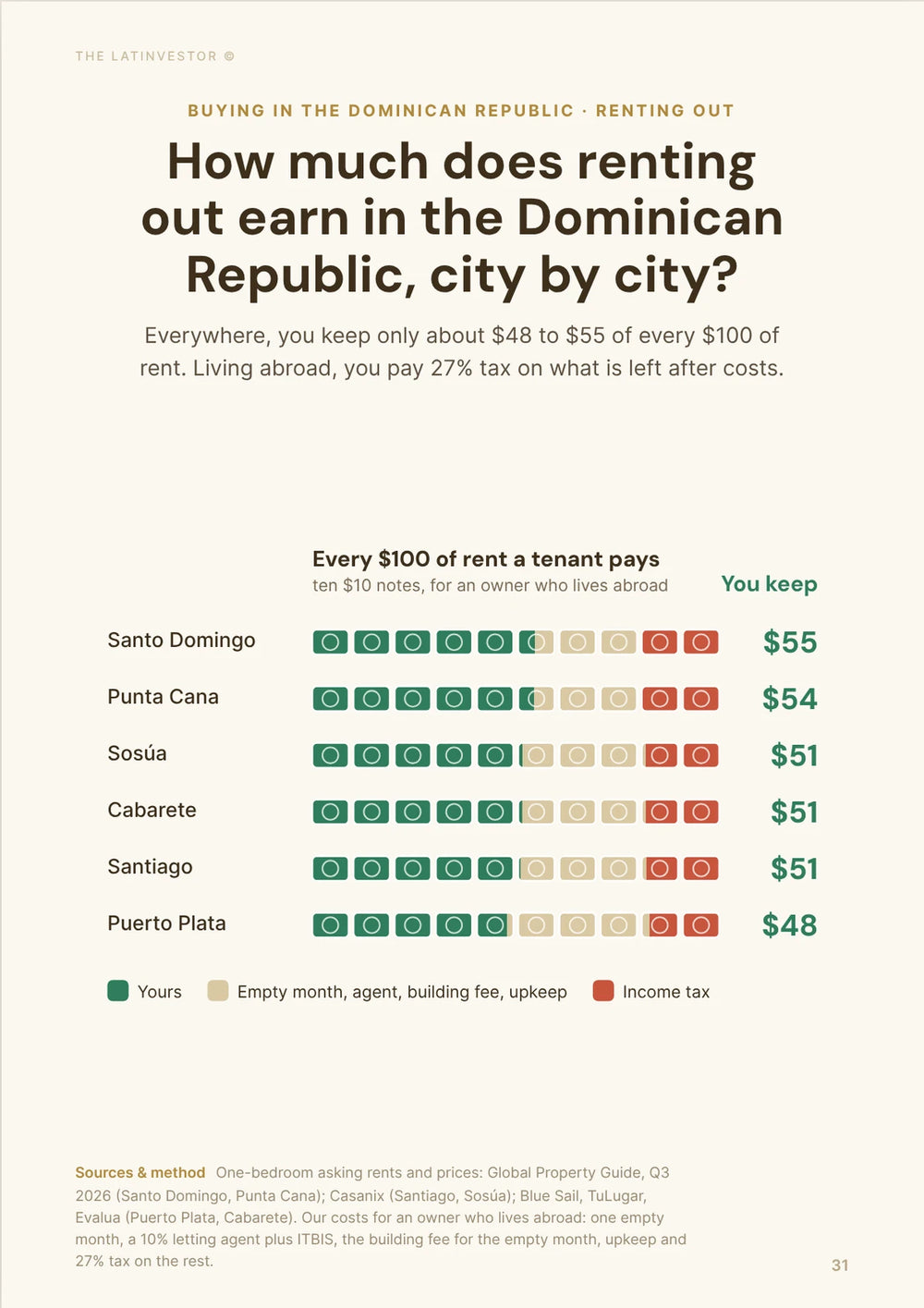
Rental income is subject to income tax (ISR). Since Law 30-26, a company that pays rent to an individual must withhold 15% of the rent (it was 10%).
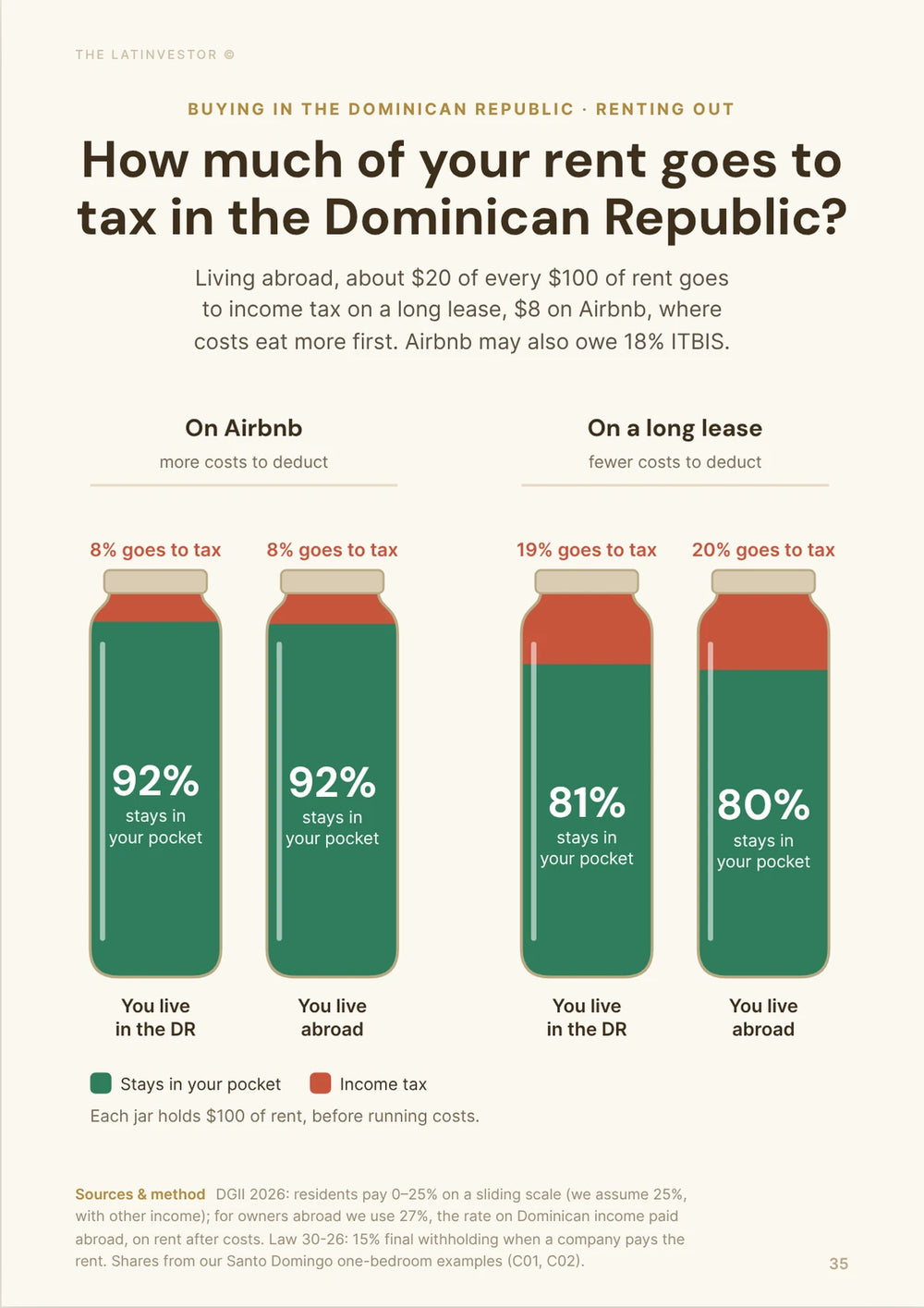
Residents pay the progressive income tax, from 0% to 25%, on their net rental profit. You can deduct documented costs linked to the property: maintenance, management, insurance and similar.
Non-residents are taxed differently. Dominican-source income of non-residents is subject to 27% withholding when a company pays it, and owners who rent to individuals or tourists usually file through a local accountant. Budget for the 27% non-resident rate on your Dominican rental profit.
Your home country may also tax that income, with a credit for Dominican tax depending on its rules and any tax treaty. Check this before you buy, not after.
Do I pay tax on short-term rentals in the Dominican Republic in 2026?
You pay income tax on short-term rental profit, like any rental. ITBIS (18% VAT) is the open question: a 2022 DGII consultation treats tourist villas, apartahotels and tourist apartments as subject to ITBIS, while long-term housing rentals are exempt. How it applies to an individual's Airbnb is not settled, so check with an accountant.
On the platform side, Airbnb's host-only fee is 15.5% in 2026 (3% for hosts still on split fees), and a manager usually takes 20% to 25% of revenue.
There is no national Airbnb license in force. MITUR's draft RENATUR registry, put to consultation in May 2026, was withdrawn on 20 July 2026 and moved to talks with the sector, with no new date. Condo bylaws can still ban short stays, so read the reglamento before you buy.
If I sell later, what taxes and fees will I pay in the Dominican Republic in 2026?
What's the total cost of selling as a % of price in the Dominican Republic in 2026?
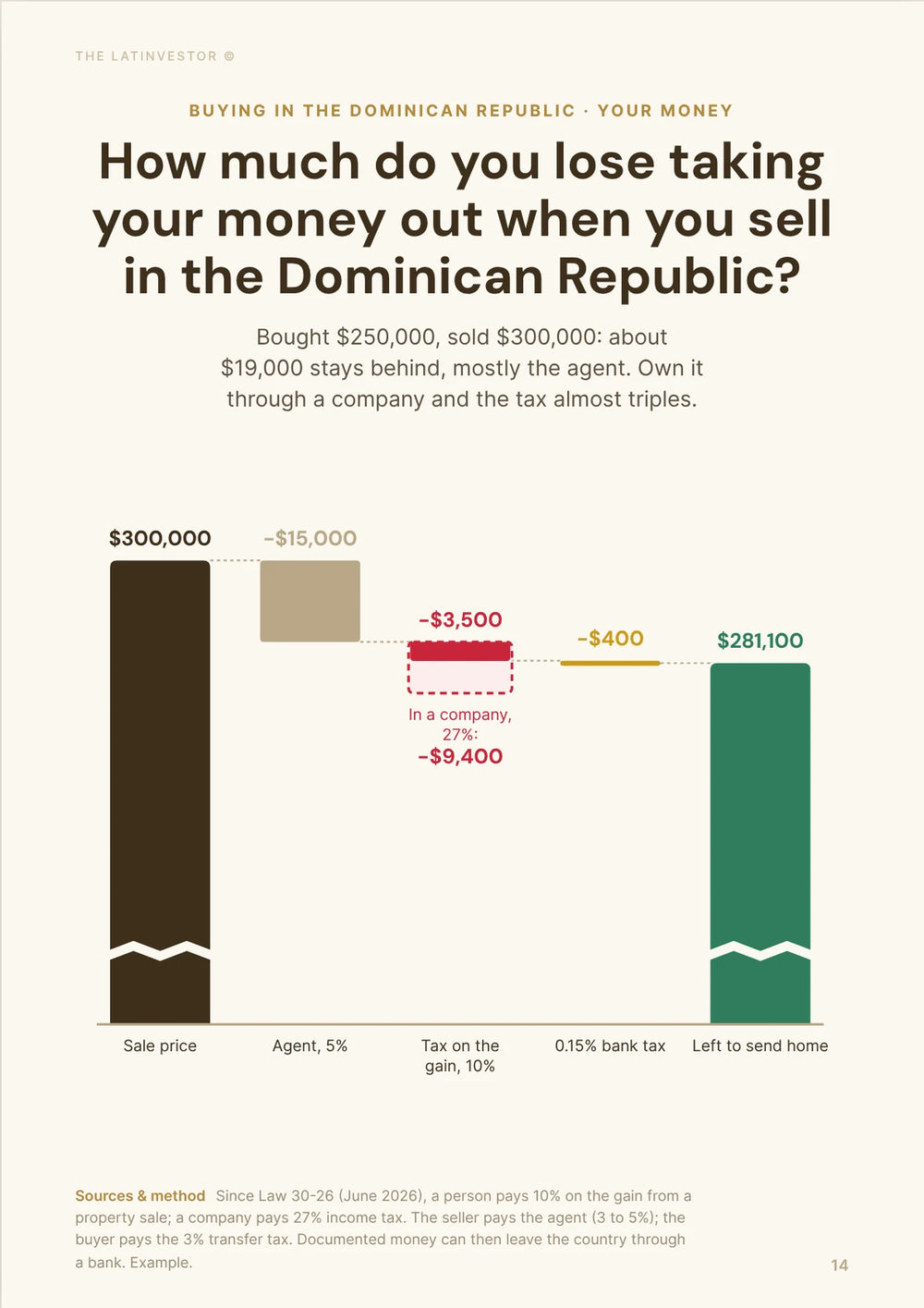
In 2026, selling usually costs about 4% to 6% of the price before capital gains tax: the agent's 3% to 5% plus about 1% for your lawyer.
Add the 10% tax on your gain. If you bought at $200,000 and sell at $260,000, the tax is about $6,000 on the $60,000 gain, and the agent and lawyer about $10,400 to $15,600. Total: roughly 6.3% to 8.3% of the sale price.
The agent commission is usually the biggest single cost. Under the old 27% rate, the tax on a large gain often beat it; at 10%, it rarely does.
What capital gains tax applies when selling in the Dominican Republic in 2026?
Since Law 30-26 (June 2026), individuals pay a flat, final 10% tax on the gain from selling property. Before, gains were taxed at up to 27%, with an inflation adjustment.
Two exemptions: the gain on your main home if you reinvest in a new main home within 6 months, and owners over 65 selling their main home. Neither covers an investment property, a rental or a holiday home.
The 10% is set for individuals, not by nationality. The law doesn't spell out how it is collected from a non-resident seller, so ask your lawyer before you sign the sale. Companies pay 27% on their gains (30% for very large companies from 2026 to 2028).
The gain is roughly the sale price minus your purchase price. Keep the deed, the transfer tax receipt and invoices for major works: whether improvements and inflation can be deducted under the new rule is still waiting for the implementing regulation.
What did Law 30-26 change for property owners in 2026?
Law 30-26, enacted on 18 June 2026, is already in force. For property, five changes matter.
Selling: individuals now pay a flat 10% on the gain instead of up to 27%. On a $60,000 gain, that's $6,000 instead of up to $16,200.
Borrowing: the mortgage registration tax is 2% of the loan in 2026, 1% in 2027 and 0 from 2028. If you plan to borrow and can wait, waiting saves money: $2,800 (about RD$172,000) on a $140,000 loan in 2026, half that in 2027.
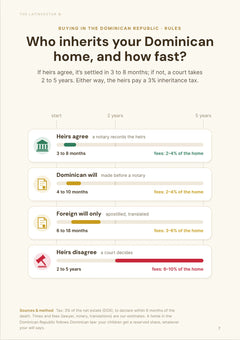
Renting: the withholding on rent paid by a company to an individual went from 10% to 15%. Inheritance: the tax stays at 3%, but estates under RD$1 million are exempt (RD$2 million for direct-line relatives), and gifts to close relatives dropped from 27% to 3%.
What hasn't changed: the 3% transfer tax, the IPI threshold and Confotur. A constitutional challenge has been filed against parts of the law, and the implementing regulation is still pending, so ask your lawyer which version applies on your closing date.
Related blog posts
- What can you buy in the Dominican Republic with $100k, $300k or $500k?
- Moving to the Dominican Republic? Here's everything you need to know
- Will property prices keep rising in the Dominican Republic?
- What are housing prices like in the Dominican Republic?
- How much is rent in the Dominican Republic?
- Can foreigners buy and own property in the Dominican Republic?
Our methodology
This article lists what a foreign buyer pays in the Dominican Republic: taxes and fees at purchase, yearly owner costs, taxes on rent, and the cost of selling. It applies nationwide; only condo fees and appraisals change from one area to another.
Total closing costs come from 1122 Real Estate's July 2026 breakdown, checked item by item: the 3% transfer tax (DGII), lawyer fees (Inmobiliaria Puntual, Guzman Ariza), notary and registry fees (1122 Real Estate, Registro Inmobiliario) and the 2% mortgage tax (Law 30-26). Agent commissions come from InstaDigs and Seekers. Condo fees come from individual 2026 listings, and electricity tariffs from the October 2026 government announcement.
Tax rules come from the DGII, the text of Law 30-26 and analyses by Pellerano & Herrera and Century 21 Perdomo. Confotur rules come from Law 158-01, Tropical Assets and MITUR. Lease rules come from Law 85-25.
We checked these figures in October 2026. Conversions use about 61.5 Dominican pesos per US dollar.
Where we had no direct figure (translations, appraisals, the monthly owner budget, discounts on price or legal fees), we estimated it or described it without a number, and say so. Your own costs will depend on the DGII appraisal, your lawyer, whether you borrow, whether the project has Confotur and your tax status at home.
Key sources used for this analysis include DGII transfer tax calculator, DGII IPI page, DGII ITBIS page, DGII ITBIS FAQ, DGII capital gains FAQ, DGII tourist rental consultation, Law 30-26, Presidency: DGII on Law 30-26, Pellerano & Herrera on Confotur and Law 30-26, Century 21 Perdomo on Law 30-26, Tropical Assets Confotur guide, MITUR Confotur search, 1122 Real Estate closing costs 2026, Inmobiliaria Puntual closing costs, Guzman Ariza legal guide, InstaDigs commissions, Seekers Inmobiliaria, Registro Inmobiliario, Law 85-25 on leases, Presidency electricity tariff freeze, Airbnb host fees, Host My Spot and Banco Central (BCRD).