


Summary
A single retiree in Colombia should currently plan around COP 6.5 million to COP 9 million a month for a comfortable lifestyle, while a couple should aim closer to COP 9 million to COP 12 million. At the current exchange rate, that is roughly US$2,100-US$2,900 for one person and US$2,900-US$3,830 for two.
The legal minimum and the comfortable minimum are now quite different numbers. Colombia's pensionado visa threshold is around COP 5.25 million a month, which can work in cheaper cities but leaves much less margin for private healthcare, international travel and unexpected costs.
Where a retiree lives matters more than shaving small amounts from groceries or transport. A central one-bedroom around COP 1.7 million in Pereira versus roughly COP 2.9 million in Medellín or COP 3.4 million in Cartagena can change the entire retirement budget.
Medellín is still affordable, but the old idea of living extremely well there on US$1,500 a month has aged badly. At today's exchange rate, a typical central one-bedroom alone can absorb well over half of that budget.
Currency has become one of the biggest hidden retirement costs. The exact same COP 8 million lifestyle cost about US$1,667 when the dollar bought COP 4,800, versus roughly US$2,550 with the peso around COP 3,130.
Couples benefit heavily from shared housing and utilities, so two people do not need twice the single-person budget. US$2,000 a month can still work for a couple in a cheaper city, but it no longer buys the kind of carefree foreigner-oriented lifestyle sometimes associated with Colombia.
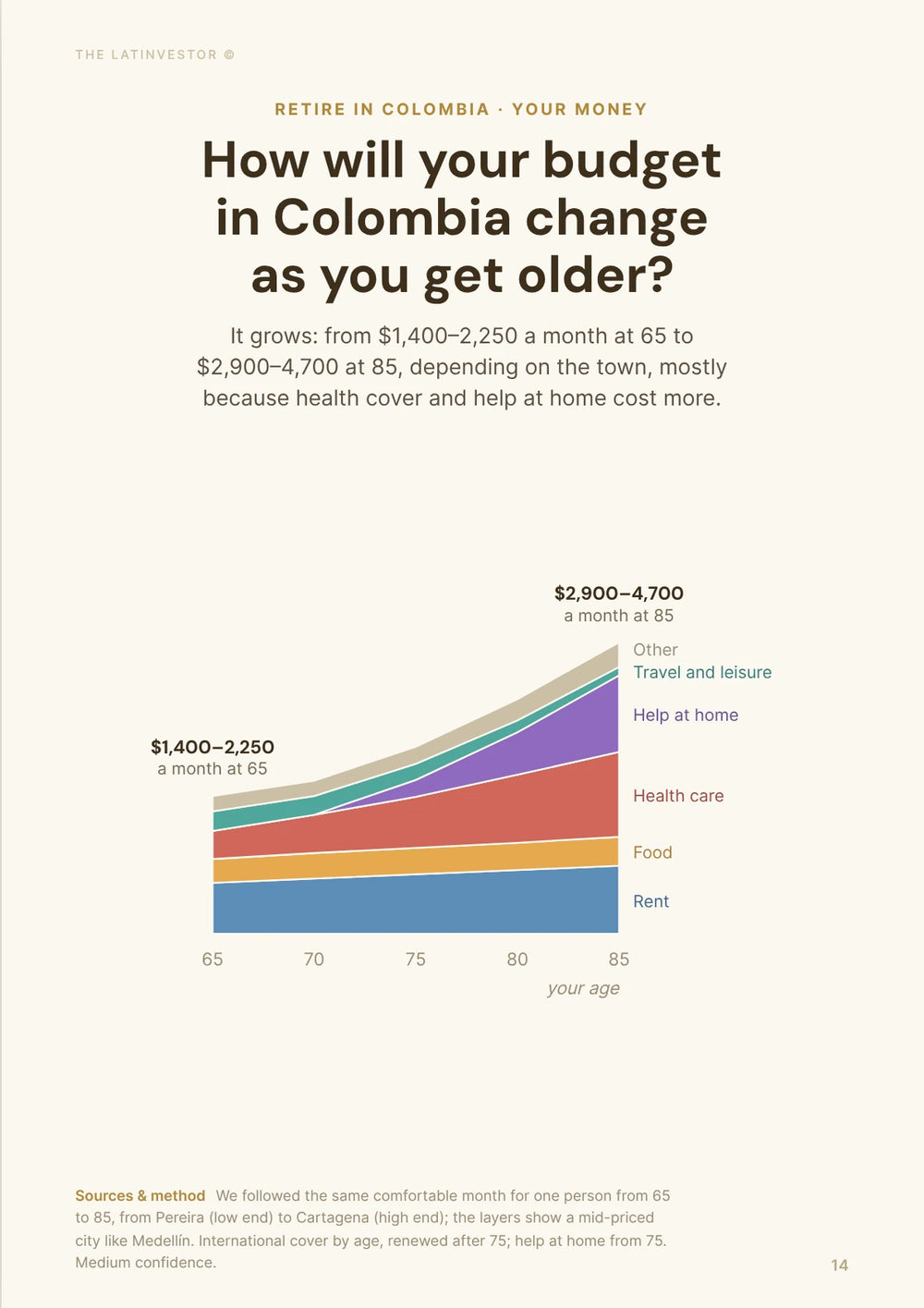
Healthcare remains comparatively affordable, but treating it as almost free is a mistake. A sensible monthly budget should leave roughly COP 400,000-COP 1 million for contributions, private coverage, medicines and routine out-of-pocket spending, with more needed at older ages.
Taxes become much more important once a retiree spends enough time in Colombia to become tax resident. The country's foreign-assets reporting threshold is only 2,000 UVT, currently about COP 104.7 million, so retirees with substantial assets abroad should look at Colombian tax exposure before making a permanent move.
Buying a home is not required to make retirement affordable. Renting first is usually the cleaner move because neighborhood choice can have a bigger impact on daily life than expected, while the financial cost of waiting a year or two before buying is relatively modest.
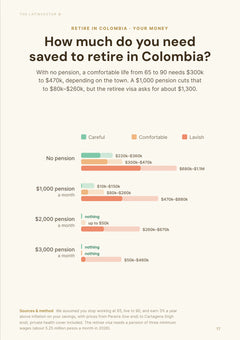
A retiree without a pension needs much more capital than headline monthly budgets suggest. Funding a comfortable COP 7.5 million monthly lifestyle entirely from investments points to roughly COP 2.25-COP 2.57 billion using 4% and 3.5% initial withdrawal assumptions, or about US$720,000-US$820,000 at the current exchange rate.
A dependable pension changes the calculation dramatically because investments only have to finance the gap between the pension and spending. Someone receiving around US$2,500-US$3,000 a month already has enough recurring income for a comfortable single retirement across most of Colombia, assuming taxes and healthcare do not create unusual personal costs.
The practical planning number today is therefore around US$2,500 a month for one person or US$3,500-US$4,000 for a couple, plus six to twelve months of liquid reserves. Colombia is still a genuinely affordable retirement destination, but the strong peso, higher rents and persistent inflation mean the old ultra-cheap expat budgets need a serious update.

How much money do you actually need to retire in Colombia today?
A single foreign retiree should currently aim for about COP 6.5 million to COP 9 million a month for a comfortable retirement in Colombia, or roughly US$2,100 to US$2,900 at today's exchange rate.
That range leaves room for a decent apartment, groceries, restaurants, local transport, healthcare and some travel without having to watch every expense. COP 5 million to COP 6 million can still work, especially outside Colombia's most expensive neighborhoods, but the margin gets thinner once private healthcare, international flights and unexpected costs enter the picture.
At the other end, COP 10 million a month is already enough for a noticeably more comfortable lifestyle in most of the country. It allows roughly US$3,200 of monthly spending today, which goes a long way unless the retiree chooses premium housing, frequent international travel or an expensive part of Cartagena, Bogotá or Medellín.
The exchange rate is particularly important right now. Colombia's official TRM is around COP 3,130 per US dollar. That makes a peso-denominated lifestyle much more expensive for a dollar-funded retiree than when the peso traded above COP 4,000.
| Retirement style | Monthly budget | Approx. USD today | What that usually buys |
|---|---|---|---|
| Lean | COP 4.5m-5.5m | $1,440-$1,760 | Modest housing, local lifestyle, little excess |
| Comfortable | COP 6.5m-9m | $2,100-$2,900 | Good apartment, restaurants, healthcare buffer |
| Very comfortable | COP 9m-12m | $2,900-$3,830 | Better housing, frequent dining and travel |
| Premium | COP 12m+ | $3,830+ | Prime neighborhoods and little need to economize |
Is Colombia's retirement visa minimum enough to live on?
Colombia's pensionado visa income threshold is enough for one person to live on, but today it sits below what we would call a reliably comfortable retirement budget.
Colombia's Foreign Ministry requires pensionado applicants to prove a lifetime pension worth at least three legal monthly minimum wages. The current minimum wage is COP 1,750,905, so the pension requirement works out to COP 5,252,715 a month.
At the current exchange rate, that is roughly US$1,680.
The threshold deserves attention because it jumped sharply. Colombia raised its minimum wage by 23% this year, and the pensionado requirement rose with it. Someone whose pension is fixed in dollars or euros therefore faces a moving Colombian requirement even if the pension itself never changes.
COP 5.25 million is workable in Pereira, Armenia, Manizales, Cali or less expensive parts of the larger cities. In El Poblado, upscale Bogotá or tourist-heavy Cartagena, it becomes a fairly constrained budget once rent and healthcare are covered.
We would treat COP 5.25 million as a useful legal floor. For the actual lifestyle, COP 6.5 million or more gives a single retiree much more room.
| Measure | Monthly amount | Approx. USD today | What it tells us |
|---|---|---|---|
| Colombian minimum wage | COP 1.75m | $560 | National wage benchmark |
| Pensionado visa threshold | COP 5.25m | $1,680 | Minimum qualifying pension |
| Comfortable single retiree | COP 6.5m-9m | $2,100-$2,900 | More realistic planning range |
| Very comfortable single retiree | COP 9m-12m | $2,900-$3,830 | Much more freedom over housing and travel |
Which Colombian cities are actually cheap for retirees now?
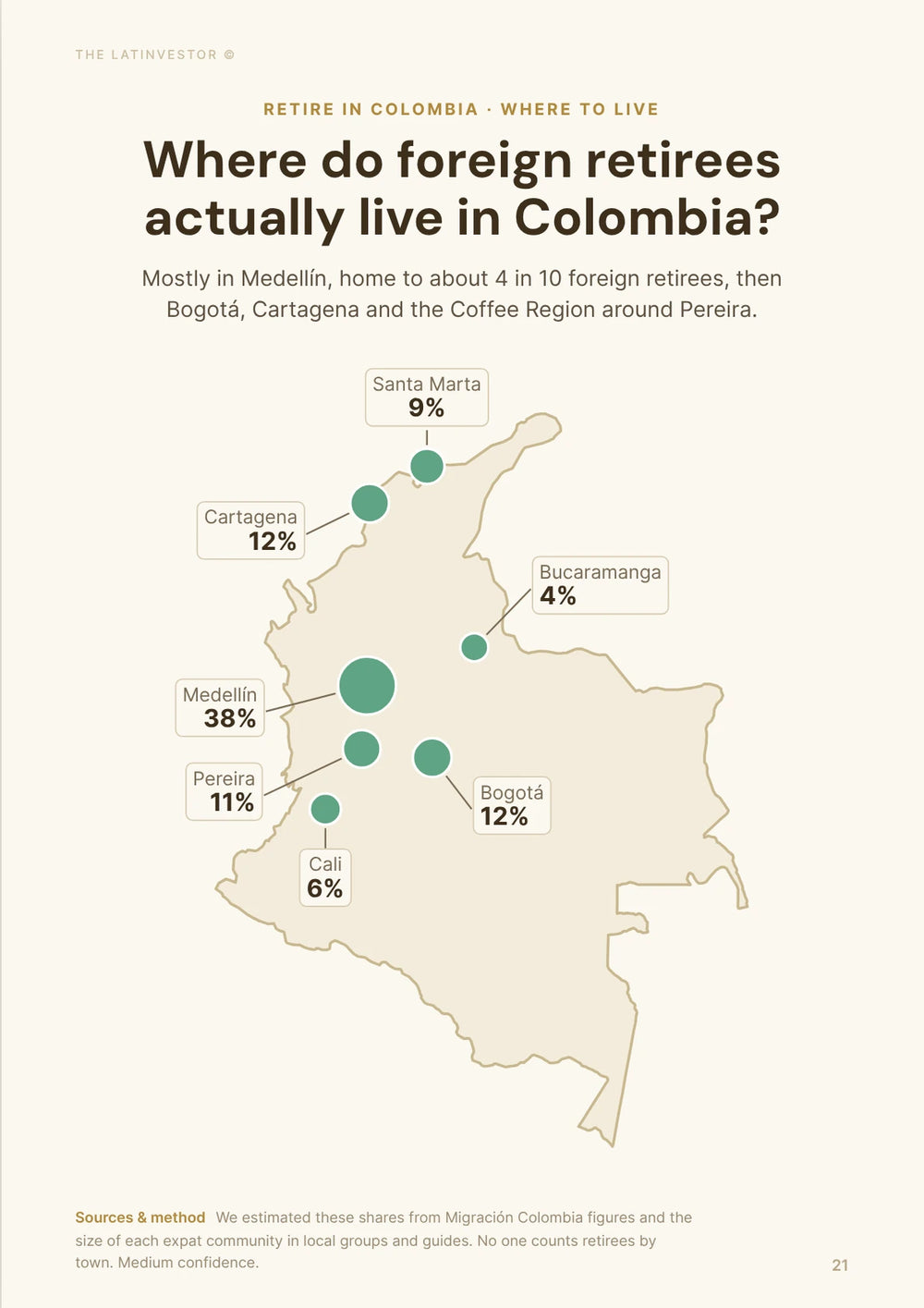
Pereira and other secondary cities still offer the clearest version of low-cost retirement in Colombia, while Medellín and Cartagena can now cost surprisingly close to larger international cities once premium housing enters the budget.
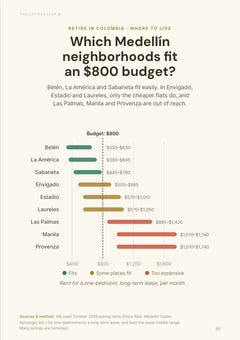
Recent Numbeo observations put a one-bedroom apartment in central Pereira around COP 1.7 million a month. The equivalent average is about COP 2.0 million in Bogotá, COP 2.9 million in Medellín and COP 3.4 million in Cartagena.
That spread is enormous for someone living on a pension. Choosing Pereira instead of Medellín can save around COP 1.2 million every month on a typical central one-bedroom before changing anything else about the lifestyle. Against Cartagena, the gap approaches COP 1.7 million.
Over ten years, a COP 1.5 million monthly housing difference adds up to COP 180 million before inflation. Small savings on coffee, taxis or groceries barely register beside that.
Generic Colombian averages also hide a selection effect. Many retirees want modern buildings, security, walkability, nearby hospitals and good restaurants. Those preferences push them toward precisely the neighborhoods where housing costs have separated most from local incomes.
| City | Recent central 1BR estimate | Rough comfortable single budget | Main trade-off |
|---|---|---|---|
| Pereira | ~COP 1.7m | COP 5m-7m | Smaller international scene |
| Bogotá | ~COP 2.0m | COP 6.5m-9m | Premium neighborhoods get expensive quickly |
| Medellín | ~COP 2.9m | COP 7m-9m | Strong foreign demand for preferred areas |
| Cartagena | ~COP 3.4m | COP 7.5m-10m+ | Tourism and higher utility costs |

Is Medellín still cheap enough to retire in?
Medellín is still affordable for retirement, but the idea that a foreigner can live extremely well there on US$1,500 a month is increasingly outdated.
Current Numbeo data put a typical one-bedroom apartment in central Medellín around COP 2.9 million. Outside the centre, the average is still above COP 2.1 million. Larger central apartments are above COP 5 million on average.
With the peso near COP 3,130 per dollar, COP 2.9 million of rent alone equals roughly US$930. A US$1,500 pension would therefore leave only about US$570 for food, electricity, healthcare, transport, entertainment and everything else.
A retiree who avoids El Poblado and other internationally popular areas can spend much less. Medellín has a huge rental market, and citywide averages hide plenty of cheaper options.
Still, a comfortable Medellín retirement now looks closer to COP 7 million-COP 9 million a month, or roughly US$2,200-US$2,900. Medellín is affordable. Dirt-cheap, not really anymore.
Can a couple still retire in Colombia for $2,000 a month?
A couple can live in Colombia on US$2,000 a month, but today that budget works best in a cheaper city and leaves little room for an expensive foreigner-oriented lifestyle.
At the current exchange rate, US$2,000 provides roughly COP 6.3 million. Couples have one big advantage: housing, internet and many utilities are shared. Two people do not need twice the budget of one.
Suppose a couple rents for COP 1.7 million in Pereira. Roughly COP 4.6 million remains for groceries, healthcare, transport, restaurants and leisure. That is enough for a solid local lifestyle.
Put the same couple in a COP 3.5 million Medellín apartment and only about COP 2.8 million remains. The budget suddenly feels very different.
For a couple who wants good housing, regular restaurant meals, private medical options and some travel, we would currently aim closer to COP 9 million-COP 12 million a month. That is roughly US$2,900-US$3,830.
US$2,000 is still a viable Colombia retirement number for two people. We just would not present it anymore as a budget that buys complete freedom.
How much should retirees budget for healthcare in Colombia?
A foreign retiree should usually leave several hundred thousand pesos a month for healthcare in Colombia, with a larger buffer at older ages or when private coverage is important.
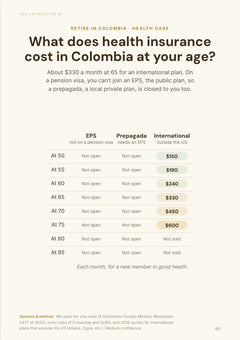
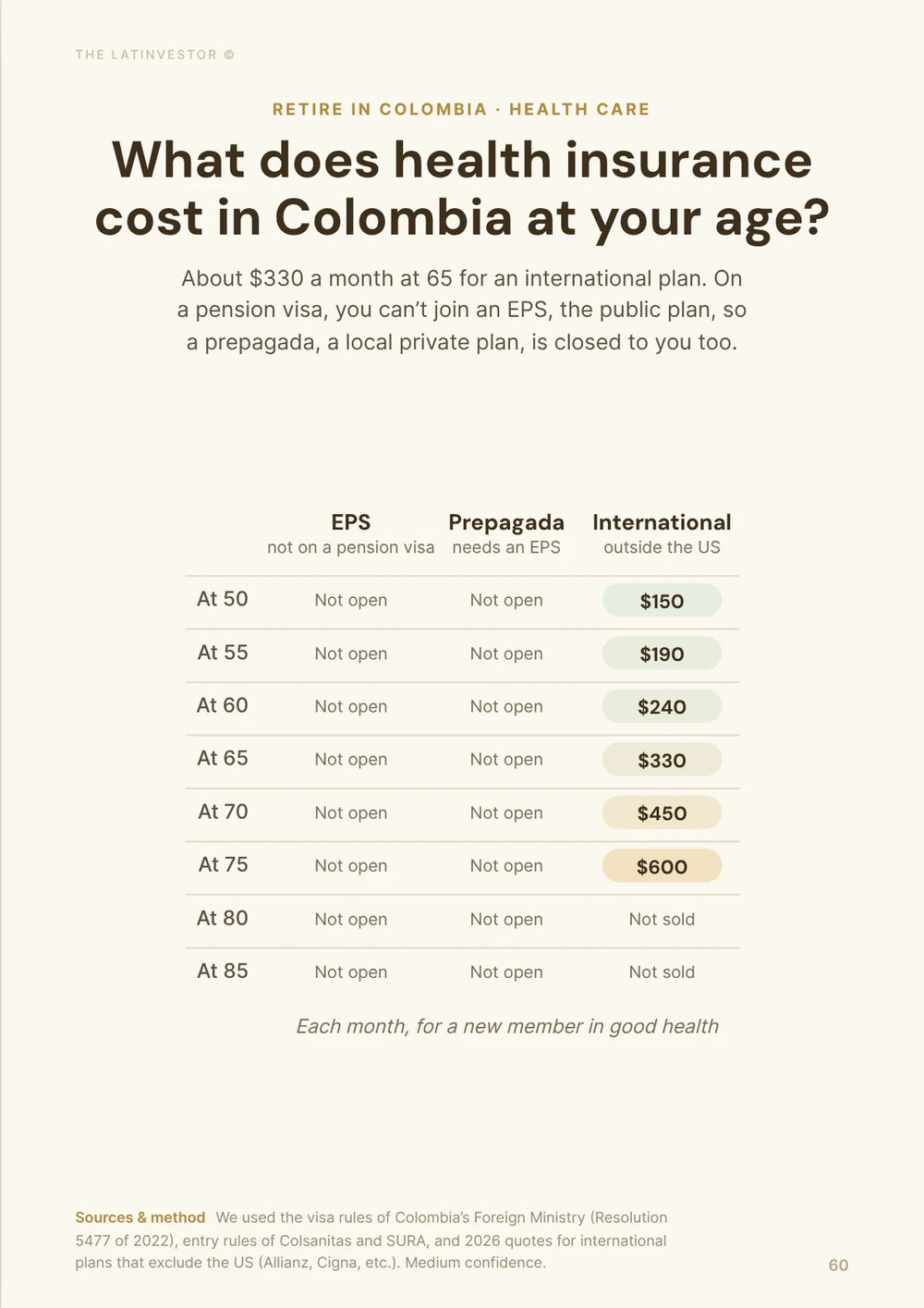
Colombia's public health system can keep costs much lower than in the United States, but foreign retirees should avoid assuming healthcare will barely affect the budget. Depending on immigration status and circumstances, a resident may join an EPS and may also choose medicina prepagada or another private plan for faster appointments and wider provider choice.
Colombia's Health Ministry states that pensioners can have compulsory health contributions linked to pension income. The exact treatment of a foreign pension and the contribution base needs to be checked for the individual retiree, especially because immigration rules and social-security rules do not use exactly the same tests.
Private coverage varies even more. Age, pre-existing conditions, insurer and level of coverage can change premiums significantly.
For budgeting purposes, we would keep roughly COP 400,000-COP 1 million a month available for contributions, supplementary coverage, medicines and routine out-of-pocket costs. A younger healthy retiree may spend less. An older retiree who wants broad private access can easily spend more.
Healthcare remains one of Colombia's attractions, but a real retirement budget should actually put a number beside it.
Has Colombia become more expensive for foreign retirees lately?
Yes. Colombia is still inexpensive internationally, but local inflation and a much stronger peso have both raised the effective cost of retiring there.
The latest DANE consumer-price reading shows annual inflation running just above 6%. Housing, utilities and healthcare were among the categories still rising faster in the latest monthly data.
Six percent inflation alone is noticeable. A COP 7 million monthly lifestyle becomes about COP 9.4 million after six years if prices rise by 5% annually. A retiree whose pension barely covers the budget today would gradually lose breathing room even without changing apartments or adding luxuries.
Currency movements have been even more dramatic for foreigners.
The peso traded above COP 4,800 per dollar around the end of 2022 and around COP 4,400 during parts of late 2024. The official TRM is now near COP 3,130.
Take exactly the same COP 8 million Colombian lifestyle. At COP 4,800 per dollar it costs about US$1,667. At COP 4,000 it costs US$2,000. At today's rate it costs roughly US$2,550.
The retiree has done nothing differently, yet the dollar cost has risen by more than 50% between the two exchange-rate extremes.
As seen above, the current exchange rate is one reason old "$1,500 a month in Colombia" articles need to be treated carefully. Some of those budgets were written in a completely different currency environment.
| Monthly Colombia budget | At COP 4,800/USD | At COP 4,000/USD | Around today's rate |
|---|---|---|---|
| COP 5m | $1,042 | $1,250 | ~$1,600 |
| COP 7m | $1,458 | $1,750 | ~$2,235 |
| COP 9m | $1,875 | $2,250 | ~$2,870 |
| COP 12m | $2,500 | $3,000 | ~$3,830 |
Could taxes make retiring in Colombia much more expensive?
Taxes may barely change the budget of one retiree and completely change another's, so anyone arriving with substantial foreign assets should deal with this before settling permanently in Colombia.
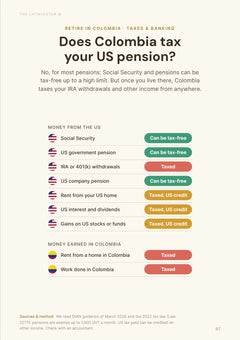
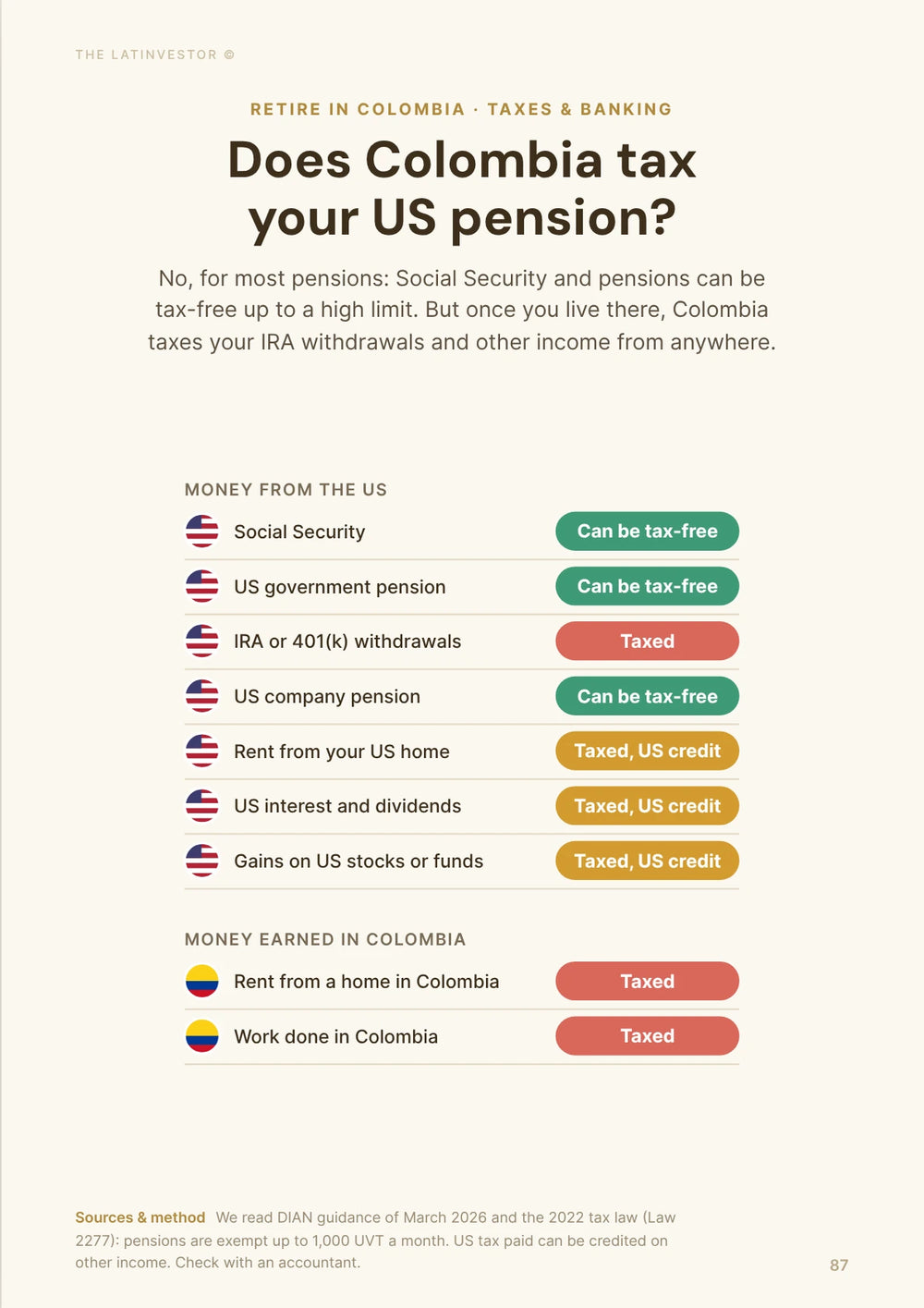
The basic residency threshold is important. DIAN generally considers someone a Colombian tax resident after more than 183 days of presence during a rolling 365-day period.
Tax residence can bring foreign income and assets into the Colombian tax conversation. DIAN currently requires qualifying taxpayers with foreign assets above 2,000 UVT to file Colombia's annual foreign-assets declaration. With the current UVT at COP 52,374, the threshold is COP 104,748,000.
That is only about US$33,000 at today's exchange rate.
The declaration itself is informational and does not automatically create a tax bill, but the low threshold shows why foreign retirees with brokerage accounts, bank accounts or property abroad should not assume their finances remain outside Colombian reporting rules.
Pensions have their own exemptions and technical rules, while investment income, capital gains and wealth can produce a very different result. Tax treaties can also change the treatment depending on the retiree's home country.
For someone living on a moderate pension, taxes may remain a secondary expense. For a retiree arriving with US$1 million or US$2 million invested abroad, tax planning can be as important as negotiating the rent.
Should retirees rent or buy a home in Colombia?
Most new retirees in Colombia should rent first because the financial penalty for waiting is fairly small and choosing the wrong neighborhood can be expensive.
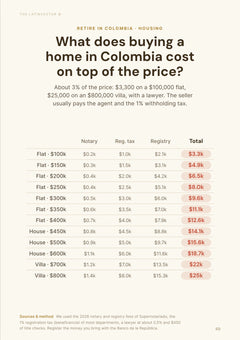
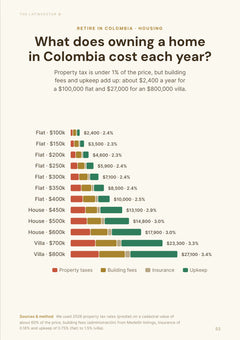
Medellín shows why. Recent Numbeo observations put central apartment purchase prices around COP 10.4 million per square metre. An 80-square-metre apartment at that average would cost roughly COP 835 million.
Meanwhile, a typical central one-bedroom rents for around COP 2.9 million a month.
Renting also lets a newcomer test daily life. Medellín can feel completely different in Laureles, El Poblado, Envigado or Belén. Bogotá changes just as much between Chapinero, Usaquén, Rosales and more residential neighborhoods. Even Cartagena's living costs change sharply once a retiree moves away from the tourist core.
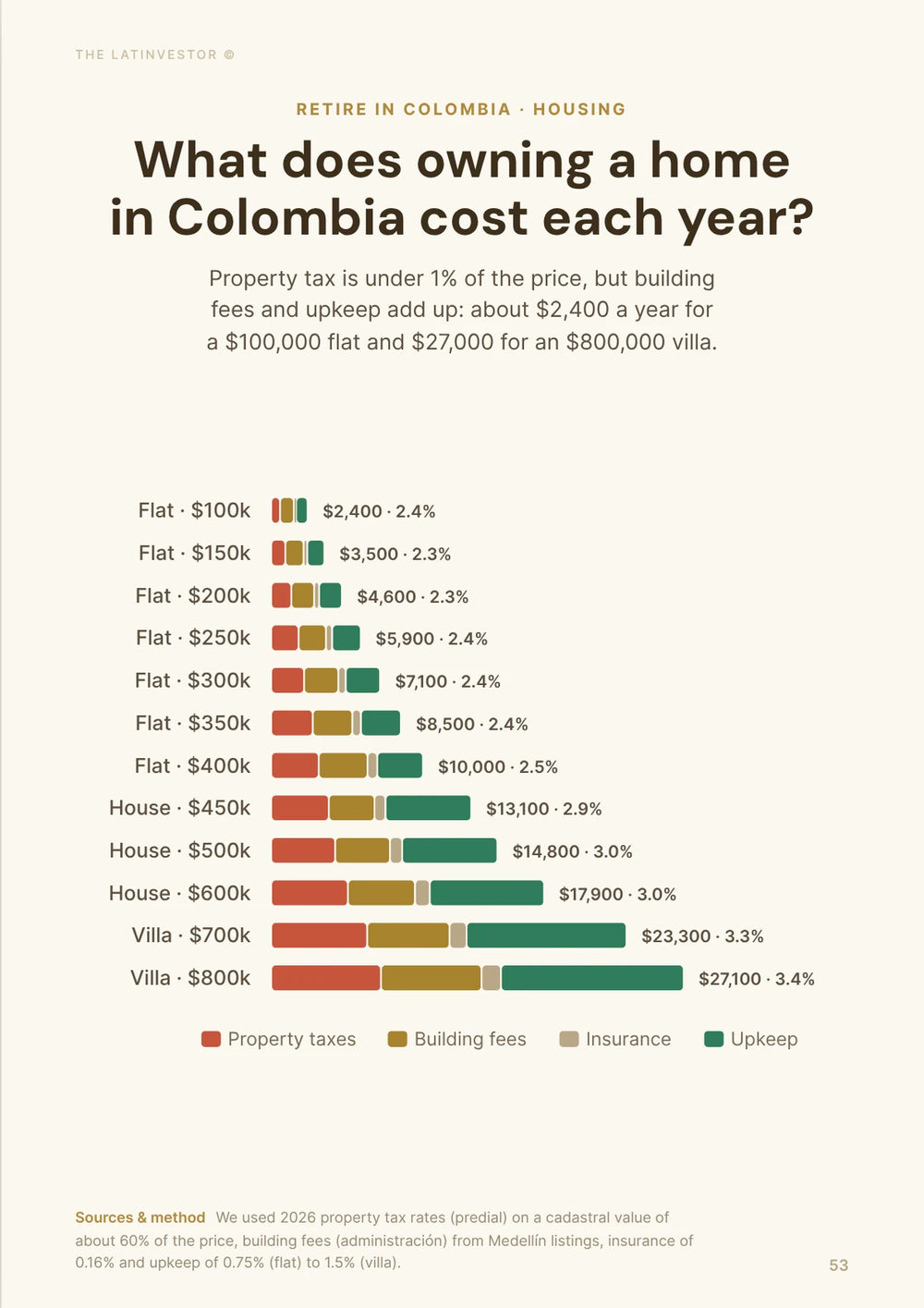
Buying can make sense after that choice is settled, particularly for someone planning to remain for many years. The owner then replaces rent with administration fees, maintenance, taxes and the opportunity cost of the capital tied up in the apartment.
Property ownership is not a prerequisite for an affordable Colombian retirement. Renting already works well financially, and the flexibility has real value during the first year or two.
How much emergency money should you keep when retiring in Colombia?
A retiree living in Colombia should normally keep six to twelve months of local spending in liquid reserves.
For someone spending COP 7 million a month, that means roughly COP 42 million-COP 84 million. At COP 9 million a month, the range becomes COP 54 million-COP 108 million.
Currency risk is one reason for keeping the reserve larger than a normal holiday fund. If the peso strengthens quickly, a dollar pension suddenly buys fewer pesos. A reserve already available in Colombia can prevent an exchange-rate move from forcing an immediate cut in spending.
Medical expenses, emergency flights home, moving apartments and replacing household equipment add other reasons.
Someone with a guaranteed pension that comfortably exceeds monthly spending can stay closer to six months. A retiree funding everything by selling investments has a stronger case for keeping twelve months or more because a market downturn and an unfavorable exchange rate can happen at the same time.
How much investment money do you need to retire in Colombia without a pension?
Without a pension, a comfortable Colombia retirement currently points to roughly US$600,000-US$900,000 of invested assets for one person, with cheaper lifestyles falling below that range and expensive ones pushing above US$1 million.
The arithmetic becomes clearer when we start in pesos.
A retiree spending COP 7.5 million a month needs COP 90 million a year. Using a 4% initial withdrawal rate, that implies COP 2.25 billion of invested assets. At 3.5%, the requirement rises to roughly COP 2.57 billion.
With today's exchange rate, those figures are approximately US$720,000 and US$820,000.
A leaner COP 5 million lifestyle requires COP 60 million a year. At 4%, the portfolio is COP 1.5 billion, currently around US$480,000.
At COP 10 million of monthly spending, the 4% calculation rises to COP 3 billion, roughly US$960,000 today.
These are planning benchmarks rather than promises that a withdrawal strategy will last forever. Investment returns, taxes, fees, lifespan and future Colombian inflation all change the result.
Still, the order of magnitude is useful. Retiring in Colombia without a pension can require several hundred thousand dollars more than a casual "Colombia is cheap" calculation suggests.
| Monthly spending | Annual spending | Portfolio at 4% | Portfolio at 3.5% |
|---|---|---|---|
| COP 5m | COP 60m | COP 1.50bn | COP 1.71bn |
| COP 7.5m | COP 90m | COP 2.25bn | COP 2.57bn |
| COP 9m | COP 108m | COP 2.70bn | COP 3.09bn |
| COP 12m | COP 144m | COP 3.60bn | COP 4.11bn |
What changes if you already have a pension?
A reliable pension can cut the investment capital needed for retirement in Colombia by hundreds of thousands of dollars.
Imagine a retiree wants to spend COP 8 million a month. With no pension, the annual requirement is COP 96 million. At a 4% withdrawal rate, funding the entire lifestyle requires COP 2.4 billion.
Now imagine the retiree receives a pension worth COP 6 million a month after currency conversion. Investments need to produce only the remaining COP 2 million, or COP 24 million a year.
At 4%, that gap requires a portfolio of about COP 600 million.
The difference between COP 600 million and COP 2.4 billion comes entirely from having predictable monthly income.
This is why the same headline retirement budget can mean very different things for two people. Someone with a US$2,500 inflation-linked pension may already have nearly everything needed to live comfortably in Colombia. Someone with no pension needs enough capital to recreate that income for decades.
For retirement planning, reliable income often matters more than total net worth.
How much can you save by retiring outside Medellín or Cartagena?
Choosing a cheaper Colombian city can save roughly COP 1 million-COP 3 million a month without forcing a dramatically different standard of living.
Housing creates most of the gap. Recent city data put a central one-bedroom in Pereira around COP 1.7 million, compared with roughly COP 2.9 million in Medellín and COP 3.4 million in Cartagena.
A retiree moving from a COP 3 million apartment to a COP 1.7 million one saves COP 1.3 million every month. That is COP 15.6 million a year before considering any difference in restaurants, transport or entertainment.
Over 20 years, the same nominal monthly difference adds up to COP 312 million.
Pereira, Armenia and Manizales are particularly interesting for retirees who care more about climate, healthcare and everyday comfort than nightlife or a huge expat community. Cali can also be cheaper than the best-known foreigner districts of Medellín.
There are trade-offs. Smaller cities have fewer direct international flights, smaller English-speaking communities and less depth in some highly specialized medical services.
But if the goal is to stretch a pension, city choice currently gives retirees far more leverage than trying to save a little on everyday purchases.
What retirement budgets are too tight for Colombia now?
A foreign retiree relying on less than about COP 5 million a month is entering the zone where Colombia can still work, but the lifestyle depends heavily on location and personal discipline.
COP 4 million is roughly US$1,280 today. A COP 1.5 million apartment immediately consumes more than one-third of it. Add utilities, groceries, transport, healthcare and occasional entertainment, and there is little room left for international travel or large unexpected expenses.
That does not make COP 4 million impossible. Colombians live on far less. A retiree who owns a home, lives outside an expensive city, cooks regularly and has inexpensive healthcare could make the number work.
The problem is resilience. Exchange rates move. Rents increase. Medical needs tend to rise with age. Flights home can cost several months of normal discretionary spending.
For a foreigner planning retirement rather than simply testing Colombia for a year, we would be uncomfortable building the entire plan around COP 4 million.
Around COP 5 million-COP 6 million, the picture improves substantially in cheaper cities. Above COP 6.5 million, one person starts getting enough room to absorb ordinary surprises without constantly rebuilding the budget.
So how much money do you really need to retire in Colombia?
For one person, COP 6.5 million-COP 9 million a month is currently the strongest general answer; for a couple, we would use roughly COP 9 million-COP 12 million.
At today's exchange rate, that means about US$2,100-US$2,900 for one person and US$2,900-US$3,830 for a couple.
People can retire for less. A single retiree spending COP 5 million-COP 6 million in Pereira, Armenia, Manizales or another affordable location can still have a good life. The pensionado visa itself currently requires approximately COP 5.25 million of qualifying monthly pension income.
The more comfortable range gives something the minimum budget does not: room for the retirement to go slightly wrong. Rent can rise without forcing a move. The peso can strengthen without destroying purchasing power. Healthcare can cost more with age. A trip home does not wipe out several months of savings.
For someone without a pension, we would currently want roughly US$600,000-US$900,000 invested for a typical comfortable single retirement, depending on spending and withdrawal rate. A retiree targeting premium housing or COP 10 million-COP 12 million of monthly spending can easily need US$1 million or more.
A pension changes the answer dramatically. Someone receiving a dependable US$2,500-US$3,000 a month already has enough recurring income for a comfortable single retirement across most of Colombia, provided taxes and healthcare do not create unusual personal costs. A couple reaching roughly US$3,500-US$4,000 a month has considerably more freedom over housing, location and travel.
Colombia therefore remains a genuinely affordable retirement destination today. The margin has simply become less spectacular than old expat budgets suggest. Medellín rents are higher, inflation is still running above 6%, the pensionado threshold has jumped with the minimum wage, and the strong peso has sharply increased the dollar cost of a Colombian lifestyle.
The number we would plan around today is about US$2,500 a month for one person or US$3,500-US$4,000 for a couple, plus a proper emergency reserve. That is high enough to keep Colombia's main financial advantage while leaving enough room for retirement to feel like retirement.
Our methodology
There is no official Colombian number for how much someone needs to retire comfortably, so this analysis breaks the question into the expenses and financial risks that actually determine the answer: housing, location, healthcare, visa income requirements, taxes, inflation, exchange rates, pensions and investment income.
We deliberately separate legal affordability from practical affordability. Colombia's pensionado visa threshold tells us the pension income required to qualify for the visa, but it does not tell us whether that income produces a comfortable lifestyle. We use the visa requirement as a floor, then compare it with higher spending levels that leave more room for housing, healthcare, travel and unexpected costs.
Housing and currency receive more weight than small everyday expenses. Housing costs vary sharply between Colombian cities, while a move in the peso can change the dollar cost of the exact same Colombian lifestyle without changing local spending at all. Those two variables explain much of the difference between an affordable retirement and a tight one.
For city comparisons, we use recent housing-market and rental evidence alongside current cost-of-living observations. The point is not to claim that every apartment in Pereira, Bogotá, Medellín or Cartagena rents at one precise price, but to compare the scale of the housing difference retirees currently face between those markets.
Healthcare is treated as a real recurring expense rather than a negligible one. We consider Colombia's contributory health system, pension-related contribution rules and the option of voluntary private plans such as medicina prepagada, while recognizing that age, insurer, coverage and individual medical circumstances can change costs substantially.
Taxes are considered separately because two retirees with the same spending budget can face very different Colombian tax outcomes. We use DIAN's residency rules, worldwide-income guidance, the current UVT value and the foreign-assets reporting threshold to identify where a simple cost-of-living calculation can stop being enough.
For retirees without a pension, annual spending is translated into portfolio requirements using 3.5% and 4% initial withdrawal assumptions. These are planning benchmarks, not guaranteed returns. Morningstar's retirement-income research is used to keep those assumptions in the context of long-term withdrawal risk rather than treating 4% as an automatic safe outcome.
We also consider liquidity separately from invested assets. Six to twelve months of spending provides a buffer against exchange-rate swings, medical costs, emergency travel, moves and the possibility that a retiree funded by investments may otherwise have to sell assets during a market downturn.
Key official sources include the Colombian Ministry of Foreign Affairs on the pensionado visa, Decree 159 of 2026 establishing the current minimum wage, the Superintendencia Financiera for the TRM, Banco de la República's historical exchange-rate series, and DANE's consumer-price data.
Additional sources used to test healthcare, taxation, housing and investment assumptions include the Ministry of Health on contributory-system rates, Superintendencia Nacional de Salud on voluntary health plans, DIAN's tax-residency guidance, DIAN's current UVT value, DIAN's foreign-assets filing guidance, Fincaraíz's Colombian real-estate market data, and Morningstar's retirement-withdrawal research.