

Summary
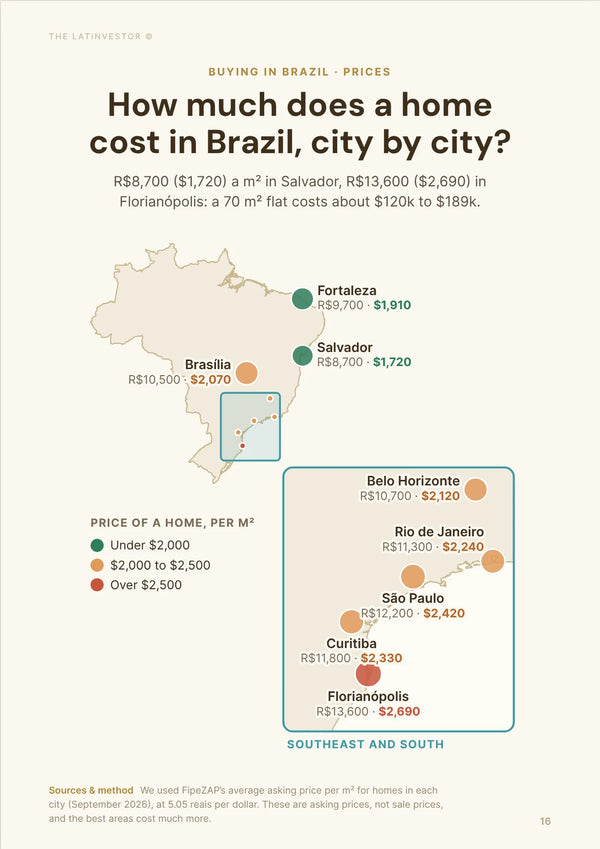
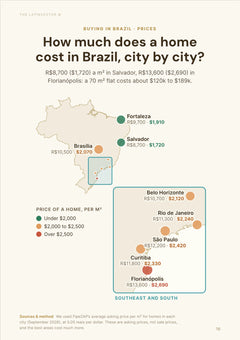
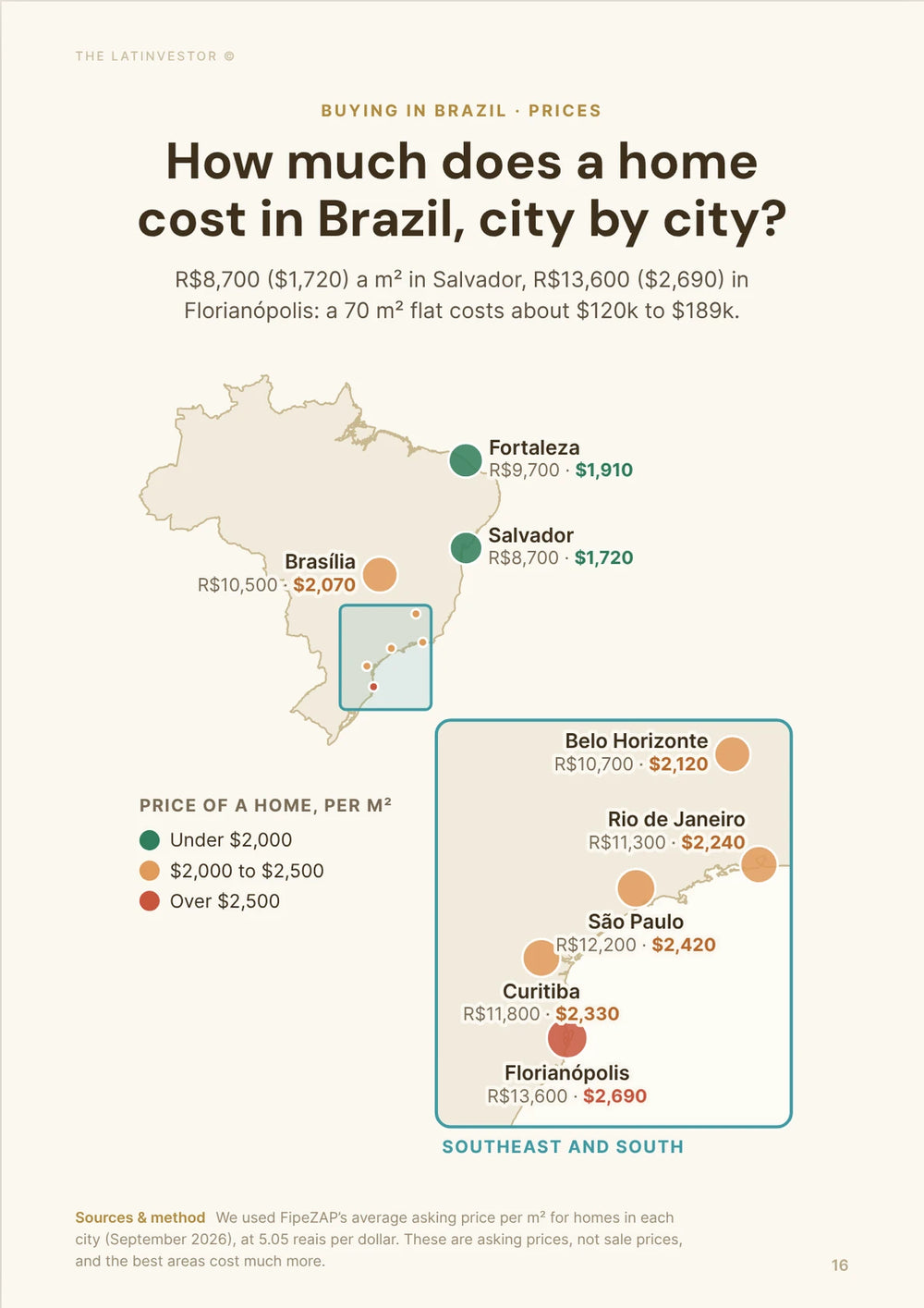
For most foreign buyers, the best place to buy in Brasília is Sudoeste or Asa Norte for rental income, and Águas Claras for a lower entry price. The city average is R$ 10,453 per square meter in asking prices (about USD 2,070), FipeZAP, September 2026.
Noroeste is the most expensive area, at about R$ 17,000 per square meter, then Sudoeste (R$ 14,672) and Asa Norte (R$ 12,706). In the Plano Piloto area, Asa Sul (R$ 9,354) and Águas Claras (R$ 9,289) are the cheapest; satellite towns go down to R$ 3,732 in Riacho Fundo.
Prices rose 9.8% in a year in Brasília, against 5.51% for Brazil as a whole, while the Selic rate is still 13.75%. Negotiate hard: asking prices are not sale prices.
Among the main apartment areas, Sudoeste has the best gross yield, about 7.36%, ahead of Águas Claras (6.98%) and Asa Norte (6.33%). Riacho Fundo shows about 8.4%, but on a thin, low-priced market. As a non-resident, 15% of your rent is withheld for tax.
On Airbnb, an average Brasília listing earned about R$ 29,125 over the last year at 41.8% occupancy (AirROI). Demand comes from government and business travel, not tourism.
Since the STJ's May 2026 ruling, a building can require a two-thirds owner vote before units go on Airbnb, so check the condo rules first.
Long-term rents rose 8.34% in a year, to R$ 53.84 per square meter. A 2-bedroom in Asa Norte asks roughly R$ 4,000 to R$ 5,700 a month.
A long lease usually beats Airbnb here: an average 2-bedroom on Airbnb grossed about R$ 33,800 a year, less than a year of rent on an average 2-bedroom in the city (about R$ 38,800 to R$ 54,900).
Noroeste, Águas Claras and Taguatinga Sul (R$ 6,635 per square meter, up 13.8% in a year) are the areas to watch. The Samambaia metro extension, funded with R$ 400 million from BNDES, is the most concrete project, but don't pay for projects that have no date: the VLT-W3 tram is still at the proposal stage, and the Noroeste viaduct was under a TCDF corrective order in May 2026.
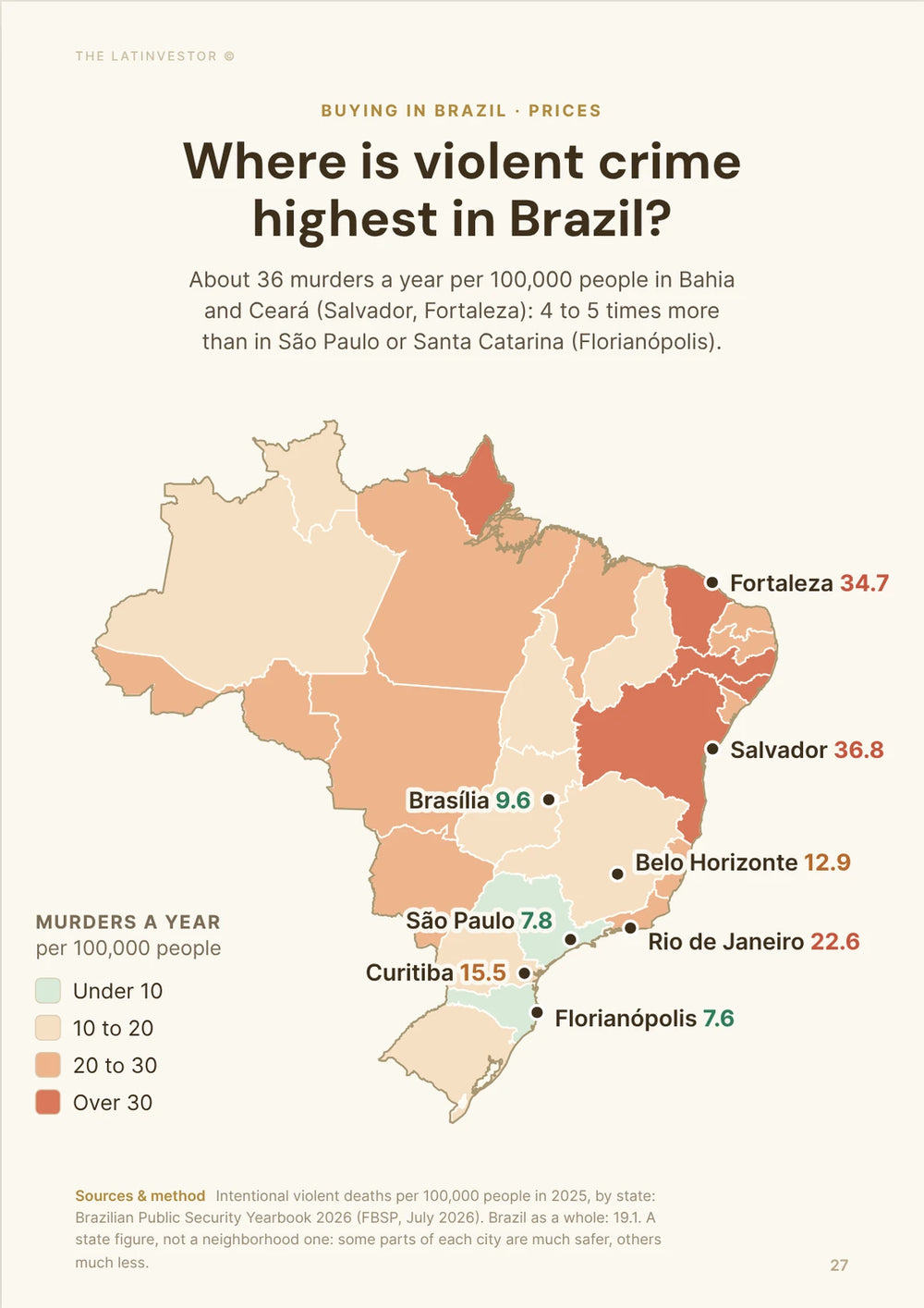
Street crime is falling: pedestrian robberies in the Federal District dropped 15% in 2025, to 9,073. The real risks are overpriced new towers and buildings with bad condo governance.
Not every area is rising: Gama asking prices fell 13.5% in a year and Guará Sul 1.8%, while Asa Norte (+13.1%) and Sudoeste (+13.4%) led the core. For the next 12 months, a FipeZAP-based model expects only about 3.76% growth for the city.
Locals and expats favor Lago Sul, Lago Norte, Sudoeste and Asa Norte. The bottom line: buy a well-run building in Sudoeste, Asa Norte or near the metro in Águas Claras, pay cash at a negotiated price, and plan for a long lease.

Which parts of Brasília cost the most, and which cost the least?
Which areas in Brasília have the highest property prices per square meter?
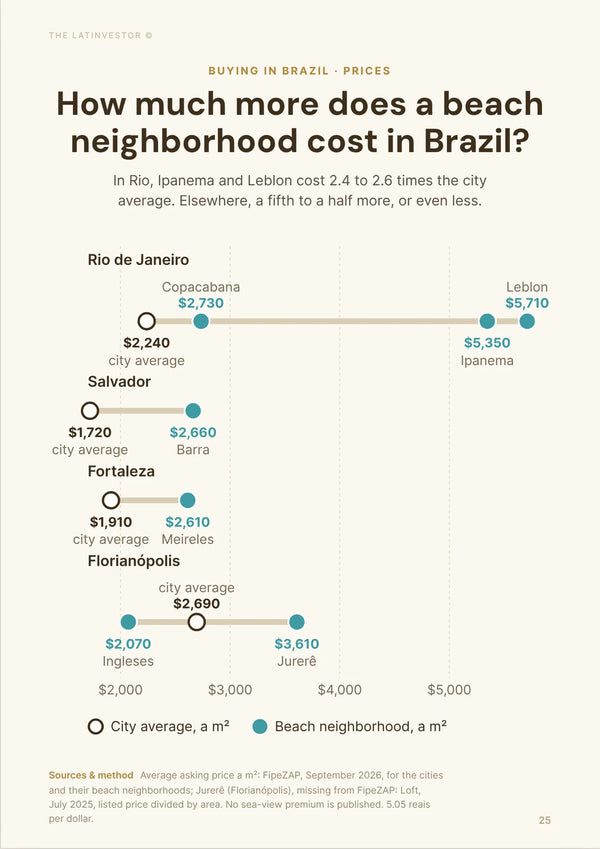
In 2026, the three most expensive apartment areas in Brasília are Setor Noroeste at about R$ 17,000 per square meter (about USD 3,370), Setor Sudoeste at R$ 14,672 (about USD 2,910) and Asa Norte at R$ 12,706 (about USD 2,520).
The city average is R$ 10,453 per square meter (FipeZAP, September 2026), so these three areas sit 20% to 60% above it. These are asking prices, and the Noroeste figure is a listing median from a different source (A Corrida dos Bairros), so compare it with care.
Each of these areas is expensive for its own reasons:
- Setor Noroeste: the newest high-spec towers in Brasília, with gyms, pools and green building features, but services and the park around it are still filling in
- Setor Sudoeste: central, walkable, full of shops and restaurants, with little new supply
- Asa Norte: the classic superquadra life, mature trees, the University of Brasília nearby and deep rental demand
Lago Sul, the lake district, is likely the most expensive area of all for houses, but it's mostly large villas on big lots, so there's no reliable price per square meter to compare with apartments. FipeZAP does track Lago Norte, at R$ 11,647 per square meter (about USD 2,310), up 13.8% in a year.
Which areas in Brasília have the most affordable property prices?
The cheapest areas tracked by FipeZAP are the satellite towns: Riacho Fundo at R$ 3,732 per square meter (about USD 739), Sobradinho at R$ 4,434, Ceilândia Sul at R$ 5,036, Gama at R$ 5,427 and Taguatinga Sul at R$ 6,635 (about USD 1,310).
Closer to the center, Águas Claras at R$ 9,289 per square meter (about USD 1,840) and Asa Sul at R$ 9,354 (about USD 1,850) both sit slightly below the city average of R$ 10,453.
In Águas Claras, 2-bedroom apartments of about 48 to 51 square meters were listed around R$ 480,000 to R$ 490,000 (about USD 95,000 to 97,000) in October 2026. Asa Sul looks cheap for the Plano Piloto because much of its stock is older and needs work.
The trade-offs in the satellite towns are real: longer commutes to the Plano Piloto job core, more uneven building quality and a thinner resale market. Their FipeZAP figures also rest on fewer listings, so they jump around more from month to month. For Samambaia, Riacho Fundo II and Núcleo Bandeirante we found no reliable 2026 figure.
 Brazil Property Prices
Brasília prices rose 9.8% in a year: are you buying at the top?
Not at the top, but you're buying after a strong run, so the price you negotiate matters more than usual. FipeZAP asking prices in Brasília rose 9.8% in the year to September 2026, against 5.51% for Brazil as a whole. After inflation (IPCA 4.58%), that's still a real gain of about 5%.
The odd part is that this happened with the Selic at 13.75% (cut from 14% on September 16, 2026) and private-bank mortgages around 11.8% plus TR. Few locals can borrow cheaply, and as a non-resident you'll almost always pay cash anyway, which gives you leverage.
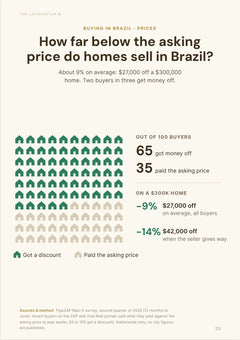
Across Brazil, FipeZAP's survey shows buyers get about 9% off the asking price on average, and about 14% when there is a discount. Use that as your target, especially on new towers in Noroeste and Águas Claras where sellers priced in last year's gains.
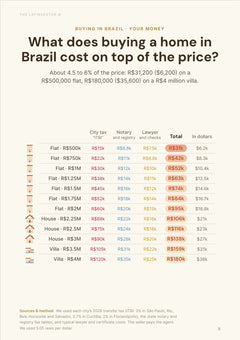
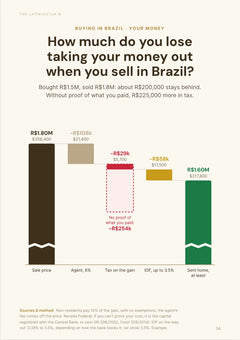
Don't count on the same pace again: a FipeZAP-based model expects about 3.76% growth for Brasília over the next 12 months. Buy for the rent, not for a quick resale, since buying and selling costs you 10% to 14% in fees and commission.
Which areas in Brasília give the best rental yields?
Which neighborhoods in Brasília have the highest gross rental yields?
Among the main apartment areas, the highest gross rental yield is in Setor Sudoeste at about 7.36%, followed by Águas Claras (6.98%), Asa Norte (6.33%) and Setor Noroeste (6.32%). Asa Sul trails at about 5.26%.
Further out, Riacho Fundo shows about 8.4% and Taguatinga Sul about 6.5%, but these rest on fewer listings and lower resale demand. The city average is about 6.2%. These are gross yields based on asking rents and asking prices, so the real figure on a given unit will be lower.
Each of these areas pays for a different reason:
- Setor Sudoeste: asking rents of about R$ 90 per square meter a month, high enough to justify the entry price
- Águas Claras: lower prices and metro access, with rents of about R$ 54 per square meter
- Asa Norte: a deep tenant pool of public servants, students and professionals, at about R$ 67 per square meter
- Setor Noroeste: high rents (about R$ 89.50 per square meter) but the highest prices, which pulls the yield down
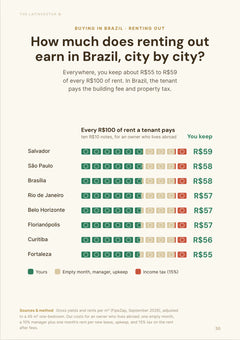
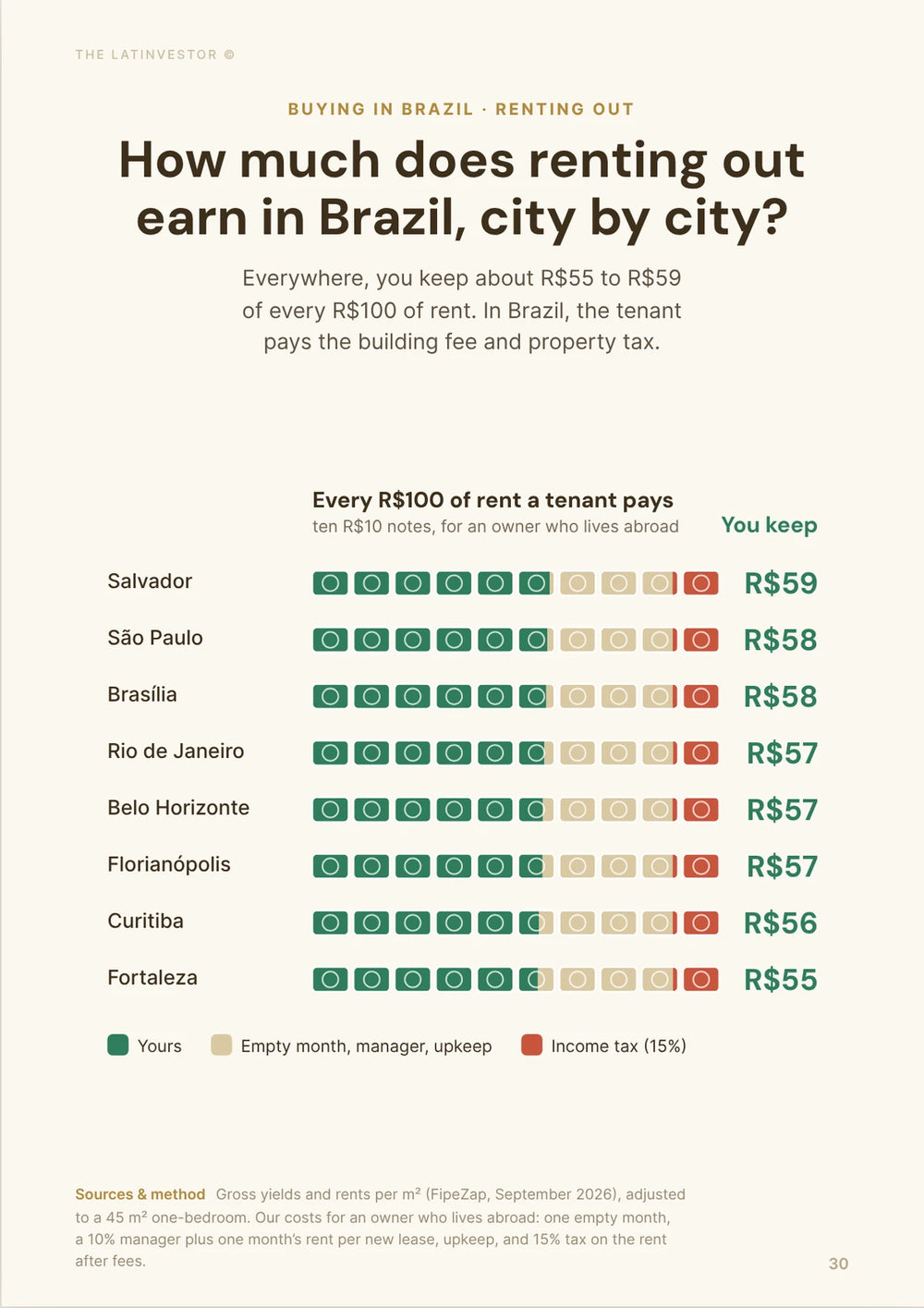
As a non-resident, 15% of the gross rent is withheld for income tax, so a 7.36% gross yield in Sudoeste becomes about 6.3% before vacancy and repairs. On a long lease, the tenant pays the condo fee and IPTU, which helps.
Is Airbnb worth it in Brasília?
Which neighborhoods in Brasília perform best on Airbnb?
The Brasília neighborhoods that do best on Airbnb are Asa Norte, Setor Sudoeste and Setor Noroeste, because guests come mainly for government work, hospitals, universities and business, not for tourism.
Across the city's roughly 2,200 active listings, the average listing earned about R$ 29,125 over the year to September 2026 (about USD 5,770), at 41.8% occupancy and R$ 317 a night (AirROI). A 2-bedroom averaged about R$ 33,800 a year, a 1-bedroom about R$ 26,800.
Demand follows the political and events calendar: occupancy peaked at 55.4% in June 2026 and fell to about 37.5% in January and February.
Why guests pick these areas:
- Asa Norte: close to universities and hospitals, so steady medical and academic stays
- Setor Sudoeste: central and walkable, good for business stays of one to four weeks
- Setor Noroeste: newer buildings with gyms and pools, for guests who want hotel-like comfort
The big risk is legal: in May 2026, the STJ ruled that offering units on platforms like Airbnb in a residential building can require approval from two-thirds of the owners. Many Brasília buildings won't vote for that.
Which areas in Brasília are becoming oversaturated with short-term rentals?
In Brasília, the risk of oversaturation is highest in a few new building clusters in Noroeste, Asa Norte and parts of Sudoeste, where many owners turned units into short-term rentals at the same time.
With an average occupancy of 41.8%, there isn't much room for more supply. The warning sign is simple: listings keep rising while occupancy stays flat or drops, which means everyone's revenue gets squeezed.
Before you buy for Airbnb, count the active listings in the building, ask the manager (síndico) whether the owners have voted on short stays, and check that low-season revenue can still cover the condo fee, which you pay yourself on short stays.
 70+pages
Which areas in Brasília are best for long-term rentals?
Which neighborhoods in Brasília have the strongest demand for long-term tenants?
The Brasília neighborhoods with the strongest long-term tenant demand in 2026 are Asa Norte, Setor Sudoeste, Setor Noroeste and Águas Claras, each serving a different kind of tenant.
Asking rents rose 8.34% in the year to September 2026 across the city, which tells you demand is still ahead of supply. The jumps were biggest in cheaper areas with metro or job access, like Águas Claras (+18.9%), while Asa Sul rents slipped 0.9%. We don't have reliable vacancy data by neighborhood, so plan for at least a month without a tenant between leases.
Who rents where:
- Asa Norte: students, young professionals and public servants who want to be central
- Setor Sudoeste: professionals and couples who pay more for quality of life
- Setor Noroeste: higher-income tenants who want new buildings and amenities
- Águas Claras: commuters and young families who want the metro and lower rents
What these areas share: a quick ride to the Plano Piloto jobs, secure buildings with parking, and supermarkets, pharmacies and restaurants within reach.
What are the average long-term monthly rents by neighborhood in Brasília?
Average asking rents in Brasília are about R$ 53.84 per square meter a month, from about R$ 41 in Asa Sul to about R$ 90 in Setor Sudoeste.
For a 2-bedroom of 60 to 85 square meters, that gives roughly R$ 2,450 to R$ 3,500 a month in Asa Sul and R$ 3,250 to R$ 4,600 in Águas Claras.
In the expensive areas, a 2-bedroom of the same size asks roughly R$ 4,000 to R$ 5,700 a month in Asa Norte (about USD 790 to 1,130), and R$ 5,350 to R$ 7,650 in Noroeste and Sudoeste.
These ranges come from rent per square meter, not from actual 2-bedroom leases, so check real listings for the building you have in mind.
Airbnb or long-term lease in Brasília: which pays more right now?
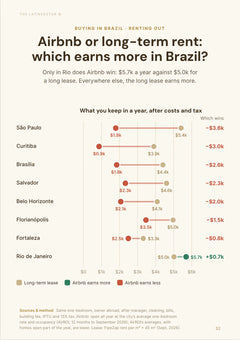
A long lease pays more for most owners. An average 2-bedroom on Airbnb grossed about R$ 33,800 a year (about USD 6,690). At the city's average asking rent of R$ 53.84 per square meter, a 2-bedroom of 60 to 85 square meters brings about R$ 38,800 to R$ 54,900 a year on a long lease, and R$ 48,000 to R$ 68,400 in Asa Norte.
And the gap is bigger than it looks. The Airbnb figure is before the 16% host fee, cleaning, a manager (about 10%), utilities and the condo fee and IPTU you pay yourself on short stays. On a long lease, the tenant pays the condo fee and IPTU.
Airbnb only makes sense if three things are true: the building has voted to allow it, your unit is in the top tier of its area (location, design, reviews), and you're happy with a weak January and February.
If you want flexibility, a mid-term lease of one to six months to public servants, consultants and medical staff is a good middle ground in Asa Norte and Sudoeste.
 70+pages
Which areas in Brasília are up and coming?
Which neighborhoods in Brasília are gentrifying and attracting new investors?
The Brasília areas drawing the most investor interest are Setor Noroeste for its new high-spec towers, and Águas Claras for its lower prices, metro access and a 6.98% gross yield.
Taguatinga Sul is the satellite town to watch: asking prices rose 13.8% in a year to R$ 6,635 per square meter, rents jumped 36.9%, and the gross yield is about 6.5%. Ceilândia Sul rose 20.8%, to R$ 5,036. These are thin markets, so check real comparable sales before you trust those jumps. For Samambaia we found no reliable 2026 price data.
In Águas Claras, the issue is supply: there are many similar towers, so pick buildings close to a metro station with a clean record on condo finances.
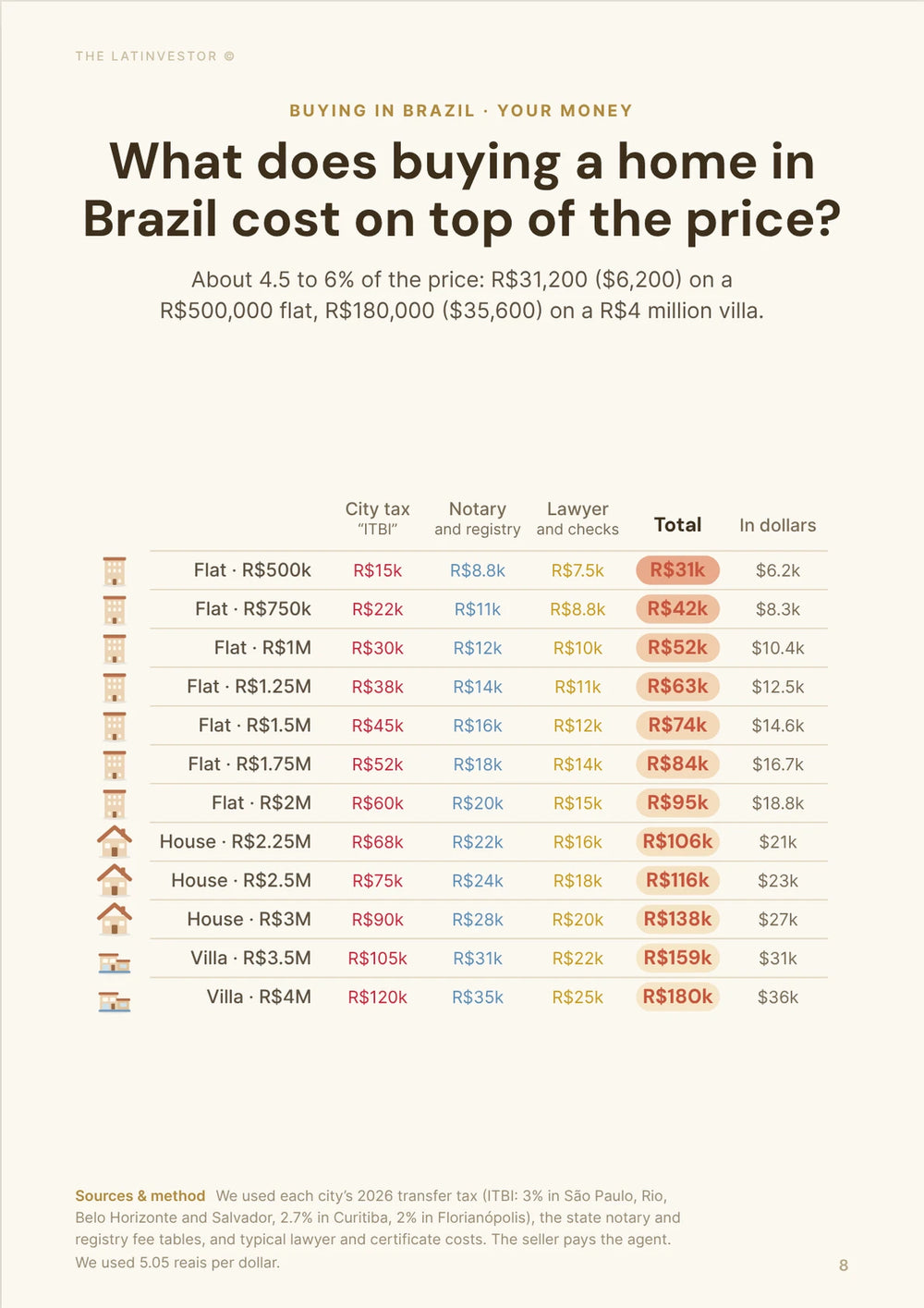
In Noroeste, new units bought from the developer can benefit from Brasília's reduced ITBI of 1% on the first transfer of a new property, against 2% normally. Ask the developer and the notary to confirm your unit qualifies.
Which areas in Brasília have major infrastructure projects planned that will boost prices?
The areas that should benefit most are Samambaia, thanks to the metro extension, Noroeste and Asa Norte, thanks to the Burle Marx Park works, and the W3 corridor, if the VLT tram project ever goes ahead.
Here's where each project stands in October 2026:
- Samambaia metro extension: financed with R$ 400 million from BNDES, with works moving forward in mid-2026
- Burle Marx Park: the first phase, about 7 km of trails and cycle paths next to Noroeste and Asa Norte, was approved in August 2026
- Noroeste viaduct: a R$ 29.6 million contract that the Federal District's audit court (TCDF) ordered corrected in May 2026, with no confirmed completion date
- VLT-W3 and airport link: still a proposed public-private project, with a process filed at the TCDF on October 7, 2026 and no opening date
- Metro: the existing 42.38 km line with 27 stations already serves Águas Claras, Taguatinga and Asa Sul
Our advice: pay for what already works, like the metro, and treat the tram, the viaduct and future metro stations as a bonus until they open. Don't accept a seller's premium for a project that has no date.
Which areas in Brasília should you avoid as a property investor?
Which neighborhoods in Brasília have problems that I should avoid, and why?
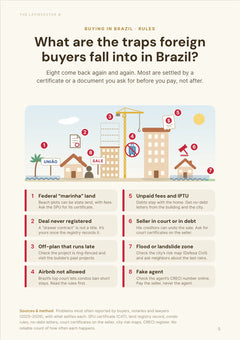
Rather than avoiding whole neighborhoods, avoid the kinds of purchases that go wrong for foreign buyers wherever they are in Brasília.
Here's what to watch for:
- Buildings without clear condo rules: you can't know whether short stays are allowed
- Units priced on optimistic rent growth: with the Selic at 13.75%, aggressive assumptions don't hold up
- Cheap areas with few comparable sales: you may struggle to resell at a fair price
- Buildings with owner disputes or unpaid condo fees: conflicts and special levies end up in the price
Safety is improving overall: pedestrian robberies in the Federal District fell 15% in 2025, from 10,722 to 9,073. In the Plano Piloto they fell from 996 to 905, and in Águas Claras from 193 to 177. Still, check the street and the building's security, not just the area.
Which areas in Brasília have stagnant or declining property prices as of 2026?
The clearest drop is in Gama, where asking prices fell 13.5% in the year to September, to R$ 5,427 per square meter. Guará Sul slipped 1.8%, to R$ 5,724, while the city as a whole rose 9.8%.
In the core, Asa Sul is the soft spot: prices rose 10.0% to R$ 9,354 per square meter, still well below Asa Norte (R$ 12,706), but rents fell 0.9%, so yields there are getting thinner.
Neighborhood series rest on few listings and move a lot from year to year, so don't read one bad year as a trend. Watch for these signs of stagnation:
- Older buildings in Asa Sul: dated layouts and deferred maintenance make them less attractive than newer stock
- Outer areas with poor transport: long commutes shrink the pool of tenants and buyers
- Overbuilt pockets in new sectors: too many similar towers for the same tenants can cap prices, as in parts of Águas Claras
 70+pages
Which areas in Brasília have the best long-term appreciation potential?
Which areas in Brasília have historically appreciated the most recently?
Brasília as a whole rose 9.8% in the year to September 2026. Among the big apartment areas, the strongest were Lago Norte (+13.8%), Sudoeste (+13.4%) and Asa Norte (+13.1%), ahead of Asa Sul (+10.0%) and Águas Claras (+6.3%). Noroeste and Lago Sul are not in the index.
What each area has going for it:
- Setor Sudoeste: little new supply and a central location, now at R$ 14,672 per square meter
- Setor Noroeste: the newest premium stock in the city, now the most expensive at about R$ 17,000 per square meter
- Asa Norte: deep and stable demand, at R$ 12,706 per square meter
- Lago Sul and Lago Norte: backed by the highest household incomes in the city; Lago Norte apartments list at R$ 11,647 per square meter
The main reason is scarcity: the Plano Piloto is a protected heritage plan, so you can't add superquadras or lakefront land, and demand from public servants, diplomats and professionals stays high.
Which neighborhoods in Brasília are expected to see price growth in coming years?
The Brasília neighborhoods most likely to keep growing are Setor Sudoeste, Asa Norte and Setor Noroeste, because supply is limited and the buyer and tenant pools are deep. But expect slower growth: a FipeZAP-based model projects about 3.76% for the city over the next 12 months, against 9.8% last year.
How they compare:
- Setor Sudoeste: very little new supply and the best yield of the central areas (7.36%)
- Asa Norte: steady tenant demand and easy resale
- Setor Noroeste: still attracts high-income buyers, but at about R$ 17,000 per square meter, much of the growth is already in the price
The main thing that drives future prices here is public-sector and professional employment in the Plano Piloto, plus the lack of new land for quality housing near it. Interest rates matter too: if the Selic keeps falling from 13.75%, more locals will be able to borrow.
What do locals and expats really think about the different areas of Brasília?
Which areas in Brasília do local residents consider the most desirable to live?
Locals consistently rank the lake districts (Lago Sul and Lago Norte) and the central premium sectors (Setor Sudoeste and the heart of Asa Norte) as the best places to live in Brasília.
What locals like about each:
- Lago Sul: big houses, greenery, security, and status as the city's wealthiest area
- Lago Norte: a similar lakeside life at somewhat lower prices than Lago Sul
- Setor Sudoeste: walkable, good restaurants, and a strong sense of community
- Asa Norte: mature trees, superquadra life, and everything close by
These areas are home to high-income professionals, senior public servants, diplomats and established families who put quality of life ahead of returns.
Locals and foreign buyers mostly agree, but locals pay more attention to the exact superquadra and the reputation of the building, while foreigners tend to look only at the neighborhood.
Which neighborhoods in Brasília have the best reputation among expat communities?
The Brasília neighborhoods with the best reputation among expats are Lago Sul, Lago Norte, Asa Norte and Setor Sudoeste, which offer the security, services and quality of life foreigners look for.
Why expats pick them:
- Lago Sul and Lago Norte: close to embassies and international schools, and quiet
- Asa Norte: central, walkable, and easy to rent out if plans change
- Setor Sudoeste: a modern urban life with restaurants and services
Diplomats and embassy staff tend to live in the lake districts, staff of international organizations and consultants in the central sectors, and academics near the university in Asa Norte.
Which areas in Brasília do locals say are overhyped by foreign buyers?
The areas locals most often call overhyped are Setor Noroeste, some new towers in Águas Claras, and high-floor units anywhere that carry a premium foreigners pay but locals question.
Why locals think so:
- Setor Noroeste: at about R$ 17,000 per square meter, rents have to stay high for years to make the numbers work
- New Águas Claras towers: heavy marketing to outside buyers, but little resale history
- High-floor premiums: foreigners pay extra for views that locals value less
Foreign buyers see new amenities and green features; locals look at high condo fees and the competition from established areas, and ask whether the price makes sense over 10 years.
Which areas in Brasília are considered boring or undesirable by residents?
The areas residents most often call boring or undesirable are Setor Central (the commercial core, empty after office hours), some outer administrative regions with few services, and older areas with dated infrastructure.
The main reason for each:
- Setor Central: no residential street life, few restaurants, little to do on weekends
- Riacho Fundo II: long commutes and few places to eat out or go out
- Núcleo Bandeirante: older buildings and little investment in public spaces
- Some parts of Samambaia: high density without matching infrastructure
For an investor, "boring" doesn't mean "bad", but it does mean you need a better pick of street and building, more cautious vacancy assumptions, and a clear idea of who your tenants will be.
Our methodology
This article estimates which Brasília neighborhoods make the most sense for a foreign buyer in 2026, comparing prices, rents, yields, Airbnb potential, risks and expected growth.
Prices and rents per square meter come mainly from the FipeZAP September 2026 indexes and the neighborhood figures Hasta publishes from them, with Noroeste from A Corrida dos Bairros listing medians. Gross yields divide 12 months of asking rent by the asking price. Airbnb figures all come from AirROI, and we never mix them with other short-term rental providers. Budget examples come from DF Imóveis listings, crime from SSP-DF, and project status from BNDES, the TCDF, Ademi-DF and Metrô-DF.
Rules come from official sources: the Federal District's ITBI law (2%, or 1% on the first transfer of a qualifying new property), the STJ's May 2026 ruling on Airbnb in condominiums, and the Receita Federal for the 15% tax withheld on a non-resident's rent.
We checked these figures in October 2026. Conversions use about 5.05 reais per US dollar and 5.65 reais per euro.
The limits: FipeZAP and listing figures are asking prices, not sale prices, and buyers in Brazil get about 9% off on average. Neighborhood rents for 2-bedrooms are estimates based on rent per square meter. Neighborhood figures for smaller areas rest on few listings and swing a lot. We couldn't find reliable 2026 prices for Lago Sul, Samambaia or Riacho Fundo II, so we don't give any.
Key sources used for this analysis include FipeZAP (sale index), FipeZAP (rental index), Hasta, A Corrida dos Bairros, AirROI, DF Imóveis, SSP-DF, BNDES, TCDF, Ademi-DF, Metrô-DF, Federal District Law 7,635/2024, STJ, Banco Central do Brasil, IBGE, PDAD/IPEDF and Receita Federal.