
Authored by the expert who managed and guided the team behind the United Kingdom Property Pack
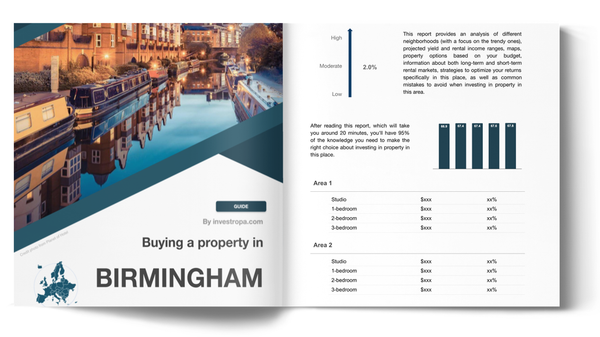
Yes, the analysis of Birmingham's property market is included in our pack
If you're thinking about buying a rental property in Birmingham, understanding current rental yields is essential before investing.
In this guide, we break down gross and net yields, highlight which neighborhoods perform best, and explain the costs that eat into your returns.
We keep this article updated regularly so you always have fresh data on Birmingham's rental market.
And if you're planning to buy a property in this place, you may want to download our pack covering the real estate market in Birmingham.
Insights
- Birmingham's average gross rental yield sits around 5.6% in January 2026, notably higher than London's 3-4%, making the city attractive for income-focused investors.
- The gap between gross and net yields in Birmingham averages about 1.8 percentage points, largely due to management fees running at 8-12% of rent plus VAT.
- High-yield Birmingham neighborhoods like Aston and Perry Barr can deliver 6-7% gross, while premium areas like Edgbaston compress to just 4-5%.
- Leasehold service charges on Birmingham city centre flats can reduce net yields by 1-2 percentage points compared to freehold terraced houses.
- With the Bank of England rate at 3.75% in late 2025, Birmingham landlords need at least 6% gross yield to meaningfully beat risk-free returns.
- Birmingham's vacancy rate translates to roughly 2-3 weeks empty per year, making a 5% void allowance a sensible planning assumption.
- The HS2 Curzon Street station and Metro Eastside extension are expected to push rents higher in Digbeth and the city centre fringe.
- Terraced houses remain Birmingham's rental workhorses, often delivering stronger net yields than flats because they avoid service charges.

What are the rental yields in Birmingham as of 2026?
What's the average gross rental yield in Birmingham as of 2026?
As of early 2026, Birmingham's average gross rental yield across all residential property types sits at approximately 5.6%, meaning landlords collect around £5.60 in annual rent for every £100 of property value.
Most Birmingham rental properties fall within a gross yield range of 4.5% to 6.8%, depending on location and property type.
This puts Birmingham comfortably above the UK average and significantly ahead of London's sub-4% yields, making the city attractive for income-focused investors.
The biggest factor influencing Birmingham's gross yields is continued rental demand strength, with rents rising around 5% year-on-year while house prices remained relatively flat.
What's the average net rental yield in Birmingham as of 2026?
As of early 2026, the average net rental yield in Birmingham is approximately 3.8%, reflecting what landlords actually keep after paying regular operating costs.
The typical gap between gross and net yields in Birmingham runs about 1.5 to 2 percentage points, meaning roughly a third of gross income goes toward expenses.
The expense that bites hardest is property management at 8-12% of rent plus VAT, though leasehold service charges on flats can be equally damaging.
Most Birmingham investment properties deliver net yields of 3.0% to 5.0%, with the lower end typical for city centre flats and the upper end achievable with terraced houses in rental-heavy suburbs.
By the way, you will find much more detailed rent ranges in our property pack covering the real estate market in Birmingham.

We made this infographic to show you how property prices in Guatemala compare to other big cities across the region. It breaks down the average price per square meter in city centers, so you can see how cities stack up. It’s an easy way to spot where you might get the best value for your money. We hope you like it.
What yield is considered "good" in Birmingham in 2026?
In Birmingham's 2026 market, a gross rental yield of 6% or above is considered good, while 7% or higher is very strong and typically requires sharp buying or targeting lower-priced districts.
The 6% threshold separates average from high performers because with Bank Rate at 3.75%, anything below 5.5% barely compensates for landlord risk and hassle versus holding cash.
How much do yields vary by neighborhood in Birmingham as of 2026?
As of early 2026, Birmingham's neighborhood yields spread substantially, from around 4% gross in premium areas up to 7% in value-driven rental districts.
The highest-yield neighborhoods include Aston, Erdington, Perry Barr, and Handsworth, where modest prices and deep renter demand enable 6-7% gross yields.
The lowest yields appear in Edgbaston, Harborne, Moseley, Kings Heath, and Sutton Coldfield, where owner-occupier demand pushes prices faster than rents.
Yields vary dramatically because house prices are far more sensitive to neighborhood desirability than rents, so premium addresses command big price premiums but only modest rent premiums.
By the way, we've written a blog article detailing what are the current best areas to invest in property in Birmingham.
How much do yields vary by property type in Birmingham as of 2026?
As of early 2026, gross yields in Birmingham range from around 4.5% for detached homes up to 6.5% for well-located terraced houses and rent-efficient flats.
Terraced houses deliver the highest average gross yields because entry prices remain accessible while rents stay robust, making them the traditional buy-to-let workhorse.
Detached houses deliver the lowest yields because higher capital values don't translate into proportionally higher rents.
The key differentiator is the leasehold trap with flats, where service charges and ground rent can quietly erase strong gross yields, while freehold houses avoid these costs entirely.
By the way, you might want to read the following:
- What rental yields can you expect for a house in Birmingham?
- What rental yields can you expect for an apartment in Birmingham?
What's the typical vacancy rate in Birmingham as of 2026?
As of early 2026, typical Birmingham vacancy translates to roughly 2-3 weeks empty per year, which is why we recommend a 5% void allowance in calculations.
Vacancy varies across neighborhoods from near-zero in high-demand areas like Harborne to potentially higher in student zones like Selly Oak with seasonal patterns.
The main driver is tenant turnover, including job moves and upgrades, plus unavoidable time for cleaning, repairs, and viewings between tenancies.
Birmingham's vacancy sits below the national private rented sector average of around 10%, reflecting strong demand from population growth and relative affordability versus London.
Finally please note that you will have all the indicators you need in our property pack covering the real estate market in Birmingham.
What's the rent-to-price ratio in Birmingham as of 2026?
As of early 2026, Birmingham's average rent-to-price ratio is approximately 0.47% per month, meaning a typical property rents for about £47 monthly per £10,000 of purchase price, annualizing to roughly 5.6%.
For buy-to-let investors, a ratio above 0.5% monthly (6% annually) is considered favorable, and this ratio is essentially gross rental yield expressed differently.
Birmingham's ratio compares favorably to most major UK cities, sitting well above London's roughly 0.3% and broadly matching other Midlands cities like Nottingham and Leicester.

We have made this infographic to give you a quick and clear snapshot of the property market in Guatemala. It highlights key facts like rental prices, yields, and property costs both in city centers and outside, so you can easily compare opportunities. We’ve done some research and also included useful insights about the country’s economy, like GDP, population, and interest rates, to help you understand the bigger picture.
Which neighborhoods and micro-areas in Birmingham give the best yields as of 2026?
Where are the highest-yield areas in Birmingham as of 2026?
As of early 2026, the top highest-yield neighborhoods in Birmingham are Aston, Perry Barr, and Erdington, consistently offering gross yields of 6-7% when purchased well.
In these areas, investors can realistically expect 6% to 7.5% gross, with the upper end achievable on well-bought terraced houses in streets with stable tenant demand.
These high-yield neighborhoods share affordable purchase prices (typically £120,000-£180,000 for a terrace) paired with consistent renter demand from working tenants seeking value and good transport links.
You'll find a much more detailed analysis of the areas with high profitability potential in our property pack covering the real estate market in Birmingham.
Where are the lowest-yield areas in Birmingham as of 2026?
As of early 2026, the lowest-yield neighborhoods are Edgbaston, Harborne, and Sutton Coldfield, where gross yields typically compress to 4-5% despite strong rental demand.
In these premium neighborhoods, yields of 4-5% sound disappointing until you consider better capital growth and more reliable tenants over the long term.
Yields are compressed because owner-occupiers compete fiercely for properties, pushing prices up while rents cannot keep pace with what buyers pay for desirable addresses.
Buying a property in a low-yield area is one of the mistakes we cover in our list of risks and pitfalls people face when buying property in Birmingham.
Which areas have the lowest vacancy in Birmingham as of 2026?
As of early 2026, the neighborhoods with lowest vacancy rates are Harborne, the Jewellery Quarter, and Moseley, where properties often have tenants waiting before current ones move out.
In these areas, void periods are typically just 1-2 weeks for changeover, compared to the citywide average of 2-3 weeks.
The main demand driver is the concentration of professionals working at Queen Elizabeth Hospital, universities, and central offices who value lifestyle amenities and transport links.
The trade-off is that peace of mind comes with a price premium, meaning lower gross yield even with stronger occupancy.
Which areas have the most renter demand in Birmingham right now?
The three areas with strongest renter demand are City Centre and Jewellery Quarter for young professionals, Digbeth and Eastside for creative workers, and Harborne for families and hospital staff.
The typical renter driving demand is a young professional aged 25-40 in tech, financial services, or healthcare who prioritizes walkability and transport over space.
In high-demand areas like the Jewellery Quarter, quality listings typically secure tenants within 1-2 weeks, especially well-priced one and two-bedroom units.
If you want to optimize your cashflow, you can read our complete guide on how to buy and rent out in Birmingham.
Which upcoming projects could boost rents and rental yields in Birmingham as of 2026?
As of early 2026, the three major projects expected to boost rents are HS2 Curzon Street station, the Metro Eastside extension to Digbeth, and the Smithfield regeneration near the Bullring.
Neighborhoods most likely to benefit are Digbeth, Eastside, Bordesley, and the southern city centre fringe, all within walking distance of new transport hubs.
Once complete, investors in affected areas might expect rent increases of 5-15% above baseline growth over 2-3 years, depending on specific location and how quickly amenities open.
You'll find our latest property market analysis about Birmingham here.
Get fresh and reliable information about the market in Antigua
Don't base significant investment decisions on outdated data. Get updated and accurate information with our guide.

What property type should I buy for renting in Birmingham as of 2026?
Between studios and larger units in Birmingham, which performs best in 2026?
As of early 2026, two-bedroom properties generally outperform studios when considering both yield and occupancy, because they attract more stable tenants with competitive returns.
Studios in Birmingham's city centre can achieve 5.5-6.5% gross (around £650-750/month on £130,000, or $820-950 / €760-880), while two-beds typically yield 5-6% (around £950-1,100/month on £200,000, or $1,200-1,400 / €1,100-1,300).
Two-beds outperform because couples, sharers, and small families stay longer and cause fewer voids than young professionals who typically rent studios.
However, studios can be better if targeting the city centre near transport hubs, where constant professional demand creates reliable turnover despite higher churn.
What property types are in most demand in Birmingham as of 2026?
As of early 2026, the most in-demand property type is the two-bedroom flat, particularly in locations with good transport links and walking distance to employment centers.
The top three types by demand are two-bedroom urban flats, two to three-bedroom terraced houses in commutable suburbs, and one-bedroom city centre apartments.
The trend driving this is young professional households, including couples and sharers, who want space without house costs and prioritize convenience over gardens.
Large detached houses in outer suburbs are underperforming because the tenant pool is smaller, families prefer buying at that price point, and yields compress from high prices.
What unit size has the best yield per m² in Birmingham as of 2026?
As of early 2026, units between 35-55 square meters deliver the best gross yield per m² in Birmingham, corresponding to well-designed one-beds and compact two-beds.
For this optimal size, gross yield per m² works out to roughly £18-22/month (approximately $23-28 or €21-26), compared to £12-16 for larger family homes.
Smaller units perform better because kitchens and bathrooms get spread across less space, and tenants pay premiums for location rather than size.
By the way, we also have a blog article detailing whether owning an Airbnb rental is profitable in Birmingham.

We did some research and made this infographic to help you quickly compare rental yields of the major cities in Guatemala versus those in neighboring countries. It provides a clear view of how this country positions itself as a real estate investment destination, which might interest you if you’re planning to invest there.
What costs cut my net yield in Birmingham as of 2026?
What are typical property taxes and recurring local fees in Birmingham as of 2026?
As of early 2026, Council Tax for a typical Band C rental flat in Birmingham runs around £1,800-2,000/year ($2,300-2,500 or €2,100-2,300), though tenants usually pay during occupancy and it only falls to landlords during voids.
Other recurring fees include landlord licensing in designated areas (around £500-750 for five years) plus building service charges for leasehold flats (£1,000 to £3,000+ annually).
These taxes and fees typically represent 5-15% of gross rental income, with the higher end applying to leasehold flats where service charges add significant burden.
By the way, we cover all the hidden fees and taxes in our property pack covering the real estate market in Birmingham.
What insurance, maintenance, and annual repair costs should landlords budget in Birmingham right now?
Annual landlord insurance for a typical Birmingham rental costs around £200-400 ($250-500 or €230-470), depending on property value, location, and rent guarantee cover.
The recommended maintenance budget is 0.5-1% of property value, meaning £1,000-2,000/year ($1,250-2,500 or €1,150-2,300) for a £200,000 house.
The expense that most catches landlords off guard is boiler replacement or heating work, easily costing £2,000-4,000 unexpectedly, particularly in older terraced stock.
In total, budget £1,500-3,000/year ($1,900-3,800 or €1,750-3,500) for combined insurance, maintenance, and repair reserves.
Which utilities do landlords typically pay, and what do they cost in Birmingham right now?
In most Birmingham rentals, tenants pay all utilities (gas, electricity, water, broadband), while landlords typically only cover utilities during voids or in bills-included lets common for studios and shares.
When landlords do pay utilities, the monthly cost runs around £150-250 ($190-320 or €175-290) for a typical one or two-bedroom flat covering all services.
What does full-service property management cost, including leasing, in Birmingham as of 2026?
As of early 2026, full-service property management in Birmingham typically costs 8-12% of monthly rent plus VAT, meaning a £1,000/month property incurs £96-144 monthly ($120-180 or €110-170) all-in.
On top of management, tenant-finding fees are typically around one month's rent as a one-off, with some agents offering reduced rates for combined services.
What's a realistic vacancy buffer in Birmingham as of 2026?
As of early 2026, Birmingham landlords should set aside approximately 5% of annual rental income as a vacancy buffer for inevitable gaps between tenancies.
This 5% translates to roughly 2-3 weeks of vacancy per year, covering tenant checkout, minor repairs, and marketing time.
Buying real estate in Antigua can be risky
An increasing number of foreign investors are showing interest. However, 90% of them will make mistakes. Avoid the pitfalls with our comprehensive guide.

What sources have we used to write this blog article?
Whether it's in our blog articles or the market analyses included in our property pack about Birmingham, we always rely on the strongest methodology we can … and we don't throw out numbers at random.
We also aim to be fully transparent, so below we've listed the authoritative sources we used, and explained how we used them and the methods behind our estimates.
| Source | Why it's authoritative | How we used it |
|---|---|---|
| ONS Housing Prices Local (Birmingham) | The UK's official statistics office publishing consistent local rent and price data. | We took Birmingham's average price and rent as anchor inputs. We calculated citywide rent-to-price ratios and baseline gross yields. |
| ONS Private Rent and House Prices Bulletin | The official release explaining UK rent and price index methodology. | We used it to frame "January 2026" timing. We verified Birmingham's rent trends fit regional patterns. |
| ONS Price Index of Private Rents Dataset | The underlying official dataset behind rent inflation, downloadable and auditable. | We supported rent direction going into 2026. We triangulated against portal asking rent trackers. |
| UK Land Registry House Price Index | The official house price index and average price series for the UK. | We triangulated Birmingham price stability. We kept yield estimates consistent with official measurement. |
| VOA Private Rental Market Statistics | The government's official collection for rental market statistics. | We validated rent levels and bedroom-size comparisons like studios versus larger units. |
| ONS Private Rental Market Summary Statistics | Combines VOA rental evidence into official summary tables with clear geography. | We grounded unit-size differences by bedroom count. We triangulated typical rent levels. |
| Rightmove Rental Price Tracker | The UK's largest portal's transparent asking rent tracker, widely cited. | We cross-checked market sentiment versus official measures. We reality-checked market speed into 2026. |
| Rightmove Local Sold Prices | A major portal showing sold-price summaries from Land Registry. | We illustrated yield variation by postcode district and neighborhood price dispersion. |
| Birmingham City Council Tax Booklet 2025-26 | The local authority's official Council Tax statement for the tax year. | We estimated holding costs during voids. We explained recurring local charges affecting net yield. |
| English Housing Survey 2023-24 Rented Sectors | The UK government's flagship survey on housing conditions and tenure. | We anchored tenant-demand fundamentals. We justified conservative vacancy assumptions. |
| English Housing Survey Vacancy Annex | An official government statistical annex with explicit vacancy figures. | We grounded national vacancy benchmarks. We converted these into practical Birmingham void allowances. |
| Bank of England Monetary Policy Summary | The UK central bank's official policy record and rate decision. | We contextualized investor required returns. We explained why "good yield" thresholds shifted. |
| GOV.UK Leasehold Service Charges Guidance | Official government guidance on service charges and how they work. | We explained why flats can have lower net yields. We structured the cost checklist around this. |
| Leasehold Advisory Service Guide | A widely used public advisory body focused on leasehold costs. | We used it as triangulation on service-charge mechanics and kept discussion practical. |
| HS2 Ltd Birmingham Curzon Street | The official project body describing the station and regeneration footprint. | We identified rent-upside corridors tied to transport regeneration with official scope. |
| Transport for West Midlands Metro Extension | The regional transport authority's official project page. | We pinpointed areas benefiting from better connectivity and stronger renter demand. |
| Birmingham City Council Digbeth Prospectus 2025 | The city's official investment prospectus for Digbeth sites. | We listed concrete development clusters and renter pull they create. |
| BeBirmingham Smithfield Regeneration | An official city regeneration page describing the Smithfield scheme. | We identified city-centre edges where new amenities support rent growth. |
| Paradise Birmingham Timeline | The project's official timeline for major city-centre regeneration. | We anchored where jobs and amenities are clustering in Birmingham. |
| Point 4 Estate Agents Landlord Fees | A real Birmingham-area agent's published, transparent fee card. | We translated management costs into realistic percentages for local landlords. |
Get the full checklist for your due diligence in Antigua
Don't repeat the same mistakes others have made before you. Make sure everything is in order before signing your sales contract.
Related blog posts
- Is now a good time to invest in property in Antigua (Guatemala)?